
All Articles
The Journal
Deadline Tracking: Reclaim Your Hours
September 25, 202611 min readtime managementproductivity
Deadline tracking isn't just admin. Discover how it reduces operational noise, restores mental bandwidth, and reclaims your hours using actionable systems.

64% of employees lose up to two hours per week because they lack deadlines, so reliable deadline tracking is a direct way to recover time that otherwise disappears into follow-ups, uncertainty, and avoidable rework. The problem usually isn't a lack of effort. It's that important commitments live across inboxes, calendars, chat threads, paper notes, and one person's memory.
A founder may be waiting for a renewal form, a parent may be coordinating a school deadline while handling a work deliverable, and a professional may discover that three “urgent” tasks are all due on the same afternoon. None of these people necessarily need more discipline. They need a system that makes ownership visible, schedules the work before the due date, and keeps someone responsible for recovery when plans change.
The Hidden Cost of Untracked Deadlines
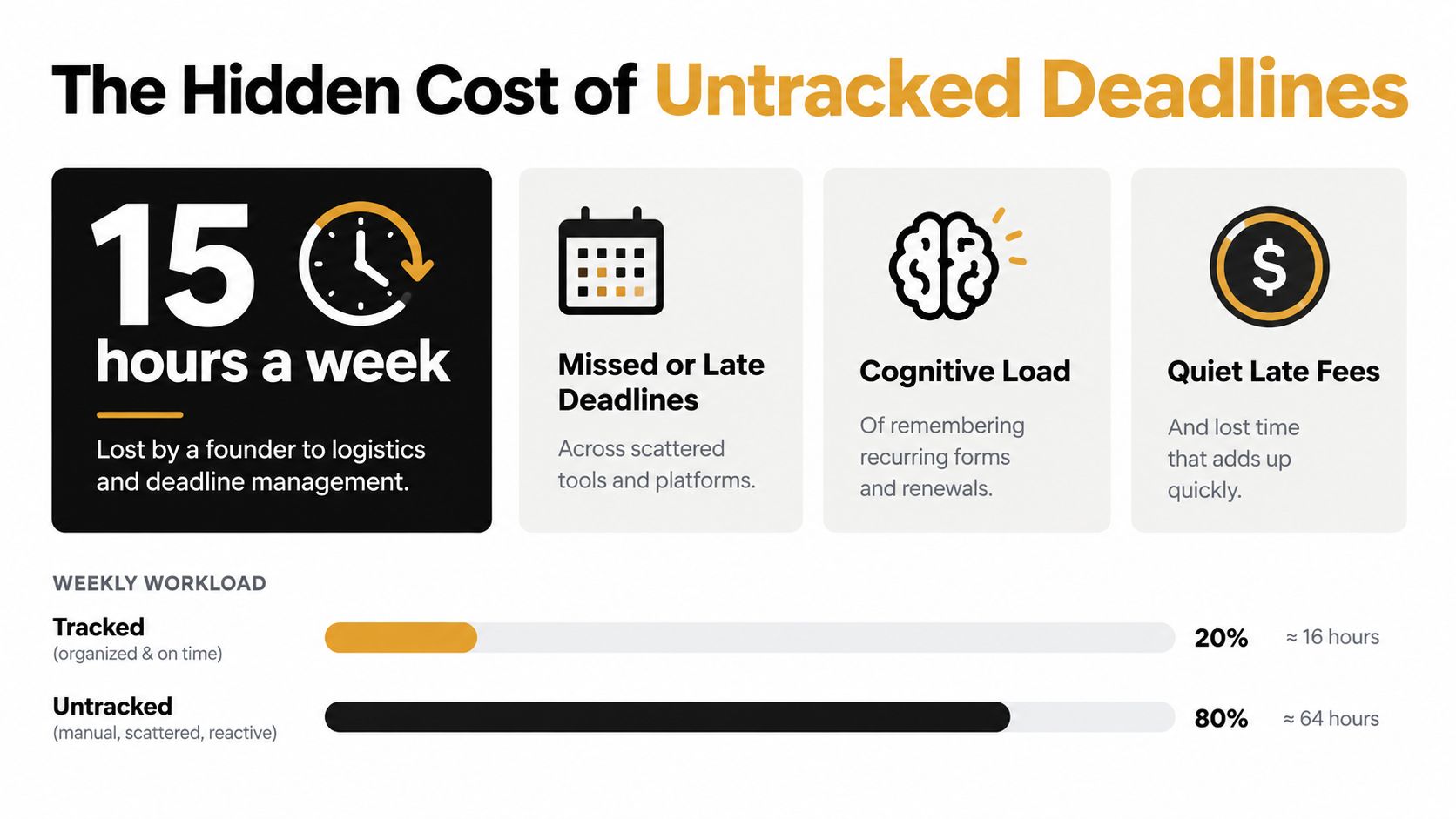
Untracked deadlines create a productivity tax that rarely appears on a timesheet. People search old messages, ask for status updates, reconstruct agreements, and interrupt focused work to determine what needs attention next. A 2023 survey reported that 64% of employees lose up to two hours per week because they lack deadlines, while about a quarter said unclear priorities hurt productivity and 17% said they have no set deadlines for their work. (CFO)
That lost time isn't only about missing dates. It includes the cognitive effort required to remember recurring forms, anticipate dependencies, and decide whether a task is actually late or just waiting on someone else. When nobody owns the next action, the deadline becomes a shared concern, which often means it becomes nobody's active responsibility.
Deadline pressure changes execution
The completion date itself can influence whether work gets finished. A Columbia Business School study found that increasing a task's deadline by one standard deviation was associated with about a 26% reduction in the likelihood of completion. The research also analyzed over half a million tasks from thousands of users and found that busier people completed overdue tasks faster than less-busy people, suggesting that deadline pressure can act as a productivity trigger in an already demanding workload context. (Columbia Business School study)
The operational lesson is straightforward. A deadline extension isn't neutral, and an overdue item shouldn't remain in the same list with a new color. Your system should record the change, identify the reason, and assign the next recovery action.
Why project-level visibility isn't enough
Project milestones can look healthy while individual tasks are stalled. A large longitudinal dataset captured 4.4 million interactions across 173,323 tasks and 50,759 projects, demonstrating that high-resolution tracking can operate at scale and reveal bottlenecks that broad milestone reviews miss. (Task-level workload research)
For a practical starting point, compare your workflow with these deadline management tips by Fluidwave. The useful shift is from asking whether a project is “on track” to asking which task is blocked, who owns it, what must happen next, and when that next action will be reviewed.
Operational rule: A deadline without a named owner and a scheduled next check is only an intention.
How Effective Deadline Tracking Works
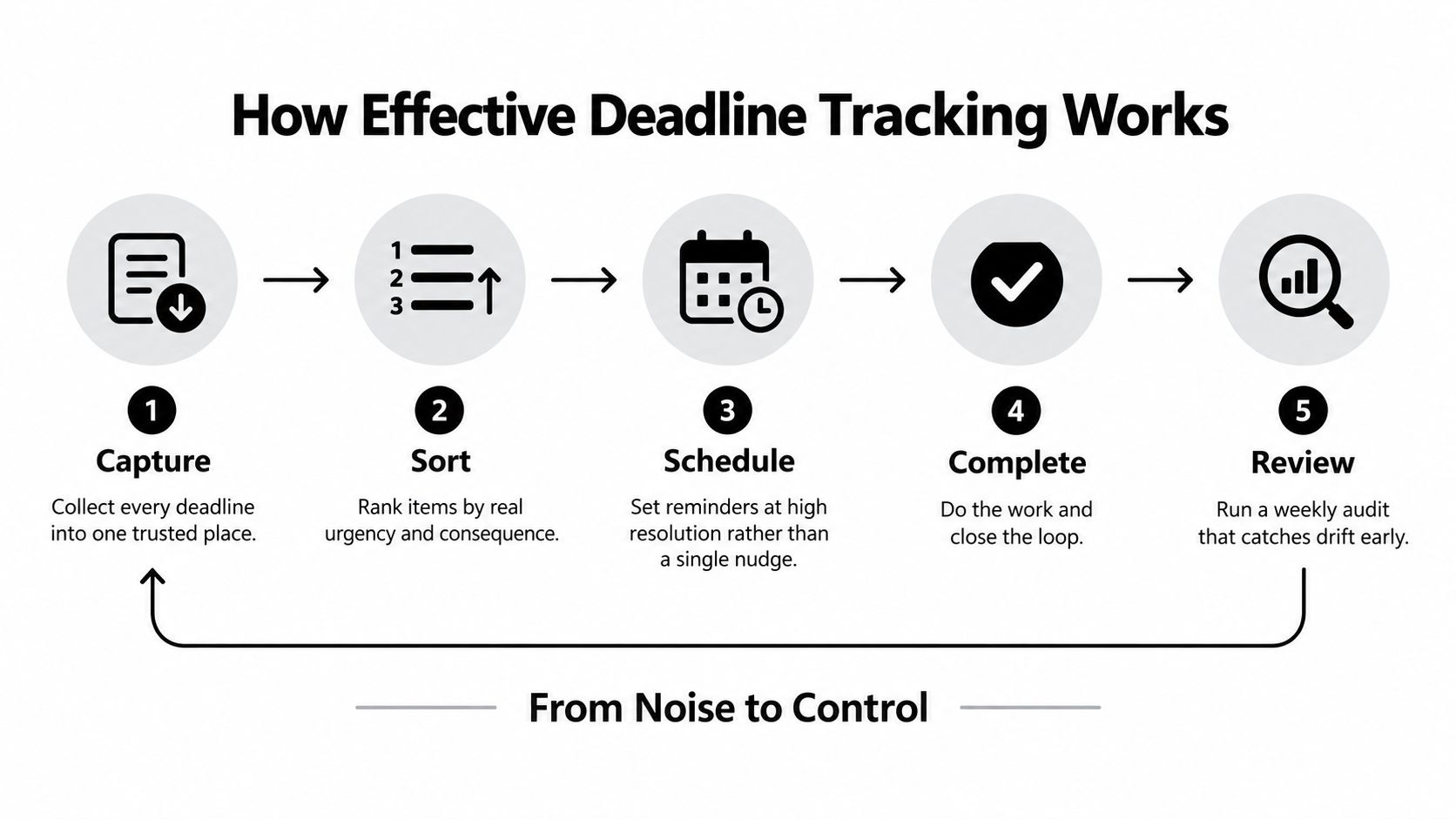
Effective deadline tracking is an active control system, not a passive list. It captures commitments, converts them into scheduled work, exposes overdue states, and creates a recurring review loop that keeps small slips from becoming major delays.
Start with one trusted capture point
Collect every meaningful deadline in one system before trying to optimize it. That includes client deliverables, approval dates, renewals, travel documents, school forms, and tasks waiting on another person. A calendar can hold the hard date, while a task platform holds the work required to reach it, but both need a consistent naming and ownership convention.
For each item, record:
- The actual due date: Use the date imposed by the client, institution, vendor, or internal commitment.
- The owner: Assign one person, even when several people contribute.
- The next action: “Send draft for review” is more useful than “marketing project.”
- The dependency: Note what must happen first and who controls that input.
- The review point: Schedule a check before the due date, not only on it.
Academic productivity guidance recommends placing major due dates on a physical or electronic calendar and blocking the time needed for the supporting steps. A useful example is to place a report deadline on a monthly calendar, then reserve specific weekly blocks for research, drafting, review, and submission. (University of Pittsburgh time-management strategies)
Space work instead of clustering it
Multiple deliverables due on the same day create an artificial capacity problem. Stagger internal deadlines, request inputs early, and build buffer periods around work that depends on external responses. If a proposal is due Friday, the internal draft might be due earlier, the review might have its own date, and the final submission should have a protected window rather than occupying the last available hour.
A static list tells you what exists. A dynamic schedule tells you what must happen next and whether the available time can support it. Systems that flag overdue tasks, notify collaborators, and show dependencies make slippage visible while there's still time to resequence the work.
For media-heavy workflows, accurate captions can also help preserve action items from recorded meetings and interviews. An accurate AI subtitle tool can support the capture stage when spoken commitments need to become searchable tasks. Teams that rely on calendars should also review these calendar management tips to keep appointments, focus blocks, and deadline reviews from competing for the same space.
DIY Tools vs. Delegated Assistant Support
DIY deadline tracking works well when the number of commitments is manageable, ownership is clear, and the person maintaining the system has enough uninterrupted time to update it. A shared calendar, task manager, and weekly review can handle a great deal of operational work. The failure begins when the system depends on one person manually translating every email, message, appointment, and change into a reliable sequence of actions.
What software handles well
A digital tool is strong at storage, sorting, recurring reminders, status fields, and visibility. It can show that a contract renewal is approaching, mark a task overdue, and place a meeting on a shared calendar. It won't reliably determine whether a vague email contains a commitment, whether a rescheduled appointment conflicts with school pickup, or whether a supplier's delay requires a different plan unless someone interprets the context.
Quickbase's 2025 Gray Work Report describes a similar systems problem. Productivity technology investment has increased, but manual tasks, fragmented systems, and low trust in data continue to create gray work. A separate 2025 academic study found that manual time tracking can expose overly optimistic planning, but that awareness alone may reveal unrealistic goals without correcting them. (Quickbase's 2025 Gray Work Report)
The practical test is whether maintaining the system consumes the time it was meant to save. If a professional spends the start of every day reconciling five tools, the problem isn't a missing feature. It's fragmented operational ownership.
When delegation creates leverage
Human-assisted coordination is useful when deadlines require judgment, persistence, and communication across channels. An Assistant can monitor requests, clarify ambiguous next steps, coordinate scheduling conflicts, and follow up when another party hasn't responded. That changes the system from “remember to check” to “someone is responsible for checking and escalating.”
A service such as Approved Lux Personal Assistant uses Triple-channel access, with a US-based Assistant team reachable by phone call, SMS text, or email. The team can support scheduling, deadline coordination, inbox triage, travel logistics, research, and follow-ups. Proactive Preference Learning lets the team adapt to a member's routines and access standards over time, while the subscription model provides capacity without the payroll, benefits, and management obligations of a direct hire.
For teams comparing software categories, a guide to subcategories for time tracking can help separate time capture from deadline control. Those functions overlap, but they solve different problems. Time tracking explains where effort went. Deadline tracking protects what must happen next.
Before delegating, define the boundaries: what can be scheduled without approval, which purchases require confirmation, who may access sensitive information, and what should be escalated immediately. A practical framework for evaluating that role is how to hire a personal assistant, especially when the work includes recurring coordination rather than isolated errands.
Reducing Mental Load and Operational Noise
The most expensive part of an untracked deadline may be the attention it occupies between tasks. Someone remembers that a form is due, wonders whether it was submitted, checks the inbox, notices a missing attachment, and postpones the follow-up because another meeting is starting. The task may take minutes to complete, but the surrounding mental loop can remain active for much longer.
Research on parents' mental load describes this burden as ongoing cognitive labor, including noticing, planning, tracking, and coordinating rather than performing tasks. The same problem appears in professional teams when one person becomes the default operating system for everyone else's commitments. (Research on parents' mental load)

Make invisible work visible
The first intervention is not a better color scheme. It's an inventory of recurring touchpoints:
- Recurring administration: renewals, forms, registrations, invoices, and maintenance appointments.
- Dependency management: approvals, signatures, school records, vendor responses, and client inputs.
- Follow-through: reminders, rescheduling, confirmations, and escalation after a missed response.
- Context switching: moving between household, business, travel, and personal commitments.
Put each category into a shared system with an owner and an escalation rule. A household might assign school registrations to one adult, maintenance coordination to another, and use a shared review for items that affect both calendars. A leadership team might route contract renewals to an operations owner while requiring executive approval only for commercial terms.
The point isn't to remove human judgment. It's to reserve judgment for exceptions instead of spending it on routine monitoring. Proactive Preference Learning can reduce repeated explanations by allowing an Assistant team to learn preferred meeting windows, travel standards, communication habits, and escalation thresholds. That creates operational continuity without requiring one person to hold every detail in working memory.
The objective isn't perfect organization. It's fewer open loops competing for attention.
Real-World Use Cases for Professionals and Parents
A founder often notices the deadline problem during a week that should be reserved for strategy. A vendor needs a response, a flight changes, a team member is waiting for an approval, and a renewal form remains buried in an inbox. The founder isn't failing at prioritization. They're performing coordination work that could be captured, assigned, and followed through by someone else.

For a working parent, the same pattern appears across school and home. A school enrollment deadline may depend on forms from a pediatrician, a summer program may require a payment and medical record, and a household repair may need to be scheduled around two working calendars. Moving those steps into shared deadline tracking makes ownership explicit instead of leaving one parent to remember every dependency.
A resource on summer camp registration is useful because these commitments rarely involve one date. The workflow includes researching options, comparing schedules, completing forms, collecting records, paying fees, and confirming acceptance. Tracking the final deadline without tracking the preparation is how families end up doing urgent administrative work at night.
A solo practitioner faces a different trade-off. Every hour spent chasing an appointment confirmation, formatting a document, or sorting administrative email is an hour unavailable for client work, business development, or recovery. The system should identify which tasks require professional judgment and which can be handled through documented preferences and escalation rules.
Frequent business travelers also benefit from ownership rather than passive reminders. A flight cancellation can trigger a chain of new deadlines involving hotel changes, ground transport, meeting notifications, and expense records. A shared Assistant team reachable by call, text, or email can coordinate those moving parts while the traveler focuses on the client or event.
The following video adds useful context for thinking about how deadline-related coordination can be organized in practice:
The value is not abstract efficiency. It's a cleared afternoon, fewer late-night checks, and a household or business that no longer depends on one person's memory.
Implementation Playbook and Templates
Build the system around the work that currently causes interruptions. Don't begin by migrating every old task. Start with active deadlines, recurring obligations, and commitments that affect other people.
Set up the operating rules
Use this basic record for each item:
| Field | Practical standard |
|---|---|
| Deadline | The external due date, including time zone when relevant |
| Owner | One accountable person |
| Next action | A visible verb, such as “submit,” “confirm,” or “request” |
| Dependency | The person, document, or decision required first |
| Reminder | An early prompt plus a review point |
| Escalation | What happens if the task is blocked or overdue |
Assign one owner even when several contributors are involved. Review progress in short check-ins rather than waiting for the final due date. If a task changes, update the date, reason, owner, and next action together so the record remains trustworthy.
Use a weekly audit
During the audit, look for:
- Unowned work: Assign a person or remove the commitment.
- Overdue work: Decide whether to complete, reschedule, delegate, or cancel it.
- Clustered dates: Move internal milestones to create breathing room.
- Repeated friction: Automate the reminder or delegate the coordination.
- False urgency: Separate external consequences from personal anxiety.
Measure the system with operational indicators rather than vanity metrics. Track gray-work hours, overdue items, missed handoffs, rescheduled commitments, and protected deep-work time. The direction matters more than a perfect baseline.
Finally, identify the tasks that should leave your head first. Recurring registrations, appointment coordination, travel changes, inbox follow-ups, and household scheduling are strong candidates because they require persistence but often follow repeatable patterns. Keep decisions with the person who has the relevant authority, and delegate the monitoring, preparation, and follow-through around those decisions.
Approved Lux provides 24/7 access to a US-based Assistant team through Triple-channel access, supporting scheduling, deadline coordination, travel logistics, inbox triage, and follow-ups without the overhead of a direct hire. Visit Approved Lux Personal Assistant to see whether delegated operational support can reclaim hours and reduce the mental load behind your deadlines.
Want the wider view?
Ten categories. One report. Every quarter. The Approved List tracks what's rising and what's fading: data-backed signals, not opinions.
Free to join · Delivered by email