
All Articles
The Journal
How to Facilitate a Meeting and Reclaim Real Hours
September 14, 202613 min readmeeting facilitationmeeting agenda
Learn how to facilitate a meeting that ends with clear decisions, not loose threads. Practical playbook for agendas, timeboxing, follow-up, and reclaiming hours
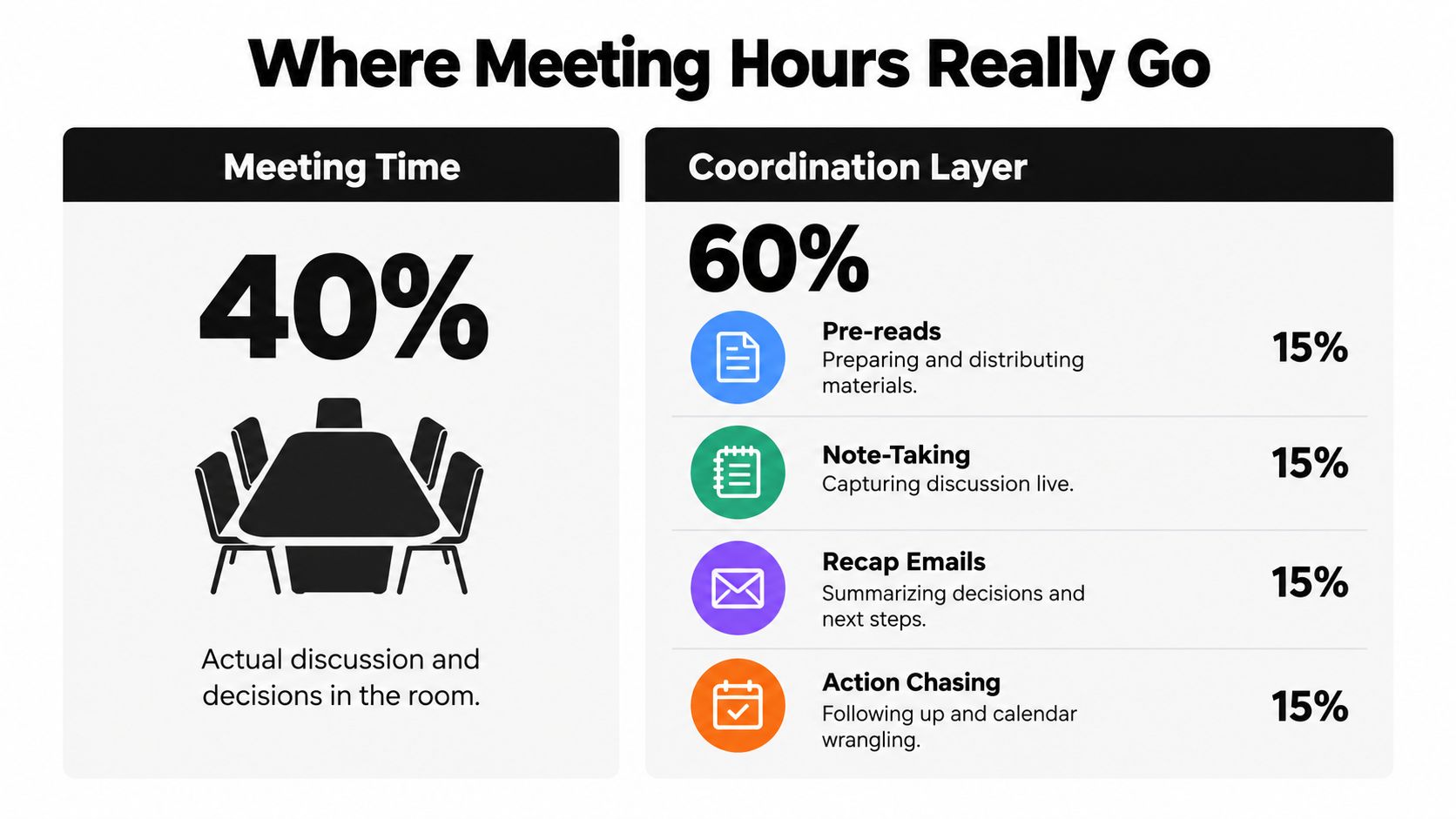
Knowledge workers now spend 11.3 hours each week in meetings, plus another 3 to 4 hours on preparation, follow-up, recap notes, and buffer time around calls, according to the State of Meetings 2026 benchmark. That means the meeting on your calendar is only part of the labor. The coordination around it can consume roughly a third more time.
Most advice about how to facilitate a meeting focuses on speaking order, confident body language, and a polished agenda. That advice misses the operational problem. A facilitator has to prepare the decision, control the room, and close the loop so nobody spends the next day reconstructing what happened.
The payoff isn't a more pleasant calendar. It's reclaimed working time, faster decisions, balanced participation, and fewer follow-up messages asking what everyone agreed to.
What It Really Means to Facilitate a Meeting
To facilitate a meeting well, you need to own three separate jobs. Treating them as one vague skill is why capable leaders end up improvising, multitasking, and leaving the room with unresolved work.
The three jobs of facilitation
First, set up the meeting before anyone arrives. Define the decision, identify the people who can change its outcome, choose the right length, and distribute whatever context participants need. A qualitative study of 238 group facilitators found that effective facilitation is strongly tied to pre-meeting planning, room and setup preparation, and agenda use. The facilitation study published in Group Processes & Intergroup Relations supports a simple conclusion: preparation isn't administrative overhead. It materially affects the meeting's outcome.
Second, run the room in real time. Protect the objective, manage the clock, balance participation, and interrupt useful but mistimed discussion. Your job isn't to generate the most conversation. Your job is to help the group reach the right result without allowing the loudest person, the latest arrival, or the most interesting side topic to take control.
Third, close the meeting cleanly. State the decisions, assign owners, confirm deadlines, review parked topics, and send the record. A meeting that ends with “we'll follow up” hasn't ended. It has created another coordination task.
Operating principle: Facilitation is a learnable operating skill, not a personality trait.
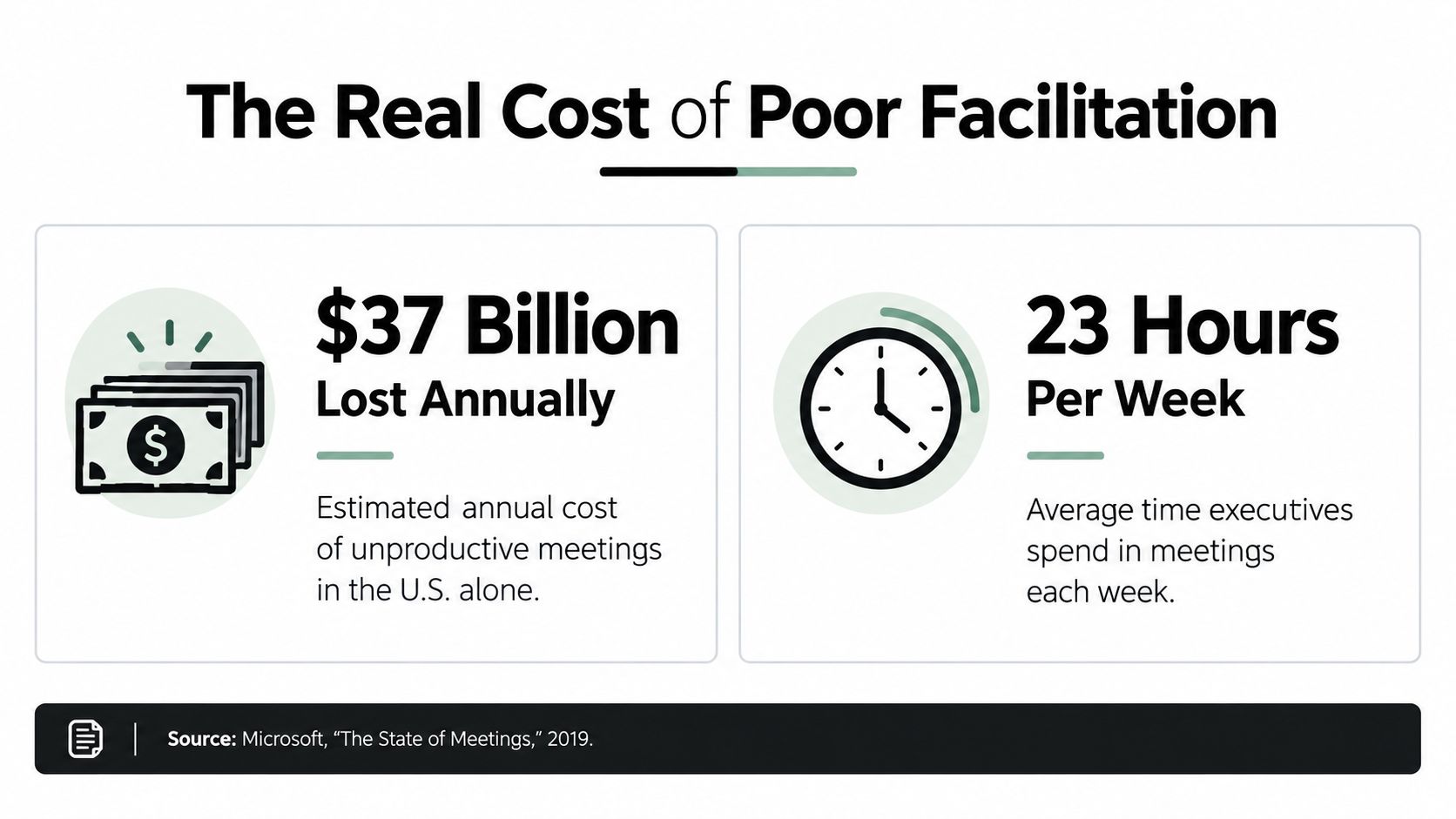
The cost of weak execution is visible in recurring meeting failures. Documented problems include 28% citing participant preparation, 20% citing poor communication, 17% citing failure to observe allocated time, 25% citing no follow-up on tasks, and 13% citing no minutes, as summarized by Better Meetings. The same source reports that 66% of workers cite late starts or endings, while 63% say a meeting was unnecessary.
This guide covers all three jobs in order. The best facilitators also recognize that preparation, capture, and follow-through don't always require the leader's personal attention. The decision owner should stay close to the decision. The coordination layer can be assigned to someone else.
Locking the Objective Before You Send the Invite
A meeting without a locked objective is a calendar placeholder with chairs. “Discuss Q4 marketing” tells participants almost nothing. They won't know whether they should bring recommendations, approve a plan, share updates, or challenge assumptions.
Write the outcome as a decision or deliverable. A useful objective names the action, the scope, and the next artifact.
| Element | Vague Setup | Locked Setup |
|---|---|---|
| Objective | Discuss Q4 marketing | Pick the channel mix for Q4 and assign owners so the media plan goes to finance by Friday |
| Meeting title | Sync on roadmap | Roadmap decision, cut scope by two items to hit the December date |
| Attendees | Marketing team | Marketing lead, finance approver, product owner, and channel owners |
| Output | Alignment | Approved channel mix, named owners, and finance-ready media plan |
| Preparation | Come ready to discuss | Review the proposed mix and mark objections before the meeting |
The pre-invite checklist
Lock five decisions before you send the invite:
- Decision: What must the group decide, approve, reject, or prioritize?
- Artifact: What document, plan, owner list, or decision record should exist when the meeting ends?
- Attendees: Who can materially change the result or execute the next step?
- Length: How much time does the decision require, not how much time is available on the calendar?
- Pre-work: What information can participants review before the discussion begins?
Cut observers who don't need to participate live. Send a short pre-read with a clear instruction, such as “approve, object, or add a missing assumption.” That turns meeting time into decision time instead of reading time.
The objective is the highest-impact move in the playbook because every downstream element falls out of it. The agenda follows the decision. Role assignments follow the agenda. The recap follows the output artifact. Use this meeting preparation checklist to verify that the invite contains enough information for participants to arrive ready.
A strong meeting title makes the expected behavior obvious before the calendar event starts.
If you can't describe the decision and output in one sentence each, don't send the invite yet. Rewrite the objective, replace the meeting with an async request, or ask one person to prepare a recommendation first.
Timeboxed Agendas That End On Time
An agenda-only meeting lists topics. A timeboxed meeting assigns a job to every minute.
Consider the difference. An agenda might say “budget, timeline, risks, next steps.” Nobody knows who leads each topic, how long it deserves, or what happens when the budget discussion consumes the entire call. The group drifts into status reports, repeats context, and discovers at the end that no one made the decision.
A fully timeboxed agenda specifies four things for every block: duration, lead, output, and overrun rule. The facilitator can then protect the objective without appearing arbitrary. The clock isn't a social signal. It's an operating constraint.
Copy-paste agenda
Use this format for a 30-minute decision meeting:
- 0:00 to 0:02, objective read-back: Facilitator confirms the decision and expected output.
- 0:02 to 0:07, pre-read recap: Pre-read owner answers only clarification questions. The timekeeper holds the floor.
- 0:07 to 0:20, deep discussion: Decision owner hears the relevant tradeoffs and tests assumptions.
- 0:20 to 0:25, decision capture: Scribe records the decision, owner assignments, and due dates.
- 0:25 to 0:30, parking lot and next steps: Facilitator assigns or closes side topics and confirms the recap process.
The rule is simple: if a block overruns by more than 20%, park it rather than finishing it. The timekeeper's only job is to interrupt. They shouldn't summarize, negotiate, or rescue a conversation. A useful interruption sounds like, “We have exceeded this block, so I'm parking the remaining question and moving us to the decision.”

Why the rule matters
Without a hard overrun rule, the facilitator faces a false choice between being polite and being effective. The meeting then ends late, the final decision gets rushed, and follow-up expands to repair what the room failed to settle.
Make the agenda visible in the shared document or meeting window. Mark each block as it starts, and write the output directly beneath it. If the discussion doesn't produce the promised output, the facilitator should name that gap before moving on.
A timebox doesn't eliminate disagreement. It forces the group to decide whether disagreement is relevant to today's objective, important enough to schedule separately, or not useful.
Assigning Roles So the Facilitator Is Not Doing Everything
One person shouldn't set direction, watch the clock, capture decisions, and manage participation at the same time. That combination creates predictable failures. The facilitator misses a key objection while typing, the scribe records discussion instead of decisions, or the decision owner avoids calling the result because they're busy controlling the room.
Split the work into four roles.
Facilitator: Sets pace, protects the objective, manages transitions, and keeps participation balanced.
Scribe: Records decisions, owners, deadlines, and unresolved questions as they happen. The scribe shouldn't attempt a polished transcript. They should capture operational facts close to the group's actual wording.
Timekeeper: Announces the start of each block and interrupts when the block reaches its limit. This role protects the agenda from social pressure.
Decision owner: Has authority to call the result when discussion stalls. This person doesn't need to dominate the conversation. They need to make the decision explicit.
Role Assignment Decision Matrix
| Meeting Type | Facilitator | Scribe | Timekeeper | Decision Owner |
|---|---|---|---|---|
| Stand-up | Team lead or rotating lead | Usually unnecessary, unless commitments need tracking | Rotating participant | Team lead for escalated issues |
| Hiring loop | Hiring manager or trained panel lead | Dedicated interviewer or recruiting partner | Recruiting partner | Hiring manager |
| Roadmap review | Product operations lead | Product operations partner | Project coordinator | Product leader |
| Client decision meeting | Account lead | Client services partner | Account coordinator | Named client or internal approver |
| Executive decision meeting | Chief of staff or neutral lead | Chief of staff or executive assistant | Operations partner | Executive with decision rights |
A stand-up rarely needs a formal scribe. A hiring loop almost always needs one because feedback must remain distinct from casual discussion and the decision must be traceable.
Role rule: If the facilitator is also the decision owner, explicitly hand the chair to someone else for that topic.
Use a short handoff protocol when someone is absent or overwhelmed. The current role holder states what has been completed, names the next responsibility, and points to the live document. The replacement confirms the handoff aloud. If the scribe falls behind, stop the discussion long enough to record the last decision before continuing. Silent role changes create silent gaps.
The facilitator can still influence the decision, but they shouldn't control both the process and the outcome without telling the group. Transparency protects trust and makes disagreement easier to surface.
Running the Room With Concrete Scenarios
Preparation gives you a structure. Real facilitation happens when someone ignores it.
When one person hijacks the discussion
A participant introduces a separate issue and keeps returning to it. Don't debate whether the issue is valuable. Acknowledge it once, write it on a visible side-topics list, and return to the agenda within thirty seconds.
Say: “That matters, and it's outside today's decision. I'm parking it under side topics so we don't lose it. We're returning to the channel recommendation.”
When a remote attendee goes silent
Hybrid meetings punish passive participation. In-room people can read the whiteboard, catch informal exchanges, and signal agreement physically. Remote participants need deliberate access to the same information and speaking opportunities.
Call on quieter participants by name, use a camera-order round, and invite a written response in chat. Guidance on encouraging participation in meetings offers useful techniques for creating more balanced involvement.
Say: “Jordan, we haven't heard your view yet. Please give us your recommendation, or put your objection in chat if you'd rather type it.”
When the decision-maker arrives late
Don't restart the meeting for one person. Summarize the missed context in ninety seconds, ask whether the group should continue or reset, then act on the answer.
Say: “You missed the assumptions and the first two options. We can continue with the current recommendation or reset for your input. Which do you want?”
When an explainer won't stop
Long explanations often contain a useful point, but the group can't act on an essay. Interrupt respectfully and convert the narrative into a decision question.
Say: “What is the decision we need from this?”
When two people start a side conversation
Don't let the pair create a second meeting inside the first. Name the behavior without accusing them, then bring the content back to the group.
Say: “I hear a separate thread developing between you. Please share the point with everyone, or add it to the side-topics list.”
When the group goes silent
Silence after a question doesn't always mean agreement. Count to eight, then narrow the response format so participants have a low-friction way to enter.
Say: “I'll make this binary. Do we approve the proposed scope, yes or no, and what is the single objection?”
These lines work because they address the behavior, not the person's character. You don't need to become more charismatic. You need a small set of repeatable moves that preserve the objective and make participation visible.
Closing Strong With Decisions, Owners, and Follow-Up
Most meetings fail in the final minutes because the facilitator asks, “Any other business?” That question invites fresh discussion when the group needs closure.
Reserve the last five minutes for a fixed closing protocol. First, recap every decision in plain language. Then name one owner, one deadline, and one success measure for each action. If nobody can state what completion looks like, the task isn't ready to leave the room.
The three-part close
Verbal recap: “We chose the partner channel. Priya owns the revised media plan, due Friday, and success means finance receives the approved mix with spend assumptions.”
Parked-list review: Read every side topic aloud. Assign it to a person, schedule it for a specific forum, or kill it. “We'll revisit later” is not a disposition.
Written recap: Send the note within sixty minutes. Keep it short enough to read immediately and structured enough to become the source of truth.
A practical recap looks like this:
Decision:
We approved [decision] because [brief rationale].Action items:
- [Verb] [deliverable], owner [name], due [date], success measure [criterion].
- [Verb] [deliverable], owner [name], due [date], success measure [criterion].
Parked items:
- [Topic], disposition [owner, meeting, or closed].
Reference:
[Recording or transcript link]
If the meeting produces several tasks, use a consistent content team action list format so verbs, owners, and dates remain easy to scan. For recurring workflows, follow-up automation can reduce the manual work of distributing reminders and keeping open actions visible.

The rule is unforgiving because it needs to be. A meeting without a recap has not happened. If the notes aren't out, the work doesn't exist in a dependable form, and the hour is at risk of being wasted.
Delegating the Coordination Layer Around Meetings
Meeting time is only the visible part of the labor. A 30-minute meeting can consume 60 to 90 minutes of adjacent administrative work once preparation, note-taking, recap, and follow-up are included. The broader benchmark, 11.3 weekly meeting hours plus 3 to 4 hours of overhead, reinforces the same operational problem, as noted earlier. The leader's highest-value contribution is the decision. Calendar wrangling, document formatting, transcription, and action chasing should have separate owners.
Separate judgment from coordination
The facilitator owns the objective, decision standard, and final call. An AI chief of staff, executive assistant, or operations partner can run the surrounding workflow:
- Assemble the pre-read from existing documents.
- Format the agenda and confirm role assignments.
- Capture discussion, decisions, owners, and unresolved questions.
- Distribute the recap within sixty minutes.
- Send status nudges on open actions.
- Maintain the decision log and flag stalled work.
Set the boundary before the meeting starts. The leader reviews flagged items and approves the final recap. The coordination owner prepares the packet, keeps the live note ready, and tracks what happens afterward. The leader should not spend the afternoon asking three people for dates already agreed in the room.
Microsoft-linked coverage cited in the 2026 systems research on hybrid meetings connects meeting load with anonymized Microsoft 365 signals and a survey of 31,000 knowledge workers across 31 markets. Treat coordination as measurable labor, not an invisible favor performed between calls.
Build a daily delegation workflow
Create one operating list for the day's meetings. Include the decision owner, preparation status, recap status, and open actions. For each meeting, the coordination owner assembles the prep packet, confirms the attendees and roles, prepares the note, and drafts the recap while the discussion remains fresh. The leader reviews exceptions, approves decisions requiring their authority, and enters the room ready to decide.
Delegation works only when the handoff is specific. Apply the discipline in delegating tasks effectively: assign one owner, define the expected output, set a review point, and record the deadline. If the request says “handle the follow-up,” the task is still unassigned.
Tools can handle repeatable portions of the workflow. Teams looking to streamline Google Workspace with AI can use automation for document assembly and reminders, while a human remains responsible for judgment, discretion, and escalation. Automation should reduce coordination work, not decide what the organization should approve.
Approved Lux Personal Assistant is one operational option for this coordination layer. Its US-based Assistant team handles scheduling, meeting preparation, email drafting, document formatting, and follow-through through Triple-channel access, phone, SMS text, or email, with support available 24/7. This gives a leader a human coordination partner without adding a direct W-2 hire and its associated management overhead.
Measure the result in hours returned to skilled work. Assign the coordination layer, keep decision authority close, and make the handoff visible. A disciplined meeting still fails operationally if the leader prepares every packet, writes every recap, and chases every action.
If meeting preparation, recap writing, scheduling, and action follow-up consume time needed for decisions, Approved Lux Personal Assistant can handle that coordination through a US-based Assistant team reachable by phone, SMS text, or email. Evaluate which recurring meeting tasks to delegate first, then track the working hours returned.
Want the wider view?
Ten categories. One report. Every quarter. The Approved List tracks what's rising and what's fading: data-backed signals, not opinions.
Free to join · Delivered by email