All Articles
The Journal
Your Guide to a Virtual Assistant for Personal Tasks
February 4, 202621 min readpersonal productivitylifestyle management
Discover how a virtual assistant for personal tasks can manage your life, save you time, and reduce stress. Learn what they do and how to choose the right one.

Let's be honest, your personal to-do list can feel like a second job. Between scheduling doctor's appointments, planning that family vacation, and figuring out who can fix the leaky faucet, the mental load is exhausting. This is where a virtual assistant for personal tasks comes in.
Think of it as having a remote COO for your life—someone dedicated to managing all the non-work stuff so you can get back to what actually matters.
Reclaim Your Time with a Personal Virtual Assistant

If you're staring at a never-ending list of personal chores, you're definitely not alone. The constant juggle of appointments, travel plans, and household management drains your energy and pulls focus away from your career and family. But there's a powerful way to get off that hamster wheel.
This guide is all about how a personal virtual assistant can become the operating system for your life, systematically taking over that relentless backend coordination. This isn't just about hiring an extra pair of hands; it's about installing a system to get back your most valuable resource: your time.
Moving Beyond Traditional Assistance
The idea of a virtual assistant has changed a lot. Forget the old one-on-one model where you're basically managing another employee. Today's VA platforms are sophisticated services built for one thing: reliable, efficient execution. You delegate a task, and it simply gets done. No need to worry about sick days, vacation time, or performance reviews.
This new approach is a perfect fit for a few key groups:
- Busy Professionals: Offload personal scheduling, gift buying, and dinner reservations to keep your head in the game at work.
- Founders and Executives: Delegate complex travel itineraries and household management to eliminate decision fatigue.
- Families: Let someone else handle the school calendars, activity planning, and coordinating home repairs.
- Frequent Travelers: Get seamless trip planning, from flights and hotels to local restaurant bookings, wherever you are in the world.
A System for a Streamlined Life
Here's a helpful way to think about it: You are the CEO of your life, and a personal VA is your Chief Operating Officer. Their job is to run the day-to-day operations so you can focus on the big picture—whether that’s scaling your business, being present with your kids, or just finding time for a hobby. Combining a personal VA with effective time management tips can completely change your productivity.
By offloading the "life admin" that eats up hours every week, you're not just buying convenience. You're investing in a more organized, less stressed, and more focused version of yourself.
In the rest of this guide, we'll walk through exactly how to put this system into practice. Consider this your roadmap to finally conquering the daily overwhelm and building a life where your personal to-do list no longer runs the show.
Your Personal Operations Manager: A New Way to Handle Life Admin

When you first hear "virtual assistant," your mind probably jumps to a single person you hire to tick off a few admin tasks. That’s the old model. A modern virtual assistant for personal tasks is a whole different beast.
Think of it less like an employee and more like your personal operations manager or a "chief of staff" for your life.
This isn't just about outsourcing a to-do list; it's about handing over the entire logistical backend of your personal world. From planning that complex family trip with multiple stops to finding and scheduling a reliable plumber, they handle the mental load so you can focus on what actually matters.
From a Single Assistant to a Full-Fledged Platform
Hiring a dedicated assistant, virtual or not, comes with a familiar set of headaches. You have to find them, train them, and manage them. But what happens when they call in sick, go on vacation, or decide to move on? Everything grinds to a halt. You’re left holding the bag.
Modern services are built to sidestep this exact problem. They’ve moved from a one-to-one relationship to a platform-based system. Instead of depending on a single person, you’re plugging into a reliable, always-on service.
The platform model gives you something a single assistant never can: built-in continuity. Your requests are handled by a coordinated team, so work gets done efficiently without you ever needing to know—or worry about—who’s handling it.
This shift turns the service from a simple helper into a dependable operational layer for your life, much like how an ops department keeps a company running smoothly.
How Does It All Work Behind the Scenes?
So, how do these platforms actually get things done? They act as a central command center for all your requests. You submit a task, and behind the curtain, a blend of smart technology and human expertise springs into action.
Here’s a quick look at the typical flow:
- You Submit a Request: It all starts with you sending a task through an app, email, or a dedicated messaging channel.
- Smart Triage Kicks In: The system—often with a bit of AI help—instantly analyzes your request and routes it to the right person or specialized team.
- The Team Gets to Work: A group of assistants collaborates to manage the task, which is especially useful for complex, multi-step projects.
- Quality Checks Are Built-In: Before anything comes back to you, the platform has quality assurance steps to make sure every detail is buttoned up.
This systematic approach delivers professional-grade support without the hassle of direct hiring. It’s this operational efficiency that’s fueling the massive growth in the virtual assistant market, which is expected to jump from $19.5 billion in 2025 to $55.4 billion by 2035—a 184% surge. This isn't just a trend; it's a clear move toward managed services that blend human skill with smart automation. You can dive deeper into these market shifts in the full virtual assistant services report.
Ultimately, a modern virtual assistant for personal tasks is about the outcome, not the individual. You delegate the "how," and the platform simply delivers the "done." The real prize? Getting back your time and mental energy to live a more focused, intentional life.
What a Personal Virtual Assistant Can Actually Do
So, what does a virtual assistant for your personal life actually do? It’s easy to picture someone just booking a few appointments, but that barely scratches the surface. The real magic happens when they take over the complex, time-consuming logistics that quietly eat away at your focus and energy every single day.
Think of it less as a simple to-do list and more as a control center for your life outside of work. To really get a feel for how a VA can slot into your world, it helps to break down the tasks by the areas where most busy people feel the most pressure.
Daily Life Logistics and Coordination
This is all about the recurring, everyday stuff—the essential but tedious tasks that clog up your schedule and your mind. These are the little administrative burdens that, when added up, become a huge drain.
A personal VA becomes the logistical backbone of your day-to-day, making sure everything runs like clockwork without you having to constantly step in. They handle the background noise so you can stay focused.
- Appointment Scheduling: Getting you in for that dentist visit, booking a haircut, or scheduling the dog’s vet appointment—and making sure it all lands on your calendar correctly.
- Reservations and Bookings: Snagging a table at that new restaurant everyone's talking about, grabbing tickets for a concert before they sell out, or arranging a spa day.
- Online Research and Purchases: Finding a well-reviewed plumber to fix a leak, hunting down the perfect birthday gift online, or comparing prices on a new appliance you’ve been meaning to buy.
- Bill and Renewal Reminders: Keeping track of when your car registration is due or when a subscription is about to renew, saving you from late fees and headaches.
This kind of proactive management is a game-changer. It's no wonder that administrative support is a huge part of the VA world. Demand for remote talent has shot up by 29% year-over-year, with administrative assistants making up the largest slice of the pie at 31.5%. They are the masters of this kind of operational support. Discover more insights about virtual assistant trends.
Travel and Itinerary Planning
If you travel often or are just trying to plan one decent family vacation, you know the logistics can be a nightmare. A personal VA can turn this entire process from a stressful chore into something you actually look forward to. They essentially become your personal travel agent, handling every single detail.
And I don't just mean booking a flight. I mean creating a complete, thoughtful travel plan that eliminates the usual stress.
- Flight and Accommodation Research: Sifting through flight options to find the one that fits your schedule and preferences (aisle seat, please!), and booking hotels that tick all your boxes.
- Ground Transportation: Arranging an Uber, a rental car, or a private driver so you’re not left scrambling when you land.
- Detailed Itinerary Creation: Pulling together a clean, day-by-day schedule with all your confirmation numbers, addresses, and contacts in one place. No more frantic searching through your inbox.
- Activity and Tour Bookings: Researching and scheduling local tours, activities, and unique experiences that make the trip truly memorable.
To give you a better idea of what a VA can do, let's look at some common tasks they handle in a bit more detail.
Common Tasks Handled by a Personal Virtual Assistant
| Category | Example Tasks |
|---|---|
| Administrative & Scheduling | Calendar management, appointment booking (medical, personal), dinner reservations, event ticketing, reminder services. |
| Travel Planning | Flight and hotel research, itinerary creation, ground transport booking, activity and tour scheduling, visa research. |
| Household Management | Sourcing and scheduling home services (plumbers, cleaners), managing family calendars, coordinating deliveries, utility bill management. |
| Research & Purchasing | Product and price comparisons, gift sourcing and purchasing, finding local service providers, planning holiday shopping. |
| Personal Projects | Coordinating a move, planning a party or family event, researching summer camps, managing a home renovation project. |
As you can see, the scope is incredibly broad. It's all about offloading the tasks that take up your time but don't require your unique expertise.
Home and Family Coordination
Let’s be honest: running a household is a full-time job. A virtual assistant can step in and take over the relentless coordination needed to keep everything on track, lifting a massive mental load off your shoulders.
A VA can act as a household manager, ensuring that family commitments, appointments, and home maintenance are handled efficiently without you having to be the one making every call and sending every email.
Here are a few ways they can help:
- Vendor Management: Finding, vetting, and scheduling home service providers like cleaners, landscapers, or repair technicians.
- Family Calendar Management: Juggling school schedules, sports practices, and family appointments to make sure nothing falls through the cracks. To learn what makes a VA great at this, you can explore our guide on essential virtual assistant skills.
- Event and Party Planning: Helping plan that birthday party or family get-together by researching venues, sending out invitations, and coordinating with caterers.
Special Projects and Unique Requests
Beyond the day-to-day grind, a VA is an amazing resource for those one-off projects that feel too big or complicated to even start. These are often the tasks that linger on your to-do list for months. Some of these assistants are even powered by sophisticated tech; you can learn more about what an AI voice assistant is and how it functions.
This could be almost anything that requires a heavy lift in research or coordination.
- Moving Coordination: Researching moving companies, gathering quotes, and scheduling everything needed for a smooth move.
- Personal Research Projects: Diving deep into a new hobby you want to start, finding the best summer camps for your kids, or planning a home renovation from start to finish.
- Holiday and Gift Logistics: Managing your entire holiday gift list, from purchasing and sending presents to even arranging for gift wrapping.
When you look at the tasks this way, it becomes crystal clear how a personal virtual assistant can systematically chip away at your workload across every part of your life. It's all about getting your time back so you can focus on what truly matters.
Comparing VA Platforms and Traditional Assistants
So you’ve decided you need help with your personal tasks. Smart move. Now comes the big question: do you hire a dedicated assistant yourself, or do you go with one of the modern platform-based services? Both will get tasks off your plate, but they work in completely different ways. Picking the right one for you really comes down to understanding those differences.
A traditional personal assistant, whether they’re in your city or working remotely, builds a one-on-one relationship with you. They get to know your quirks, start to anticipate what you need before you ask, and can become a true right-hand person. This is fantastic for tasks that require a ton of personal context and nuance.
But—and it's a big but—hiring someone directly means you become a manager. You're now in charge of the entire process: recruiting, interviewing, training, payroll, and performance reviews. Plus, you’re completely reliant on that one person. If they get sick, go on vacation, or decide to take another job, your support system vanishes overnight.
The Platform Advantage: Reliability and Skill Diversity
This is exactly where platform-based virtual assistant services come in. Instead of hiring a single person, you subscribe to a service that gives you access to an entire team of assistants. Right away, this solves the reliability problem. Your requests keep moving forward, no matter who is working that day.
Think of it this way: a traditional assistant is like having a personal chef. They know your tastes perfectly, but if they're unavailable, you're back to making your own dinner. A platform is like a top-tier restaurant with a full kitchen staff. You get a consistently great meal every time, even if different chefs are on duty.
This team model also gives you access to a much broader set of skills. Your go-to person might be a rockstar at booking complicated travel, but are they an expert at finding and vetting local contractors for a home project? With a platform, you get specialized teams for different types of requests, so the right pro is always handling your task.
The core trade-off is simple. A dedicated assistant offers deep personal context at the cost of reliability and management effort. A platform provides built-in continuity and skill diversity, making it a more efficient and resilient system for offloading logistics.
This simple decision tree is a great way to visualize how to delegate tasks effectively—it’s a common framework that platform services use to route requests efficiently.
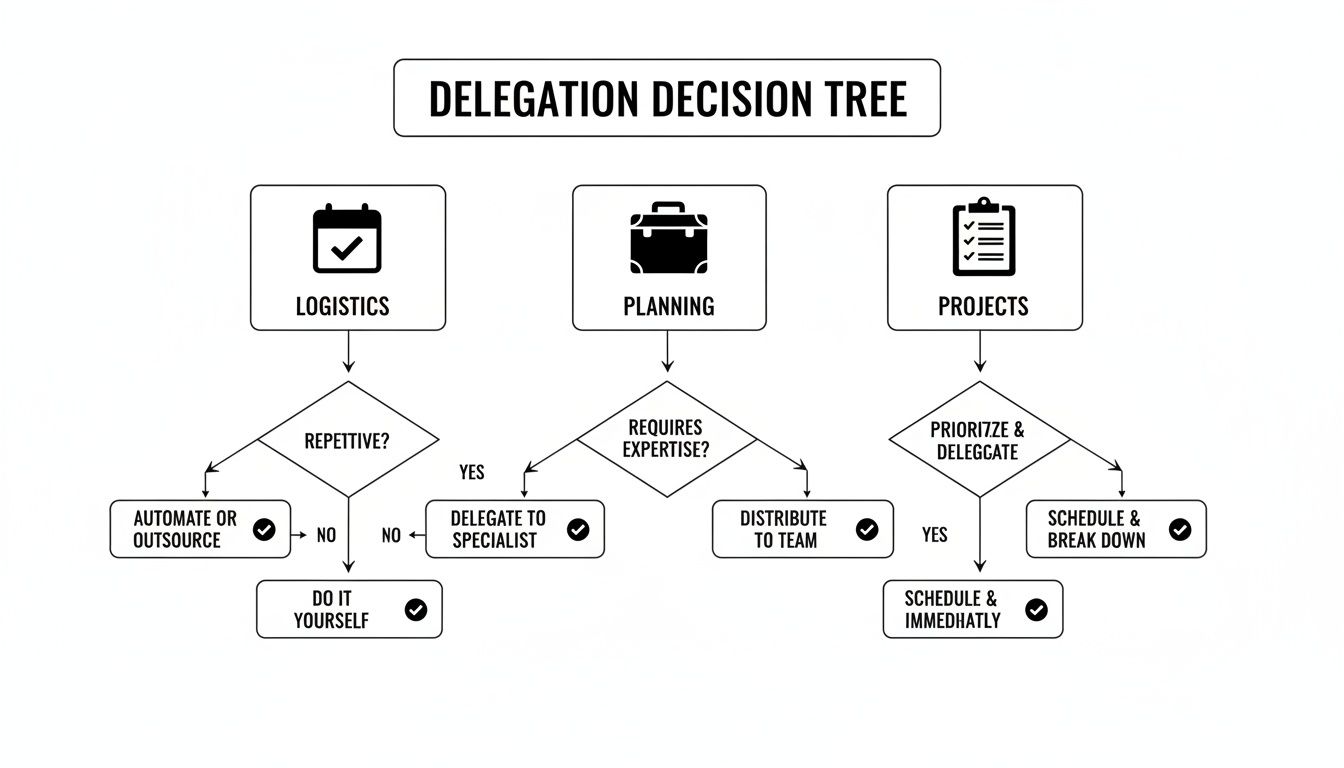
This visual shows how platforms can categorize requests for logistics, planning, and projects, ensuring that each task lands with the team best equipped to handle it.
Cost and Management: A Clear Distinction
When you look at the numbers, the two models are worlds apart. Hiring even a part-time assistant is a major financial commitment. You’re looking at a salary, benefits, and payroll taxes, which can quickly add up to thousands of dollars every month.
Platforms, on the other hand, typically work on a subscription basis. You pay a predictable flat monthly fee for a certain number of tasks or hours. It’s a straightforward operational expense that you can scale up or down as your needs change. You get all the help, without any of the headaches of being an employer. You can see how different models stack up in our guide to the top virtual assistant companies.
To make it even clearer, let's break down the key differences in a table.
Platform-Based VA vs. Hiring a Personal Assistant
| Feature | Platform-Based Virtual Assistant | Traditional Human Personal Assistant |
|---|---|---|
| Cost Structure | Predictable monthly subscription | Full salary, benefits, and payroll taxes |
| Reliability | Always-on support with built-in backup | Single point of failure (vacation, sick days) |
| Skill Access | Access to a diverse team of specialists | Limited to one person's skill set |
| Management | The platform handles all HR and oversight | You are the manager; requires your time |
| Flexibility | Easily scale your plan up or down | Locked into a fixed employment contract |
At the end of the day, a platform isn't trying to be an exact copy of a dedicated personal assistant. It's a modern, more efficient alternative designed for getting things done. For busy professionals who value reliable execution over managing a direct report, the platform model just makes more sense.
How to Choose the Right Virtual Assistant Service
Picking a virtual assistant for personal tasks isn't like hiring for a simple job; it's more like finding the right operational partner for your life. The right service melts into the background and just works, while the wrong one can feel like you’ve just taken on another management project. To get it right, you have to look past the shiny marketing and dig into how they actually operate.
First off, how will you actually talk to them? Is it through a slick app, a simple email address, or some clunky web portal you'll never want to open? The easier it is to hand off a task, the more you'll actually do it. You want a system that feels natural, whether you’re firing off a quick request between meetings or delegating on the fly.
Next, think hard about the skills you actually need. Some services are fantastic at general admin—the bread and butter of scheduling and booking. Others are built for much heavier lifts, like planning a multi-leg international trip or coordinating contractors for a home renovation. Get honest about your biggest headaches. Are you a road warrior who needs a travel logistics pro, or a busy parent desperate for help running the household?
The goal is to find a service whose strengths align directly with the biggest logistical pain points in your life. A mismatch here is the most common reason for disappointment.
Evaluating Technology and Automation
The tech behind the curtain makes a massive difference. The best services aren't just a pool of people; they blend human expertise with smart automation. AI isn't just a buzzword in this space—it’s what makes for fast, intelligent task routing, quality control, and quicker turnarounds. It’s also what's fueling the industry’s explosive growth.
The intelligent virtual assistant market is on a rocket ship, projected to grow from USD 23.8 billion in 2025 to USD 223.43 billion by 2033. That’s a staggering growth rate of 32.3% every year. This boom is all about the platforms that are smartly using AI for everything from understanding your requests to connecting directly with your favorite apps. You can discover more insights about the intelligent VA market on SkyQuestt.
Security and Privacy Protocols
Let’s be real: you’re about to hand over the keys to your kingdom. Your calendar, your travel plans, and maybe even your credit card for bookings. Security can’t be an afterthought; it has to be a top priority. Before you even think about signing up, get serious about their privacy policy and security measures.
Don't be afraid to ask the tough questions:
- Data Encryption: Is everything I send and you store encrypted end-to-end?
- Access Controls: Who sees my information, and when?
- Confidentiality Agreements: Are your assistants bound by strict non-disclosure agreements (NDAs)?
- Payment Information: How do you securely handle my credit card details for purchases?
Any reputable company will have clear, confident answers. If they get vague or defensive, that’s a huge red flag.
Pricing and Value Alignment
Finally, you have to make sense of the price tag. Most services run on a subscription, but the devil is in the details. Are you buying a bucket of tasks, a block of hours, or truly unlimited requests? Each model is designed for a different kind of user. If you want a full breakdown of the pros and cons, you can learn more about virtual assistant pricing models in our article.
And a word of caution: if a plan seems too good to be true, it probably is. A bargain-basement price often means you're getting undertrained assistants or a system held together with duct tape. This translates to slow response times, sloppy work, and more frustration for you. The best value isn't the cheapest plan; it's the one that reliably delivers, giving you back your single most valuable asset: your time.
Getting Started with Your Personal VA

So, you can see how a virtual assistant for personal tasks isn't just a luxury—it's an operational layer for your life. Think of it as a system for handling all the logistics that chip away at your focus and energy. This is a direct investment in your own well-being, designed to quiet the mental chatter and help you run your life like a well-oiled machine.
The key is moving from thinking about it to actually doing it. The good news? The onboarding process is incredibly straightforward, so you can start clearing your plate almost immediately.
Your First Steps to Delegation
Jumping in is probably much simpler than you imagine. Today’s platforms are built to get you up and running fast, often letting you hand off your first task just minutes after signing up.
Here's a simple breakdown of what it looks like:
- Choose Your Plan: Pick a subscription that makes sense for how many tasks you think you'll offload each month.
- Set Your Preferences: You’ll go through a quick setup where you can share key details—things like your frequent flyer number, dietary restrictions, or calendar access—that help your VA get things right from the start.
- Delegate Your First Task: Don't overthink it. Start with something small and specific. A simple, low-stakes task is the perfect way to see how it all works and build a little confidence in the process.
This initial setup is all about creating a foundation. Once it’s done, your VA service can handle future requests without needing much back-and-forth from you.
The most successful users I've seen always start small. They pick one annoying, nagging task that's been on their to-do list for weeks. Nailing that first win builds momentum and trust, making it so much easier to hand off bigger things down the road.
Tips for a Successful First Week
That first week is all about building a new habit and finding a good rhythm. To make the transition feel natural, just focus on clear instructions and setting realistic expectations. The whole point is to make delegation feel like second nature.
Here are a few practical tips to help you start strong:
- Be Specific with Your Requests: Clear context gets clear results. Instead of just saying, "Find a good restaurant," try, "Book a table for two at a quiet Italian restaurant near downtown for 8 PM on Friday."
- Start with Research-Based Tasks: These are easy wins. Ask your VA to research summer camps for the kids, find three gift options for an upcoming anniversary, or compare quotes from local plumbers. They’re easy to define and deliver immediate value.
- Establish Communication Norms: Figure out how you want to get updates. Would you prefer a single summary at the end of the day, or do you want a notification as each task gets ticked off the list?
By taking these small steps, you'll quickly see your personal VA transform from a cool idea into an indispensable tool. This is your chance to stop juggling endless logistics and finally get back to what really matters.
Frequently Asked Questions
Even when you see the benefits laid out, it's totally normal to have a few lingering questions before you hand over parts of your personal life to someone else. Let's tackle the big ones—security, value, and how it all actually works—so you can feel confident moving forward.
How Is My Personal Information Kept Secure?
This is, hands down, the most important question you should be asking. Any serious virtual assistant for personal tasks platform treats security as its foundation, not just a feature. They should be using encrypted channels for all communication, and internally, they need strict rules about who can access your data.
Professionals will have their assistants sign non-disclosure agreements (NDAs) and put them through rigorous training on how to handle sensitive information. Don't be shy about asking a potential provider directly about their security protocols. How do they store your credit card details? What's their process for protecting your privacy? This is a major dividing line between a professional-grade service and a more casual one.
Is a Personal Virtual Assistant Cost-Effective?
The real value here isn't about saving a few bucks—it's about buying back your time and clearing your head. The better question is, "What's an hour of my time truly worth?" Think about what you could do with an extra 10, 15, or even 20 hours back each month.
For most founders, executives, or busy parents, the ROI from offloading all those time-consuming personal logistics easily justifies the monthly cost.
You're not just paying for a service. You're making a strategic investment in your most finite resource: your time. When you frame it that way, the value becomes crystal clear.
Can a VA Handle Complex or Nuanced Personal Tasks?
Absolutely. But this is where you can really see the difference between a basic service and a premium one. A simple service might be great for booking a dinner reservation, but a high-quality platform is built to handle complicated, multi-step projects.
Think about planning a multi-country family vacation that requires visa research and coordinating across different time zones. Or managing a home renovation with multiple vendors. A top-tier service nails these kinds of projects. The secret is to provide them with clear context—give them the "what" and the "why," and a skilled assistant can run with it, no matter how nuanced the task.
How Much Time Does It Take to Manage a VA?
This is one of the biggest advantages of using a platform versus hiring someone directly. A well-oiled service requires very little management on your end. There’s an initial onboarding phase where you’ll set your preferences and grant any necessary access, but after that, delegating a task should be as easy as sending a quick text or email.
The platform itself handles all the behind-the-scenes work—assigning tasks, tracking progress, and ensuring quality. The whole point of a virtual assistant for personal tasks is to reduce your workload, not add "manage my assistant" to your to-do list. It should feel like a seamless extension of you, not another job.
Ready to stop managing logistics and start living more? Approved Lux Personal Assistant is the operational layer for your life, designed to handle the details so you can focus on what matters. Reclaim your time and reduce your mental load today. Start delegating with Approved Lux.
Want the wider view?
Ten categories. One report. Every quarter. The Approved List tracks what's rising and what's fading: data-backed signals, not opinions.
Free to join · Delivered by email