
All Articles
The Journal
How to Delegate Tasks Effectively and Reclaim Your Time
February 5, 202616 min readdelegation skillstime management
Learn how to delegate tasks effectively with our guide. Discover practical strategies to boost productivity, empower your team, and focus on what matters most.

Effective delegation isn't about just handing off tasks you don't want to do. It's a strategic move to multiply your effectiveness and get back your most valuable resource—time. The real secret is to stop being the doer and start being the director. You empower others while you zero in on the work that truly moves the needle.
Why Smart Delegation Is Your Ultimate Growth Strategy
Sound familiar? You're buried under a to-do list that never seems to end. Many high-achievers fall into the trap of confusing busyness with impact, thinking that if they don't personally handle every detail, quality will suffer. But that's a dead-end road. This approach quickly turns you into the bottleneck, stifling not only your own potential but the growth of your entire team or company.
We've all said it: "It's just faster if I do it myself." While that might be true for a single task, it’s a short-term fix that guarantees long-term stagnation.
Real growth demands a shift in thinking. Stop seeing delegation as a loss of control and start seeing it as a powerful investment. When you hand off a task correctly, you're not just clearing your calendar. You're giving someone else a chance to build a new skill, take real ownership, and contribute in a bigger way. That's how you build a more resilient and capable team around you.
From Overload To Opportunity
The signs you’ve maxed out your personal bandwidth are usually pretty obvious. You're…
- Working longer hours but making less progress on your big goals.
- Becoming the bottleneck, with your team constantly waiting for you.
- Spending your days on routine admin instead of big-picture strategy.
- Feeling completely overwhelmed and on a fast track to burnout.
Spotting these red flags is the first step toward a saner, more sustainable way of working. It's about building a system that lets you operate at your absolute best. To explore the broader principles, you can find more strategies for effective delegation.
Here's the core idea: You should only focus on the work that only you can do. Everything else is a prime candidate for delegation, creating leverage that lets you accomplish more with far less personal effort.
This isn't just some business school theory—it has a real impact on the bottom line. A Gallup study found that CEOs who truly mastered delegation grew their companies 33% faster than those who tried to do it all themselves. For many busy professionals, getting expert support is the key; our guide on virtual personal assistant services breaks down exactly how that works.
This table is a quick way to check in with yourself. See if any of the signs on the left feel familiar, and then look at the direct rewards you gain by shifting your approach.
Delegation Readiness Signs vs Strategic Rewards
| Common Sign You Need to Delegate | The Reward of Effective Delegation |
|---|---|
| Your calendar is packed with low-value administrative tasks. | Your schedule opens up for strategic planning and revenue growth. |
| You're the bottleneck holding up team projects. | The team becomes more autonomous, skilled, and faster. |
| You constantly feel overwhelmed and close to burnout. | You reclaim mental clarity and find a sustainable work-life balance. |
| You avoid taking vacations because "things will fall apart." | You can fully disconnect, knowing your business runs without you. |
| You spend time on tasks you dislike or aren't good at. | You operate in your "zone of genius," increasing your impact. |
Think of this as moving from being the one playing every instrument in the band to being the conductor—ensuring every part works together to create something incredible.
Deciding What to Delegate and What to Own
Knowing how to delegate well starts way before you actually hand a task off. It really begins with an honest look at your own to-do list. Let's be real—not all tasks are created equal. Figuring out what only you can do versus what someone else can handle is the single biggest step toward getting your focus back.
If you skip this step, you’ll either delegate the wrong things (creating more work for yourself) or, more likely, you just won't delegate at all.
The guiding thought here is simple: your time and your expertise are your most valuable assets. You should only be spending them on work that truly moves the needle. Everything else? It’s probably a good candidate for delegation. The first step is to get a clear picture with a quick task audit.
Running a Personal Task Audit
Grab a notebook or open a doc and jot down everything you do in a typical week. And I mean everything—from finalizing that high-stakes proposal to booking your flight for the conference and clearing out your inbox. No filter.
Once you have that list, you can start to see where your time is actually going. It's an eye-opening exercise. I've seen leaders shocked to discover that up to 40% of their week is eaten up by administrative tasks or busywork that someone else could knock out in a fraction of the time.
This decision tree gives you a simple way to think about it.
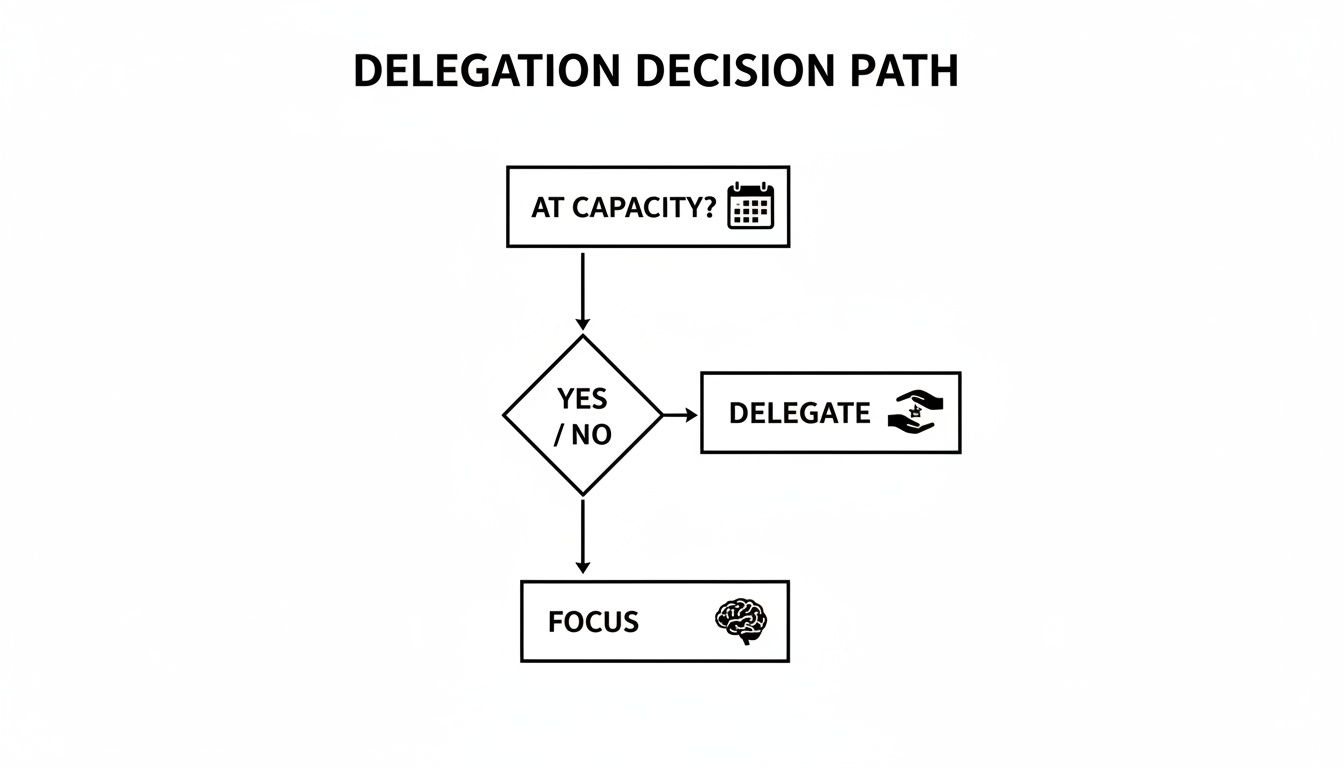
When your plate is full, the choice is clear: delegate to get your focus back. The idea is to build a system where your time is automatically shielded for what matters most.
The Four Buckets for Sorting Your Tasks
As you go through your list, sort every single item into one of four buckets. This framework makes it incredibly clear what to do with each task.
-
Do It (Your Zone of Genius): These are the things that absolutely require you. They tap into your unique skills, your strategic insight, or your key relationships. Think closing a major deal, setting the vision for the next quarter, or mentoring your top talent. These are non-negotiable—they stay with you.
-
Delegate It (Time to Empower): This bucket is for tasks that someone else can handle effectively, and in many cases, it’s a great chance for them to grow their own skills. This could be anything from drafting the initial quarterly report to managing a small-scale project. If you're wondering what a pro can take on, our guide on essential virtual assistant skills is a great place to start.
-
Automate It (The Repetitive Stuff): Here’s where you put all the recurring, process-driven tasks that eat up time but don't require much brainpower. We're talking about data entry, scheduling routine meetings, or sending standardized follow-up emails. A lot of this can be handled by software or a platform like Approved Lux.
The real objective here is to live almost entirely in the 'Do It' bucket. Every single task you can shift out of your hands—by delegating or automating it—gets you one step closer.
- Ditch It (Time to Get Ruthless): Finally, we get to the tasks that add little to no value. You know the ones: that old report nobody reads anymore, or the weekly meeting with no clear purpose. Be honest and cutthroat here. If a task isn’t actively pushing your goals forward, it needs to go.
Matching the Task to the Right Person or Platform
You’ve figured out what you need to get off your plate. Now comes the real million-dollar question: who should handle it?
Making the wrong choice here is a classic rookie mistake. It can quickly turn a simple handoff into a frustrating, time-consuming mess that you have to clean up later. The goal is to match the task with the right set of hands—whether that’s someone on your team or an outside expert.
This isn’t just about finding someone with the right skills. It's about thinking strategically. Are you trying to develop your people, or do you just need this done fast and right?
Your Three Main Options
When you boil it down, you’ve really got three paths you can take. Each one has its own pros and cons when it comes to cost, speed, and how much you’ll have to manage the process.
- Your Internal Team: This is your go-to for tasks that can double as a growth opportunity for an employee. It's a long-term investment in your team's skills and their commitment to the company.
- Specialized Freelancers: Got a specific, one-off project that needs a pro? Think graphic design, coding, or copywriting. Freelancers are perfect for parachuting in with high-level skills your team doesn't have.
- On-Demand Platforms: This is the secret weapon for all those recurring administrative, personal, and logistical tasks. Think of things that need to be done reliably and efficiently but don’t require deep strategic thinking.
Ask yourself: Is this a recurring headache or a one-time project? Does it require someone who knows the company inside and out, or is it better for an external specialist? Your answers will point you in the right direction.
Choosing who to delegate to is a strategic decision, not just a logistical one. Delegating internally builds capacity, while delegating externally buys you speed and specialized expertise.
When to Delegate In-House to Develop Your Team
Handing off responsibilities to your team is one of the most effective ways to help them grow. And if you don't? The consequences are real. Research shows a staggering 79% of employees quit because they feel unappreciated—a feeling often tied to a lack of new challenges and responsibilities.
There’s also the 70/20/10 learning model, which suggests that a massive 70% of our professional development comes from tackling challenging on-the-job tasks. These are the exact kinds of assignments you can and should be delegating.
When you trust your team with more, you build a more capable, engaged, and resilient group. You can see how different roles support this by comparing a personal assistant vs an executive assistant and the types of tasks they manage.
When to Go External for Speed and Expertise
Let’s be honest—sometimes you just need something done now, without a long ramp-up or a lot of hand-holding. That’s where freelancers and on-demand platforms like Approved Lux come in. They give you instant access to proven experts and polished processes.
This is the perfect route for:
- Tasks that require specific software or tools your team doesn’t use.
- Projects with a tight, non-negotiable deadline.
- Personal and administrative tasks that simply don’t fit into anyone’s job description.
Outsourcing things like travel planning, event logistics, or complex scheduling doesn't just save your time; it protects your team's focus for mission-critical work. You get the peace of mind that comes from knowing an expert is on it, all without adding another person for you to manage.
Crafting a Handoff That Guarantees Success
Let's be honest. The single biggest point of failure in delegation isn't a lack of skill or effort—it's a breakdown in communication. I've seen it happen a thousand times. A vague, two-minute handoff almost guarantees you'll get a result that misses the mark, forcing you to jump back in and clean up the mess.
If you want to delegate tasks effectively, you have to treat the handoff itself as a crucial step. This isn't about writing a ten-page manual for every small task. It’s about creating a simple, repeatable blueprint for clarity that gives the other person everything they need to execute with confidence.
A great handoff isn't just about assigning a task; it's about transferring ownership of the outcome.

The Core Four of a Perfect Handoff
Every single task you delegate, whether it's booking a complex business trip or just drafting a client email, needs four key ingredients to work. Think of this as your pre-flight checklist before you let a task take off.
- The Outcome (The 'What'): Start with the end in mind. What does "done" actually look like? Instead of saying, "Can you look into flights to London?" try this: "Please find three flight options to London for the week of the 10th, prioritizing a morning arrival and staying under a $1,200 budget." See the difference? One is a wish, the other is a target.
- The Context (The 'Why'): This is the part most people skip, but it’s often the most powerful. Sharing the "why" behind a request gives a person the context they need to make smart judgment calls without you. For example, adding "...because I need to be fresh for a 2 PM client pitch" immediately tells them why that red-eye flight, even if it's cheaper, is a non-starter.
- The Resources (The 'How'): What does this person need to get the job done? This could be anything—access to software, login details, a contact person's info, or even a specific budget. Providing these upfront eliminates the frustrating back-and-forth and clears roadblocks before they even appear.
- The Deadline (The 'When'): Ambiguity is the enemy of execution. "Sometime next week" is a recipe for disaster. It creates stress and confusion. "Please have the three options in my inbox by EOD on Thursday" is actionable, concrete, and sets a clear expectation.
Following this framework shifts your request from a vague idea into a well-defined project with a clear finish line.
Handoffs in the Real World
Let’s bring this to life with a common request you might send to an assistant or a platform like Approved Lux.
Here’s the wrong way (the vague request): "Hey, can you set up a team meeting for the Q3 planning session?"
This just creates more work. It leaves a dozen questions unanswered. Who's on the team? What day? How long? The result will be a long chain of emails just trying to figure out the basics.
And here's the right way (the clear request): "Hi, please schedule our Q3 planning meeting for the first week of June.
- Outcome: A 90-minute meeting on the calendar with all five department heads.
- Context: We need to finalize our Q3 rocks before the June 15th board meeting, so getting this session locked in is critical.
- Resources: Please use my Calendly link to find a time that works for everyone. The draft agenda is attached.
- Deadline: Please have this confirmed and on everyone's calendar by this Friday."
This level of detail takes an extra 60 seconds to write but can save you hours of follow-up. To keep things organized after the meeting, you can capture all decisions and next steps by using a meeting action items template.
Ineffective delegation is a massive time-waster. A survey from SHL revealed that managers waste an average of 14% of their workday redoing tasks or fixing mistakes that stem from poor handoffs. That inefficiency completely undermines the entire point of delegating, but a structured approach can help you reclaim that lost time.
How to Monitor Progress Without Micromanaging
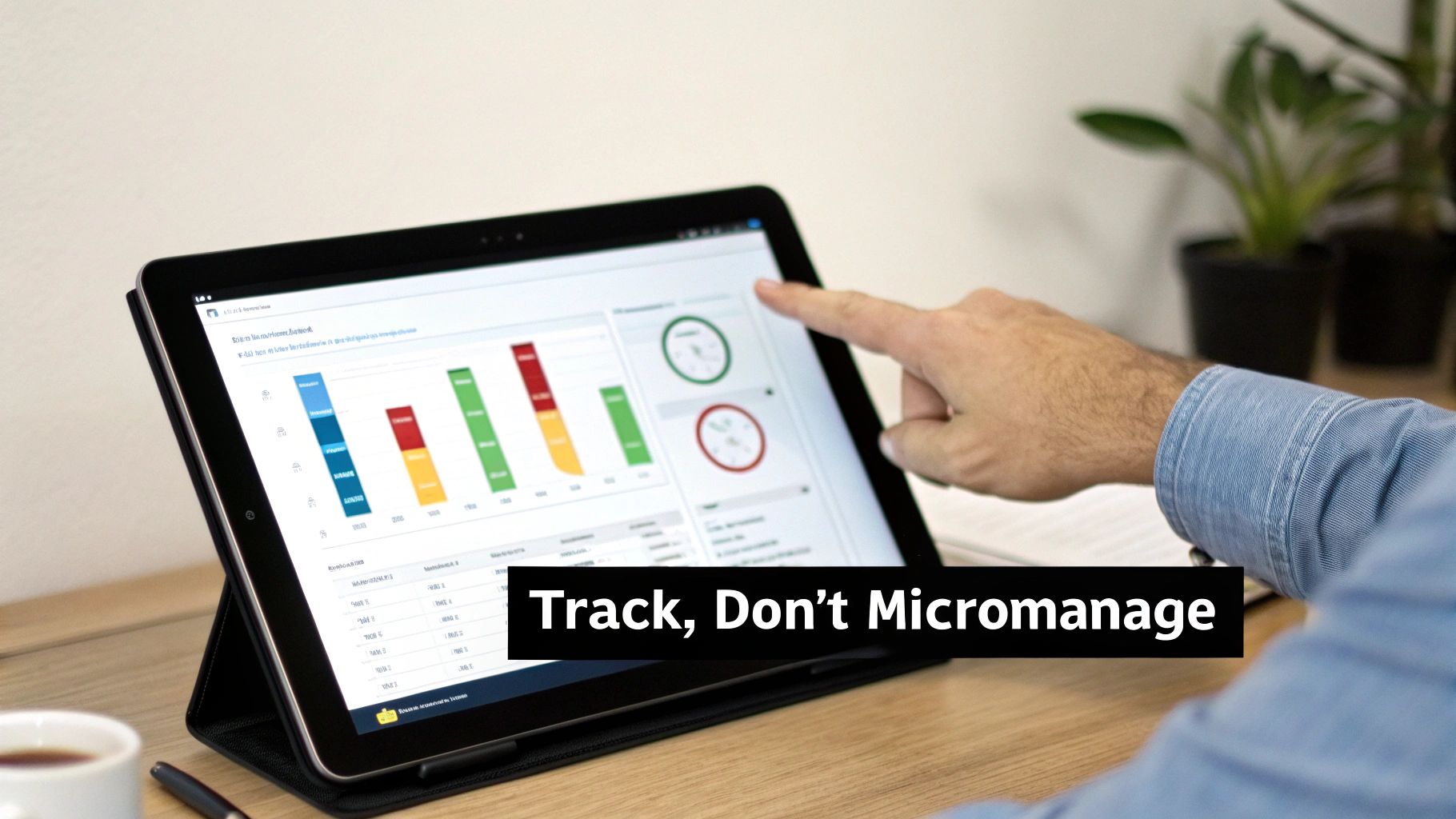
Letting go of a task doesn't mean you lose all visibility. The real art of effective delegation is staying informed without slipping into the micromanagement trap—a practice that crushes autonomy and creates bottlenecks. Instead of hovering, your goal is to establish a clear and predictable rhythm of communication that builds trust.
This isn’t about constant check-ins or asking for a play-by-play. It's about agreeing on a monitoring system before the work even begins. This simple step eliminates anxiety for both you and the person executing the task, ensuring everyone knows when and how updates will be shared.
Establish a Communication Rhythm
The key is to create a structure for updates that feels natural, not intrusive. This system should be mutually agreed upon, giving the other person a clear path to keep you in the loop without feeling like they're under a microscope. You’re building a framework for accountability, not surveillance.
Consider these simple but effective methods:
- Set a specific check-in schedule: This could be a quick five-minute sync at the end of each day or a brief email summary every Monday morning. The frequency depends on the task's complexity and deadline.
- Use shared progress trackers: For larger projects, a shared tool like a simple spreadsheet, Trello board, or Asana project can provide instant visibility. This allows you to see progress at a glance without ever having to ask, "Where are we on this?"
- Define progress milestones: For longer-term tasks, break them down into smaller milestones. Agree that updates will be provided as each key milestone is hit. This focuses communication on tangible progress rather than just the passage of time.
This approach gives you the oversight you need while empowering your team or assistant to work with autonomy. It replaces nagging questions with a reliable flow of information.
Remember: nine times out of ten, the person you delegate to will not do the task exactly as you would. They’ll bring their own approach. Your job is to get over it, focus on the final outcome, and resist the urge to jump in and correct their method unless the end result is at risk.
Focus Feedback on Outcomes Not Methods
When you do check in, the language you use makes all the difference. Micromanagers ask "How are you doing it?" while effective delegators ask "How is it going?" This subtle shift focuses the conversation on progress and potential roadblocks, not on critiquing their process.
Here are a few phrases you can use to check in constructively:
- "How's everything tracking against the deadline we discussed?"
- "Are there any roadblocks I can help clear for you?"
- "Just checking in to see if you have everything you need from my end."
This type of inquiry reinforces that you are there to support, not to control. You become a resource rather than an inspector. This builds confidence and encourages the other person to proactively flag issues, which is exactly what you want. The ultimate goal is a system where you feel confident and in control, while your team feels trusted and empowered to deliver exceptional results.
Got Questions About Delegation? We've Got Answers.
As you start to hand off more work, you're bound to run into some tricky situations. It’s completely normal to feel a little hesitant at first. Let's tackle some of the most common hurdles you'll face, with practical advice for handling them like a pro.
What If They Don't Do It Right?
This is the big one. It's the number one fear that keeps people from delegating in the first place. When you get a piece of work back that isn’t quite right, your first move is to pause. Don't just react.
Take a moment to ask yourself: is the work actually bad, or is it just different from how I would have done it? If the goal was met, then chalk it up as a win and learn to appreciate a different approach.
But what if the quality genuinely missed the mark? Your gut reaction might be to snatch it back and fix it yourself. Resist that urge. Doing so teaches your team that you'll always be the safety net, and it guarantees you'll be fixing their work forever.
Instead, turn it into a coaching opportunity. Sit down with them and ask questions. "What part of my instructions wasn't clear?" or "Looking back, what could have helped you get this closer to the finish line?" This reframes a simple mistake into a powerful learning experience.
This one shift in your response transforms a short-term failure into a long-term investment in your team's capability. Every task you delegate from then on will be that much better.
How Can I Delegate Something I Don't Know How to Do Myself?
This feels counterintuitive, but it's actually where the real magic of delegation happens. Delegating a task that's outside your wheelhouse forces a critical shift in your role. You're no longer the instructor; you're the director.
Don't pretend you know the process. Be upfront about it! Frame the request as a chance for the person to truly own the project and bring their expertise to the forefront. Your job isn't to explain the 'how'—it's to be crystal clear on the 'what' and the 'why.'
Focus on painting a vivid picture of the successful outcome. What does it look like? Why does it matter to the bigger picture? How will we all know we've won? Then, get out of the way and trust the expert you've chosen to figure out the best path forward. This empowers them and frees you from the impossible burden of knowing everything.
But Isn't It Faster If I Just Do It Myself?
For a tiny, one-off task? Yes, probably. Spending ten minutes explaining a five-minute task feels inefficient. This is the classic delegation trap, and it's how you end up with a calendar full of tiny things that derail your entire day.
You have to stop thinking about the immediate five minutes and start thinking about the cumulative cost.
That "quick" five-minute task you do every single day adds up to nearly 22 hours over the course of a year. That's almost three full workdays you're losing to something minor. When you frame it that way, spending ten minutes to properly delegate it once is an incredible bargain.
Every small, recurring task you can successfully hand off is an investment. The return on that investment is your focus, your energy, and your most valuable asset: your time.
Ready to stop doing it all yourself? The team at Approved Lux Personal Assistant acts as your personal operations layer, handling the logistics so you can focus on what truly matters. Discover how you can reclaim your time today.
Want the wider view?
Ten categories. One report. Every quarter. The Approved List tracks what's rising and what's fading: data-backed signals, not opinions.
Free to join · Delivered by email