
All Articles
The Journal
Can You Take a Rental Car to Mexico? A Practical Guide
December 22, 202516 min readrental car mexico bordermexico car insurance
can you take a rental car to mexico? Learn about insurance, border rules, permits, and rental policies so you travel with confidence and clarity.

So, can you take a rental car to Mexico? The short answer is yes, absolutely. But it's not quite as simple as grabbing the keys and heading for the border.
Driving a U.S. rental into Mexico is a fantastic way to explore, but it requires a bit of homework. If you just show up at the border, you’ll likely find your rental agreement is void, and you're completely uninsured. For example, a traveler who just drives a rental from Phoenix to the border without prior approval will be turned away by their rental company's policy, ending their trip before it begins. To do it right, you need to work with specific rental companies, in specific locations, and get the right kind of insurance.
Yes, You Can, but It's All About the Planning
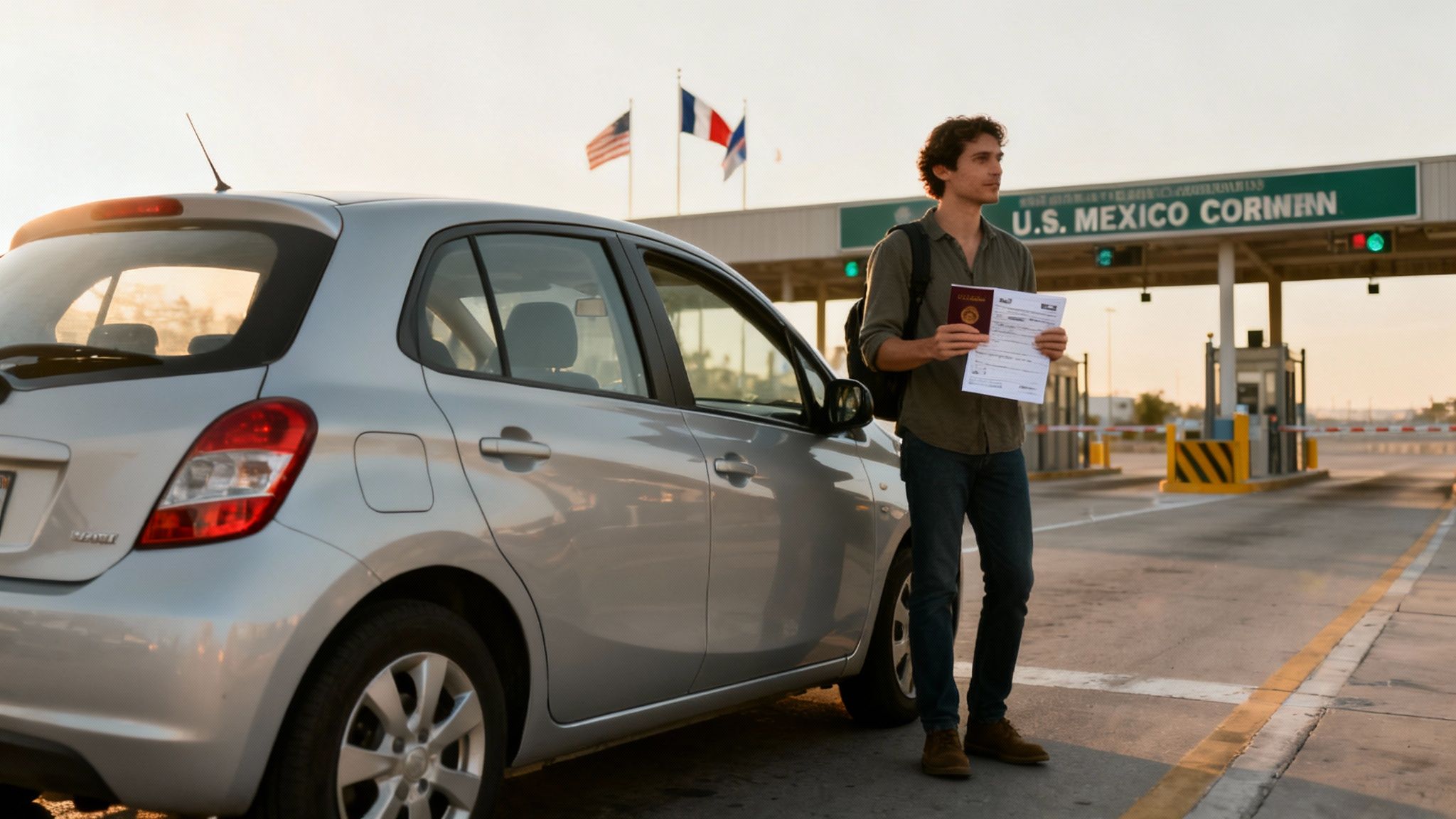
The dream of hitting the open road in Baja or exploring a charming colonial town is totally achievable. But getting there successfully means treating the border crossing with the respect it deserves. It’s a process, not a spontaneous decision.
Think of this guide as your roadmap. We’ll walk through everything you need to know, from getting the thumbs-up from your rental agency to understanding the non-negotiable insurance that keeps you protected on Mexican roads.
The Three Must-Haves for a Legal Trip
I find it helps to think of this like international air travel. You wouldn't just show up at the airport without a ticket or passport, right? The same logic applies here. To drive a rental car into Mexico legally, you absolutely need to have three key things sorted out first.
- Rental Company Permission: This is your boarding pass. Without explicit, written authorization from the company that owns the car, your trip is a non-starter.
- Mexican Auto Insurance: Consider this your visa. Your U.S. auto policy means nothing south of the border; Mexican law requires you to have insurance from a Mexican company. It’s mandatory.
- Vehicle & Entry Permits: These are your passport stamps. Depending on where you’re going and for how long, both you and the vehicle will need official permits issued by the Mexican government.
Getting these three things in order isn't just a suggestion—it's critical. Skip a step, and you could be facing huge problems, from voiding your rental contract to serious legal and financial trouble if you get into an accident. Let’s make sure you avoid any of those headaches.
Before we dive into the details, here's a quick at-a-glance summary of the essentials.
Quick Checklist for Driving a Rental Car to Mexico
This table breaks down the absolute must-haves for a smooth and legal border crossing.
| Requirement | Is It Mandatory? | Key Takeaway |
|---|---|---|
| Rental Company Consent | Yes | Must get written permission specifically allowing the car into Mexico. Not all locations offer this. |
| Mexican Auto Insurance | Yes | U.S. insurance is not valid. You must purchase a separate policy from a Mexican provider. |
| Valid Driver's License | Yes | Your U.S. or Canadian license is typically sufficient for driving in Mexico. |
| Valid Passport & FMM | Yes | A passport is required, and you'll need a Forma Migratoria Múltiple (FMM) for stays over 72 hours. |
| Vehicle Import Permit | Sometimes | A Temporary Vehicle Importation Permit (TIP) is required if you drive outside the "Free Zone." |
Ticking off every item on this list is the foundation of a successful trip. Now, let's explore what each of these requirements means in practice.
Alright, before you even start dreaming about Mexican insurance or border permits, there's a giant, non-negotiable first step: getting the green light from your rental car company.
Trying to sneak a rental car across the border without explicit, written permission is a massive gamble. It's a direct violation of your rental agreement, and if anything happens—theft, an accident, you name it—you'll be on the hook for the entire value of the car. This is the foundational "yes" you absolutely must have before any other planning can even start.

Here's the most important thing to get your head around: not all rental locations are created equal. While the big names like Hertz, Avis, and Enterprise often have policies for Mexico travel, this permission is almost always tied to the specific branch you rent from.
Think of it this way: a rental office in Cleveland, Ohio, has zero reason to deal with the headaches of international vehicle crossings. But an office in San Diego or El Paso? They field these requests every single day. Because of this, you’ll find that permission is pretty much exclusively granted by branches in border states—think California, Arizona, Texas, and New Mexico.
Finding a Location That Plays Ball
So, you have to be strategic when you're booking. Start your search at airport or city locations within a reasonable drive of the U.S.-Mexico border. These are the offices most likely to have cars already prepped and designated for cross-border trips.
For instance, you might get permission renting from Los Angeles International Airport (LAX), but you have a much better shot renting from the San Ysidro branch, which is literally a stone's throw from the Tijuana border. They have a standard, repeatable process for this exact scenario.
A "yes" from the corporate 1-800 number means nothing if the manager at your specific pickup location says "no." You must get confirmation directly from the branch where you'll be getting the keys.
Asking the Right Questions is Everything
When you call or book, you need to be crystal clear. Vague questions will get you vague answers, and that can lead to a trip-ending surprise when you show up at the counter.
Here’s exactly what you need to ask to get the clarity you need:
- "Do you allow your vehicles to be driven into Mexico?" Get a straight yes or no right out of the gate.
- "Will you provide a formal letter of authorization for Mexico travel?" This isn't optional; you'll need this piece of paper at the border.
- "Are there any geographic restrictions on where I can go?" Most policies will limit you to a certain distance from the border (like 250 miles) or to specific states, such as Baja California or Sonora.
- "What are your cross-border fees?" You should expect to pay a daily surcharge or a flat fee for the privilege.
- "What are the rules for Mexican auto insurance?" Some companies will insist you buy their policy. Others will let you bring your own from an approved provider.
- "Are any of your vehicle types off-limits?" They'll almost always say no to luxury cars, premium SUVs, and large passenger vans. Your best bet is usually an economy or standard sedan.
Getting firm, confident answers to these questions is non-negotiable. If the agent sounds unsure or hesitant, don't be afraid to ask for a manager or just call a different branch. A little due diligence now can save you from a complete disaster when you arrive to pick up the car.
Once you’ve got that permission locked in, it's time to tackle the next critical piece of the puzzle: getting the right insurance.
So, you've got the green light from the rental agency. That’s step one. But the next step is arguably the most important of all: getting proper Mexican auto insurance.
Let's be crystal clear: this is not optional. It’s the law. The second your tires touch Mexican soil, your U.S. or Canadian insurance policy is effectively null and void.
Think of it this way: your U.S. policy is a key that only works for your house. In Mexico, you're at a completely different address, and you need a key that fits that lock. Get caught in an accident without a valid, Mexican-issued policy, and you’re facing serious trouble, from heavy fines to potential jail time while they sort out who’s at fault.
Your Two Main Insurance Options
When it comes to getting covered, you really have two ways to go. Each has its own pros and cons, usually trading convenience for cost.
- Buy it Straight from the Rental Agency: This is the easy button. The rental company will have a policy ready for you at the counter. It's fast and simple, but you'll almost certainly pay a premium for that convenience. For example, the rental company might charge $35 per day, while a third-party offers a similar policy for $20 per day.
- Get it From a Third-Party Insurer: This approach takes a little more legwork, but it can save you a good chunk of change and often gets you much better coverage. There are reputable companies that specialize in exactly this kind of cross-border insurance.
A crucial heads-up: some rental agencies insist you buy their specific insurance package. They won't accept an outside policy, period. You absolutely have to confirm this when you book, otherwise you could end up paying for insurance twice.
What to Look for in a Mexican Insurance Policy
Not all insurance is created equal. Whether you buy at the rental desk or from a third party, you need a policy that’s built for real-world problems, not just one that checks a legal box. A rock-bottom-priced policy might keep you technically legal but could leave you on the hook for a fortune if things go sideways.
Here's your checklist for a solid policy:
- Sufficient Liability Coverage: This is for any damage you might cause to other people or their property. You should be looking for a minimum of $300,000 USD in third-party liability. Don't cheap out here.
- Legal Aid and Bail Bond: This is non-negotiable. If you're in a serious accident, this coverage is what pays for a lawyer and helps get you out of jail while the incident is investigated.
- Physical Damage and Theft: This covers the rental car itself. Make sure the coverage limit is high enough to cover the vehicle's full value.
- Roadside Assistance: Your U.S. rental company's roadside help stops at the border. A good Mexican policy will include assistance for things like flat tires, dead batteries, or towing.
Mexico's vehicle rental sector is booming, with a projected 10% expansion and over 330,000 new car registrations in just the first quarter of the year. This explosion in rental car use for both tourism and business makes having the right insurance more critical than ever. You can dig into Mexico's evolving rental market trends to see what this growth means for travelers like you.
Alright, you've got your rental agreement and that all-important Mexican insurance policy. Now for the final piece of the puzzle: actually crossing the border. It sounds more dramatic than it is, but there are a couple of key rules you absolutely need to know, especially depending on how far south you plan to go.
The first thing to wrap your head around is Mexico's "Free Zone," sometimes called the "Border Zone." Think of it as a welcome mat. It’s a strip of land that runs along the U.S. border, typically about 12 to 16 miles (20-26 kilometers) deep. If you're just popping over for a day trip to Tijuana or Nogales and staying within this area, you're golden—no special vehicle permit needed.
When a Temporary Vehicle Importation Permit Is Required
The moment you decide to venture beyond that welcome mat, things change. To drive deeper into Mexico, you’ll need a Temporary Vehicle Importation Permit (TIP). The "Free Zone" is for casual visits; the TIP is your official passport for the car to explore the rest of the country. Trust me, trying to drive further south without one is a recipe for a serious headache.
So what is a TIP? It’s simply an official permit that lets your foreign-plated rental car legally travel throughout Mexico for a specific timeframe. It's the government's way of keeping track of vehicles to make sure they don't overstay their welcome.
You'll get your TIP at a Banjercito, which is the official government bank you'll find at every major border crossing. The process is pretty routine.
Just be ready with your paperwork:
- Your valid passport and driver's license.
- The rental agreement you signed with the car company.
- That crucial letter of authorization giving you permission to drive the car into Mexico.
- Proof of your mandatory Mexican auto insurance.
This decision tree lays it out perfectly—getting the right insurance is the first domino to fall before you can even think about a permit.
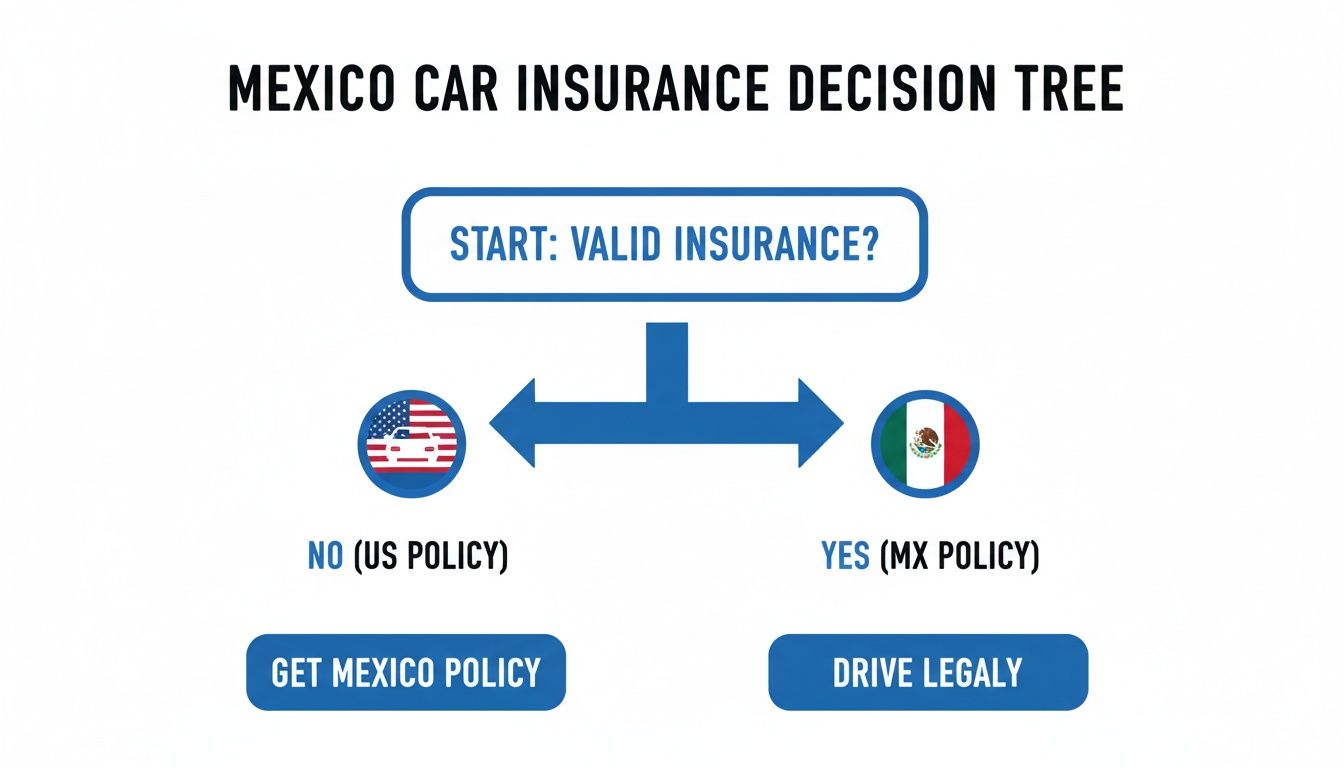
As you can see, without a valid, Mexican-issued policy, the permit process is a non-starter.
The Security Deposit and Why It Matters
Getting the TIP also involves paying a security deposit. The amount changes based on the car's model year, but don't worry—it's fully refundable. The deposit is simply your guarantee to the Mexican government that you'll bring the car back out of the country before the permit expires.
Crucial Tip: This is the part you can't forget. To get that deposit back, you must stop at a Banjercito office on your way out of Mexico to officially cancel the TIP. If you skip this step, you'll lose the entire deposit and could be blacklisted from bringing another car into Mexico down the road.
The whole system is designed to be straightforward because, frankly, tons of people do this. With a 45% market share, economy cars are the most popular rental choice, so they're a common sight on Mexican roads for tourist trips. It's a well-trodden path. If you're curious about the numbers behind this trend, you can dig into more insights on the Mexican car rental market at imarcgroup.com.
Weighing the Risks and Exploring Alternatives
So, you can take a rental car to Mexico, but let's be honest about what you're getting into. Is the convenience really worth the gamble?
Crossing the border without explicit, written permission from your rental company isn't just bending the rules—it's a serious breach of your contract. The moment your tires hit Mexican soil without authorization, your rental agreement might as well be confetti.
This means you are personally on the hook for the full value of the vehicle if it gets stolen or totaled. And that roadside assistance plan you have? Gone. It vanishes the second you cross the border, leaving you stranded if you get a flat tire or the engine gives out.
The Consequences of an Unauthorized Crossing
Ignoring the rules can spiral into a world of financial and legal pain. It's like borrowing a friend's car without asking—if you crash it, the mess is entirely yours to clean up.
- Massive Financial Liability: With no valid contract, you're responsible for 100% of any repair costs or the car's entire replacement value. We're talking tens of thousands of dollars.
- Insurance Becomes Useless: Even if you were smart enough to buy Mexican auto insurance, it could be voided. Why? Because the rental company didn't authorize the trip, meaning you no longer have a legal right to possess the car in Mexico.
- You're on Your Own: Your rental company won't lift a finger to help with towing, repairs, or getting you a replacement vehicle. You're completely isolated south of the border.
The bottom line is simple: a small oversight can turn your dream vacation into a financial nightmare. The convenience of keeping the same car just isn't worth the catastrophic expense and stress if things go sideways.
Practical and Safer Alternatives to Consider
Thankfully, there are much smarter ways to handle this that eliminate all the risk. These options give you the freedom of a car in Mexico without the headache of cross-border rental policies.
One of the most popular strategies is the classic 'Park and Walk' method. For example, you can park your U.S. rental at a secure lot in San Ysidro for about $20-$30 per day, walk across the pedestrian bridge into Tijuana, and pick up a pre-booked Mexican rental car just a few blocks from the border. It’s often simpler and can even save you money.
Another fantastic option is to use a reliable cross-border bus service, like the well-known ADO bus line, to get to your main destination. Once you arrive, you can easily rent a car locally. This works especially well for reaching cities deeper inside Mexico.
Don't worry about finding a car once you're there. Mexico's domestic car rental market is a well-oiled machine, having grown into a $1.4 billion industry that's projected to nearly double by 2032. This growth is fueled by international tourists just like you, so you'll find plenty of reliable, professional options waiting. You can dig into more data on Mexico's booming rental market on coherentmarketinsights.com.
Lingering Questions About Driving a Rental to Mexico
Even after you've got the big picture sorted, a few nagging questions always seem to pop up. Let's tackle the most common ones I hear from travelers, so you can cross the border with total confidence. Think of this as your final sanity check before you hit the road.
Which Rental Companies Will Actually Let Me Drive to Mexico?
This is the big one, and the answer isn't as simple as picking a brand. It almost always comes down to the specific rental office. While major players like Hertz, Avis, Enterprise, and Budget often give the green light, they typically only do so from their locations in border states—think California, Arizona, New Mexico, and Texas.
A rental office in San Diego is likely set up for this, but one in Chicago definitely isn't. You absolutely must call the exact branch where you plan to pick up the car and get explicit, written permission. Never, ever assume a company-wide policy applies to every location.
Can't I Just Grab Mexican Insurance at the Border?
You'll see insurance kiosks on the U.S. side, and while you technically can buy a policy there, it's a risky move for a rental car. Why? Because most rental companies insist you buy their specific Mexican insurance policy or one from a partner they've already approved.
Waiting until you get to the border is a gamble. You could easily buy a policy that your rental agency won't accept, which means you've just wasted money and will have to buy their approved coverage anyway.
Always sort out the insurance when you book the car. If the agency partners with a specific insurer, showing up with a different policy could put you in breach of your rental agreement. Get it all handled upfront to avoid the headache.
What Happens If I Forget to Return My Temporary Vehicle Import Permit (TIP)?
This is a mistake you don't want to make. Forgetting to cancel your TIP at a Banjercito office before you leave Mexico is a huge deal in the eyes of the government. They see it as if the car was illegally left in the country, and the penalties are no joke.
First off, you'll lose the entire security deposit you paid for the permit, which can be hundreds of dollars down the drain. Worse, the car's VIN gets flagged, which can prevent that specific car—and possibly you—from re-entering Mexico until the mess is sorted out. This creates a massive problem for the rental company, and you can bet they'll be sending you the bill for all the fines and administrative costs.
Is It Just Cheaper to Rent a Car in Mexico Instead?
Honestly? A lot of the time, yes. It adds an extra logistical step, but renting directly from an agency in Mexico is often simpler and easier on the wallet. The daily rates can be quite competitive, and you get to sidestep all the cross-border fees and paperwork required by U.S. companies.
Let's break it down:
- Option A (U.S. Rental): You're paying the U.S. daily rate, plus a cross-border fee (maybe $25/day), plus the mandatory Mexican insurance policy they sell you.
- Option B (Mexican Rental): You park your car or take a shuttle across the border, then rent from a local spot like Europcar or a regional brand. Everything is self-contained. The insurance is bundled right in, and there are no extra U.S. fees to worry about.
This "park and walk" approach is a popular workaround for a reason. It cuts through the red tape and is often the more affordable route, ensuring you're 100% compliant with local rules from the get-go.
Ready to plan your next adventure with exclusive savings? Approved Experiences Traveler offers members up to 50% off car rentals and wholesale pricing on over one million hotels worldwide. Unlock luxury travel benefits and make your trip to Mexico—or anywhere else—more affordable. Start saving today at https://www.approvedexperiences.com.
Want the wider view?
Ten categories. One report. Every quarter. The Approved List tracks what's rising and what's fading: data-backed signals, not opinions.
Free to join · Delivered by email