
All Articles
The Journal
Cruise Ship Itinerary Changes and Refund Rules
October 28, 202615 min readcruise refundsmissed port
Cruise ship itinerary changes explained: which refunds are automatic, which are goodwill, and the steps to rebook ports, flights, and hotels.
The usual advice about cruise ship itinerary changes is to complain until the cruise line offers compensation. That starts with the wrong question. Before arguing about a missing island, find out what changed, why it changed, and which costs you can recover.
A family organizer has more at stake than a disappointing beach day. Private tours, flights, hotels, and relatives' separate bookings can all be affected. The useful response is to separate refundable charges from goodwill offers, protect cancellation windows, and compare workable alternatives before anyone abandons a booking.
Why Ships Skip or Swap a Port
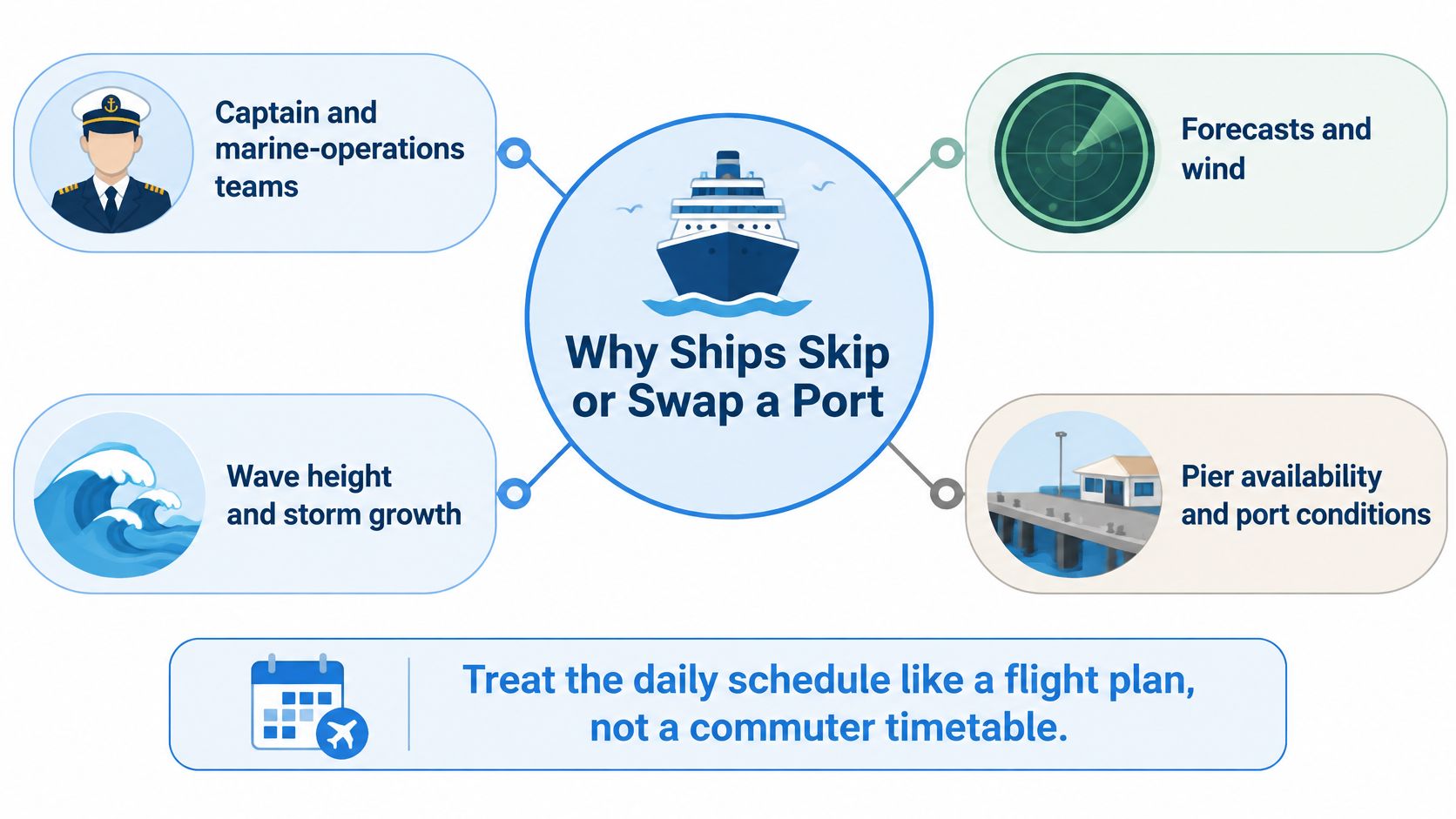
Treat the daily schedule like a flight plan, not a commuter timetable. The captain plans a route within operating limits, then adjusts it when conditions make the original plan unsafe or impractical.
As The Independent's cruise operations explainer describes, captains and shoreside marine-operations teams assess forecasts, wind, wave height, storm development, port access, and tendering conditions before changing a call. A ship can be safe at sea while conditions make approaching a pier or transferring passengers into small tender boats unacceptable.
The main checks are connected, rather than separate reasons to accept or reject a port.
What passengers can influence
High wind can stop docking even when passengers barely notice movement onboard. Swell can make tender boarding unsafe while the ship remains offshore, with the destination plainly visible. Seeing the beach isn't evidence that the captain can safely land passengers.
Port access also runs on a berth clock. If a vessel occupies its berth beyond its allotted window, the next ship may have to change its sequence or miss the call.
What forces a cruise itinerary change
| Driver | Who decides | Typical effect | Passenger leverage |
|---|---|---|---|
| Wind, waves, storm, unsafe tender | Captain and marine operations | Skip, substitute, reorder, or retime a call | Very low on the day |
| Berth congestion or a missed window | Port plus the line | Another ship alters sequence or skips the call | Very low |
| Regional security closure | Line after security and government advice | Several brands reroute; sea days replace ports | Medium only if a route choice is offered |
| Mechanical failure | Cruise line | Cancel, shorten, or substitute a ship | Higher when the cause is mechanical |
| Strike, labor stoppage, medical, or regulatory halt | Cruise line under the contract | Cancel, postpone, or deviate, sometimes without prior notice | Contract remedies only |
“Leverage” here means influence over your booking or remedy, not authority over the captain's decision. A mechanical problem may strengthen a refund request without giving passengers any say in whether the ship sails.
Separate immediate decisions from structural changes
Weather and port-authority closures leave little room for negotiation that day. Medical diversions require an immediate operational response. A seasonal redeployment is different: shoreside teams may redesign the route well before departure, leaving time to evaluate another sailing.
Ask for the stated cause rather than guessing from the replacement port. That explanation will matter when you classify the disruption.
Practical rule: Don't attach a nonrefundable private tour to the arrival morning at a tender port. Choose a provider whose written policy addresses a ship that can't land passengers.
Network Reroutes Not Single Port Swaps
Say your family books a voyage because it strings together ports along one maritime corridor, such as a Suez Canal transit linking the Mediterranean with Asia. A published itinerary works like an operating envelope, a range of routes the ship can lawfully and safely run, rather than a guarantee that every named call will happen. When the corridor itself closes, the line cannot swap in a nearby beach. It may have to move the ship around a continent.
The Red Sea disruption shows the gap between a local substitution and a full network redesign.
When an entire corridor becomes unsuitable
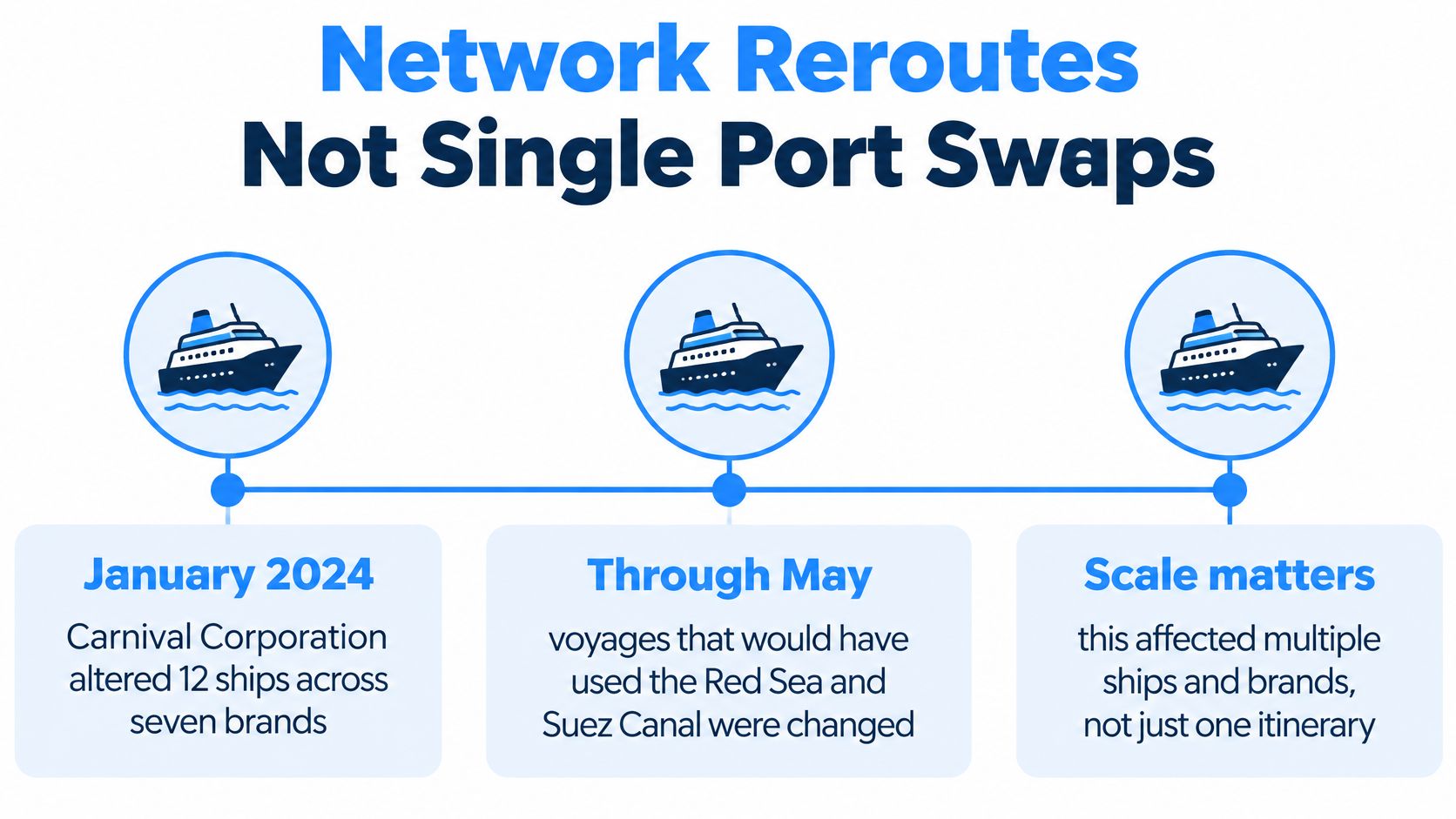
In January 2024, Carnival Corporation announced itinerary alterations for 12 ships across seven brands, rerouting Red Sea and Suez Canal voyages around Africa's Cape of Good Hope and adding approximately 7–10 days to the affected sailings, according to Cruise Arabia's account of the rerouting. The company said it acted after consultations with security specialists and government authorities.
Read that scale carefully. One skipped port is a pothole in the road. A closed corridor tears up the map itself. Planned Red Sea and Mediterranean calls gave way to long open-ocean passages and substitute stops in Africa or the Atlantic, and the change landed on several brands at once rather than on a single departure.
For a family organizer, the stakes run past a different excursion menu. Extra days at sea can collide with school calendars, return flights, medication supplies, and arrangements waiting at home, while a replacement region may no longer deliver the reason you booked.
A different map can keep the same end date
Reroutes come in two shapes. Some stretch the calendar: the ship adds days, arrival dates slide, and the voyage ends later than the ticket showed. Others hold the calendar steady and replace the middle. World-cruise sailings that had planned to pass through the Suez Canal in 2024 were sent around Africa instead, and some passengers were offered a choice of alternative routings while the original final date stayed in place.
That distinction drives every decision that follows. An unchanged end date does not mean an unchanged holiday. A longer voyage and a redrawn one create different problems for flights, hotels, and the people expecting you back on a particular day.
Before accepting a revised sailing, ask the line:
- Route: Does the voyage still cross the corridor shown in the original itinerary?
- Duration: Are embarkation, disembarkation, or intermediate arrival dates changing?
- Experience: Which destinations become sea days, and which replacement ports are confirmed?
- Choice: Can you select another route, transfer the booking, or decline under the applicable terms?
Get those answers in writing before you price replacement flights. A new map and a new travel calendar are different problems.
Refunds and Credits by Type of Change
Start by naming the event, not the emotion. A skipped port, a swapped berth, a canceled sailing, and an early return sit in different refund buckets, and the published itinerary works more like an operating envelope than a promise that every listed call will happen.
What travelers can recover by disruption type
| Disruption | Typical remedy | Automatic or goodwill | What to keep |
|---|---|---|---|
| Missed port, cruise continues | Port taxes and fees for the skipped call; cruise-line excursion refund; outside tours under that operator's policy | Port charges and line excursions generally automatic; outside tours aren't | Change notice, folio, excursion receipt |
| Weather, swell, or berth substitution | Onboard credit, partial refund, future-cruise credit, or no fare refund | Usually goodwill unless the contract says otherwise | Stated cause and old versus new ports |
| Security reroute that adds sea days or drops a region | Revised duration and ports; compensation isn't guaranteed | Line by line, often goodwill | Original and revised daily itineraries |
| Mechanical failure cancels the voyage | Full refund when the contract or applicable passenger-rights guidance treats mechanical failure as a covered cancellation | Contract or guidance category; confirm the trigger | Cancellation notice naming mechanical failure |
| Mechanical failure ends the voyage early | Partial refund for unused days when covered by the contract or applicable guidance | Contract or guidance category; confirm the calculation | Early end date and unused days |
| Canceled cruise or delay beyond the contractual calendar-day threshold, passenger rejects alternative | American Cruise Lines refunds fare and related accommodation, service, facility, port-fee, tax, and ancillary charges paid to the line | Contract-specific, not every line | Calendar-day count and written decline |
| Cruise terminates early under a pro-rata clause | Per-day fare refund less applicable fees, as in the American Cruise Lines contract | Contract-specific | Days sailed and fee schedule |
Label your notice against a row before asking for compensation. A removed port, a canceled voyage, and an early termination aren't interchangeable events.
Separate returned charges from compensation
Cruise Critic's guide to itinerary changes distinguishes generally refundable port taxes and fees and typically refunded line-sold excursions from discretionary offers such as onboard credit, partial fare refunds, future-cruise credit, or penalty-free rebooking. Independent tours remain subject to their own cancellation terms.
Think of the first bucket as money coming back because a service was not used, and the second as an offer the line chooses to make. “Generally automatic” still deserves a check. Match each credit to the original charge, confirm which passengers it covers, and ask whether it returns to the payment card or appears on the onboard account.
A future-cruise credit isn't cash. Before accepting it as a solution to family losses, check its expiration, eligible sailings, named-passenger restrictions, and whether using it requires another deposit.
Mechanical failure is a separate category
Industry passenger-rights guidance commonly addresses refunds after mechanical failure, with a canceled voyage and an early end treated differently from a routine missed call. The exact amount, timing, and definition still live in the ticket contract, so confirm the provision that applies to your sailing.
Preserve the notice naming mechanical failure, and ask the line to identify the applicable provision in writing. That request keeps the conversation anchored to the event that occurred.
A family example
Suppose a family's Caribbean sailing drops an island call. Its line-booked catamaran excursion is typically refunded, while its independently booked snorkeling trip follows the outside operator's policy. If that policy allows cancellation when a ship misses port, send the notice promptly rather than assuming the cruise line will contact the operator.
Keep a refund ledger showing the payer, booking reference, requested amount, promised processing date, and actual receipt. If an approved payment hasn't arrived, Compass+ explains how to follow up on missing refunds without losing the correspondence trail.
What the Ticket Actually Promises
“Any other reason” is broader than many passengers expect. Royal Caribbean's published itinerary-change terms say strikes, riots, weather, mechanical difficulties, or any other reason may permit cancellation, postponement, advancement, or deviation from a sailing or port call, substitution of another ship or port, and avoidance of refund or compensation obligations.
That's permission to alter the operating plan, not a promise that every advertised stop will happen. A published itinerary works like a flight schedule printed before the season starts: it describes the intended route, and the carrier reserves room to change it. It also doesn't settle every possible dispute, since mandatory consumer protections and specific contractual remedies can still matter.
A regulator isn't the usual referee
The U.S. Federal Maritime Commission does not regulate ordinary cruise customer-service issues such as itinerary changes, passenger cancellations, denied boarding, or cabin concerns. A routine missed beach call is therefore usually a contract conversation with the line, not an appeal an agency will decide for you.
The terms that govern that conversation sit in your own booking paperwork. Pull up cruise contractual terms such as Norwegian Cruise Line's and read the version attached to your reservation rather than relying on a general FAQ.
Limited agency involvement doesn't mean no options. You can request a written decision, use the line's formal complaint process, consult your insurer about covered losses, or seek jurisdiction-specific consumer advice when the amount warrants it.
A port call is an intention inside an operating envelope. Your financial rights come from the applicable contract and law, not from how prominent the port looked in the brochure.
Highlight the operative provisions
Read the ticket attached to your booking, including the terms applicable to its market of sale. A foreign-market FAQ or another passenger's contract may govern a different product entirely.
Find these provisions before final payment:
- Deviation authority: What can the line change, and what notice does it promise?
- Delay and termination remedies: Does the contract define a qualifying delay or an early-end calculation?
- Refundable charges: How does it treat unused government fees, excursions, and ancillary purchases?
- Cancellation deadlines: When do penalties increase, and are deposits transferable or refundable?
Each row answers a different question. Deviation authority tells you what the line may do; the remedies rows tell you what you may claim when it does.
Photograph or download the relevant pages and retain the version supplied with your booking. A current website can change after you buy, and the language in force on your purchase date is the language that counts.
If your main reason for sailing is a particular destination, make that preference part of the booking decision. A cruise may still be the right format, but a land stay gives you a different level of control over being in that destination. Stop adding nonrefundable cars, hotels, or guides that work only if the ship uses a particular pier.
Turn a Change Notice Into Claims
Work from the notice outward. Don't begin by changing everyone's flights, because the cost of reversing a rushed decision may exceed the original loss.
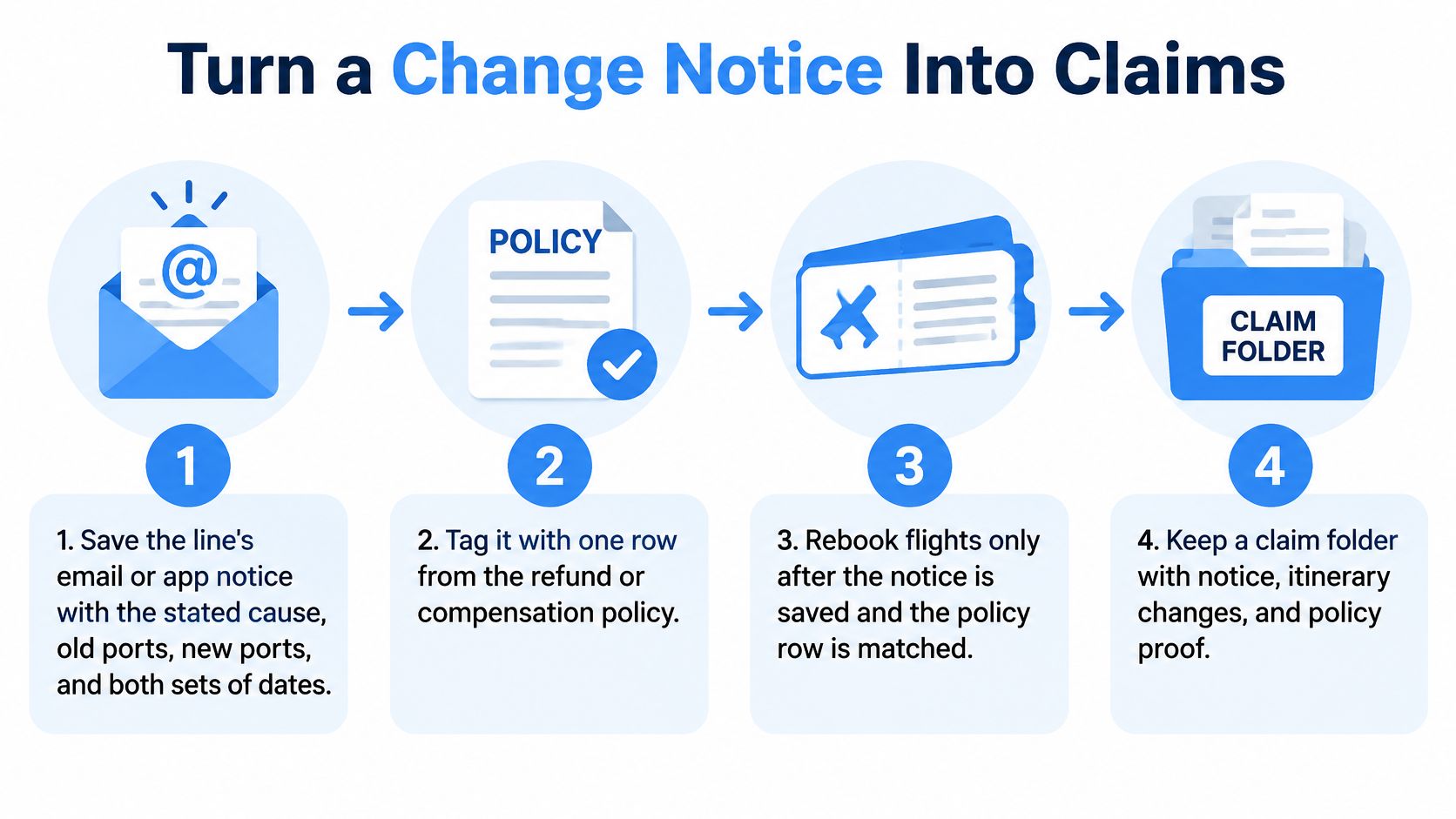
The workflow below keeps evidence, remedy selection, and replacement travel in a useful order.
Follow the notice before moving the bookings
-
Save the evidence. Download the email or app notice, original itinerary, revised itinerary, and booking confirmation. Capture the stated cause and dates before an app replaces the old schedule.
-
Match the notice to the appropriate remedy row. If it doesn't say whether the change is weather-related, mechanical, or commercial, ask the line or booking agent for clarification in writing. Don't select the strongest-sounding category yourself.
-
Contact the booking channel first for cruise remedies. Ask the line, or the agent managing the reservation, to itemize the port-charge and line-excursion refunds associated with the missed-port row. Obtain a case reference and expected processing date.
-
Contact independent tour operators immediately after that initial request, or sooner if their cancellation deadline is imminent. Send the revised itinerary and ask for cancellation, rescheduling, or a written refusal under their policy. This is the outside-tour portion of the missed-port row.
-
Use the mechanical rows only when supported. If the notice identifies mechanical failure and cancellation or early termination, request the corresponding remedy and retain repair updates. Ask how unused services will appear in the refund calculation.
-
Measure a qualifying delay using the contract's unit. Under American Cruise Lines' passenger contract, cancellation or a delay exceeding three calendar days permits passengers who reject an alternative or choose not to travel to request cruise fare and related charges paid to the line; an early termination carries a per-day pro-rata fare refund less applicable fees and charges. Hypothetically, a four-calendar-day delay clears that threshold, but a hotel booked independently isn't automatically part of the line-paid charges.
-
Call the insurer before creating avoidable losses. Ask which policy provision might apply, what documentation it requires, and whether authorization is needed before buying replacement travel. Use this guide to travel cancellation insurance to distinguish cancellation protection from other disruption benefits; a changed itinerary alone doesn't establish coverage.
-
Confirm the final embarkation and disembarkation arrangements before calling airlines and hotels to reprice. For the group, list every nonrefundable air, villa, and activity balance before a relative cancels anything. Tag each cost as keep, refund from line, claim on insurance, or absorb.
Close each request separately
Keep written refusals as carefully as approvals. A refusal identifies what remains disputed and gives an insurer or adviser something concrete to assess.
Don't close the file when the cruise line announces an overall credit. Close each entry only when the correct household receives its money or knowingly accepts the substitute remedy.
Protect Flights Hotels and Group Plans
Build slack around the ship rather than confidence around the advertised pier list. A flexible land plan can absorb an altered arrival; a tightly linked chain of prepaid arrangements cannot.
Avoid a same-day flight after disembarkation when your family can't absorb a missed departure. A flexible overnight stay in the return city gives you more room to handle a late arrival, mobility needs, and the slower transfers that often accompany a multigenerational group.
Buy flexibility where the exposure is largest
Read the rate rules before choosing the hotel. This hotel cancellation policy guide can help you distinguish a flexible booking from a rate that merely allows changes for an added cost.
For flights, compare the actual change terms, fare difference, and credit restrictions. “Changeable” doesn't mean moving the flight will be free.
- Outbound travel: Arrive with enough margin to handle a disrupted flight without relying on the ship waiting.
- Shore activities: Prefer written missed-port protection over a provider's informal assurance that it understands cruises.
- Transfers: Check whether a driver can serve an alternative terminal or arrival time.
- Group lodging: Identify who holds the reservation and whether partial cancellation changes the whole property's price.
Use seasonal exposure as a planning input
According to Cruise Critic's Hurricane Melissa coverage, nearly all cruise lines operating near Jamaica, the Virgin Islands, or the Bahamas during October 24–31, 2025 rerouted ships or adjusted port orders. That's a historical example of widespread disruption, not a forecast for a future sailing.
Before final payment, examine the route's storm exposure and strategic corridors alongside the cancellation terms. The question isn't whether trouble is certain; it's whether your surrounding bookings can survive a change.
Group planning test: Would the reunion still work if the marquee port disappeared and the family spent more time at sea?
Suppose grandparents booked a private guide, siblings reserved a villa after disembarkation, and another household arranged a domestic connection. Put those commitments in a shared folder with receipts, insurance wording, cancellation deadlines, and replacement quotes. Assign a named owner to each booking so nobody assumes someone else has canceled it.
Replace a Broken Itinerary With Live Inventory
Keep the altered sailing when it still serves the family's purpose and the remaining costs are manageable. Consider moving when the central region disappears, revised timing breaks essential connections, or the booking can still be unwound on acceptable terms.
Don't let a goodwill credit decide the holiday by itself. A credit can reduce the cost of staying without making the new route suitable.
Keep or move test for an altered sailing
| Test | Keep the altered sailing | Move to other inventory |
|---|---|---|
| Marquee region still on route | Yes, or the change is minor | No, the region is gone |
| Added sea days break flights | No, flights still work | Yes, several households affected |
| Final payment locked | Yes, substantial nonrefundable commitments remain | No, deposit is still movable under its terms |
| Line refund covers land costs | Yes, usable compensation offsets the losses | No, costs exceed what the line offers |
Compare the whole replacement trip
Suppose a family's revised Caribbean route no longer includes the destinations that brought everyone together. Compare keeping it with alternative sailings across other lines, using the same travel window and room requirements.
Include the total cost of moving: lost deposits, new airfares, cabin availability, accessibility needs, hotel changes, and transfers. Check whether an apparent replacement has enough suitable cabins before anyone cancels the existing reservation.
Use a comparison sheet with a column for each option and a named owner for confirming availability. This cruise vacation planning guide provides a useful basis for checking the replacement as a complete trip rather than an isolated cabin purchase.
- Confirm inventory: Price cabins the group can book, not a headline fare without suitable occupancy.
- Check connections: Match flight times and ground arrangements to the revised ports.
- Protect the transition: Get deposit, cancellation, and hold terms in writing before releasing the original booking.
The strongest response to a broken itinerary isn't necessarily winning an argument about the missing call. It's choosing a workable holiday without stranding more money in the process.
Approved Experiences Traveler offers consolidated access to cruise, air, hotel, and activity inventory so you can compare a replacement sailing with its connecting arrangements. Visit Approved Experiences Traveler to evaluate alternatives together before committing your family to a revised trip.
Want the wider view?
Ten categories. One report. Every quarter. The Approved List tracks what's rising and what's fading: data-backed signals, not opinions.
Free to join · Delivered by email