
All Articles
The Journal
Culinary Travel Experiences: A Practical Planning Guide
September 19, 202615 min readfood tourism planningwholesale travel membership
Plan unforgettable culinary travel experiences with practical guidance on itineraries, group logistics, and using membership infrastructure
Your family group chat is already off the rails. One person wants the famous trattoria. Someone else found a vineyard an hour away. Your parents need a slower pace. The kids will melt down if lunch lands at 2:30. And if you get the lodging wrong, the whole thing turns into a string of expensive taxis and rushed meals.
That's shape of culinary travel experiences. They aren't restaurant lists. They're operating plans.
I've booked enough food-focused trips to say this plainly: the travelers who enjoy them most are the ones who treat food as the organizing axis of the trip. Not decoration. Not one splurge dinner dropped into a sightseeing week. If the point of the trip is olive oil, pasta, market culture, mezcal, seafood, or harvest season, then your transport, lodging, pacing, and booking windows all need to follow that logic.
What Culinary Travel Experiences Actually Mean
A lot of travelers say they want a food trip when they really mean they want better dinner reservations. That's not the same thing.
Culinary travel experiences are trips built around ingredients, dishes, production methods, regional traditions, and access. The trip might be one day long or two months long. What makes it culinary travel is that food determines the structure.
Food as the trip framework
Take a family planning a week in Tuscany. If they book a hotel in Florence and then casually try to “fit in” wineries, a cooking class, a market visit, and a cheese producer, they usually waste time in transit and miss the best slots. If they build the week around those experiences first, the trip works. They stay where kitchen access matters, rent the right vehicle, leave room for market mornings, and keep evenings lighter.
That's the difference between food tourism and a real culinary itinerary.
A generic food tourist adds a famous restaurant to a city break. A culinary traveler builds the route around what has to be booked, what only happens on certain days, and what becomes more meaningful when paired together. A Palermo market crawl followed by a hands-on class works. A rushed reservation across town after a full museum day often doesn't.
For travelers who want deeper local context, cultural immersion travel often overlaps with the strongest culinary itineraries because markets, kitchens, and farms reveal more than staged sightseeing ever will.
What counts and what doesn't
A proper culinary trip can include:
- Short-format trips: A one-day market tour with a local guide and a class built around what you bought that morning.
- Regional circuits: Moving through Emilia-Romagna for balsamic vinegar, Parmigiano Reggiano, prosciutto, and pasta workshops.
- Long stays: Renting an apartment in Oaxaca for several weeks and building a routine around markets, producers, and neighborhood cooking.
Practical rule: If food changes where you sleep, how you move, what you pre-book, and how you spend, you're planning a culinary travel experience.
The best versions are never overpacked. They're sequenced. That's what most guides miss.
Why Food Has Become a Primary Travel Driver
Food now drives travel in a way it didn't a generation ago. That shift isn't hype. It has cultural backing, budget backing, and market backing.
UNESCO helped legitimize the category when it created the Representative List of the Intangible Cultural Heritage of Humanity in 2003, then added the Mediterranean diet in 2010 and recognized the art of Neapolitan pizza making in 2016. Those milestones matter because they framed food practices as heritage worth traveling for, not just consuming.
At the same time, the market stopped behaving like this was a niche. One estimate places the culinary tourism market at USD 61.90 billion in 2026, up from USD 58.95 billion in 2025, with a projection to USD 86.66 billion by 2031 at a 6.96% CAGR, while another estimate puts the broader food tourism market at USD 1,630.0 billion in 2025, projected to reach USD 6,890.5 billion by 2034, with Asia-Pacific identified as a dominant or fastest-growing region in multiple estimates, including 32.5% of global revenue in one report and above 43.1% in 2025 in another, according to Mordor Intelligence's culinary tourism market analysis.
Cultural recognition changed booking behavior
Once food gets recognized as cultural infrastructure, travelers stop treating it like filler. They start choosing destinations because of it.
That behavior shows up clearly in traveler preference data. In the World Food Travel Association annual industry report, travelers rank food and beverage at an average of 8.2 out of 10 in destination selection, 66% say food matters more to their travel choices than five years earlier, tourists allocate about 25% of their total travel budget to food and beverages, and 64% prefer unique local experiences over traditional fine dining.
The planning consequence
If food is the reason for the trip, you can't plan it loosely.
| Signal | Year | Impact on Trip Planning |
|---|---|---|
| UNESCO creates the Intangible Cultural Heritage list | 2003 | Food traditions become legitimate trip anchors, not side entertainment |
| Mediterranean diet added to UNESCO heritage framework | 2010 | Regional food practice gains destination value across multiple countries |
| Art of Neapolitan pizza making recognized by UNESCO | 2016 | Specific techniques and local food craft become bookable cultural drawcards |
| Culinary tourism market estimated at USD 61.90 billion | 2026 estimate | Operators can justify dedicated inventory, not just ad hoc restaurant bookings |
| Broader food tourism market estimated at USD 1,630.0 billion | 2025 estimate | Food-led travel is large enough to shape lodging, routing, and packaging decisions |
When food drives the booking, flights and hotels become support systems. The reservation at the producer, market, or workshop becomes the real anchor.
That changes everything operationally. You need longer dwell times, earlier reservations, and tighter coordination across the group.
The Main Formats of Culinary Travel Experiences
Not every food trip should look the same. The format has to match trip length, group size, energy level, and how much work the travelers want to do.
Formats that work for short stays
If you only have a few days, keep it tight.
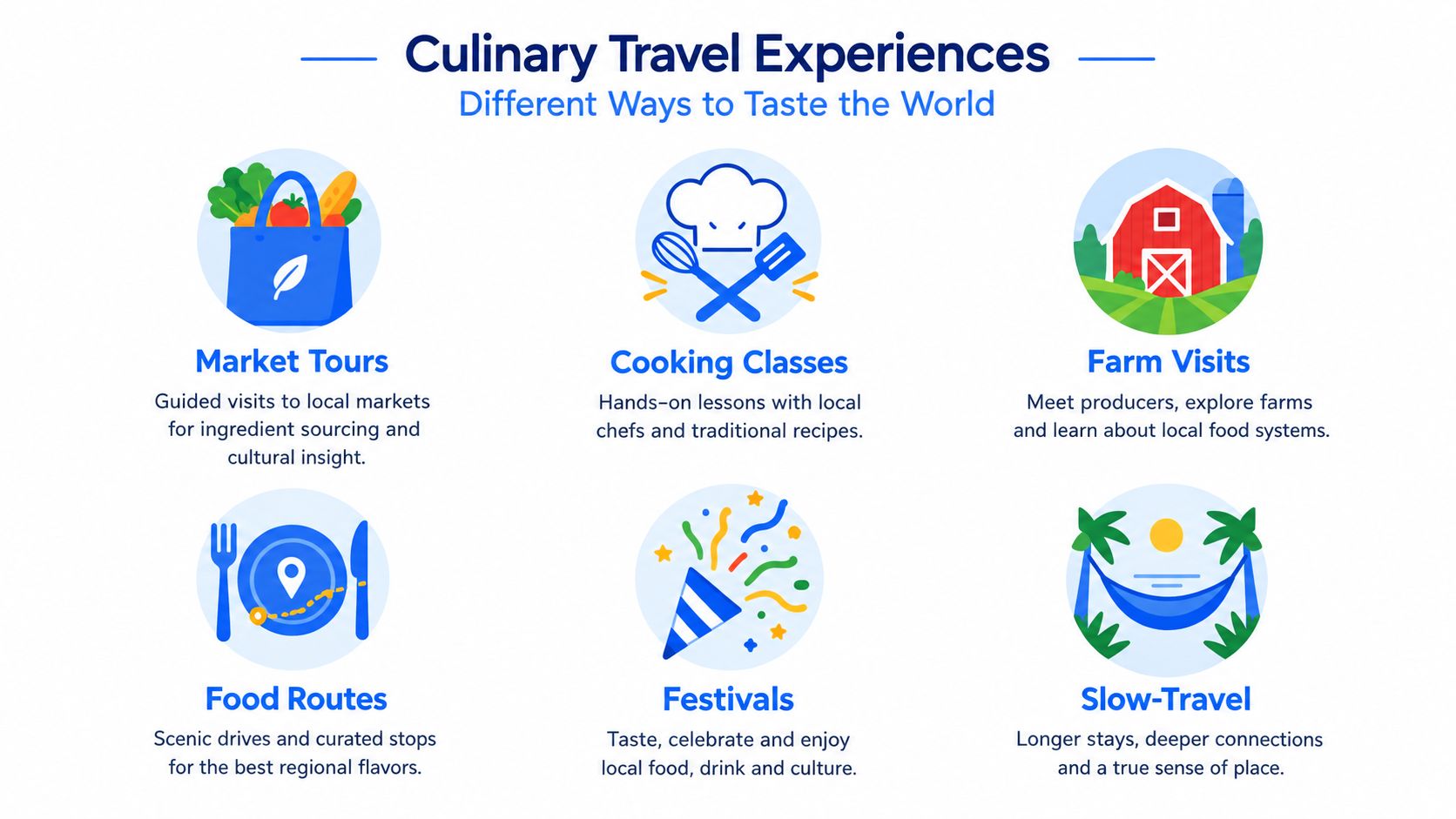
- Guided market tours: Best for city breaks and cruise port days. You get context fast, eat well, and avoid wasting hours deciding where to go. The trade-off is shallow depth.
- Hands-on cooking classes: These work well for families and mixed-age groups because everyone participates. They also solve the “what do we do together” problem better than another tasting menu.
- Festival add-ons: Useful if the trip already exists and you want one concentrated food event layered onto it. Timing is rigid, and crowds are the obvious downside.
A traveler doing a quick stop in Barcelona, for example, will usually get more from a market-led half day than from chasing three separate reservations. If you're building a city itinerary around neighborhood pacing, these kinds of Barcelona city tours pair especially well with food routes.
Formats that reward slower travel
Longer trips create better culinary outcomes. That's just true.
- Producer and farm visits: Better for travelers with patience. Cheese makers, olive mills, fisheries, and vineyards often sit outside urban cores, so transport matters.
- Regional food routes: Strong for repeat travelers, drivers, and anyone doing a week or more in one region. You can connect products to terrain instead of tasting everything in one blur.
- Slow-travel residencies: Best for remote workers, retirees, and families staying put long enough to shop, cook, revisit, and learn.
If you're building your own wine-focused travel rhythm, joining a resource like Sonoma wine club for enthusiasts can be useful before the trip because it sharpens your palate and helps you book vineyard days with more intention instead of treating every tasting room as interchangeable.
Match the format to the traveler
Recent industry coverage notes that nearly 80% of travelers rate food as important or very important when choosing a destination, while practical demand is moving toward cooking classes, market tours, foraging walks, and producer visits rather than just restaurant coverage, according to Hotel News Resource's summary of culinary travel demand. I agree with that shift. Restaurant lists are the laziest part of most planning.
Use this filter:
- Limited time: book a market tour or class.
- Family group: choose a class with a meal built in.
- Long stay: build around producers and self-catered meals.
- Luxury add-on: reserve private access, not just premium seating.
The best format is the one your group can sustain without rushing.
Which Traveler Profiles Get the Most from Food-Focused Trips
The same destination behaves differently depending on who's traveling. Oaxaca for a couple on a long stay is one trip. Oaxaca for grandparents, teenagers, and in-laws is another operation entirely.
Seven profiles, seven very different needs
For multi-generational families, food works because it gives everyone a shared task. A cooking class is usually better than a hard-to-hear chef's counter. The pain point is pace. Kids, older relatives, and opinionated adults don't move at the same speed.
That profile is already mainstream. Hilton's 2026 trends research says 48% of surveyed team members are seeing more families traveling with three or more generations, and in Australia 33% of families take holidays with three or more generations at least once a year, according to Hilton's generation travel trends. Food planning for these groups needs interconnecting rooms, larger homes, and meals that don't require everyone to perform perfect restaurant behavior for three hours.
For snowbirds, the culinary win is routine. They get the market vendor they trust, the bakery they revisit, the weekly class they stick with. Their issue isn't inspiration. It's housing and staying long enough to settle into a region's rhythm.
For timeshare owners, the smart play is using the kitchen. Buy from local markets, book fewer but better restaurant meals, and make lunch the flexible meal. Legacy exchange systems create friction, too. A 2026 guide states RCI Weeks membership costs $99 per year, RCI Points membership costs $124 per year, and each exchange transaction adds a $289 exchange fee, while another comparison places standard exchange pricing for major networks in the roughly $209–$269 range, as outlined in Go Koala's RCI and exchange fee breakdown.
Comparison at a glance
| Profile | Primary Culinary Goal | Best-Fit Format | Key Pain Point |
|---|---|---|---|
| Multi-gen families | Shared activity everyone can enjoy | Cooking classes and market lunches | Pace mismatch across ages |
| Snowbirds | Build seasonal food routine | Slow-travel residency | Long-stay housing and kitchen quality |
| Timeshare owners | Stretch value through local cooking | Regional routes with self-catering | Exchange friction and fixed inventory |
| Remote workers | Blend work hours with food learning | Producer visits and neighborhood classes | Reliable workspace plus location |
| Frequent travelers | Add depth without extending trip too much | Guided market tours | Time compression |
| High-net-worth households | Secure access and privacy | Private tastings and after-hours visits | Coordination complexity |
| Cruise enthusiasts | Maximize short port windows | Fast, guided tasting sprints | Limited time ashore |
Where the setup changes the outcome
For remote workers, the ideal plan is a month-long base with good Wi-Fi, a real kitchen, and classes scheduled around meetings. They shouldn't overbook daytime excursions. Their best culinary trips feel local by week two, not theatrical on day one.
For frequent travelers, food works as a layer. One market tour, one producer visit, one serious meal. That's enough. They don't need a full culinary residency every time they fly.
For high-net-worth households, privacy and sequencing matter more than price. They tend to do better with private driver support, after-hours access, and properties that let the kitchen become part of the trip. Public luxury can still feel inconvenient.
For cruise enthusiasts, speed matters. Travel Market Report notes that almost 9 in 10 advisors in the U.S. and Canada have sold multi-generation trips, while one survey found 43% of grandparents usually paid and a later survey found 50% pay and 54% plan and organize these trips, according to Travel Market Report's coverage of grandparents driving family travel. In practice, that means the planner isn't always the eater. Port-day food plans have to be clear, fast, and pre-coordinated.
A good food trip fits the travelers you actually have. Not the fantasy version who'll happily spend six hours moving between tastings.
Planning and Booking Culinary Travel at Scale
The fastest way to ruin a food trip is to stack too much into each day. You don't need five stops. You need one anchor and enough room around it for the trip to breathe.
Build each day around one anchor
Pick one signature experience per day. A market morning. A cheese producer. A private cooking class. A vineyard lunch. Then shape the rest of the day around transit, appetite, and recovery time.
Use this sequence:
- Lock the anchors first: book the experiences that have limited capacity or fixed timing.
- Add buffer around them: market stops always take longer than you think if people start buying oils, spices, ceramics, or wine.
- Protect evenings: after a class or producer lunch, don't force a formal late dinner unless the group specifically wants it.
- Watch closure patterns: many producers, small shops, and family-run operations don't follow the assumptions travelers make from city restaurant culture.
Choose lodging for the itinerary, not for the photos
Food-led trips need operational lodging. That means kitchen access, parking if you're driving, enough refrigeration for market hauls, and common space where the group can regroup without paying for another round of drinks somewhere.
Vacation-rental research cited in industry coverage found 90% of people rent vacation homes with family, 36% bring children, and nearly half shared their rental with extended family beyond spouse or children. Another industry snapshot reports that multi-generational travel has grown 34% from 2022 to 2024, according to Tripping.com's family vacation rental research summary. That tracks with what works on these trips. Bigger groups do better in villas, condos, or adjacent apartments than in scattered hotel rooms.
If you're coordinating the moving parts for several households, a dedicated group travel planning platform helps because food trips create more shared decisions than standard vacations.
A sample seven-day Emilia-Romagna rhythm
Here's a practical structure that works:
- Day 1: Arrive in Bologna. Light lunch, neighborhood orientation, easy dinner.
- Day 2: Morning market visit and afternoon cooking class.
- Day 3: Parmigiano Reggiano producer visit with long lunch nearby.
- Day 4: Slower day. Self-catered lunch from local shops, one evening aperitivo stop.
- Day 5: Modena for balsamic vinegar and a second anchor meal.
- Day 6: Prosciutto-focused excursion with flexible dinner at the villa or apartment.
- Day 7: Open day for repeats, shopping, or one final reservation.
Leave one meal a day unplanned on purpose. That's where local spontaneity belongs. Not in your anchor bookings.
That structure beats a maximalist spreadsheet every time.
Using Membership Infrastructure to Operationalize the Trip
Most culinary travel guides stop before the hard part. They tell you what sounds good. They don't tell you how to make the itinerary runnable across lodging, transport, bookings, family members, and long stays.
That's where infrastructure matters.
Match the tool to the trip phase
If you're sourcing villas, boutique hotels, activities, flights, and rental cars across separate websites, you create booking fragmentation. That's annoying on a normal trip. On a food-focused trip, it becomes expensive in time because every change affects the rest of the schedule.
The cleanest setup consolidates inventory access first, then layers in booking support. One factual example is Approved Traveler, an annual travel membership from Approved Experiences that provides access to over 1,000,000 hotels, 700+ airlines, 44+ cruise lines with 30,000+ itineraries, 30,000+ car rental locations, 500,000+ vacation homes, 5,500+ tour packages, and 150,000+ activities, with household coverage for up to 10 members, plus Reward Credits, a 110% Best Value Guarantee, Boomerang Member Share, and V.O.I.C.E. for timeshare owners who can deposit up to 5 weeks per year.
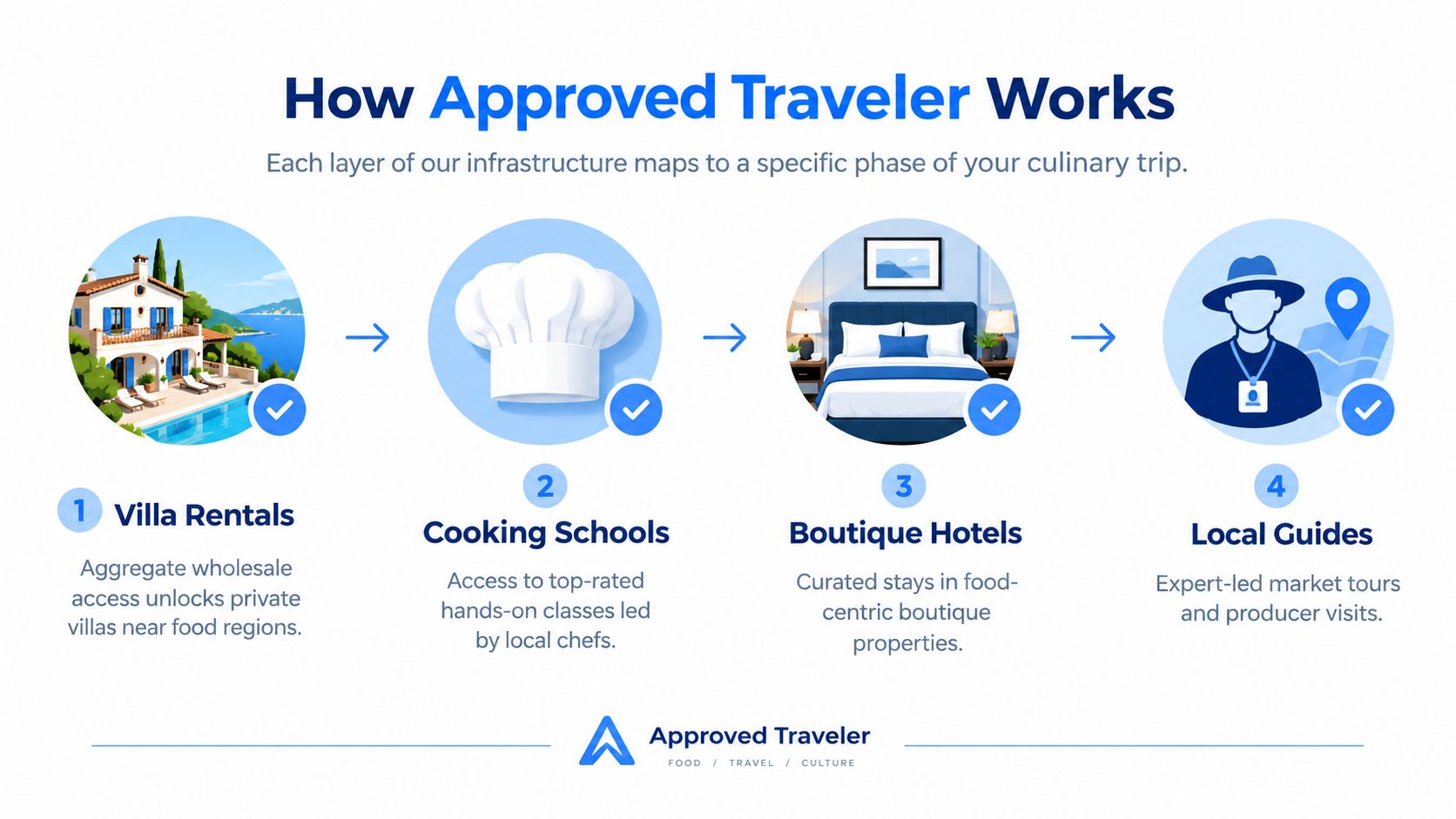
That matters because culinary trips often involve a villa in one place, a boutique hotel in another, a car for producer days, and bookable activities spread throughout the trip. Consolidation reduces friction.
Which infrastructure layer solves which problem
Use the layers this way:
- Aggregated wholesale access: Best for the planner building multi-stop itineraries with lodging changes. It gives you broader inventory to match kitchens, location, and group size.
- Reward Credits: More useful for repeat travelers than one-off vacationers because culinary travel often becomes recurring once people realize how much better it feels than generic sightseeing.
- Family scale for up to 10 members: Essential for multi-generational groups splitting rooms, flights, and side trips across several adults.
- 110% Best Value Guarantee: Useful when you're validating a public rate against what you're seeing elsewhere and need a comparison anchor.
- V.O.I.C.E.: Practical for timeshare owners comparing whether to use, exchange, deposit, or rent out fixed weeks while building longer food-driven stays.
- Boomerang Member Share: Helpful when one planner wants to keep the household structure centralized but still let extended family or friends book into the same travel ecosystem.
- Approved Lux 24/7 Personal Assistant: Higher-complexity trips get easier. Rescheduling a class, finding a driver to a remote winery, or sorting dietary requests mid-trip is operational work, not inspiration.
A phased checklist
Think in phases:
- Trip design: choose region, pace, and stay length.
- Inventory lock: secure lodging, transport, and fixed culinary anchors.
- Group alignment: sort rooming, kitchens, allergies, and payment structure.
- In-trip support: handle changes without collapsing the rest of the itinerary.
The mistake people make is shopping for culinary experiences first and operational support second. Reverse it. The better your infrastructure, the better your food decisions hold up under real travel conditions.
Choosing the Right Setup and Avoiding Common Mistakes
Most culinary trip failures aren't dramatic. They're quiet planning mistakes that compound by day three.
Four mistakes that derail good food trips
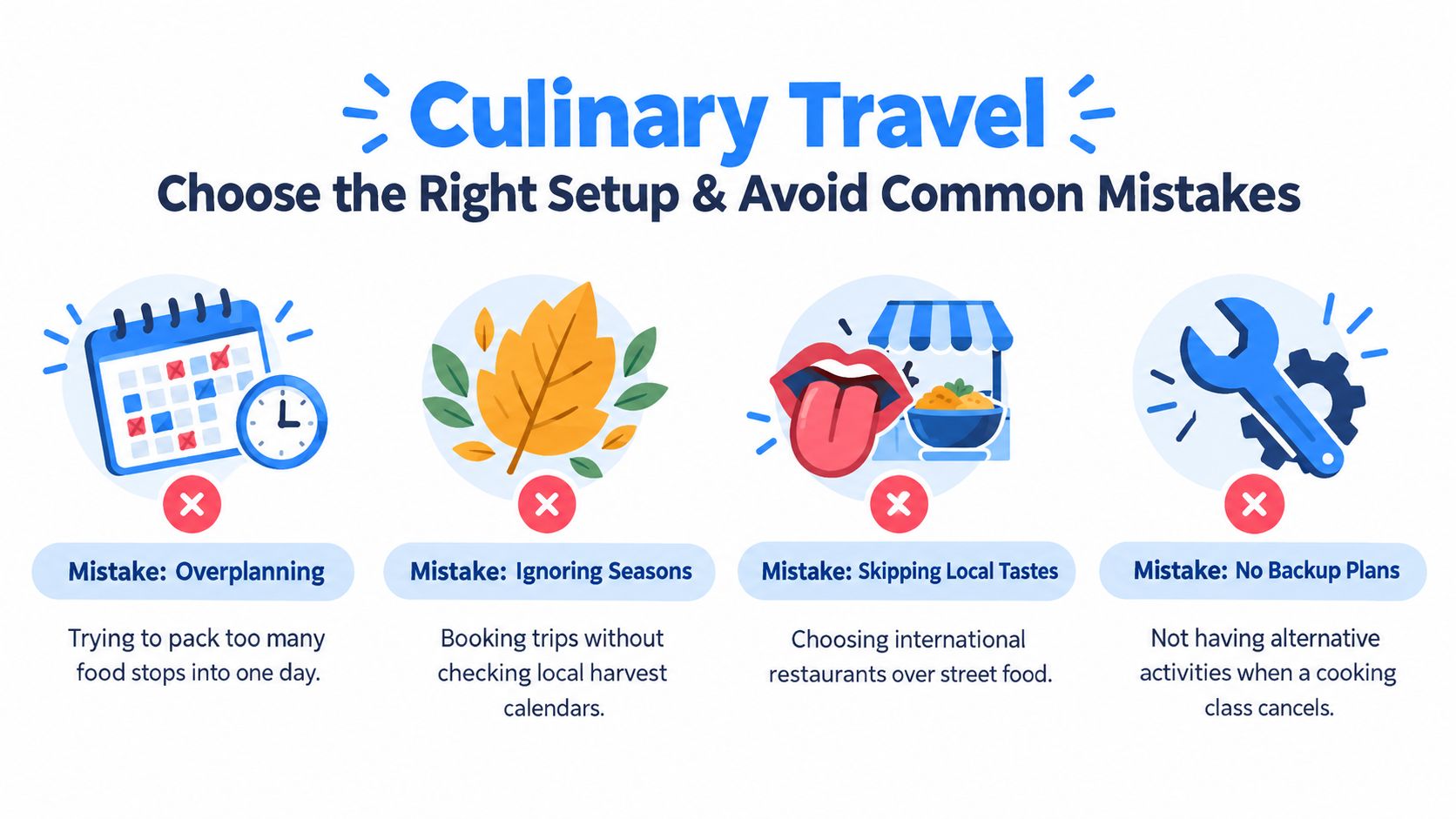
The first mistake is front-loading one city with too many reservations. Travelers arrive ambitious and tired. By the second night, they're dragging themselves through meals they were supposed to enjoy.
The second is ignoring transit reality. A charming producer visit can turn into a punishing day if you add another tasting, a long lunch, and a dinner reservation in a different town.
The third is misjudging seasonal closures and long-stay kitchen needs. A beautiful rental with a poor kitchen is a bad fit for a food-led trip. So is a shoulder-season itinerary built around places that aren't open when you need them.
The fourth is assuming retail booking channels will mirror wholesale-access inventory. They often won't. That matters most on larger group stays and longer trips, where one wrong lodging choice ripples through everything else.
Use a simple decision filter
Ask four questions before you book anything:
- How long is the trip? Short stays need concentration. Long stays need rhythm.
- Who's in the party? Kids, grandparents, and remote workers all change timing.
- What's the budget ceiling? Not every meal needs to be purchased outside the property.
- Do you want spontaneity or precision? If the answer is both, you need fixed anchors plus open windows.
Book fewer marquee meals than you think you need. Put your effort into access, timing, and the right base. That's where the trip gets won.
If you're a volume-driven planner, prioritize consolidated access and Reward Credits. If you care most about oversight and comparison discipline, use the 110% Best Value Guarantee as a check. If you're juggling ownership inventory or changing long-stay plans, V.O.I.C.E. belongs in the decision. If the trip extends across relatives and friends, Boomerang Member Share solves a real coordination problem. And if your itinerary has enough moving parts that one cancellation could scramble the week, Approved Lux 24/7 Personal Assistant earns its place.
Good culinary travel experiences don't happen because you saved twenty restaurants to a map. They happen because the setup matches the trip.
If you're building a food-focused trip with real moving parts, Approved Experiences Traveler gives you operational travel infrastructure instead of another pile of disconnected bookings. You can use it to consolidate lodging, flights, cars, cruises, vacation homes, and activities into one planning environment, which is exactly what culinary travel needs when food is driving the itinerary.
Want the wider view?
Ten categories. One report. Every quarter. The Approved List tracks what's rising and what's fading: data-backed signals, not opinions.
Free to join · Delivered by email