
←All Articles
The Journal
Europe Travel Agent: What They Do and When to Use One
October 5, 202613 min readeurope travel planninggroup travel europe
Discover what a Europe travel agent actually does, from rail passes to group bookings. Learn when to hire an agent versus using infrastructure like Approved

In a European market estimated at €121.5 billion in 2026, with 97,427 active businesses, a Europe travel agent can turn fragmented bookings into one operational plan. The trade-off is clear: you pay for coordination and service, while travel infrastructure gives you self-service access to wholesale inventory with more responsibility on your side.
What happens when ten relatives arrive in Italy on different flights, sleep in different room configurations, move between several cities, and expect one person to know what happens next? Most Europe itinerary advice answers where to go. It rarely answers how to keep three generations, multiple suppliers, border requirements, rail schedules, and extended stays working as one trip.
That operational gap is where a Europe travel agent earns their fee. Booking software can display availability and process transactions, but it doesn't automatically reconcile a late arrival with a prepaid train, an accessible room request, a grandparent's documentation, and a family dinner reservation. For straightforward trips, self-service tools are efficient. For complex itineraries, coordination is the product.
What a Europe Travel Agent Actually Does
You're organizing a two-week family reunion in Italy for ten people across three generations. One couple wants a double room, grandparents need a quieter ground-floor option, and the parents need adjoining rooms for children. Two travelers arrive before the rest of the group, one flight lands late, and the itinerary includes rail travel between cities.
Without a coordinator, the bookings may all look correct in isolation. The hotel has rooms, the train has seats, and the airport transfer has a pickup time. The problem appears when the pieces interact. A late flight can make a nonrefundable train unusable, separate hotel reservations can place the family in different buildings, and an activity booked for the whole group may not suit travelers with different mobility levels.

The agent as operational coordinator
A capable Europe travel agent starts by collecting information that booking forms often treat as optional:
- Room configurations: Who shares, who needs privacy, and whether adjacent rooms or a connected villa layout matter.
- Movement constraints: Arrival times, train connections, transfer windows, luggage, and mobility requirements.
- Group dynamics: Which activities everyone can share, where the group should split, and how the itinerary reunites.
- Documentation: Passport validity, entry rules, visa questions, insurance requirements, and contact details for every traveler.
- Contingencies: What happens if a flight is delayed, a rail connection changes, or a property can't honor the original room assignment.
Travelive's group-planning process illustrates why these inputs matter. It handles groups of 10 or more guests and 5 or more rooms, asks for dates, duration, budget, room configurations, ages, mobility needs, and trip purpose, then provides a customized proposal in 5 to 7 business days and holds rates for two weeks. Those mechanics are more useful than a generic promise of “personalized service,” because they define the information required to make a large trip workable. Travelive's group service shows the practical questions a professional planner should ask.
What gets consolidated
The agent doesn't merely make separate reservations. They create a usable travel record with supplier contacts, confirmation numbers, payment deadlines, cancellation conditions, transfer instructions, and a day-by-day sequence that reflects how the group travels.
That can mean placing a shorter activity after a long transfer, reserving a private guide for part of the family while others rest, or choosing a hotel close to a station rather than one that looks better on a map. The best result isn't necessarily the lowest individual rate. It's a plan with fewer points of failure.
Practical rule: If a booking only works when every flight, train, traveler, and supplier performs perfectly, it isn't a finished itinerary.
Core Services and Operational Value
A booking website is good at presenting inventory. A professional agent adds judgment about how that inventory fits together. The difference becomes visible in four service areas.
Group and multi-room bookings
Start with the sleeping plan, not the destination list. A family of ten may need several room types, a villa with separate living space, or two properties within walking distance. The agent checks occupancy rules, bedding, accessibility, meal arrangements, deposits, and cancellation terms before presenting a workable combination.
Ask for a rooming list early. Include names, ages, relationships, bed preferences, mobility needs, and whether anyone needs a kitchen or workspace. This prevents the common mistake of selecting a property that technically accommodates the group but creates daily friction.
A useful agent will also distinguish a true group booking from several individual reservations. The former may allow coordinated payment deadlines, shared terms, and a single contact for changes. The latter can leave one traveler with a different cancellation policy or a separate arrival process.
Rail passes and complex transit
European rail planning rewards sequence awareness. A pass isn't automatically better than point-to-point tickets, and point-to-point tickets aren't automatically simpler. The right choice depends on the route, reservation requirements, flexibility, traveler ages, and how likely the group is to change plans.
Give the agent the full movement pattern, including airport arrivals and day trips. They can then compare a pass with individual fares, identify trains that require reservations, and avoid building a connection that leaves no practical margin for luggage or a delayed arrival.
Transfers deserve the same scrutiny. A station-to-hotel transfer may be unnecessary in a compact city, while a late arrival with children and heavy luggage can justify a prearranged vehicle. The value lies in matching support to the difficult segments rather than adding transfers everywhere.
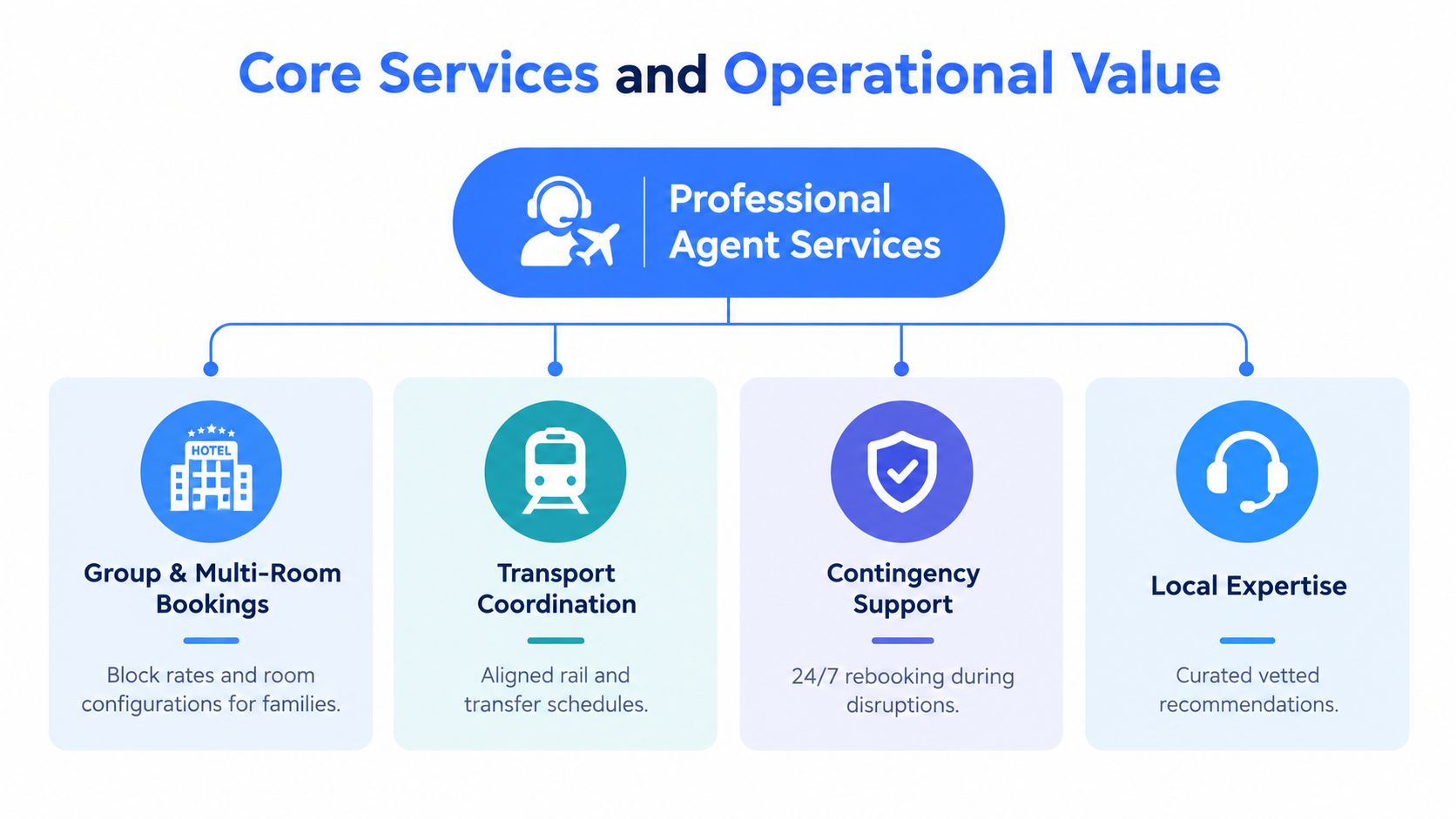
Local supplier integration
Public booking tools can help you find an attraction. They may not tell you which guide can adapt a walking tour for a mixed-mobility group, which restaurant can serve a complicated dietary requirement, or which local operator has a reliable vehicle for ten passengers and luggage.
A strong agent uses local suppliers selectively. Ask who will deliver the service, whether the provider is licensed where required, how cancellations work, and what happens if weather or transport disrupts the plan. For initial inspiration, curated resources such as Simsima Europe trip packages can help you compare itinerary structures, but a complex family trip still needs supplier-level verification.
Commission and service arrangements also affect recommendations. Travelers who want to understand how agencies may be compensated can review this explanation of travel agency commission rates, then ask the agent which components carry a planning fee, commission, or both.
Visa and insurance support
An agent can't guarantee a visa decision, replace official instructions, or provide legal advice. They can, however, identify the documents and timing questions that need official confirmation, keep traveler information organized, and make sure the itinerary doesn't contradict the application.
Insurance support should focus on fit rather than a generic add-on. Compare medical coverage, cancellation triggers, interruption rules, pre-existing-condition terms, baggage limits, and evacuation provisions. For a multi-country trip, check that the policy follows the entire itinerary and every traveler, not just the first destination.
The practical test is simple. Ask the agent to explain the plan if a flight is delayed, a hotel becomes unavailable, or one traveler needs to leave early. If the answer is only “contact the supplier,” the service may not extend beyond the booking transaction.
The State of the European Market
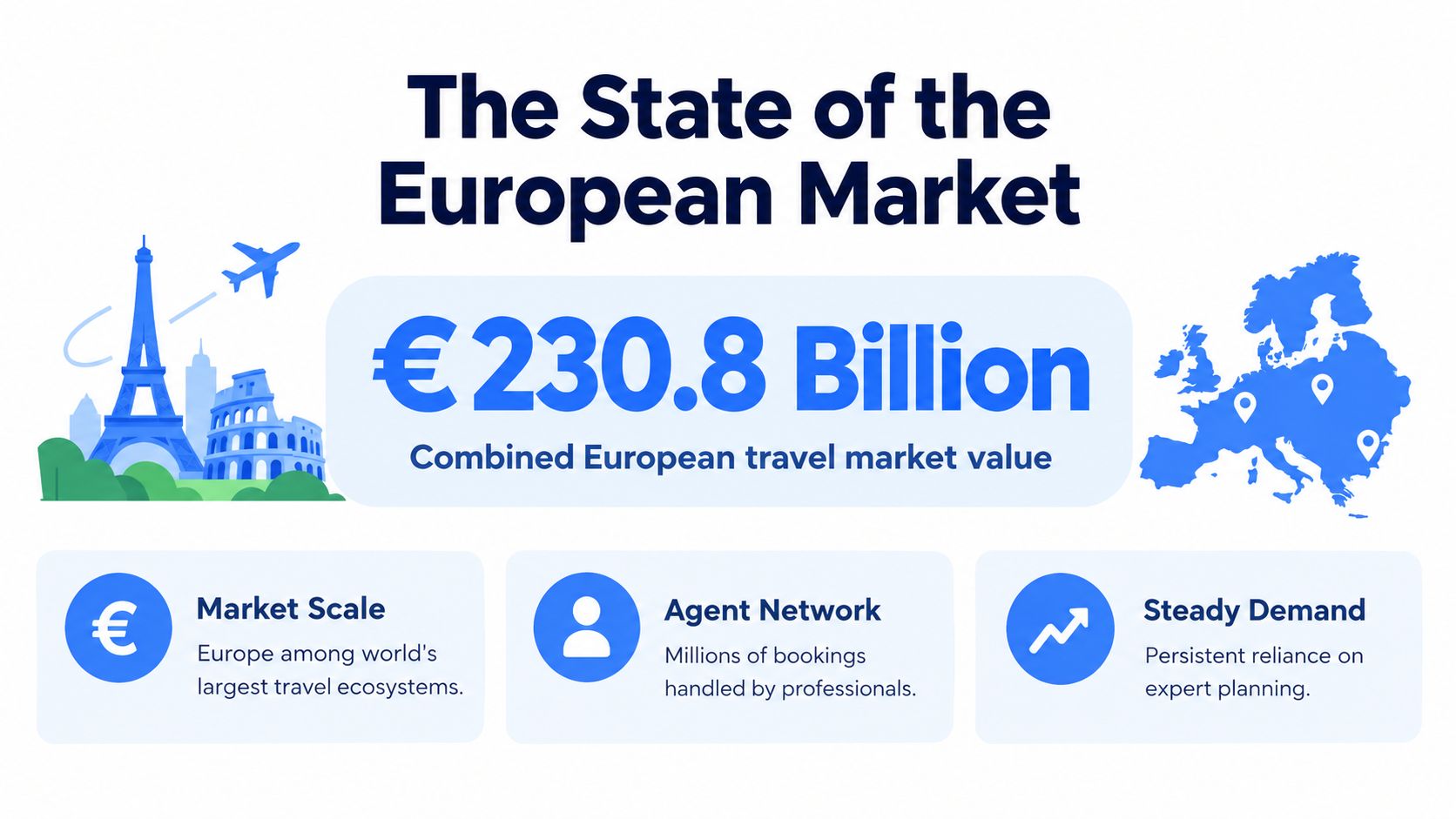
Travel agents remain relevant partly because the European intermediary layer is large, distributed, and difficult to manage from one interface. The combined market for travel agencies, tour operators, and travel assistance service activities in Europe is estimated at €230.8 billion in 2026, with about 190,000 businesses and a 13.8% CAGR from 2020 to 2025, according to IBISWorld's European travel-services market estimate.
That scale doesn't mean every traveler needs a human planner. It does show why inventory, supplier relationships, booking rules, and service standards remain spread across many organizations. A traveler may see one destination, but the transaction passes through hotels, airlines, railways, guides, insurers, transfer companies, and local operators.
From traditional agency to distribution infrastructure
The industry has changed without disappearing. European travel organisers were estimated at about EUR 42,000 million in 1997 and EUR 52,000 million in 2002, an increase of roughly 24% over five years, based on the historical figures in this European Commission document.
By 2018, ECTAA reported 80,000 enterprises, 370,000 employees, €197 billion in turnover, USD 60.1 billion in air ticket sales, 300 million tickets sold, and 210 million travel packages sold across European travel agents and tour operators. Those figures describe a high-volume distribution layer, not a marginal retail channel.
The more useful question is what this structure means for travelers. Fragmentation creates choice, but it also creates reconciliation work. Someone has to compare terms, align dates, retain records, and understand which supplier owns the next step when a change affects the rest of the itinerary.
Why fragmentation matters to families
EU tourism data recorded €104 billion in turnover in 2022 for travel agencies and tour operators, up 88% versus 2021, with about 0.4 million employees. More than 39% of employment in this segment was in micro-enterprises, as reported by Eurostat's tourism-industry analysis.
That employment structure helps explain the uneven experience travelers receive. One operator may have advanced systems and multilingual support, while another relies on manual emails and limited local coverage. A human agent can reduce the visible impact of that fragmentation by acting as the traveler's working interface across suppliers.
For a simple city break, that layer may be unnecessary. For a long-stay itinerary, a group with different needs, or a trip involving several countries, consolidated oversight can be more valuable than another search filter.
Agent Versus Approved Traveler Infrastructure
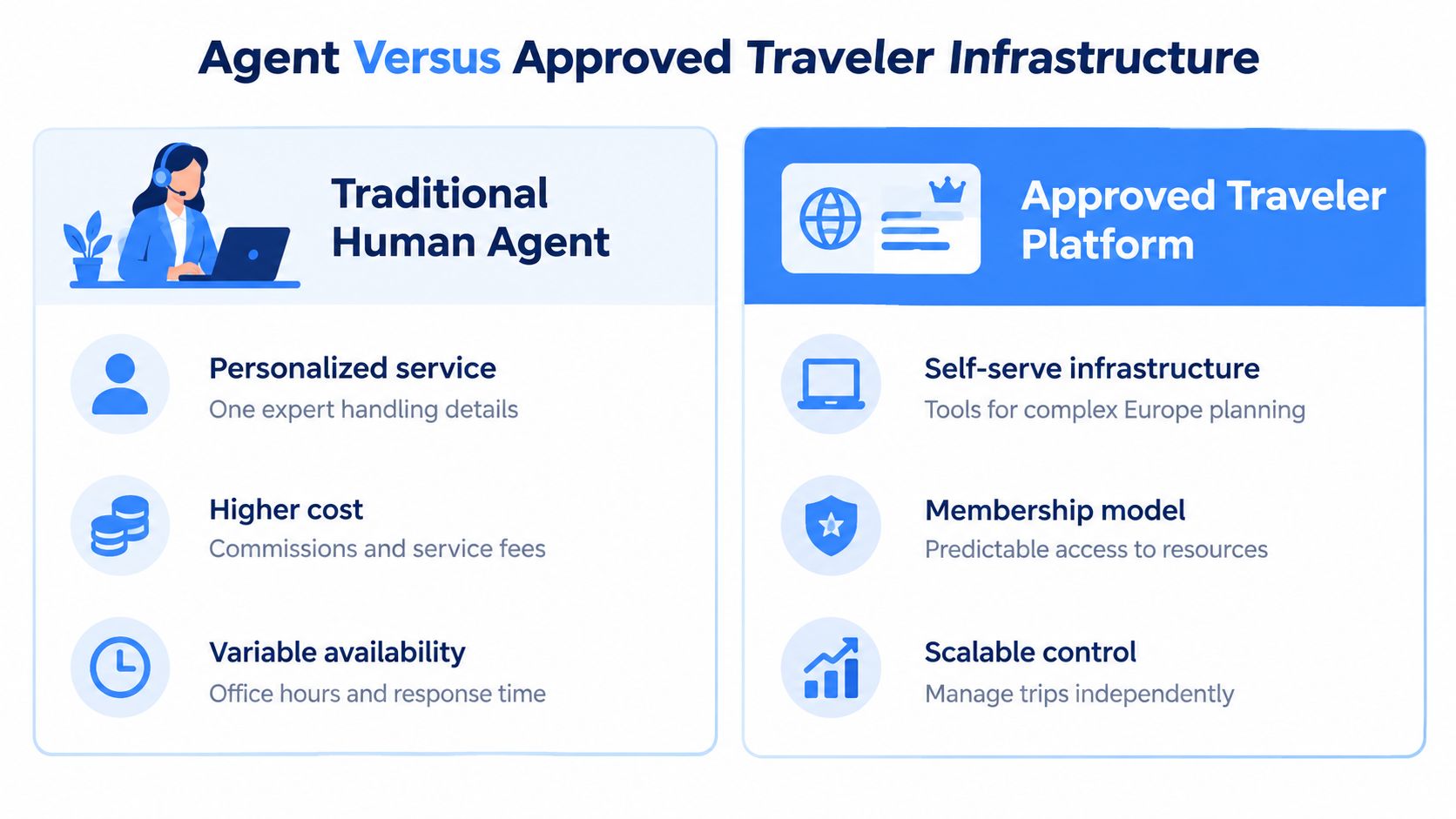
Which matters more for a complex Europe trip, a person who coordinates the moving parts or a platform that gives the traveler direct control? The operational difference is accountability. A traditional Europe travel agent interprets the brief, selects suppliers, sequences the itinerary, and manages changes across several bookings. Approved Traveler infrastructure gives members consolidated access to travel inventory while leaving more comparison, booking, and follow-up work with them. For a closer look at travel inventory management systems, see how consolidated inventory is organized behind the scenes.
The platform provides access to over 1,000,000 hotels, 700+ airlines, 44+ cruise lines with 30,000+ itineraries, 30,000+ car rental locations, 500,000+ vacation homes, 5,500+ tour packages, and 150,000+ activities. Traveler membership costs $899 per year, while Lux Traveler costs $1,799 per year and includes an Approved Lux 24/7 Personal Assistant for up to 10 household members.
That range can support a snowbird comparing monthly-style lodging, a family searching for vacation homes, or a repeat traveler combining flights, hotels, cars, and activities in one operating environment. It does not decide whether a room layout works for grandparents and children, whether a transfer leaves enough time after a train arrival, or whether a cancellation rule fits an extended stay. Inventory access supplies options. Judgment connects them into a workable trip.
A practical comparison
| Planning need | Traditional human agent | Approved Traveler infrastructure |
|---|---|---|
| Inventory access | Curated supplier access selected by the agent | Broad consolidated access across hotels, airlines, homes, cruises, cars, tours, and activities |
| Service model | One person interprets the brief and coordinates suppliers | Self-service planning, with an Approved Lux 24/7 Personal Assistant included in Lux Traveler |
| Cost structure | Service fees, commissions, or both, depending on the agency | Annual membership, with the traveler managing more of the workflow |
| Best fit | Families that want one accountable coordinator | Travelers who want control, repeat access, and scalable inventory |
| Main friction | Higher service cost and dependence on the agent's availability | More responsibility for comparison, sequencing, and follow-up |
A multi-generational organizer booking several rooms, rail segments, and coordinated activities may benefit from a human agent when relatives disagree, mobility needs require careful matching, or disruption support matters more than browsing control. The agent's value lies in reducing the decisions one organizer must reconcile across suppliers.
A snowbird or remote worker may prefer infrastructure for longer stays involving kitchens, workspaces, and repeated searches across destinations. Direct access makes it easier to compare properties and preserve control over dates and accommodation style, but the traveler must verify details and retain responsibility when one booking affects another.
Language can create another handoff problem. Families managing local communication themselves may use best language apps for travel, particularly when dealing with hosts, drivers, and smaller suppliers.
Timeshare owners need a separate cost review. The Federal Trade Commission's guidance on timeshares and exchange programs explains that exchange bookings may carry an extra charge and that most timeshares have annual maintenance fees that often rise at or above inflation. EU rules also recognize annual membership fees or a separate fee for each exchange, alongside a minimum 10-day withdrawal period and restrictions on advance payments during that period.
An itemized 2026 RCI-style fee example lists $99 for Weeks membership, $124 for Points membership, $289 per exchange, $49 per month to extend an unused deposit, about $99 for a guest certificate, and $89 for optional Trading Power Protection. The example totals $487 for one family trip before home-resort maintenance fees, or $576 with protection, as detailed in this timeshare exchange cost breakdown. Compare those mechanics with any infrastructure membership before treating an exchange network as the simpler option.
How to Select the Right Agent or Platform
Start with the trip, not the brand. Write down the number of travelers, room configurations, countries, arrival constraints, mobility requirements, desired support, and whether the trip is a short holiday or an extended stay. A provider that is excellent for a luxury cruise may be poorly suited to a family moving through several European regions by rail.
Vet a human agent
Ask for evidence that the agent understands your itinerary type. Check whether the agency holds relevant IATA accreditation if it sells air tickets, read recent reviews on independent platforms, and ask who handles the trip when the named consultant is unavailable.
Use an interview rather than a generic consultation. Ask:
- How would you structure our rooming plan? Look for questions about ages, beds, accessibility, and privacy.
- How would you handle a missed rail connection? The answer should distinguish supplier rules from the agent's own support.
- Which services are included? Confirm planning fees, change fees, after-hours support, and supplier charges in writing.
- What do you specialize in? A specialist in family travel, cruises, or long stays should explain trade-offs in that category without forcing a standard package.
A useful conversation produces a risk map. You should leave knowing which decisions are fixed, which remain flexible, and where the plan could fail.
Evaluate infrastructure
For a platform, test the workflow before committing. Search the actual destinations, inspect cancellation terms, review whether properties support the required occupancy, and see how confirmations and traveler details are stored. Compare membership tiers according to the help you need, not the features you might use someday.
Traveler provides marketplace access. Lux Traveler adds the Approved Lux 24/7 Personal Assistant and household coverage. That distinction matters for a family organizer who wants delegation, but it may be unnecessary for a confident traveler who prefers to research and book independently.
Also ask how the platform handles value after booking. Approved Traveler members earn Reward Credits on bookings, and those credits can be used toward future bookings, maintenance fees, resort usage fees, annual renewal, and eligible eGift cards. The 110% Best Value Guarantee applies when a member finds a lower publicly available price, with the refund based on 110% of the difference. Treat these as operating terms to verify, not as a substitute for comparing the total itinerary.
A practical review of travel booking tools can help you create a checklist for search, comparison, documentation, and follow-up. For agency relationships, this travel agent partnership playbook is also useful context when assessing how a provider may work with local transport and service partners.
Making the Final Decision
Choose a human agent when the central problem is coordination. That usually includes a multi-generational family with several room types, a complex arrival pattern, shared activities, mobility considerations, or a low tolerance for personally managing disruptions.
Choose travel infrastructure when the central problem is access and repeat control. It can suit a snowbird comparing extended-stay homes, a remote worker who needs a kitchen and workspace, a frequent traveler building trips independently, or a timeshare owner evaluating alternative uses for existing inventory.
The wrong choice creates predictable friction. An agent can feel expensive when the itinerary is simple and the traveler wants to make every decision. A platform can feel overwhelming when the group needs one person to reconcile preferences, supplier terms, and contingency plans.
The decision isn't about whether one model is more modern or prestigious. It's about where you want the operational work to sit. Put it with a specialist when coordination is the hard part. Keep it in your own hands when consolidated access, repeat use, and flexibility matter more than delegation.
Approved Experiences Traveler provides consolidated access to hotels, airlines, vacation homes, cruises, cars, tours, and activities for travelers who want to manage Europe logistics through one infrastructure layer. Review the membership options and visit Approved Experiences Traveler to decide whether its inventory access and household support match the way you plan complex trips.
Want the wider view?
Ten categories. One report. Every quarter. The Approved List tracks what's rising and what's fading: data-backed signals, not opinions.
Free to join · Delivered by email