
All Articles
The Journal
How to Find Cheap Flights: The Ultimate Airfare Savings Guide
January 25, 202621 min readcheap airfaretravel hacks
Learn how to find cheap flights with our expert guide. Discover actionable travel hacks, timing secrets, and tools to save hundreds on your next trip.

Finding cheap flights isn't about luck—it's a game of strategy. I've found that the whole process really boils down to three simple things: being flexible, booking at the right time, and using the right tools. If you can master these, you’ll consistently sidestep eye-watering fares and turn expensive trip ideas into affordable realities.
Your Blueprint for Finding Cheap Flights
Scoring a great flight deal doesn't mean you have to spend hours glued to your screen, not if you start with the right mindset. It’s about flipping the script: instead of finding a flight for a fixed plan, you build a plan around a great flight deal. This one shift in approach is where the biggest savings are always found.
The whole game really comes down to a few core principles that seasoned travelers live by. Once you get these down, you'll completely change how you book travel, putting those dream destinations well within your reach.
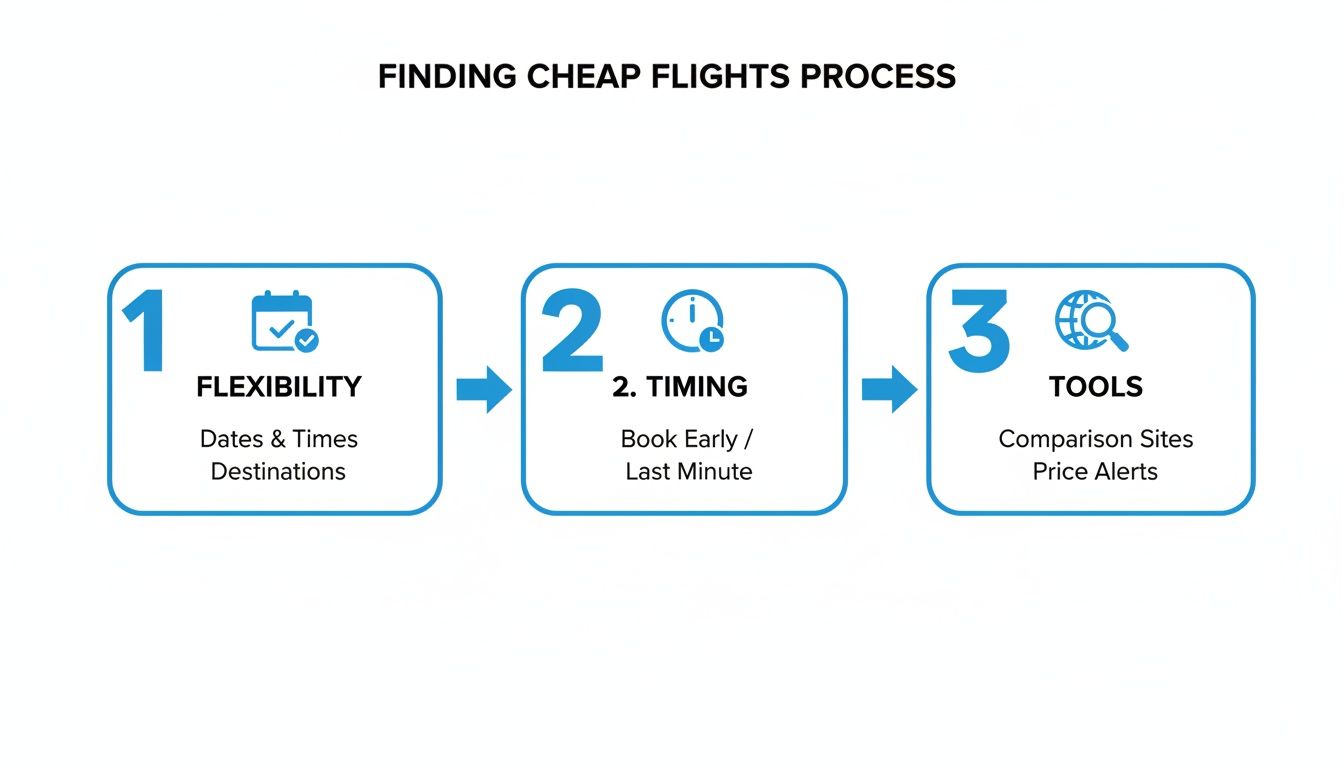
This simple workflow shows that the hunt for a cheap flight starts long before you pull out your credit card. It begins with an open mind.
Flexibility Is Your Secret Weapon
Let's get one thing straight: the number one, non-negotiable rule for finding cheap flights is flexibility. If your dates are set in stone, you’re stuck paying whatever the airline decides to charge. But if you can nudge your travel by just a day or two, you can unlock massive savings.
- Actionable Insight: When you start your search, instead of entering exact dates like "July 12th to July 19th," use the calendar view on Google Flights. You'll instantly see which days are cheapest. Flying out on a Tuesday or Wednesday instead of a Friday can easily save you $50-$100 per ticket.
The same goes for airports. Being open to flying into a smaller, alternate airport can be a total game-changer.
- Practical Example: For a trip to Los Angeles, a flight into Long Beach (LGB) could easily be $100 cheaper than flying into Los Angeles (LAX). A short Uber ride is a tiny price to pay for that kind of saving. This trick works everywhere—think Newark (EWR) or LaGuardia (LGA) instead of JFK in New York, or Gatwick (LGW) and Stansted (STN) instead of Heathrow (LHR) in London.
The biggest mistake I see travelers make is locking in their destination and dates before even looking at flight prices. Flip the process: find the cheap flight first, and then build your amazing trip around that opportunity.
Let Technology Do the Heavy Lifting
Being flexible is half the battle; using the right tech is the other. Modern flight search engines are incredibly powerful, but most people barely scratch the surface of what they can do.
Here are the tactics I use every single time:
- Set Price Alerts: This is non-negotiable. Let the bots do the work for you. Set up alerts for your dream route on sites like Google Flights or Skyscanner. You'll get an email the second the price drops, so you can book at the perfect moment.
- Always Search Incognito: The jury is still out on how much this really helps, but why risk it? Searching in a private or incognito browser window stops websites from using cookies to track your searches. Some people swear this prevents prices from creeping up on routes you check over and over.
- Use the Big Aggregators: Start your search with a meta-search engine. Tools like Google Flights, Skyscanner, and Momondo scan hundreds of airlines and online travel agencies (OTAs) in a single click, giving you the full picture in seconds.
For anyone just getting started, focusing on a few high-impact strategies is the fastest way to see real savings.
Quick Wins for Cheaper Flights
This table breaks down the most effective tactics you can use right now to find a better deal on your next flight.
| Tactic | Why It Works | Real-World Example |
|---|---|---|
| Search Nearby Airports | Airlines often price flights lower to less-congested secondary airports to fill planes. | Instead of flying into London Heathrow (LHR), check London Gatwick (LGW). A family of four could save $400+. |
| Fly Mid-Week | Business travelers dominate Monday/Friday flights, and leisure travelers fill weekend seats. Tuesdays and Wednesdays have lower demand. | A round-trip from Chicago to Orlando is often $50-$75 cheaper per ticket if you fly Tuesday to Tuesday versus Friday to Friday. |
| Set Price Alerts | Airline pricing is volatile. Alerts notify you of temporary price drops and flash sales you'd otherwise miss. | Setting an alert for "NYC to Rome" for October travel could notify you of a 24-hour sale dropping the fare from $850 to $550. |
| Check One-Way Fares | Sometimes, booking two separate one-way tickets (even on different airlines) is cheaper than a round-trip ticket. | A round-trip on United might be $350, but a one-way on United for $150 and a return on Spirit for $120 saves you $80. |
By combining a flexible travel plan with these simple search tactics, you create a powerful blueprint for consistently finding flights that don't break the bank.
Mastering the Art of Smart Searching
This is where the real hunt begins. Your search strategy is the single most powerful tool you have for slashing flight costs. To consistently beat the average price, you have to think like a pro and move beyond basic round-trip searches.
Think of every flight search as a puzzle. Swapping out a few key pieces—like your departure airport or travel dates—can reveal a completely different, and much cheaper, picture. The real savings are found when you give the search engine more room to work its magic.

Embrace Airport and Date Flexibility
Let’s get this out of the way: The two golden rules of finding cheap flights are flexibility with where you fly and when you fly. Locking yourself into one specific airport and rigid dates is the fastest way to overpay, period.
Airlines use incredibly complex algorithms to price their routes, and tiny adjustments on your end can trigger huge price drops.
Imagine you're planning a trip to Los Angeles. A standard search will point you straight to LAX, the massive international hub. But a savvy traveler knows to look at the whole picture.
-
Actionable Insight: When searching on Google Flights, instead of typing "LAX" into the destination box, type "Los Angeles" and select the option for all area airports (e.g., "LAX, Los Angeles"). The search engine will automatically compare prices for all of them.
-
Long Beach (LGB): This is often a hub for budget carriers. Flying here can sometimes be 25% cheaper than flying into LAX.
-
Burbank (BUR): A smaller, far more convenient airport that can offer shockingly competitive prices, especially on domestic routes.
-
Orange County (SNA): Another fantastic alternative that can have surprise deals, particularly if your final destination is south of LA proper.
This same logic works everywhere. Flying into London Gatwick (LGW) instead of Heathrow (LHR) or choosing Fort Lauderdale (FLL) over Miami (MIA) can literally save a family hundreds of dollars. The small cost of a train or Uber from the alternate airport is almost always a fraction of the airfare savings.
Unleash the Power of Discovery Tools
Sometimes the best way to score a cheap flight is to not have a specific destination in mind at all. This is where tools like the Google Flights Explore Map completely change the game. Instead of telling it where you want to go, you tell it when you can go and let it show you the deals.
- How to Do It: Go to Google Flights, enter your home airport, but leave the destination field blank and click "Explore." You can then set broad dates like "1-week trip in October." The map will instantly populate with the cheapest fares around the world. You might find a flight to Dublin for $450 while Paris is $900, making your decision for you. It flips the whole planning process on its head—you let the deal guide the destination.
The cheapest trips often start with one simple question: "Where can I fly for under $300 next month?" This open-ended approach uncovers deals you'd never find if you were fixated on a single city.
Go Beyond the Standard Round-Trip Search
While it’s easy, just booking a standard round-trip ticket isn't always the cheapest way to fly. Experienced searchers know how to piece together itineraries to find hidden savings.
The Two One-Ways Trick I use this all the time. Booking two separate one-way tickets—sometimes on completely different airlines—is often cheaper than a single round-trip booking. This strategy, sometimes called a "hacker fare," works especially well on competitive domestic routes.
- Practical Example: A round-trip ticket from Chicago to Denver on United might be $280.
- But, look closer: A one-way flight to Denver on United could be $130, and a separate one-way flight back on Southwest might be just $110.
- Your total savings: A quick $40 just by booking two tickets instead of one.
Leveraging Multi-City Bookings If your trip involves more than one stop, using the multi-city search function is non-negotiable. It allows you to build a complex trip under a single ticket, which is almost always cheaper and easier than booking a string of separate one-way flights.
- Practical Example: For a European tour, you want to fly from New York to London, take the train to Paris, and then fly home from Paris. Instead of booking a round-trip to London and a separate flight home from Paris, use the "Multi-city" tab. Search for "NYC to LHR" on your departure date and "CDG to NYC" on your return date. This "open-jaw" itinerary saves a ton of money and avoids having to fly all the way back to London just to catch your flight home.
Timing Is Everything for Booking Flights
Flight prices can feel like a total lottery, but I promise you, there’s a method to the madness. Airlines run on what’s called dynamic pricing. In simple terms, fares are constantly changing based on demand, the season, and how close you are to your travel date. If you can learn to read the patterns, you’ll know exactly when to pull the trigger.
Think of it like buying fruit at the grocery store. You wouldn't expect to get a good deal on strawberries in the middle of December, right? The same logic applies here. Booking a flight to Miami for spring break a week out is going to cost you a fortune. The real secret is aligning your purchase with the predictable lulls in the pricing cycle.

Nail the Booking Sweet Spot
There's a "Goldilocks window" for booking flights—not too early, and definitely not too late. Airlines release seats about 11 months ahead of time, but booking that far out is almost never the cheapest option. They start with high prices to see who bites. But wait too long, and you'll get hit with those last-minute desperation fares.
Your goal is to book inside the window where prices typically bottom out before they start creeping back up.
- For Domestic Flights: I always aim to book 1 to 3 months in advance. This is usually when airlines have a solid read on demand and start competing more aggressively on price.
- For International Flights: You need a much longer runway. Start your search 2 to 8 months out from your travel date. Long-haul routes have more complex factors at play, so great deals can pop up much earlier.
This isn't just a guess; it's based on years of watching how airlines manage their inventory. They want to fill every single seat, and these windows are when they’re most actively tweaking fares to get people like us on their planes.
Fly When Others Don't
Honestly, the single most effective strategy is to travel when nobody else wants to. That means avoiding peak holidays and picking the least popular days of the week to fly.
Flying on a Tuesday or Wednesday is almost always cheaper than a Friday or Sunday. Why? Business travelers pack the airports on Mondays and Fridays, and weekend warriors take over on the weekends. The middle of the week is quiet, and airlines will slash prices just to fill those empty seats.
The time of year is just as critical. Instead of battling the summer crowds and paying sky-high prices, look at the "shoulder seasons." These are the magical periods right before and after peak season—think April-May or September-October for a trip to Europe.
Practical Example: A round-trip ticket from New York to Rome in July can easily top $1,200. I’ve seen that exact same route in early October for under $600. You get better weather, far fewer tourists, and literally cut your flight cost in half just by being a little flexible.
Watch for Pop Culture Price Drops
Sometimes, the best deals show up in the most unexpected ways—like from your new favorite TV show. When a destination gets a sudden jolt of fame from a hit series or movie, it can actually create a price war as airlines scramble to capture the new wave of interest.
- Actionable Insight: If you’re flexible, these media-fueled trends can unlock huge savings. For example, after Sicily became the star of The White Lotus, the number of flight deals to the island shot up 5x, while the average price dropped by 7%. We saw the same thing happen with the K-drama boom, which led to a doubling of deals to South Korea with 13% cheaper fares. Stay aware of pop culture trends and set alerts for those destinations.
This "trendification" of travel, as the team at Going calls it, creates these perfect little windows of opportunity. You can read more about it in their 2024 State of Cheap Flights report.
When you combine the booking sweet spot with smart travel dates and keep an eye on what's trending, you stop hoping for a cheap flight and start strategically timing your purchase to lock in a great price.
Unlocking Deeper Discounts with Memberships
Standard search engines are a great place to start, but they only scratch the surface, showing you the same public fares everyone else sees. To find the kind of deals that feel like an inside secret, you need to look beyond the obvious. This is where membership-based travel platforms completely change the game.
Think of these services as the wholesale club of the travel world. They negotiate directly with airlines and suppliers to get access to prices that are never advertised publicly. Because you pay a subscription, they can pass those wholesale rates straight to you, unlocking savings that public sites simply can't touch.
Accessing Exclusive Wholesale Pricing
Membership platforms operate behind a paywall, and that's their secret weapon. It allows them to sidestep the strict pricing rules that govern public travel agencies, opening up a hidden layer of the market where the discounts run much, much deeper.
Instead of just showing you retail prices, these services tap into a completely different inventory of fares. For anyone who travels more than once a year, this can fundamentally change the economics of flying.
- Direct Airline Partnerships: Memberships like Approved Experiences Traveler build networks with over 700 airlines to secure negotiated rates that you won't find anywhere else.
- Consistent Savings: This isn't about getting lucky with a one-off glitch fare. Members consistently see real discounts, often up to 50% off on flights.
- Next-Level Service: Many platforms offer tiered memberships. The higher tiers can even include a dedicated 24/7 concierge to hunt down and book these deals for you, saving you both time and cash.
The concept is beautifully simple: you pay a membership fee to enter a private marketplace where the retail markups have been stripped away. It’s the closest you can get to booking travel at wholesale cost.
This model is especially potent right now. While it feels like prices for everything are climbing, airfares have actually been on a long-term downward trend. This creates a sweet spot for savvy travelers.
For example, NerdWallet's Travel Inflation Report found that U.S. airfares fell 3.4% year-over-year and are down a whopping 9.0% compared to a decade ago. You can dig into the numbers yourself and check out the airfare trends from NerdWallet's report.
Stacking Savings with Loyalty Programs
Now for the real power move: combining these membership discounts with your airline loyalty programs and credit card points. This is how you turn a great deal into a trip that’s practically free.
The strategy is simple but incredibly effective. Use the membership to slash the cash price of the ticket, then use your points to cover what's left.
You're essentially getting a two-part discount. First, you lock in a flight that’s already way cheaper than retail. Then, you apply your hard-earned miles to that already-low price.
Let’s walk through a real-world scenario:
- Retail Price: A regular search engine shows a flight from Chicago to London for $950.
- Membership Price: Through a platform like Approved Experiences, you find the exact same flight for $650. That’s an instant $300 back in your pocket.
- Points Redemption: You’ve got 20,000 airline miles sitting in your account, which you can redeem for a $200 statement credit.
- Final Cost: You apply those points to the already-discounted fare, and your final out-of-pocket cost plummets to just $450.
This "stacking" method maximizes the value of every single point you earn. Instead of burning your miles on a full-price ticket, you're applying them to a deeply discounted base fare. It’s an insider’s approach that can make even luxury travel feel surprisingly affordable.
Alright, you've got the basics down. Now it's time to pull back the curtain on the stuff the pros do—the kind of moves that can land you truly insane deals. These tactics take a bit more finesse, but the payoff can be huge.
Just as important, though, is knowing the common blunders that can wipe out all your hard work in a heartbeat. It’s all about knowing which rules to bend and which ones to follow religiously.
The High-Risk, High-Reward World of "Hidden-City" Tickets
You’ve probably heard whispers about a controversial trick called hidden-city ticketing. The idea is pretty simple: you book a flight from A to C that has a layover in B, but your real destination was B all along. You just get off the plane and walk out.
Why would anyone do this? Sometimes, a direct flight to a major hub (your destination B) is way more expensive than a less popular flight that just happens to connect through it.
- Practical Example: A flight from Chicago to San Francisco might be going for $400. But a flight from Chicago to a smaller city like Reno—with a layover in San Francisco—might only be $250. The hidden-city traveler books the Reno flight and just leaves the airport in San Francisco, saving $150.
Warning: I have to be crystal clear here. While it sounds genius, hidden-city ticketing is a high-stakes gamble. Airlines absolutely forbid this in their contracts. If they catch you, they can cancel your ticket on the spot, ban you from the airline, and even zero out your frequent flyer miles.
This trick only even works under a very specific set of rules:
- One-way only. If you skip a leg on a round-trip ticket, the airline will cancel every single flight that follows. Game over.
- Carry-on only. Your checked bags are going to the final destination on the ticket (Reno, in our example), whether you are or not.
Hunting for Those Mythical Error Fares
Every now and then, a glitch happens. Someone types an extra zero, a currency conversion goes haywire, and an airline accidentally posts a ridiculously low price. These are error fares, and for deal hunters, they're the holy grail.
I’m talking about cross-country flights for $50. International business class for under $500. They're real, but they don't last.
- Actionable Insight: The key is pure speed. Follow deal-finding accounts on social media or subscribe to newsletters that specialize in flagging these. When you see one, book it immediately. Don't hesitate. You can ask questions later. In the U.S., the 24-hour rule usually lets you cancel without penalty anyway if you have second thoughts.
The Simple Mistakes That Are Secretly Costing You a Fortune
Knowing the advanced tricks is great, but avoiding the common traps is just as important for your wallet. Honestly, the biggest mistake I see is people being too rigid with their plans. That inflexibility is the number one killer of a good deal.
Another smart move is to let data guide you. Why not go where the deals already are? Analysis of millions of flights shows that some destinations are just consistently cheap.
- Practical Example: You can often find domestic roundtrips to Fort Lauderdale (FLL) for around $95. Internationally, you might see roundtrips to San Salvador (SAL) for a shocking $198 or to Lisbon (LIS) for under $500 during the shoulder season. This isn't guesswork; it's based on hard numbers, and you can see more in the latest cheap flight forecast data.
Finally, please look beyond the sticker price, especially with budget airlines. That $49 fare is tempting, right? But once you add the fees for a carry-on, a checked bag, and even picking your own seat, that "deal" can suddenly cost more than a ticket on a major airline. Always, always do the full math before you hit "purchase."
Your Pre-Booking Checklist for Securing the Deal
You’ve found it. That unicorn flight deal. But before you slam that "purchase" button, hold on for just a second. A cheap flight isn't a good deal if it’s a Trojan horse filled with hidden costs and last-minute surprises.
Running through a quick mental checklist right now is the single best way to protect your wallet and ensure your trip starts off smoothly. This isn’t about doubting your find; it's about making absolutely certain the price you see is the price you actually pay. A few minutes of diligence can save you hundreds of dollars and a monster headache down the road.
Confirm the Fine Print
This is where a great deal can fall apart. You need to dig into the details that can secretly inflate your total cost. Budget airlines are the masters of this game, turning a rock-bottom fare into an expensive trap if you're not paying attention.
- Baggage Allowance: What are you really getting? Does your ticket include a proper carry-on and a checked bag, or will you be shelling out extra for both? These fees can easily tack on $60+ each way, completely wiping out your savings.
- Seat Selection: Is picking your seat included, or is that another fee? If you're flying with family or friends and skip this, you’re almost guaranteed to be scattered all over the plane.
A personal tip I live by: Triple-check every traveler's name and date of birth before you book. I once fat-fingered a single letter in a name and had to pay a painful $200 change fee. The name on that ticket must match the government ID exactly. No exceptions.
Know Your Rights and Requirements
Beyond the airline’s own rules, there are a few final logistical hurdles to clear, especially for international travel. Missing just one of these can torpedo your entire trip, no matter how cheap the flight was.
First off, always remember the 24-hour rule. In the United States, regulations mandate that airlines must let you cancel a booking within 24 hours of purchase for a full refund, provided you booked at least seven days before departure. Think of it as your safety net—a crucial window to fix a mistake or jump on an even better deal if one pops up.
Next, do a final check on your travel documents:
- Visa Requirements: Does your destination require a visa for your citizenship? Don't rely on secondhand info; check the country's official embassy or consulate website.
- Passport Validity: This is a big one. Make sure your passport is valid for at least six months after your planned return date. It’s a standard entry rule for many countries and can get you denied boarding on the spot.
Once you’ve run through this list, you can book with confidence, knowing that your incredible flight deal is locked in without any nasty, expensive surprises waiting for you at the airport.
Your Top Questions About Cheap Flights, Answered
Even with all the tricks up your sleeve, the hunt for the perfect flight deal can feel a bit murky. Let's tackle some of the most common questions I hear, so you can book your next trip with total confidence.
What's the Actual Best Day to Book a Flight?
Forget the old myth about a single magic day. While Tuesday sometimes has a slight edge because airlines tend to launch sales early in the week, it's not a golden rule.
What matters infinitely more is the booking window. For domestic trips, that sweet spot is usually 1-3 months out. For international, think 2-8 months. That window will save you hundreds more than obsessing over whether you book on a Tuesday versus a Wednesday.
Do Last-Minute Flights Ever Get Cheaper?
Almost never. This is one of the most persistent, and costly, travel myths out there.
- Practical Insight: Airlines know that last-minute travelers are often desperate—either business travelers with no choice or people dealing with an emergency. They bank on that desperation and hike the prices accordingly. Waiting until the final week is a surefire way to overpay, sometimes double or triple the average fare.
Does Clearing My Browser Cookies Actually Do Anything?
The jury is still out on this one, but it’s a simple habit that costs you nothing. The theory is that airlines use cookies to see you’re repeatedly searching for a specific route, then bump the price to create a false sense of urgency.
Does it happen? Maybe. Is it the biggest factor? No. A much more reliable strategy is to simply search in an incognito or private browser window from the start.
The real source of truth isn't in your browser's cache—it's in the data. Tracking a fare over time with price alerts will tell you the real story. Data beats assumptions every single time.
Should I Book Directly with the Airline or Use a Third-Party Site?
This is a classic dilemma, but I have a go-to method: Use search aggregators like Google Flights or Skyscanner to find the absolute best deal, then click through and book directly with the airline whenever possible.
- Why this is actionable: If anything goes sideways—a flight gets canceled, a schedule changes—you want to be dealing with the airline's customer service, not a third-party middleman. It makes resolving issues infinitely easier and faster.
When Are Budget Airlines Actually Worth It?
Budget airlines can be a fantastic deal for short, non-stop flights, especially if you’re a minimalist traveler. But you absolutely must do the math on the total cost.
- Actionable Example: Spirit might advertise a $49 flight. But if you need a carry-on ($55), a checked bag ($50), and a seat assignment ($20), your one-way total is now $174. A major airline might have offered the same route for $150 with all of that included. Always calculate the final, all-in price before you hit "buy."
Once you've locked in that amazing flight deal, get your trip finances in order. A big piece of that puzzle is figuring out how to exchange foreign currency to get the best rates before you even leave home.
Ready to stop searching and start saving? With Approved Experiences Traveler, you gain exclusive access to wholesale flight prices you won't find anywhere else. Join our 12,000+ members and unlock a smarter way to travel. Start your journey with Approved Experiences Traveler today.
Want the wider view?
Ten categories. One report. Every quarter. The Approved List tracks what's rising and what's fading: data-backed signals, not opinions.
Free to join · Delivered by email