
All Articles
The Journal
How to Save Money on Hotels: The Ultimate Guide
December 16, 202520 min readhotel booking tipscheap hotels
Discover how to save money on hotels with expert tips on booking, timing, loyalty programs, and negotiation. Start slashing your travel costs today.

Forget everything you think you know about booking hotels. Saving money isn't about finding a dingy, last-minute deal or sacrificing the comfort you deserve on vacation. The real secret? It’s all in the approach.
It comes down to a savvy combination of flexible timing and a little insider knowledge. We’re going to shift your mindset from simply finding a room to strategically securing the best value for your stay.
Your New Playbook for Slashing Hotel Costs
Everyone wants to save a buck on hotels, but most of the advice out there is recycled and generic. This guide is different. We’re cutting through the noise to give you the exact, actionable strategies we personally use to knock down accommodation costs, time and time again.
This is about more than just a low nightly rate; it’s about mastering the entire booking ecosystem. Think of this as your new playbook for landing incredible stays without the painful price tag. We’ll show you how, with the right tactics, even a taste of luxury can become surprisingly affordable.
Here’s What We’ll Cover
We're going way beyond the obvious tips. Instead of just telling you to "book in advance," I’ll show you exactly how to pinpoint that booking sweet spot for different types of trips.
You’re going to get practical advice you can actually use, like:
- Timing and Location: You'll learn to use off-peak and "shoulder seasons" like a pro. For example, grabbing a hotel in a major European city in May instead of July can easily slash your rates by 20-30%, and you'll still get fantastic weather. An actionable step is to search for your dream destination on Google Flights and use the flexible date grid to see when airfare is cheapest—hotel prices often follow the same pattern.
- The Right Tools for the Job: We’ll walk through how to use comparison tools to do more than just search. I'm talking about setting targeted price alerts on sites like Kayak or Google Hotels. For instance, if you're eyeing a specific hotel for a trip in three months, set an alert now. You’ll get an email the moment the price drops, letting you book at the optimal time without having to check manually every day.
- Why You Should Still Pick Up the Phone: I’ll let you in on the surprising power of a simple phone call. So many travelers don't realize that hotels often have the freedom to offer better rates or free perks to guests who book direct, saving them from hefty online travel agency commissions. A real-world example: A front desk manager might not be able to lower a $200 rate but could easily waive the $30/night parking fee, saving you $90 on a three-night stay.
The goal isn’t just to spend less—it’s to get more bang for your buck. A slightly higher nightly rate that includes free breakfast, parking, and a room upgrade is a much smarter deal than a rock-bottom price that leaves you paying for everything a la carte.
By the end of this, you’ll have a repeatable process you can use for every trip. You'll know how to weigh your options, spot true value, and book with the confidence of a seasoned traveler. Master these strategies, and you'll make every trip more rewarding and affordable, freeing up your budget for what really matters.
When it comes to slashing your hotel bill, it all boils down to two simple things: where you go and when you go.
Forget the last-minute scrambles. While a bit of spontaneity is fun, getting strategic about your timeline and destination is the single most powerful way to unlock serious discounts. Mastering these two elements puts you firmly in control of the price you pay.
It's all about playing the game smarter, not harder. This is how the pros consistently pay less.
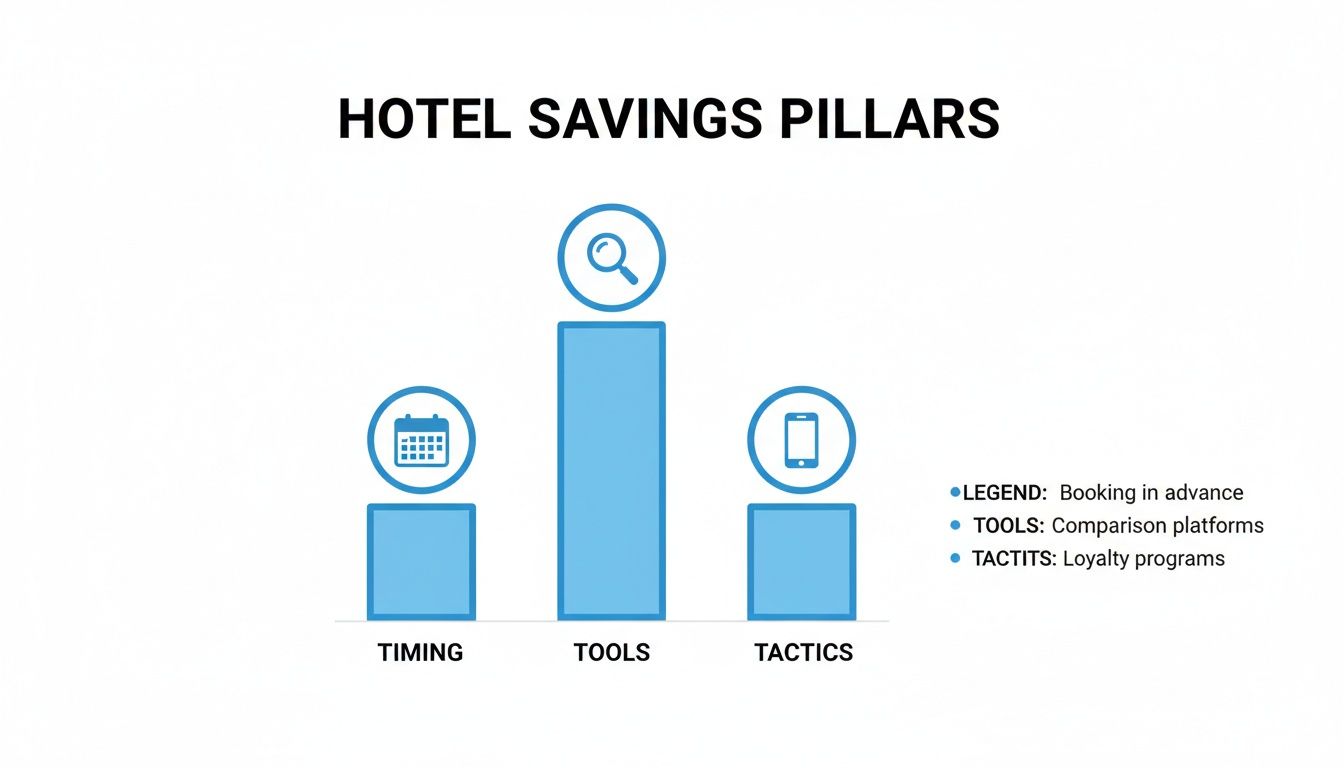
As you can see, the way you approach booking—from your travel dates to how you lock in the deal—has a massive impact on your final cost.
Find the Sweet Spot: Travel During the Shoulder Season
Every destination has a peak season, and you know what that means: sky-high prices and crowds. On the flip side, the off-season has rock-bottom prices but often comes with lousy weather or closed attractions.
The real secret is hitting the "shoulder season"—that perfect window just before or after the peak.
Think about it: booking Rome in May instead of July gets you gorgeous weather and breathing room at the attractions, all while paying a fraction of the peak summer hotel rates. The same logic works for ski resorts in late March or Caribbean islands in late April, right after the spring break chaos subsides. You get a premium experience without the premium price.
Stay Mid-Week for a Drastic Rate Drop
Weekend trips are popular for a reason, but that popularity sends hotel prices through the roof. Hotels know that demand spikes from Friday to Sunday, and they price accordingly.
If your schedule has even a little wiggle room, shifting your stay to the middle of the week can save you a bundle.
Let's say you're looking at a hotel in New York City. A room that goes for $300 on a Saturday night might be just $220 on a Tuesday. Over a three-night stay, that simple change just saved you a couple hundred bucks you can now spend on a great dinner or a Broadway show. A practical way to see this is to use the monthly calendar view on booking sites, which often color-codes prices, making the cheaper midweek days immediately obvious.
Pro Tip: Hotels that cater to business travelers often have their lowest rates on weekends when their corporate clients are back home. Always check both weekday and weekend prices to uncover those hidden deals. A hotel in a city's financial district, for example, is a prime candidate for a cheap weekend stay.
Think Outside the Tourist Zone
Everyone wants to be in the heart of the action, but that convenience comes at a steep price. Hotels in prime tourist traps charge a massive premium. By looking just a little further out, you can often find a much better hotel for way less money.
- For New York City: Instead of staying right in Times Square, check out hotels in Hell's Kitchen or the Upper West Side. A 15-minute subway ride is a tiny price to pay for saving $100+ per night. Use Google Maps to check the transit time from a potential hotel to your must-see sights before booking.
- For Los Angeles: A sprawling city like L.A. has tons of options. Staying in a central but less-hyped area like Culver City is way more affordable than Santa Monica or Beverly Hills, and you still have great access to everything.
This isn't just a U.S. trick. In Rome, booking a hotel in the charming Trastevere neighborhood instead of right next to the Colosseum not only saves you money but also gives you a more authentic, local vibe.
This strategy pays off globally. Big-picture pricing data shows that booking in regions experiencing a slowdown can lead to incredible discounts. For example, hotel rates in parts of Asia and Africa saw a 20% year-over-year drop in the first half of 2025. That's how savvy travelers find rooms in places like Malaysia for just $64 a night, while the U.S. average is sitting at $272. You can dive deeper into these global hotel pricing trends to find your next value-packed destination.
To see just how much your timing can impact the cost, take a look at these real-world examples.
Peak vs Off-Peak Hotel Rate Comparison
This table shows the stark difference in average nightly rates for a standard double room in popular destinations, comparing the pricey peak season to the much more affordable off-peak or shoulder seasons.
| Destination | Peak Season (Avg Nightly Rate) | Off-Peak Season (Avg Nightly Rate) | Potential Savings |
|---|---|---|---|
| Mykonos, Greece | July-August: $450 | May or September: $250 | 44% |
| New York City, USA | December (Holidays): $375 | January-February: $210 | 44% |
| Paris, France | June-July: $320 | October-November: $190 | 41% |
| Aspen, Colorado, USA | January (Ski Season): $600 | October (Fall Colors): $350 | 42% |
The numbers don't lie. The savings are substantial.
By simply being strategic about when and where you book, you're laying the groundwork for huge savings before you even think about promo codes or comparison sites.
Finding Value Beyond the Nightly Rate
That number you see on the booking site—the nightly rate—is just the opening act. A cheap rate can look like a steal until you get hit with resort fees, parking charges, and paid Wi-Fi. The real secret to saving money on hotels is looking past that initial price tag to see the total value of your stay.
Sometimes, a room that costs a little more but includes valuable perks is actually the smarter financial move. It's all about understanding the entire cost-benefit equation, not just grabbing the lowest advertised price.
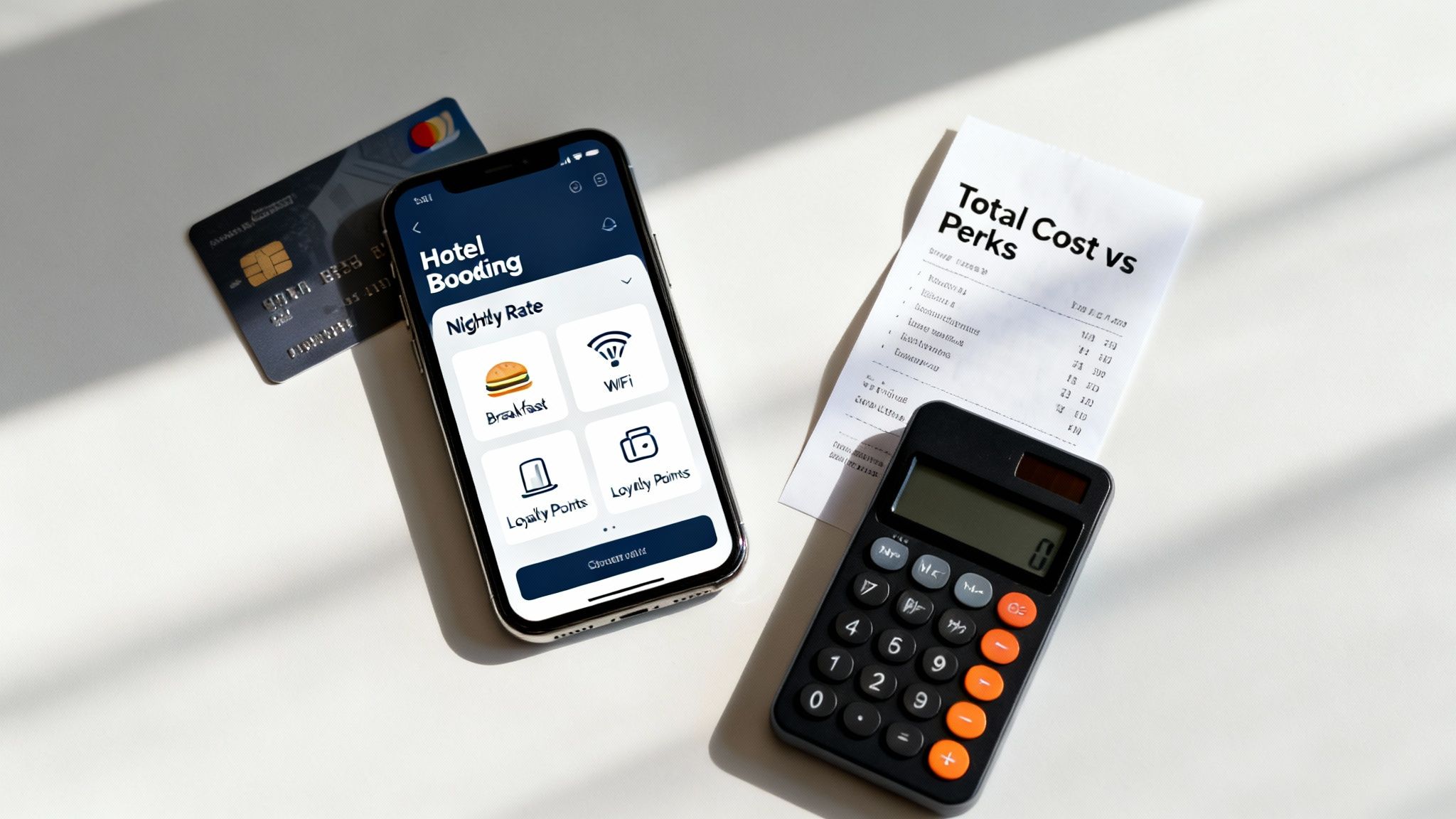
This shift in mindset is what separates rookie travelers from seasoned pros. You're not just booking a bed for the night; you're investing in an experience. True value comes from getting the most out of that investment.
Decoding Different Rate Types
You’ve probably noticed that the same room can have several different price points. These aren't random; they're tied to specific rules, and picking the right one can either save you a bundle or cost you dearly if your plans go sideways.
The most common decision you'll face is choosing between a flexible rate and a cheaper, non-refundable one. A non-refundable rate often dangles an immediate discount of 10-25%, which is hard to ignore. If your trip is 100% locked in and you have solid travel insurance, it can be a savvy move.
But if there's even a shadow of a doubt, paying a bit more for a flexible rate is your safety net. Life happens. Flights get canceled, work emergencies pop up. That slightly higher price buys you priceless peace of mind and the power to change or cancel without losing your entire payment.
Think about it this way: You book a non-refundable room for a three-night trip at $150/night, saving you $75 compared to the flexible rate of $175/night. If a last-minute conflict forces you to cancel, you're out the full $450. Had you paid for flexibility, you would be out $0. The actionable takeaway is to book the flexible rate early to lock in a price, then keep an eye out for deals. If a non-refundable rate drops significantly closer to your travel date and your plans are firm, you can cancel the flexible booking and re-book the cheaper rate.
Leverage Loyalty Programs and Credit Card Rewards
Hotel loyalty programs are free, and honestly, they're one of the most reliable ways to get more for your money. Even as a brand-new member, you can often score immediate perks like free Wi-Fi, a later checkout, or even a room upgrade if you get lucky. The benefits just get better as you build status.
Big players like Marriott Bonvoy and Hilton Honors have built entire ecosystems to reward you for coming back. Every dollar you spend earns points that you can cash in for free nights—the ultimate hotel savings. A free night in a hotel that would have set you back $300 is a direct, tangible win.
To really juice the system:
- Sign Up for Everything: Join the loyalty program for any hotel chain you might even consider staying at. It costs you nothing and immediately unlocks member-only rates and perks.
- Hunt for Promotions: Hotels constantly run promotions for double or even triple points. A quick scan of their website before you book can massively boost your points haul. For example, registering for a "double points on all stays" promotion for a $1,000 trip could net you an extra 10,000 points, enough for a free night at a lower-tier property later.
- Use Co-branded Credit Cards: If you find yourself loyal to one brand, their co-branded credit card can be a game-changer, fast-tracking your elite status and multiplying your points on every purchase.
Beyond the hotels themselves, your general travel credit card is a powerhouse. You can often transfer points from everyday spending to hotel partners or book stays directly through your card's travel portal, sometimes at a surprisingly good rate.
Uncovering the Value in Bundle Deals
Bundling your flight and hotel together through an online travel agency (OTA) like Expedia or Booking.com can sometimes unlock serious savings. These platforms negotiate package deals behind the scenes, passing a chunk of that discount on to you.
This trick works especially well for popular vacation spots like Orlando, Cancun, or Las Vegas, where OTAs have a massive inventory to play with. The key is to always compare the bundled price against the cost of booking everything separately.
For example, a flight to Vegas might be $300 and a hotel $500, for a total of $800 booked on your own. An OTA might offer that exact same flight and hotel as a package for $720—an instant 10% savings. Just do the math to make sure the bundle is a genuine deal. The goal is to find real value that improves your trip, not just another way to spend.
The Power of Direct Booking and Negotiation
While online travel agencies (OTAs) are incredible research tools, their listed prices are rarely the final word on what you should pay. One of the most powerful, yet often forgotten, strategies for saving money on a hotel is beautifully old-school: just pick up the phone.
Hotels fork over hefty commissions—often 15-25%—to OTAs for every single booking. When you book directly, that money stays with the hotel, giving them a massive incentive to win your business with a better deal. We're not just talking about a lower nightly rate; this opens the door to valuable perks OTAs simply can't offer.
Use OTA Prices as Your Starting Point
Don't ditch the comparison sites. Instead, learn to use their data to your advantage. Hunt down the best available rate on a site like Booking.com or Expedia, and think of that number as the beginning of a conversation, not the end.
Armed with that price, a simple five-minute call to the hotel's front desk can unlock serious value. Suddenly, you have leverage because you represent a far more profitable customer to them.
Simple Scripts for a Friendly Negotiation
You don’t need to be a master haggler. In fact, a polite, friendly tone works wonders. You're just asking a few smart questions to gently guide the front desk staff toward giving you a better deal.
Here are a few lines I've used that you can adapt for your own calls:
- The Price Match Play: "Hi there, I'm looking to book a king room for next Tuesday and saw it on Expedia for $220. I'd much rather book directly with you. Is there any chance you can match that rate, or maybe even do a little better?"
- The Special Occasion Nudge: "We are so excited to be celebrating our anniversary with you next month! I was just wondering if you have any complimentary upgrades or special amenities available for guests celebrating an occasion?"
- The Value-Add Angle: "I'm ready to book a room for three nights right now. If I book directly through you, are there any perks you might be able to include, like complimentary breakfast or perhaps waiving the resort fees?"
Often, the front desk has the power to offer small but meaningful extras. Getting free daily breakfast for two on a three-night stay can easily save you $90+. Getting a $35 daily resort fee waived adds up even faster.
Why Hotels Are Happy to Make a Deal
It's about more than just dodging that OTA commission. When you book direct, the hotel builds a relationship with you. They get your contact information for future marketing and have a much better shot at turning you into a loyal, repeat guest.
Direct bookers are often treated better, period. You're more likely to get a better room assignment, receive a warmer welcome, and have special requests honored. In their system, you're not just another confirmation number from a third-party site; you're their customer. That simple difference can completely change your stay, proving that a little conversation goes a very long way.
Alright, you've got the basics down—you're timing your bookings, using your points, and calling hotels directly. Now it's time to level up. These are the strategies I use to unlock serious value, the kind that completely changes the game.
This isn't just about knocking a few bucks off the nightly rate. It's about thinking like a global traveler and making the market work for you.

Play the Global Market with Destination Arbitrage
One of the most powerful, yet overlooked, concepts is destination arbitrage. All this really means is finding amazing places where your money goes further. A lot further. You’re essentially getting a 5-star experience for what a 3-star hotel would cost you back home.
Instead of defaulting to the usual high-priced cities, you get strategic. You pick destinations that offer incredible quality and experiences without the insane price tag.
Think about it: A nice hotel in New York or London can easily set you back $600+ a night. For that same amount, you could be living it up for several nights in a top-tier hotel in Lisbon, Mexico City, or Bangkok. Your budget suddenly feels enormous.
The data backs this up. In 2025, luxury international hotels are projected to be 27% cheaper on average than their U.S. counterparts. You can find incredible high-end rooms for under $200 a night in places like Hanoi or Auckland. Check out the latest global hotel price trends for 2025 to see for yourself.
Match Your Savings Strategy to Your Trip
A one-size-fits-all approach to saving money just doesn't work. The best deals pop up when you tailor your search to the specific kind of trip you're taking.
- Traveling with Family? Forget booking two rooms. Look for suites or apartment-style hotels that come with a kitchenette. For example, brands like Embassy Suites or Homewood Suites often include a separate living area, kitchenette, and free breakfast, saving you money on both space and food. Even better, pick up the phone and call the hotel to ask for guaranteed adjoining rooms—something that’s notoriously difficult to lock in online. That one call can save you a world of stress.
- A Business Trip or Work-cation? If you’re staying put for a while, don't book by the night. Most hotels offer steep discounts for longer stays. Always search for weekly or even monthly rates. You'll be amazed at how much the per-night cost drops. A practical example is searching for a 7-night stay versus a 6-night stay; sometimes the total price for seven nights is cheaper due to a weekly rate kicking in.
Your travel style dictates where the best value lies. A family saves more with a kitchenette to cut down on dining costs, while a remote worker benefits most from a long-stay discount and reliable Wi-Fi.
Embrace the Calculated Risk of "Mystery" Hotels
For those with a bit of an adventurous streak, opaque booking sites like Hotwire or Priceline's "Express Deals" can be a goldmine. These platforms offer massive discounts—we’re talking 30-50% off—on hotels, but there’s a catch: you won't know the exact hotel name until after you pay.
It's not a total shot in the dark, though. They give you the important details: the general neighborhood, the star rating, and a list of amenities.
This move is perfect when:
- You aren't married to a specific hotel brand.
- Your exact location within a neighborhood is flexible.
- You have a good feel for the star-rating quality in that city.
It’s a calculated gamble. The risk is ending up a few blocks away from your ideal spot. The reward? A top-notch hotel at a price you simply can't find anywhere else. A pro tip is to cross-reference the listed amenities (e.g., "Indoor Pool," "Pet-Friendly," "On-site Restaurant") with hotels in that area on a site like TripAdvisor to make an educated guess before you book.
Domestic vs International 5-Star Hotel Price Comparison
To see just how powerful a change in scenery can be for your wallet, let's look at the numbers. This table compares the average nightly rate for a 5-star hotel in a few major U.S. cities against what you'd pay in some incredible international spots.
| City | Country | Average 5-Star Nightly Rate |
|---|---|---|
| New York City | USA | $650 |
| Hanoi | Vietnam | $160 |
| Miami | USA | $580 |
| Pattaya | Thailand | $185 |
| Los Angeles | USA | $610 |
| Auckland | New Zealand | $195 |
The numbers don't lie. Shifting your focus beyond the usual domestic hotspots opens up a world of affordable luxury. These advanced tactics take a little more thought and flexibility, but the payoff is huge: a far richer travel experience that costs a whole lot less.
Your Top Hotel Savings Questions, Answered
Even when you feel like you've got all the tricks down, a few persistent questions always seem to surface right when you're about to book. It’s these little details that often make the difference between a good deal and a great one.
Let's clear up the confusion around some of the most common hotel booking myths so you can lock in your next stay with absolute confidence.
Is It Always Cheaper to Book a Hotel at the Last Minute?
This is probably the biggest gamble in travel, and honestly, it’s one that rarely pays off. While you might hear stories about someone snagging a wild last-minute deal, that's the exception, not the rule. More often than not, it's a high-stakes bet you'll lose.
Hotels run on dynamic pricing, just like airlines. As a hotel fills up, the price for the few remaining rooms goes up, not down. Waiting until the final hour usually means you’re left choosing between the most expensive rooms or a hotel you wouldn't have picked otherwise.
So, when does this strategy actually work? It’s a very narrow window:
- You have total flexibility with your dates and destination. For example, you live in Los Angeles and are open to a spontaneous weekend trip to either San Diego or Las Vegas, depending on which has better deals.
- You're traveling in the dead of the off-season when hotels are just trying to fill beds.
- You’re a solo traveler or couple who isn’t picky about room type.
For everyone else—especially families or anyone with fixed vacation days—booking ahead is almost always the smarter, safer, and cheaper path.
How Can I Save Money Without Elite Loyalty Status?
It's a common myth that you need to be a top-tier road warrior with a major hotel chain to get a good deal. The truth is, some of the most powerful saving tactics are available to anyone, no matter how many points you have (or don't have).
The best tools in your arsenal are simple: a little bit of diligence and a direct phone call.
First, use a price comparison site to get a baseline rate, then set up a few price-drop alerts for the hotels you're eyeing. It’s like putting your research on autopilot. Once you have a number, pick up the phone. As we talked about earlier, calling the hotel's front desk and simply asking if they can offer a better rate than what you see online is surprisingly effective. They can often throw in perks like free breakfast, a room upgrade, or waived resort fees. An actionable tip is to call during off-peak hours, like mid-afternoon on a weekday, when the front desk staff is less busy and more likely to help.
Are Flight and Hotel Package Deals a Good Value?
Bundles can be a fantastic deal, but they're not the automatic win they're often made out to be. Whether a package saves you money really boils down to where you're going and what kind of trip it is. You'll typically find the biggest savings on bundles for major tourist destinations like Las Vegas, Orlando, or all-inclusive resorts in Mexico and the Caribbean.
Online travel agencies buy flights and rooms in bulk, which allows them to offer a combined price that's lower than booking separately. But you have to do your own math. Always price out the flight and hotel on their own to see if the package is actually saving you money. For instance, open two browser tabs: one with the package deal and another where you're booking the exact same flight and hotel separately. This five-minute check can save you from a fake "deal."
Don’t get lured in by a low sticker price without reading the fine print. A "great deal" can quickly sour once you factor in hidden resort fees, terrible flight times, or iron-clad non-refundable policies.
What Is the Single Best Way to Save on a Hotel?
If I had to boil it all down to one "silver bullet," it would be this: strategic flexibility combined with diligent research. It’s less of a single action and more of a mindset. It’s about being willing to shift your dates by a day or two to land on a cheaper mid-week rate or choosing a fantastic hotel that's just a ten-minute walk from the main tourist drag.
Once you have a few flexible options, it’s time for the multi-layered price check. Compare rates across a few booking sites, check the hotel’s own website, and then—always—make that direct call. This process ensures you're seeing the whole board and can book the absolute best rate out there. It’s not about finding some hidden secret; it’s about having a smart, repeatable process you use every time.
Ready to stop overpaying for travel and unlock exclusive, members-only rates? Approved Experiences Traveler gives you access to wholesale pricing on over a million hotels, with savings of up to 70%. Start your journey toward smarter, more affordable luxury travel today. Learn more and become a member at https://www.approvedexperiences.com.
Article created using Outrank
Want the wider view?
Ten categories. One report. Every quarter. The Approved List tracks what's rising and what's fading: data-backed signals, not opinions.
Free to join · Delivered by email