
All Articles
The Journal
Vacation Rental Amenities That Actually Matter
September 16, 202613 min readvacation rental checklistfamily vacation rentals
Learn which vacation rental amenities matter most, how to prioritize by trip type, and how to verify listings before you book across 500,000+ homes.
You're coordinating a family trip for eight or ten people, and the property looks perfect until the details start to unravel. The Wi-Fi barely reaches the back bedrooms, the kitchen has fewer useful cooking tools than your home, and everyone shares the same bathroom during the morning rush. A beautiful listing can still create a difficult stay when its vacation rental amenities don't support the way your group lives.
That's why amenities aren't decorative extras. They're the operating infrastructure of a rental. Internet keeps people connected, kitchen capacity supports meals, bedroom separation protects sleep, and access features keep arrival from becoming a logistical problem. A pool or hot tub may shape the booking decision, but reliable essentials determine whether the property works after check-in.
This guide treats amenity selection as a practical planning exercise. You'll learn how to separate core systems from optional upgrades, prioritize features by trip type and length of stay, verify listing language before paying, and search larger inventories without jumping between disconnected platforms. If you're also improving the property itself, these stylish Airbnb decorating tips can help you pair visual appeal with functional comfort.
Introduction Why Amenities Make or Break Your Stay
A multi-generational trip usually fails in small, predictable ways. Grandma needs a bedroom that isn't reached by steep stairs. Parents need a kitchen that can handle breakfast for the whole household. Teenagers need a stable connection, and the person organizing the trip needs parking, clear entry instructions, and enough bathrooms to keep everyone moving.
None of these needs sounds luxurious. Together, they determine whether the rental behaves like a workable home or a collection of attractive rooms.
The distinction matters because guests don't experience amenities separately. They experience a chain of daily routines. A washer supports a longer stay, but only if guests can find detergent and understand the controls. A workspace helps a remote worker, but only if the chair, lighting, outlets, and internet support a normal workday. A full kitchen saves restaurant trips, but only if there are enough pans, knives, plates, and refrigerator space for the household.
Planning rule: Choose amenities by asking what could create a bottleneck, not what looks impressive in a listing photo.
Search visibility is part of the same system. Platforms group properties by amenity filters, so a feature that's accurately listed can help the right guest find the home. A vague phrase such as “internet available” gives a family little confidence about streaming, schoolwork, or video calls. “Kitchen” also needs context. It might mean a full cooking space, or it might mean a kitchenette with limited equipment.
The strongest booking process follows a simple sequence:
- Define the trip: Identify whether you're booking for a reunion, an extended seasonal stay, or work-from-anywhere travel.
- Find the friction points: Look at sleeping arrangements, bathrooms, meals, connectivity, laundry, climate, parking, and entry.
- Prioritize the infrastructure: Fund or filter for the features that keep daily routines moving.
- Verify the wording: Ask specific questions before assuming a checked box means full functionality.
A rental can have stylish furniture and thoughtful artwork while still being operationally incomplete. The right amenities reduce coordination for the organizer and friction for every traveler, from young children to older adults.
What Vacation Rental Amenities Really Mean
A vacation rental amenity is any feature or system that adds comfort, convenience, access, or enjoyment to a stay. That definition is broad, so it helps to sort features by the job they perform rather than by how luxurious they sound.
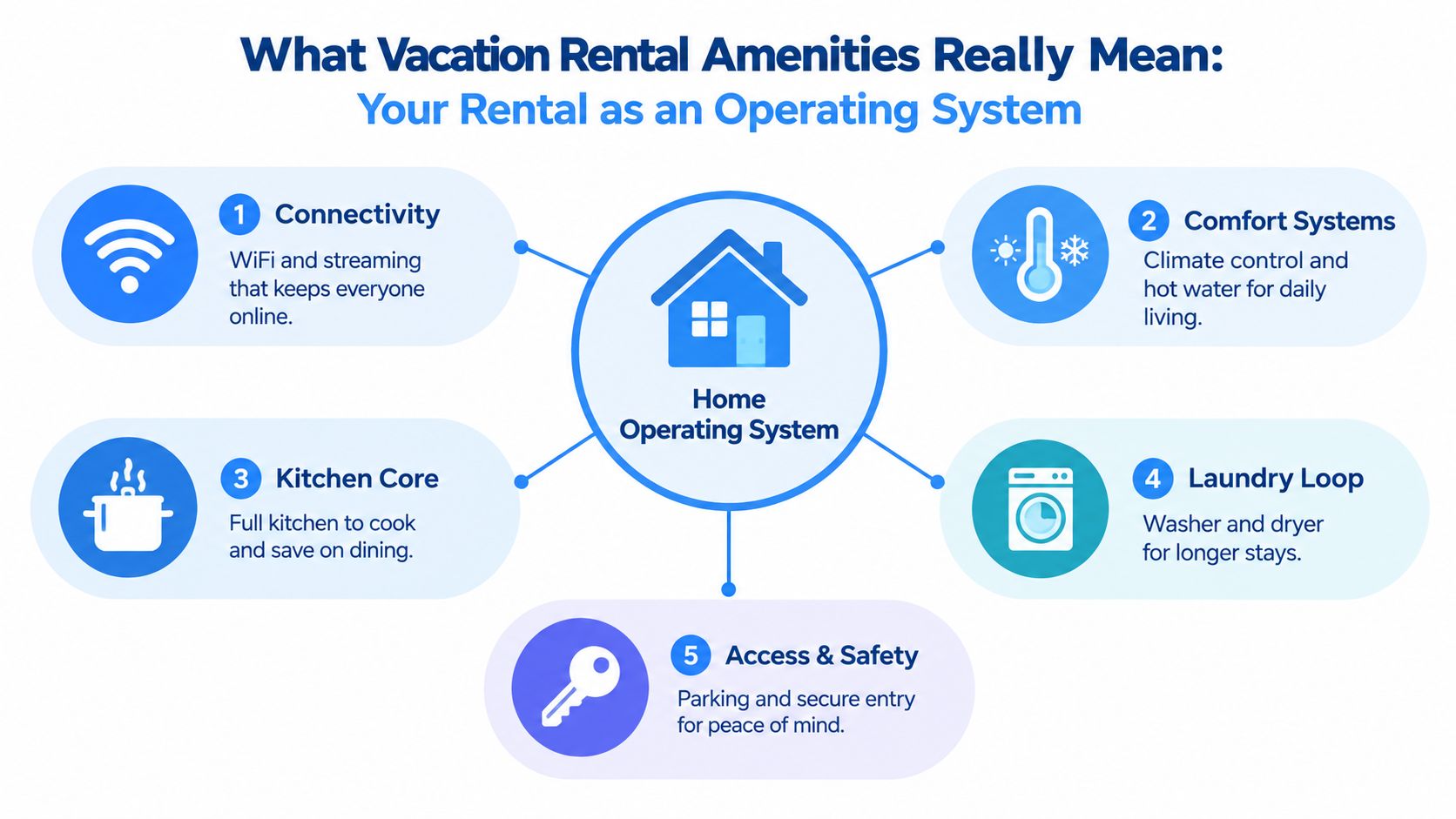
Think of the home as an operating system. Connectivity is the network layer. Climate control and hot water keep the environment usable. The kitchen handles food preparation. Laundry supports repeated daily routines. Parking, secure entry, and clear access instructions manage arrival and movement. A pool, hot tub, view, or dedicated workspace then works like a specialized module built around a particular kind of traveler.
Start with the systems that keep the home running
Core infrastructure answers practical questions:
- Can everyone connect their devices reliably?
- Can the household prepare a meal?
- Can guests sleep comfortably in the local climate?
- Can they wash clothes during a longer visit?
- Can they enter the property without confusion?
- Can the available parking handle the group's vehicles?
These systems don't always photograph as dramatically as a pool or mountain view, but their absence becomes obvious quickly. A guest may admire a stylish living room for a few minutes. They'll notice an unusable kitchen every time they try to prepare breakfast.
Specialized amenities serve a narrower purpose. A hot tub may matter greatly to a winter leisure group and hardly at all to a family spending most of its time at the beach. A desk may be decisive for a remote worker but irrelevant to someone booking a short sightseeing trip. The feature's value depends on the job the rental must perform.
Read platform categories like an operator
Platforms use amenity categories to help guests filter inventory. That creates a difference between having a feature and describing it precisely. A listing may technically offer Wi-Fi, but the useful question is whether the connection is stable throughout the property and suitable for the household's expected use.
The same principle applies to bathrooms, parking, air conditioning, laundry, and kitchen access. Look for details about location, capacity, coverage, and exclusivity. “Parking available” doesn't tell you whether the space is private, shared, street-based, narrow, or suitable for more than one vehicle.
A shopper asks, “Does this home have a kitchen?” An operator asks, “Can this kitchen support our meals, storage needs, and group size?” That second question leads to better bookings because it evaluates the rental as a functioning environment rather than a checklist.
The Amenities Guests Value Most and Why
Guest preferences show a clear connection between amenities and everyday friction. In a 2024 Booking.com host-research summary, 70% of global travelers said a free internet connection was very or extremely important. The same summary reported that 53% appreciated a nice view, 39% valued cooking facilities, and 33% responded positively to spa facilities (Booking.com's vacation rental amenity guidance).
The hierarchy makes practical sense. Connectivity affects communication, entertainment, navigation, schoolwork, and remote work. A view affects the emotional character of a stay. Cooking facilities help families and long-stay guests manage meals. Spa facilities create a sense of retreat, but they don't replace the basic systems that make a home usable.
The same Booking.com summary found that 24-hour check-in and parking were appreciated by more than half of global guests, while device connectivity was welcomed by 39%. It also identified climate-oriented amenities as being among the most requested features across major traveler cohorts. These preferences describe a complete operating environment, not a collection of isolated luxuries.
Why the numbers translate into booking behavior
A guest searching for a family home may begin with location and dates, then narrow the options using parking, kitchen, air conditioning, laundry, or pool filters. A remote worker may treat internet and a desk as screening criteria. A long-stay retiree may care more about cooking, laundry, climate control, and easy access than about decorative upgrades.
Historical U.S. data points in the same direction. A 2015 Tripping survey found that 38% of U.S. consumers named Internet or Wi-Fi as their number-one in-house amenity, while 33% ranked a pool or hot tub second (Tripping's vacation rental amenity survey). The survey also showed meaningful demographic variation. Among women aged 25 to 34, 50% chose a pool or hot tub first and 48% chose Wi-Fi, while among women aged 35 to 44, the figures were 37% and 29%, respectively.
That variation matters for hosts and bookers. There isn't one universal amenity hierarchy. A destination feature can be highly valuable when it matches the audience, while infrastructure remains broadly useful across groups.
Pricing power follows decision-changing features
High-signal amenities can affect pricing because they influence search visibility and guest segmentation. Independent host-market analysis reports that a private pool can lift peak-season nightly rates by 35% to 60% in many U.S. markets, while a hot tub typically adds 20% to 35% ADR, particularly where a pool isn't practical (AvantStay's vacation rental amenity analysis).
The operational lesson is more important than the exact feature. One destination amenity that changes the booking decision can be more valuable than several minor additions that guests barely notice. Hosts should connect the feature to the audience, photograph it, and maintain it consistently.
How to Prioritize Amenities by Trip Type and Length of Stay
The right amenity mix changes when the trip's “job” changes. A family reunion needs flow and separation. A seasonal stay needs self-sufficiency. A work-from-anywhere trip needs predictable performance during ordinary weekdays.
For multi-generational groups, start with bottlenecks. Separate bedrooms help different households preserve routines and sleep schedules. Bathroom count and configuration affect morning flow, especially when some bathrooms are shared or only partially equipped. Kitchen capacity and parking matter because group meals and arrivals create concentrated demand. A family-rental guide from Lumina emphasizes these same pressure points, including the importance of confirming whether bathrooms are full or half baths and whether they're ensuite or shared (Lumina's guide to group-friendly family rentals).
A longer stay has a different rhythm. Guests need to cook repeatedly, wash clothes, store food, manage supplies, and maintain a comfortable workspace or living area. A feature that feels optional for a weekend can become central after several weeks. Market analysis associates cooking basics with roughly 17% higher host earnings and laptop-friendly workspaces with about 14% higher earnings (Ximplifi's vacation rental amenity analysis). Those figures should be treated as market analysis, not a guarantee for any individual property.
Remote workers need performance details rather than broad labels. Expedia Group's resource identifies 100 Mbps or more Wi-Fi as a key benchmark for digital-nomad rentals and states that video calls need at least 25 Mbps upload speed for reliable performance (Expedia Group's work-from-home amenity guidance). A dedicated desk, task lighting, accessible outlets, quiet surroundings, and a clear cleaning process complete the daily-use picture.
Amenity Priorities by Trip Type
| Trip Type | Top Priority Amenities | Why It Matters |
|---|---|---|
| Multi-generational family reunion | Bedroom separation, bathroom count and configuration, kitchen capacity, laundry, parking, safe access | Reduces morning queues, protects sleep, and keeps multiple households coordinated |
| Long-stay seasonal visit | Full kitchen, cooking storage, washer and dryer, climate control, comfortable seating, reliable internet | Supports repeated routines and reduces dependence on restaurants and frequent supply runs |
| Work-from-anywhere trip | Published download and upload speeds, dedicated desk, ergonomic seating, outlets, quiet zone, strong climate control | Protects work continuity while preserving a comfortable residential stay |
A destination amenity still matters, but it should be selected after the core bottlenecks are covered. If you're planning for a larger household, this guide to a vacation rental for large groups adds another useful planning reference.
Hosts also need to maintain the systems they advertise. A reliable Canes Cleaners Airbnb turnaround service can support consistent changeovers, but the host still needs an inventory process for linens, kitchen equipment, access devices, and safety items. Cleanliness doesn't fix an undersized kitchen, and attractive furnishings don't compensate for missing beds or inadequate bathrooms.
Verification Checklist Before You Book
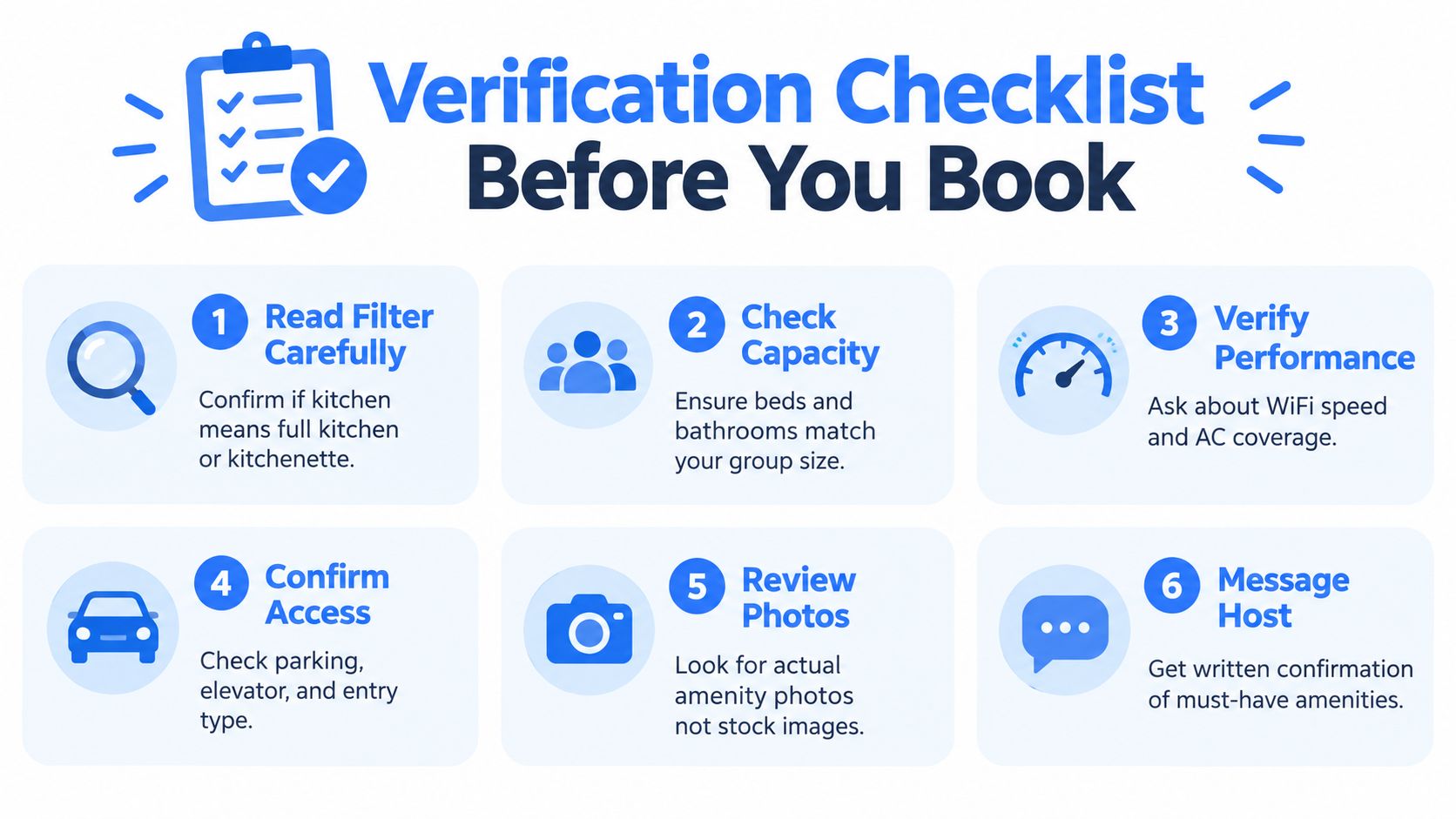
A platform filter is a starting point, not proof that an amenity will work for your group. Verification means translating a broad listing label into a capacity, location, and performance question.
Begin with the infrastructure that would be hardest to replace after arrival. For internet, ask for download and upload speeds, whether the connection reaches every bedroom, and whether the host has a backup option. For air conditioning, ask which rooms are covered and whether guests control the system. For the kitchen, confirm the cooking equipment, refrigerator capacity, dishwasher access, and the number of place settings.
Convert vague labels into direct questions
Use a written message so the host can answer each point clearly:
- Internet performance: “What are the advertised download and upload speeds, and does the signal reach the bedrooms and workspace?”
- Kitchen function: “Is this a full kitchen or kitchenette? Which appliances, cookware, knives, and serving items are provided?”
- Bathroom layout: “How many full bathrooms are there? Which are ensuite, and which are shared?”
- Sleeping capacity: “Are all listed beds permanent beds, and where are they located?”
- Parking access: “Is parking private, reserved, covered, or shared? How many vehicles can use it?”
- Entry process: “Is check-in self-guided? Are there stairs, an elevator, a gate, or a time-sensitive key collection?”
- Climate coverage: “Does every sleeping area have heating or cooling, and can guests adjust it?”
The wording matters because “sleeps ten” may include sofa beds or sleeping areas without privacy. “Washer available” may refer to a shared laundry room rather than an in-unit machine. “Pool access” may mean a community facility with opening rules, not a private pool at the home.
Audit photos and reviews for operational evidence
Photos should show the actual amenities, not just the most attractive rooms. Look for the kitchen work surfaces, appliance placement, bathroom entrances, bed arrangement, desk position, parking area, and access route. If a feature is important but never appears in the photos, ask why.
Reviews can reveal repeated friction. Search for mentions of internet stability, hot water, noise, stairs, parking, kitchen equipment, mattress comfort, and check-in. One isolated complaint may reflect an unusual event. Repeated comments point to a system that deserves clarification.
For accessible or luxury properties, use the same discipline. A luxury vacation rental should be evaluated by the performance and privacy of its features, not by the label alone. Written confirmation protects the booking decision because it gives you a record of what the host said the property would provide.
How to Search and Filter for Amenities at Scale
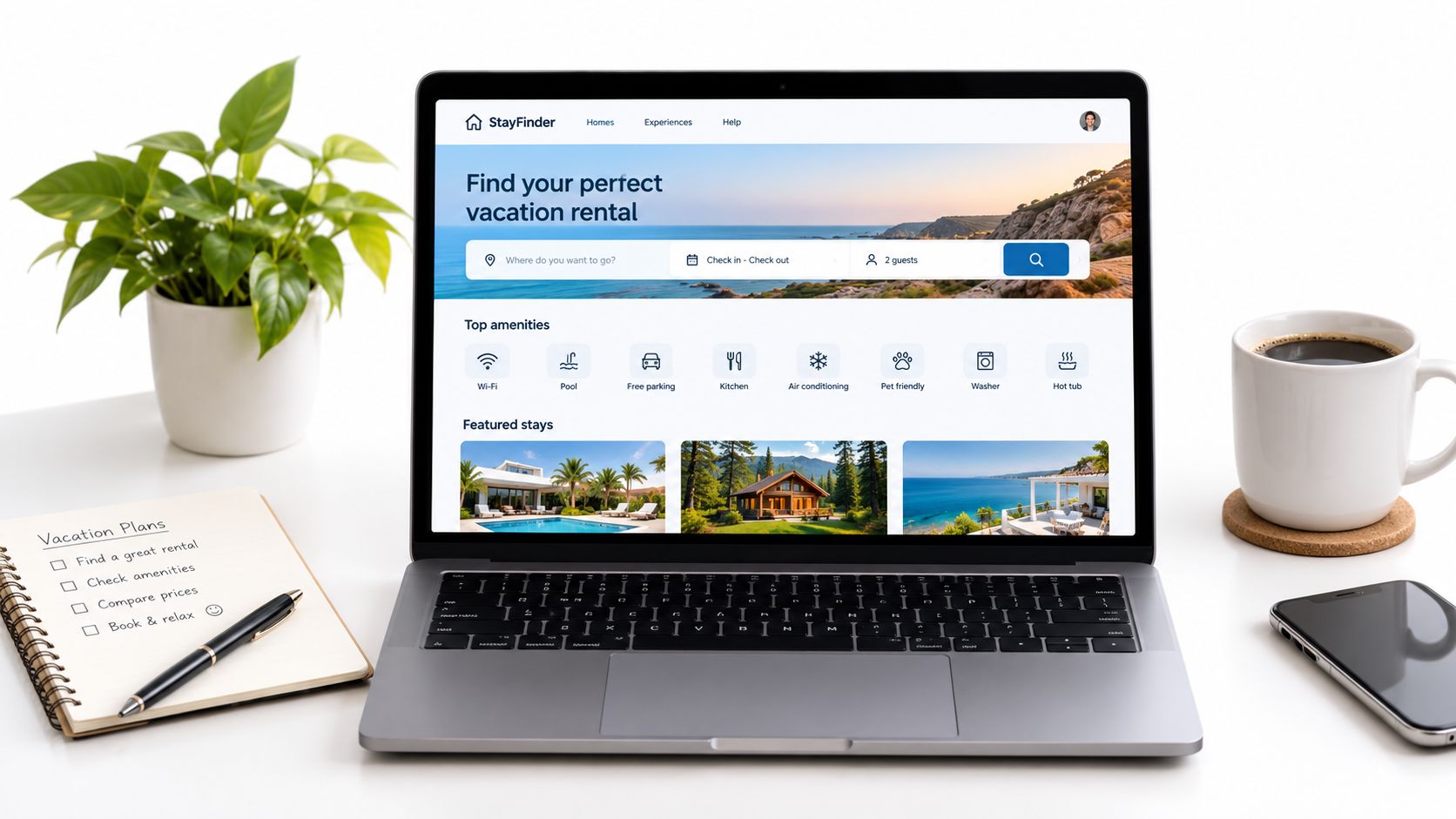
Searching for a suitable rental becomes difficult when the inventory is fragmented. One platform may have strong filters for pools and hot tubs, another may describe kitchens better, and a third may expose weekly or whole-home inventory that the first two don't show clearly. Moving between sites also makes it harder to compare amenity definitions consistently.
A consolidated marketplace changes the workflow. Instead of opening separate searches for each destination, household configuration, and amenity combination, you can start with the trip requirements and filter the available inventory around them. Approved Experiences Traveler provides access to 500,000+ vacation homes, alongside 1,000,000+ hotels, 700+ airlines, 44+ cruise lines, 30,000+ car rental locations, 5,500+ tour packages, and 150,000+ activities, according to the publisher's stated marketplace scope.
Build the search around the trip's constraint
Start with the essentials, not the visual wish list. For a family group, filter for whole-home inventory, bedroom separation, bathroom capacity, parking, kitchen access, and a destination amenity such as a pool or hot tub. For a long stay, prioritize laundry, kitchen functionality, climate control, workspace, and calendar availability. For remote work, confirm the connection details with the host after filtering.
This approach helps preserve pricing power without confusing decoration with infrastructure. A private pool may carry meaningful rate influence in suitable markets, while a pool that isn't open during the travel period has no practical value. A hot tub may be the better fit where climate, HOA rules, or lot constraints make a pool infeasible, as the host-market analysis linked earlier explains.
The platform's other operating features can also matter. Approved Traveler members earn Reward Credits on every booking, and the membership includes a 110% Best Value Guarantee if a member finds a lower publicly available price, with the refund based on 110% of the difference. Those features belong in the booking-cost analysis, after the property passes the amenity and performance tests.
Use travel booking tools to organize dates, household requirements, and comparisons before you commit. For complex family coordination, Lux Traveler adds the Approved Lux 24/7 Personal Assistant, which can help manage travel logistics and household scheduling for up to 10 household members.
Conclusion Choosing Amenities That Deliver Real Value
The best vacation rental amenities don't make a property look appealing. They determine whether the home can support the people, routines, and responsibilities brought into it. Reliable connectivity, usable kitchens, appropriate climate control, workable bathrooms, laundry, parking, and straightforward access form the infrastructure. Pools, hot tubs, views, and workspaces add value when they match the trip.
Choose by consequence. For a family reunion, prevent queues and sleep disruption. For a long seasonal stay, protect independence through cooking, laundry, storage, and climate systems. For remote work, verify bandwidth, upload performance, desk setup, and quiet. Then select one destination amenity that can change the booking decision instead of scattering resources across low-signal extras.
Before paying, convert every important listing label into a direct question. Confirm the answer in writing, compare the property against the group's daily routines, and use consolidated inventory when fragmented searches make that comparison difficult. The right rental won't eliminate every travel surprise, but it will remove avoidable friction from breakfast through bedtime.
Approved Experiences Traveler gives members consolidated access to vacation-home inventory and related travel infrastructure, including amenity-based rental searches, Reward Credits, and the 110% Best Value Guarantee. Review your trip requirements, then visit Approved Experiences Traveler to compare suitable vacation homes and coordinate the rest of the journey from one platform.
Want the wider view?
Ten categories. One report. Every quarter. The Approved List tracks what's rising and what's fading: data-backed signals, not opinions.
Free to join · Delivered by email