All Articles
The Journal
What Are Operations Support Services and How Do They Work
February 7, 202619 min readpersonal operationslifestyle management
Discover how operations support services streamline your life by managing complex tasks, reducing mental load, and freeing up your time for what matters most.

Think of operations support services as the operating system for your life and work. It's the powerful, behind-the-scenes engine that manages all the complex moving parts that drain your time and mental energy. It acts like a personal chief of staff, handling the crucial logistics so you can focus on what actually moves the needle.
Your Personal OS: Understanding Operations Support Services
Imagine trying to run the latest, most demanding software on a computer with a 20-year-old operating system. It would lag, glitch, and probably crash. That's exactly how many successful founders, professionals, and busy families operate—juggling high-stakes decisions with a personal 'OS' patched together with sticky notes, mental reminders, and a chaotic inbox. This constant context-switching puts a serious drag on your performance.
This is precisely the problem operations support services solve. It's not just about hiring someone to check off a to-do list; it’s about implementing an integrated system for execution. This support layer is the invisible force making sure your personal and professional life runs like a well-oiled machine, much like your computer’s OS manages countless processes without you ever having to think about it.
The Air Traffic Controller for Your Life
A great way to think about it is as your own personal air traffic controller. You're the pilot, and your focus should be on flying the plane—making big strategic decisions, closing a game-changing deal, or just being fully present with your family. Your operations support team is on the ground, managing everything else.
- Coordinating Landings and Takeoffs: They handle the intricate scheduling of meetings, personal appointments, and your kids' soccer games.
- Managing Airspace: They're the ones researching travel options, booking the flights, and arranging for a car to be waiting when you land.
- Monitoring Weather Patterns: They proactively deal with potential disruptions, like finding a reliable plumber to fix a leak before it turns into a disaster.
- Clearing Runways: They take care of the administrative grind—paying bills, making dinner reservations, and processing tedious paperwork.
By offloading all of this coordination, you reclaim an incredible amount of cognitive bandwidth. You're no longer forced to abruptly switch from a critical work project to figuring out a dinner reservation or scheduling a home repair.
To really get what these services are about, it helps to see that the main goal is to boost your personal efficiency. A good starting point is understanding the principles behind What is operational efficiency in a business setting and then applying that same focused mindset to your own life.
Beyond a Traditional Assistant
This approach is fundamentally different from hiring a standard assistant. Instead of managing a person, you’re plugging into a system built from the ground up for reliability and flawless execution. It’s an "always-on" support layer that takes full ownership of outcomes, not just single tasks.
You can get a better sense of how this model stands apart by exploring its differences from a virtual assistant for personal tasks. At the end of the day, operations support services provide the essential structure that helps you shift from a life of reactive problem-solving to one that is proactive, intentional, and smooth.
The Real Payoff: Reclaiming Your Time and Focus
Every high-achiever fights a silent battle against an invisible enemy: decision fatigue. It's the mental exhaustion that comes from making countless small, logistical choices that slowly drain your brainpower. Should you book the 7 AM flight or the 9 AM? Which contractor is the right one to fix the kitchen leak? What's the most efficient route for school drop-offs this week?
Each one of these questions, no matter how small, chips away at the same mental energy you need for big-picture thinking and creative problem-solving. This is where operations support services come in. It’s not just about ticking items off a to-do list; it’s about strategically offloading all that logistical noise to get back your two most critical assets: time and focus.
Lightening Your Mental Load
The true cost of juggling every detail of your life isn't just about the hours you lose. It's the constant, low-level mental processing that runs in the background, like having too many apps open on your computer. Eventually, everything starts to lag. An operations support service acts like an external hard drive, handling the heavy lifting of coordination, research, and planning so your own "CPU" can operate at its peak.
This is all about moving from a mind cluttered with endless reminders to one that's clear and ready for what's important.
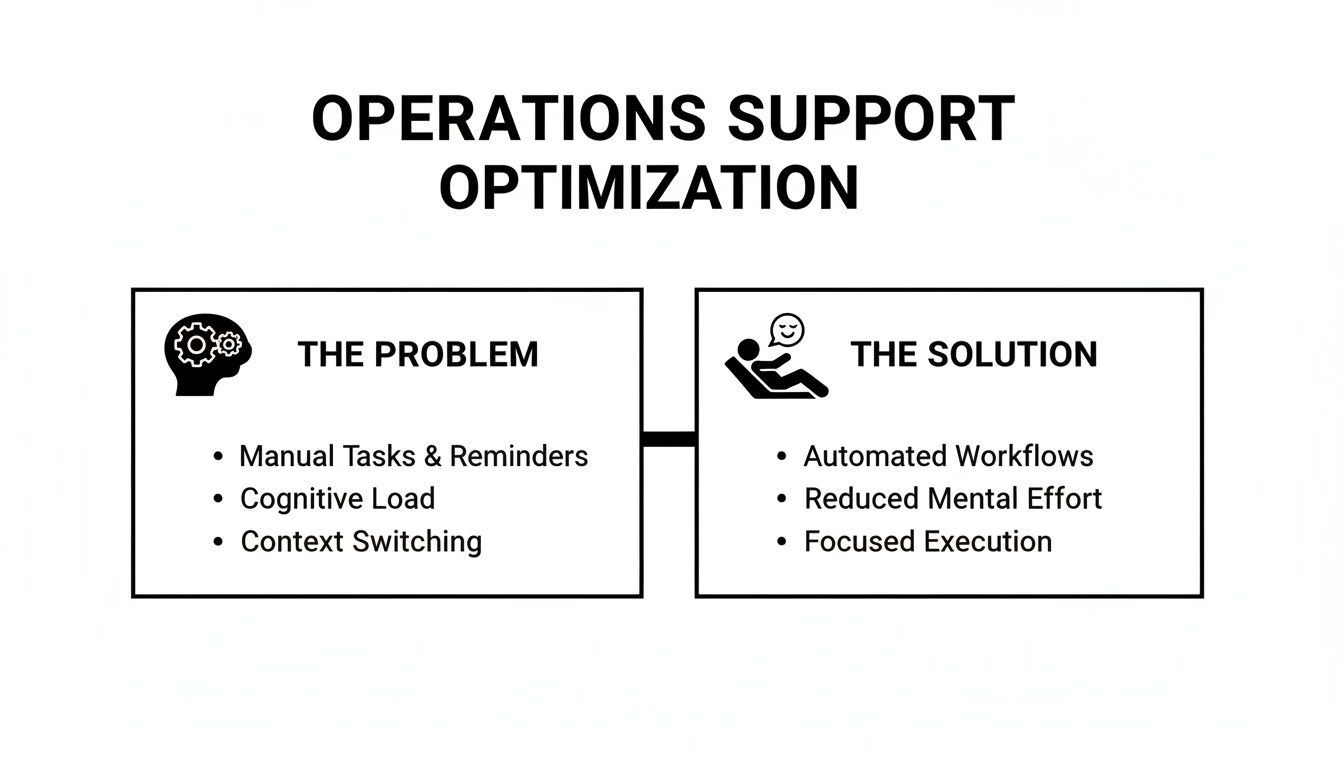
The image above really gets to the heart of it: turning mental chaos into focused clarity by handing off the logistical burden.
This isn't just a life hack; it's a powerful principle that scales from your personal life all the way up to global corporations. The worldwide market for business support services is expected to hit a staggering USD 989.81 billion by 2030, growing at a steady 8.1% each year. This boom is fueled by a simple truth: outsourcing non-essential functions allows organizations to double down on what they do best. It’s a proven strategy you can apply directly to your own life.
Comparing Your Options for Managing It All
So, how do you get things done? You really have three main paths, and each one comes with its own set of trade-offs in terms of your time, money, and mental energy.
Task Management Approaches Compared
Let's break down the common ways people try to manage their overwhelming task lists and see how they really stack up.
| Aspect | DIY (Do-It-Yourself) | Traditional Personal Assistant | Operations Support Service (e.g., Approved Lux) |
|---|---|---|---|
| Effort Required | High. You're on the hook for all the research, coordination, and follow-through. | Medium. You still have to hire, train, and manage another person. | Low. You submit a request and the system takes over from there. |
| Time Investment | Very High. Your personal and professional hours get eaten up fast. | High. Finding the right person, onboarding, and daily check-ins take time. | Minimal. The entire model is built around brief, clear communication of your goals. |
| Cost Structure | Low direct cost, but high opportunity cost. What could you have earned in that time? | High fixed cost. You're paying a salary, benefits, and payroll taxes. | Flexible subscription. Costs are predictable and scale with your needs. |
| Mental Load | Maximum. You own every decision and worry about every detail. | Moderate. You've offloaded tasks, but you're now managing a direct report. | Minimum. The service is designed to remove decision fatigue, not add to it. |
As the table shows, there’s a clear difference. Modern operations support services aren't just another person to manage; they're an execution-focused system you simply plug into. The model is built for reliability and efficiency, focused on delivering outcomes with as little friction as possible. Of course, getting the most out of any support system means knowing how to delegate tasks effectively.
The biggest takeaway here is that an operations support service is much more than just task completion. It's a strategic investment in creating more capacity for what truly matters—whether that's scaling your business, innovating in your field, or just being fully present with your family.
Ultimately, it’s a choice that delivers a powerful return on investment measured not just in saved hours, but in the peace of mind that comes from operating with a clear, focused mind.
How Operations Support Works in The Real World
Theory is great, but let's be honest—what really matters is how this stuff works day-to-day. The real magic of operations support services isn't in a definition; it's in seeing how they can take the abstract chaos of a to-do list and turn it into real-world progress that frees up your mind and your time.
Let's dive into a few concrete stories to see how this support layer actually fits into the lives of busy people.

These aren't just hypotheticals. They show the actual flow of communication, the specific tasks getting checked off someone else's list, and the powerful result of having a reliable system running your life's logistics in the background.
Scenario One: The Founder Prepping for a Global Launch
Meet Alex. He's the founder of a tech startup on the verge of a massive product launch. To get there, he has to pull off a grueling two-week, four-city international trip to lock down investors and partners. The logistics are a beast: different time zones, tight flight connections, and back-to-back meetings.
Instead of losing entire days to planning, Alex sends a single, straightforward brief to his operations support team: "Need a full itinerary for my trip to London, Berlin, Singapore, and Tokyo from June 10th to 24th. Meeting schedule is attached. Please book all flights, ground transport, and hotels near each meeting location. Also, book dinner reservations for two in each city."
That’s it. His team gets to work immediately. Less than a day later, a clean, consolidated itinerary lands in his inbox with all confirmations.
- Complex Travel, Handled: Flights are booked to minimize layovers and travel fatigue. All ground transportation—from airport pickups to Ubers between meetings—is scheduled and ready.
- Accommodations, Secured: Hotels are hand-picked for their proximity to his meetings and solid reviews. All the booking details are managed for him.
- Client Dinners, Planned: Highly-rated restaurants perfect for business dinners are researched and reserved in each city, taking all the guesswork out of playing host.
The result? Alex walks onto the plane focused entirely on his investor pitches, not on whether his rental car will be there when he lands. He easily saved 15-20 hours of tedious planning and dodged a huge source of stress, allowing him to be at the top of his game for a trip that could make or break his company.
Scenario Two: The Family Juggling a Hectic Summer
Now let's look at the Miller family. With two school-aged kids, summer is a logistical cyclone of camp sign-ups, vacation planning, and home projects they’ve been putting off for months. Their mental to-do list is a mile long and frankly, it's exhausting.
They decide to use their operations support service as a central command for their family. Over the course of a week, they fire off a few requests:
- "Sign both kids up for their preferred summer camps. All registration info is in our shared folder."
- "Find and schedule a reliable contractor to repair the backyard fence before our family reunion in July."
- "Plan our one-week beach vacation. We need a family-friendly rental with a pool within a five-hour drive."
The support team takes full ownership. They wrestle with the clunky camp registration websites, vet local contractors by checking reviews and insurance, and come back with three perfect vacation rental options, complete with pricing and availability.
The Millers didn't just outsource tasks; they outsourced the entire management process. They skipped the endless back-and-forth emails, the follow-up calls, and the mental energy drain of keeping all those balls in the air. Their summer just became about relaxing, not running a marathon of errands.
Scenario Three: The Executive Blending Work and Life
Finally, meet Sarah. She's a senior executive whose professional calendar is as demanding as her personal life is full. She needs a system that can manage both worlds without letting anything slip through the cracks.
Her operations support service acts as a true extension of her own brain. Her requests are a mix of professional and personal needs:
- Calendar Harmony: "Please sync my personal and work calendars, resolve all scheduling conflicts for next month, and add buffer time between meetings."
- Thoughtful Gifting: "My parents' anniversary is next week. Find a great gift basket from a local gourmet shop and have it delivered."
- Seamless Event Planning: "Organize a catered dinner party for 12 guests at my home to celebrate a recent promotion."
Her service becomes the execution partner she can count on. Her calendars are merged and optimized. A beautiful, locally sourced gift basket is on its way. A top-notch caterer is booked and digital invitations are sent. This is the kind of high-level help that the best executive assistants provide, delivered through a flexible, on-demand service. To get a better sense of what's possible, check out these common tasks of an executive assistant.
For Sarah, the outcome is a feeling of being in total control, without having to manage every last detail herself. She’s free to focus on leading her team at work and actually enjoying her own party, confident that all the logistics are humming along perfectly in the background.
How to Choose the Right Operations Support Service
So, you see the value in getting operations support. That's the easy part. Now for the real challenge: picking a provider that actually fits into your life. This isn't just about hiring someone to check off tasks; it’s about finding a true partner that can act as a reliable execution layer for your entire world, both personal and professional.
Making the right choice means looking past the slick marketing. You’ve got to get into the weeds of how they work, how they communicate, and what they guarantee. The wrong provider will create more headaches than they solve, so a little due diligence now pays off big time later.
And you're not alone in looking for this kind of help. The global market for operations and business support is already valued at around USD 83.9 billion and is expected to grow by a massive 15.8% each year. This isn't just a niche trend; it's a fundamental shift in how people are getting things done. You can see more on this expanding market and its drivers on technavio.com.
Key Features to Scrutinize
Let’s be honest, not all operations support services are built the same. As you start comparing options, zoom in on the features that actually matter for day-to-day effectiveness. These are the things that separate a simple task-doer from a genuine operational partner.
First, look at their integration capabilities. How easily can their service plug into the tools you already use every day? A provider that forces you to abandon your favorite calendar or communication apps is creating friction, not removing it. The whole point is for them to blend into your existing workflow, not make you build a new one around them.
Next, get a clear picture of what they can actually do. A top-tier service should be able to handle a wide spectrum of logistical headaches, like:
- Complex Travel Planning: We’re talking multi-city international trips, not just booking a single flight.
- Household Management: Juggling plumbers, cleaners, and other home vendors so you don't have to.
- Event Coordination: Anything from a small dinner party to a significant family celebration.
- Scheduling and Calendar Management: Protecting your time by untangling personal and professional commitments.
Finally, check out their communication style. Is it flexible? Can you shoot them a text, send an email, or use an app? Submitting a request should feel as natural as messaging a friend.
Understanding Service Level Agreements (SLAs)
The term Service Level Agreement (SLA) might sound like dry corporate-speak, but it's probably the most critical document you'll look at. An SLA is simply the provider's written promise to you. It sets clear expectations and holds them accountable.
An SLA isn't just a policy; it's the foundation of trust. It tells you exactly what to expect in terms of response times, availability, and reliability, ensuring there are no surprises when you need support the most.
A solid SLA should clearly spell out a few key things:
- Response Times: How quickly will they acknowledge your request? For urgent needs, what's their guarantee? You should be looking for acknowledgement within an hour or less during business hours.
- Availability: Is support available 24/7, or do they clock out at 5 PM? If you travel across time zones or keep odd hours, "always-on" support is non-negotiable.
- Reliability Guarantees: What happens when they mess up? A good SLA will define how they fix mistakes and make things right, showing they take ownership.
Questions to Ask Potential Providers
Before you sign on the dotted line, come prepared with a handful of smart questions. The way they answer will tell you everything you need to know about their process and whether they’re the right fit for you.
- What does your onboarding process look like for a new client?
- Will I work with a dedicated team or a random person from a call center?
- How do you ensure my confidential information stays private?
- Can you give me a real-world example of a complicated request you've handled?
- What are the specific response and resolution times in your standard SLA?
- How do you actually measure client satisfaction?
Choosing the right operations support service is an investment in your own focus and sanity. By concentrating on these key areas and asking direct questions, you can find a partner who will genuinely help you perform at your best.
Building an Operations Layer for Your Life
Think about the best platforms you use every day. They’re clean and simple on the surface, but there's a powerful engine running underneath. That’s exactly what it feels like to implement the right operations support services. You’re essentially creating an execution-focused layer for your life—an "always-on" system for getting things done without the headache of hiring and managing more people.
This isn’t about luxury; it’s about raw efficiency. The goal isn't to add another person to your payroll. It's to have a reliable system you can plug into anytime a logistical problem pops up, knowing a capable team will own it from start to finish. You send a request, and the platform takes care of everything else. It’s that simple.
This model has quietly become a linchpin of the modern global economy. The business-process-services industry, where operations support lives, is a massive space valued somewhere between USD 900 billion and USD 1 trillion each year. Its steady growth points to a major shift: people are increasingly outsourcing operational burdens to specialists. This trend exploded after more than 90% of global service hubs proved they could maintain productivity while working remotely. You can get more insights on this from McKinsey's analysis of the global business services sourcing industry.
The Power of an Execution-Focused Platform
What really separates a premium service from the pack is its relentless focus on execution. This isn't just a recommendation engine or a glorified to-do list app. It's an operational partner designed from the ground up to deliver outcomes.
An effective operations layer is built on a few core principles:
- Outcome Ownership: You don’t delegate a task like "find me a flight." You delegate an outcome: "get me to my Chicago meeting on Tuesday morning, stress-free." The service owns every single step in between.
- Minimal Friction: The whole experience is designed to take work off your plate. Communication is short, direct, and actionable—no more endless email chains.
- Proactive Problem-Solving: A great platform sees problems coming. It anticipates things like a tight flight connection or a sold-out hotel and solves them before they ever become your problem.
This systematic approach means you're not just offloading tasks; you're truly offloading the mental energy that goes with them.
An operations layer is the bridge between your intention and a completed outcome. It removes the logistical hurdles, research, and coordination that stand between having an idea and seeing it done.
How It Works From Request to Resolution
The user experience is intentionally dead simple. It follows a clear, repeatable workflow built for busy people who value clarity and speed.
- Submit Your Goal: You explain what you need to get done, usually through a quick message, email, or a dedicated app. You focus on the "what" and "why," not the "how." For instance: "I need to plan a surprise 40th birthday dinner for my spouse for 15 people."
- The Platform Takes Over: The operations team immediately gets to work behind the scenes. They’re researching venues, checking availability, comparing menus, and talking to vendors.
- Receive Curated Options: Instead of a flood of information, you get a concise summary of vetted options. For the dinner party, that might look like three distinct proposals with all the key details clearly laid out.
- Confirm and Execute: You make the final call with a simple "yes," and the team handles all the booking, confirmations, and final coordination.
This process turns complicated, multi-step projects into just a few simple touchpoints. It's the ultimate leverage for your time and attention, allowing you to operate at a higher level by building a reliable execution platform for your life.
Common Questions About Operations Support Services
Even when the concept makes sense, jumping into operations support services can feel like a big step. It’s a totally different way of thinking about getting things done, so it's natural to have a few questions about how it compares to more familiar options.
Let's clear up some of the most common questions. Getting these answers will help you see exactly where this model fits and how to think about its real-world value.
How Is This Different from a Virtual Assistant or Concierge?
This is probably the most important question, and the difference is huge. While VAs, concierges, and operations support all help you out, they play fundamentally different roles. Think of it like building a house.
A Virtual Assistant (VA) is like hiring a skilled carpenter. You point to a wall and say, "Frame this doorway." They are task-oriented and need you to provide direct, specific instructions for every job on the list. You are the project manager.
A traditional concierge is more like an interior designer. They'll show you a lookbook and say, "Here are three fantastic lighting fixtures for this room." They offer excellent options, but you're still the one who has to place the order, schedule the electrician, and make sure it all gets installed correctly.
Operations support services act as the general contractor for your life. The entire focus is on end-to-end execution and managing the outcome. You don't just delegate a task; you hand off a whole project.
You give them the blueprint—"Plan my business trip to New York"—and they own every single detail. From the initial research and booking flights to arranging ground transport and confirming dinner reservations, they handle it all with minimal input from you. The real value isn't just getting tasks done; it's outsourcing the mental burden of managing them.
What Kinds of Tasks Are Best for an Operations Support Service?
Knowing what to delegate is just as important as knowing how. The sweet spot for operations support services is anything complex, time-consuming, or filled with the kind of logistical hurdles that just drain your energy. If it has multiple moving parts and requires coordination, it's a perfect candidate.
Here are a few classic examples where you get a huge return on your investment:
- Complex Travel Planning: Multi-city business trips, family vacations with tricky logistics, or getting a whole group of people from point A to point B.
- Household and Property Management: Think of it as a remote manager for your home. They find, vet, and schedule plumbers, landscapers, cleaning services, or electricians.
- Comprehensive Event Coordination: This can be anything from planning a small dinner party to organizing a big birthday celebration or even a small company retreat.
- Major Purchase Research: When you need to buy a new car, a major appliance, or another significant item, the service can handle all the research, price comparisons, and even initial communications with sellers.
- Family Schedule Management: For busy families, this is a lifesaver. They can manage summer camp sign-ups, coordinate doctors' appointments, and keep track of extracurriculars so nothing gets missed.
Basically, if a task needs your unique personal expertise or for you to be physically present, it's not a good fit. But for nearly any logistical challenge that can be managed remotely, these services are built to take the entire process off your plate.
Is an Operations Support Service a Smart Financial Investment?
This question gets right to the point. To see the real ROI, you have to stop thinking of it as an expense and start seeing it as an investment in your most limited resource: your time.
The math is actually pretty simple. First, figure out your effective hourly rate. If you earn $200,000 a year, your time is worth about $100 per hour. If you spend three hours wrestling with travel websites to save $50 on a hotel, you've just spent $300 of your time to save $50. That’s a $250 loss. An operations support service takes that low-value work off your hands so you can focus on what you do best.
But the financial benefit goes beyond just your hourly rate. Think about the hidden costs of mental clutter and decision fatigue. Making smart, high-stakes decisions at work requires a clear mind. When your brain is bogged down by a dozen little logistical problems, the quality of your most important work starts to slip.
By offloading all that mental noise, you improve your performance where it truly counts. The global trend of businesses outsourcing non-core functions proves this works. Companies pay specialists to handle operations so they can focus on growth. The same logic applies directly to your own life.
Ready to stop managing logistics and start living more effectively? Approved Lux is the always-on operations layer designed for busy professionals and families who need to reclaim their time and focus. We handle the execution so you can concentrate on what matters most.
Discover how our platform can become your personal operations system at https://www.approvedexperiences.com/approvedlux.
Want the wider view?
Ten categories. One report. Every quarter. The Approved List tracks what's rising and what's fading: data-backed signals, not opinions.
Free to join · Delivered by email