
All Articles
The Journal
Travel Cancellation Insurance: A Practical Guide
October 13, 202614 min readtrip cancellation coveragecancel for any reason
Learn what travel cancellation insurance actually covers, when to buy it, and how claims work. A practical guide for families and frequent travelers.

More than 40% of paid travel-insurance claims in 2024 involved trips that were canceled or shortened, including trip cancellation, trip interruption, and Cancel For Any Reason benefits. Trip-cancellation claims alone represented 26% of all claims, with an average payment of $1,456 and a highest reported claim of $50,102 (Insurance Business).
That changes how you should evaluate travel cancellation insurance. The important question isn't, “Does this policy cover my trip?” It's, “Which defined event activates coverage, how much of my prepaid balance is genuinely at risk, and can I prove the loss?”
Travel cancellation insurance is a financial backstop for prepaid, non-refundable expenses. It isn't a general refund facility, a promise that every change of plan will be reimbursed, or a substitute for reading the policy certificate. Families and long-stay travelers need to assess the total household exposure across flights, rooms, cruises, vacation homes, tours, and activities, not just the price of one reservation.
What Travel Cancellation Insurance Does
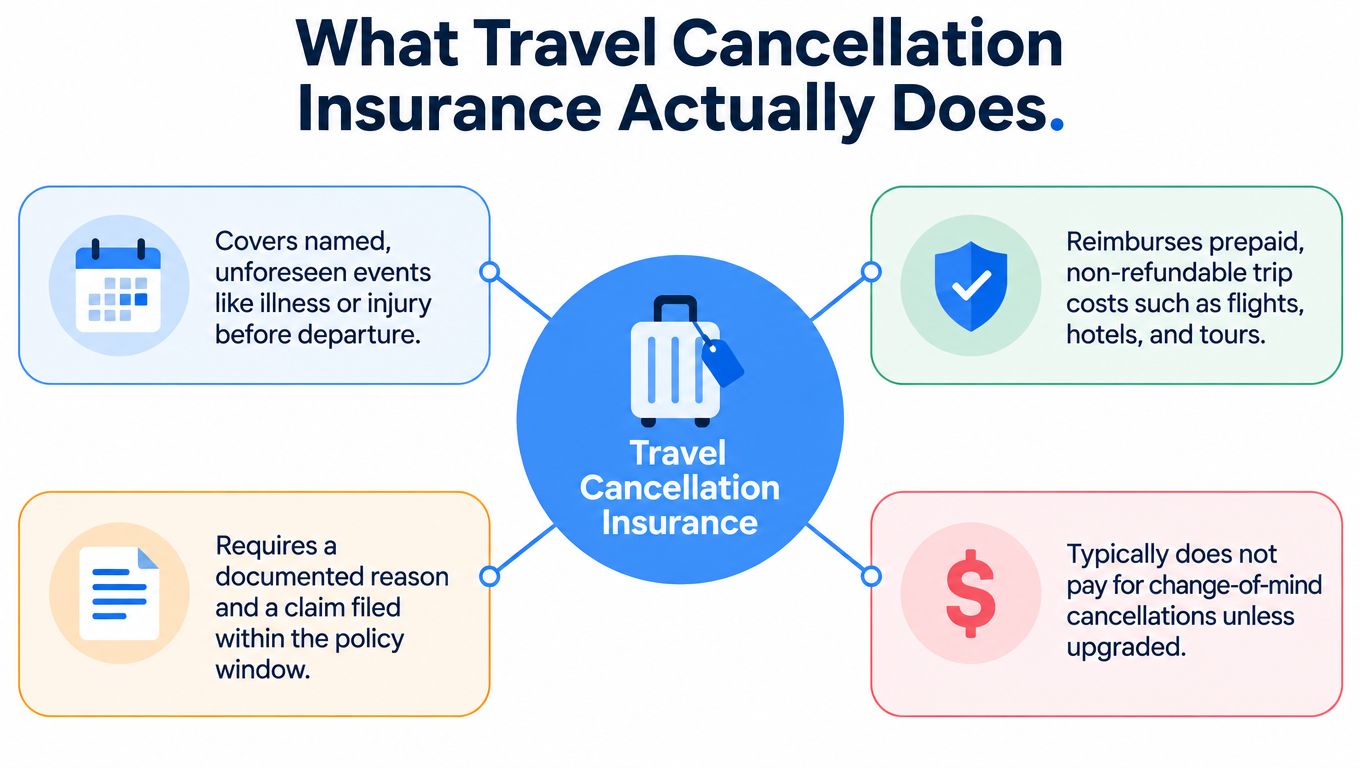
Travel cancellation insurance reimburses eligible prepaid, non-refundable costs only when you cancel because of a covered, unforeseen event specifically listed in the policy. Before the insurer considers payment, you generally must seek refunds, credits, or waived charges from the airline, hotel, cruise line, tour operator, or other provider.
Covered events may include an unexpected illness, qualifying injury, death, jury service, a subpoena, severe weather, or a home becoming uninhabitable. The named-peril list controls the outcome. A genuine personal reason still may not qualify if the policy does not define it as a covered event.
The operating model
Every cancellation claim turns on four questions:
- What happened? The event must match a named peril.
- When did it happen or become known? Timing may determine eligibility.
- What did the suppliers refund? Insurance generally covers only the remaining loss.
- What can you document? Medical records, official notices, booking confirmations, and cancellation terms may be required.
A $4,000 family itinerary does not automatically create a $4,000 insured loss. If providers return part of the payment, issue usable credits, or waive a cancellation charge, the potentially insurable balance falls. The insurer then applies the policy's limits, exclusions, and documentation requirements to the remaining eligible loss.
Practical rule: Assign every non-refundable payment a dollar value and a specific coverage trigger.
Medical-only travel insurance addresses a narrower risk. It may pay covered medical expenses during travel, but it does not automatically reimburse prepaid flights, accommodations, cruises, or tours canceled before departure. In the first quarter of 2026, 34% of travelers selected medical-only insurance and skipped trip-cancellation and interruption reimbursement coverage, leaving those prepaid costs unprotected under those benefits (Squaremouth).
Refundable fares and supplier waivers follow booking rules rather than insurance rules. A refundable fare gives you a contractual right to recover money under its fare conditions. A cruise or tour waiver may offer cancellation flexibility, but it is not necessarily insurance and may not receive the same regulatory oversight, as the North Carolina Department of Insurance travel guidance explains.
The distinction is clear: insurance responds to a defined cause, supplier terms respond to booking rules, and medical-only coverage responds to a narrower risk category. Families should total every traveler's prepaid exposure before buying, then confirm that the policy names the events most likely to affect the household.
Coverage Types and What Each One Really Pays
A travel policy can list several benefits, but each responds to a different financial exposure. Standard trip cancellation reimburses eligible prepaid, non-refundable costs only after a listed peril occurs. Trip interruption applies after departure when a covered event ends the trip early. Cancel For Any Reason, or CFAR, broadens the acceptable reason for canceling, but lowers the recovery and imposes strict timing conditions.
| Coverage Type | Typical Recovery | Key Constraint |
|---|---|---|
| Standard trip cancellation | Eligible prepaid, non-refundable costs, subject to the policy limit | The reason must be a listed peril and properly documented |
| Trip interruption | Eligible unused costs and qualifying additional return expenses | The covered event must occur after departure or meet the plan's interruption definition |
| Cancel For Any Reason | Commonly 50% to 75% of the insured trip cost, per NAIC guidance | Usually requires early purchase, full-trip insurance, and cancellation at least 48 hours before departure |
| Pre-existing-condition waiver | Eligible cancellation or interruption losses when waiver conditions are satisfied | Medical stability rules and a short purchase window apply |
| Supplier cancellation waiver | Benefits defined by the cruise line, tour operator, or other supplier | It isn't insurance and may offer credits or restricted recovery instead of cash |
Standard coverage and CFAR
Standard cancellation is a named-peril benefit, not a general refund facility. An illness, injury, death, qualifying severe weather, jury duty, or another expressly listed event may qualify. A change of mind, broad fear of travel, financial difficulty, or an excluded event generally does not. The policy wording controls, and documentation must connect the loss to the covered cause.
CFAR addresses the discretionary gap, but its recovery is limited. The National Association of Insurance Commissioners states that CFAR commonly reimburses only 50% to 75% of the insured trip cost. Plans often require purchase within a specified period, insurance for the trip's full cost, and cancellation at least 48 hours before departure. Miss one condition and the benefit may not apply.
Pre-existing-condition waivers affect eligibility rather than creating unlimited medical protection. Policies commonly use medical look-back periods ranging from 60 to 180 days, while purchase requirements often fall roughly 7 to 21 days after the first trip deposit or payment (AARDY). A new test, medication change, treatment, or worsening condition can affect eligibility even when the traveler feels well on the purchase date.
Supplier waivers require a separate comparison. A cruise line or tour operator may offer a future credit, restrictions, or recovery limited to its own booking. That arrangement may leave independently booked flights, hotels, and activities outside its protection.
A 110% Best Value Guarantee is a pricing mechanism, not an insurance benefit. It does not replace named-peril coverage, CFAR, or the supplier's cancellation terms. For airline bookings, this airline ticket insurance guide helps distinguish fare flexibility from insurance coverage. Family itineraries deserve extra scrutiny because one uncovered cancellation can expose several prepaid tickets, rooms, and activity fees at once.
Common Gaps That Catch Travelers Off Guard
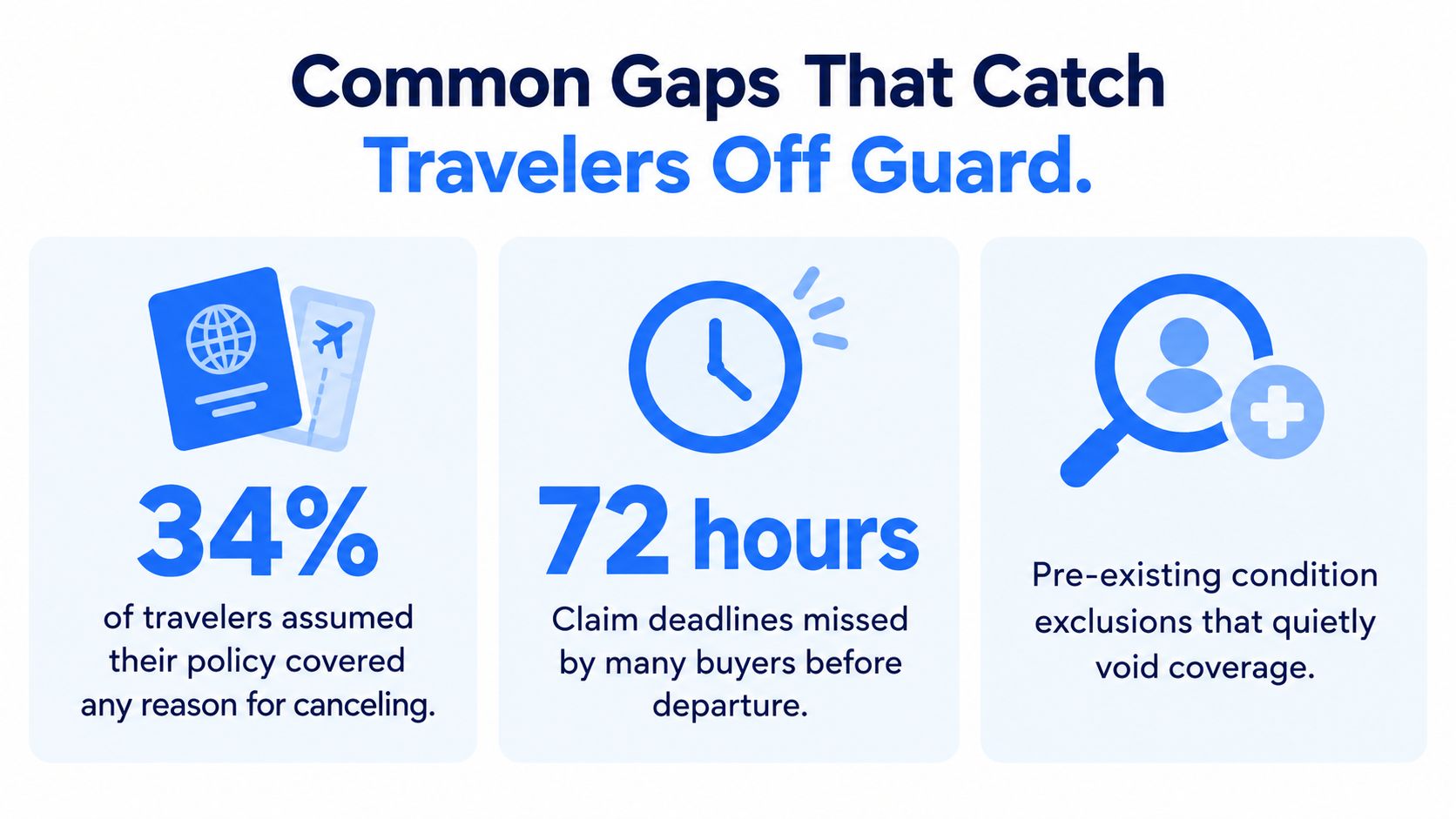
A cancellation policy reimburses losses only when the reason appears among its named perils. It is not a general refund facility. A serious personal reason can still produce a denied claim if the certificate does not list it.
Medical coverage creates a frequent misunderstanding. Travelers may buy protection for treatment abroad while leaving cancellation and interruption benefits outside the selected coverage. Check the benefit schedule line by line before assuming the policy protects the prepaid itinerary.
CFAR creates another gap. Searches for CFAR rose from 14% of insurance quotes in December 2025 to 18% in March 2026, a 29% increase, per Squaremouth's Q1 2026 trends report. 53% of travelers who searched for it did not ultimately purchase it, and 32% of those searchers had already missed the time-sensitive purchase window. If discretionary cancellation protection matters, check the purchase deadline before making more non-refundable payments.
Exclusions that matter
Read exclusions before paying the premium. Common gaps include:
- Change of mind: Deciding not to travel generally is not a covered peril.
- Fear of travel: Anxiety about a destination or broad uncertainty usually does not trigger standard cancellation benefits.
- Pre-existing conditions: A condition may be excluded unless the plan's waiver requirements are satisfied.
- Pandemics and civil unrest: Wording may exclude these events or cover them only under narrow conditions.
- Provider-caused changes: An airline or cruise-line schedule change may belong under supplier obligations rather than cancellation coverage.
Connecticut regulatory guidance states that covered events generally must appear expressly in the policy. North Carolina guidance advises confirming coverage before canceling and preserving supporting documentation. Florida All Risk Insurance agents can offer a separate insurance perspective, but the policy certificate controls the claim.
For a family itinerary, calculate exposure across every traveler, ticket, room, transfer, and activity. One uncovered cancellation can leave the household absorbing several prepaid losses.
Discover an exclusion before the first non-refundable deposit, not after the doctor's appointment or storm warning.
How a Cancellation Claim Works
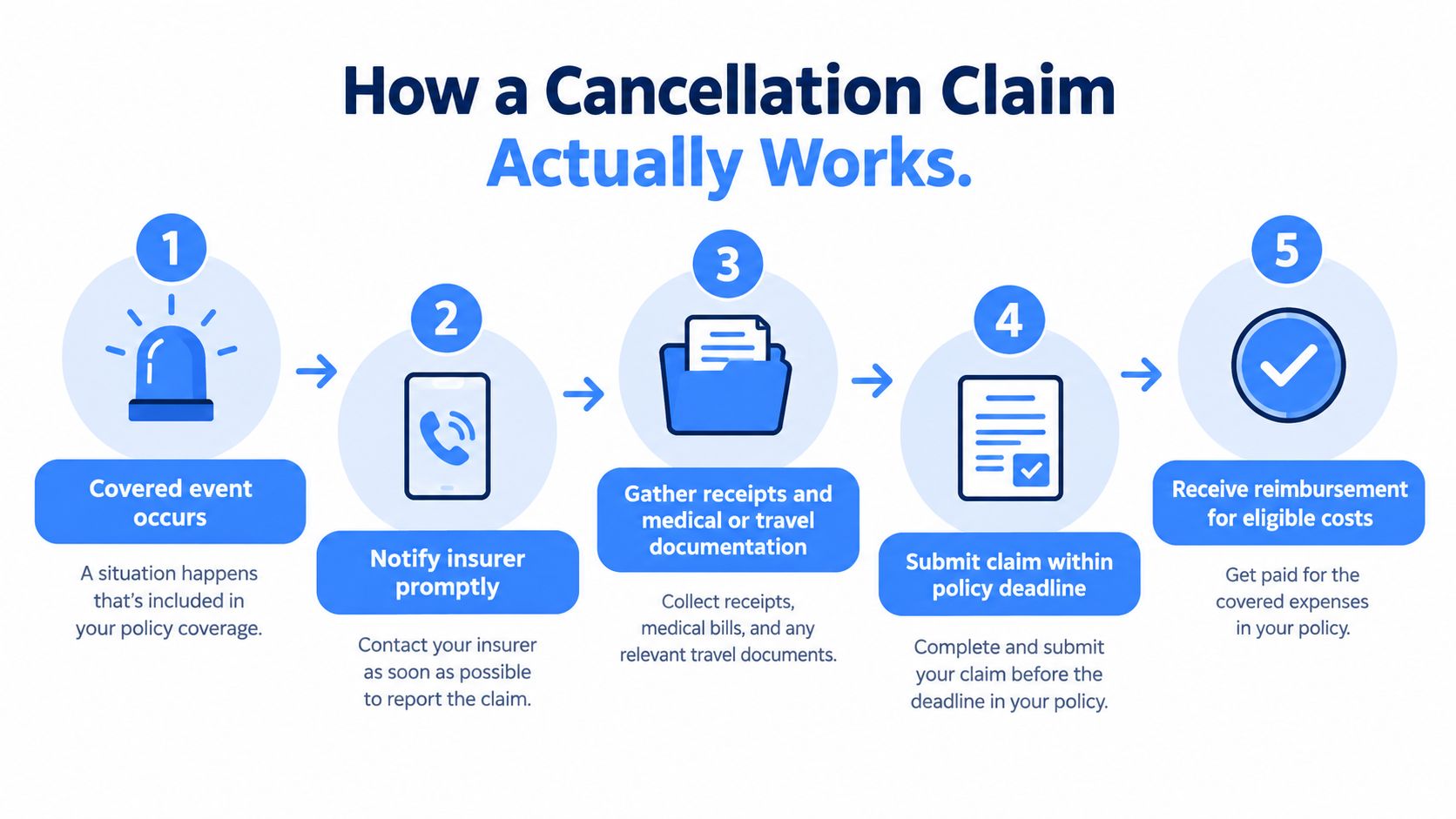
A cancellation claim is reimbursement against a defined list of covered events, not an automatic refund of the itinerary price. The sequence matters because insurers expect travelers to seek refunds, credits, or other compensation from airlines, hotels, cruise lines, tour operators, and vacation-rental providers before claiming the remaining loss.
Follow the claim sequence
1. Identify the event. Match the illness, injury, death, official duty, weather event, or other cause to the policy wording. A serious reason is not enough if it is absent from the covered-peril list.
2. Notify the insurer promptly. Contact the insurer before canceling when the policy requires or recommends that step. The North Carolina Department of Insurance advises travelers to confirm coverage before canceling and preserve documentation supporting the claim.
3. Preserve the evidence. Save booking confirmations, invoices, supplier cancellation terms, medical records, official notices, cancellation emails, and correspondence. Request written confirmation showing what each provider refunded, credited, or retained.
4. Seek supplier recovery. Ask every provider for the refund or credit available under its booking terms. Insurance generally does not pay for an amount recoverable from another source.
5. File for the residual. Submit the claim by the policy deadline. Show the original prepaid cost, the provider's recovery, and the remaining eligible amount.
Consider a cruise costing $3,000 and described as non-refundable. If the cruise line returns $2,000, the potentially insurable loss is $1,000, subject to the policy's excess, limits, exclusions, and documentation requirements (Financial Ombudsman Service).
The claim value follows that financial trail, not the original itinerary total. For a household itinerary, calculate each traveler's flights, rooms, transfers, and activities, then track every refund or credit. One uncovered cancellation can leave several prepaid costs with the family.
The guide to cancelling airline tickets helps explain what the carrier may owe before an insurance claim is submitted. It does not replace the policy contract.
Use this visual process as a quick operational reminder:
Cancellation Insurance Compared With Refundable Fares and Membership Protections
These options don't solve the same problem. Cancellation insurance transfers the financial risk of defined, high-severity events. Refundable fares buy contractual flexibility. Membership infrastructure consolidates access and may reduce the friction of arranging complex travel, but it doesn't turn every booking into an insured booking.
Choose according to the risk
Travel cancellation insurance makes the most sense when a household has substantial prepaid, non-refundable exposure and the feared loss comes from an event the policy covers. A family reunion with multiple rooms, flights, and activities can create a large aggregate loss even when every individual reservation looks manageable.
Refundable fares are cleaner when plans are uncertain and the provider's refund rules are generous enough to justify the higher upfront price. You don't need to prove illness or produce medical records to use a refundable fare. You do need to comply with its cancellation deadline and conditions.
Supplier waivers sit between those approaches. A cruise line or tour operator may offer a cancellation waiver tied to its own inventory, but the protection may not extend to separately booked transport, lodging, or activities. Compare cash recovery, credits, deadlines, and scope before treating the waiver as complete trip protection.
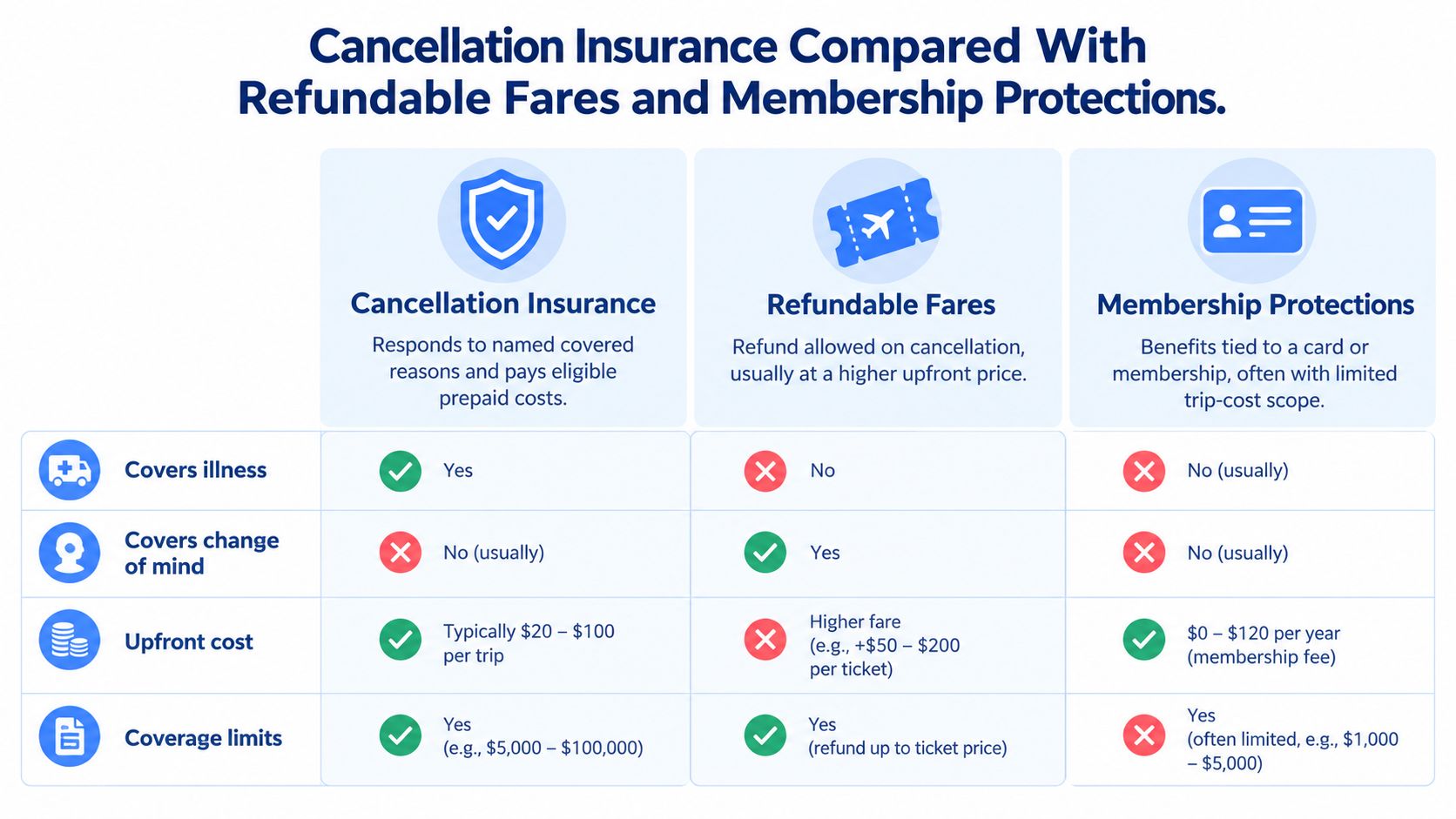
Approved Traveler is a different category of infrastructure. It consolidates access to wholesale travel inventory across hotels, airlines, cruises, vacation homes, car rentals, tours, and activities through one membership platform. The 110% Best Value Guarantee addresses a qualifying public-price difference, while Reward Credits accumulate on bookings for future eligible uses. Those features can improve booking flexibility and organization, but they don't replace a policy's named-peril reimbursement.
For frequent households, the practical comparison is not “insurance or membership.” It may be insurance for catastrophic covered events, refundable inventory for uncertain plans, and membership infrastructure for repeated booking and household coordination.
Decision rule: Buy flexibility where uncertainty is likely, insurance where the loss would be severe, and infrastructure where fragmented booking has become an operational burden.
No option dominates every itinerary. A short, expensive trip with fluid plans may favor refundable inventory. A long, multi-person trip with large non-refundable deposits may justify named-peril insurance. A household that books repeatedly may evaluate whether consolidated access and Reward Credits provide value independently of cancellation protection.
Scenarios for Multi-Generational Families, Snowbirds, and Frequent Travelers
Household size changes the exposure faster than many travelers expect. Start with the total non-refundable balance, then identify whose covered event could affect each booking.
A multi-generational reunion
An organizer pays for flights, hotel rooms, ground transportation, and activities for parents, children, siblings, and in-laws. One traveler becomes ill before departure. Three separate tests apply: whether the policy defines that person as a covered traveler, whether the illness meets the policy's terms, and whether the other bookings can be canceled because of that event.
Build a household exposure map before the trip. List every traveler, supplier, payment, cancellation deadline, and refund rule. The policy reimburses eligible losses tied to its named perils, not every booking affected by a family emergency. Medical evidence must support the event, and pre-existing-condition requirements should be checked immediately after the first deposit. Guidance on traveling with elderly parents can help with practical arrangements, while the insurance contract determines claim eligibility.
Decision: Use named-peril insurance when the combined non-refundable balance would create a serious loss and the family can produce the required documentation. Consider CFAR only when discretionary cancellation flexibility justifies partial recovery and stricter timing requirements.
A snowbird's extended stay
A snowbird reserves a 60-day condo stay at a non-refundable rate and books transportation separately. The decision is whether to pay more for refundable inventory or pair the lower non-refundable rate with cancellation insurance.
Choose based on the likely reason for cancellation. A traveler concerned about changing plans needs a refundable rate. A traveler concerned about an unexpected covered illness, qualifying family event, or another listed peril may use insurance for the eligible non-refundable balance. A general desire to return home early remains outside the policy unless a covered event caused it.
Map the full exposure, including the condo, flights, vehicle rentals, activities, and provider credits. Travelers assessing seasonal transportation and property risks can separately compare snowbird RV coverage options, because vehicle coverage does not provide trip-cancellation protection.
Decision: Choose refundable inventory when plan changes are the main concern. Add named-peril insurance when a covered medical or household event could leave a large unrecoverable balance.
A frequent leisure traveler
A traveler taking four trips a year can assess trip-specific insurance separately from an annual travel infrastructure membership. Approved Traveler costs $899 per year, provides access to listed travel inventory, and awards Reward Credits on eligible bookings. It helps organize repeated purchases, but it does not insure a canceled trip or replace claim reimbursement.
The decision depends on booking exposure. Use insurance for trips with substantial non-refundable costs and a realistic covered-peril risk. Consider Approved Traveler when recurring access, household coordination, and accumulated credits have value independently of cancellation protection.
Decision: Match each tool to the loss it addresses. Insurance responds to covered events, refundable bookings handle uncertain plans, and membership infrastructure supports repeated booking.
Decision Criteria and Pre-Departure Checklist
Before making the first non-refundable payment, run four checks. Start with the loss you could suffer and the covered event that would trigger reimbursement. A cancellation policy is not a general refund facility. It pays eligible unrecovered costs only when the facts match a listed peril.
Check the peril list
Read the covered reasons and exclusions. Confirm that the policy addresses the risks affecting your household, such as illness, injury, death, severe weather, jury duty, or an uninhabitable home. Then compare the policy wording with your likely situation. A preference not to travel does not equal a physician-documented covered illness.
Check medical timing
Review the pre-existing-condition look-back period, stability requirement, and waiver deadline. The cited look-back examples range from 60 to 180 days, and waiver purchase windows commonly run from 7 to 21 days after the initial trip deposit (AARDY). If a parent, spouse, or child has a changing medical condition, make the timing decision before that condition affects the itinerary.
Check the evidence standard
Build the claim file before a problem occurs:
- Booking records: Keep invoices, confirmations, payment records, and the complete itinerary.
- Supplier rules: Save cancellation terms and written confirmation of refunds, credits, or retained amounts.
- Medical proof: Obtain the required records from the treating provider, not only a personal explanation.
- Official proof: Preserve jury notices, subpoenas, weather notices, and other records establishing the event.
- Timing evidence: Record when the event occurred, when it became known, and when you notified providers and the insurer.
Check the recovery sequence
List every supplier and identify what it will return after cancellation. Insurance generally addresses the eligible balance left after available refunds or credits. This sequence keeps the claim accurate and gives the insurer a clear financial trail.
Household exposure makes this check more important. Add the non-refundable costs for each traveler, then include flights, lodging, activities, rental vehicles, and deposits held by separate providers. A family itinerary can create a much larger residual loss than one traveler's fare, even when every booking appears manageable on its own.
Common denial causes include:
- Late purchase: The event or medical change was already known, or the waiver window had passed.
- Voluntary cancellation: The traveler changed plans without a covered peril or qualifying CFAR benefit.
- Weak documentation: Medical, official, booking, or cancellation evidence is missing.
- Unrecovered supplier funds: An available refund or credit was not pursued first.
- Coverage mismatch: The buyer selected medical-only coverage or misunderstood a supplier waiver.
Final checklist: Confirm the peril, verify timing, calculate household exposure, preserve proof, pursue provider recovery, and file the residual claim on time.
Travel cancellation insurance transfers defined financial risk. It does not remove the need for disciplined booking, careful timing, or clause-level policy review.
Approved Experiences Traveler provides access to travel inventory across hotels, airlines, cruises, vacation homes, car rentals, tours, and activities, with Reward Credits on eligible bookings and a 110% Best Value Guarantee for qualifying price differences. Review Approved Experiences Traveler if repeated household bookings matter, while keeping trip-specific cancellation insurance decisions separate.
Want the wider view?
Ten categories. One report. Every quarter. The Approved List tracks what's rising and what's fading: data-backed signals, not opinions.
Free to join · Delivered by email