
All Articles
The Journal
Cancelling Airline Tickets: A Practical Guide
September 26, 202613 min readairline refund rulesflight cancellation rights
Learn how cancelling airline tickets actually works — from the 24-hour rule to refunds, credits, EU and DOT rights, and strategies to cut fees.
You're staring at a 4 a.m. voicemail, three itineraries, and a booking screen offering “credit” when you expected cash. One flight moved, another was canceled, and the third no longer works for your plans. Before you click anything, identify who caused the change and which deadline is still open. That decision determines whether you can demand a refund, preserve value through rebooking, or accept a travel credit under the fare rules.
The First Fork That Decides Everything
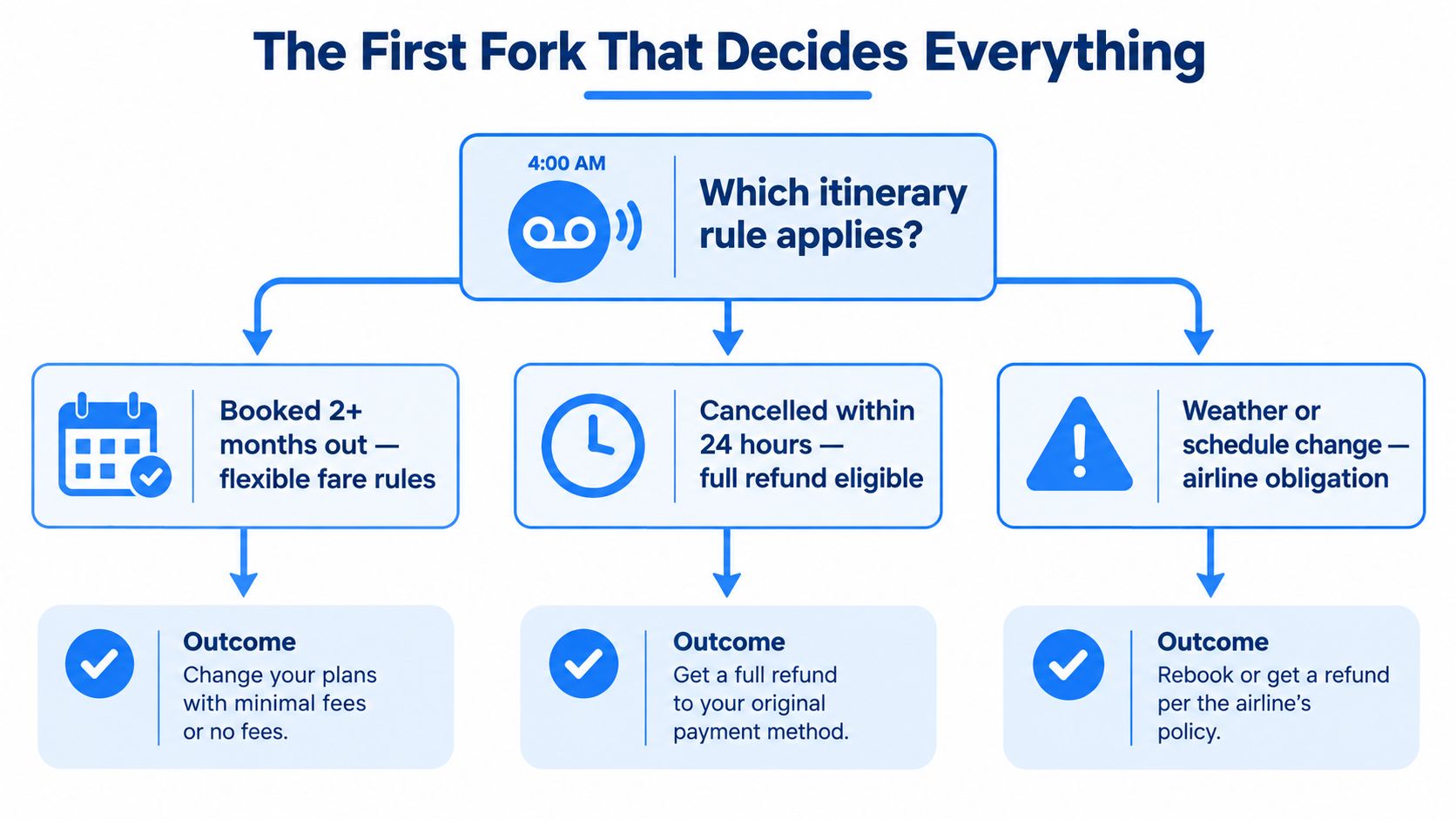
Start with the booking record, not the chatbot. Find the purchase time, departure date, ticketing channel, fare class, and every airline notification. Then place the reservation into one of three branches.
Branch one is the 24-hour window. For a U.S. booking made at least 7 days before departure, the Department of Transportation requires the airline either to let you cancel within 24 hours without penalty or to hold the quoted fare for 24 hours without payment. The rule applies to domestic and international tickets sold by airlines operating in the U.S., although a third-party booking may require you to work through that seller. The DOT refund guidance explains the federal protection.
Branch two is an airline-initiated disruption. The airline canceled the flight, shifted the schedule materially, removed a connection, or otherwise changed the itinerary. Don't label this a voluntary cancellation. Under current DOT guidance, a canceled or significantly changed flight can qualify for a refund even when the fare is non-refundable, provided you reject the alternative transportation or travel credit. The current federal definition uses schedule shifts of more than 3 hours for domestic itineraries or more than 6 hours for international itineraries, with automatic refunds due within 7 business days for credit cards or 20 calendar days for other payment methods. Check the DOT automatic refund rule before accepting a voucher.
Branch three is your own decision. You're canceling because the meeting moved, the wedding was postponed, or you just don't want the trip. Fare-class restrictions now control the outcome. A refundable fare may return cash, while a non-refundable fare usually produces credit or no usable value, particularly in Basic Economy.
Practical rule: Never cancel a disrupted itinerary as “voluntary” before you document the airline's change and ask for the involuntary refund option.
If the line between airline-caused and traveler-caused is unclear, stop clicking and escalate. An Approved Lux Personal Assistant can review the record, identify the correct branch, and help preserve the paper trail before a refund option disappears.
Four Ways to Actually Cancel a Ticket
The best cancellation channel depends on the booking, not your personal preference. Use the website for a clean, uncomplicated reservation. Switch to the phone when the record has multiple moving parts.
Website and mobile app
The airline's Manage Trip page is usually fastest. Confirm the itinerary, open the cancellation screen, and read the final outcome carefully before submitting. If it offers a credit but the airline caused a qualifying cancellation or schedule change, stop and request the cash-refund path instead.
The mobile app uses the same reservation system, but it's useful for capturing screenshots, attaching documents, and saving the cancellation confirmation immediately. Keep the confirmation number, timestamp, displayed refund amount, and any message describing the reason for cancellation.
Phone support
Call when the booking is a codeshare, includes multiple payment cards, contains several travelers under one record, or changed after the website stopped recognizing the confirmation code. Ask the agent to state whether the cancellation is being processed as voluntary or involuntary, and request that the reason and refund commitment be added to the booking notes.
Phone queues can be painfully long. Still, an agent's notes are more useful in a later dispute than an unexplained web click, especially when the system automatically routes you to credit.
Airport counter
Use the counter only when the ticket was purchased at the airport shortly before departure, the airline has rejected the other channels, or the disruption is unfolding at the airport. It's rarely the efficient choice for a future booking. Bring identification, the payment card, and the written itinerary.
| Cancellation Channel | Best For | Common Failure |
|---|---|---|
| Website | Simple direct bookings and clear voluntary cancellations | Refund option hidden behind a credit workflow |
| Mobile app | Documentation, screenshots, and quick confirmation | Auto-decline after a schedule change |
| Phone | Codeshares, group records, multiple cards, and disputes | Extended holds and inconsistent agent notes |
| Airport counter | Active travel-day problems or rejected requests | Slow handling and limited authority |
Don't confuse cancellation with transferability. If another traveler needs to use the ticket, review whether airline tickets can be transferred before canceling, because many tickets remain tied to the original passenger.
Airline Policy Checkpoints Worth Knowing
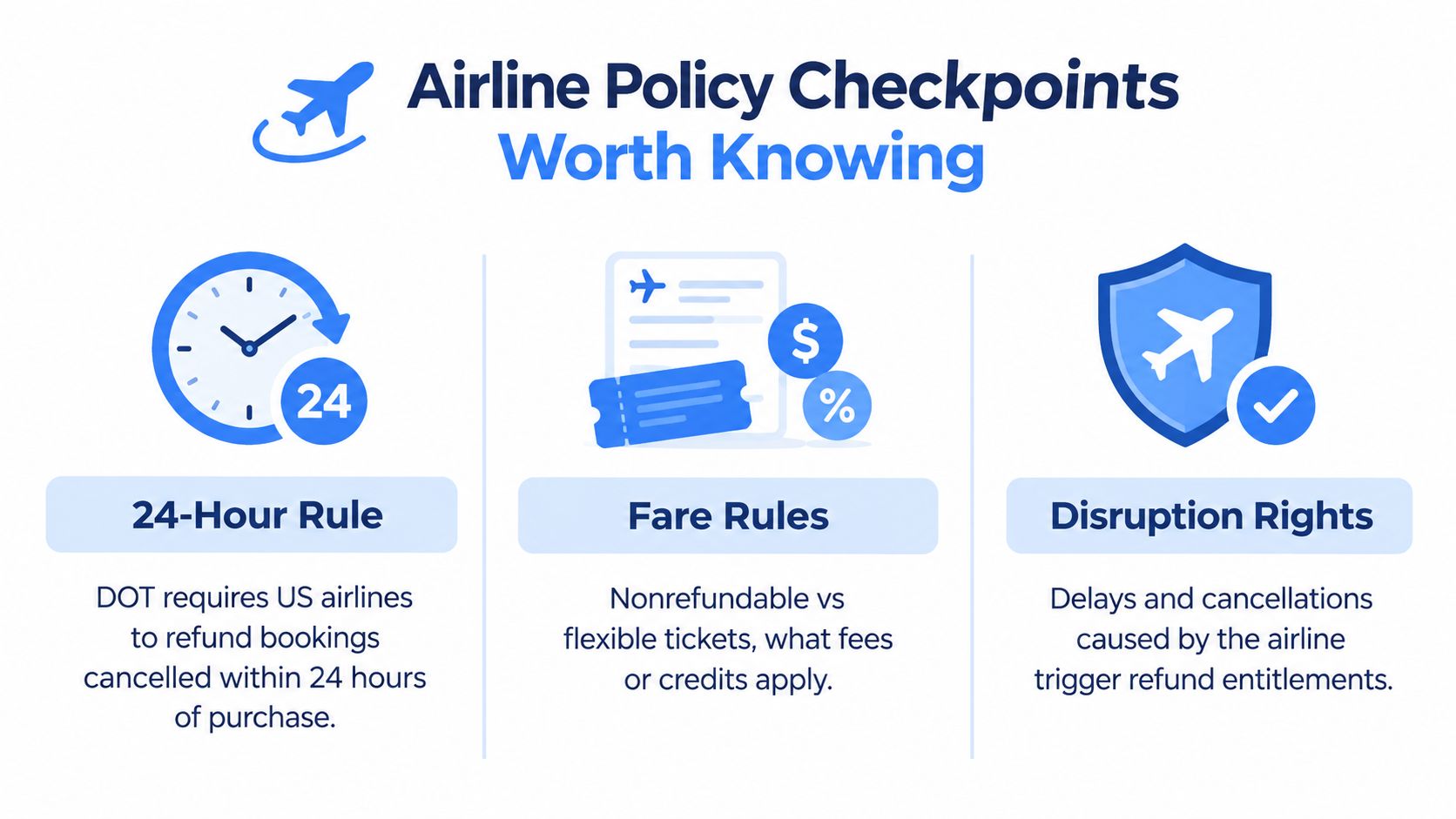
Three checkpoints decide what you're entitled to. Check them in order, because the strongest protection can disappear when you treat an airline-caused change as an ordinary voluntary cancellation.
The 24-hour checkpoint
For a U.S. airline booking made at least 7 days before departure, DOT rules require either a penalty-free cancellation within 24 hours of purchase or a 24-hour fare hold without payment. The airline may offer a broader policy, but it can't shorten the federal protection. American Airlines says its 24-hour refund policy covers all ticket types when the booking meets the advance-purchase condition, while bookings made through an agency or other booking source must be handled through that seller. Review American Airlines' customer-service policy if the reservation is on American.
The timing is measured from purchase, not from the first time you open the booking. If you bought at 11:40 p.m., the clock doesn't reset the next morning. Cancel through the correct booking channel, save the confirmation, and verify that every traveler and segment was included.
The disruption checkpoint
If the airline cancels or significantly changes the flight, you can refuse rebooking and request a refund to the original payment method. The current DOT rule treats domestic schedule shifts over 3 hours and international shifts over 6 hours as significant for this purpose. The entitlement can apply to a non-refundable fare, but you must avoid accepting a travel credit or replacement itinerary if cash is the outcome you want.
Many cancellation guides fail here. Changeability and refundability aren't the same thing. DOT guidance doesn't require airlines to provide free date or name changes just because a ticket exists. It does protect you when the airline fails to provide the transportation you bought and you reject the substitute.
The fare-class checkpoint
Voluntary cancellation is governed by the ticket conditions. Basic Economy is generally the least flexible option. Standard economy may preserve value as an airline credit, while refundable economy, premium, and business fares may return money subject to their published conditions.
For a broader comparison of carrier networks and fare structures, consult this overview of the best airlines in the US. If you routinely coordinate complex itineraries, a specialist such as Haute Black air travel services can also be a useful resource when fare conditions and rebooking choices need human review.
United adds an important operational detail: its 24-hour policy requires the flight to be booked at least one week ahead, canceled within 24 hours, and canceled for every passenger on the reservation. A partial cancellation won't qualify under that policy, so check the record before submitting the request.
Refund Versus Travel Credit
A refund and a travel credit aren't interchangeable. A refund returns money to the original payment method. A credit keeps value inside the airline's system, often with restrictions on passenger name, itinerary, expiration, and fare difference.
The refund route is mandatory when the airline cancels the flight, makes a qualifying significant change, or when the booking falls inside the U.S. 24-hour rule. For qualifying airline disruptions, DOT's current automatic-refund framework sets 7 business days for credit-card payments and 20 calendar days for other payment methods. That's different from a voluntary cancellation, where the fare rules determine whether cash is available at all.
| Condition | Refund to Original Payment | Travel Credit |
|---|---|---|
| U.S. booking canceled within 24 hours and at least 7 days before departure | Required when the DOT conditions apply | May be offered, but don't accept it if you want cash |
| Airline cancels the flight | Required if you reject rebooking or credit | Available only if you choose it |
| Qualifying significant schedule change | Required if you don't accept the alternative | Available as an alternative |
| Voluntary cancellation of a non-refundable fare | Usually unavailable | Common outcome, subject to fare rules |
| Basic Economy canceled voluntarily | Usually unavailable | May be restricted or unavailable under the ticket terms |
| Refundable fare canceled voluntarily | Governed by the fare conditions | Usually unnecessary unless you prefer future travel value |
Treat every chatbot offer as a proposal, not a final entitlement. An eVoucher can look like money on the screen while remaining unusable for a different passenger, route, or booking channel. Before accepting one, ask whether it expires, whether it can be transferred, and whether a residual fare difference will remain.
For a qualifying refund, keep the airline's confirmation and track your refund status using the payment record as well as the airline record. If the airline says “processed” but the card hasn't posted the money, those two records help separate an airline delay from a card-issuer delay.
How to Cut or Eliminate Cancellation Fees
The cleanest fee strategy starts before you cancel. Open the fare conditions and ask one question: is preserving the ticket's value more useful than ending the booking?
A refundable fare gives you the most control. A non-refundable fare normally requires either a qualifying waiver, a change into a new itinerary, or acceptance of airline credit. Basic Economy can be especially restrictive, so don't assume that a cheap fare can be salvaged after the 24-hour window.
Rebooking instead of canceling
If you still expect to travel, change the flight rather than cancel it. You keep the ticket value active and may avoid the cancellation outcome entirely, although a fare difference can still apply. This is often the better move when the new date is uncertain but the trip itself remains likely.
The timing matters. Rebook before the ticket's original departure and before the airline's own deadline. A no-show can destroy remaining value and may affect later segments on the same reservation.
Waivers and documented events
Ask for a waiver when the airline has published one for weather, a mechanical issue, crew disruption, or a travel advisory. Use the airline's language, attach the notice, and ask what the waiver covers. A waiver may remove a fee without creating a cash-refund right.
Split decisions can also help. If only one traveler's plans changed, canceling the affected one-way segment instead of the full round trip may protect the rest of the reservation. Don't split a record casually, though. Ask the airline to confirm how it will treat the remaining segments before you authorize the change.
Insurance and card benefits
Travel insurance may respond to a covered medical event, serious family emergency, or other named trigger. Credit-card coverage can also matter when the fare was purchased with an eligible card. Chase Sapphire Reserve and Amex Platinum are examples of cards that may include trip-cancellation protections, but the specific benefit terms and documentation requirements control the claim.
Elite status can improve flexibility on some airlines and fares, but it doesn't override federal refund rules or rewrite a restrictive ticket. Use status as a bargaining point for service and waiver review, not as a substitute for reading the fare conditions.
Escalation Paths Beyond the Airline
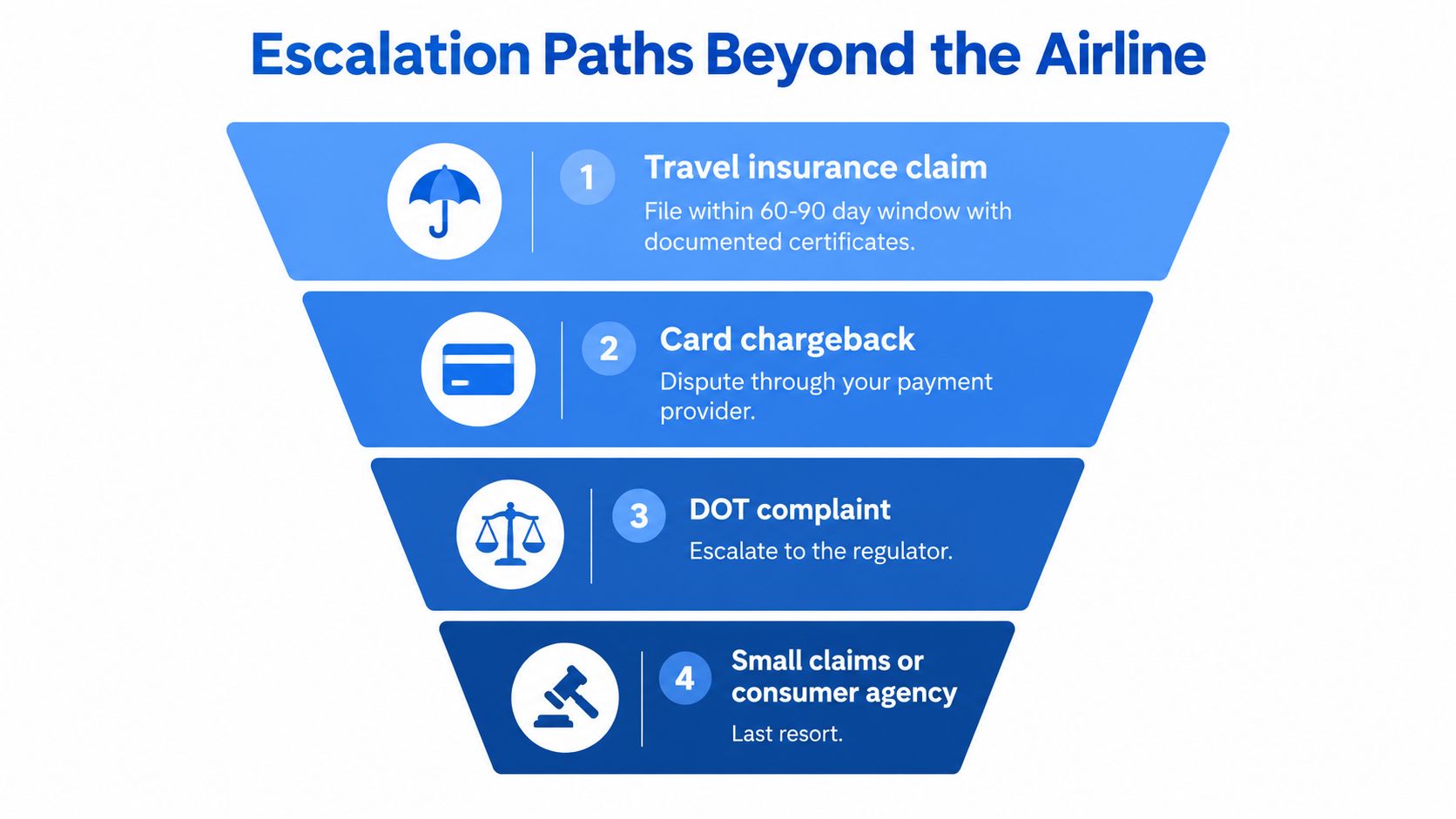
Escalate in proportion to the problem. A covered insurance claim deserves a claims file. An airline refusal of a legally due refund deserves a written complaint. A routine voluntary cancellation usually doesn't justify a chargeback.
Start with insurance
Read the policy's covered reasons, notice deadline, exclusions, and documentation list. File within the carrier's stated window, preserve medical notes or certificates when relevant, and attach itemized receipts plus the airline's written cancellation or refusal.
Use a chargeback carefully
A card dispute can make sense when the airline refuses a refund that its policy or applicable law requires, or when the paid transportation wasn't delivered. It's a poor tool for reversing a disclosed non-refundable fare after a voluntary cancellation. Give the airline a documented opportunity to resolve the matter first, then submit the booking record, policy language, correspondence, and refund request to the card issuer.
Contact the regulator
For U.S. domestic and codeshare issues, file a complaint with the DOT after you've assembled the record. For flights departing from EU or UK airports, or flights covered by EU or UK carrier rules, use the relevant passenger-rights process. EU rules require a choice between refund and rerouting when the airline cancels, and compensation can apply when notice arrives less than 14 days before departure, subject to the applicable exceptions. UK guidance says refunds must be paid within 7 days. The official EU air passenger rights guidance is the right starting point.
Don't threaten a chargeback before you know whether you're claiming a refund, compensation, or reimbursement. Those are different claims with different evidence.
Small-claims court belongs at the end, not the beginning. Use it only when the amount matters, the legal theory is clear, the airline has ignored a well-supported request, and the court's jurisdiction is appropriate. Keep the full timeline, including screenshots, call records, receipts, notices, and the exact remedy you requested.
When an airline's response is incomplete, a regulator complaint can expose a systemic policy problem. It won't replace a refund request, so submit the request first and attach the complaint reference later if needed.
Working a Real Cancellation Through Approved Experiences
Consider three travelers booked two months ahead for a European wedding. The wedding is postponed, but the family still wants to travel together. The wrong move is canceling all three tickets immediately and hoping the airline later restores the value. The better move is to secure a workable alternative before releasing the original itinerary.
A Lux Traveler member could contact the Approved Lux 24/7 Personal Assistant to review the reservation and pull alternatives from consolidated inventory across 700+ airlines. The assistant checks whether the original booking should be changed, credited, or canceled, then helps coordinate the three names, dates, segments, and payment records in one workflow.
If a rebooking is appropriate, the member can redeem existing Reward Credits toward the new booking. The 110% Best Value Guarantee provides a defined review path if a lower publicly available fare is found for the same qualifying arrangement. The point isn't to gamble on a refund. It's to preserve travel value while the itinerary is still operational.
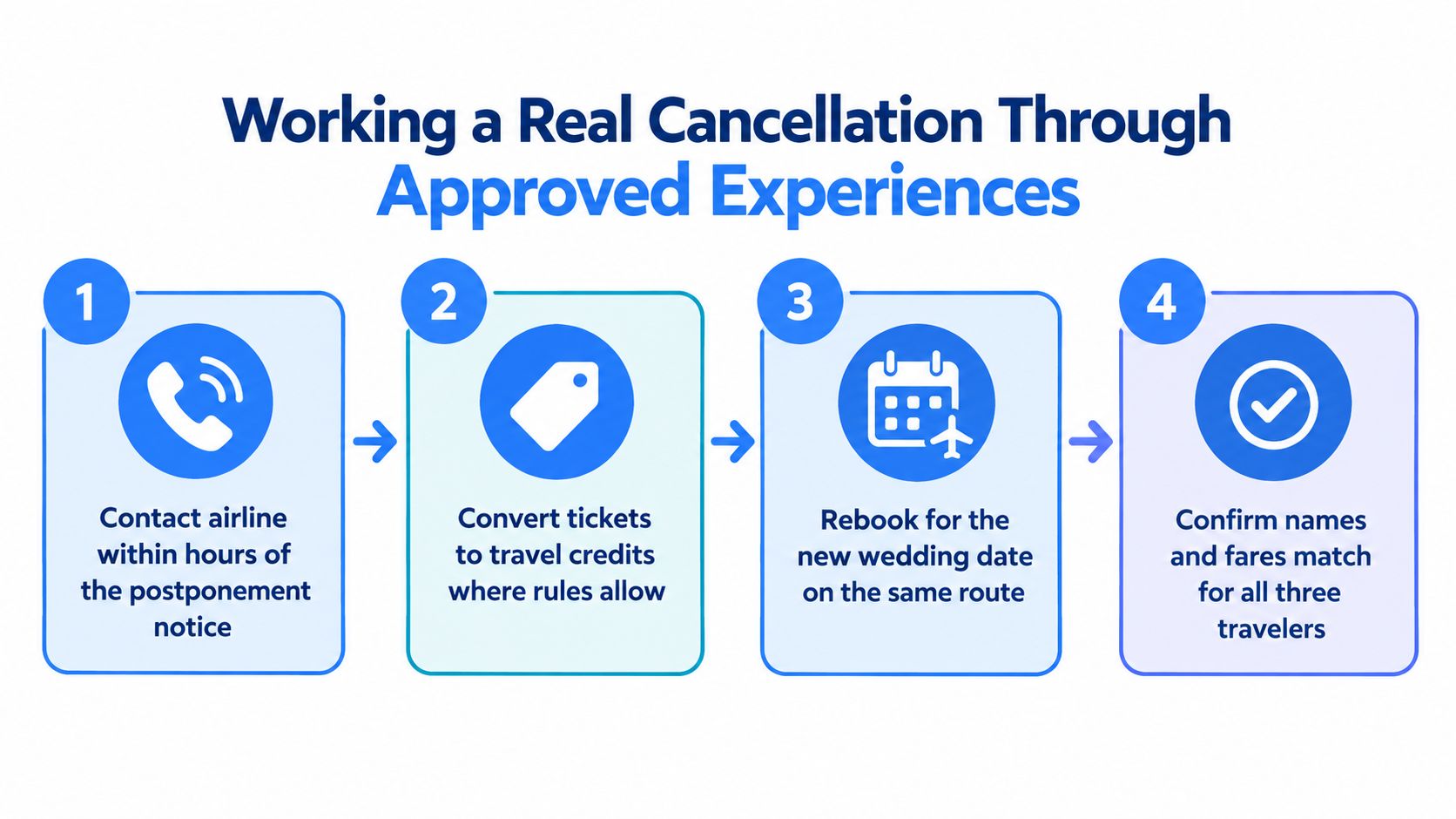
Use the V.O.I.C.E. sequence as a working checklist:
- Verify: Confirm the booking channel, fare class, purchase time, departure date, airline change notice, and whether all travelers share one record.
- Organize: Save the PNR, receipts, fare conditions, schedule-change emails, screenshots, and payment details before making a change.
- Initiate: Use Manage Trip for a simple record, the app for documentation, or the phone for a codeshare, group PNR, multiple-card payment, or disputed disruption.
- Confirm: Get the refund or credit amount, destination, processing timeline, expiration terms, and passenger restrictions in writing.
- Evaluate: Compare the result with the policy. If the airline caused the disruption, confirm that you didn't accidentally accept credit when cash was available.
For the legal side of airline-caused disruption, keep this guide to flight cancellation payouts available when assessing whether a refund claim is separate from a compensation claim.
Hand off the file instead of improvising when:
- The schedule change crosses the applicable DOT threshold.
- The itinerary may qualify for EU or UK passenger-rights compensation.
- The airline has refused a refund that appears required and a card dispute may become necessary.
- The itinerary's value exceeds $5,000 and multiple travelers, segments, or payment methods are involved.
The most common mistake is simple: canceling before the replacement itinerary is confirmed in the same session. Once the original record is released, the preferred routing, fare, or seat inventory may disappear. Preserve the alternative first, then cancel or rebook with the correct classification.
Approved Experiences Traveler provides consolidated access to airline and broader travel inventory, while Lux Traveler adds the Approved Lux 24/7 Personal Assistant for travel logistics and household coordination. If you want a structured way to manage complex rebooking, credits, and cancellation records, visit Approved Experiences Traveler and review the membership options.
Want the wider view?
Ten categories. One report. Every quarter. The Approved List tracks what's rising and what's fading: data-backed signals, not opinions.
Free to join · Delivered by email