
←All Articles
The Journal
7 Best Personal Assistant Services for 2026
September 30, 202616 min readpersonal assistantsexecutive assistant services
Compare the best personal assistant services by pricing, staffing, channels, features, hours saved, and fit for professionals, founders, and families.

Adults spend more than 12 hours each week on administrative work, according to the benchmark used by Brightpearl's administrative-work analysis. That makes a personal assistant service a capacity decision, not a luxury purchase. The question is how much recurring work you can delegate, how reliably requests get handled, and whether the provider creates less management overhead than the work it removes.
This comparison evaluates seven of the best personal assistant services through the same operational scorecard: communication access, staffing geography, team versus solo continuity, pricing transparency, capacity model, target-user fit, and likely time-return scenarios. Estimate your own recoverable hours by grouping travel coordination, scheduling, inbox triage, research, errands, and household logistics. A founder may measure success in fewer interruptions and cleaner calendar control. A dual-career household may measure it in school paperwork, appointments, and follow-ups no longer sitting with one parent.
The best fit isn't the service with the longest task list. It's the one that removes a meaningful portion of your second job without creating another system to manage. For a broader framework on delegation and automation, see this founder's playbook for automation.
1. Approved Lux Personal Assistant
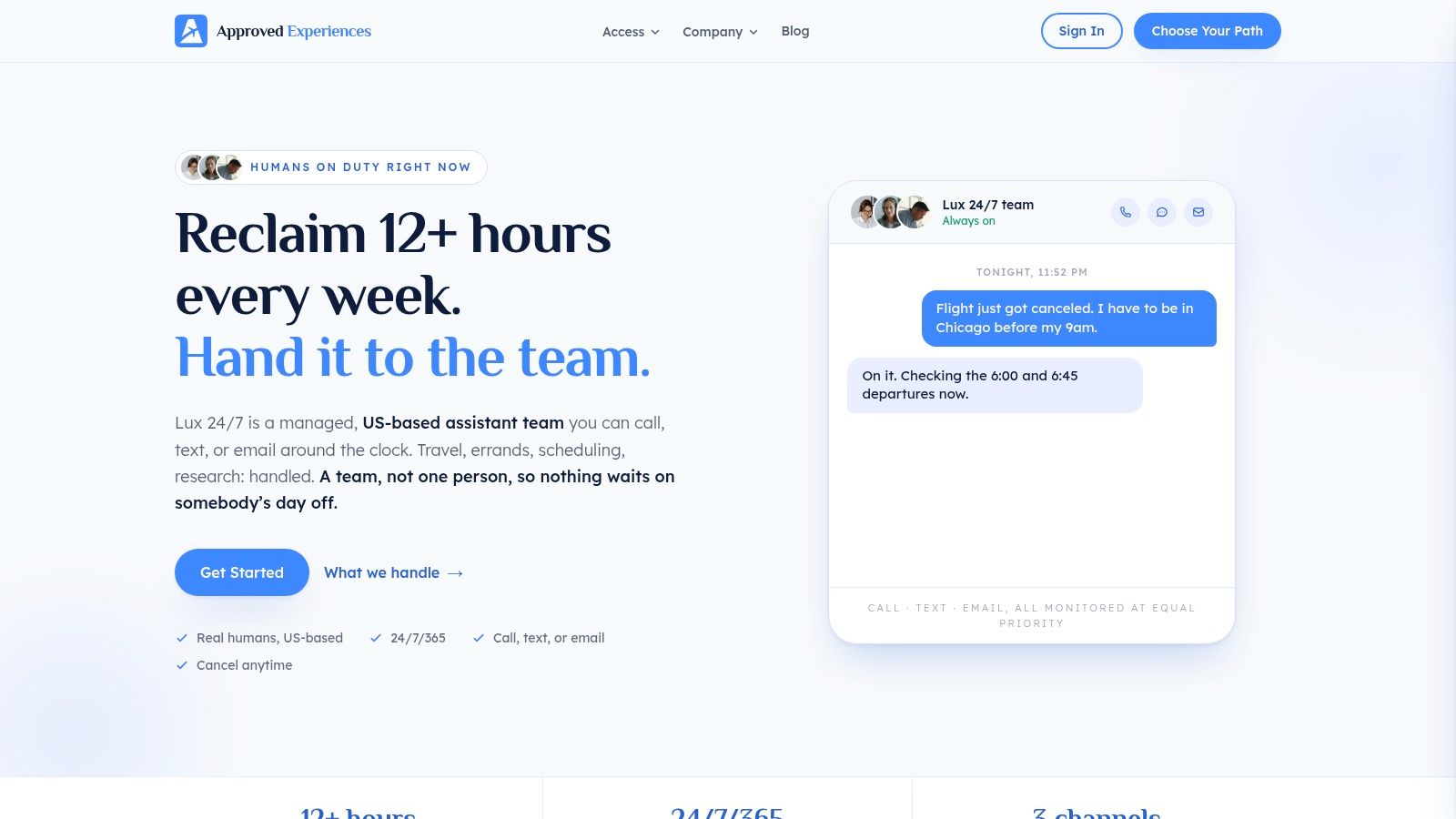
Approved Lux is built for buyers who need human judgment, constant reachability, and operational support across business and household tasks. Its US-based, managed Assistant team is available 24/7/365 through Triple-channel access, with phone calls, SMS texts, and email treated as equal ways to submit requests.
The service fits recurring coordination better than isolated, one-time assignments. Assistants can arrange flights, hotels, ground transport, restaurant reservations, and full itineraries. They can also manage appointments, deadline reminders, calendar conflicts, gift sourcing, home-service research, event planning, dry cleaning, personal shopping, vendor vetting, price negotiation, review synthesis, inbox triage, email drafting, document formatting, expense tracking, and meeting preparation.
That breadth affects the time-return calculation. A traveler can text during a late-night disruption, email a detailed itinerary request, then call when a replacement route requires judgment. A parent can delegate pediatrician scheduling, school enrollment paperwork, and household service coordination without transferring each request into a separate ticketing system. The likely return comes from fewer handoffs and follow-ups, not from completing one large project.
Why the team model changes the calculation
Approved Lux uses a managed team rather than assigning every request to one solo assistant. Shared context and managed coverage reduce the risk of a single point of failure when a request arrives outside normal working hours or the usual assistant is unavailable. Onboarding records standards and preferences, while Proactive Preference Learning helps the team adapt to recurring routines.
This capacity model differs from hourly and scope-based services. It gives the buyer ongoing access without payroll, benefits, recruiting, or W-2 management, while the team absorbs more of the coordination required to keep requests moving. The trade-off is that clients must define approvals and retain control of private accounts.
Pricing is straightforward to compare. Lux Solo costs $99.99 per month for one account holder, while Lux Circle costs $299.00 per month for up to 4 people, per the published plans. A 7-day try option is listed at $9.99, with month-to-month flexibility and cancel-anytime terms.
Operational rule: Judge Approved Lux by the follow-ups, decisions, and interruptions it removes, not by the number of services listed on the website.
The service does not include in-person work or private account logins, and it does not provide legal, medical, financial, or tax advice. It can research options and shortlist licensed professionals instead. This practical guide to what a personal assistant does can help define an appropriate first delegation batch.
Pros
- 24/7/365 human coverage: US-based Assistants are reachable by call, text, or email.
- Force-multiplier economics: The subscription adds capacity without payroll, benefits, recruiting, or W-2 management.
- Preference continuity: Proactive Preference Learning helps the team work from established standards.
- Household fit: Lux Circle supports up to 4 people with shared context.
- Travel support: Lux Traveler bundles travel benefits with Approved Lux.
Cons
- No physical presence: The team coordinates work but does not perform in-person errands.
- No private account access: Members retain control of their accounts and approvals.
- No regulated advice: Licensed professionals are researched and shortlisted rather than replaced.
2. Boldly
Boldly is designed for businesses that can assign a recurring workload to an experienced Assistant. Its subscription uses published hour packages, while Assistants are W-2 employees of Boldly rather than contractors. The provider handles employment and coverage, and clients receive fractional access to senior talent.
The operating model combines executive and personal support with selected specialist work. Assistants can manage calendars and inboxes, coordinate travel and projects, support light operations, and handle work such as marketing or design. Staffing spans the US and Europe. Assistants are described as having roughly 10 to 15 years of experience, according to this comparison of virtual assistant companies.
A capacity model for recurring delegation
Boldly publishes monthly plans beginning at 40 hours, with larger options of 60, 80, and 100 hours or more. That pricing structure makes capacity easier to compare before purchase, and trained backup coverage reduces reliance on one individual. The trade-off is commitment: a buyer with sporadic demand may pay for hours that do not produce enough reclaimed time.
A marketing leader could direct a recurring package toward calendar protection, meeting preparation, travel bookings, and project follow-up. Those tasks can remove repeated coordination from the leader's week and preserve attention for campaign decisions. A founder with irregular demand should first estimate the weekly request volume, then compare it with the minimum package. If the workload regularly falls below the commitment, unused hours become overhead rather than operational return.
Boldly fits a professional or business team that can define work in advance and maintain a stable queue. It is less suitable for a household seeking equal personal and professional support, or for occasional spikes that do not justify a monthly plan.
Operational test: Choose Boldly when recurring delegation can consume the package consistently. The employee model and backup coverage reduce staffing administration, while specialist access can extend support beyond routine administration. The client still needs to track hours and confirm that the subscription is removing enough scheduling, research, travel, and follow-up work to justify its cost.
3. Time etc
Time etc suits founders and small teams that need assistant capacity without buying a large recurring commitment. Its US-based Assistants handle administration, scheduling, research, travel coordination, light marketing, and administrative operations. The model is built around queued work and available hours, so it differs from services organized around a defined scope, continuous access, or a managed team.
The main operational advantage is rollover. Unused hours carry forward instead of disappearing at the end of the billing period. There is no setup fee, and clients can change or cancel month to month. A task dashboard and mobile app show request status, while an optional free first-task trial lets a buyer test the working relationship before assigning a wider workload.
A consultancy might need intensive travel and meeting support before an event, followed by a quieter period. A small company may move between research-heavy weeks and calendar administration. Rollover protects some of that unused capacity, although someone still needs to check whether the selected bundle is consistently too large or too small.
How the capacity model affects time returned
Time etc works best when requests can be specified and queued in advance. Suitable examples include researching software vendors, preparing meeting agendas, comparing travel options, confirming appointments, and maintaining a prospecting list. These tasks can return focused hours by removing repeat coordination from a founder's or operator's week.
Its access model is less suitable for work requiring immediate judgment across phone, text, and email at all hours. Buyers should also clarify how continuity works when the workload depends on one assigned Assistant, rather than assuming the same coverage as a team-based service. That distinction affects both response speed and the management effort required from the client.
The virtual assistant pricing guide provides useful context for comparing hourly capacity with fixed subscriptions and scope-based providers.
Operational scorecard: Time etc offers US-based staffing, visible task management, and month-to-month control. Pricing is easier to evaluate through hour capacity than through an undefined scope, but the buyer remains responsible for forecasting demand, prioritizing requests, and preventing unused hours. Choose it when predictable queued work can reclaim meaningful administrative time without requiring continuous access or broad vendor coordination.
4. BELAY
BELAY is a scope-based managed support provider for organizations that want several functions coordinated through one vendor. Its US-based talent covers Executive, Operations, Marketing, and Personal Assistant work, with time-zone alignment and managed delivery rather than a simple hourly marketplace.
BELAY's main distinction is scope and capacity. A client defines recurring responsibilities such as executive calendar management, operational coordination, marketing administration, or household support, then receives a monthly engagement priced around that scope. This structure suits work that requires judgment across connected processes, because the buyer is not counting every individual action. It can reduce operational noise and return time otherwise spent coordinating separate tasks.
The service also extends beyond assistant work. Through its financial services, BELAY offers bookkeeping and accounting support, which may reduce vendor sprawl for a growing company managing executive support, operations, marketing administration, and financial tasks through separate providers.
Where the model fits
BELAY's scorecard is strongest on role coverage and managed delivery. Multiple specializations let one provider support executive, operational, marketing, personal, and financial responsibilities. US-based alignment may fit clients that need familiar working hours and communication norms. Managed delivery means the client does not recruit and supervise each Assistant directly.
Pricing requires more work to assess. BELAY does not publish a public price list for assistant engagements, so buyers need a scoping call before comparing the commitment with hourly, fixed-capacity, or app-led services. The quote becomes easier to evaluate when expected deliverables, response needs, and responsibility boundaries are defined in advance.
A small agency could assign calendar management, client meeting preparation, travel coordination, and project follow-up to one engagement. A household buyer may find BELAY's business orientation less natural unless personal support is explicitly included. Broader services can reduce coordination overhead, but scope dependence creates friction when requests fall outside the agreed responsibilities.
Choose BELAY when several recurring functions need one managed relationship and the resulting coordination reduction should reclaim meaningful administrative time. Choose another model when instant household delegation, transparent public pricing, or flexible hourly capacity matters more than centralized coverage.
5. Prialto
A fixed capacity model defines Prialto's operating profile. Prialto sells Prialto Units of about 55 hours per month, with the option to purchase multiple units. The service is built for buyers who value documented processes, predictable capacity, and a formal service layer.
Assistants work from Prialto offices in the Philippines, Kenya, and Guatemala, with coverage aligned to US working hours. Engagement managers, training, and backup coverage sit above the individual Assistant relationship. That team structure reduces client responsibility for recruitment, training, replacement coverage, and day-to-day process correction.
The pricing model is transparent at the capacity level, although buyers still need to assess the total commitment against their workload. Fixed units suit recurring executive tasks better than irregular demand. Compared with hourly services, scope-based engagements, or app-led delegation, Prialto offers steadier monthly coverage and more management support, with less flexibility when demand falls below the purchased capacity.
Its best fit is work that can be documented and repeated. Calendar administration, meeting preparation, travel planning, contact management, and follow-up can move through established processes. Managed process and Backup coverage reduce dependence on one person, while Fixed capacity makes monthly workload planning easier. SOC 2 Type II compliance gives organizations with stricter data and operational-control requirements another factor to evaluate.
Access remains the main limitation. Standard support covers weekday daytime hours rather than continuous 24/7 reachability. A business leader delegating routine scheduling during office hours may reclaim substantial administrative time. A frequent traveler handling a midnight cancellation, or a parent managing urgent household logistics after hours, may need a service with broader access.
Staffing geography also affects the scorecard. The distributed model may support predictable process delivery, but buyers requiring US-based human accountability should treat location as a primary selection criterion.
Prialto works best when recurring executive administration creates enough volume to justify a fixed unit and the client values continuity over short-term flexibility. Lower or highly variable workloads may make unit sizing inefficient. Compliance signal and Managed process matter more for organizations seeking formal controls than for buyers who primarily need instant, occasional household delegation.
6. Zirtual
For buyers sizing support by workload, Zirtual offers a clear hour-based model. Its four core Assistant plans provide 12, 20, 30, or 45 hours, with multi-user access available on higher tiers. That makes the initial capacity decision easier than with providers that require a broad scope before revealing commercial terms.
A solo professional could assign calendar maintenance, research, travel coordination, and outbound follow-up to a defined monthly allocation. A small team could share higher-tier capacity across several employees instead of arranging separate support for each person. The likely return comes from removing repeatable administrative tasks, although clients must track whether the chosen tier leaves enough room for deadline-driven work.
Where Zirtual fits the scorecard
Pricing transparency and capacity sizing are Zirtual's clearest advantages. Its plan structure supports a direct comparison between expected workload and purchased hours. The tradeoff is limited elasticity. A launch, travel disruption, or deadline can create a spike that requires a plan upgrade instead of a temporary increase.
Zirtual also offers outbound-calling packages priced by calling hours, plus legal-focused plans for virtual paralegals or legal Assistants. Those options extend the service beyond general delegation for sales-led small teams and solo practitioners with structured calling or legal-administrative workloads.
A boutique professional might use a smaller plan for appointment coordination, client follow-up, document preparation, and research. A sales team could assign a defined campaign to the calling option, but should confirm how quickly capacity can expand before committing time-sensitive work. Buyers should also verify access channels, staffing geography, and continuity expectations if those factors affect response speed or relationship ownership.
Granular tiers make initial sizing clearer through the 12-, 20-, 30-, and 45-hour options. Multi-user access supports shared team capacity, while Calling support addresses a specific campaign need. Legal specialization broadens the fit through virtual paralegal and legal Assistant options.
The main constraints are Hour ceilings, which can make spikes harder to absorb, and Capacity accounting, which requires close usage monitoring. The model may suit defined workloads better than buyers seeking a managed team with broad coverage and more flexible continuity.
7. Double
Double is an app-led delegation service built around a remote executive Assistant and a purpose-built platform. Clients can submit tasks through the iOS or web app, use voice-to-task requests, track time, and monitor status. An AI co-pilot speeds up recurring workflows, while human Assistants retain responsibility for judgment and execution.
The operational advantage is visibility. A leader can assign a request by voice, check progress without another meeting, and review time reports to identify work that repeatedly consumes attention. Those records can support process documentation or automation, giving the service a force-multiplication role beyond simple hourly task coverage.
Best for technology-forward delegation
Double fits teams that want a dedicated Assistant relationship with a digital control layer. Its stated matching and onboarding process is designed to take days rather than weeks. The model suits product executives and other managers who will consistently use the platform, rather than buyers seeking support entirely through email, phone, or text.
The service's remote staffing geography is not specified in the supplied information, and the model centers on an individual Assistant relationship rather than a clearly described managed team. Buyers should therefore confirm backup coverage, continuity during absence, and how capacity changes when workload spikes. These details affect how much management overhead remains with the client.
Pricing isn't publicly listed. Double scopes engagements before quoting, so a buyer must compare the proposed fee with the value of app-based capture, status visibility, time reporting, and human support. That creates more evaluation work than published hourly or subscription models, while the platform may provide more operational control than an unstructured email arrangement.
A product executive could delegate meeting preparation, follow-up tracking, travel coordination, and recurring project administration. A household needing urgent requests by phone or text, including outside standard working patterns, may find a provider with Triple-channel access better suited.
Pros: Task visibility through status and time information; Voice capture for requests that do not warrant written instructions; Human oversight that keeps judgment with the Assistant; Fast onboarding intended to reduce setup delay.
Cons: No public pricing before a sales conversation; Platform dependence for task intake and monitoring; Less channel breadth for buyers who expect equal-priority phone, text, and email access.
Top 7 Personal Assistant Services Comparison
| Service | 🔄 Implementation Complexity | ⚡ Resource Requirements | ⭐ Expected Outcomes | 📊 Ideal Use Cases | 💡 Key Advantages |
|---|---|---|---|---|---|
| Approved Lux Personal Assistant | Low, simple onboarding, managed team handoff | Low monthly subscription (Lux Solo $99.99; Circle $299.99); 24/7 US-based team | High, measurable time reclaimed (~12+ hrs/week), compounding quality via preference learning | Busy professionals/families needing around-the-clock operational support and travel coordination | US-based humans; triple-channel access (call/text/email); proactive preference learning; managed-team continuity |
| Boldly | Moderate, matching to experienced W‑2 assistants; hour-package setup | High, minimum 40 hrs/mo per assistant; published monthly hour plans | High, senior-level assistance and consistent support | Executives/businesses needing senior talent and compliance (W‑2) for ongoing workload | Experienced assistants (~10–15 yrs); backup coverage; transparent hourly scaling |
| Time etc | Low, quick matching, task dashboard and mobile app | Moderate, hour bundles with rollover; no setup fee; month-to-month flexibility | Good, predictable support with reduced wasted hours via rollover | Founders/small teams with variable monthly workloads | Rollover of unused hours; simple month-to-month control; low-friction onboarding |
| BELAY | Moderate, scoped, month-to-month engagements; managed matching | Variable, scope-based pricing; vetted U.S. talent with time-zone alignment | High, consistent, specialized support across functions | Organizations needing multiple assistant specializations without adding headcount | Multiple specializations (Exec, Ops, Marketing, Personal); bookkeeping option; U.S. time‑zone alignment |
| Prialto | Moderate, managed-service model with engagement managers | Predictable, fixed “Prialto Unit” (~55 hrs/mo); offshore delivery with U.S-hours coverage | Good, reliable, documented processes and manager oversight; SOC 2 compliance | Teams wanting managed, low-touch outsourcing with predictable cost and compliance | Managed layer (training, backups); published pricing; SOC 2 Type II |
| Zirtual | Low, straightforward hour-tier setup | Low–Moderate, granular tiers (12/20/30/45 hrs); multi-user on higher plans | Good, right-sized support for steady workloads; transparent pricing | Solo practitioners, small sales/legal teams needing specific skill tiers | Granular, transparent tiers; legal-specialist options; multi-user support |
| Double | Moderate, fast matching plus app integration and AI assist | Variable, pricing by quote; requires app adoption and tooling | High, enhanced speed/visibility via AI co-pilot and time tracking | Tech-forward leaders wanting fast onboarding and operational visibility | Dedicated assistant + proprietary app; AI co‑pilot; fast matching/onboarding |
Turn the Shortlist Into Reclaimed Hours
Choose a provider by starting with the workload, not the brand. Write down recurring tasks from the last several weeks and group them into travel, scheduling, inbox and communication, research, errands, household logistics, and professional follow-up. Estimate the weekly time each group consumes, then mark which tasks require human judgment, which need a specific time zone, and which can wait for a standard service window.
Next, define the operating requirements. Do you need phone, SMS text, and email, or would a dashboard and email queue be sufficient? Does staffing geography matter for trust, language, and working hours? Would a managed team protect continuity better than a solo Assistant relationship? Can you accept an hourly minimum, or do you need a monthly subscription that avoids payroll and benefits?
Pricing should be compared against the capacity you will use. A traditional executive assistant role had a median annual wage of $73,680 and a median hourly wage of $35.42 in May 2023, according to the US Bureau of Labor Statistics executive assistant data. A subscription isn't automatically better, but it can be more efficient when you need meaningful support without recruiting, onboarding, payroll administration, benefits, and full-time capacity.
Practical test: Give each shortlisted provider a small batch containing one recurring task, one ambiguous request, one time-sensitive request, and one research assignment.
Review the result for more than completion. Measure how many follow-ups you needed, whether the Assistant understood your approval limits, how clearly exceptions were escalated, and how much time you spent correcting the output. Then document preferences, escalation standards, approval limits, preferred vendors, communication rules, and recurring workflows during onboarding.
Approved Lux is the clearest fit when your priorities are 24/7/365 US-based human judgment, Triple-channel access, a managed Assistant team, and Proactive Preference Learning. Choose Lux Solo for one person at $99.99 per month or Lux Circle at $299.99 per month for up to 4 people. Lux Circle is especially relevant to dual-career households, caregivers, and families coordinating school, medical appointments, home services, and shared calendars.
If you need both assistant support and travel benefits, Lux Traveler costs $1,799 per year and includes Approved Lux, rather than requiring separate purchases. The separate annual products are listed at approximately $4,487 per year, comprising $3,588 plus $899, according to the supplied Approved Lux plan information.
Review delegated hours and follow-up reduction after the first month. The useful outcome isn't status or aspiration. It's the number of hours reclaimed, decisions delegated, deadlines protected, and pieces of operational noise removed from your week.
Approved Lux provides a 24/7/365 US-based human Assistant team through phone, SMS text, and email, with support for travel, scheduling, research, errands, and professional administration. If you want a practical first hire without payroll overhead, visit Approved Lux Personal Assistant and compare the plan that matches your workload.
Want the wider view?
Ten categories. One report. Every quarter. The Approved List tracks what's rising and what's fading: data-backed signals, not opinions.
Free to join · Delivered by email