
←All Articles
The Journal
Best Time to Book Cruises: Timing Windows That Save Money
September 18, 202614 min readwave seasoncruise deals
Find the best time to book cruises with timing windows, Wave Season tactics, and final-payment tricks that reveal when fares actually drop on any sailing.

The best time to book cruises isn't one calendar month. For most sailings, target 10 to 12 months before departure for inventory-rich pricing, January through March for Wave Season promotions, or 1 to 2 months before departure for last-minute fare compression.
That timing pattern matters more than the familiar advice to “book early” or “wait for a sale.” A 2025 analysis of 608,236 cruise records across 23 cruise lines found that last-minute bookings produced 20% to 47% savings compared with booking 6 to 9 months ahead, with MSC fares in one comparison falling from £1,115 to £606 when booked 1 to 2 months before sailing. Yet a separate 2026 market report found the average booking window had extended to 218 days out, roughly seven months ahead. Both patterns can be true because cruise pricing responds to inventory, fare rules, final-payment deadlines, and demand, not a fixed weekly calendar.
Why Cruise Timing Has Three Inflection Points
Three pricing inflection points shape the best time to book cruises: the early release window, Wave Season, and the final-payment deadline. The first usually appears 10 to 12 months before sailing, when inventory is broad. Wave Season, from January through March, adds promotions to available fares. The third typically arrives 60 to 120 days before departure, when unsold cabins may face sharper repricing.
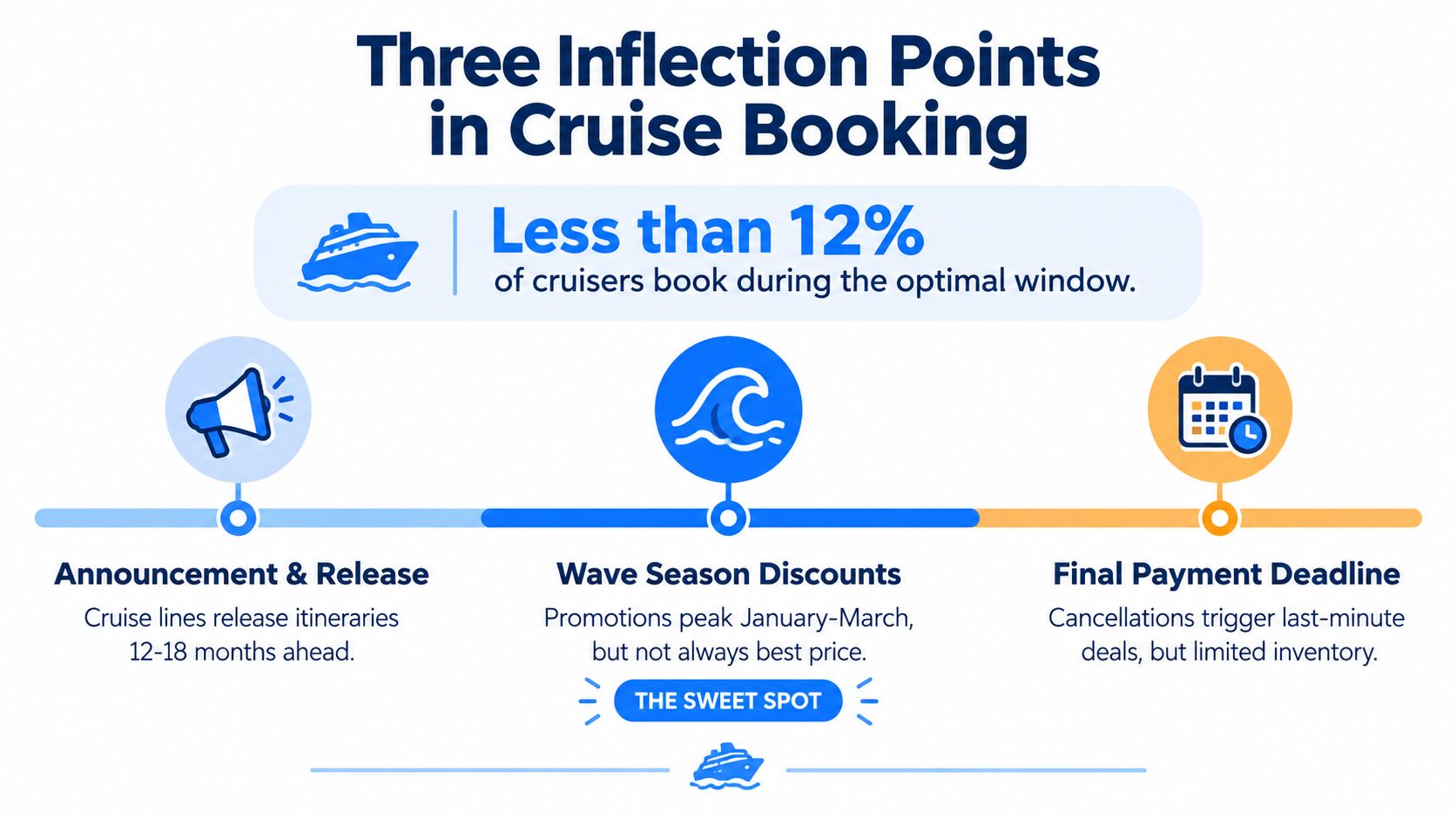
The three-anchor model
At the sale opening, cruise lines release inventory across many cabin categories. Lower fare buckets may sit alongside a broad choice of rooms, giving early buyers control over both price and placement. Use this anchor for Alaska, Galapagos, world cruises, peak holiday sailings, and trips requiring adjacent cabins. General cruise booking guidance for first-time travelers places cruises within a 6 to 12 month booking window, while high-demand categories may call for 9 to 18 months.
Wave Season is a promotional reset, not a guaranteed fare floor. From January through March, cruise lines compete for future bookings through fare reductions or added value, including onboard credit, beverage packages, reduced deposits, and guest offers. A 2025 cruise pricing analysis reports up to 20% off plus added perks during Wave Season. Forbes Advisor's summary places the strongest booking activity between mid-November and mid-March.
Final payment changes the buyer's risk. Once passengers must pay the remaining balance, cancellations can return unsold cabins to the market. Cruise lines may reprice selected rooms to improve occupancy, especially on off-peak sailings. Waiting can mean a lower fare, but it can also mean fewer cabin choices, less flexibility, reduced dining access, and less time for pre-cruise planning.
Practical rule: Choose your target inflection point before comparing sailings. Compare the fare, cabin, inclusions, and flexibility together, rather than treating a last-minute price as automatically better than an early one.
The Early Booking Window and Fare Bucket Mechanics
Cruise pricing moves in steps, not along a smooth line. Cruise lines release cabins through fare buckets, or inventory tiers. Each tier has its own price and rules. Once a lower bucket sells through, the next tier can appear at a higher fare even though the ship and sailing remain unchanged.
A Cruise Critic analysis of early versus late booking found that about half of itineraries reached their lowest fare around 10 months before departure. Use 10 to 12 months out as the starting point when you need a particular cabin category, deck, location, dining time, or connected-room arrangement.
What the fare ladder controls
A sailing can include interior, oceanview, balcony, suite, solo, accessible, and family-oriented categories. Each category may have several fare levels, while promotional inventory remains limited within each level. Cruise lines separate these buckets with price fences, including deposit requirements, cancellation terms, upgrade conditions, and included benefits.
A lower headline fare may therefore include stricter terms or fewer benefits. Waiting for a later promotion does not guarantee access to the same cabin or fare conditions. A promotion may lower the price of remaining inventory, add onboard value, or change the deposit structure without reopening an exhausted low bucket.
| Months Before Departure | Bucket Stage | Typical Pricing Posture |
|---|---|---|
| 10 to 12 months | Broad initial release | Strongest combination of fare access and cabin choice |
| 6 to 9 months | Active selling period | Balanced pricing, with inventory becoming more selective |
| January through March | Wave Season overlay | Promotional value may be added to existing fare levels |
| 1 to 4 months | Late inventory review | Remaining cabins may reprice, but category choice narrows |
Early booking also gives you room to respond if the cruise line changes the fare or adds an eligible offer. Depending on its rules, you may request a rebooking, upgrade, or adjustment. Treat that option as conditional. Check the cancellation policy, deposit terms, and final-payment date before counting on future savings.
Waiting can work on flexible, lower-demand sailings. Suitable candidates include shoulder-season Caribbean trips, September through November Caribbean departures, European shoulder seasons, Alaska shoulder seasons, and less popular repositioning routes. A timing guide for flexible cruise travelers identifies the period after final payment, generally 60 to 120 days before sailing, as a point when unsold cabins may be repriced.
The decision is operational: secure early inventory when the cabin or arrangement matters, and wait only when you can accept fewer choices in exchange for a possible fare reduction.
Wave Season and the Annual Promo Calendar
Wave Season runs from January through March, the cruise industry's most concentrated annual promotion window. Cruise lines use it to convert future demand into bookings, combining base fares with onboard credit, beverage inclusions, reduced deposits, or pricing for additional guests.
The timing serves both sides. Travelers begin planning the year ahead, while cruise lines secure forward revenue and can assign cabins before popular categories thin out. January can still offer broad inventory across many departures, so Wave Season often produces strong overall value even when it does not deliver the lowest advertised fare.
Where Wave Season works best
Wave Season suits travelers who have selected a sailing but still have several cabin choices. Families can coordinate rooms, flights, excursions, and school calendars. Couples can compare balconies and suites while promotional extras remain available. Longer-itinerary travelers can secure suitable inventory and add inclusions instead of waiting for a late fare that leaves only undesirable categories.
Membership access changes how this window should be used. A wholesale membership can provide another pricing and inventory checkpoint, allowing you to compare the public promotion with the available cabin and package terms before committing. The gain is operational, not automatic savings. Check whether the offer applies to your sailing, category, occupancy, and booking conditions.
Do not wait for January if demand is already strong. Holiday weeks, Alaska peak departures, and specific suites can reach the preferred inventory tier before Wave Season begins. A promotion may add a perk without restoring the cabin you wanted. Early access to suitable inventory remains separate from later promotional value.
Wave Season is a promotion window, not a permission slip to ignore inventory.
Use it as a decision checkpoint. If the sailing opened well before January and your preferred cabin is available at a workable fare, book according to the cabin and terms. If availability remains broad, monitor the promotion and compare the complete package. Review deposit rules, onboard credit, included packages, and cancellation conditions instead of judging the advertised fare alone.
A Forbes Advisor overview identifies a broad cruise-booking watch period from Black Friday through March 31. Treat that span as a monitoring calendar, not an automatic purchase date. Buy when the fare, cabin, and rules meet your requirements, whether that occurs before Wave Season or during it.
Final Payment Deadlines and Last Minute Compression
Final payment creates the clearest late-booking boundary. Cruise lines commonly require the remaining balance 60 to 120 days before departure, depending on the sailing and itinerary, according to CruiseZoom's guide to cruise deposits and final payment. Cancellation after that deadline can trigger penalties, while the cruise line reassesses unsold cabins and the time left to fill them.
Before the deadline, prices may move gradually as the line sells through planned fare tiers. After it passes, remaining inventory has less time to produce revenue. On an off-peak sailing, the line may lower the fare or add value rather than depart with empty cabins. This creates fare compression, but the effect varies by category and demand.
Which cabins usually move
Interior and oceanview cabins are the strongest candidates for late reductions when demand is soft. Balconies and suites often attract repeat cruisers, groups, and travelers with fixed cabin preferences, so their remaining inventory may hold its price or disappear first. Solo cabins are harder to replace because supply is limited and single-occupancy pricing follows different rules.
The trade-off is straightforward. A lower base fare can cost you cabin location, dining time, excursion availability, flight coordination, and pre-cruise hotel choice. Flexible travelers who can change the ship, date, region, and category can use this window effectively. Families arranging multiple cabins and travelers requiring a suite should book earlier.
| Days Before Departure | Final-Payment Status | Cabin Categories Likely to Drop | Typical Discount Range |
|---|---|---|---|
| 120 to 90 days | Deadline approaching or recently passed | Remaining interior and oceanview inventory | Qualitative compression may begin on soft-demand sailings |
| 90 to 60 days | Final payment commonly active | Select interior, oceanview, and some balcony inventory | Deeper reductions may appear, but availability narrows |
| 60 to 30 days | Late inventory period | Cabins left in less-requested categories | Strongest potential compression, with limited choice |
| Under 30 days | Departure logistics dominate | Isolated remaining cabins | Pricing varies sharply, and practical availability may be poor |
The final-payment date is a decision boundary, not a promise of a lower fare. Late compression is more plausible for shoulder-season Caribbean, European, and Alaska sailings than for peak summer or holiday departures. Use a wholesale membership as a second checkpoint before committing: compare the public fare with available cabin categories, package terms, and booking conditions. The membership can improve access to a viable option, but it cannot restore inventory that has already sold.
Timing by Cruise Type, Region, and Season
The itinerary sets the booking window more than the calendar. A Caribbean sailing with frequent departures carries less inventory risk than a limited Antarctica voyage, while a short repositioning trip follows a different pattern from a world cruise.
Use these ranges as practical starting points:
- Caribbean and Bahamas, 6 to 9 months: This usually balances cabin access with fare flexibility outside peak holidays. Shoulder-season sailings are stronger candidates for waiting.
- Alaska and Mediterranean, 10 to 14 months: Peak summer demand, short seasonal schedules, flight planning, and popular shore excursions make earlier booking sensible.
- Antarctica and world cruises, 14 to 18 months: Limited-capacity itineraries can sell around the sailing itself, not only around preferred cabins.
- River cruises, 9 to 12 months: Concentrated capacity makes specific dates, cabin positions, and connecting travel arrangements harder to replace.
- Short repositioning sailings, 1 to 3 months: Flexible travelers can monitor these closer to departure, accepting fewer cabin and date choices.
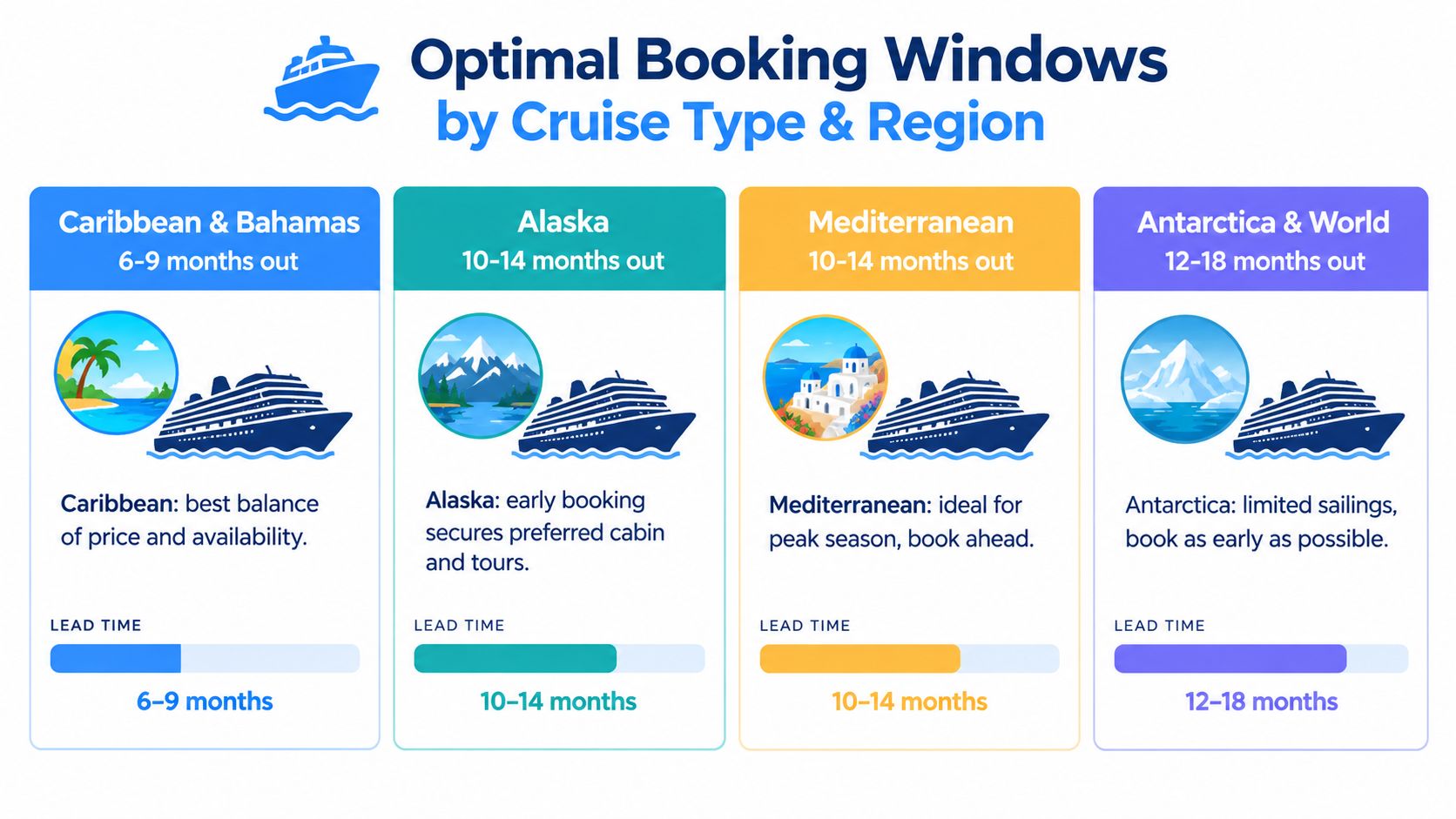
Match the window to the itinerary
A family targeting Alaska in peak summer should work near the early end of the 10 to 14 month range. That preserves more cabin categories and leaves time for flights and tours. A Caribbean traveler choosing a shoulder-season week can monitor the final-payment period if adjoining rooms are not required.
Mediterranean summer voyages deserve early action because favorable weather, school holidays, and popular ports concentrate demand. Antarctica and world cruises require a firmer rule: if the itinerary cannot be replaced, do not build the trip around a speculative late fare.
Approved Experiences Traveler provides access across 44+ cruise lines and 30,000+ itineraries, giving travelers a broader view when they are comparing operators, ships, and departure dates. That wider inventory view matters when the region is fixed but the sailing is flexible.
Classify each option by demand, season, itinerary length, and cabin requirements. A flexible Caribbean traveler can wait for a later pricing checkpoint. A group of 8 to 10 seeking adjacent cabins on a holiday sailing should secure inventory early, then use wholesale access to compare available fares and terms before committing.
Tailored Timing for Specific Traveler Profiles
The right booking window depends on what you're unwilling to sacrifice. Price, cabin selection, dining flexibility, and included value don't carry equal weight for every traveler.
Couples who care about the cabin
Honeymooners and anniversary couples should book 10 to 12 months out when a suite, balcony location, connecting cabin, or preferred dining time matters. The point isn't to secure a fare. It's to protect the physical setup that shapes the trip.
Families working around fixed dates
Families with school-age children should anchor first on the school and holiday calendar, then target 9 to 12 months ahead. Wave Season can add onboard credit or other inclusions, but waiting for a promotion can backfire if the family needs adjacent rooms. Practical guidance for larger family groups is available in this cruise planning guide for a family of six.
For a group of 8 to 10, divide the search into two questions: which sailing works, and which cabin arrangement works. If both answers are fixed, book early. If the group can accept separate decks or nearby dates, monitoring later becomes more viable.
Flexible retirees
Retirees with open calendars are the strongest candidates for final-payment monitoring. Target shoulder-season sailings and keep several regions or departure dates in play. The savings opportunity comes from flexibility, but the cabin category may be whatever remains.
Solo travelers should generally book early. Single-occupancy cabins are limited, and their pricing structure may harden before final payment. Waiting for compression can leave you comparing a lower double-occupancy fare that doesn't apply to your booking.
Repeat cruisers with strong loyalty benefits have more room to wait, especially if they can switch ships or lines. Member-only Wave Season promotions may provide enough added value to justify booking during the promotional period, but loyalty shouldn't override the cabin and itinerary constraints that matter most.
Decision rule: If the trip has a fixed date and a fixed cabin requirement, buy inventory. If the trip has flexible dates and flexible geography, monitor price compression.
How Inventory Access Changes the Timing Game
Most travelers ask, “When do cruise fares drop?” The more useful question is, whose inventory can you see when fares move?
Cruise-line-direct searches show the inventory and promotions available through that channel. Agency tiers may expose different fare structures, blocked cabins, or promotional access. A shopper comparing only one operator can mistake channel visibility for the entire market.
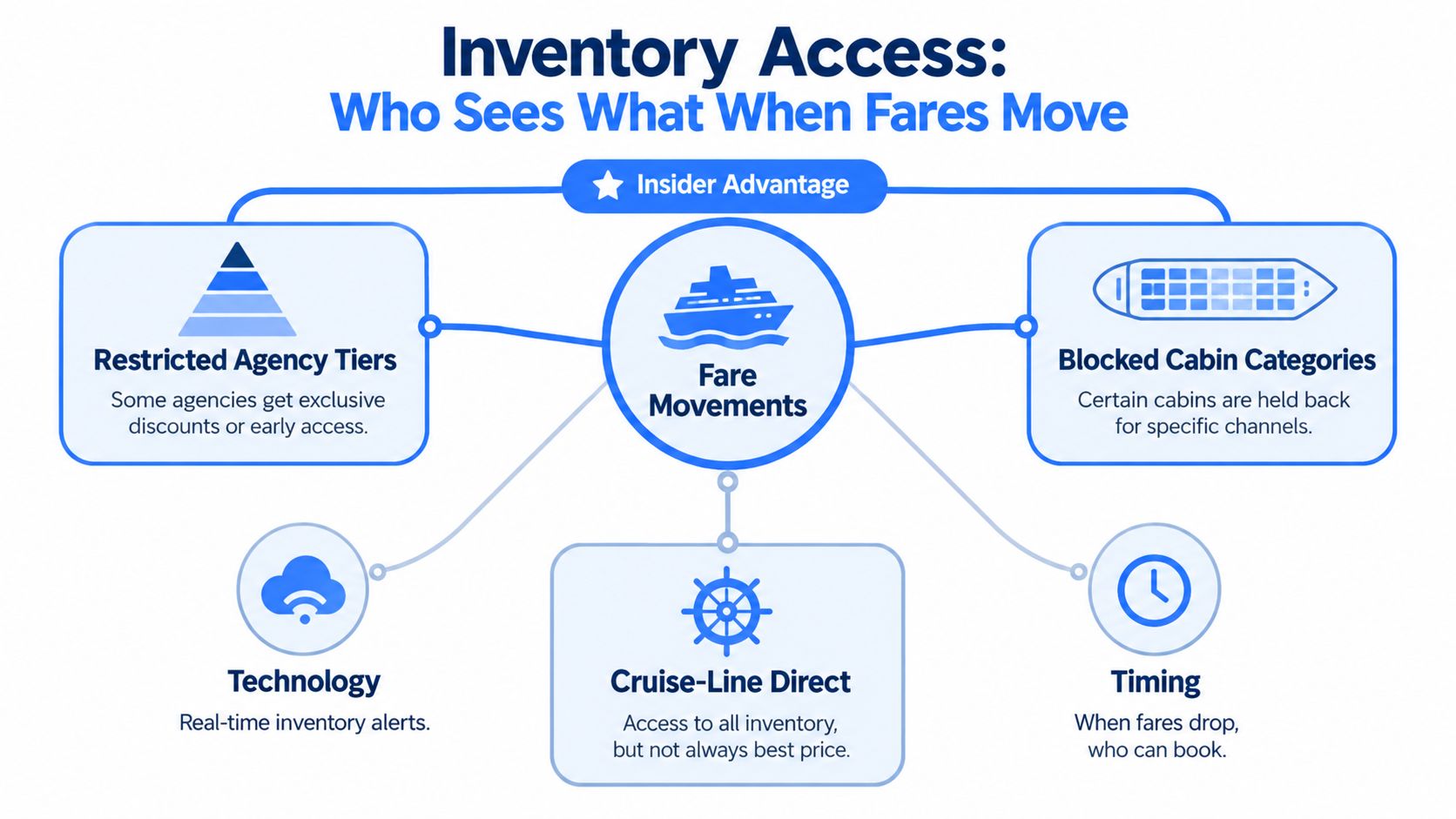
Access creates timing leverage
A wholesale membership changes the monitoring problem by consolidating inventory across 44+ cruise lines and 30,000+ itineraries. Instead of checking one operator's calendar and assuming its fare represents the market, a member can compare alternative ships, dates, cabin categories, and lines in one marketplace.
That access doesn't eliminate fare rules. It makes the comparison more complete. If one sailing becomes unattractive after final payment, another operator may still offer the right itinerary at a workable fare. The effective decision window becomes wider because the traveler isn't locked into one inventory pool.
Reward Credits add another layer. Members earn Reward Credits on every booking, and those credits don't expire. They can be redeemed toward future bookings, maintenance fees, resort usage fees, annual renewal, and eligible eGift cards. The value is operational rather than cosmetic. A booking that isn't the absolute lowest base fare may still produce stronger total trip economics when future booking value is included.
The cruise booking site comparison guide is useful for evaluating channel differences, but don't reduce the decision to a coupon search. Approved Traveler is travel infrastructure. It consolidates access, fare comparison, and future-use value in one account rather than making the traveler recreate the process across fragmented platforms.
The 110% Best Value Guarantee also changes the risk of booking early. If a member finds a lower publicly available price later, the refund is issued as credit equal to 110% of the difference, subject to the program's terms. That doesn't make every early fare correct, but it can reduce the cost of committing before preferred inventory disappears.
Putting It Together With a Decision Framework
Use this workflow before every cruise search:
- Identify the sailing. Classify it by cruise type, region, itinerary length, season, and cabin requirement.
- Set the lead-time baseline. Use 10 to 12 months for popular categories, 6 to 9 months for flexible shoulder-season Caribbean sailings, and longer windows for limited or peak itineraries.
- Check the three inflection points. Review the opening fare, monitor January through March Wave Season promotions, and mark the 60 to 120 day final-payment boundary.
- Compare accessible inventory. Look across cruise lines, cabin categories, fare rules, and included value instead of comparing one headline fare.
- Decide based on the trade-off. Book when the comparable accessible fare is worth more than the projected late-fare possibility once you account for locked cabin selection, dining, itinerary certainty, and included perks.
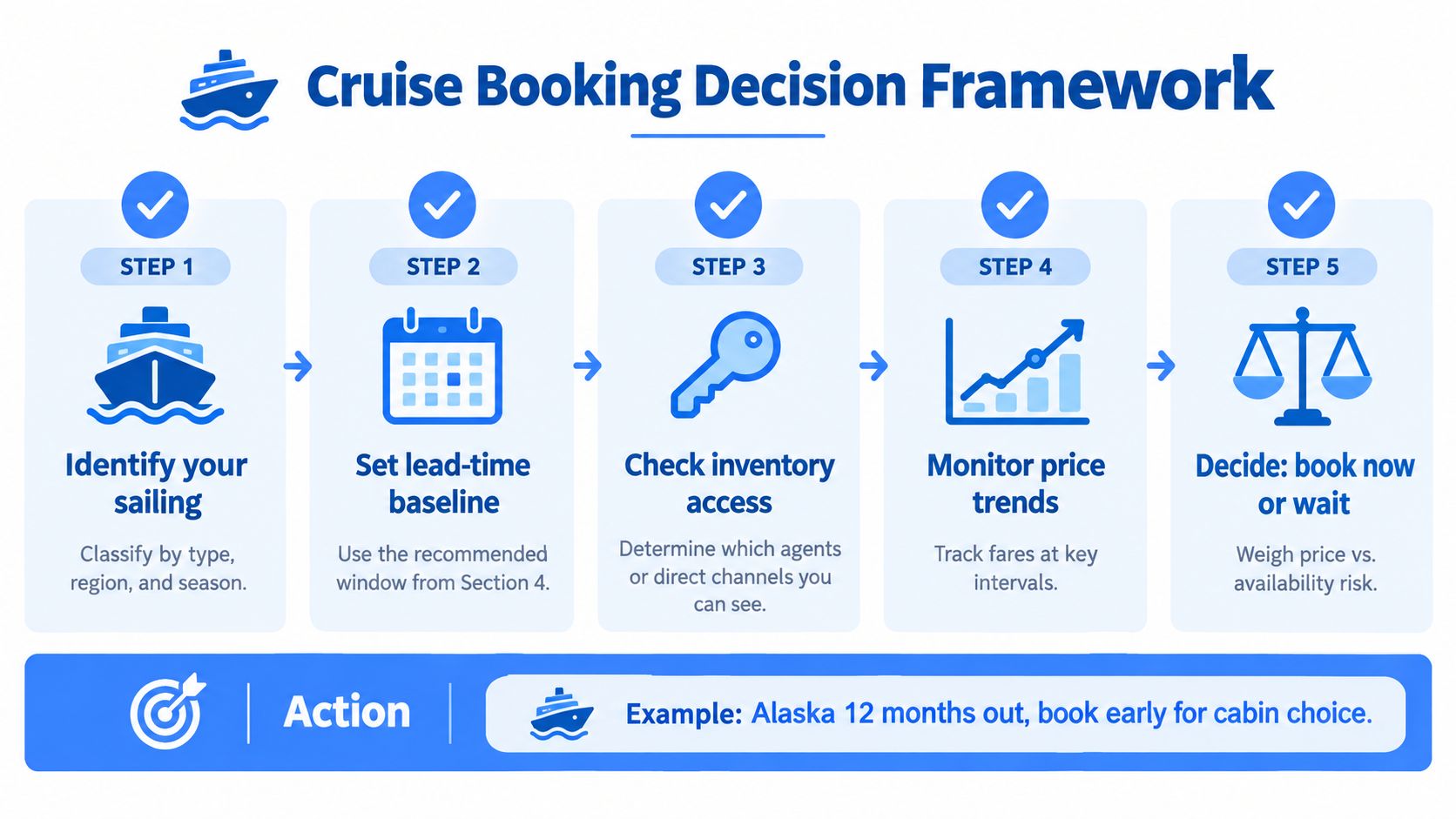
A simple prompt keeps the decision disciplined: What am I protecting, and what am I willing to trade? If you're protecting a specific suite, family cabin arrangement, holiday date, or Alaska itinerary, book inside the early inventory window. If you're protecting only the base fare and can change the destination, monitor final-payment compression. For more cost-control tactics, use this guide on how to save money on cruises.
Approved Experiences Traveler gives you consolidated access to wholesale cruise inventory across 44+ cruise lines and 30,000+ itineraries, with Reward Credits earned on every booking and the 110% Best Value Guarantee as a pricing backstop. Visit Approved Experiences Traveler to compare your sailing across channels, choose the timing strategy that fits your trip, and book with a clearer view of the inventory trade-off.
Want the wider view?
Ten categories. One report. Every quarter. The Approved List tracks what's rising and what's fading: data-backed signals, not opinions.
Free to join · Delivered by email