All Articles
The Journal
Corporate Travel Policy Best Practices: The Definitive Guide for 2024
January 24, 202625 min readtravel managementbusiness travel
Explore corporate travel policy best practices to cut costs, boost compliance, and improve traveler experience with practical steps.

A well-crafted corporate travel policy does more than just control costs. It becomes a strategic asset that boosts employee satisfaction, ensures safety, and drives operational efficiency. Many companies struggle with policies that are outdated, overly restrictive, or difficult to enforce, leading to maverick spending and frustrated travelers. This creates a cycle of non-compliance, lost savings, and administrative headaches.
This guide moves beyond generic advice to deliver a comprehensive roundup of actionable corporate travel policy best practices. We will break down specific, proven strategies you can implement immediately to transform your program. Instead of vague concepts, you will find practical examples, sample policy snippets, and clear implementation steps for everything from approval workflows to duty of care protocols.
Throughout this listicle, we'll explore how modern platforms can automate compliance while unlocking significant savings on hotels, car rentals, and even luxury accommodations. You'll learn how to build a dynamic policy that balances cost control with traveler well-being, turning a necessary expense into a competitive advantage. It's time to build a policy that works for your business and your people, eliminating friction and maximizing value on every trip.
1. Establish Clear Travel Authorization and Pre-Approval Workflows
A foundational element of effective corporate travel policy best practices is implementing a structured and transparent pre-approval workflow. This system requires employees to submit a formal travel request before any bookings are made. By doing so, you ensure every trip is vetted for business necessity, aligns with departmental budgets, and adheres to company guidelines from the very beginning. This proactive approach prevents unauthorized or out-of-policy spending and provides critical data for forecasting and negotiating with preferred suppliers.
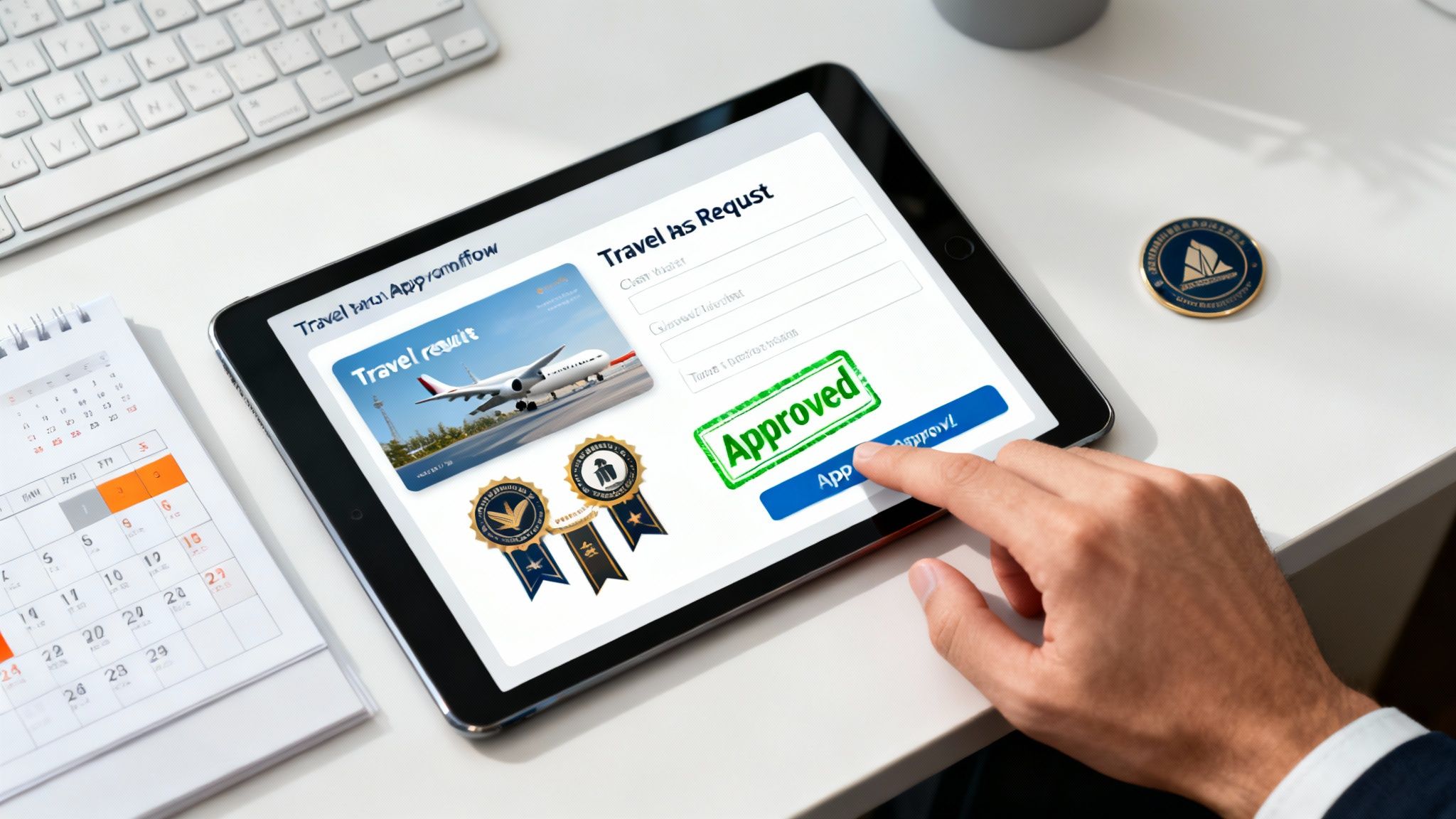
This process eliminates the costly and inefficient "book first, ask for forgiveness later" culture. It empowers managers with the visibility needed to control costs and ensures that all travel directly supports strategic business objectives.
Successful Implementation Examples
- Practical Example: A mid-size tech company implemented a simple workflow: any travel request under $1,500 with at least 14 days' advance notice is auto-approved if it's within the team's travel budget. Requests over $1,500 or for international travel are automatically routed to a department head for manual review. This reduced approval times for 80% of their domestic trips.
- Actionable Insight: By using a travel management platform, IBM slashed its manual processing time by over 60%. Their system automatically cross-references travel requests with project codes and budget availability, flagging exceptions for human review rather than requiring a manager to approve every single trip.
How to Implement This Practice
To build a robust pre-approval system, focus on clarity, automation, and integration.
- Set Clear Thresholds: Define specific triggers for approval levels. For example:
- Manager Approval: Required for all trips.
- Director Approval: Required for trips over $3,000 or any international travel.
- VP Approval: Required for all business class bookings or trips over $7,500.
- Leverage Automation: Use travel management software to automate request routing, send notifications, and enforce policy rules. This significantly reduces the administrative burden on both travelers and approvers.
- Integrate with Your Booking Platform: Platforms like Approved Experiences Traveler allow companies to pre-load approval parameters directly into the booking portal. This ensures that once a trip is approved, employees can only book flights and hotels that fall within the pre-authorized budget and policy constraints.
- Plan for Exceptions: Build a clear, expedited process for last-minute or emergency travel. For example: Create a specific "Emergency Travel Request" form that requires a one-sentence justification and is flagged for immediate review by an authorized approver.
2. Leverage Preferred Vendor and Negotiated Rate Programs
A cornerstone of modern corporate travel policy best practices is the strategic use of preferred vendor programs. This involves establishing partnerships with a curated network of hotels, airlines, and car rental agencies to secure negotiated discounts, exclusive benefits, and preferred pricing. By consolidating your company's travel spend with these key suppliers, you gain significant leverage to unlock volume-based savings that aren't available to the general public.
This approach not only drives direct cost reduction but also simplifies the booking process for employees and provides a higher, more consistent standard of service. It shifts your company from being a transactional buyer to a strategic partner, unlocking value far beyond the initial price tag.
Successful Implementation Examples
- Practical Example: A consulting firm noticed 70% of its travel was to five major cities. They negotiated a preferred rate with a hotel chain that had properties in all five locations, guaranteeing a certain number of room nights per year in exchange for a 15% discount off the best available rate, free Wi-Fi, and complimentary breakfast for all employees.
- Actionable Insight: Programs like Hertz and Enterprise offer corporate accounts that provide streamlined billing (eliminating individual expense reports for rentals), dedicated account support, and lower daily rates, which simplifies ground transportation management and reduces administrative overhead.
How to Implement This Practice
To build an effective preferred vendor program, focus on data analysis, consolidation, and technology.
- Audit Your Spending: Analyze historical travel data to identify your top vendors by volume and cost. For example: Pull a report showing your top 10 hotel chains by spend over the last 12 months. This list becomes your starting point for negotiations.
- Consolidate and Partner: Instead of spreading bookings thinly across dozens of suppliers, consolidate your spend with 3-5 key partners in each category (e.g., lodging, air, car) to maximize your bargaining power.
- Use a Modern Booking Platform: Platforms like Approved Experiences Traveler provide instant access to a vast pre-negotiated network, including over 700 airlines and one million hotels. This allows companies to tap into corporate-equivalent rates and benefits without the lengthy process of direct contract negotiations.
- Monitor Compliance: Use your travel management software to track employee adherence to the preferred vendor policy. Actionable step: If compliance is low, send a targeted communication explaining the benefits (e.g., "Booking with our preferred hotel saves the company an average of $45 per night and gives you free breakfast.").
- Review Annually: Re-evaluate your vendor contracts and performance each year to ensure the rates remain competitive and the service levels meet your travelers' needs.
3. Implement Spend Visibility, Real-Time Monitoring, and Quarterly Policy Review
A static travel policy quickly becomes obsolete. One of the most critical corporate travel policy best practices is creating a dynamic feedback loop through real-time spend visibility and consistent policy reviews. This involves deploying systems that track travel expenses as they happen, not just after the expense report is filed. By continuously monitoring spending trends and formally reviewing policy effectiveness every quarter, you can make data-driven adjustments that ensure your program remains cost-effective, compliant, and aligned with evolving business goals.
This proactive approach transforms travel management from a reactive, cost-center function into a strategic, value-driven asset. It provides the insights needed to negotiate better supplier deals, identify compliance gaps, and optimize travel budgets with precision.
Successful Implementation Examples
- Practical Example: A company noticed through real-time monitoring that ancillary airline fees for checked bags had increased 30% in one quarter. During their policy review, they decided to negotiate a corporate rate with an airline that included one free checked bag for all employees, saving thousands annually.
- Actionable Insight: Google uses an internal system that flags out-of-policy expenses before they are submitted, prompting employees with messages like, "This flight is 20% over the average price for this route. Please provide a justification or select a different option." This real-time feedback loop trains employees to make better spending decisions.
How to Implement This Practice
To build an effective monitoring and review cycle, focus on data, benchmarks, and stakeholder engagement.
- Establish Clear KPIs: Track key performance indicators (KPIs) that are easy to understand. Examples: Average Cost per Trip, Advance Booking Rate (%), and Out-of-Policy Spend (%). This creates a baseline for measuring success.
- Automate Alerts: Configure your travel management platform to send automated alerts. For example: Set an alert for the finance manager if a single trip is booked that exceeds $5,000, enabling immediate intervention.
- Leverage Platform Dashboards: Use platforms that offer real-time analytics. For instance, the Approved Experiences Traveler membership dashboard provides a live view of bookings, total savings achieved, and Reward Credits earned, quantifying the program's ROI instantly.
- Schedule Quarterly Reviews: Set a recurring meeting with key stakeholders (e.g., finance, department heads). Actionable step: Come to each meeting with a simple one-page report showing the top 3 KPIs and one specific trend (e.g., "Ancillary fees are up 15%"). Discuss one policy change to address it.
- Gather Traveler Feedback: Supplement quantitative data with qualitative insights by sending annual surveys. Ask specific questions like: "On a scale of 1-5, how easy is it to book travel within policy?" or "What is the single biggest frustration with our current travel policy?"
4. Create Tiered Travel Policies Based on Employee Level and Trip Type
A one-size-fits-all approach to corporate travel policy is rarely effective. A best practice is to develop a tiered policy that differentiates rules based on employee seniority, trip purpose, and travel duration. This strategic segmentation balances fiscal responsibility with the need to provide appropriate accommodations for different roles, ensuring that a C-suite executive on a critical international trip isn't bound by the same per diem as a junior employee attending a local conference.
This nuanced approach allows you to control costs where it matters most while empowering senior staff and road warriors with the flexibility and comfort needed to perform at their peak. It acknowledges that not all business travel is created equal and aligns policy with strategic importance and employee expectations.
Successful Implementation Examples
- Practical Example: A software company created a simple tier for "Client-Facing Travel." Any employee traveling to meet a key client is pre-approved for a slightly higher hotel budget and can book direct flights, even if they aren't the absolute lowest price. This prioritizes client relationships over minimal cost savings.
- Actionable Insight: Salesforce implements a clear hotel tiering system. Individual contributors are approved for 3-star hotels with a nightly cap of $250, managers can book 4-star properties up to $350, and executives are permitted 5-star accommodations, directly aligning lodging standards with seniority.
How to Implement This Practice
Building a tiered policy requires thoughtful segmentation and clear communication.
- Define Your Tiers: Segment employees by level, trip type, or travel frequency. Here's a sample matrix:
- Tier 1 (Associates/Specialists): Economy flights, 3-star hotels (e.g., Courtyard by Marriott), standard rental car.
- Tier 2 (Managers/Directors): Premium Economy on flights > 6 hours, 4-star hotels (e.g., Marriott, Hilton), full-size rental car.
- Tier 3 (VPs/Executives): Business class on flights > 6 hours, 5-star hotels (e.g., Four Seasons), premium rental car.
- Benchmark Competitor Policies: Research industry standards for different roles to ensure your policy remains competitive and helps attract and retain top talent.
- Automate Enforcement: Program your tiered rules directly into your travel management software. This automatically displays compliant booking options based on the traveler's profile, preventing out-of-policy selections from the start.
- Leverage Membership Models: Platforms like Approved Experiences Traveler offer a natural framework for policy tiering. You can align its Gold, Platinum, and Diamond membership levels with your employee seniority, granting executives access to exclusive benefits like concierge services and private jet availability while providing cost-effective wholesale rates for all staff.
5. Establish Advance Booking Requirements and Booking Windows
A powerful yet simple cost-control lever in corporate travel policy best practices is mandating advance booking. By requiring employees to book flights, hotels, and car rentals within a specific timeframe, typically 7 to 21 days before departure, companies can avoid the premium prices associated with last-minute travel. This forward-planning approach not only secures significant savings on airfare and accommodation but also allows for better logistical coordination and resource management.
This policy shifts the corporate culture from reactive to proactive, ensuring that travel is a well-considered strategic activity rather than a rushed, costly necessity. It provides the visibility needed to forecast expenses accurately and empowers travel managers to negotiate better rates with preferred suppliers based on predictable booking patterns.
Successful Implementation Examples
- Practical Example: A marketing agency analyzed their data and found that flights booked less than 7 days in advance cost, on average, 45% more. They implemented a policy requiring 14-day advance booking. If a booking is made within the 14-day window, the employee's manager receives an automated notification asking for a one-click justification. This simple "soft block" increased their advance booking rate from 60% to 85% in six months.
- Actionable Insight: Leading consulting firms often mandate a 14-day advance booking window for all client-related travel, aligning their travel schedules with project timelines and maximizing cost-efficiency on billable engagements.
How to Implement This Practice
To effectively implement advance booking rules, focus on automation, education, and structured flexibility.
- Set Realistic Windows: Establish clear, tiered guidelines based on trip type. A common best practice is a 14-day advance purchase for domestic travel and 21 days for international to capture the best fares without being overly restrictive.
- Automate Enforcement: Configure your travel management software to flag or block bookings that do not meet the advance purchase requirement. For example: The system can show a pop-up: "This booking is within the 14-day window and is $200 more expensive than booking in advance. Please confirm you wish to proceed."
- Define Clear Exceptions: Create a straightforward process for handling legitimate last-minute needs. Policy Snippet: "Exceptions to the advance booking rule are permitted for customer-facing emergency support or new business opportunities confirmed within the booking window. Approval from a Director is required."
- Educate and Incentivize: Clearly communicate the financial impact of booking early. Platforms like Approved Experiences Traveler allow companies to set advance booking parameters that can unlock even deeper wholesale discounts, creating a natural incentive for employees to plan ahead.
6. Enable Flexible Accommodation Options Including Vacation Homes and Alternative Lodging
A forward-thinking corporate travel policy best practice involves expanding accommodation guidelines beyond traditional hotels. By including options like vacation homes, serviced apartments, and other alternative lodging, companies can unlock significant cost savings and improve traveler satisfaction. This approach is especially valuable for extended stays, team offsites, or when employees travel with family, offering more space, amenities like kitchens, and a more residential experience.

This flexibility allows your program to adapt to diverse travel needs, moving beyond a one-size-fits-all model. It empowers employees with choices that can lead to better productivity and well-being while often delivering a lower cost-per-night, particularly for groups or long-term assignments.
Successful Implementation Examples
- Practical Example: A project team of four needed to be on-site for a month. Instead of booking four separate hotel rooms at $150/night each ($18,000 total), they booked a three-bedroom corporate apartment for $8,000 for the month. This saved the company $10,000 and provided the team with a kitchen and collaborative living space.
- Actionable Insight: Platforms like Airbnb for Business offer a dedicated portal for corporate clients, featuring properties that meet specific "business-ready" criteria (e.g., verified Wi-Fi speeds, 24-hour check-in), centralized billing, and duty of care tools to ensure traveler safety.
How to Implement This Practice
Integrating alternative lodging requires clear guidelines and the right technology to maintain control and safety.
- Set Quality and Safety Standards: Define non-negotiable requirements for alternative lodging. Policy Snippet: "All alternative lodging must have a minimum of 10 reviews with an average rating of 4.5 stars or higher and must be designated as a 'Superhost' or 'Business Ready' property if on a third-party platform."
- Establish Clear Use Cases: Create guidelines for when different lodging types are appropriate. For instance, permit vacation homes for stays of five or more nights or for groups of three or more employees, while recommending hotels for short, individual trips.
- Leverage Integrated Booking Platforms: Use a travel management platform like Approved Experiences Traveler that incorporates vacation homes and villas alongside standard hotel inventory. This allows for direct comparison and booking within a single, policy-controlled environment, showcasing potential savings of up to 70% on homes.
- Maintain Universal Price Caps: Apply your nightly rate caps across all accommodation types. This ensures that the choice is driven by value and suitability rather than an opportunity for out-of-policy spending.
7. Establish Ground Transportation and Ride-Sharing Policies
A critical component of modern corporate travel policy best practices involves creating clear guidelines for ground transportation. With the rise of ride-sharing and dynamic pricing, this category has become a rapidly growing and often unpredictable expense. A well-defined policy governs choices like rental cars, ride-sharing services, taxis, and public transit, ensuring traveler safety, convenience, and cost-effectiveness. By addressing this area specifically, you can rein in costs without sacrificing employee mobility.
This policy moves beyond simply approving expense reports; it proactively guides employees toward the most logical and economical choice for each situation. It provides a framework that balances cost control with the practical needs of business travelers on the move.
Successful Implementation Examples
- Practical Example: A company in a major city with excellent public transit updated its policy to state that any trip within the downtown business district under 2 miles must be taken via public transit or walking. For trips to the airport, ride-sharing is preferred, but black car services are not reimbursable. This cut their local ground transport costs by 25%.
- Actionable Insight: SAP Concur's integration with services like Uber and Lyft allows receipts to be automatically captured and categorized when a corporate profile is used. This eliminates manual data entry for employees and gives managers real-time visibility into ride-sharing spend.
How to Implement This Practice
To build an effective ground transportation policy, focus on hierarchy, preferred partnerships, and technology.
- Define a Modal Hierarchy: Establish a default order of preference to guide employee decisions. Policy Snippet: "For ground transportation, please use the most economical option available, in the following order of preference: 1) Hotel shuttles/public transit, 2) Standard ride-sharing (e.g., UberX, Lyft), 3) Rental car (for trips requiring multiple stops), 4) Taxi."
- Negotiate with Preferred Partners: Instead of allowing unlimited choices, negotiate corporate rates with one or two ride-sharing providers like Uber for Business or Lyft Business. For car rentals, leverage platforms like Approved Experiences Traveler to access discounts of up to 50% as your baseline policy rate, ensuring significant savings.
- Set Clear Spend Limits: Implement per-trip or daily caps for ride-sharing to mitigate the impact of surge pricing. For example: Any ride exceeding $75 requires a brief justification in the expense report. Disallow premium services (e.g., Uber Black) unless for specific client transport needs with pre-approval.
- Automate Expense Capture: Mandate the use of corporate accounts or integrated expense tracking apps to automatically capture ride-sharing receipts. This guarantees accurate, timely reporting and reduces administrative friction for travelers.
8. Implement Airline and Flight Class Policies with Dynamic Purchasing
A well-defined air travel policy is a cornerstone of corporate travel policy best practices, directly impacting both cost and traveler well-being. This involves setting clear guidelines for preferred airlines, cabin class eligibility, and ancillary fees. The goal is to balance stringent cost controls with the need to ensure employees, especially those on long-haul flights, arrive rested and productive. This practice moves beyond simple "lowest fare" mandates by strategically managing carrier relationships and flight choices.
By establishing rules based on flight duration and distance, you create a fair, transparent system that supports employee comfort on strenuous trips while maximizing savings on shorter ones. This strategic approach prevents unpredictable spending on last-minute upgrades and unauthorized premium cabin bookings.
Successful Implementation Examples
- Practical Example: A company implemented a "lowest logical fare" policy. This means employees must book the lowest available fare within a certain window (e.g., +/- 2 hours of their desired departure time) and on a preferred airline. This prevents travelers from choosing a much more expensive direct flight when a slightly less convenient but significantly cheaper option is available.
- Actionable Insight: Salesforce employs a tiered flight class policy that is widely seen as a best practice. It requires economy class for all flights under six hours, allows for premium economy on flights between six and 12 hours, and authorizes business class for any flight exceeding 12 hours.
How to Implement This Practice
To effectively manage air travel, combine clear rules with smart purchasing strategies and technology.
- Set Duration-Based Cabin Thresholds: Clearly define flight time cutoffs for cabin class upgrades. Policy Snippet: "Economy class is required for all flights with a scheduled duration of under 7 hours. For international flights exceeding 7 hours, Premium Economy is permitted. Business Class requires VP approval."
- Establish Ancillary Fee Policies: Pre-define rules for what is reimbursable. Example: "The company will reimburse for one checked bag and standard seat selection. Fees for priority boarding, extra legroom seats in economy, and in-flight entertainment are not reimbursable."
- Leverage Dynamic Purchasing: Use platforms like Approved Experiences Traveler, which connects to over 700 airlines, to access and compare wholesale pricing across a vast network. This ensures you secure the best possible rate that still adheres to your carrier and cabin class policies.
- Consolidate Loyalty Programs: Encourage travelers to use company-negotiated preferred airlines like American, United, or Delta. This consolidates spending to earn volume-based discounts, upgrade certificates, and bonus miles through programs like AAdvantage for Business.
9. Develop Rewards, Incentives, and Return-on-Investment Tracking Programs
A forward-thinking corporate travel policy best practice involves creating mechanisms that actively reward employees for compliance and smart booking choices. Rather than viewing policy as a restrictive set of rules, this approach reframes it as a shared value proposition. By implementing rewards, incentives, and clear ROI tracking, companies can motivate employees to make cost-conscious decisions that benefit both the organization's bottom line and their own travel perks.
This strategy shifts the dynamic from enforcement to encouragement. It transforms travel from a pure cost center into an opportunity to generate tangible returns through rebates, loyalty points, and member credits, fostering a culture of mutual benefit and financial responsibility.
Successful Implementation Examples
- Practical Example: A tech startup implemented a "split the savings" model. If an employee's total trip cost is below the pre-calculated budget for that trip, they receive 25% of the savings as a bonus or travel credit for a future trip. This directly incentivized employees to book in advance and choose more economical options.
- Actionable Insight: Programs like Marriott Bonvoy for Business allow companies to consolidate loyalty points earned by their travelers, which can then be redeemed by the company for future stays, upgrades, or corporate events, creating a direct financial return on concentrated spend.
How to Implement This Practice
To build an effective rewards program, focus on transparency, simplicity, and tangible value.
- Make Rewards Visible and Easy to Track: Transparency is key to driving compliance. For example: When an employee is booking, the system could show, "Choosing this hotel instead of the one across the street will earn you 200 reward points."
- Leverage Built-in Platform Rewards: A core feature of platforms like Approved Experiences Traveler is a built-in reward credit system. Members automatically earn credits on every hotel, flight, and car rental booking, which accumulate in real-time and can be redeemed for future travel or gifts, simplifying program administration.
- Offer Multiple Redemption Options: Increase the appeal of your program by providing flexibility. Allow employees to redeem their earned credits or points for travel upgrades, gift cards, or airline miles.
- Gamify Compliance: Create friendly team-based competitions. For example: "The department with the highest rate of advance bookings this quarter will win a team lunch." Share a leaderboard in a monthly company newsletter.
- Communicate the Impact: Regularly share results with employees. Frame the benefits in clear terms, such as, "Our team's policy compliance last quarter generated $15,000 in rebates and travel credits, which will be used to fund our holiday party."
10. Establish Duty of Care, Safety, and Travel Risk Management Protocols
A core component of any responsible corporate travel policy is a robust duty of care program. This legal and moral obligation requires organizations to protect employees from foreseeable harm while traveling for business. Implementing comprehensive safety protocols, risk assessments, and emergency support systems not only safeguards your team but also shields the company from liability and demonstrates a genuine commitment to traveler well-being.
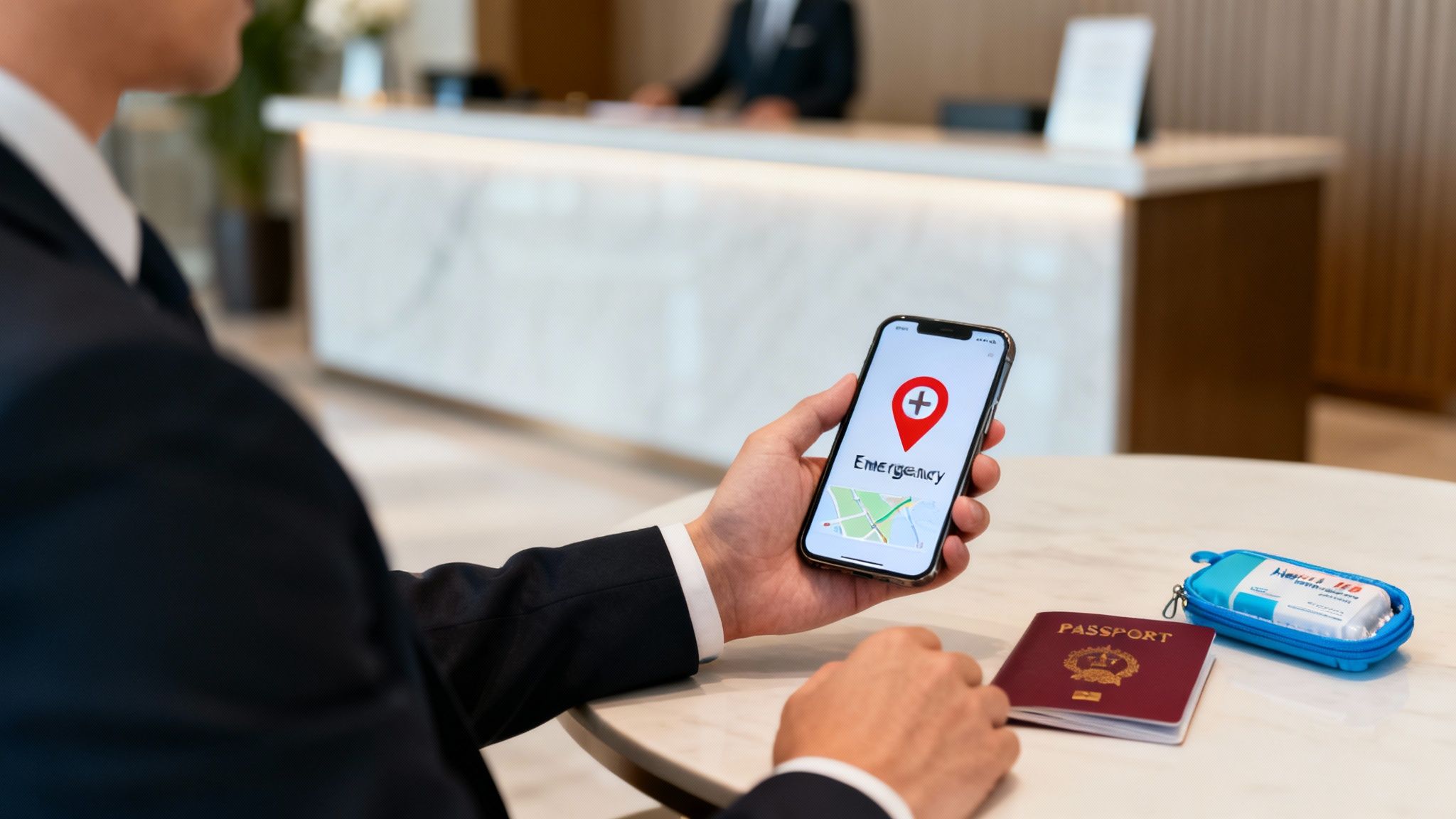
This proactive approach moves beyond simple travel insurance, creating a framework for identifying, mitigating, and responding to risks. It ensures your travelers are informed, prepared, and supported no matter where their work takes them, which is a critical aspect of modern corporate travel policy best practices.
Successful Implementation Examples
- Practical Example: During a major airline system outage, a company with a traveler tracking system was able to immediately identify all 50 employees who were scheduled to fly that day. They proactively contacted each one, rebooked them on other airlines, and authorized hotel stays, resolving the issue before employees were stranded.
- Actionable Insight: International SOS, a leading medical and travel security services firm, provides multinational corporations with a 24/7 emergency hotline, on-the-ground support, and medical evacuation services, forming the backbone of their duty of care programs.
How to Implement This Practice
To build an effective duty of care protocol, focus on preparation, support, and communication.
- Establish Risk Ratings: Classify travel destinations into risk tiers (e.g., green, yellow, red) based on official government advisories. Actionable step: Travel to "red" locations requires explicit VP-level approval and a mandatory pre-trip security briefing.
- Provide Pre-Travel Briefings: Require travelers to register all international trips. For example: Automate an email to be sent upon booking an international trip that includes embassy contact information, local emergency numbers, and cultural etiquette tips for the destination.
- Offer 24/7 Emergency Support: Provide a dedicated emergency hotline or service that travelers can contact anytime for medical, security, or logistical assistance. Services like Approved Experiences' 24/7 Diamond concierge can help coordinate emergency support and travel changes.
- Secure Comprehensive Insurance: Ensure your travel insurance goes beyond basic coverage. To ensure employee safety, consider including comprehensive coverage like medical evacuation insurance in your policy for critical situations.
- Develop a Crisis Communication Plan: Create clear protocols. For example: In a crisis, establish a single point of contact within the company to manage communications. Use a mass notification system (text/email) to send alerts and status checks to affected travelers.
10-Point Corporate Travel Policy Comparison
| Policy | 🔄 Implementation Complexity | ⚡ Resource Requirements | ⭐ Expected Outcomes | 💡 Ideal Use Cases | 📊 Key Advantages |
|---|---|---|---|---|---|
| Establish Clear Travel Authorization and Pre-Approval Workflows | Medium — design workflows and approval tiers | Moderate — approval system + admin time | High — reduces maverick spend 20–30%, better forecasting | Routine corporate travel with cost-control needs | Prevents unauthorized spend; audit trail; enables vendor negotiation |
| Leverage Preferred Vendor and Negotiated Rate Programs | Medium–High — contract negotiation & partner management | High — vendor management, legal review, ongoing oversight | High — per-transaction savings 15–35% and rebates | High-volume travel programs and consolidated spend | Better rates via volume; simplified choices; rebates and incentives |
| Implement Spend Visibility, Real-Time Monitoring, and Quarterly Policy Review | High — integrations, dashboards, analytics | High — TMS/BI tools + dedicated analysts | Very High — real-time compliance, 40–50% faster expense processing | Organizations needing data-driven controls and benchmarking | Proactive cost control; data for negotiations; continuous optimization |
| Create Tiered Travel Policies Based on Employee Level and Trip Type | Medium–High — policy design and role mapping | Moderate — communications + booking rule enforcement | Medium — balances satisfaction and cost control | Companies with diverse roles and seniority levels | Role-appropriate allowances; improved employee satisfaction |
| Establish Advance Booking Requirements and Booking Windows | Low–Medium — policy + enforcement rules | Low–Moderate — booking platform alerts and exceptions | High — airfare savings 20–40% with predictable bookings | Projected travel schedules and consulting firms | Lower fares; improved planning; inventory leverage |
| Enable Flexible Accommodation Options Including Vacation Homes | Medium — vetting and new category rules | Moderate — partner vetting, platform integrations | High for extended stays — 30–50% lower cost | Extended stays, team offsites, remote-work locations | Cost-effective group stays; unique experiences; extended-stay savings |
| Establish Ground Transportation and Ride-Sharing Policies | Low–Medium — modal hierarchy and limits | Moderate — preferred partners and app integrations | Medium — ground spend reduction 15–30% in urban markets | Urban travel, airport transfers, high ride-share usage | Safer vetted options; modal cost control; simplified expense reporting |
| Implement Airline and Flight Class Policies with Dynamic Purchasing | Medium — duration rules and airline agreements | Moderate — carrier negotiations and booking rules | Medium–High — dynamic buying saves ~10–15%; better productivity | Frequent long-haul travelers and high-fare cohorts | Controlled cabin upgrades; consolidated FF benefits; lower ancillaries |
| Develop Rewards, Incentives, and ROI Tracking Programs | Medium — program rules and communications | Moderate — rewards administration and tracking tools | Medium — increases compliance 20–30%; improves satisfaction | Firms wanting to boost compliance and employee engagement | Aligns employee incentives with savings; visible ROI and rewards |
| Establish Duty of Care, Safety, and Travel Risk Management Protocols | Medium–High — risk processes and emergency plans | High — 24/7 support, insurance, monitoring systems | Very High — reduced liability, faster emergency response | International travel, high-risk destinations, duty-of-care sensitive orgs | Protects employees; crisis response; builds trust and legal compliance |
Putting Your Policy into Action: A Ready-to-Use Checklist
We've explored the essential pillars of a modern, effective corporate travel program, moving far beyond simple rules and into the realm of strategic management. From establishing tiered policies and robust duty of care protocols to leveraging preferred vendors and implementing dynamic booking windows, the journey to a best-in-class system is multifaceted. The core takeaway is this: a travel policy is not a static document. It's a living framework that must adapt to your company’s goals, your travelers’ needs, and the ever-changing travel landscape.
Mastering these corporate travel policy best practices transforms an expense line item into a strategic asset. A well-designed policy directly impacts your bottom line by controlling costs and maximizing ROI on every trip. More importantly, it enhances employee satisfaction and well-being by providing clarity, flexibility, and a commitment to safety. When travelers feel supported and valued, they are more engaged, productive, and loyal. The true value lies in balancing fiscal responsibility with a superior traveler experience, creating a virtuous cycle where compliance becomes a natural outcome of a well-liked program, not a forced mandate.
From Blueprint to Reality: Your Implementation Roadmap
Translating these concepts into a functional policy requires a structured approach. A great plan on paper is only as good as its execution. This ready-to-use checklist provides a clear, actionable path to bridge the gap between ideation and implementation, ensuring your new policy launches successfully and delivers immediate impact.
-
Assemble a Cross-Functional Policy Team: Your first step is to gather the right stakeholders. This isn't just a finance initiative. Involve representatives from Finance, Human Resources, Legal, and key department heads or frequent travelers. This collaborative approach ensures the final policy is balanced, practical, and has buy-in from across the organization.
-
Conduct a Comprehensive Travel Spend Audit: Before you build the future, you must understand the past. Dive deep into your current travel data. Identify your top vendors, uncover patterns of non-compliance or "policy leakage," and pinpoint the most significant opportunities for savings. Are employees consistently booking last-minute flights? Are they using unapproved hotel booking sites? This data is the foundation of your new strategy.
-
Draft the New, Modernized Policy: Using your audit findings and the best practices from this guide, begin drafting the policy. Incorporate critical elements like tiered travel levels for different employee roles, clear advance booking requirements, flexible accommodation options, and non-negotiable duty of care protocols. Focus on clarity and simplicity; a policy no one can understand is a policy no one will follow.
-
Select Your Core Technology Partner: Technology is the engine that powers a modern travel program. Evaluate and select a platform that aligns with your goals. Look for a solution that combines booking capabilities, exclusive cost-saving opportunities, and integrated reporting. A membership-based platform like Approved Experiences Traveler can provide access to wholesale rates, consolidating savings and booking into one user-friendly system.
-
Communicate, Educate, and Train: A policy launch should never be a surprise. Develop a comprehensive communication plan. Host interactive workshops or webinars to walk employees through the changes, highlighting the benefits for them, such as improved safety measures and access to better travel options. Create a clear, easily accessible policy document or FAQ page on your company intranet.
-
Launch, Monitor, and Support: Go live with your new policy and technology platform. The work doesn't stop here. Use real-time dashboards to actively monitor key performance indicators (KPIs) like policy compliance, average booking costs, and traveler satisfaction. Establish a clear support channel for travelers to ask questions or get help.
-
Schedule and Commit to Quarterly Reviews: A static policy quickly becomes an outdated one. Schedule mandatory quarterly reviews with your cross-functional team. Use this time to analyze performance data, gather traveler feedback, and make necessary adjustments. Is a specific spending cap too restrictive? Are new, more cost-effective vendors available? This iterative process of refinement is the ultimate secret to long-term success in managing corporate travel.
Ready to build a travel program that offers unparalleled savings without sacrificing traveler experience? Discover how the exclusive, members-only wholesale rates on Approved Experiences Traveler can become the cornerstone of your cost-control strategy. Explore Approved Experiences Traveler to see how our platform empowers you to implement these corporate travel policy best practices with ease.
Want the wider view?
Ten categories. One report. Every quarter. The Approved List tracks what's rising and what's fading: data-backed signals, not opinions.
Free to join · Delivered by email