
←All Articles
The Journal
Cruise Line Loyalty Programs Guide
September 30, 202616 min readcruise rewardstravel membership
Compare cruise line loyalty programs and learn how to leverage wholesale travel infrastructure for better status, perks, and multi-brand cruising value.
Most advice about cruise line loyalty programs starts with the same prescription: choose one brand, sail repeatedly, and wait for elite status to transform your vacations. That strategy works for travelers whose itineraries, cabin choices, and household preferences consistently align with one cruise line. For everyone else, it can turn loyalty into a form of travel lock-in.
The better question is operational: does concentrating bookings with one line create more usable value than accessing the right itinerary across several lines? Tier charts matter, but so do earning algorithms, credit-posting delays, cabin selection, onboard utility, family coordination, and the value of travel inventory outside cruising. A status level that takes years to build may be less useful than a system that lets a household compare multiple cruise lines while earning portable value on every booking.
The basic structures already show why the answer isn't universal:
| Cruise line | Earning model | Top tier threshold | Cabin multiplier |
|---|---|---|---|
| Royal Caribbean | Cruise points by completed night | Pinnacle Club at 700 points | Suite or qualifying solo occupancy earns an additional point per night |
| Norwegian Cruise Line | Points by cruise night | Ambassador at 700 points | Suite or The Haven earns an additional point per night |
| Carnival | Cruise credits by sailing and cruise days by night | Diamond at 200+ points | No cabin multiplier in the summarized structure |
| Holland America | Cruise Day credits by sailing day and eligible onboard purchases | 5-star at 500 credits | Eligible onboard purchases can add credits |
The thresholds and earning mechanics above are documented by Royal Caribbean, Norwegian Cruise Line, Carnival's summarized program rules, and Holland America's Mariner Society. The practical conclusion is immediate: tier names are less important than the equation used to earn them.
The Fragmentation Problem in Cruise Loyalty
Sailing exclusively with one cruise line isn't automatically the efficient choice. It only makes sense when the line repeatedly wins on the routes, dates, ships, cabin categories, and onboard experience your household wants. If you select an inferior itinerary merely to preserve status, the loyalty benefit has become a constraint rather than an asset.
Fragmentation appears in ordinary travel decisions. Parents may prefer one line's family facilities, grandparents may value another line's service model, and a couple may choose a third brand for a particular region. Pricing, departure ports, school calendars, and accessible cabin availability can push the same household toward different operators. Each booking then contributes to a separate status ledger, while the family experiences the administrative burden of several accounts, benefit rules, and credit-posting systems.
Practical rule: Treat loyalty as a logistics variable, not as the objective of the trip.
The cost of fragmentation isn't only lost status. It includes time spent checking whether a benefit applies to a particular sailing, confirming when cruise credits post, tracking separate loyalty balances, and deciding whether a preferred itinerary is worth abandoning for a familiar brand. Some programs automatically enroll passengers after a first sailing, while credit posting can occur after the voyage and may require a wait of up to 30 days, as described in this overview of cruise loyalty operations.
Why single-line concentration can fail
A concentrated strategy produces its strongest return when a traveler cruises frequently enough to reach useful tiers and can repeatedly consume the associated benefits. It produces a weaker return when trips are occasional, spread across brands, or organized around a larger family whose members don't share the same cruise preferences.
The household organizer should compare two forms of value:
- Status value: priority services, onboard credits, laundry, Wi-Fi, drinks, dining access, and other line-specific privileges.
- Choice value: the ability to select the best itinerary, ship, date, cabin, and port combination without protecting a single loyalty balance.
A useful comparison of loyalty program structures helps expose the difference between a loyalty account and a broader travel infrastructure. The first rewards repetition inside a brand. The second can consolidate access across inventory sources, which matters when a household's travel pattern is multi-brand.
This doesn't make cruise loyalty worthless. It means travelers should concentrate only when the expected operational benefits justify the restrictions. A traveler who consistently books one line's suites may progress faster than a standard-cabin passenger, while a family choosing different lines for different generations may gain more from broad access and unified booking records.
Decoding Tier Thresholds and Earning Algorithms
Cruise loyalty rewards repetition, but the speed of progress depends on what the program counts and what kind of booking creates the credit. A traveler comparing brands should calculate status velocity, not just compare the highest advertised tier.
Royal Caribbean's Crown & Anchor Society awards one Cruise Point per completed night. A suite or qualifying single-occupancy booking adds another point per night, so a 7-night suite sailing produces 14 points rather than 7. Pinnacle Club begins at 700 points. The lower thresholds are Gold at 3 points, Platinum at 30, Emerald at 55, Diamond at 80, and Diamond Plus at 175, according to Royal Caribbean's published loyalty structure.
Norwegian uses a similar night-based structure. Members earn one point per cruise night, plus one additional point per night for suite or The Haven bookings. Its tiers run from Bronze at 1 point through Silver at 20, Gold at 45, Platinum at 75, Sapphire at 150, Diamond at 350, and Ambassador at 700, as set out in Latitudes Rewards. A 10-night suite sailing therefore generates 20 points and reaches Silver under that structure.
An applied calculation makes the difference clearer:
| Booking pattern | Royal Caribbean outcome | Norwegian outcome | Planning implication |
|---|---|---|---|
| 7-night standard cabin | 7 points | 7 points | Base-rate progression |
| 7-night suite | 14 points | 14 points | Cabin class doubles nightly earning |
| Two 7-night standard sailings per year | 14 points annually | 14 points annually | Slow movement toward a 700-point tier |
| Two 7-night suite sailings per year | 28 points annually | 28 points annually | Faster progress, still dependent on sustained repetition |
The calculation is a planning tool, not a ranking. Suite bookings accelerate progress only when the traveler already intends to buy that cabin category. Choosing a more expensive cabin solely to reach status can create a poor return if the resulting benefits are used infrequently. A qualifying solo traveler may also progress faster without changing the itinerary, while a standard-cabin passenger remains tied to the base rate.
Cross-brand travelers face a different constraint. Points earned with Royal Caribbean do not advance a Norwegian account, and Norwegian nights do not advance Royal Caribbean status. A household dividing trips among several lines may therefore accumulate fragmented balances, even when its total cruise activity is substantial. Wholesale access or a consolidated membership can be more useful for that household than accelerating one brand's tier, because the value lies in preserving itinerary and cabin choice across lines.
Trip count, nights, and purchase class
Carnival separates completed sailings from cruise days. The VIFP Club structure has historically included Blue after the first sailing, Red from the second sailing through 24 points, Gold from 25 through 74, Platinum from 75 through 199, and Diamond at 200 or more. Carnival announced in 2026 that it would eliminate the Blue entry-level tier while retaining the other four, according to the USA Today overview of cruise loyalty programs. Under the summarized cruise-day model, four 7-night cruises produce 28 cruise days, reaching Gold.
Holland America's Mariner Society uses Cruise Day credits and adds eligible onboard purchases. Its thresholds are 30 credits for 2-star, 75 for 3-star, 200 for 4-star, and 500 for 5-star status. That design gives time onboard and qualifying spend separate roles, unlike a purely night-based model.
A useful worksheet should record cabin category, average voyage length, annual sailing frequency, and eligible purchases. Compare the resulting annual total with the next tier's threshold, then assign a practical value to the benefits. If progression is slow and the perks do not fit the household's travel pattern, concentrating bookings is hard to justify. If the booking pattern already includes suites or frequent nights on one line, status may be a by-product worth keeping.
Evaluating the Operational Utility of Elite Status
Elite status earns its keep through repeated operational savings, not through the tier label itself. The relevant question is whether a household can use enough included services, priority access, and support channels across trips it already plans to take. That makes elite status a travel-management tool, while fragmented memberships often leave family members unable to use benefits together.
Royal Caribbean's Pinnacle Club begins at 700 points and includes six daily drink vouchers, unlimited Wi-Fi for one device during the sailing, free laundry, Coastal Kitchen access, and milestone certificates at each additional 350 points. Celebrity's Zenith tier begins at 3,000 points and includes complimentary laundry, drinks package access, premium Wi-Fi, and a 7-night Caribbean or Bermuda cruise offer upon reaching the tier, according to Royal Caribbean's cruise loyalty guide.
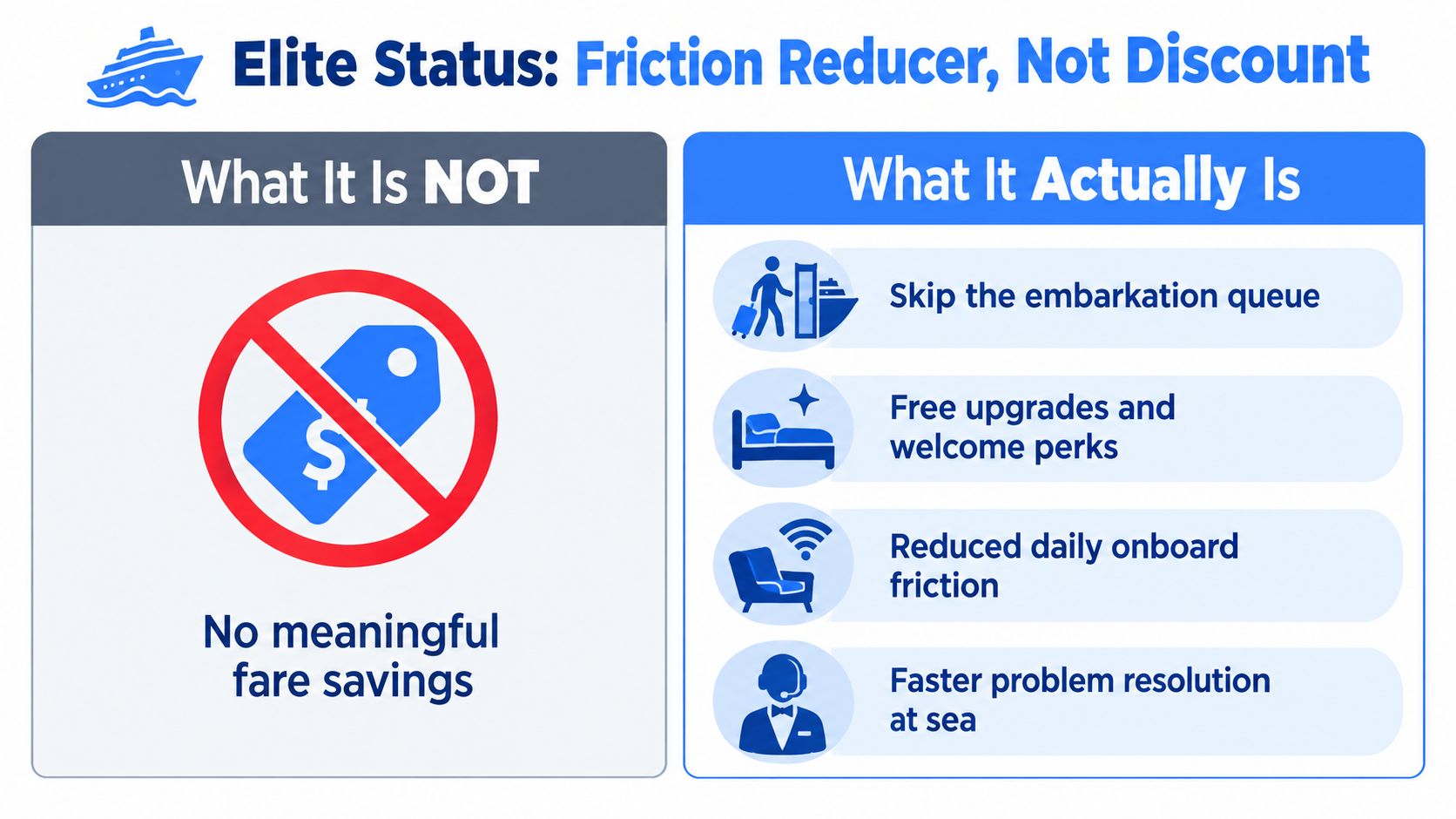
Measure friction removed, not perks collected
A remote worker on a 10-night sailing who would otherwise purchase Wi-Fi at $25 per day saves approximately $250 per voyage. A traveler who never uses laundry derives $0 from that benefit. Calculate the household's actual friction cost before assigning value to a tier.
A family may value priority boarding, shorter waits, and faster problem resolution more than a milestone certificate. A multi-line household may assign little value to an elite benefit that applies only when everyone books the same brand. The return therefore depends on usage, trip length, and whether the membership fits the household's wider travel pattern.
Evaluate each benefit against a recurring operational problem:
- Connectivity: Does included or reduced-cost Wi-Fi remove a necessary purchase?
- Turnaround: Does priority embarkation, check-in, or tender access reduce waiting?
- Maintenance: Does complimentary laundry simplify a longer sailing or multi-generational trip?
- Access: Do lounges, restaurants, or reserved spaces improve the experience enough to influence line selection?
- Recovery: Does a dedicated service channel resolve disruptions faster?
This worksheet separates usable value from advertised value. For itinerary research, travelers comparing regional options can use best cruises in Japan to assess destination fit before committing bookings to one line.
Top-tier status becomes compelling when one traveler repeatedly uses several benefits. It becomes weak when reaching the tier requires unsuitable voyages, or when household members split bookings across brands and cannot share the perks. For multi-line cruisers and families, consolidated travel infrastructure may outperform a higher tier whose benefits remain trapped within one program. The practical benchmark is the net reduction in friction across trips already planned, not the headline perk.
Navigating Spend-Based Shifts and Cross-Brand Ecosystems
Cruise loyalty is becoming a purchasing system, not just a record of nights sailed. Status planning now requires travelers to identify qualifying purchases, track the qualification window, and understand how long earned status remains valid. That shift favors households with concentrated spending and makes fragmented, multi-line travel harder to evaluate.
Carnival Rewards is scheduled to launch on September 1, 2026, with elite qualification based on Status Qualifying Stars earned at three stars per $1 on eligible purchases. Status is earned over a two-year window and then enjoyed for the following two years, according to coverage of the planned 2026 changes. The relevant calculation now involves more than just the number of nights completed. Travelers must check which purchases qualify, when those purchases post, and whether their normal booking pattern supports requalification.
A direct comparison shows why the earning formula matters. Under Carnival's $1 = 3 Stars model, $2,000 in eligible spending produces 6,000 Stars. A nights-based structure would treat a 7-night sailing as 7 points, regardless of how much the traveler spends onboard. These models reward different behaviors, so households should model their actual purchase mix rather than assume the highest tier is reachable through routine travel.
Spend-based programs create two practical risks. Travelers may confuse total trip spending with eligible spending, or increase brand-specific purchases merely to preserve status. That commitment can reduce choice across cruise lines, especially when family members book different brands or pay for travel components separately.
Portability adds another layer
Royal Caribbean Group's Points Choice allows eligible members to direct points across Royal Caribbean, Celebrity, and Silversea. Requests may be submitted before sailing or up to 14 days after sailing. This arrangement can reduce fragmentation within one corporate family, but it still requires accurate timing and record-keeping.
Portability does not create universal utility. Points or credits may move among related brands while remaining unusable elsewhere. Travelers should document how earning, transferring, redeeming, and qualifying for elite status connect before treating a parent company's portfolio as a complete solution.
Decision test: If you cannot explain which purchase creates status, when the credit posts, how long the status lasts, and where the benefit can be used, do not assign it full value in your travel plan.
For multi-line cruisers, the useful question is which infrastructure gives the household the broadest return across planned trips. That may be one cruise line, a corporate family with transferable value, or a consolidated membership that remains usable across brands. The strongest structure is the one that preserves itinerary choice while converting existing travel spending into benefits the household can actually use.
Leveraging Wholesale Travel Infrastructure for Multi-Line Cruisers
A multi-line traveler needs access before loyalty. The booking decision should begin with the itinerary, ship, departure date, cabin, and household requirements. Only then should the traveler ask whether concentrating the booking creates enough status value to outweigh the loss of choice.
An annual travel membership can provide a different operating layer. Approved Traveler is an annual travel membership providing wholesale-rate access to over 1,000,000 hotels, 700+ airlines, 44+ cruise lines with 30,000+ itineraries, consolidated into one platform where members earn Reward Credits on every booking that never expire. That structure changes the unit of loyalty from one cruise brand to the household's broader travel activity.
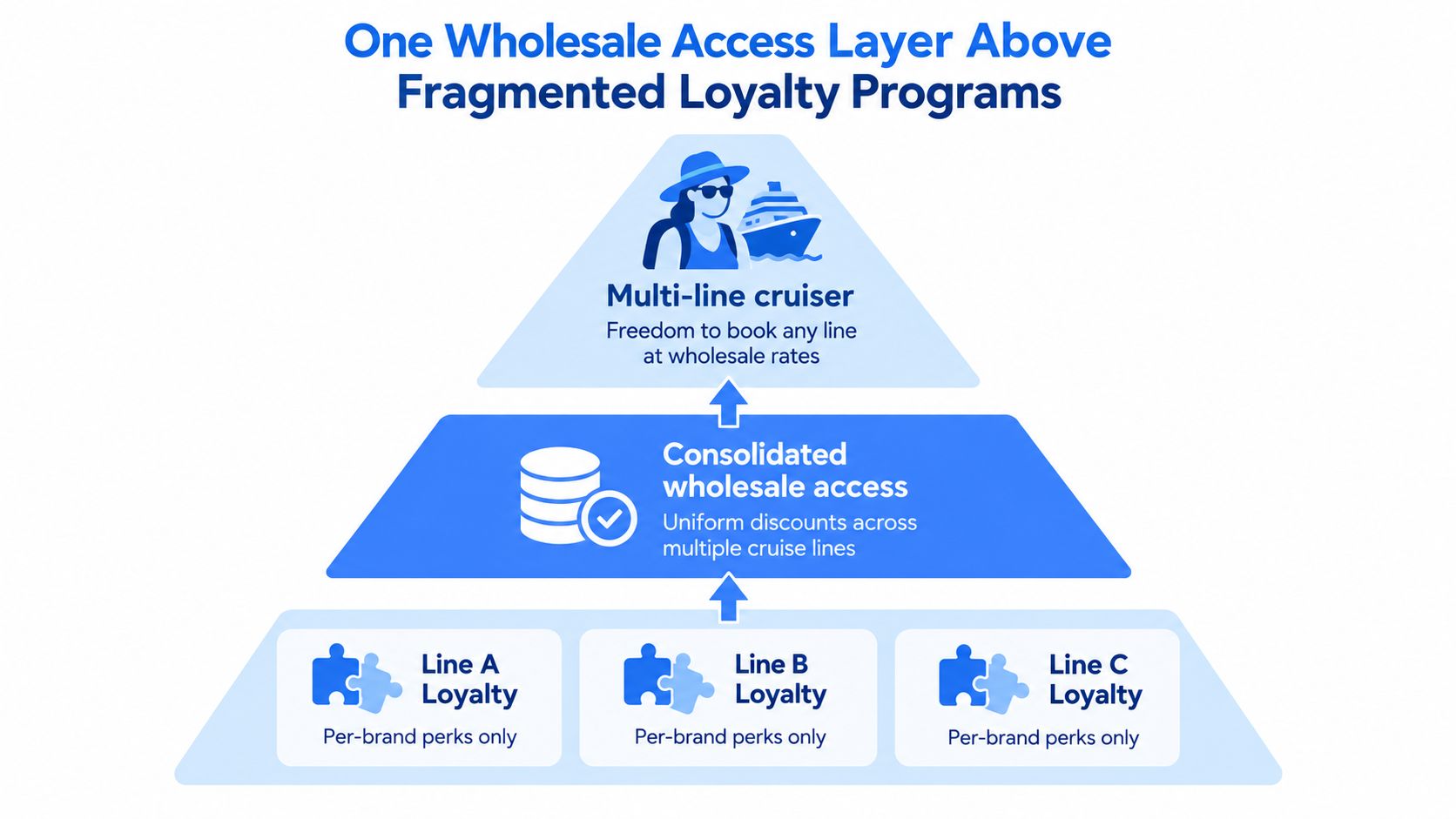
Use access as the first filter
A practical workflow looks like this:
- Define the trip requirements. Record the destination, dates, embarkation port, cabin needs, mobility considerations, and who is traveling.
- Compare the available inventory. Review multiple cruise lines rather than excluding options to protect a single status balance. A tool such as compare cruise ships can help organize ship-level differences before booking.
- Check the total travel sequence. Include pre-cruise hotels, flights, ground transport, and post-cruise stays. A cruise rarely exists as an isolated transaction.
- Track the booking's downstream value. Record the Reward Credits generated and the future booking categories where they can be applied.
- Test the alternative. Compare the consolidated access route with the benefits you would forgo by booking outside a preferred cruise line.
This approach doesn't erase line-specific loyalty. A Royal Caribbean regular can still retain Crown & Anchor status while using broader inventory for other trips. The difference is that the traveler no longer treats every non-Royal Caribbean sailing as a failure.
The infrastructure becomes especially relevant for families. One organizer can evaluate cruise inventory alongside hotels and other travel components, rather than forcing each household member to manage separate brand accounts. The value is coordination, not merely a lower displayed rate. Reward Credits that never expire also create a continuing travel ledger instead of a benefit balance constrained by one operator's redemption rules.
The following video provides additional context for thinking about travel access as a coordinated system rather than a collection of isolated bookings.
A consolidated platform still requires verification. Check the actual itinerary, fare conditions, cancellation rules, cabin inclusions, and the terms governing Reward Credits before committing. The operational advantage is the ability to make that comparison across multiple cruise lines without treating brand diversification as wasted effort.
Strategic Profiles for Families Timeshare Owners and Snowbirds
A cruise loyalty strategy should follow the traveler profile, not the other way around. The family organizer, timeshare owner, and snowbird face different constraints, so they shouldn't evaluate loyalty with the same scorecard.
The multi-generational family organizer
A family planning a shared sailing may have grandparents who need a particular cabin location, parents who prioritize schedule and connectivity, and children who care about ship facilities. If the organizer forces everyone into one brand solely to consolidate status, the group may sacrifice itinerary fit and create unnecessary coordination problems.
The better method is to separate trip selection from status preservation. Choose the sailing that satisfies the group's actual constraints, then use a consolidated membership to coordinate related hotels, flights, vacation homes, and activities where appropriate. A shared travel infrastructure can also make it easier to keep booking information, traveler details, and future travel value in one operating record.
The timeshare owner with unused inventory
Unused timeshare weeks represent a different kind of trapped travel value. The owner may have access to accommodation but lack a practical way to use it during the assigned period. A peer-to-peer exchange or deposit system can create a route from unused inventory to travel credits, subject to the platform's eligibility and transaction rules.
The relevant resource for evaluating alternatives is this guide to timeshare alternatives. The analytical question is not whether the owner can extract theoretical value from a week. It's whether the process reduces exchange friction, avoids unnecessary fees, and produces travel utility the household will use.
The snowbird and long-stay retiree
Snowbirds often need a condo-style base before or after a cruise, not just a hotel room for a single night. Their travel plan may combine a long stay, a repositioning flight, a cruise, and another extended accommodation period. A cruise-only loyalty account can't coordinate that sequence because its value is limited to the line's own ecosystem.
A broader membership can be assessed by inventory breadth, booking flexibility, and whether the same account creates value across lodging and cruise bookings. For retirees, the most important return may be reduced planning effort and consistent access to suitable accommodation, rather than a high cruise tier that takes years to build.
Operational conclusion: Match the loyalty mechanism to the shape of the trip. A one-brand tier fits repetition. A consolidated access layer fits a travel pattern that crosses brands and accommodation types.
Building a Data-Driven Travel Logistics Strategy
The strongest strategy doesn't reject cruise loyalty. It assigns it a role. Concentrate bookings when one line repeatedly fits the household and the earning algorithm rewards your actual cabin and sailing pattern. Diversify when itinerary choice, family needs, or regional coverage matter more than status continuity.
Start with a simple decision record. Don't estimate value from the tier name or a promotional headline. Write down what you book, what you use, and what each structure removes from the planning process.
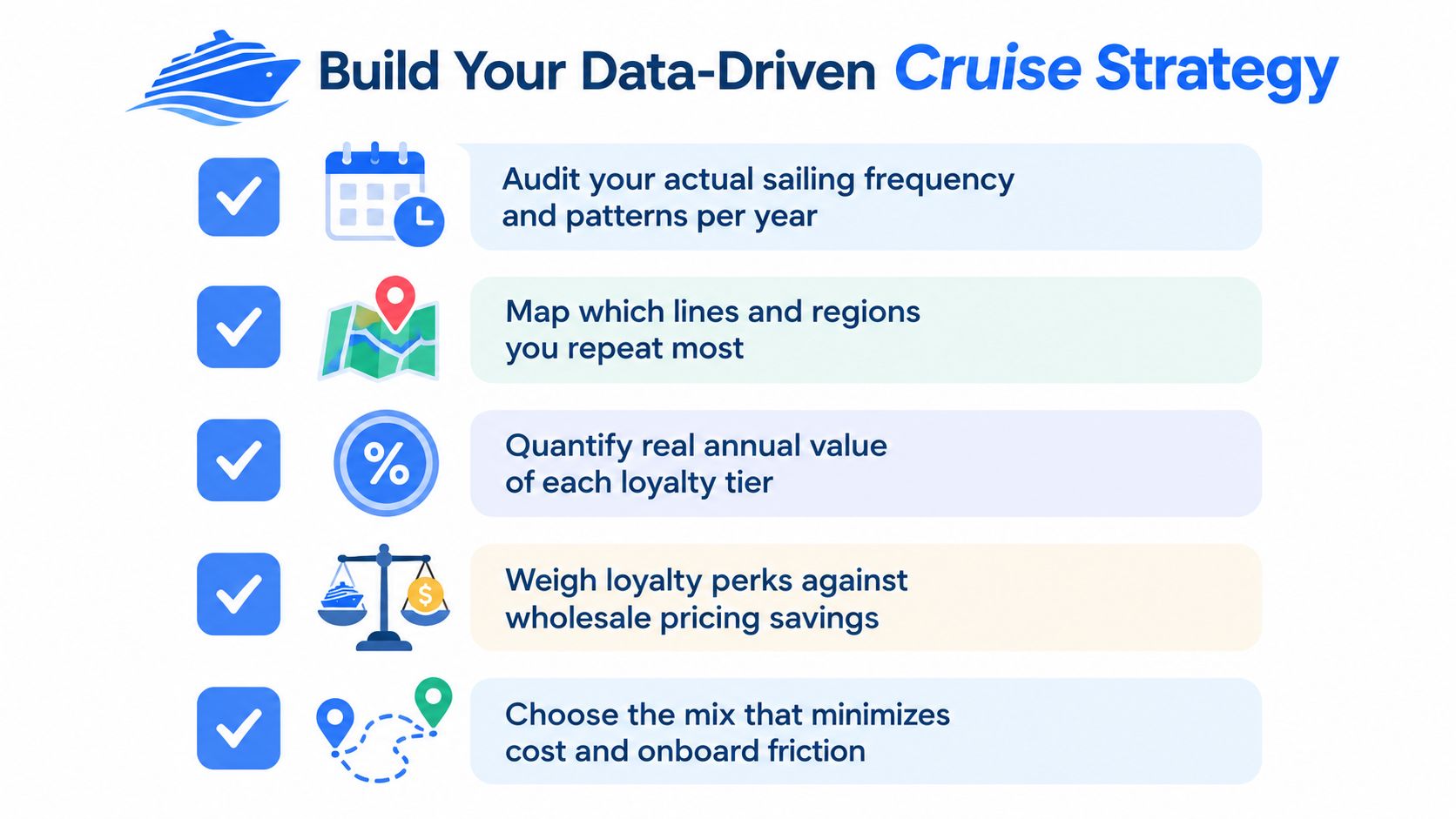
Build the decision record
- Audit your actual pattern: Count your usual cruise frequency, voyage length, cabin category, and brand mix without assuming next year's travel will resemble an idealized plan.
- Map repeated routes: Identify the regions and departure ports where one line consistently meets your needs, then note where another brand has the better operational fit.
- Value usable benefits: Assign qualitative or household-specific value to Wi-Fi, laundry, drinks, priority services, dining access, and service recovery. A benefit you never use shouldn't drive the booking.
- Compare infrastructure: Weigh line-specific status against cross-brand access, consolidated booking, broader inventory, and Reward Credits earned on eligible bookings.
- Choose the lower-friction mix: Select the structure that leaves your household with fewer manual checks, fewer disconnected accounts, and more flexibility at the point of purchase.
The decision should also include timing. Verify when cruise credits post, whether status qualification uses a rolling or fixed window, and whether a transfer or points-direction request has a deadline. Small administrative conditions can determine whether an apparently portable benefit is actually usable.
A data-driven approach protects travelers from two opposite mistakes. One is chasing elite status long after the benefits stop influencing the trip. The other is ignoring a valuable tier that a traveler is already close to earning and would use repeatedly. The right answer can change by household member, destination, cabin type, and year.
For multi-line cruisers and family organizers, the durable asset is choice with coordination. A cruise line loyalty account may reduce friction onboard, while broader travel infrastructure can reduce friction before departure, across brands, and through the rest of the journey. Evaluate both layers together instead of assuming that brand allegiance is the only path to travel value.
If your household cruises across multiple lines, use Approved Experiences Traveler to access consolidated inventory across 44+ cruise lines and 30,000+ itineraries, while earning Reward Credits on every booking that never expire. Visit Approved Experiences Traveler to compare a broader travel infrastructure with the status benefits of staying inside one cruise brand.
Want the wider view?
Ten categories. One report. Every quarter. The Approved List tracks what's rising and what's fading: data-backed signals, not opinions.
Free to join · Delivered by email