All Articles
The Journal
Florida Monthly Rentals: A Practical Long-Stay Playbook
October 3, 202613 min readmonthly rentalssnowbird rentals
Plan Florida monthly rentals with confidence. Learn pricing bands, lease and tax rules, packing checklists, and how to consolidate access through one
A January arrival can expose every weakness in a Florida rental plan. A couple from Ohio reaches Naples with a 28-day booking that automatically converts to a peak weekly rate. A Sarasota condo looks affordable until the quote excludes electricity and pool heat. In Tampa, a remote worker loses three workdays coordinating keys, Wi-Fi, and luggage across three short-term stays.
These aren't isolated annoyances. Florida monthly rentals operate across separate coastal, inland, seasonal, and property-type markets. A furnished condo in Sarasota, a pool home in Southwest Florida, and an extended-stay suite in Orlando can all advertise “monthly” availability while using different pricing, lease terms, taxes, and approval processes.
The practical answer is to stop treating Florida as one rental market. Match the property type to the region, calculate the all-in cost, verify the legal structure, and consolidate inventory access before peak demand compresses your options.
Why Monthly Rentals in Florida Are a Different Game
A family staying from January through April can face snowbird pricing in Naples, association approval in Miami-Dade, and different service expectations in Tampa or the Keys. The state has no single monthly-rental market, so one statewide price is a poor planning tool.
Florida's post-pandemic rental reset shows why. A Florida policy review found median rent increased from $1,187 in December 2020 to $1,545 in December 2023, after peaking in June 2022 and declining over the following 18 months (Florida TaxWatch review). Newer tracking reported a statewide median of $1,508 in August 2026, against a U.S. median of $1,390. Other snapshots put Florida's median near $2,499 per month. These figures describe different inventory mixes, not one reliable quote for every stay.
The $1,508 statewide median reflects unfurnished apartments, while the $2,800 South Florida median reflects furnished lease listings. Use each figure only for its specific inventory type.
South Florida makes the distinction clear. A 2026 index covering 26,997 active lease listings reported a median asking rent of $2,800 per month, with half of listings between $2,050 and $4,200. The median listing had been available for 42 days, and 30% of listings were furnished (South Florida rental market data). A furnished monthly stay carries different costs, terms, and services from an unfurnished annual apartment.
Operational rule: Compare rentals by region, property type, stay length, and included services. Ignore the word “monthly” until you have checked the actual product.
Choose the market and property type first. Then price utilities, cleaning, parking, taxes, deposits, and approval costs. Finally, consolidate access through one membership where possible. A broader inventory pool reduces repeated negotiations and documentation, turning each monthly booking into useful compounding access rather than another isolated search.
What a Monthly Rental Actually Is in Florida
A Florida monthly rental is usually a furnished stay lasting roughly 28 to 90 nights. It sits between a hotel reservation and an annual residential lease, but it is not just an apartment divided into four weekly payments.
Start with the furnishing question. Unfurnished annual rentals are designed around a household moving in with its own furniture, kitchen equipment, internet arrangement, and long-term schedule. Monthly inventory is usually ready to occupy, with beds, cookware, linens, Wi-Fi, and basic household equipment already in place.
Then check the minimum-stay rule. Florida law allows tenancies to be structured as year-to-year, quarter-to-quarter, month-to-month, or week-to-week depending on when rent is payable under Chapter 83 of the Florida Statutes. A listing's marketing label doesn't determine the legal arrangement. The written agreement and rent cycle matter.
Why “monthly” rarely means a calendar month
A host may call a stay monthly while pricing 28 nights, 30 nights, or a fixed seasonal block. A vacation-home operator may require four months, while another property allows three months and a third requires six or twelve. Extended-stay hotels and corporate housing providers use their own minimum-stay ladders.
That changes your comparison. A 30-night quote may exclude electricity, impose a utility cap, require a mid-stay cleaning, or charge separately for parking. An annual apartment lease may include different services but demand more documentation and a longer commitment.
For readers comparing annual market conditions before choosing furnished inventory, browse 2026 rent prices with the distinction between ordinary long-term housing and a ready-to-live-in monthly stay in mind. The numbers can help establish context, but they won't replace a written all-in quote.
Treat the product as a furnished residential arrangement marketed with short-stay convenience. Ask what happens if you leave early, who pays utilities, whether the building approves the occupant, and whether the quoted amount covers every night of the agreed term.
The Three Property Types That Cover Most Long Stays
Most Florida monthly rental decisions come down to three property types. The right choice depends less on the advertised rate than on how many people need to live there, how much equipment they need, and how much friction they can tolerate.
| Property Type | Typical Monthly Cost | Included Amenities | Best For |
|---|---|---|---|
| Vacation home | Premium relative to other monthly options | Full kitchen, private outdoor space, pool or garage in many properties | Families, groups, and guests staying for an extended seasonal period |
| Condo | Middle position, with wide regional variation | Shared pool, gym, building services, and sometimes beach access | Couples, retirees, and remote workers who want managed amenities |
| Extended-stay hotel | Often the lowest pure accommodation rate | Front desk, furnished suite, and hotel services | Solo workers, transitional stays, and guests who value convenience over space |
Vacation homes buy capacity
A house makes sense when the alternative is renting multiple units. Families can spread across bedrooms, keep a full kitchen in use, store beach equipment, and use outdoor space without coordinating shared building facilities. The tradeoff is that pool care, utilities, cleaning, and maintenance terms require careful review.
A condo is the practical middle path. Buildings in Miami, Fort Lauderdale, Sarasota, and Clearwater can provide shared facilities and a more predictable maintenance structure. Parking, pet rules, guest registration, and association approval can still determine whether the property works. Review Florida condo rental considerations before treating a building amenity as guaranteed access.
Extended-stay hotels work when the guest values a simple arrival process and doesn't need a separate living room, full storage, or a private laundry setup. They're useful for a remote worker testing a new city or a household between homes. They become less attractive when several people need privacy, meal preparation, and work separation.
Practical test: If your group needs two or more workstations, several bedrooms, parking, and daily living space, price a house before assuming multiple hotel rooms are simpler.
Pricing Bands by Market and How to Read Them
Florida monthly rentals operate as separate local markets, not one statewide product. The Panhandle, Tampa Bay, Orlando, Southwest Florida, Southeast Florida, and the Keys attract different guests, offer different inventory, and attach different costs to the same length of stay.
| Market | Low Season Monthly | Peak Season Monthly | Typical Premium |
|---|---|---|---|
| Panhandle | Lower outside winter and beach-demand periods | Higher for furnished coastal inventory | Location, beach access, and seasonal demand |
| Tampa Bay | Moderate, with urban and coastal variation | Higher for furnished units near the water | Parking, building amenities, and furnished readiness |
| Orlando | Broad inventory across apartments, homes, and suites | Higher around concentrated travel periods | Space, resort access, and family capacity |
| Southwest Florida | Wide range from inland units to premium coastal homes | Strong winter premium | Pool, beach proximity, and seasonal availability |
| Southeast Florida | Higher overall in many coastal submarkets | Strong winter and furnished-unit demand | HOA rules, parking, and location |
| Keys | Limited inventory and stricter property rules | Highest pressure during preferred seasonal windows | Suitable-home scarcity, access, and minimum stays |
Use South Florida pricing as a negotiation reference, not a universal quote. The South Florida lease index reports a $2,800 median asking rent and a $2,550 median for leases closed during the prior 12 months, with county medians ranging from $2,450 in Broward to $3,000 in Miami-Dade. For a furnished monthly rental, that gap sets a practical expectation: an asking price is a starting position, and a longer commitment may justify a discussion about the final rate, furnishings, utilities, or fees.
Use an all-in formula
Write the calculation before contacting an owner or manager:
Base rent + electricity + water + internet + trash + cleaning + parking + pet fees + application fees + applicable tax = true monthly cost
Florida's state sales tax on transient rentals is 6% for accommodations rented for six months or less. Counties can add local transient rental taxes under the Florida transient rental tax statute. Ask the owner or manager to show the exact tax and county charges instead of applying a guessed rate.
Winter demand is concentrated, especially for furnished coastal homes. Summer and shoulder periods usually give renters more room to negotiate, while winter inventory rewards early planning.
Compare markets through aggregated inventory rather than chasing isolated coupons. A single membership that brings listings across Florida markets into one search can make pricing differences visible and help turn each completed stay into useful reward credits for later bookings. For hotel-based alternatives, compare the full term using long-stay hotel rate guidance, including parking, resort charges, internet, and laundry.
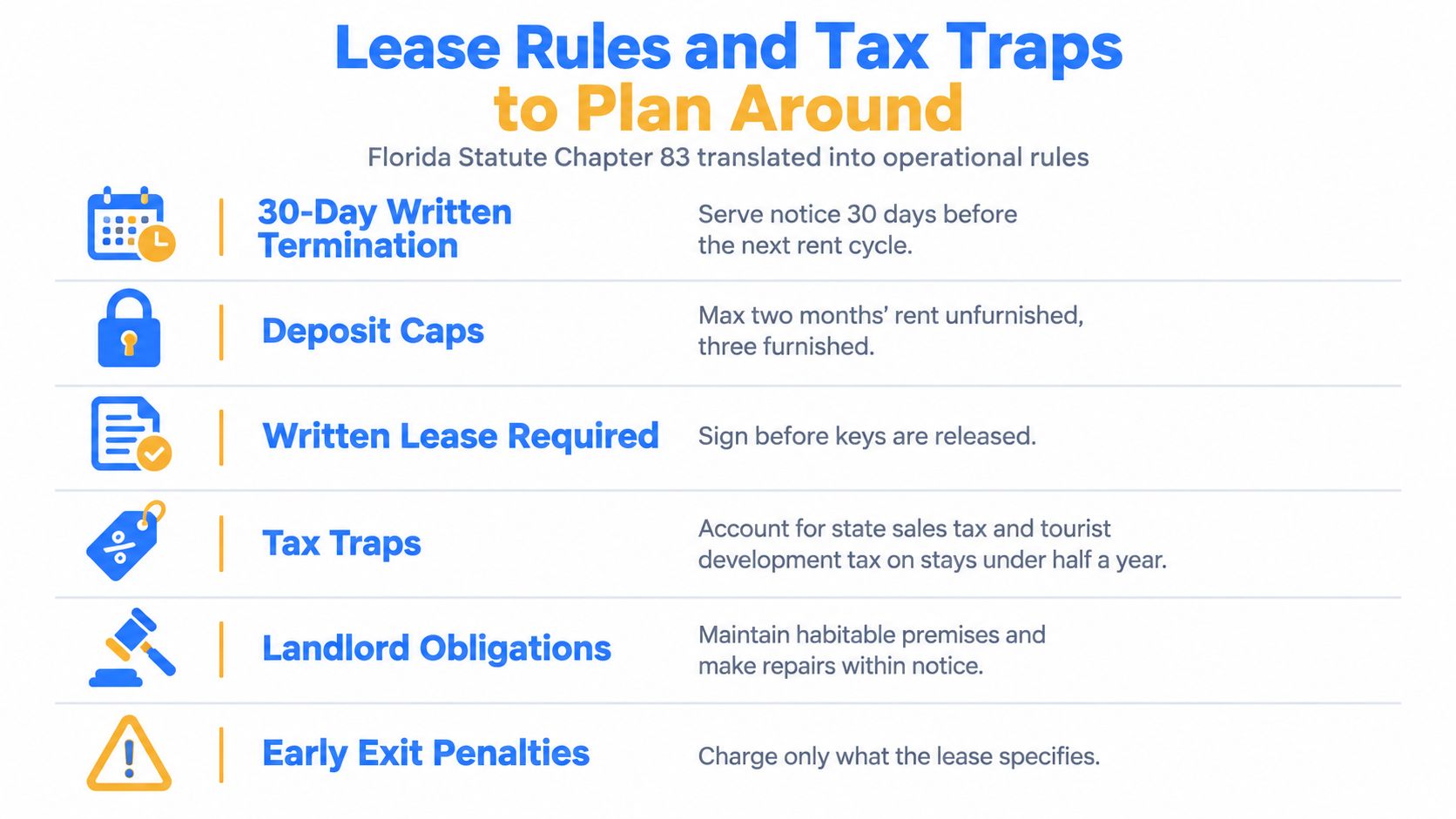
Lease Rules and Tax Traps to Plan Around
The lease determines what you can do when plans change. Florida's month-to-month rule allows either party to terminate with at least 30 days' written notice before the end of the next monthly period, according to Florida Bar guidance on residential tenancies. Put the notice method, delivery address, and effective date in your records.
Separate residential terms from transient occupancy
A bona fide written lease for continuous residence longer than six months is exempt from transient rental tax. If a guest continuously occupies one transient accommodation for more than six months and has paid the tax during the first six months, charges become exempt from the seventh month onward while that residency continues (Florida Department of Revenue sales tax guidance).
That doesn't mean extending a booking automatically changes its tax treatment. Ask whether you're signing a residential lease or a transient rental agreement. Confirm who collects tax, whether local charges apply, and whether the property is authorized for the proposed use.
Before signing, verify:
- Notice terms: Confirm the 30-day written termination process and the rent-cycle date.
- Deposit handling: Read the deposit amount, permitted deductions, and return process in the agreement.
- Entry and repairs: Identify the contact for maintenance and the notice process for property access.
- Association approval: Get written confirmation that the building permits the stay and has approved the occupant.
- Tax treatment: Request an itemized quote instead of assuming a long stay is tax-exempt.
- Property authorization: Confirm that the owner or manager can legally offer the accommodation for the stated term.
A signed agreement is more useful than a platform cancellation policy when the parties disagree about utilities, damage, early departure, or access. Use a practical Florida residential lease form guide as a review aid, then have the actual agreement reflect the property, dates, fees, and responsibilities you accepted.
Booking, Check-In, and Packing Logistics
Peak-season planning begins before the search feels urgent. Snowbird monthly stays are commonly booked six to nine months in advance, and Gulf Coast stays beginning between January and March 2026 were booked a median of 153 days ahead, with 45% booked more than six months out (Florida snowbird booking timing).
For January through April arrivals, start with a four-to-six-month operating window. Shorter lead times can work in flexible markets, but they reduce your choice of furnished homes, layouts, parking arrangements, and pet policies.
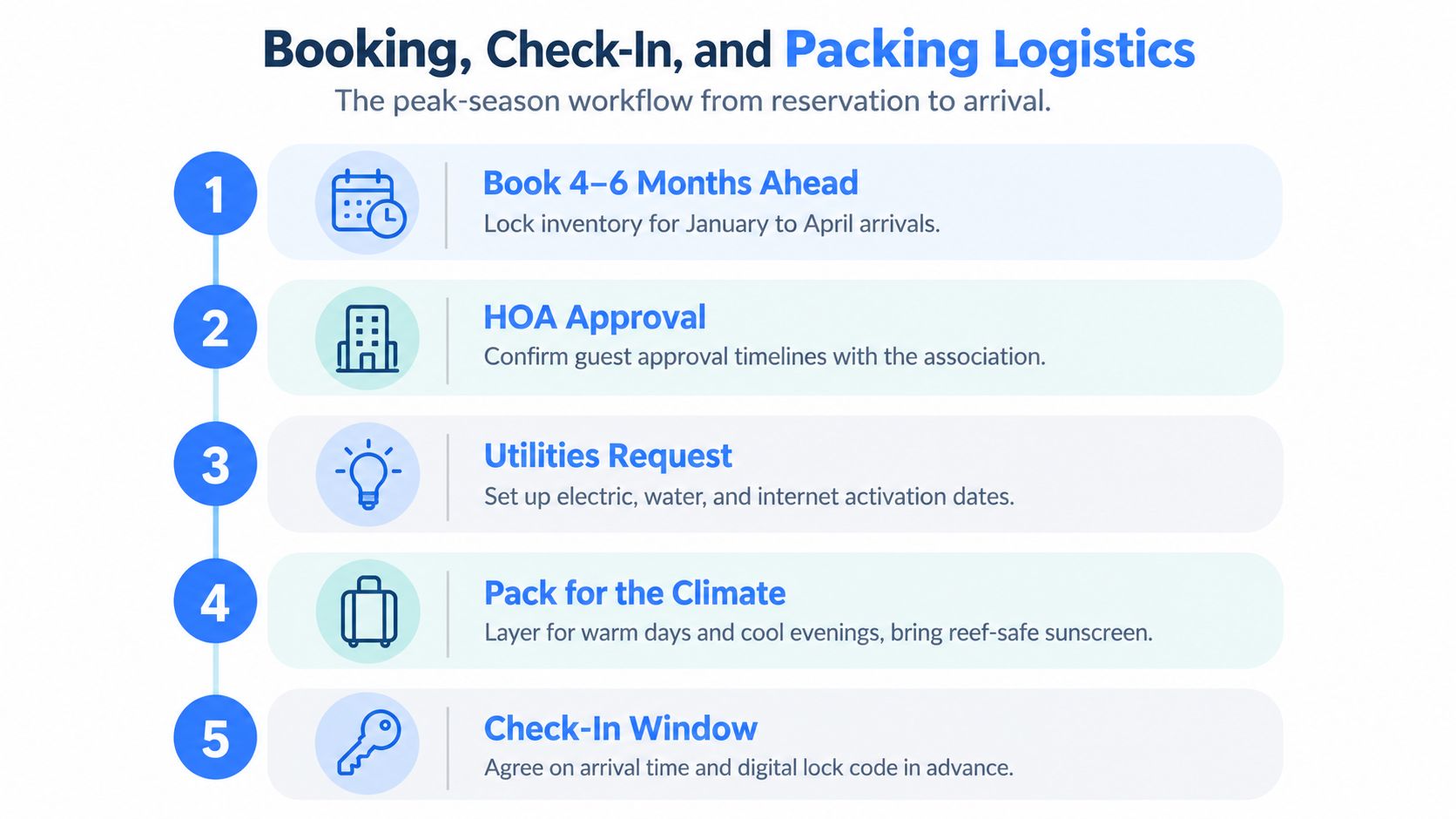
Run the booking sequence
- Confirm association timing. Ask how guest applications work, what documents are needed, and whether approval occurs before the lease begins.
- Request utility history. If electricity isn't included, ask for prior usage context and identify any cap or reimbursement process.
- Negotiate the term, not just the rate. Offer a longer stay in exchange for a better monthly structure, waived parking, or a reduced pet charge. Ask whether the owner can provide a 60-day rate at the 30-day floor.
- Request useful services. A mid-stay cleaning can be more valuable than a small headline reduction, especially for families and homes with pools.
- Confirm amenities in writing. Specify the exact parking space, internet arrangement, laundry access, pool access, kitchen equipment, and workspace.
Pack according to the property. Condo guests should verify cookware, knives, coffee equipment, and storage. Gulf Coast visitors may need beach equipment and climate-appropriate clothing. Extended-stay hotel guests should bring a lightweight remote-work kit, including a portable stand, keyboard, and backup connectivity plan.
At check-in, photograph existing damage, test locks and internet, record the HVAC filter date, inspect hot water performance, and confirm the documented condition of appliances. Send the record to the manager immediately. That evidence protects your deposit when the stay ends.
Consolidating Access and Earning Reward Credits
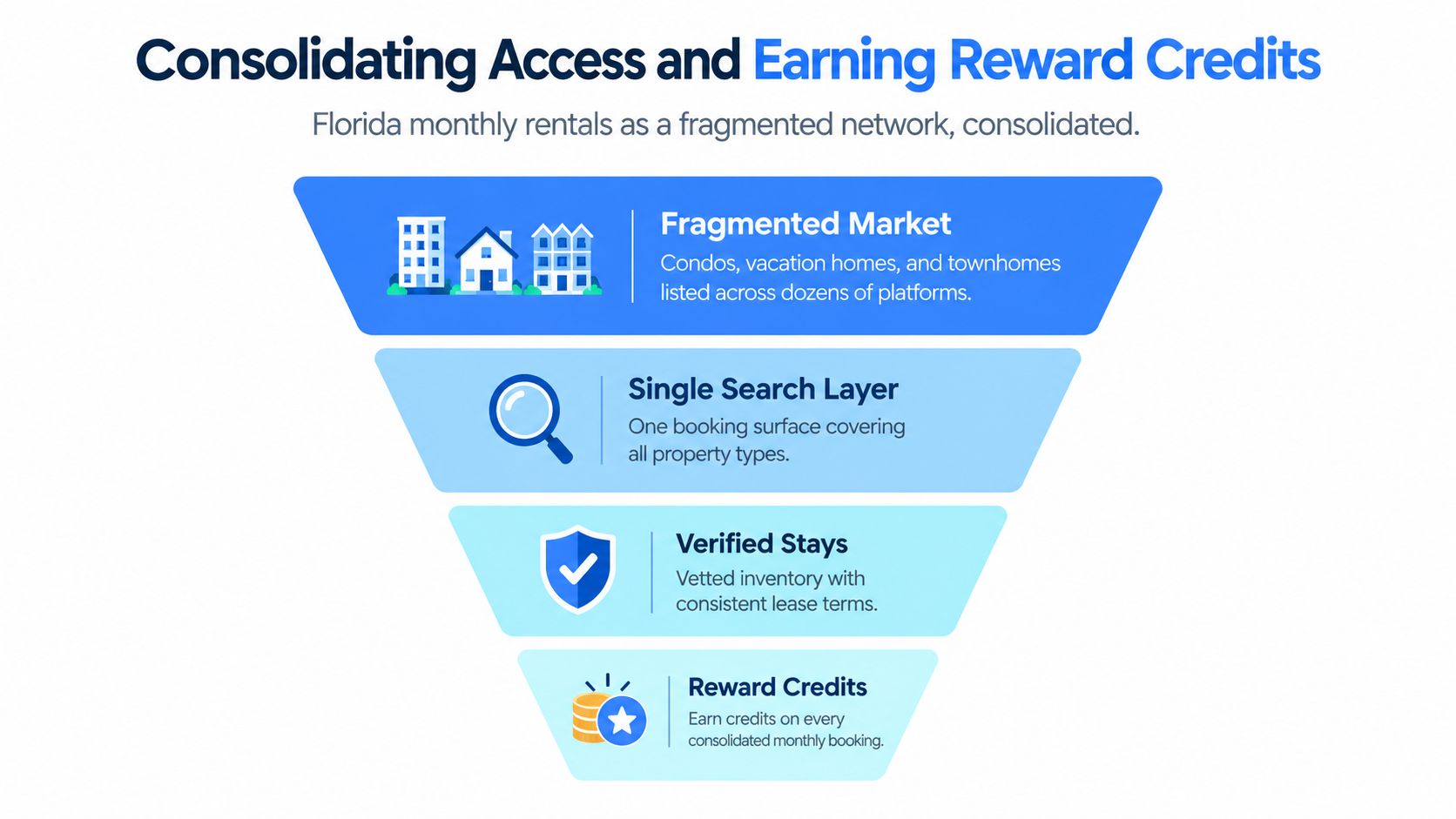
The operational mistake is treating every Florida monthly rental as a separate project. A condo, vacation home, and extended-stay unit may sit in the same destination, but each can require a different platform login, host conversation, fee review, deposit process, and amenity verification.
A single Approved Traveler membership creates a consolidated access point across the broader travel marketplace. In practical terms, the value isn't a coupon. It's infrastructure: one credentialed relationship for comparing eligible inventory, organizing longer stays, and keeping the booking trail in one place.
Replace fragmented searches with a repeatable system
Use the same filters every time:
- Region: Compare Gulf Coast, Atlantic Coast, Central Florida, and the Keys separately.
- Property type: Decide whether the group needs a house, condo, or suite before comparing price.
- Stay structure: Filter for the actual term, then verify minimum-stay and association requirements.
- All-in cost: Record utilities, cleaning, parking, tax, pet charges, and deposits beside the base rate.
- Verification: Confirm the amenity claims and lease terms before releasing funds.
The membership model also changes the economics of repeated travel because members earn Reward Credits on bookings, and those credits can be applied toward future eligible travel and other stated redemption categories. A four-month stay split between Sarasota and Naples can therefore become part of a continuing booking cycle rather than two isolated transactions. Referral activity through Boomerang Member Share can add another credit-earning path when eligible bookings are made by shared family and friends.
The important discipline is to calculate the full value after fees and terms are known. Credits don't erase a bad property choice, an unsuitable minimum stay, or an unverified utility arrangement. They become useful when the underlying booking already fits the household's location, space, and timing requirements.
Advisor's view: Consolidation beats coupon chasing because it improves the operating process before it improves the price outcome.
Approved Traveler also includes access to a large travel inventory across vacation homes and other categories, while the 110% Best Value Guarantee provides a defined process when a lower publicly available price is found. Review the exact membership terms before relying on any guarantee or redemption assumption.
For households comparing broader travel infrastructure, travel loyalty program structures can help distinguish a recurring credit system from a single-brand points program. The relevant question is whether the system supports the way you book, including multi-property stays and family coordination.
Your One-Page Florida Monthly Rental Checklist
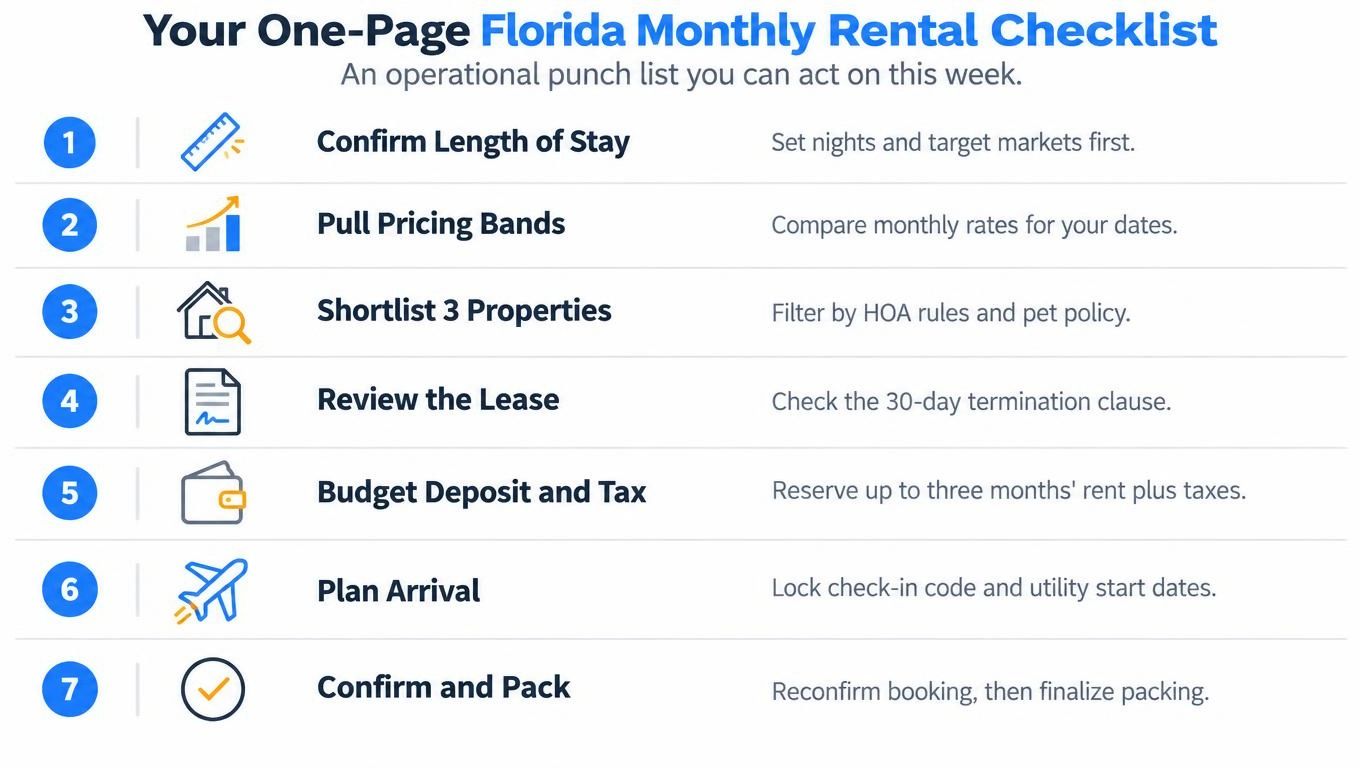
- Confirm length of stay: Set the dates, number of nights, and target Florida markets.
- Pull pricing bands: Compare at least two property types for the same dates.
- Shortlist three properties: Filter for HOA rules, pet policy, parking, bedrooms, and workspace.
- Review the lease: Check the rent cycle, notice process, tax treatment, deposit terms, and early-exit language.
- Itemize the budget: Add utilities, cleaning, parking, application costs, pet charges, deposits, and applicable tax.
- Lock the booking window: Secure January through April inventory well before peak-season demand compresses availability.
- Confirm amenities in writing: Verify internet, laundry, kitchen equipment, pool access, parking, and check-in details.
- Plan arrival: Coordinate the key code, utility start dates, association approval, and arrival window.
- Document the stay: Save the lease, receipts, tax records, and business or reimbursement documentation.
- Consolidate access: Use one membership where it provides suitable inventory and captures Reward Credits on eligible bookings.
For households furnishing a longer Central Florida stay, this Central Florida home setup checklist can help identify practical gaps beyond the listing description. Use it after the property is selected, not as a substitute for verifying what the rental already supplies.
Approved Experiences Traveler offers consolidated access to travel inventory, including vacation-home options suited to longer Florida stays, with Reward Credits earned on eligible bookings. Visit Approved Experiences Traveler to compare the membership structure and build your next Florida stay around verified access, clear terms, and a repeatable booking process.
Want the wider view?
Ten categories. One report. Every quarter. The Approved List tracks what's rising and what's fading: data-backed signals, not opinions.
Free to join · Delivered by email