
←All Articles
The Journal
Luxury Cruise Lines Comparison for Smart Travelers
September 21, 202616 min readluxury cruise linesluxury cruise comparison
Luxury cruise lines comparison with real criteria, costs and use cases. See which line fits your style and how Approved Traveler unlocks value.
You're probably looking at two or three luxury sailings right now that seem close enough to be interchangeable. Same region. Similar dates. Fares that don't look wildly different at first glance. Maybe one line promises “all inclusive,” another highlights spacious suites, and a third wins on itinerary. On paper, they all look refined.
Then the confusion starts.
One ship may feel calm because it carries far fewer guests. Another may have a better baseline suite layout for long in-cabin time. A third may look cheaper until you add drinks, gratuities, Wi‑Fi, and specialty dining. That's where most luxury cruise lines comparison content falls short. It compares brands as if the brand itself is the product, when the product is the operating model behind the trip.
I look at luxury cruises the way an auditor would. Ship scale, berth count, suite architecture, inclusion bundling, and guest mix change the trip more than slogans do. Those factors decide whether sea days feel crowded, whether a family can function in one suite configuration, whether a solo traveler gets the atmosphere they want, and whether the “better fare” stays better after onboard charges.
A practical example: two Mediterranean sailings can both qualify as luxury, yet one may suit a couple who spends little time in the room and wants port intensity, while another better fits a multi-generational family that needs private veranda space and predictable onboard costs. Same region. Different operational fit.
Introduction Why Luxury Cruise Choice Feels Harder Than It Should
Luxury cruise buying gets harder when every line markets comfort, cuisine, and service in roughly the same language. That language hides the variables that passengers feel. The result is a familiar mistake: travelers compare itinerary names and headline fares, then book a ship that doesn't match how they travel.
The booking problem most travelers run into
Consider a family organizer choosing between a Mediterranean sailing on Regent, Silversea, and Oceania. One line may look more expensive at the starting fare, but that doesn't tell you whether specialty dining is already included, whether most suites have verandas, or whether the baseline room is comfortable for long in-cabin use. If you're traveling with parents, children, or another couple, those details stop being minor.
The same issue hits repeat cruisers. They often know the region they want, but not the operational trade-off they're making. A smaller ship can feel more intimate. A larger luxury ship can offer more dining choice. An expedition product can justify a much higher nightly rate if your priority is destination access rather than onboard breadth.
Practical rule: Don't start with the brand. Start with the way you'll use the ship.
Here's the framework that usually clarifies the decision fastest:
| Decision Lens | What to Compare First | Why It Matters |
|---|---|---|
| Ship scale | Berth size and guest band | Predicts density, flow, and how public spaces feel |
| Suite architecture | Baseline suite size and veranda coverage | Determines privacy, livability, and family usability |
| Inclusions | Drinks, gratuities, dining, Wi‑Fi, fitness | Changes total trip cost and onboard spending uncertainty |
| Guest mix | Ocean, expedition, or river format | Shapes atmosphere, itinerary rhythm, and onboard priorities |
| Booking access | Ability to compare across many lines | Reduces loyalty lock-in and improves value matching |
That criteria-based approach does more than simplify shopping. It reduces the odds of paying luxury rates for a trip design that doesn't fit your party.
For travelers comparing many brands at once, access matters too. If you're only shopping inside one loyalty ecosystem, you're often comparing the wrong set. Broader access across 44+ cruise lines and 30,000+ itineraries lets you judge the actual fit of the sailing rather than defaulting to the line you already know.
Understanding the Luxury Cruise Market at a Glance
Luxury cruising is a small category inside a much larger cruise system, and that context matters. Luxury brands don't compete in isolation. They operate inside a market where capacity keeps expanding and where travelers can choose from many ship formats, from mega-ships to small expedition vessels.
Luxury is small, but supply has expanded
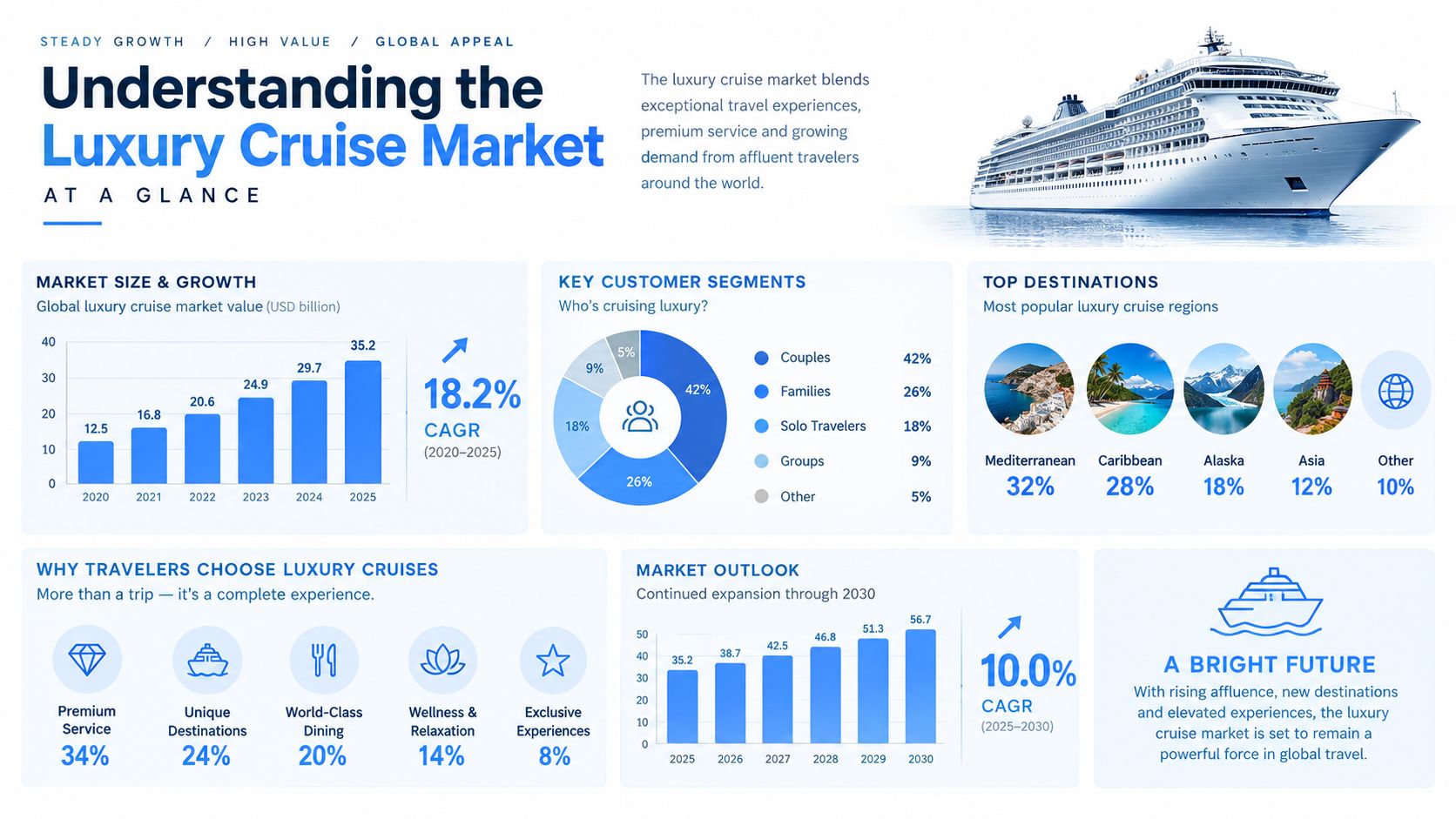
Independent market tracking cited by WorldMetrics luxury cruise industry statistics estimated about 125 luxury cruise vessels globally in 2023, up from 105 in 2020, which implies roughly 19% growth in luxury ship supply over three years. The same source cites Celebrity Cruises at 16 ships in 2023, Ponant at 13, and Silversea at 11.
That concentration explains why brand count alone is a weak comparison tool. A line with more ships can offer more itinerary breadth, more departure dates, and often a wider spread of vessel ages. A line with fewer ships may still be stronger for a specific use case, but it usually gives you fewer routing and date combinations.
The wider cruise market sets the benchmark
Luxury ships also sit inside a much bigger operating environment. CLIA reported that the global member fleet surpassed 300 ocean-going vessels for the first time in 2024 and reached 310 in 2025, with global capacity approaching 700,000 lower berths in 2026 at 692,000. CLIA also said member cruise lines accounted for 91% of global ocean-going lower berths in 2026 in its State of the Cruise Industry Report 2025.
For luxury buyers, that matters for one reason. Comparison isn't just about luxury versus luxury. It's also about understanding what luxury is deliberately not trying to be. Smaller ships, fewer berths, and higher service intensity are structural choices, not branding flourishes.
A useful primer on broad line differences is this guide to different cruise lines and how they compare. It helps frame why a luxury line should be judged against the traveler's desired onboard environment, not against the most famous names.
The market is fragmenting by product type
The category is also splitting by use case. MarketIntelo's luxury cruise market report says ocean cruises hold 48.3% of the luxury cruise market in 2025, while expedition and river segments are growing faster in multiple reports. The same report ranks quote-request activity across lines including Cunard, Oceania, Azamara, Viking Ocean, Silversea, Explora Journeys, Seabourn, Regent, Windstar, and Crystal.
That split matters because “luxury cruise” now covers products that aren't interchangeable. Ocean, expedition, and river lines solve different travel jobs. If you don't separate them early, your comparison gets muddy fast.
How Fleet Size and Ship Scale Shape Your Onboard Experience
Passengers usually describe the difference as atmosphere. Operators would call it density, flow, and service load. Either way, ship scale is one of the fastest ways to predict whether you'll enjoy a luxury cruise.
Berth count tells you more than marketing language
Cruise industry reporting commonly segments ships by less than 1,000 lower berths, 1,000 to less than 3,000, and 3,000 to greater than 4,000 lower berths in the CLIA industry report classification. For luxury travelers, that berth count is a practical proxy for scale.
A ship under the lower-berth threshold associated with larger mainstream vessels will usually feel less compressed in public rooms, at embarkation, and on sea days. That doesn't mean every smaller ship is better. It means the trade-off is clearer. Smaller scale usually buys intimacy and lower passenger density. Larger scale within luxury can buy venue variety and more cabin categories.
Ship Scale and Service Density at a Glance
| Scale Indicator | What It Means for Guests |
|---|---|
| Lower berth count | A practical proxy for how intimate or crowded the ship is likely to feel |
| Guest capacity band | Tells you whether you're in a yacht-like setting or a broader resort-style luxury environment |
| Staff-to-guest ratio | Signals how consistently the ship can deliver attentive service during busy periods |
| Baseline suite size | Affects privacy, storage, in-room dining comfort, and livability on sea days |
Independent comparison sheets compiled in the trade put premium and ultra-luxury ships in a broad range from roughly 100 to 750 guests on some lines, while major luxury brands commonly fall in the 300 to 1,000-passenger band. Those same published comparison sheets show staff-to-guest ratios around 1:1.35 to 1:1.45 across comparable luxury ships, with suite sizes spanning 28 m² to 36 m² in the sample set in the Nexion luxury comparison sheets.
The important point isn't that one ratio is always “good” and another “bad.” It's that two sailings with similar fares can deliver different lived results. On sea days, that can show up in dining wait times, how quickly staff turn requests, and whether lounges feel comfortably active or overused.
Space per passenger is not a luxury talking point. It's an operating condition that shapes almost every hour onboard.
How to use scale in a real comparison
If you're comparing similar itineraries, ask three blunt questions:
- How much ship do you want around you? If you want lots of dining and social options, a larger luxury ship may fit better. If you want quiet circulation and fewer crowded touchpoints, smaller scale usually helps.
- How much time will you spend in the suite? Larger baseline suite dimensions matter more on port-light itineraries, long voyages, and trips with in-room breakfasts or downtime.
- How sensitive are you to service inconsistency? Similar service ratios can still feel different depending on the number of venues, passenger flow, and sea-day concentration.
A practical example: a traveler taking a port-heavy itinerary may care less about public-space variety and more about quick service and a calm boarding experience. A traveler on a longer sailing with several sea days may feel the opposite.
Suite architecture changes the trip more than many buyers expect
One expert comparison notes that Regent's all-balcony model starts at 300+ square feet and extends to the 4,443-square-foot Regent Suite. The same comparison notes that Silversea's entry suites are about 269 to 295 square feet on some ships and nearly 90% of suites carry private verandas, while Seabourn's entry verandas are generally around 355 square feet on expedition ships, with fewer all-veranda categories on some ocean classes in the Smart Luxury comparison guide.
That's not cosmetic. For a couple working remotely for part of a voyage, a family sharing a suite, or repeat cruisers who value private in-cabin time, veranda coverage and starting suite size change the practical utility of the room. They also change how much you need to spend to get the cabin experience you want.
What Your Fare Actually Includes and What It Hides
Luxury cruise fares can be honest or misleading depending on how you read them. The right comparison isn't nightly rate versus nightly rate. It's total trip cost adjusted for inclusions and cabin architecture.
Inclusion bundling is where price comparison gets real
Some luxury lines bundle the charges that frustrate travelers most on mainstream sailings. According to Cruise Critic's guide to what's included on luxury cruises, luxury cruise fares often include alcoholic drinks, gratuities, specialty dining, fitness classes, and Wi‑Fi, and on Regent, Seabourn, Oceania, and Windstar all specialty restaurants are included in the price.
That matters because bundled pricing reduces spending uncertainty. If you know your party will use specialty dining, onboard internet, and drinks, a higher starting fare can be operationally cleaner than a lower one with recurring onboard charges.
Here's the short version of how to normalize a fare:
- Strip out emotion from the headline price. Compare what the base fare buys before you react to the number.
- Price your actual habits. If your group drinks wine at dinner, books specialty dining, and needs Wi‑Fi, treat those as expected costs, not optional extras.
- Account for room use. A less expensive fare can lose value fast if the entry suite is too small for how you travel.
A useful companion read for cost normalization is this guide on how to save money on cruises without distorting the comparison.
Regional price bands help set expectations
Industry comparison guides place luxury cruise pricing at roughly $400 to $900 per person per night for Caribbean sailings, $600 to $1,400 for Mediterranean sailings, and $1,200 to $3,000 for expedition sailings in this luxury cruise lines guide.
Those ranges are broad, but they're useful for a reality check. Mediterranean luxury pricing, for example, can sit in a band that looks manageable at the entry level and then rises quickly once you move into higher cabin categories or compare lines with different inclusion models.
For a practical example, a 7-night Mediterranean luxury itinerary can easily move from mid-four figures to much higher totals once you compare cabin category and inclusions across lines from that same source. That's why “which fare is lower” is usually the wrong first question.
A quick visual primer can help if you're sorting ocean, expedition, and river options before you start pricing.
What to check before you assume one line is better value
Use this checklist when two fares look close:
- Dining coverage. Are specialty restaurants included or limited by category?
- Gratuities and drinks. If they're separate, budget for them as standard use.
- Wi‑Fi quality and policy. Included access matters more on longer voyages.
- Cabin baseline. Compare the lowest suite you'd accept, not the cheapest one shown first.
A luxury fare only looks simple until you compare it against your real onboard behavior.
Which Luxury Line Fits Your Travel Style and Party Size
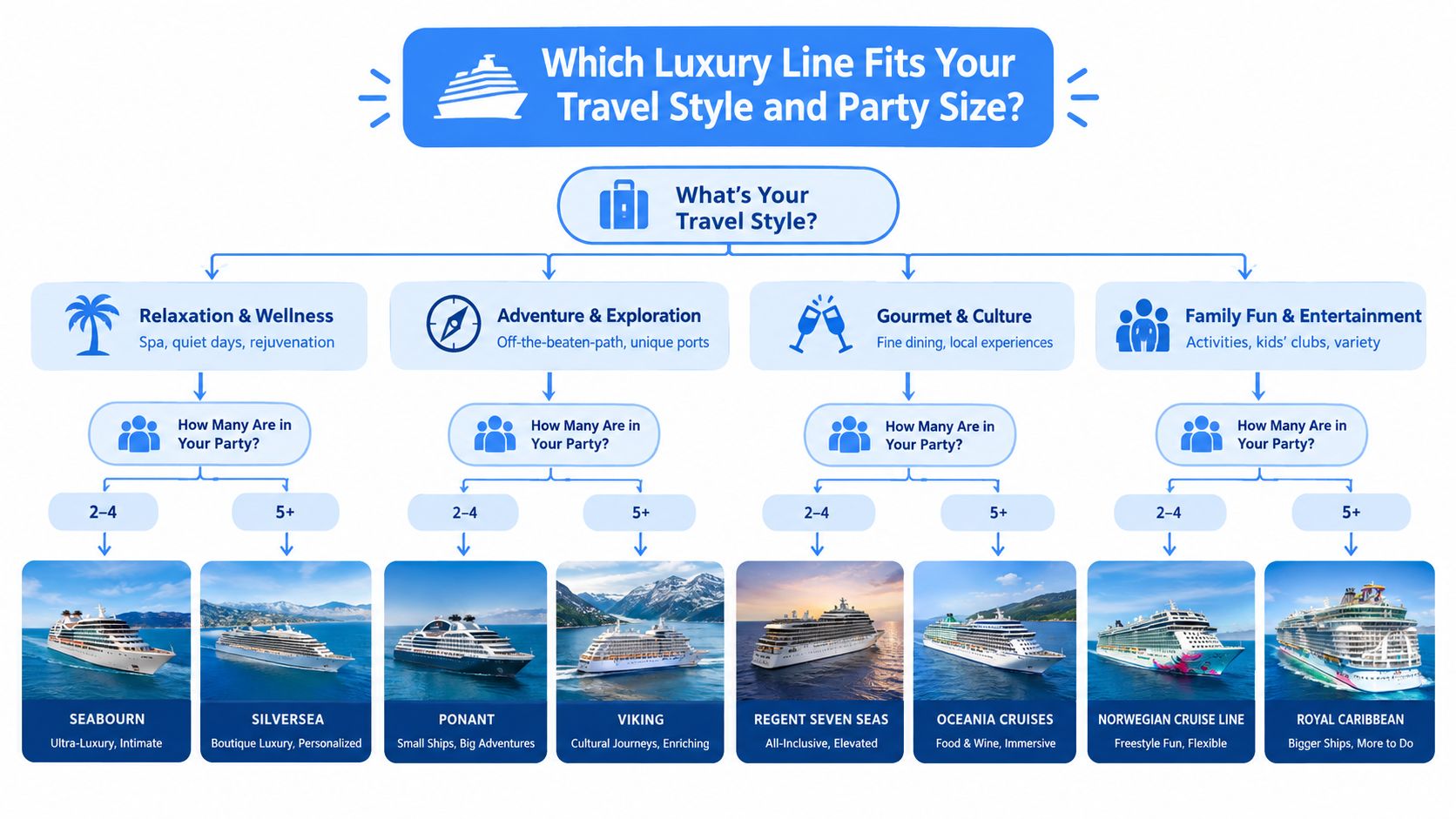
Most travelers don't need the “best” luxury line. They need the line whose product design matches the trip they're trying to run. That starts with format. Ocean, expedition, and river aren't substitutes.
Start with the travel job, not the prestige label
Ocean luxury remains the biggest part of the category, but that scale can obscure the fact that some travelers should start elsewhere. If your goal is broad onboard choice, ocean often fits. If your goal is remote landings and destination specialists, expedition belongs in a separate comparison. If your goal is steady cultural access with frequent landings, river delivers a different kind of luxury altogether.
The most useful lens here is party composition.
For families and multi-generational groups
Families need two things that many comparison lists barely mention. First, they need suite layouts and veranda access that can handle shared downtime without forcing an upgrade to the very top suite tier. Second, they need a guest mix that won't make children or grandparents feel out of place.
If privacy and room usability are high priorities, compare baseline suite architecture carefully. Veranda coverage, entry-suite size, and the ability to create comfortable multi-room combinations matter more than polished marketing language.
For families hiring childcare support on more complex voyages, especially where parents want shore time and formal evenings without constant schedule friction, this practical resource on what to expect from a superyacht nanny is useful because it explains the kind of onboard family support some high-service travel setups can require.
The right family luxury line doesn't just “allow” families. It supports how families actually move through the day.
For couples, solo travelers, and long-stay guests
Couples usually divide into two camps. Some want privacy, suite comfort, and a calm onboard rhythm. Others want destination intensity and don't need a large in-room footprint. Those are different shopping patterns.
Solo travelers should pay close attention to ship atmosphere and social structure. A quiet, suite-centric product may suit one solo cruiser and feel too closed for another. Expedition products can work well for travelers who value shared purpose and guided activity more than onboard nightlife.
Long-stay travelers, including retirees and snowbirds who think in weeks rather than short vacations, should weight cabin livability heavily. The suite stops being a place to sleep and becomes part lounge, office, and retreat. On those trips, the baseline room matters more than an extra restaurant.
Situational recommendations that usually hold up
- Choose ocean luxury when you want the broadest shipboard experience and a classic cruise rhythm.
- Choose expedition luxury when the destination itself is the product and you accept a higher nightly cost for access and specialization.
- Choose river luxury when cultural immersion and frequent city access matter more than shipboard scale.
That's the underlying reason a luxury cruise lines comparison often feels messy. People compare unlike products as if they serve the same job.
How Approved Traveler Changes Access and Value Across Cruise Lines
The hardest part of luxury cruise shopping isn't finding options. It's comparing them cleanly across systems that were never built to make cross-line evaluation easy. Brand sites push their own inventory. Loyalty ecosystems narrow your field. General travel platforms often flatten cruise differences into price-first lists.
Why consolidated access matters in cruise buying
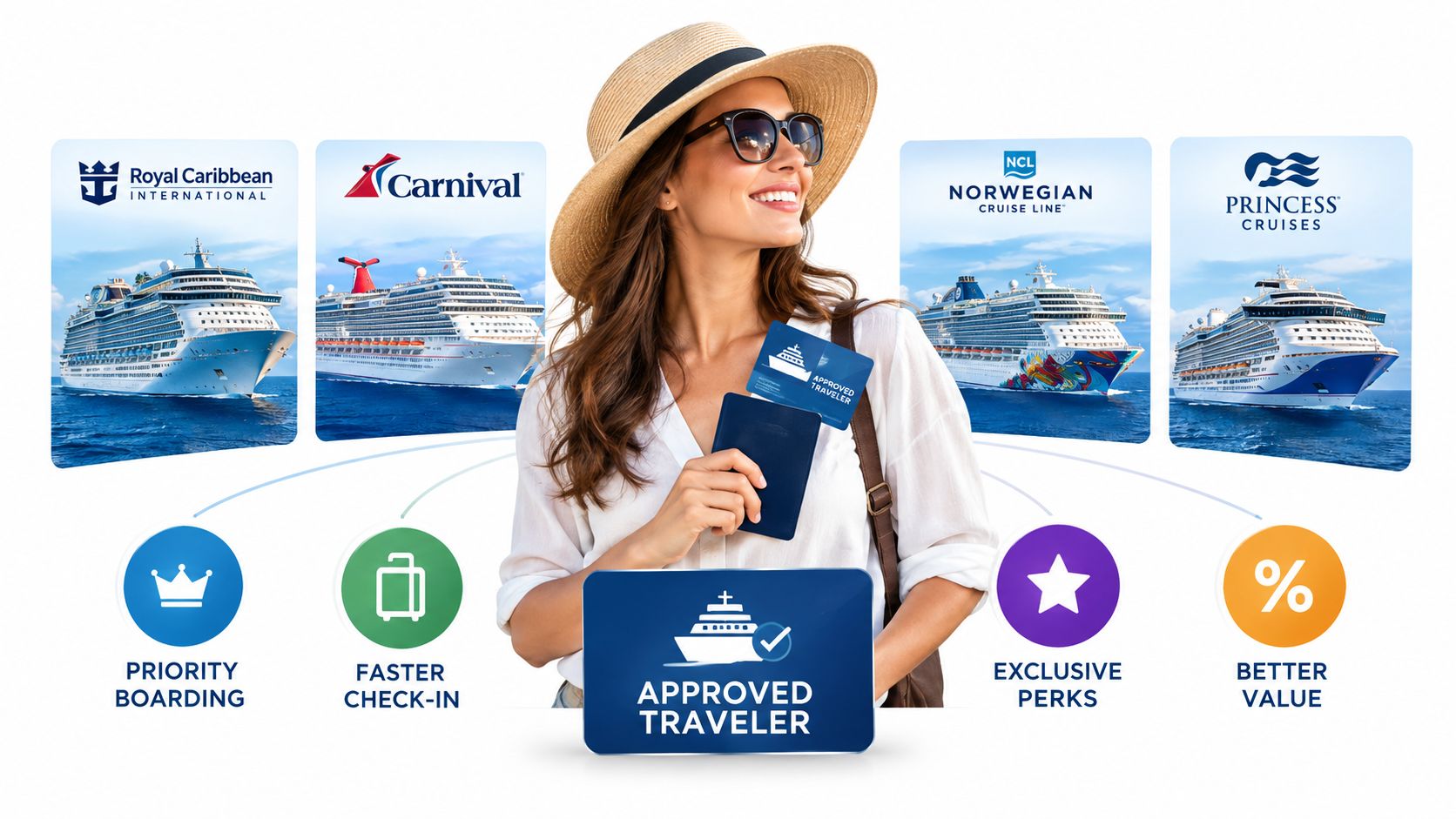
That's where travel infrastructure changes the process. Approved Traveler provides access to 44+ cruise lines and 30,000+ itineraries, alongside 1,000,000+ hotels, 700+ airlines, 30,000+ car rental locations, 500,000+ vacation homes, 5,500+ tour packages, and 150,000+ activities in one membership platform.
For cruise buyers, the operational benefit is straightforward. You can compare across line types without relying on a single loyalty stack or jumping between fragmented booking environments. That matters most when you're choosing between ocean, expedition, and river products, or when you're coordinating cabins for extended family.
The value isn't just booking access
The structure behind the membership is what makes it relevant to luxury cruise comparison:
- Reward Credits accrue on every booking, never expire, and can be redeemed toward future bookings, annual renewal, and certain other eligible uses.
- Household scale covers up to 10 members with full benefit parity, which is practical for multi-cabin family travel.
- Boomerang Member Share lets the primary member earn Reward Credits on hotel and car bookings made by shared family and friends.
- 110% Best Value Guarantee provides a defined process if a lower publicly available price is found.
- V.O.I.C.E. lets timeshare owners deposit up to 5 weeks per year for credits, exchange weeks at no fee, or list weeks on a peer-to-peer rental marketplace with no listing fee.
Where Lux Traveler changes the equation
Some cruise bookings aren't hard because the ship is hard to choose. They're hard because the party is hard to coordinate. The Lux Traveler tier includes the Approved Lux 24/7 Personal Assistant, a US-based service that supports travel logistics and household coordination for up to 10 household members.
That has obvious use for complex bookings. Think multiple cabins, grandparents flying from one city, adult children from another, shore logistics layered around medical or childcare constraints, and pre- or post-cruise stays that need to line up cleanly.
The value of cruise access rises when the comparison sits inside a system that can also coordinate flights, hotels, homes, and family logistics.
Making Your Final Choice With Confidence
A strong luxury cruise decision usually comes down to five checks. Not ten. Not twenty. Five.
The final decision checklist
- Match ship scale to your tolerance for density. If you dislike waiting, crowded lounges, or busy sea days, favor smaller-berth environments and lower-density products.
- Verify suite architecture before fare. Check starting suite size, veranda coverage, and whether the room works for how your party will use it.
- Normalize inclusions. Compare fares only after you account for drinks, gratuities, specialty dining, Wi‑Fi, and fitness access.
- Choose the right format. Ocean, expedition, and river lines solve different travel goals. Don't compare them as if they're one category.
- Protect booking flexibility. Wider access across lines reduces the chance that loyalty habits push you into the wrong product.
If-then guidance that helps in practice
If you're booking for a family and expect shared downtime, prioritize lines with stronger baseline suite livability and veranda access.
If privacy matters more than public-space variety, pay closer attention to accommodation architecture than to entertainment breadth.
If you're choosing expedition, accept that the nightly rate can be much higher than ocean luxury and judge value by destination access, not by restaurant count.
Before you commit, confirm three things in writing: veranda coverage for the exact cabin category, what the fare includes onboard, and the terms around price protection or guarantee claims. Those are the details that most often change whether a booking feels like smart value or avoidable regret.
One final, practical point. Trips go better when the people taking them are on the same page. If you're organizing parents, teens, or in-laws, a short list of conversation openers for trips can help surface preferences early, before you lock in a ship that fits only the lead booker.
Luxury cruise buying gets easier once you stop shopping brands and start shopping operating fit.
Approved Experiences Traveler gives members consolidated access to cruise, hotel, air, home, car, and activity inventory in one platform, including 44+ cruise lines and 30,000+ itineraries that make side-by-side luxury comparison more practical. If you want to evaluate lines by berth scale, suite design, and inclusion value without defaulting to a single loyalty ecosystem, visit Approved Experiences Traveler.
Want the wider view?
Ten categories. One report. Every quarter. The Approved List tracks what's rising and what's fading: data-backed signals, not opinions.
Free to join · Delivered by email