
←All Articles
The Journal
8 Operational Planning Examples for Travel
September 17, 202616 min readtravel planninggroup travel
Explore 8 operational planning examples for travel, from family reunions to cruise groups, with tactics for consolidating inventory and coordinating bookings.

A family reunion rarely fails because nobody found a hotel. It fails because one organizer must coordinate flights for several households, rooms or vacation homes, cars, activities, extended stays, or cruise cabins across booking channels that don't share inventory, permissions, or financial records. One person holds the confirmations, another books transportation, a third pays for activities, and nobody has a clear view of the household's Reward Credits balance.
Strong operational planning examples treat travel as an infrastructure problem. They consolidate inventory, assign booking authority, track value centrally, and turn repeat bookings into a workflow instead of a series of disconnected transactions. Approved Traveler provides annual membership access to 1M+ hotels, 700+ airlines, 44+ cruise lines, 500,000+ vacation homes, and other travel inventory, with household access for up to 10 members. For travel logistics outside the booking itself, flexible billing and vehicle options in Cancun illustrate why transportation needs to fit the wider operating plan.
The eight models below examine how the system works, who benefits, what each model gives up, and what action makes it repeatable.
1. Aggregated Inventory Consolidation Model
Fragmented inventory creates fragmented decisions. A multi-generational family may compare hotels in one account, flights in another, cars through a rental portal, and activities through separate operators. That structure forces the organizer to reconcile different cancellation rules, receipts, loyalty systems, and payment records before the trip has even started.
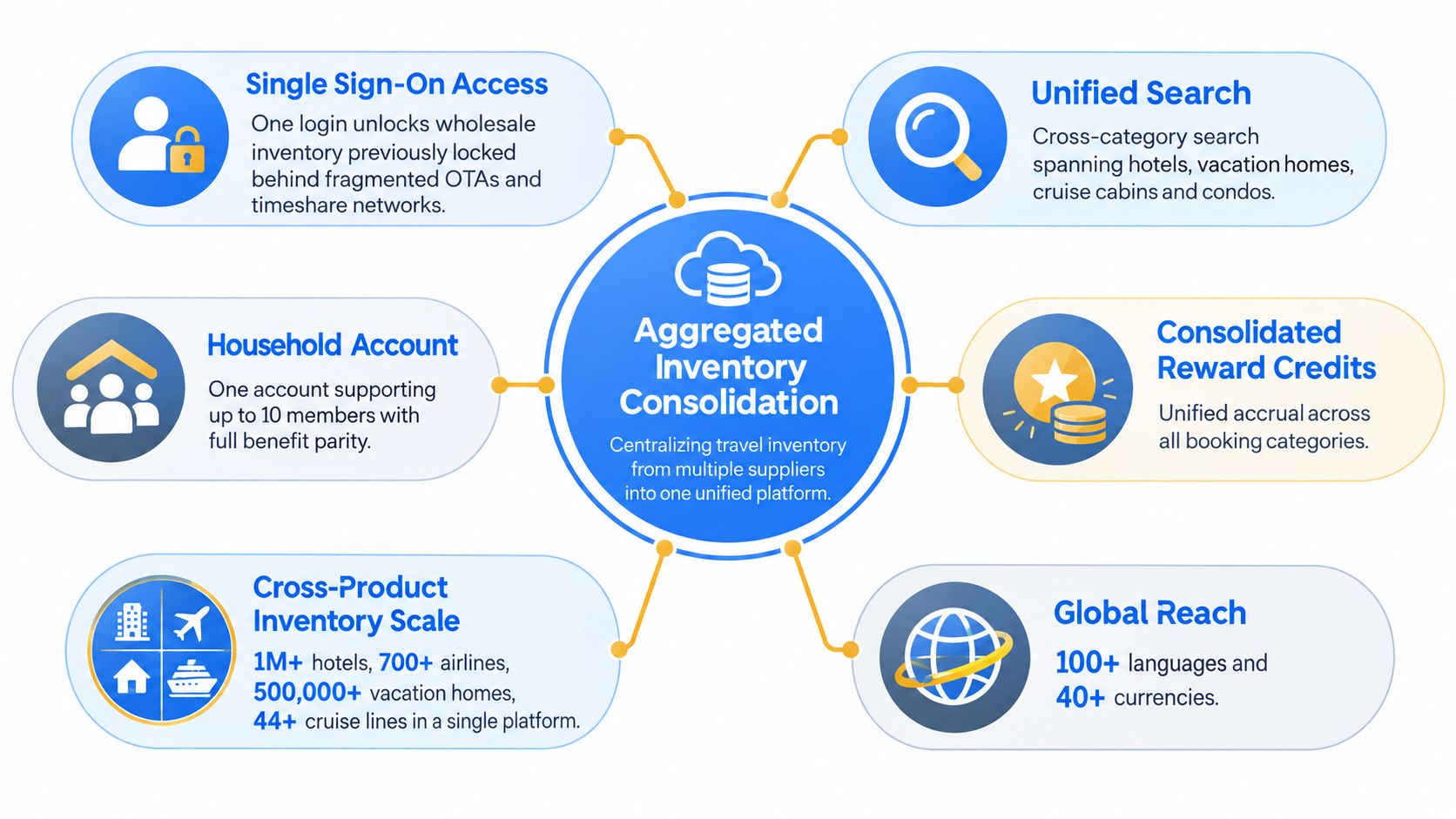
Approved Traveler brings 1M+ hotels, 700+ airlines, 44+ cruise lines, and 500,000+ vacation homes into one travel membership platform. A family can evaluate rooms, flights, ground transportation, and activities in a connected session rather than maintaining separate access points for every supplier. A snowbird can search extended-stay condos without switching among multiple vacation-home platforms, while a remote worker can compare homes with kitchens and workspaces across 100+ languages and 40+ currencies.
The trade-off is that aggregation simplifies discovery but doesn't remove the need for comparison discipline. A unified result should show the total cost, ancillary fees, cancellation conditions, and the supplier fulfilling the reservation. Otherwise, one interface merely hides the same fragmentation behind a cleaner screen.
Practical rule: Rank options by total trip cost and operating fit, not by the first nightly rate displayed.
Make the account the operating center
A household dashboard should show upcoming reservations, booking ownership, spending authority, and the aggregate Reward Credits balance. Members should be able to book independently while directing credits to the primary account holder through Boomerang Member Share. Transparency matters too. The traveler should see whether the hotel, airline, activity provider, or home supplier fulfills each booking.
For a deeper framework on consolidating travel supply and booking workflows, use this travel inventory management system. The replicable action is straightforward: create one inventory record for every trip component, assign one accountable household owner, and compare the complete itinerary before anyone books an isolated segment.
2. Perpetual Reward Credits System With Non-Expiring Accrual
A travel plan becomes more durable when each booking contributes to a future booking rather than disappearing into a supplier-specific program. Approved Traveler Reward Credits never expire, and members can apply them toward future bookings, annual membership renewal, ancillary fees, and eligible gift cards across supported markets. The value is operational because the credit record follows the household's travel activity instead of remaining locked to one hotel chain or airline.
Consider a frequent leisure traveler who takes several trips during the year. The useful question isn't just how much each booking costs. It's whether the household can see the earning rate, understand the next redemption opportunity, and decide whether credits should support renewal, lodging, or a larger family trip. An eight-person family can use the same logic by routing eligible activity to one shared balance rather than scattering value among separate accounts.
Snowbirds also need a seasonal view. A household that books repeated warm-weather stays should track credits against the next extended-stay requirement, while distinguishing between projected accrual and credits already available. The system shouldn't assign a fixed dollar value to Reward Credits because redemption rates vary by use.
Turn accrual into a decision signal
A useful dashboard would display:
- Current balance: Separate available credits from pending credits tied to unsettled bookings.
- Earning activity: Show which household member generated each booking and how the credit flows to the primary account.
- Redemption paths: Present future travel, renewal, ancillary fees, and gift-card options without implying identical redemption rates.
- Seasonal prompts: Remind the household to review its balance before the periods when it typically travels.
The guide to earning travel points should be treated as a workflow reference, not as a substitute for reviewing the account's actual terms. The replicable action is to add a Reward Credits review to the same calendar event used for itinerary confirmation, then decide in advance whether the balance supports the next trip or should remain available for renewal.
3. Multi-Generational Household Account Structure With Parity Benefit Access
The family organizer shouldn't have to become the family's permanent travel clerk. A household account changes the operating model by letting up to 10 members access the same platform benefits, including inventory access, Reward Credits accrual, and the 110% Best Value Guarantee, without creating separate per-person access silos.
That structure fits an extended family planning a reunion across several properties, flights, car rentals, and shared activities. Grandparents can hold the primary account while adult children book their own rooms or transportation. The organizer retains visibility, but each household can handle the part of the itinerary it understands best. A snowbird household can use the same account across recurring warm-weather stays rather than rebuilding its travel infrastructure for every season.
Parity improves coordination, but shared access introduces governance questions. The account needs a clear primary owner, defined payment authority, and a process for high-value reservations. Without those rules, the same flexibility that lets relatives book independently can create duplicate reservations or disputes over who approved an upgrade.
Assign authority before the search begins
Use a simple permission structure:
- Primary owner: Controls the account, credits, payment records, and final reconciliation.
- Trip leads: Manage a specific reunion, cruise, or extended stay.
- Household members: Book within an agreed scope and submit receipts or confirmations.
- Approval route: Escalates unusual or high-value bookings before payment.
A centralized record also helps families apply practical household management services principles to travel administration. For families considering a cruise, these tips for multigenerational cruises reinforce the same operational lesson, different travelers need clear roles even when they share the trip.
The replicable action is to name one account owner, add the relevant household members, and write a one-page authority rule before opening the booking platform.

4. 110% Best Value Guarantee With Real-Time Price Monitoring
Price protection changes the post-booking workflow. Instead of treating payment as the end of the planning process, the household continues monitoring the same accommodation, flight, or activity under defined comparability rules.
The 110% Best Value Guarantee means a qualifying lower publicly available price produces a credit equal to 110% of the difference. For example, a member books a three-night hotel stay for $450, then finds the same room publicly available for $420. The $30 difference produces $33 in Reward Credits, provided the claim meets the applicable comparison requirements. That arithmetic is useful because it shows the guarantee is a measurable operating rule, not a general promise.
A similar process can apply when a cruise or vacation home changes price. The household needs the reservation details, the competing public offer, the timing, and proof that the inventory is genuinely comparable. A lower headline price isn't enough if it changes the cabin, dates, occupancy, inclusions, or cancellation conditions.
Separate monitoring from decision-making
The platform should display the guarantee at checkout, notify members of qualifying price movement, and offer a claims interface with evidence upload and validation. Support teams need consistent comparability rules so different claims don't receive different outcomes.
A price review is only useful when the traveler knows what counts as the same inventory.
The replicable action is to save the original confirmation, record the exact room, cabin, or activity conditions, and schedule a post-booking review against the 110% Best Value Guarantee requirements. That turns a vague hope of a later adjustment into a documented control point.
5. Timeshare Liquidity and Deposit Program With Fee-Free Exchange
Timeshare ownership creates a different operational problem. The traveler doesn't begin with open market demand. They begin with a contracted week that may be useful, exchangeable, or unused. V.O.I.C.E. gives owners three paths for up to 5 weeks per year: deposit unused weeks for platform credits, exchange weeks for other listed properties, or list weeks through a peer-to-peer marketplace. The source states that each option carries no exchange fee or listing fee, making the workflow explicit.
An owner can deposit a week in Mexico for access credits, exchange a week for another listed property, or list available inventory for another traveler. A retiree with multiple weeks can direct some toward future travel while retaining a week for personal use. The key decision isn't only whether to travel. It's which use produces the best fit among personal occupancy, exchange flexibility, and marketplace exposure.
The trade-off is control versus effort. Depositing or exchanging reduces the owner's listing workload but depends on available platform inventory and credit terms. A marketplace listing may provide greater control over presentation and calendar management, but it requires accurate dates, clear photographs, responsive communication, and realistic pricing.
Make the week legible before activating it
An effective deposit workflow should validate ownership documents, show exchange availability and credit conversion terms before activation, and provide listing support where needed. Owners also need an annual statement that separates deposited weeks, exchanged weeks, listed inventory, and resulting credits or income.
The V.O.I.C.E. program details provide the operating paths and their stated limits. The replicable action is to inventory every unused week, classify it as personal, exchange, deposit, or marketplace inventory, and activate only after comparing the resulting travel utility with the effort required.
6. Extended-Stay Condo and Vacation Home Inventory With Weekly Rate Standardization
Nightly pricing is a poor control mechanism for a stay that lasts several weeks. It obscures cleaning charges, parking, fragmented reservations, and the difference between a hotel room and a functioning household. Family travel research shows why this matters: in a 2025 survey, 92% of parents said they were likely to travel with their children in the next year, 81% planned to increase or maintain domestic travel spending, and 73% cited affordability as the top obstacle. The same source reports that the average family spent about $8,052 on travel in 2024, up roughly 20% year over year. (Family Travel Association survey)
That evidence supports a planning shift toward full-stay cost visibility. A snowbird couple needs a condo with practical kitchen and laundry access. A remote worker needs a workspace and reliable internet. A family may need bedroom distribution, bathrooms, parking, and an outdoor gathering area more than a lower advertised nightly figure.
Treat the stay as one operating unit
Search filters should identify minimum stay length, kitchen capacity, laundry, workspace, parking, and sleeping arrangements. The booking screen should show the full cost for the selected period and separate mandatory fees from optional upgrades. For multi-week reservations, a short hold window can protect the planning process while the household confirms dates and permissions.
Approved Traveler's family-planning guidance recommends building family pods around sleep schedules, mobility needs, and bathroom tolerance. It also recommends pricing reunion trips by the week rather than by the night and keeping confirmations and payment records centralized under one adult account.
The replicable action is to define the household's required amenities first, search by total weekly cost, and reject any property whose room layout or operating conditions cannot support the full stay.

7. Approved Lux 24/7 Personal Assistant Integration for Household Logistics Coordination
Some households don't have an inventory problem. They have an execution problem. An executive, physician, founder, or attorney may be able to authorize a complex trip but lack the time to reconcile calendars, dietary requirements, childcare, transport, medical appointments, and changes across several travelers.
Lux Traveler includes the Approved Lux 24/7 Personal Assistant, a US-based service layer covering travel logistics, family scheduling, childcare coordination, medical appointments, and household management for up to 10 household members. The value lies in connecting requests to the household's travel infrastructure. An assistant can coordinate a family reunion across properties, align transportation with arrival times, monitor guarantee requirements, and keep the booking owner informed.
A blended household might use the service to coordinate school or childcare schedules with travel dates and medical appointments. A founders' household might use it during a multi-week sabbatical, where property bookings, vendors, activities, and schedule changes interact. The assistant doesn't replace household authority. It carries out authorized work inside boundaries the household defines.
Put service boundaries in writing
Onboarding should identify request categories, approval thresholds, communication preferences, and escalation routes. The platform should connect assistant requests to inventory and Reward Credits records, while quarterly reviews can identify recurring tasks and underused service capacity.
The trade-off is delegation versus oversight. Delegation reduces the organizer's workload, but unclear authority creates errors. A personal assistant should never have to guess whether a family member can approve a new property, alter a payment method, or change a medical appointment.
The replicable action is to create a household operating brief with traveler profiles, authorization rules, recurring logistics, and emergency contacts before sending the first assistant request.
8. Cruise-Line Aggregation and Multi-Carrier Loyalty Consolidation
Cruise planning exposes the limits of single-brand loyalty. A group may compare Caribbean routes, ship layouts, cabin types, dining policies, home ports, and onboard inclusions across different operators. If every traveler searches separately, the group loses a common basis for comparing itinerary fit and may split loyalty value across unrelated programs.
Approved Traveler aggregates 44+ cruise lines with 30,000+ itineraries in one booking environment. A cruise enthusiast can compare options from Royal Caribbean, Carnival, and Norwegian through a shared search. A repeat cruiser can evaluate different sailing styles across Viking and Royal Caribbean while directing eligible activity toward consolidated Reward Credits. A multi-generational group can compare itineraries from Regent, Norwegian, and Disney while coordinating cabins, dates, and invoicing through one household process.
The operational trade-off is breadth versus research complexity. More inventory creates more comparison work unless the search includes per-diem pricing, cabin and amenity data, home-port filters, dining inclusions, and onboard credit policies. A family also needs to distinguish between one itinerary that works for everyone and multiple sailings that share dates or ports but serve different traveler preferences.
Compare the ship and the operating consequences
A useful cruise workflow records:
- Route fit: Check ports, embarkation requirements, and travel time to the home port.
- Cabin fit: Compare occupancy, accessibility, location, and proximity for related households.
- Included value: Review dining, onboard credit, excursions, and other stated inclusions.
- Account treatment: Track how bookings contribute to the household's Reward Credits balance.
- Invoice control: Keep deposits, payment deadlines, and cabin assignments in one record.
The replicable action is to define essential group requirements, filter the aggregated itinerary set, compare total operating implications, and assign one person to maintain the final cabin and payment register.
8-Point Operational Planning Comparison
| Model | 🔄 Implementation Complexity | ⚡ Resource & Operational Requirements | 📊 Expected Outcomes (Impact) | Ideal Use Cases | 💡 Key Advantages / Quick Tips |
|---|---|---|---|---|---|
| Aggregated Inventory Consolidation Model | 🔄 High, complex supplier sync & real‑time parity | ⚡ Very high, API integrations, multi‑currency pricing engines, expanded support | 📊 ⭐⭐⭐⭐, unified UX, reduced churn, higher cross‑sell | Multi‑generational trips, snowbirds, remote workers | 💡 Rank by total cost; show supplier source; family dashboard |
| Perpetual Reward Credits System with Non‑Expiring Accrual | 🔄 Medium, accounting rules & anti‑arbitrage controls | ⚡ Medium, ledger, transparency UI, fraud prevention | 📊 ⭐⭐⭐, stronger retention and compounded LTV | Frequent leisure travelers; multi‑gen families; snowbirds | 💡 Visible credits dashboard; milestones; clear redemption rates |
| Multi‑Generational Household Account Structure | 🔄 Medium, permissions, admin and sharing workflows | ⚡ Medium, account management UI, approval flows, support | 📊 ⭐⭐⭐, lower friction for group bookings, increased volume | Multi‑generational family organizers; HNW households | 💡 Onboard households with granular permissions; reconciliation reports |
| 110% Best Value Guarantee with Real‑Time Monitoring | 🔄 Medium–High, live price monitoring and claims engine | ⚡ Medium, monitoring tech, claims ops, validation rules | 📊 ⭐⭐⭐, increased booking confidence; occasional refund liability | Price‑sensitive travelers; frequent bookers; snowbirds | 💡 Automate alerts; clear comparability rules; simple claims UI |
| Timeshare Liquidity & Deposit Program (V.O.I.C.E.) | 🔄 High, deed validation, deposit accounting, legal compliance | ⚡ High, marketplace ops, host vetting, jurisdictional legal support | 📊 ⭐⭐⭐, converts idle inventory to credits/income; owner acquisition | Timeshare owners; retirees; multi‑property owners | 💡 Fast deed validation, owner income projections, listing best practices |
| Extended‑Stay Condo & Vacation Home Inventory | 🔄 Medium, sourcing scale and quality control | ⚡ Medium‑High, property manager partnerships, support for long stays | 📊 ⭐⭐⭐⭐, captures multi‑week market; steady revenue streams | Snowbirds; remote workers; long‑stay retirees | 💡 Standardize weekly rates; show full‑stay cost; extended‑stay filters |
| Approved Lux 24/7 Personal Assistant Integration | 🔄 Medium–High, staffing, SLAs, training and integrations | ⚡ Very high, 24/7 trained personnel, platform integration, QA | 📊 ⭐⭐⭐⭐, high customer retention; justifies premium pricing | High‑net‑worth households; busy executives; multi‑family coordination | 💡 Define service boundaries, SLA tiers, integrate assistant workflows |
| Cruise‑Line Aggregation & Multi‑Carrier Loyalty Consolidation | 🔄 High, carrier APIs, fare normalization, loyalty reconciliation | ⚡ High, itinerary data, dynamic pricing, complex support rules | 📊 ⭐⭐⭐⭐, removes loyalty lock‑in; simplifies cruise shopping | Cruise enthusiasts; multi‑generational cruise planners | 💡 Surface per‑diem pricing, ship amenity comparisons, loyalty calculator |
Turn These Models Into a Repeatable Travel System
These operational planning examples work best as connected controls, not isolated features. Start with fragmented inventory. If the organizer can't see hotels, flights, vacation homes, activities, cars, or cruise cabins in one decision environment, every later step depends on manual reconciliation. Approved Traveler functions as travel infrastructure by consolidating access to 1M+ hotels, 700+ airlines, 44+ cruise lines, 500,000+ vacation homes, and other inventory through one annual membership.
Next, assign household authority. A shared account for up to 10 members can support independent booking without losing central visibility, but only if the primary owner, trip leads, payment authority, and approval rules are written down. The household should also decide whether Boomerang Member Share directs eligible booking value and Reward Credits activity back to the primary member.
Then separate short trips from long-stay operations. For 2 to 12 weeks of travel, search by weekly cost, property layout, workspace, kitchen, laundry, parking, and total fees. A nightly rate can obscure the operating burden of a long stay. For family reunions, group organizers should secure the anchor stay first, add transportation, reserve shared activities, and document the financial rules before collecting money. Shared lodging should be divided among the travelers who benefit, shared transportation among vehicle users, optional activities only among participants, and personal meals or upgrades by each household unless the group agrees otherwise. (Approved Traveler group-planning guidance)
Timeshare owners should classify unused inventory before choosing a path. V.O.I.C.E. supports deposits, exchanges, or peer-to-peer listings for up to 5 weeks per year, with no exchange fee or listing fee according to the program information. Cruise groups should widen the comparison set when requirements are complex, using the platform's 44+ cruise lines and 30,000+ itineraries rather than defaulting to one loyalty ecosystem.
For households that need execution beyond booking, Lux Traveler adds the Approved Lux 24/7 Personal Assistant for travel logistics and broader household coordination across up to 10 members. That makes the distinction clear. Approved Traveler provides the inventory and account infrastructure. Lux Traveler adds an execution layer for households whose scarce resource is time.
A practical implementation sequence is:
- Define travelers and permissions: Name the primary account owner, trip leads, payment authority, and approval thresholds.
- Centralize inventory: Record every required hotel, flight, home, vehicle, activity, or cruise component in one itinerary.
- Document the booking workflow: Secure the anchor stay, then transportation, shared activities, and financial rules.
- Track Reward Credits: Review pending and available credits after each booking and before the next major trip.
- Review the guarantee: Save confirmations and check the 110% Best Value Guarantee requirements after booking.
For a broader budget-friendly travel planning guide, apply the same principle: make the workflow visible before the itinerary becomes urgent.
Approved Traveler gives households access to consolidated travel inventory, shared account infrastructure for up to 10 members, Reward Credits that don't expire, V.O.I.C.E. options for eligible timeshare weeks, and the 110% Best Value Guarantee. Visit Approved Experiences Traveler to evaluate whether that infrastructure fits your family, long-stay, timeshare, cruise, or multi-household travel workflow.
Want the wider view?
Ten categories. One report. Every quarter. The Approved List tracks what's rising and what's fading: data-backed signals, not opinions.
Free to join · Delivered by email