
All Articles
The Journal
St Croix USVI Travel: Logistics, Stays & Groups in 2026
October 9, 202612 min readst croix usviusvi travel guide
Plan your St Croix USVI travel with our complete guide covering logistics, group stays, and local tips for a smooth 2026 trip.

You're coordinating a St. Croix family trip, and the first problem usually appears before anyone reaches the beach. One traveler has a separate flight, another expects to arrive by ferry from St. Thomas, a grandparent needs an easy transfer, and someone still hasn't confirmed whether the rental home has dependable water. The island looks simple on a map, but a loosely assembled itinerary can turn arrival day into a chain of missed connections and improvised decisions.
St. Croix works better when you treat it as an operational destination, not just a list of attractions. Flights, lodging, rental cars, ferry options, water infrastructure, reservations, and group activities need to fit together. That approach is especially valuable for families, snowbirds, remote workers, and timeshare owners who want a usable base rather than a short, disconnected stop.
St Croix Travel Reality Check
A family of several generations can arrive with completely reasonable expectations and still encounter friction immediately. The adults have arranged a vacation home, the children are ready for the pool or beach, and older relatives are expecting a short transfer. Then the ferry schedule changes, the rental-car pickup takes longer than expected, or the property manager mentions that water conservation is part of normal island life.
That experience doesn't mean St. Croix is difficult to visit. It means the island rewards deliberate sequencing. St. Croix is not a ferry-accessible extension of St. Thomas. The ferry operates only on selected days, air connections through Henry E. Rohlsen Airport are more limited than St. Thomas, and road-based transportation can require advance organization. A plan that works for two flexible adults may fail for a group carrying checked bags, traveling with children, and coordinating separate arrival times.
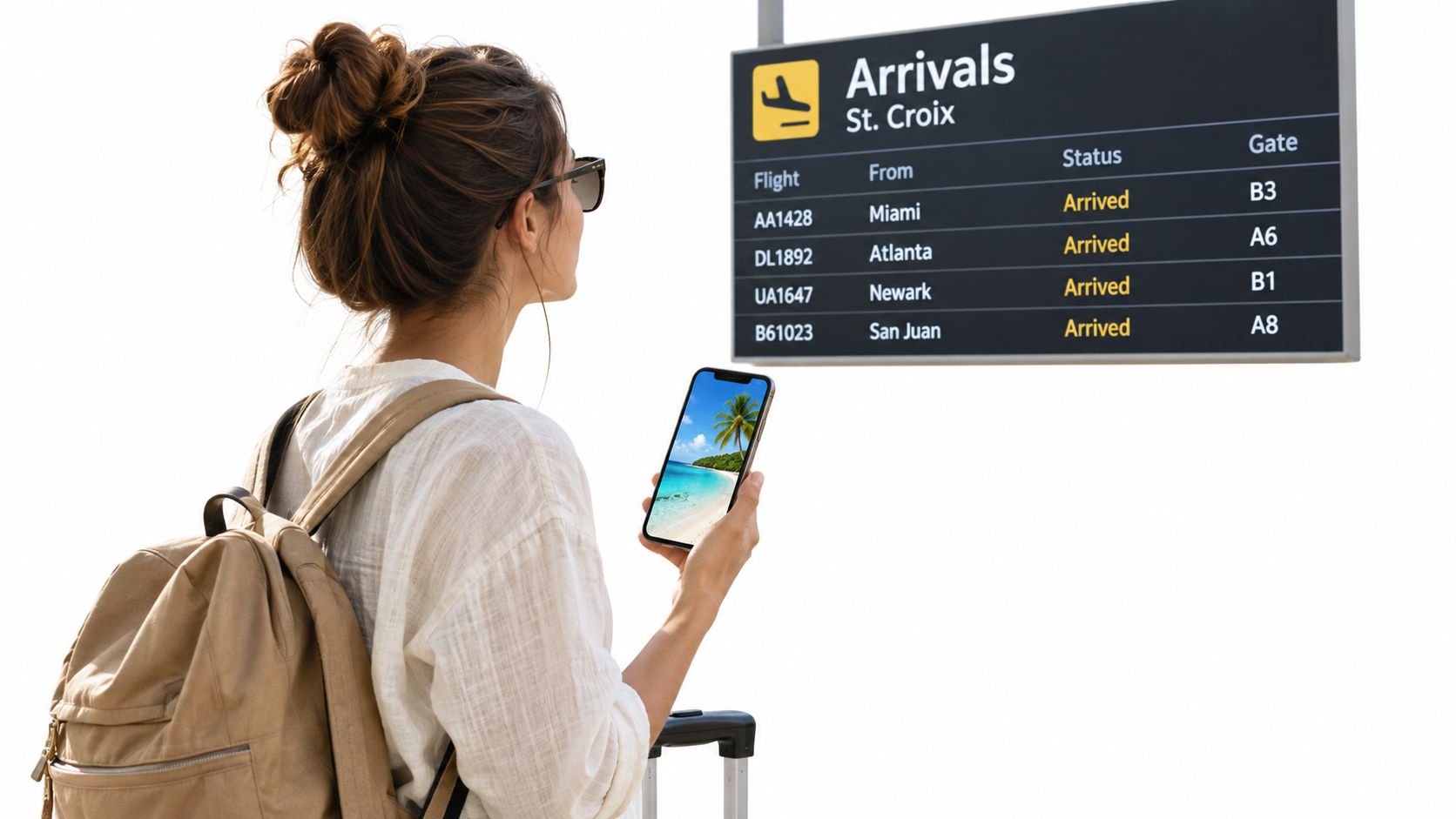
Build around one operating base
The more bookings a trip organizer manages separately, the more opportunities there are for timing gaps. A flight may arrive after a rental desk closes. A ferry may not run on the day a group needs it. A beach excursion may be too far from the accommodation to combine comfortably with airport transport.
A stronger structure starts with St. Croix as a self-contained base. Book the primary arrival through STX, place the lodging near the activities and services the group will use, reserve suitable ground transportation, and treat inter-island travel as an optional addition. This doesn't eliminate every risk, but it gives the trip a stable center.
St. Croix also offers more than beach tourism. The National Park Service record covers the dedication of Saint Croix Island National Monument in 1968, following congressional authorization in 1949, and its redesignation as Saint Croix Island International Historic Site in 1984 (National Park Service historical record). Those milestones sit alongside maritime infrastructure, European colonial activity, and Caribbean geography.
Practical rule: If a missed connection could disrupt lodging access, meals, transportation, and activities for the entire group, it belongs in the primary plan, not the backup plan.
The island's history makes a multi-purpose itinerary practical. A family can combine a residential stay, beach time, heritage visits, and boat activities without treating St. Croix as a single-use resort market. The operational goal is simple: reduce the number of independent decisions travelers must make after arrival.
Air First or Ferry Flexible
For most St. Croix itineraries, air first is the safer default. Henry E. Rohlsen Airport is the island's principal commercial gateway, and choosing STX as the final destination avoids building an entire family arrival around a sea crossing. The Virgin Islands Port Authority ferry schedule lists St. Croix service from Thursday through Monday, with departure from Gallows Bay at 8:00 a.m. and return from Charlotte Amalie at 3:00 p.m. The published crossing takes approximately 2 hours 10 minutes each way, and passengers should arrive 30 minutes before departure.
What the ferry changes
The ferry can be scenic and useful, but it has a narrow operating window. A traveler who lands in St. Thomas outside the ferry's schedule may need an overnight stay or a different connection. Weather can also disrupt sea travel. For a group of 8–10 travelers, the impact isn't limited to one delayed passenger. A missed sailing can affect airport transfers, rental-car collection, grocery arrangements, lodging check-in, and the first day's activities.
Every passenger should carry government identification or birth documentation, and travelers should verify current requirements before departure. The schedule also makes the ferry better suited to a planned excursion or secondary connection than to a single point of failure.
Why air capacity still needs planning
Recent reporting described a 56.5% year-over-year increase in air capacity to St. Croix, while another industry projection cited a 16% increase in continental-U.S. seats for winter 2025–26. These are useful signs of stronger access, not a guarantee that every preferred date, aircraft, baggage arrangement, or rental car will be available (air access and winter capacity reporting).
A group organizer should compare direct mainland-to-STX routing with San Juan connections, then check arrival times against car pickup and property access. The flights to the Virgin Islands planning guide can help travelers evaluate STX as the final arrival airport.
For a multi-generational group, predictable arrival is usually worth more than a theoretically simpler connection.
Use the ferry when the date, weather tolerance, luggage plan, and overnight contingency all work. Use air as the foundation when the trip includes a fixed rental, a large household, children, older travelers, or a short arrival window.
Choosing Your Extended Stay Base
A hotel can work for a short visit, but it often becomes inefficient for a week or longer. Families need kitchens, laundry, shared living space, and sleeping arrangements that don't force every household into a separate room. Snowbirds and remote workers also need a workspace, dependable internet arrangements, and enough storage to maintain routines.
A weekly condo or vacation home usually provides a more functional base. It lets travelers prepare breakfast before an excursion, keep different sleep schedules, and avoid turning every meal into a group logistics meeting. It also gives a large household a place to regroup between activities.
Verify the property before paying
St. Croix's visitor fact sheet reports average daytime temperatures near 80°F, evening temperatures around 70°F, prevailing easterly trade winds, and approximately 50 inches of annual rainfall. The same fact sheet notes that water is scarce and should be conserved (St. Croix visitor fact sheet). For an extended stay, water infrastructure deserves the same attention as bedroom count.
Ask the property manager specific questions rather than accepting a generic statement that utilities are reliable:
- Cistern capacity: Is the property supplied by a cistern, public service, or both?
- Backup storage: Is there reserve storage if replenishment is delayed?
- Operating procedures: What does the household need to do during a dry period?
- Service responsibility: Who responds if water pressure or supply changes?
- Work suitability: Can remote workers continue without avoidable interruptions?
These questions matter most for retirees, families with young children, and anyone staying multiple weeks. A beautiful property with uncertain basic services can create more work than it removes.
Make the home operational
Before arrival, confirm check-in instructions, grocery access, vehicle parking, laundry equipment, kitchen supplies, and workspace details. If you're managing a property for others, a practical guide to stocking a rental without overspending can help you decide which supplies should be purchased locally and which should be prepared in advance.
For travelers comparing residential inventory, long-stay rentals are worth evaluating alongside hotels. The decision isn't only about nightly cost. It's about whether the accommodation supports the way the group intends to live.
A workable base should reduce daily coordination. Choose location according to the group's pattern, not a generic island ranking. A Christiansted-oriented stay may suit restaurant access and East End activities, while a Frederiksted or west-side base may simplify cruise-port access and beach days. Either way, verify the practical systems before committing.
Building a Balanced Itinerary
A successful St. Croix itinerary gives each age group a meaningful day without requiring everyone to do the same activity. Grandparents may prefer a shorter cultural visit or an accessible beach. Parents may want a boat excursion or driving loop. Children may need water time, shade, and the ability to leave before the day becomes tiring.

Match activities to the transport day
Frederiksted Beach is practical for cruise passengers because it's close to the cruise-ship pier. Shoys Beach is on the East End, a few miles outside Christiansted. Cane Bay is associated with diving at the Wall, while Rainbow Beach supports water sports and beach-bar activity. Sandy Point is described by the U.S. Virgin Islands tourism authority as one of the territory's longest and least disturbed beaches, but it may close because it's protected nesting habitat for sea turtles (St. Croix beach guidance).
That distinction matters. A cruise passenger with only a few hours shouldn't select a beach that requires a long cross-island transfer. A weekly visitor can schedule a quieter beach day when the group has a rental car and no fixed departure.
Buck Island Reef National Monument requires visitors to book a half-day or full-day trip with an approved tour operator, combining access to Turtle Beach with snorkeling at one of the Caribbean's coral barrier reefs (Buck Island visitor guidance). It isn't an independently accessible beach stop, so the boat schedule should be placed before restaurant reservations or airport activities.
This video can help travelers visualize the kind of excursion and pacing involved:
Leave room for age and weather
The Buck Island underwater trail has a maximum depth of about 12 feet, takes approximately 45 minutes as a round trip, and includes a route described as steep and rocky (Buck Island physical details). Visitors should bring drinking water, wear sturdy footwear for shore access, and confirm what snorkeling equipment the operator supplies. Older travelers and young children may need assistance on the approach even when the shallow water feels manageable.
A balanced day might look like this:
- Morning: A scheduled boat departure, with enough time for boarding and shore access.
- Midday: Lunch and recovery at the accommodation rather than another fixed booking.
- Afternoon: A nearby beach or low-effort town visit.
- Evening: A flexible meal that doesn't depend on everyone returning at the same time.
Don't use cruise-day crowds as a proxy for overnight availability. Cruise calls create concentrated demand, while air visitors support longer stays across lodging, restaurants, beaches, and activities. Families booking weekly stays should reserve experiences that have fixed capacity, then leave unstructured time for weather and energy levels.
Consolidating Travel Inventory
A group organizer often pays for fragmentation before paying for the trip itself. Flights sit in one account, lodging in another, cars through a separate rental channel, and activities through individual operators. Splitting costs across households then becomes a manual exercise, and the organizer has to remember which reservation can be changed without affecting another.
A consolidated platform changes the operating model. Instead of treating every booking as an isolated purchase, the organizer can evaluate lodging, air, vacation homes, cruises, car rentals, tours, and activities through one travel infrastructure. That makes it easier to compare the entire itinerary against the group's actual needs.
Inventory that fits different trip types
Approved Experiences Traveler publishes access to over 1,000,000 hotels, 700+ airlines, 44+ cruise lines with 30,000+ itineraries, 30,000+ car rental locations, 500,000+ vacation homes, 5,500+ tour packages, and 150,000+ activities. Inventory breadth matters when a trip includes different arrival dates, separate households, or a residential stay followed by a cruise.
| Category | Inventory Size |
|---|---|
| Hotels | Over 1,000,000 |
| Airlines | 700+ |
| Cruise lines | 44+ |
| Cruise itineraries | 30,000+ |
| Car rental locations | 30,000+ |
| Vacation homes | 500,000+ |
| Tour packages | 5,500+ |
| Activities | 150,000+ |
The value isn't a promise that every option will suit every traveler. The value is access and coordination. A family planner can look for homes that fit the household, align vehicle capacity with baggage, and place activities around the confirmed arrival pattern. A snowbird can search residential inventory instead of forcing a month-long stay into a hotel model. A cruise enthusiast can compare a St. Croix land stay with a broader cruise itinerary.
Turn bookings into reusable infrastructure
Members earn Reward Credits on every booking, and those credits never expire. They can be used toward future travel, maintenance fees, resort usage fees, annual renewal, and eligible eGift cards. The redemption value varies, so the useful principle is accumulation across normal travel rather than assigning a fixed cash equivalent.
Approved Traveler also includes access to a 110% Best Value Guarantee. If a member finds a lower publicly available price, the refund equals 110% of the difference, subject to the program's terms. That feature is operationally different from chasing coupons. It gives the organizer a defined process for addressing a verified public price difference while keeping reservations within one infrastructure.
The best booking workflow is the one another family member can understand when the primary organizer is unavailable.
For a household that travels repeatedly, the platform can also support family scale. Up to 10 household members can share the account with full benefit parity and no per-person fees, while Boomerang Member Share lets shared family and friends generate Reward Credits on eligible hotel and car bookings. That structure is more useful than a collection of disconnected logins when one person coordinates travel for a wider group.
Membership Tiers and Timeshare Liquidity
The membership decision depends on two variables, household scale and coordination complexity. A family arranging occasional hotel bookings may not need expanded assistance. A household managing multiple travelers, long stays, air connections, activities, and schedule changes may value a service layer in addition to inventory access.
Compare the two membership paths
| Membership path | Annual price | Household access | Operational scope |
|---|---|---|---|
| Traveler | $899/year | Up to 10 household members | Full marketplace access and travel infrastructure |
| Lux Traveler | $1,799/year | Up to 10 household members | Traveler access plus Approved Lux 24/7 Personal Assistant |
The Traveler tier costs $899/year, covers up to 10 household members, and provides full benefit parity across the marketplace. It fits organizers who can manage their own bookings but want consolidated access to hotels, airlines, vacation homes, cars, cruises, tours, and activities.
The Lux Traveler tier costs $1,799/year and adds an Approved Lux 24/7 Personal Assistant based in the United States. That additional layer is designed for complex logistics, including family scheduling, childcare, medical appointments, and household management. The distinction isn't just premium branding. Traveler supplies the infrastructure, while Lux Traveler adds human operational capacity for households with less time to manage it themselves.
Timeshare owners need a different decision
A timeshare week can be useful when the owner has a predictable travel pattern. It becomes a liability when dates, health, family obligations, or work make usage uncertain. The V.O.I.C.E. program is designed for that liquidity problem. Timeshare owners can deposit up to 5 weeks per year for credits, exchange weeks at no fee, or list weeks on a peer-to-peer marketplace.
That makes V.O.I.C.E. different from abandoning unused inventory. An owner can choose whether to apply a week toward future access, exchange it, or expose it to another traveler through the marketplace. Anyone evaluating the resale route should review the mechanics of selling timeshare weeks before deciding how to handle unused dates.
Choose the membership around the work you need removed, not the number of destinations you hope to visit.
For St. Croix, Traveler is suited to an organizer who wants one account for a family and a more coherent booking workflow. Lux Traveler makes more sense when the household needs an Approved Lux 24/7 Personal Assistant to coordinate moving parts beyond the reservations themselves. V.O.I.C.E. addresses a separate issue, converting unused timeshare inventory into a more flexible travel asset.
Approved Experiences Traveler gives families and long-stay travelers consolidated access to lodging, flights, vacation homes, cars, cruises, tours, and activities, with up to 10 household members sharing the infrastructure. Visit Approved Experiences Traveler to evaluate the Traveler and Lux Traveler paths alongside the V.O.I.C.E. option for unused timeshare weeks.
Want the wider view?
Ten categories. One report. Every quarter. The Approved List tracks what's rising and what's fading: data-backed signals, not opinions.
Free to join · Delivered by email