All Articles
The Journal
Time Management for Executives A Practical Guide
February 15, 202622 min readexecutive productivityleadership efficiency
Master time management for executives with proven strategies for prioritization, delegation, and focus. Reclaim your hours and lead more effectively.

Effective time management for executives has nothing to do with squeezing in more work or downloading the latest productivity app. It's about a fundamental shift in strategy—reclaiming control over your most valuable, non-renewable asset to drive real business growth and, just as importantly, stay sane.
Why Your Calendar Feels Completely Out of Control
Let's be blunt: your calendar is a mess. It’s packed from morning to night, but are you actually moving the needle on what matters? So many leaders I work with are stuck in this same trap—they're perpetually busy, but they aren't making meaningful, strategic progress.
This isn't a personal failure. It’s a systemic problem where low-value tasks and other people's priorities have hijacked your schedule, leaving no space for the high-impact work that only you can do.

Think of your time as the company's most critical investment account. Every pointless meeting, every administrative task you shouldn’t be touching, every "quick question" that derails your focus—it's an unplanned withdrawal. These small withdrawals pile up over the weeks and months, creating a massive "time debt."
Before you know it, you're strategically overdrawn and running on fumes, stuck in a reactive loop. This isn't just an inconvenience; it's a direct threat to your leadership and your company’s momentum.
The Hidden Cost of Being Busy
That constant pressure to be "on" and available? It’s a killer. It leads to a calendar clogged with obligations that have zero alignment with your core business objectives. You get dragged into meetings you have no business being in, buried under administrative details, and flooded with requests that your team should be handling. This cycle is the number one cause of executive burnout and strategic drift.
The data backs this up. Executives and business owners routinely lose a huge chunk of their week to these productivity black holes. On average, it’s about 7 hours each week spent on tasks that could easily be delegated or automated—things like managing a chaotic inbox, scrolling social media, or sitting through meetings that go nowhere.
This is a massive opportunity cost. Think about what you could do with an extra seven hours a week.
Let's break down where that time really goes. The little things add up to a huge drain on your most valuable resource.
The Executive Time Drain Audit
Here’s a look at common culprits that eat away at an executive's week and the real cost they represent over a year.
| Low-Value Task | Average Hours Per Week | Annual Time Lost | Potential Solution |
|---|---|---|---|
| Managing Email & Scheduling | 3 - 5 hours | 150 - 250 hours | Inbox rules, delegation, virtual assistant |
| Unnecessary/Poorly Run Meetings | 2 - 4 hours | 100 - 200 hours | Strict agendas, default to 'no', clear objectives |
| Administrative Tasks (Reports, etc.) | 1 - 3 hours | 50 - 150 hours | Templatize, delegate to team, operational support |
| Context Switching & Interruptions | 2 - 3 hours | 100 - 150 hours | Time blocking, clear communication channels |
Seeing the numbers laid out like this is often a wake-up call. We’re talking about hundreds of hours a year that could be redirected toward strategy, team development, or innovation—the work that actually grows the business.
Shifting from Reactive to Proactive Leadership
True executive time management is the art of clawing back this lost time. It's about building a system—a fortress, really—that protects your focus and channels your energy toward the activities that create exponential value.
This guide is your roadmap. We’re going to walk through how to:
- Identify and eliminate your time debt: We'll pinpoint exactly what's eating your schedule alive and get rid of it.
- Implement powerful frameworks: You'll learn how to prioritize the work that truly matters.
- Design a high-impact week: We'll structure your time around your strategic goals, not everyone else’s immediate demands.
- Master strategic delegation: You'll build an operational layer that amplifies your focus and impact.
By mastering these principles, you can fundamentally change your relationship with your calendar. And if you're juggling multiple professional and personal schedules, our guide on how to manage multiple calendars can be a great starting point.
Ultimately, this is about flipping the script—from a calendar that runs your life to a calendar you control, so you can lead proactively and make the impact you're meant to make.
Prioritizing What Truly Moves the Needle
The classic to-do list is an executive’s worst enemy. It's a flat, democratic system where “Reply to vendor email” and “Finalize Q3 strategic plan” sit side-by-side, commanding equal visual weight and mental real estate. This is a perfect recipe for being busy but not effective—a trap that’s all too common in high-stakes roles.
Real executive time management isn't about doing more; it's about doing more of what matters. The question isn't, "What do I need to do today?" It must become, "What action will create the most value today?" This subtle but powerful shift is the very foundation of strategic prioritization. It’s what moves you from a task-oriented operator to a results-driven leader.
Beyond Urgent vs. Important with the Eisenhower Matrix
One of the most effective tools for making this mental shift is the Eisenhower Matrix. It’s a simple grid that forces you to evaluate tasks not just by their deadlines (urgency) but by how much they contribute to your core goals (importance). This framework is your escape hatch from the "tyranny of the urgent," where minor, immediate demands constantly crowd out major strategic work.
Think about a CEO steering a critical product launch. Here’s how the matrix brings clarity to their day:
- Urgent & Important (Do Now): A last-minute, launch-blocking bug is found by the QA team. This is a fire that needs to be put out immediately.
- Not Urgent & Important (Schedule): Drafting the investor update for next month's board meeting. This is absolutely critical for long-term success, but it doesn't have to happen right now. Block out two hours for it next Tuesday.
- Urgent & Not Important (Delegate): A non-critical vendor sends an inquiry about an invoice. It feels immediate because it's in your inbox, but it can and should be handled by the finance team or an assistant.
- Not Urgent & Not Important (Eliminate): Mindlessly scrolling through industry news feeds. This provides very little value and can be cut from the day entirely.
When you start running your day through this filter, your calendar transforms from a reactive list of demands into a proactive plan for making a real impact.
"The key is not to prioritize what's on your schedule, but to schedule your priorities." - Stephen Covey
This single idea captures the essence of what we're talking about. It’s about consciously deciding where to invest your most valuable and finite resource—your time—to generate the highest possible return for the business.
Applying the 80/20 Rule to Your Executive Functions
The Pareto Principle, better known as the 80/20 Rule, is another essential lens for any leader. It states that, in most cases, roughly 80% of your results will come from just 20% of your efforts. Your biggest challenge is ruthlessly identifying and protecting that vital 20%.
For an executive, this high-leverage 20% almost always involves activities like:
- Setting and communicating a crystal-clear strategic direction.
- Mentoring and developing the key leaders on your team.
- Building and nurturing relationships with major clients or strategic partners.
- Solving the gnarliest, most complex problems holding the business back.
Conversely, the low-value 80% is filled with things like attending meetings where you aren't a key decision-maker, getting bogged down in administrative details, or reviewing reports that could have been summarized by your team. A massive part of executive time management is mastering how to prioritize tasks at work to ensure your focus stays locked on that game-changing 20%.
A Quantitative Approach with RICE Scoring
When you need to evaluate larger initiatives and remove emotional bias from the equation, a more structured model like RICE scoring is incredibly useful. It provides a common language for your team to discuss priorities. RICE stands for Reach, Impact, Confidence, and Effort.
Here's how it breaks down:
- Reach: How many people will this project affect in a specific timeframe? (e.g., 5,000 customers in the next quarter)
- Impact: How much will this move the needle on our primary goal? (Assign a score: 3 for massive, 2 for high, 1 for medium, 0.5 for low)
- Confidence: How sure are we about our estimates for reach and impact? (e.g., 90% confident)
- Effort: How much time will this demand from the team? (Often measured in "person-months")
By running potential projects through this simple formula, you can objectively compare different opportunities and guarantee your team’s limited resources are pointed at the initiatives with the highest potential ROI. It turns prioritization from a gut feeling into a data-informed strategic decision.
Designing Your High-Impact Executive Week
Once you know what to work on, the real game begins: structuring your time to actually get it done. A reactive executive calendar is nothing more than a record of other people's priorities hijacking your day. A strategic one, however, is your most powerful tool for driving results.
The goal isn't to create a rigid, minute-by-minute schedule you can never deviate from. Instead, it’s about architecting a default weekly template that intentionally channels your best energy toward your most important work. This is how you transform your calendar from a defensive shield into an offensive weapon.
Align Tasks with Your Natural Rhythm Using Energy Mapping
Let's be honest: not all hours are created equal. You have times when you're sharp, creative, and on fire, and other times when you're just going through the motions. Energy Mapping is the dead-simple practice of matching your most important tasks to your natural energy peaks and valleys. It's about working with your biology, not against it.
For most of us, that means the morning is prime time for the heavy lifting—the strategic thinking, complex problem-solving, or deep analysis that truly moves the needle. The afternoon slump? That's perfect for the routine stuff that has to get done but doesn't require your A-game.
Here's a simple way to think about it:
- Peak Energy (e.g., 9 AM - 12 PM): Guard this time with your life. This is your "deep work" window for your #1 priority.
- Mid-Energy (e.g., 1 PM - 3 PM): A great slot for collaborative work, like team check-ins or brainstorming sessions where you feed off the energy of others.
- Low Energy (e.g., 3 PM - 5 PM): Perfect for clearing out your inbox, returning non-urgent calls, or handling administrative tasks.
This approach creates a natural daily flow from high-focus work to collaborative engagement and finally, to wrapping up routine items.
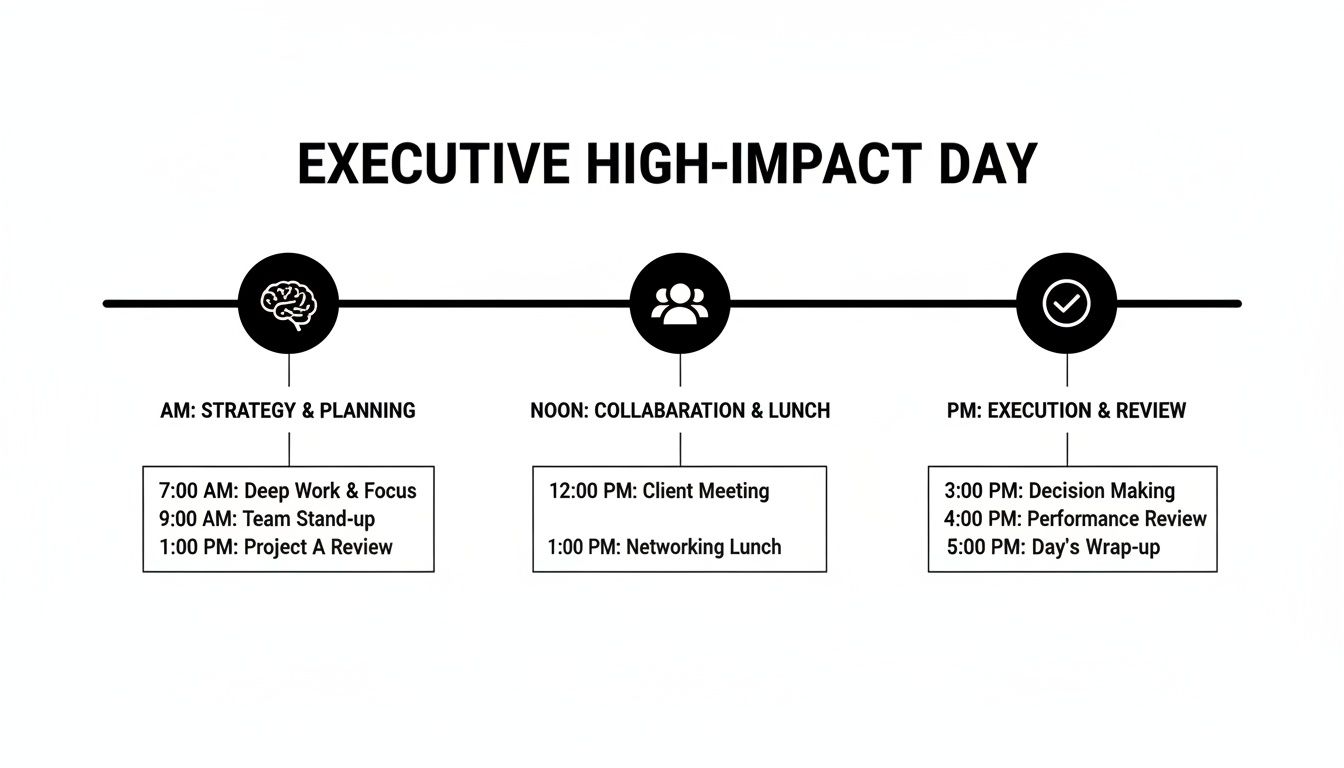
As you can see, the day has a deliberate arc, moving from solitary strategic work to team-based activity and finishing with execution.
Minimize Context Switching with Task Batching
Every time you jump from reviewing a spreadsheet to brainstorming a marketing campaign and then back to your email, your brain pays a price. It's called a "cognitive switching tax," and it's a productivity killer. You lose momentum, waste mental energy, and get less done.
The antidote is Task Batching. It's the simple idea of grouping similar tasks together and knocking them out in one dedicated block.
Instead of letting different types of work bleed into each other all day, create dedicated batches. Maybe you have a "communications batch" for clearing emails and calls, a "finance batch" for reviewing all reports, and a "people batch" for all your one-on-ones. This lets your brain stay in one "mode," which is far more efficient and far less draining.
Think of it like an assembly line versus a workshop. An assembly line is built for efficient, repetitive motion. A workshop where the craftsman is constantly stopping to find a new tool is built for chaos. Batching turns your day into an assembly line for your key tasks.
Protect Your Deep Work with Focus Blocks and Buffer Time
Your most valuable contributions—the ones that justify your role—require deep, uninterrupted concentration. A Focus Block is a non-negotiable appointment with yourself on the calendar, usually 90 to 120 minutes, dedicated to a single, high-priority task. No notifications. No email. No "quick questions." Protecting these blocks is one of the most critical disciplines for any leader.
Just as important is building in Buffer Time. Rushing from one meeting to the next is a surefire way to feel frazzled and make poor decisions. Scheduling just 10-15 minutes between appointments gives you a moment to breathe, review your notes, and mentally prepare for the next conversation. It prevents that dreaded back-to-back fatigue and ensures you walk into every room present and prepared.
Template for an Ideal Executive Week
To put these concepts together, here is a sample template for structuring a high-impact week. This isn't a rigid prescription, but a framework you can adapt to your own role and rhythm. It combines daily themes with energy mapping to create a powerful default schedule.
| Time Slot | Monday (Strategy & Planning) | Tuesday (Team & Operations) | Wednesday (Deep Work) | Thursday (External Relations) | Friday (Review & Prep) |
|---|---|---|---|---|---|
| 8-9 AM | Weekly Goal Setting & Prioritization | Prep for Team Meetings | Prep for Deep Work Session | Prep for External Mtgs | Clear Urgent Comms |
| 9-11 AM | Focus Block: Qtrly Strategy Review | Team Leadership Meeting | Focus Block: Project Alpha | Key Partner/Client Meetings | Focus Block: Financial/KPI Review |
| 11 AM - 12 PM | One-on-Ones (Direct Reports) | One-on-Ones (Direct Reports) | Open Slot / Buffer | External Calls / Networking | Inbox Clearing & Admin Batch |
| 12-1 PM | Lunch / Personal Time | Lunch / Personal Time | Lunch / Personal Time | Business Lunch / Networking | Team Lunch / Morale |
| 1-3 PM | Cross-Functional Sync Mtgs | Department Check-ins | Focus Block: Project Beta | Investor/Board Relations | Business Development Calls |
| 3-4 PM | Email & Comms Batch | Project Status Updates | Open Slot / Buffer | Industry Research | Personal Development / Learning |
| 4-5 PM | Prep for Tuesday | Prep for Wednesday | Email & Comms Batch | Prep for Friday | Weekly Review & Plan Next Week |
This structure provides a clear purpose for each day, protects your peak energy hours for high-value work, and batches similar activities to maintain momentum. It creates a proactive rhythm that helps you stay in control of your week, rather than letting your week control you.
The Art of Strategic Delegation and Outsourcing
For most executives, that little voice saying, "it's just faster to do it myself," is a familiar and dangerous trap. While it might feel true in the moment, that mindset is the single biggest killer of long-term strategic focus. Real time management at the executive level isn't about how fast you can clear your own to-do list; it's about building a system that multiplies your impact.
Effective delegation is a force multiplier for your leadership, not a sign you can't handle the workload. It’s the critical skill of offloading the right tasks to free up your mental space and calendar for the high-value work only you can do. This is a shift from just handing off tasks to actively building a more resilient and efficient operational structure around yourself.

The first step is a ruthless audit of your plate. You have to figure out what can and should be done by someone else. Not all tasks are created equal, and knowing how to categorize them is the key to deciding their fate.
What to Delegate: A Simple Framework
Most of your tasks likely fall into a few key buckets. By sorting your to-do list this way, you can instantly see what’s ready for delegation versus what truly needs your direct oversight.
- Administrative Tasks: This is the absolute low-hanging fruit. Think scheduling meetings, booking travel, managing the firehose of your inbox, and filing expense reports. These tasks are necessary but require zero of your unique strategic brainpower.
- Operational Tasks: This bucket holds things like preparing standard weekly reports, pulling data for an upcoming meeting, or managing routine project check-ins. If a task follows a clear, repeatable process, it’s a perfect candidate for a team member or assistant.
- Personal Logistics: Don't underestimate the mental drain from your personal life. Making dinner reservations, scheduling appointments for your home or family, and planning a vacation all consume the same valuable cognitive energy as your professional duties.
Once you’ve sorted your tasks, the path forward becomes much clearer. The next move is empowering others to take them on. For any executive, learning how to delegate tasks effectively is the single fastest way to buy back time for high-impact work.
Calculating the Long-Term ROI of Delegation
Let's completely dismantle the "it's faster to do it myself" myth with some simple math. Say a task takes you 15 minutes to complete. To train a team member to do it might take a full 1 hour upfront. That initial time investment feels painful, right?
But if this is a weekly task, you break even in just four weeks. Over the course of a year, you’ve reclaimed over 10 hours of your own time from that one decision. That’s more than a full workday you can now pour into strategy, mentoring your team, or driving innovation.
Delegation is not about offloading work you dislike. It is about investing your time in activities that generate the highest return for the organization.
This principle is the very essence of effective leadership. Every minute you spend on a task someone else could do is a minute you aren't spending on the critical work that actually moves the needle. Our internal guide on how to delegate tasks effectively breaks down even more frameworks for this.
Building Your Operational Layer
In the past, the only real solution for this level of support was hiring a full-time executive assistant. Today, a far more flexible and powerful option has emerged: building an "operational layer." This means using modern support systems, like a platform-based personal assistant service, to absorb the constant flow of logistics and coordination.
Think of it as having an on-demand resource that manages your administrative and personal life without the overhead of a direct hire. This layer acts as a buffer between you and the daily noise, executing your requests reliably and efficiently.
This model gives you several distinct advantages:
- Scalability: You can dial support up or down based on your needs—a busy quarter or a slow month—without a complex hiring and firing process.
- Specialization: These platforms often employ teams with a wide range of skills, from complex travel planning to in-depth research, giving you access to broader expertise on demand.
- Reduced Management: You just submit requests and get results. This eliminates the time sink of direct management, training, and other HR responsibilities.
By embracing this approach, you're doing more than just delegating tasks; you are designing a complete ecosystem of support. This strategic outsourcing turns time management from a daily battle into a solved problem, freeing you to operate at your highest and best use.
Building Systems for Sustained Productivity
Having a solid prioritization framework and a well-mapped week is a fantastic start, but those plans are only as good as your ability to execute them consistently. Here’s the reality: willpower isn’t endless. It's a battery that drains throughout the day, which is why the most effective leaders don't rely on it to get things done.
Instead, they build systems. Think of these as repeatable routines and automatic workflows that make high-value work the default, not the exception. The goal is to design your day so that doing the right thing is actually the easiest option. This is how you lock in productivity gains for the long haul, rather than just riding a temporary wave of motivation.
The Daily Shutdown Routine
How you finish your workday is every bit as crucial as how you start it. A Daily Shutdown is a non-negotiable ritual to consciously close out your professional day, clear your mental RAM, and tee up a successful tomorrow. It’s the wall you build between your work life and your personal life, preventing tasks and worries from spilling over.
This doesn't have to be a huge time commitment. A powerful shutdown ritual can take just 10-15 minutes. It’s a simple checklist to run through before you sign off:
- Review Today's Progress: Take a quick glance at your calendar and task list. Acknowledge what got done. This simple act provides a valuable sense of closure.
- Capture Open Loops: Got a nagging thought? A new idea? A task for later? Get it out of your head and into your notes or task manager. This prevents those "I forgot to..." moments late at night.
- Set Tomorrow's Top Priorities: Pinpoint the one to three things that absolutely must get done tomorrow. This means you walk in the next morning with total clarity, ready to tackle what matters.
- Declare the Day Over: It might sound silly, but a simple verbal cue like, "Shutdown complete," sends a powerful signal to your brain that it's time to disengage and recharge.
The Power of the Weekly Review
If the daily shutdown is your tactical reset, the Weekly Review is your strategic command center. This is a dedicated 60-90 minute block of time—often on a Friday afternoon—to pull back from the day-to-day chaos, see the bigger picture, and plan the upcoming week with intention.
A weekly review is your defense against the tyranny of the urgent. It's the time you carve out to make sure next week's calendar is a reflection of your priorities, not just a collection of other people's requests.
This isn't about just making another to-do list. It's about strategic alignment. A proper weekly review ensures the work you’re doing is actually moving you closer to your most important goals. To amplify this control, explore how lifestyle management services can provide an operational backbone to execute on both your professional and personal objectives.
Establishing Ironclad Meeting Rules
Meetings are notorious productivity killers. Without firm guardrails, they drift aimlessly, expand to fill whatever time is allotted, and end with a vague "we'll circle back." Setting a few non-negotiable rules can reclaim a shocking number of hours each year.
- No Agenda, No Meeting: This is the golden rule. If an invitation arrives without a clear agenda outlining the goals, it's an automatic decline. A clear purpose is a prerequisite for your attendance.
- Default to 30 Minutes: Make half-hour meetings the standard. You'd be amazed how much more focused and efficient everyone becomes when the clock is ticking.
- End with Concrete Action Items: No meeting should end without a clear answer to "What happens next?" Wrap up by summarizing decisions and assigning specific action items to specific people, with clear deadlines. This simple habit eradicates ambiguity and drives real momentum.
How to Measure the ROI of Your Reclaimed Time
Let's be honest: if you can't measure it, you can't improve it. While feeling less frantic and more in control of your calendar is a huge win, the most effective executives treat time management less like a soft skill and more like a hard business objective. It needs to have a tangible return on investment (ROI).
This means we have to move beyond just feeling more productive and get into quantifiable results. By tracking the right numbers, you can actually prove the value of your new systems, make a solid case for delegating even more, and build a feedback loop that keeps you getting better. The real goal here is to see exactly how those hours you claw back translate into real strategic progress and bottom-line value.
The KPIs That Actually Matter for Your Time
To get started, you don’t need a complicated dashboard. Just focus on a few simple but incredibly powerful Key Performance Indicators (KPIs). These metrics give you a clear before-and-after snapshot, turning abstract ideas like "being more focused" into cold, hard data.
Here are the essential KPIs to start tracking:
- Hours of Deep Work per Week: This is your north star metric for strategic focus. Simply add up the hours you spend in uninterrupted, high-level thinking on your most important projects. Your goal is to see this number climb week after week.
- Percentage of Time on High-Priority Tasks: Pull out your Eisenhower Matrix and categorize what you did all week. Calculate the percentage of time you spent in that crucial "Important but Not Urgent" quadrant. That's where strategy lives.
- Reduction in Meeting Hours: Just track your total time in meetings each week. A well-executed system will show a clear drop here as you start saying "no" to non-essential invites and running the meetings you do attend with ruthless efficiency.
These numbers tell the real story of where your most valuable asset—your attention—is actually going.
The true ROI of executive time management isn't just about saving hours; it's about reinvesting those hours into the activities that create exponential value for the business.
This is a critical shift in thinking. You're not just cutting waste; you are reallocating your most precious capital to opportunities with the highest potential for growth.
How to Run a Personal Time Audit
Before you change anything, you need a baseline. To get one, run a simple time audit for one full week. You can use a basic spreadsheet or a time-tracking app to log what you're doing in 30-minute blocks. Don't cheat—be brutally honest with yourself.
Once the week is up, go back and categorize everything. How many hours did you sink into low-value admin? How much time was eaten alive by pointless meetings or constant shoulder-taps and notifications? That data, however painful it might be to look at, is your benchmark.
Then, after you’ve put your new systems into practice for a month, do the audit again. The difference between your "before" and "after" will be all the proof you need. You won't just feel the difference in your stress levels; you’ll have the numbers to back it up, demonstrating a powerful ROI on mastering your own time.
Common Questions from the Executive Trenches
Let's be realistic. Adopting new frameworks is one thing, but making them stick amidst the chaos of back-to-back meetings and constant demands is another challenge entirely. Even the best-laid plans run into friction when they meet the reality of an executive's schedule.
Here are some of the most common questions I hear from leaders trying to implement these changes, along with some practical, battle-tested advice.
"My Calendar Is Already a Disaster. Where Do I Even Begin?"
Trying to overhaul your schedule when you're already drowning feels like trying to fix an engine while it's still running. The secret isn't a massive, immediate change. It's about finding one small crack of daylight.
Forget about clearing your whole week. Instead, find just one meeting you can reschedule, shorten, or simply decline. Take back those 30-60 minutes. Use that tiny window to conduct your very first Weekly Review. That single session will give you the clarity to start carving out more space for the next week.
The goal here isn't to achieve a perfect schedule overnight. It's to gain a strategic foothold. That one block of reclaimed time is the beachhead from which you'll start to take back control.
"How Do I Deal With the Constant 'Got a Minute?' Interruptions?"
If you're constantly being pulled into other people's priorities, it's usually a sign that your boundaries and availability are too ambiguous. The solution is to introduce a little bit of healthy friction for non-urgent matters while keeping the door open for genuine emergencies.
Try this three-pronged approach:
- Set "Office Hours": Block out two specific 30-minute slots each day. Let your team know this is the time to bring you their questions and roadblocks.
- Create Asynchronous Channels: For everything else, direct people to a specific Slack channel or email thread. The key is you only check these during your designated communication blocks.
- Use Physical Cues: A closed office door is a powerful, universal signal. It tells your team you're in a Focus Block and shouldn't be interrupted unless something is truly on fire.
This system trains your team to batch their questions, respect your deep work time, and think twice about what’s truly urgent versus what can wait a few hours. You protect your focus without becoming a bottleneck.
"How Long Until I Actually Feel a Difference?"
You'll get a hit of immediate relief from quick wins, like achieving inbox zero or completing your first Daily Shutdown. That feels great. But the deep, measurable shifts—like seeing a sustained increase in strategic work or feeling a genuine drop in your stress levels—that takes a bit more time.
Give it about 3-4 weeks. That's the typical timeframe for new routines to solidify into habits, not just for you, but for your team as well. Patience is key. Focus on being consistent, not perfect. The small disciplines you practice every day are what ultimately compound into massive, lasting change.
Ready to build an operational layer that executes your logistics so you can focus on leadership? Approved Lux Personal Assistant acts as your on-demand support system for everything from complex travel planning to managing your personal calendar. Stop managing tasks and start leading with Approved Lux.
Want the wider view?
Ten categories. One report. Every quarter. The Approved List tracks what's rising and what's fading: data-backed signals, not opinions.
Free to join · Delivered by email