All Articles
The Journal
9 Travel Itinerary Ideas: Work, Family, and Weekend Trips
October 24, 202617 min readweekend itineraryfamily vacation planning
Nine travel itinerary ideas for weekend breaks, business trips, and family vacations, with day-by-day plans and the bookings an Assistant team can run.

You've picked the destination, opened flight searches, and promised everyone a break. Now you're spending your evening comparing hotels while a museum reservation, an airport pickup, and a moving work commitment all need answers. You haven't left home, but you've already taken on another coordination job.
Most trip plans fail in the same place: transfers, hotel changes, and reservation deadlines never get mapped at the start. These travel itinerary ideas start with those constraints instead of a sightseeing wish list. Each proposed schedule limits hotel changes, groups outings geographically, and protects recovery time.
The counts below describe suggested operating plans, not destination requirements. Transfer counts cover airport journeys and moves between overnight bases, with substantial day-trip movements identified separately. Local sightseeing transport still needs planning, but it shouldn't dictate every hour.
Booking deadlines are decision gates rather than invented advance-purchase rules. Confirm the provider's actual release dates, payment terms, and cancellation cutoff before committing.
- Protect first: Work commitments, school dates, accessibility needs, and the departure home.
- Reserve next: Lodging, major transport, and the attraction you'd regret missing.
- Delegate the rest: Give Approved Lux the searches, comparisons, confirmations, and follow-ups. Keep approval of cost, timing, and trade-offs.
The useful measure isn't how many attractions fit. It's how much of the trip you can enjoy without reopening a booking app.
1. 4-Day Washington, D.C., Family Itinerary With One Hotel Base
The day starts with a delayed airport pickup, hungry children, and a museum reservation across town. Keep the trip manageable with one hotel base, one main outing each day, and optional plans that can be dropped without disrupting the schedule.
Proposed operating plan: One hotel base, no hotel changes, and two airport or station transfers. Group outings around the National Mall to reduce cross-city trips between reservations.
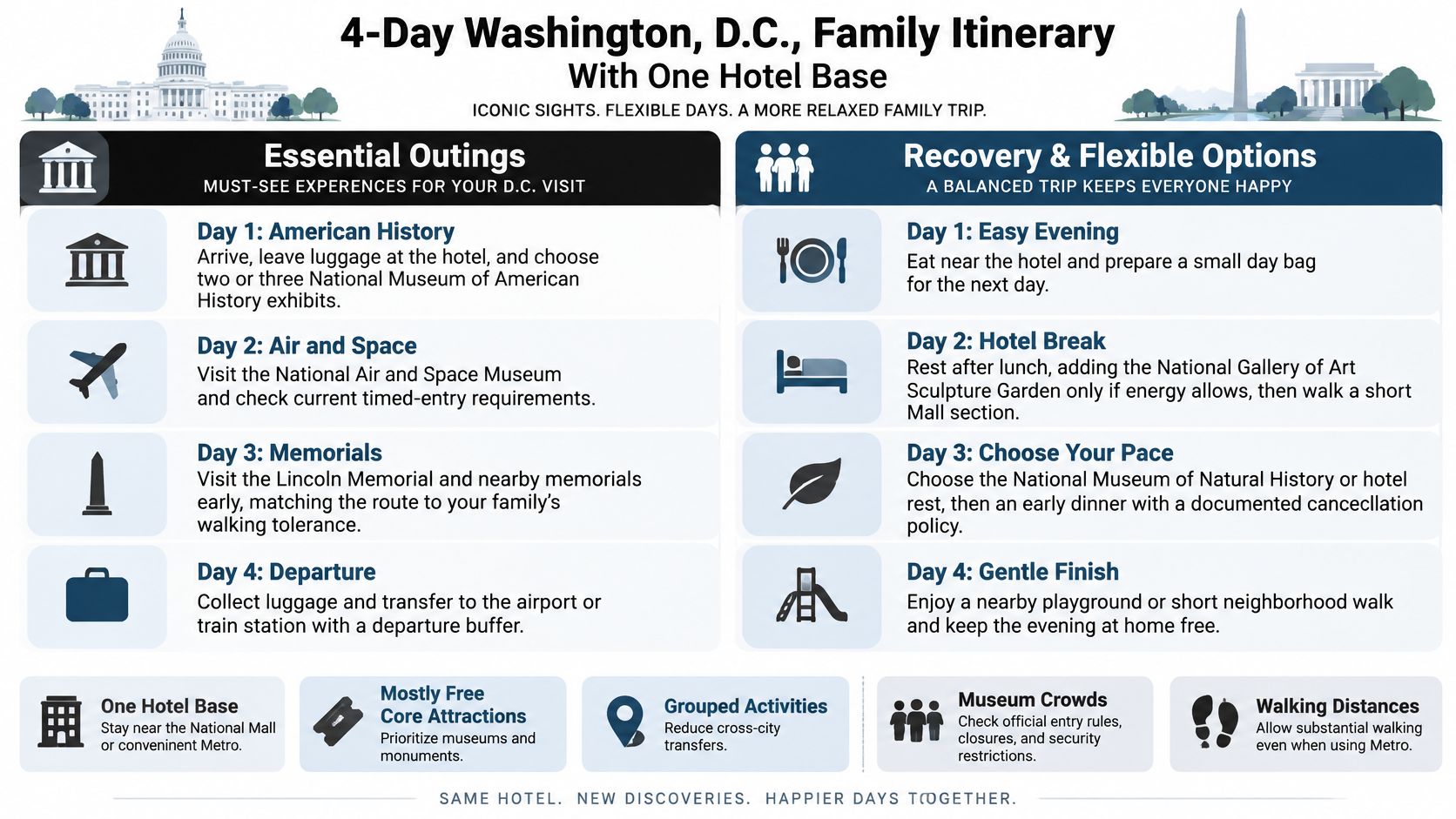
- Arrival day: Check in, eat nearby, and make a short outdoor walk optional.
- Museum day: Pick a Smithsonian museum that fits the children's interests. Return to the hotel before deciding on dinner.
- Monuments day: Follow a compact route with a planned stopping point. Leave room to skip memorials if the group is tired.
- Departure day: Choose an outing near the hotel, then collect luggage and head to the airport or station.
This plan trades a longer attraction list for fewer decisions when children are tired. Metro can reduce some travel time, but walking remains part of the day. Check routes and station access against everyone's needs before choosing the hotel.
Set the Reservation Order
Booking deadlines: Check each museum's official website for entry rules, closures, and security restrictions before setting the day's schedule. Confirm any required entry reservation first, then book meals around that fixed time.
School-break dates can constrain family schedules, so settle travel dates before comparing hotels and attractions. In the 2025 U.S. Family Travel Survey, parents identified school-break timing and available vacation time as planning obstacles.
Delegate to Approved Lux: Hand off hotel comparisons, museum-entry checks, reservation monitoring, transport options, and nearby meal searches. Ask the Assistant team to return a recommended schedule with an indoor fallback. You approve the timing and choices, rather than spending hours comparing options or rebuilding the day after a closure.
2. 5-Day London Itinerary for a Business Trip With a Family Extension
Book around the meeting location first. A hotel that looks ideal for a family weekend may create an unnecessary commute during the part of the trip you can't rearrange.
Proposed operating plan: One hotel base, no hotel changes, and two airport transfers per shared arrival-and-departure schedule. If family members arrive separately, add their transfers explicitly rather than burying them in the sightseeing plan.
Protect the opening working days. Give accompanying family members independent activities, then begin the shared extension only after the final business commitment.

Keep Work and Leisure on Separate Tracks
Use the remaining days for a Westminster outing, a museum-and-park combination, and a flexible departure block. If a meeting runs late, move an optional walk, not a prepaid family highlight.
Compare the best areas to stay in London against both the meeting address and family transport needs. Staying put avoids repacking, but it may mean accepting a less picturesque base.
- Before nonrefundable purchases: Check passport, visa, and UK Electronic Travel Authorisation requirements for every traveler through official government sources.
- At booking: Separate personal and business charges and confirm room occupancy arrangements.
- Before family reservations: Confirm when work ends and leave that evening flexible.
Interest in planning support is substantial: a Booking.com business-traveler survey found interest in AI itinerary planning among 45% of US respondents and 42% of UK respondents. The practical need goes beyond generating routes: someone must handle the changed meeting.
Delegate to Approved Lux: Meeting-to-hotel route comparisons, family arrival coordination, separate booking records, restaurant options, and revised pickups. Retain approval of business-versus-personal spending.
3. 7-Day Tokyo and Kyoto Itinerary With Only One Hotel Change
Don't turn a first Japan trip into a luggage relay. Use Tokyo and Kyoto as the complete route, not as the starting point for adding more cities.
Proposed operating plan: Two hotel bases, one hotel change, and three major transfer legs: arrival airport to Tokyo, Tokyo to Kyoto, and Kyoto to the departure airport. Plan four nights in Tokyo followed by two in Kyoto.
Spend the Tokyo portion in neighborhood blocks. For example, pair an Asakusa-focused outing with nearby interests rather than adding a cross-city reservation just because it appears on a must-see list.
- Tokyo arrival: Eat near the hotel and preserve recovery time.
- Tokyo exploration: Assign separate neighborhood days, with optional shopping or food stops.
- Rail-transfer day: Travel to Kyoto, check in, and leave the evening uncommitted.
- Kyoto stay: Choose a temple-focused area and a traditional-street outing, then protect departure logistics.
A hotel change includes packing, checkout, station access, luggage handling, and check-in. The train ride is only part of the work.
Price the Actual Route
Booking deadlines: Compare arrival into Tokyo and departure from Kansai before buying flights. Secure both hotel stays once dates are firm, then confirm rail-sale availability and baggage rules before reserving Shinkansen seats.
A rail pass isn't automatically the right purchase. Compare it against individual tickets for the journeys you plan to take, including any optional excursions you're willing to keep.
Delegate to Approved Lux: Open-jaw flight comparisons, hotel-location research, rail-ticket versus pass calculations, baggage-rule checks, and station-to-hotel instructions. Ask for a recommended option with its total transport cost and cancellation exposure, not a folder of competing search results.
That delegation removes repeated comparison work while leaving the meaningful choice with you: a simpler route or additional destinations.
4. 5-Day Lisbon Itinerary With a Sintra Day Trip
Lisbon works better here as a single-base trip than as a launchpad for constant excursions. Keep the city days flexible and give Sintra its own operating plan.
Proposed operating plan: One hotel base, no hotel changes, two airport transfers, and a separate round-trip Sintra excursion. Count the attraction-access journey within Sintra as well as transport from Lisbon.

Use arrival day for a nearby meal. Follow with a central Lisbon neighborhood day, a Belém-focused outing, the Sintra excursion, and a light departure day, rearranging those blocks around actual access and weather.
Lisbon's hills belong in the transport plan. Don't schedule an ambitious walking route before a timed reservation if a member of the group may need a slower pace or vehicle assistance.
Verify the Whole Sintra Journey
- Before assigning attractions: Check current monument access and restoration notices.
- Before paying: Confirm the correct Pena Palace ticket category and read its timed-entry conditions.
- Before approving transport: Verify how travelers get from the vehicle drop-off to the actual entrance.
Accessibility needs more than a hotel filter. In a survey of travelers with mobility and accessibility needs published by ENAT, more than 8 in 10 reported transportation challenges on their most recent trip.
Booking deadlines: Resolve the Sintra entry and transport sequence before adding other paid activities that day. Record the actual cancellation cutoffs in the shared itinerary.
Delegate to Approved Lux: Ticket-category research, route verification, hotel-access questions, ground-transport comparisons, and dinner reservations near the return point. Have the Assistant team flag unconfirmed accessibility details explicitly, so you approve known compromises rather than discover them on arrival.
5. 6-Day Costa Rica Family Itinerary Based in La Fortuna
A La Fortuna base keeps the family out of repeated hotel check-ins, but it means longer transfers to activities farther afield. This plan uses one hotel base, no hotel changes, and two airport-to-hotel transfer legs. Arrange local transport separately when an outing operator does not provide it.
Day 1: Arrive, transfer to La Fortuna, and keep the evening free to recover.
Day 2: Choose a guided nature outing near Arenal Volcano, with a pace the children can manage.
Day 3: Take a lighter day at a local hot spring, or leave time for rest at the hotel.
Day 4: Pick another active outing, such as a guided wildlife or rainforest walk.
Day 5: Keep a hot-spring visit or a postponed activity as the flexible block.
Day 6: Have breakfast, complete the airport transfer, and avoid adding a timed excursion.
Let children choose between suitable outings on the lighter days. This gives them a say without making the whole schedule open-ended.
Choose the Airport Before the Excursions
Compare San José and Liberia using flight schedules and road-transfer estimates for your dates. The arrival sequence, including the drive to La Fortuna, matters more than map distance alone.
- Before flights: Compare the full arrival and return journeys.
- Before paying for ground transport: Request child restraints in writing and confirm luggage capacity.
- Before paying for activities: Check safety practices, age limits, participation requirements, and cancellation terms.
The trade-off is less geographic variety for fewer packing sessions and handoffs. Keep the active outings spaced out, so the single base does not turn into a demanding schedule every morning and afternoon.
Booking deadlines: Settle the airport and transfer plan before confirming excursions. Check each operator's cancellation cutoff before paying.
Delegate to Approved Lux: Ask the team to compare airports and transfer options, confirm child-restraint and luggage requirements, vet operators, and sequence outings around recovery time. Have them flag unanswered questions and distinguish confirmed inclusions from items still awaiting a response.
You approve the activity mix and acceptable spend. The Assistant team handles vendor follow-ups, while the lighter blocks give you room to adjust plans without rebuilding the itinerary.
6. 5-Day San Diego Multigenerational Itinerary With Flexible Activity Levels
A shared trip doesn't require a shared pace. Give grandparents, parents, and children an agreed meeting point without requiring everyone to complete the same outing.
Proposed operating plan: One hotel base, no hotel changes, and two airport transfers for the group if traveling together. Add separate arrival transfers where needed, plus suitable local transport for each subgroup.
Use arrival day to settle in. Then assign a Balboa Park outing, a coastal day, and an optional major attraction before a light departure schedule.
For example, some travelers might choose an extended museum visit while others return to the hotel. Everyone can meet for dinner without treating the early return as a failed day.
Practical rule: Confirm the reunion location and transport before the group separates. Don't rely on everyone finding each other later.
Confirm Functional Details in Writing
A room category doesn't tell you everything you need. Ask the hotel about bathroom layout, elevator access, room proximity, and the route between the entrance and bedroom.
- Before hotel commitment: Obtain answers to the specific mobility and room-layout questions.
- Before attraction tickets: Check mobility-device rules directly with the attraction.
- Before departure: Share pickup locations and a designated contact for each subgroup.
Use this guide to travel with elderly parents to structure the conversations before reservations become expensive to change. Discuss stamina and assistance preferences privately rather than making assumptions in front of the group.
Delegate to Approved Lux: Hotel questions, room-proximity requests, attraction-policy checks, vehicle comparisons, and a shared itinerary with subgroup contacts. The trade-off is extra planning upfront, but fewer on-the-spot negotiations about who can continue, who needs rest, and who's arranging the ride.
7. 7-Day Rome and Florence Itinerary With a Single Rail Transfer
Choose the attractions you most want, then leave room around them. A tightly booked Italy trip can leave you managing admission times instead of enjoying the neighborhoods between them.
Proposed operating plan: Two hotel bases, one hotel change, and three major transfer legs: arrival airport to Rome, Rome to Florence by rail, and Florence to the departure airport. Compare an open-jaw flight itinerary against returning to Rome before committing.
Begin with an easy Rome arrival. Separate an ancient-Rome outing from a Vatican-focused day, preserving flexible neighborhood time between major reservations.
Move to Florence without attaching a high-stakes attraction booking to the arrival afternoon. Use the remaining time for selected art visits, unhurried meals, and an outdoor block you can move if needed.
Lock the Dependencies, Not Every Hour
- Before assigning calendar dates: Confirm attraction closing days.
- Before purchasing admission: Read identity, entry-time, and cancellation rules.
- Before booking rail: Confirm checkout, station access, luggage handling, and the next hotel's arrival arrangements.
Compare direct flights to Rome from the US with your preferred return routing. A cheaper round trip may still require a return rail journey and another set of timing decisions.
The trade-off is breadth versus control. Keeping this route to Rome and Florence means declining additional overnight destinations, not finding a clever way to squeeze them in.
Booking deadlines: Establish the flight route and hotel dates first, then use official ticket-release information to set attraction-purchase reminders.
Delegate to Approved Lux: Flight-routing comparisons, attraction-rule research, rail options, hotel luggage questions, and restaurant reservations near each day's final stop. Request a consolidated schedule that distinguishes fixed admission times from optional walks, so changing lunch doesn't trigger a full itinerary rewrite.
8. 4-Day Chicago Work-to-Weekend Itinerary
A work trip can become a short Chicago break without adding another destination. Keep the same hotel, protect the work commitment, then build leisure plans around the time you have free.
Proposed operating plan: One hotel base, no hotel changes, and two airport transfers. Extend the existing reservation to avoid a mid-stay checkout. Confirm room continuity before adding personal nights.
On Day 1, finish work before committing to dinner or an evening outing. Use Day 2 for a river architecture cruise, with time around the Chicago Riverwalk. On Day 3, visit the Art Institute of Chicago, then choose a neighborhood for a meal or walk, such as the West Loop or Lincoln Park. Keep Day 4 close to the hotel and airport route, with no timed attraction before departure.
Make the Extension Earn Its Time
Check citywide event dates before extending the room. Compare the added hotel cost and revised airfare with the leisure hours you will gain. A longer stay has little value if work runs late or departure logistics consume the final day.
Flight disruptions can also affect return plans. AirHelp's 2025 U.S. Flight Disruption Report is a reminder to leave room for schedule changes and avoid placing a critical commitment immediately after the flight home.
- Before extending: Confirm hotel availability, room continuity, and separate business and personal billing.
- Before booking outings: Check that work is finished and review cancellation terms.
- Before airport travel: Check current transport service information and allow a buffer.
Pack for both work and leisure. The guide to choosing the right leather duffel size can help frame capacity choices. Check airline baggage rules and leave space for work equipment.
Booking deadlines: Confirm the hotel extension and flight changes first. Book any timed outing only after work commitments are clear.
Delegate to Approved Lux: Ask the team to compare extension pricing, request billing arrangements, find architecture-tour options, book restaurants, and check airport transport. You approve the cost and preferred outings; the team handles the searches, reservations, and updated confirmations.
9. 6-Day Seattle and Olympic National Park Itinerary With Weather Buffers
Don't attempt every park area from a Seattle hotel. This route accepts more overnight bases to reduce repeated long driving days.
Proposed operating plan: Three hotel bases across Seattle, Port Angeles, and the Forks area, with three hotel-change legs if you return to Seattle for the final night. Include arrival and departure airport legs separately, for five major transfer legs overall.

Use Seattle for arrival recovery, then move to Port Angeles for selected northern park outings. Continue to the Forks area for a rainforest or coast-focused day, return to Seattle before departure, and avoid adding a major outing to the flight day.
Keep the outdoor sequence conditional. A coastal visit belongs on the schedule only when official tide information, park guidance, and conditions support the specific route.
The weather buffer is usable time, not an empty space to fill before departure.
Separate Reservations From Conditions Checks
Booking deadlines: Confirm the lodging sequence and rental vehicle before adding excursions. If using a ferry, verify arrangements for the specific service rather than assuming reservations work the same way across routes.
- Before booking: Review National Park Service alerts and whether the intended areas fit the driving plan.
- Before each park day: Recheck alerts, access, weather, and relevant coastal safety guidance.
- Before leaving reliable coverage: Download maps, confirmations, and essential contact information.
Delegate to Approved Lux: Lodging comparisons, rental-car arrangements, ferry research, alert checks, and alternative daily sequences. Keep safety decisions grounded in current official guidance, not a reservation's sunk cost.
The trade-off is more repacking but less backtracking. Approve the route only after seeing each driving leg alongside the proposed outing.
How the nine travel itinerary ideas compare by trip length, structure, and traveler
| Item | Trip Length | Core Structure | Primary Traveler |
|---|---|---|---|
| 4-Day Washington, D.C., Family Itinerary With One Hotel Base | 4 days | One hotel base; grouped museums and monuments; daily recovery time | Families with school-age children, dual-career parents, and multigenerational groups |
| 5-Day London Itinerary for a Business Trip With a Family Extension | 5 days | Protected workdays followed by family-focused leisure; minimal hotel changes | Business travelers extending a work trip with family |
| 7-Day Tokyo and Kyoto Itinerary With Only One Hotel Change | 7 days | Tokyo and Kyoto bases; one intercity transfer | Professionals, couples, and families comfortable with rail travel |
| 5-Day Lisbon Itinerary With a Sintra Day Trip | 5 days | One hotel base with a day trip to Sintra | Couples, independent professionals, and European city-break travelers |
| 6-Day Costa Rica Family Itinerary Based in La Fortuna | 6 days | One main destination; alternating outdoor activities and rest | Families with children, outdoor-minded couples, and travelers seeking fewer transfers |
| 5-Day San Diego Multigenerational Itinerary With Flexible Activity Levels | 5 days | One major outing daily; optional parallel activities and shared meals | Multigenerational families and travelers with mixed mobility needs |
| 7-Day Rome and Florence Itinerary With a Single Rail Transfer | 7 days | Two cities connected by one rail transfer; advance-booked attractions | Couples, first-time Italy visitors, and professionals taking a one-week break |
| 4-Day Chicago Work-to-Weekend Itinerary | 4 days | Protected work time followed by city activities from one hotel base | Solo business travelers, founders, and independent professionals |
| 6-Day Seattle and Olympic National Park Itinerary With Weather Buffers | 6 days | Seattle arrival and departure with peninsula stays and weather alternatives | Outdoor-minded professionals, families with older children, and road-trip travelers |
Turn Any Itinerary Into a Delegated Plan
Pick the template closest to your next trip, then count its hotel bases and transfers. List the reservations that determine everything else: flights, lodging, intercity transport, essential attractions, and any assistance that needs advance confirmation.
Treat that list as an operating brief, not a collection of links. Include dates, traveler names, fixed commitments, budget boundaries, preferred airlines and hotels, luggage requirements, accessibility needs, and what you're willing to skip.
The budget should be visible before optional activities accumulate. The 2025 Family Travel Survey release from NYU reported average American family travel spending of approximately $8,052 in 2024, making total-trip visibility more useful than isolated hotel or airfare deals.
Delegate Research With Decision Authority Defined
Hand Approved Lux the flight comparisons, hotel research, ground transport, restaurant reservations, and consolidated itinerary. Ask the Assistant team to present a recommended choice, the meaningful alternative, and the deadline for your decision.
- Keep approval of: Total spending, nonrefundable commitments, major routing compromises, and changes affecting work or family obligations.
- Delegate coordination of: Provider questions, availability checks, reservation requests, confirmation collection, and itinerary updates.
- Define escalation rules: Specify which disruptions need your immediate input and which alternatives you've already approved.
Human judgment matters in these situations. A canceled flight isn't just a flight problem if it also affects the hotel arrival, airport pickup, and next morning's meeting.
Approved Lux provides access to a dedicated US-based human Assistant team, rather than a chatbot handling the trip in isolation. Triple-channel access means phone calls, SMS text, and email are monitored at equal priority, so you can send a change in the channel that suits the moment.
Measure Leverage, Not Just Completed Bookings
Track the time you spend preparing the brief and approving choices. Compare it with the searches, provider calls, follow-ups, and changes you no longer handle yourself.
Also track unresolved questions and repeated explanations. Proactive Preference Learning lets the Assistant team adapt to your routines over successive requests, reducing the need to restate preferences while keeping exceptions visible.
The subscription is a force multiplier, not a reason to add complexity to the trip. It provides flexible assistance without directly hiring and managing an employee, but its value still depends on whether you delegate meaningful work.
Start with the next real journey on your calendar. Send the dates, fixed commitments, preferred template, and approval boundaries, then ask for a decision-ready operating plan with booking deadlines and backup options.
Approved Lux Personal Assistant offers a monthly subscription with around-the-clock access to a US-based human Assistant team for travel research, reservations, logistics, and itinerary updates. Visit Approved Lux Personal Assistant to hand off your next trip's coordination and keep your attention on the decisions only you can make.
Want the wider view?
Ten categories. One report. Every quarter. The Approved List tracks what's rising and what's fading: data-backed signals, not opinions.
Free to join · Delivered by email