
←All Articles
The Journal
Trip Planning Business Launch Guide That Reclaims Hours
September 19, 202617 min readtravel business guidetrip planning pricing
Launch a trip planning business that reclaims hours and scales profitably. Niche, pricing, SOPs, tools and ROI playbooks inside.

A good trip planning business doesn't sell wanderlust. It sells time back.
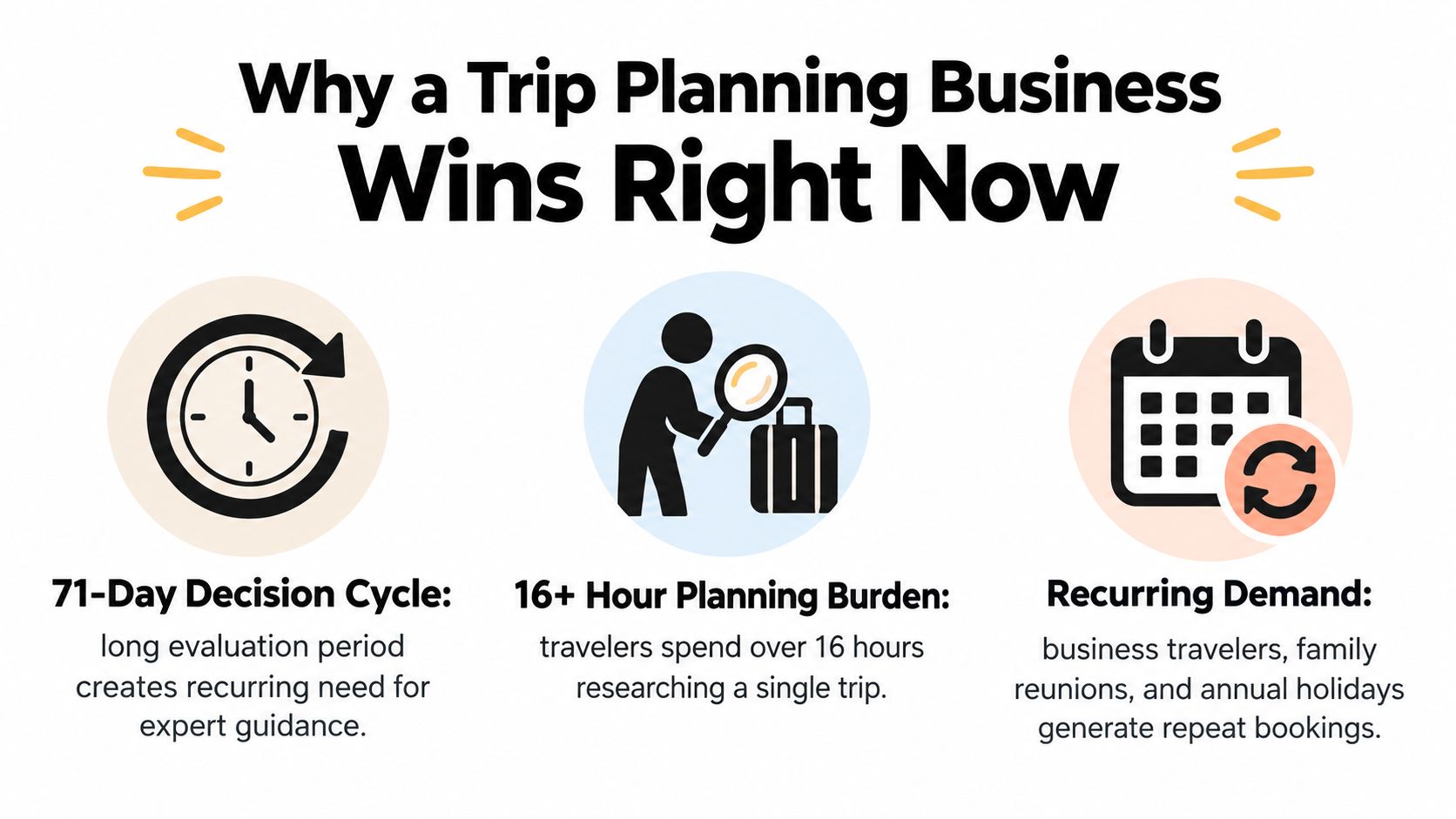
That distinction matters because travelers aren't drowning in destination ideas. They're drowning in tabs, calendar conflicts, fare checks, family coordination, confirmation emails, and change requests. Priceline reported in 2024 that the average traveler spends 16 hours to plan and book a trip, and that the trip from first consideration to booking stretches across 71 days, including 33 days of inspiration and 38 days of researching and planning, while business travelers book closer to departure at 43 days according to the same release and cited dataset (Priceline travel planning research). That's not a leisure activity. That's a workflow.
The operators who win in this category understand a simple truth. A trip planning business is closer to remote operations support than to travel content. If you build it that way, you can charge for friction removed, protect margin with tight SOPs, and turn one-off bookings into repeat service.
Why a Trip Planning Business Wins Right Now
Travel admin is eating work time at a scale many clients underestimate. Engine reported in 2026 that people spend an average of 7.8 hours per month on travel-related admin, which adds up to about 94 hours per year, or roughly 12 working days. For small and midsize businesses, that climbs to 9 hours per month, or about 14 working days per year. The same report found that travel admin shows up about 1.5 times as often as travel itself (Engine travel admin statistics).
That is why this business works now.
The winning offer is not “help planning a trip.” It is owning a live workflow that starts before booking and continues through changes, delays, rebooking, and confirmation cleanup. Busy professionals pay for fewer decisions, faster execution, and one point of contact when plans break.
The shift to ask, shortlist, decide
A founder flying to Chicago for two meetings does not need inspiration. That client needs a short list that accounts for arrival windows, hotel location, loyalty status, cancellation terms, and the risk of same-day changes. A dual-career family booking spring break has the same pattern. Different destination, same operational problem.
Skift noted in 2026 that nearly one-third of travelers now use AI extensively for trip planning, and that share rose by 17 percentage points in a single year, while trust in AI to handle the actual transaction still trails (Skift travel AI planning shift). That gap matters. Clients will gladly use tools to gather options. They still want a human to pressure-test trade-offs, make the call clear, and handle the booking details correctly.
That changes how a profitable service should be delivered. Replace open-ended itinerary creation with a decision-ready workflow. Collect dates, airport preferences, loyalty numbers, budget range, meeting times, child constraints, and acceptable layover rules up front. Then return three options, one recommendation, and clear notes on what the client gains or gives up with each choice.
That model protects margin too. It cuts revision loops, shortens client response time, and makes the handoff into booking or monitoring much cleaner.
Recurring travel problems create recurring revenue
One-off vacation inspiration is harder to systematize. Repeated coordination problems are easier to price, scope, and retain.
Conference travel, quarterly family visits, school-break trips, founder offsites, and multi-stop business itineraries all create predictable work. They also create disruption risk after booking, which is where many planners undercharge. The profitable operator prices for the full workload, including schedule changes, airline credits, missed connections, supplier follow-up, and after-hours messages.
I look at this as operations math. If a client saves 8 to 12 hours on one trip and avoids even one expensive booking mistake, a planning fee in the mid-hundreds is easy to justify. If that client travels several times a year, retainer or membership pricing starts to make more sense than one-off fees.
A useful framing comes from Waymap journey innovation. The value sits in reducing uncertainty across the journey, not just presenting options at the start.
For a broader view of how human operators fit beside booking tools, this breakdown of the virtual travel agent service model is worth reading.
The sale is operational noise reduction around a trip.
That is why a trip planning business can win even in a market full of booking platforms. The client is not buying access to flights and hotels. The client is buying back evenings, attention, and the confidence that someone competent is still on the job when the plan changes.
Choosing Your Niche and Packaging Profitable Services
Generalist trip planning sounds flexible. In practice, it creates scope creep.
The strongest trip planning business picks a client type with repeat need, urgency, and a clear willingness to pay for handled logistics. In the early stage, I'd rather see a narrow niche with obvious pain than a broad offer with vague value.
Which niche gives you the best operating leverage
Four segments stand out.
- Frequent business travelers: They buy speed, not inspiration. They care about fast rebooking, sensible hotel selection, loyalty alignment, and after-hours changes.
- Dual-career parents: They need someone to consolidate preferences, school calendars, child constraints, and budget boundaries into one clean plan.
- Founders and solo professionals: They hate low-value coordination work and tend to decide quickly if your process is efficient.
- High-net-worth households without staff: They often have more complexity than glamour. Multiple homes, multiple travelers, and layered scheduling make them profitable if boundaries are clear.
A 2026 survey of travel planners reported that more than 7 in 10 spent over 10 hours organizing a single trip, nearly half spent up to 20 hours, and 21.5% spent 40 hours or more (Zurich business travel outlook 2026). That's why niche selection should center on complexity and recurrence. The heavier the hidden coordination load, the easier it is to justify your fee.
Package what you will do, and what you won't
If you don't package tightly, clients will keep expanding the brief. Your margin disappears in revisions and scattered messages.
Use three tiers with hard boundaries.
| Package Tier | Core Deliverables | Best For |
|---|---|---|
| Essential Planning | Intake review, destination or route research, up to three shortlisted flight and hotel combinations, one revision round, booking links or managed booking | Solo professionals and simple family trips |
| Managed Trip Build | Full itinerary assembly, booking management, confirmation tracking, dining and ground transport coordination, limited post-booking support | Founders, couples, and multi-stop travelers |
| Operations Support | Everything in Managed Trip Build plus disruption monitoring, same-day change handling, alternate options prepared in advance, multi-traveler coordination | Frequent business travelers and complex households |
A few scope rules keep these tiers profitable:
- Revision caps: Include a clear number of decision rounds before additional fees apply.
- Channel rules: Decide whether support happens by email only, or whether text and calls are included.
- Supplier boundaries: State whether you'll only book preferred suppliers or any client-requested source.
- After-hours change coverage: Charge more if you are expected to own disruption response.
Price from labor math, not vibes
Most founders underprice because they benchmark against consumer travel planning instead of assistant-level problem solving.
A useful anchor is labor substitution. A 2026 U.S. Executive Assistant salary source pegs average annual pay at $88,739, or about $43 per hour, and notes common benefits on top (Executive Assistant salary benchmark). That doesn't mean you bill by the hour. It means your client already understands the cost of hiring dedicated support.
Start with three internal numbers:
- Average hours per trip
- Revenue per client
- How many trips that client is likely to bring per year
Example math works like this. If a package consistently takes too many touches, too many reworks, or too much hand-holding, it's mis-scoped even if clients like it. On the other hand, a package that returns clean inputs, fast approvals, and repeatable booking flow can support lower-friction margins and easier referrals.
Practical rule: Package around decisions owned, not around destinations served.
That keeps your offer tied to actual effort. “Weekend in Napa” can be simple or chaotic. “One traveler, one approval round, no after-hours changes” is operationally clear.
Building Intake Systems and SOPs That Scale
A trip planning business gets profitable when intake reduces live decision-making later.
Every missing preference becomes a text thread, a re-search task, or a preventable change request. In this business, intake is not admin. It is the first layer of operations control.
Build one intake that shortens every future trip
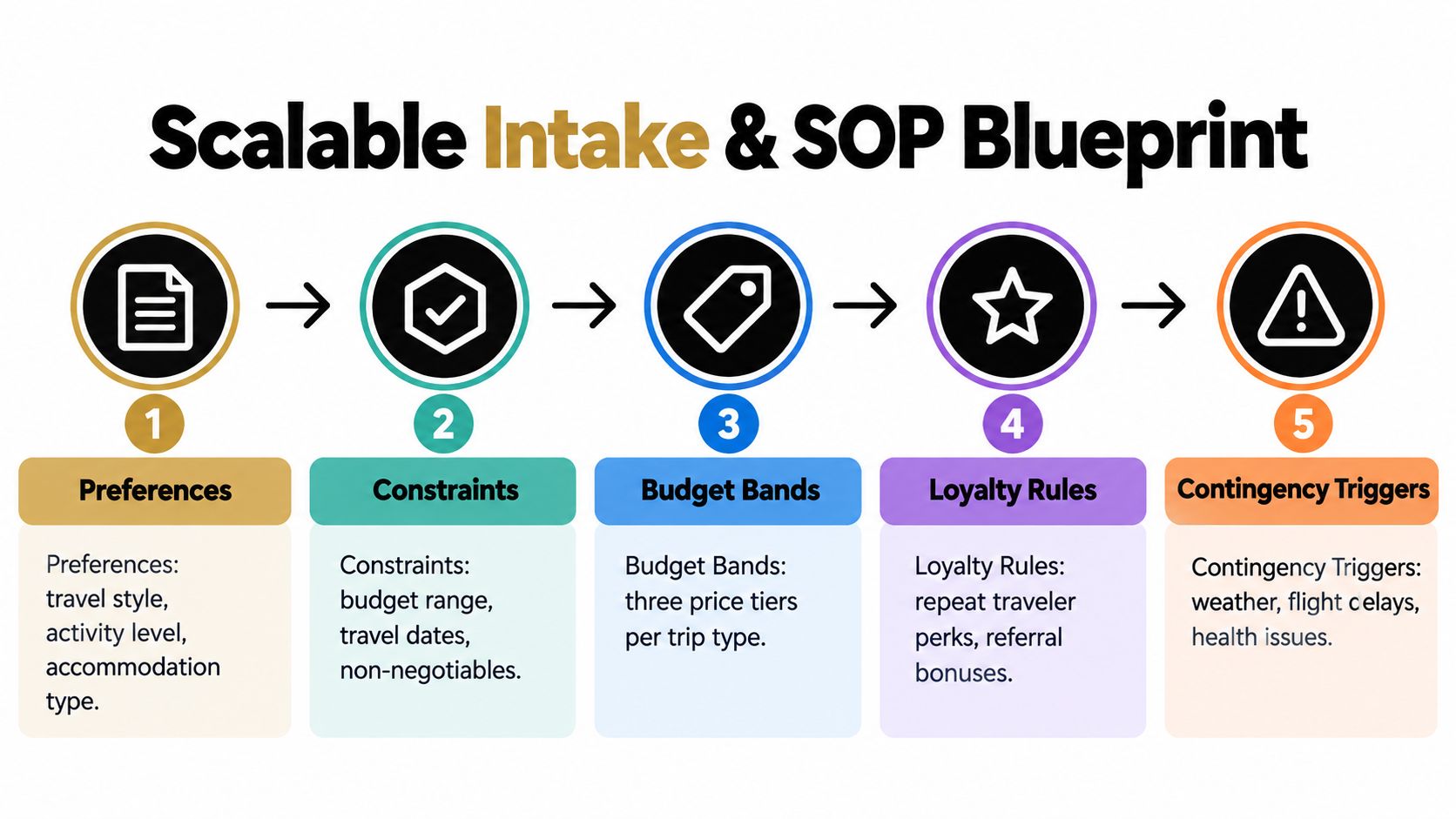
A good form does two jobs at once. It gets enough detail to price and scope the current request, and it builds a reusable traveler record for the next one.
For time-starved professionals, the win is fewer approval cycles and fewer clarifying messages once the trip is in motion. That only happens if the form captures both preferences and rules.
At minimum, collect:
- Preferences: Cabin class, seat location, hotel style, walkability, activity level, food priorities, preferred neighborhoods
- Constraints: Budget bands, date flexibility, school calendars, visa concerns, accessibility needs, hard scheduling limits
- Loyalty rules: Airline and hotel programs, credit card portal preferences, status goals, points versus cash preference
- Decision rules: Pay more for nonstop, avoid early departures, prefer one hotel over split stays, accept a longer transfer for a lower nightly rate
- Contingency triggers: What to do if fare jumps, a preferred flight disappears, weather risk increases, or a traveler gets sick
I also recommend one field many planners skip. Ask who can approve what, and how fast. A trip with clean traveler preferences can still turn into margin loss if the spouse, chief of staff, or finance lead enters late and restarts the process.
If you want a client setup model that cuts confusion before the first booking, these onboarding best practices fit this kind of service business well.
Build SOPs for a live operations job
Trip planning looks creative from the outside. Day to day, it behaves more like dispatch.
Flights change. Hotels oversell. Travelers send partial information from a car between meetings. SOPs keep those interruptions from eating your week. They also protect revenue per client because the same request does not require fresh judgment every time.
Use a five-stage workflow and document the exit condition for each step:
-
Intake validation
Confirm dates, traveler count, budget range, loyalty accounts, passport status if relevant, and final approver. Research starts only after required fields are complete. -
Option research
Pull a tight set of viable choices that match the client's stated rules. If a request falls outside package scope, flag it before building extra options. -
Decision-ready shortlist
Present clear trade-offs. Higher fare and nonstop. Lower total cost with one stop. Better location with a smaller room. The client should be choosing, not decoding. -
Booking and confirmation control
Save every confirmation number, cancellation rule, payment record, and supplier contact in the same place every time. -
Post-booking monitoring
Review schedule changes, supplier notices, check-in timing, and pre-departure risks before the traveler is affected.
That structure matters because trip planning revenue is often won or lost after the booking. A planner who only creates itineraries gets paid once. A planner who prevents disruption, catches changes early, and handles exceptions becomes much harder to replace.
Make the shortlist decision-ready
A weak shortlist creates hidden labor. Clients ask follow-up questions, forward links to other stakeholders, and reopen the search because nothing feels resolved.
A usable shortlist is smaller and more opinionated.
Bad shortlist: ten flight screenshots and five hotel links.
Good shortlist: three complete paths with one recommended choice, one lower-cost choice, and one flexibility-first choice.
A practical format might include:
- Option A with the best arrival time and the shortest ground transfer
- Option B with the lowest total cost inside the stated budget band
- Option C with the best loyalty return or cancellation terms
Add one sentence explaining why each option exists. Then state your recommendation plainly.
If the client still has to synthesize the research, the work is not finished.
Standardize handoffs before you hire
Solo operators need handoffs too. They happen between research mode, booking mode, client communication, and disruption response.
That is why micro-checklists matter. They reduce memory errors and make it possible to train support later without rewriting the business from scratch.
Create checklists for:
- pre-booking approval
- payment and traveler detail verification
- final itinerary issue
- departure-week review
- disruption escalation
Hours get reclaimed. A documented handoff cuts repeat questions, reduces missed details, and keeps after-hours work from spilling into the next day. It also gives you a cleaner read on package profitability, because you can see which trip types create extra touches and which ones produce a strong operational return.
Tools and Triple Channel Operations for Real Time Execution
Business travelers lose time fast when a trip breaks. A disrupted itinerary can turn a 20 minute handoff into two hours of rebooking, supplier calls, and client approvals, which is why tool choice affects margin as much as service quality.
A trip planning business does not need more apps. It needs fewer handoffs, faster context, and a clear rule for where live issues get handled.
Match each tool to one operational job
The stack should map to the service promise. If clients pay for research only, a lightweight setup can work. If clients expect booking support, day-of changes, and after-hours help, every tool needs a defined role inside that response model.
Use five categories.
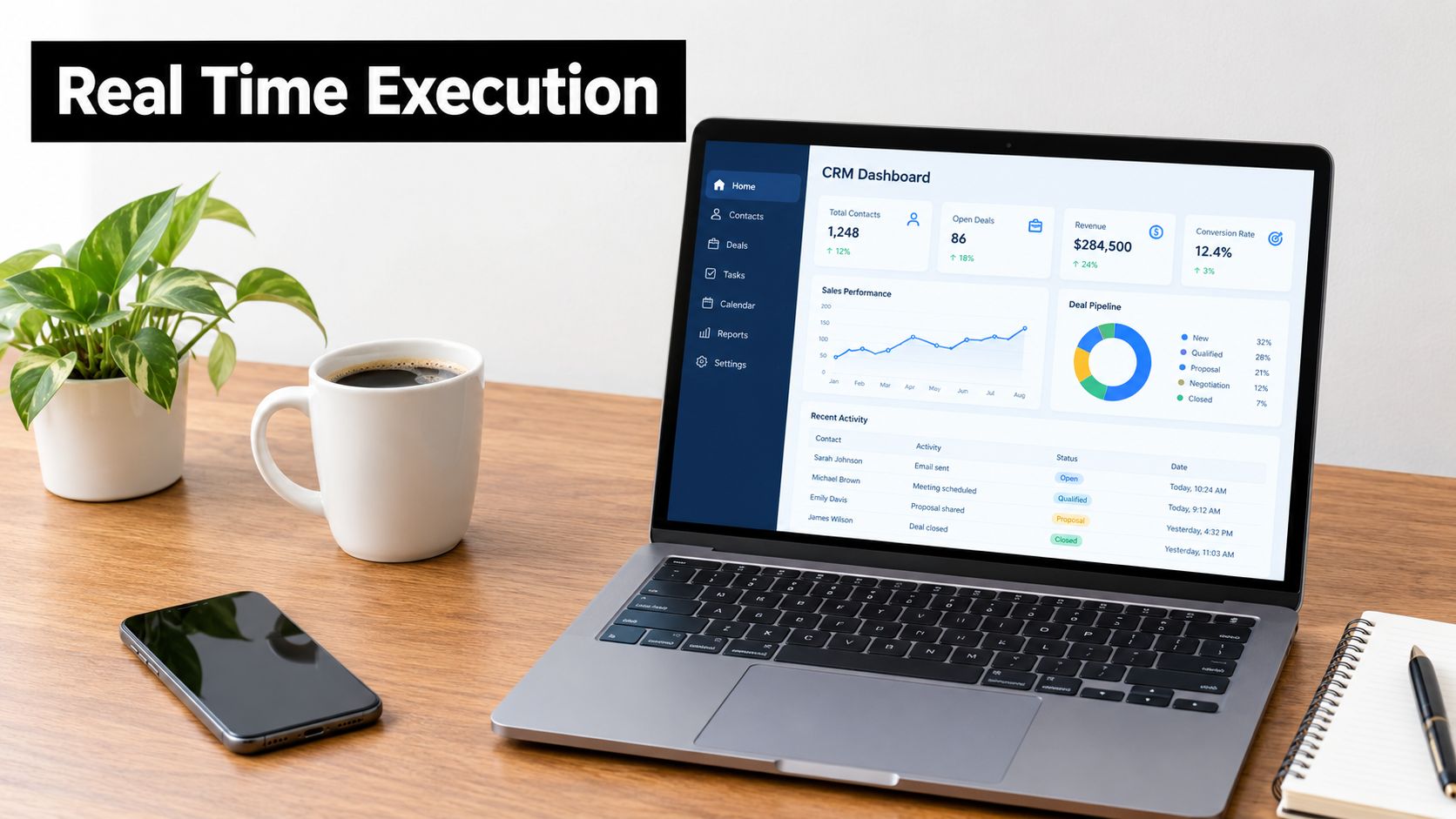
- CRM and intake: Store traveler profiles, passport details, loyalty numbers, seating rules, budget bands, approval contacts, and past trip patterns.
- Research and booking workflow: Keep supplier tabs, fare notes, cancellation rules, and approval status in one repeatable process.
- Itinerary assembly: Publish confirmed details in a format clients can use quickly from a phone.
- Payments and expense tracking: Separate planning fees, pass-through travel spend, and supplier charges so package margins stay visible.
- Communication hub: Keep calls, texts, and emails tied to the same client record when multiple people may touch the trip.
A practical tool stack usually fails in one place. Communication gets scattered across inboxes, text threads, and personal phones. That is where response time slips and billable hours disappear.
For a grounded stack comparison, use this guide to best travel planning tools for client communication, itinerary delivery, and workflow control.
Build for disruption response, not itinerary presentation
Itinerary design gets attention because clients can see it. Operations is where the labor sits.
A 2025 business travel disruption survey summary reported that 89% of business travelers experienced disruptions, 56% had delays longer than one hour, 36% faced cancellations, and 26% missed connections. The same summary said disrupted trips cost travelers an average of 4 hours and 45 minutes and left 39% working extra hours to catch up (business travel disruption survey summary).
That reality changes the buildout.
Your operating setup needs:
- pre-vetted alternate flights on key routes
- backup car service or rail options for late arrivals
- hotel change rules by budget tier and approval threshold
- one record with traveler preferences, policy limits, and who can authorize exceptions
- a triage rule for what gets answered by text, what needs a call, and what can wait for email
I have found that the hidden labor is rarely the initial booking. It is the scramble after a cancellation notice lands at 9:40 p.m. with no documented backup plan.
Industry guidance on disruption support makes the same point. Teams need full traveler context, the ability to rebook quickly, and policy-aware decisions without forcing the traveler to repeat details (corporate travel safety checklist guidance).
Triple-channel access supports real-time execution
Clients do not report urgent issues in a clean sequence. An airline email arrives first. Then a text from the gate. Then a call because boarding starts in eight minutes.
Support coverage has to match that behavior. Flight Centre's business support model separates standard business-hours contact from 24/7 support lines for urgent needs (Flight Centre business support contact model). That is a useful benchmark for service design. If your package includes active trip support, clients need a reliable path to reach someone with enough context to act.
One option in this category is Approved Lux Personal Assistant, which offers a US-based human Assistant team with triple-channel access by phone, SMS, or email, along with trip research, booking support, and itinerary building on a subscription model.
The practical question is not which brand looks polished. The practical question is whether the client can reach the right person, through the right channel, with the full trip context already in front of them. That is what protects response time, preserves margins, and turns trip planning into an operations business instead of an inspiration business.
Sales and Marketing Playbooks That Fill Your Calendar
Most trip planners market the visible output. Photos. destination copy. sample itineraries. That attracts browsers.
Time-starved professionals buy something else. They buy fewer decisions on their plate.
Sell the reclaimed hours
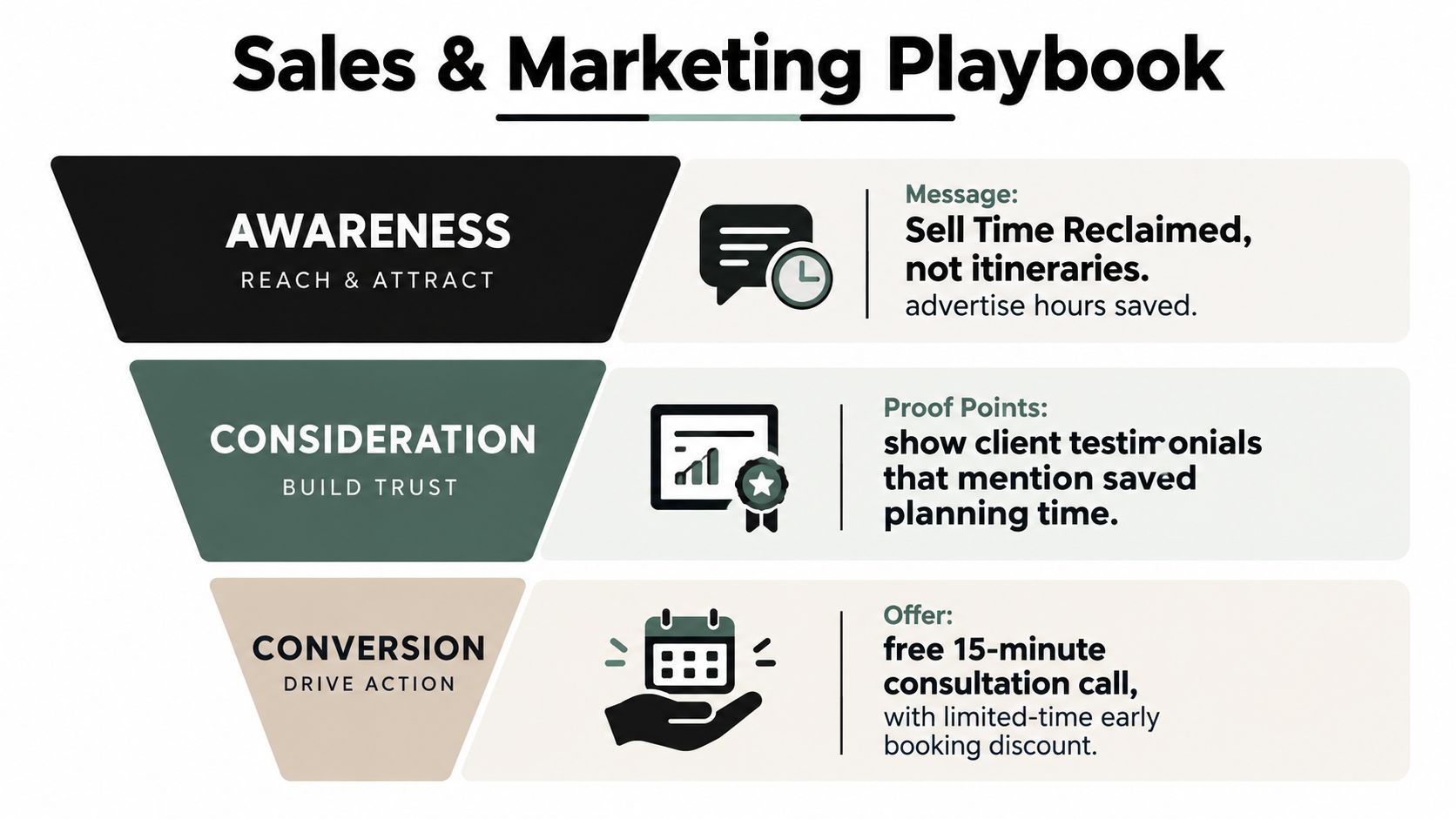
The sharper message is about removed admin, not curated experiences.
A survey of 2,000 adults found people spend 21 hours and 36 minutes per week on work admin and 8 hours and 48 minutes per week on personal-life admin, or roughly 30.4 hours weekly of administrative friction (Brightpearl admin time survey). Your trip planning business sits inside that bigger pain. That's why “we plan beautiful trips” underperforms “we take booking, coordination, and follow-up off your plate.”
Four channels that produce qualified leads
You don't need a huge audience. You need buyers with active friction.
- Executive Assistant and advisor referrals: EAs, bookkeepers, family office-adjacent professionals, and relocation advisors already see the chaos and can refer complex clients.
- LinkedIn outreach to founders and revenue leaders: Keep it short. Lead with time reclaimed, not travel taste.
- Parent and professional communities: Workshops on reducing family travel planning load can work better than destination-specific talks.
- Content built around situations: “How to manage a last-minute multi-city work trip” converts better than “best places to visit this fall.”
Use a discovery call that qualifies fast
A strong discovery call isn't about travel dreams. It's about workflow fit.
Ask:
- How often do you travel or coordinate travel?
- Who currently handles bookings, changes, and confirmations?
- What part breaks most often?
- How many people are usually involved in the decision?
- Do you need planning only, or ongoing support after booking?
That structure tells you whether the prospect is buying research, execution, or disruption cover.
For fee-sensitive leads, don't defend your price by listing tasks. Tie the fee to the alternative. A busy professional can keep spending nights comparing options and fixing confirmations, or they can pay to remove that from their week.
The fastest way to lose a sale is to pitch aspiration to someone who came in exhausted.
A simple 30-day playbook
If I were launching a trip planning business this month, I'd do this:
- Week one: Build one niche-specific offer page and one intake form.
- Week two: Reach out to referral partners who already serve the same client profile.
- Week three: Publish situation-based content that addresses booking friction and trip changes.
- Week four: Run discovery calls, tighten objections, and revise packaging based on the questions that keep repeating.
What works is specificity. “Travel planning for dual-career parents managing school-break logistics” is easier to sell than “custom travel planning.”
Scaling Smart and Measuring What Matters
Growth breaks service businesses when the founder tracks bookings but not capacity.
A trip planning business should be measured like an operations service. The point isn't whether a trip got booked. The point is whether your system reclaimed meaningful client time without turning your backend into a scramble.
Start with four operating metrics
Track these from the beginning:
- Hours reclaimed per client: Estimate from the planning and coordination work you absorbed.
- Revenue per client: This reveals whether a niche is worth serving.
- Utilization by trip type: Some “simple” trips eat more labor than complex ones.
- Recovery time after disruptions: How long it takes your system to produce a next step after something fails.
Those numbers will tell you more than social engagement ever will.
Know when to hire and when not to
Don't hire because you feel busy. Hire when the work is standardized enough that another person can follow your system without dragging you back into every task.
The usual first support layers are:
- contractor research help
- bookkeeping and invoicing support
- account coordination for confirmations and follow-up
- a broader Assistant team model when requests span travel, scheduling, and personal logistics
The hiring decision is easier when you remember the in-house benchmark. A full-time Executive Assistant carries an average annual pay benchmark of $88,739 before you add the management and benefits layer noted earlier. That's why subscription or contractor-based arrangements can make sense for clients who need support but don't need a full W-2 role.
Capacity expands when context compounds
Many travel services stall. They treat each booking like a new project.
The better model compounds context. The second or third trip for the same client should move faster because the system already knows airport preferences, hotel standards, budget bands, loyalty rules, and disruption thresholds. That's what turns a trip planning business from custom labor into operational efficiency.
A practical quarterly review should answer:
- Which package creates the best revenue per hour?
- Which niche produces the fewest revisions?
- Which trips generate most of the urgent messages?
- Where did the SOP fail and force manual rescue?
- Which clients are buying planning, and which are really buying ongoing logistics ownership?
Raise prices when the math says the client is underpaying
Price increases shouldn't be emotional. They should follow evidence.
If a package repeatedly absorbs after-hours changes, extra travelers, or more approval rounds than intended, revise scope or fee. If a niche brings cleaner intake, faster approvals, and stronger repeat demand, lean harder into it. The market rarely rewards being broadly helpful. It does reward solving a narrow, expensive problem with consistency.
A concise launch checklist looks like this:
- Choose one niche with repeat complexity
- Define three packages with hard scope limits
- Build one intake form that captures reusable preferences
- Document one SOP from research through post-booking monitoring
- Track four metrics from day one
- Review quarterly and cut offers that consume time without margin
That's how you build a trip planning business that doesn't trap you inside every booking.
If you want this handled as an operating system instead of a side task, Approved Lux Personal Assistant offers a subscription-based, US-based human Assistant team for travel planning, booking coordination, itinerary building, and the follow-up work that usually spills into nights and weekends. For professionals and households who need trip logistics, scheduling, and admin support in one place, visit Approved Lux Personal Assistant.
Want the wider view?
Ten categories. One report. Every quarter. The Approved List tracks what's rising and what's fading: data-backed signals, not opinions.
Free to join · Delivered by email