
All Articles
The Journal
What Is Boomerang? Returning Tools, History and Flight
October 27, 202611 min readreturning boomerangboomerang history
What is boomerang? Learn how returning and non-returning boomerangs fly, their history, a safe beginner throw, and the Boomerang Member Share program.

A boomerang is a curved, wing-shaped throwing implement, and only some boomerangs are built to fly back to the thrower. The oldest known boomerang-like object is about 72 centimeters long and dates to roughly 39,000 to 42,000 years ago.
If your mental picture is only a U-shaped toy that always comes home, that picture is the gap. What is a boomerang when the same word also covers a hunting stick, a child's practice toy, a returning sport wing, a worker who rejoins a former employer, and a travel-membership share program? Return flight is a specialised branch of a much older tool family. The other meanings aren't flight tools at all.
A Boomerang Defined by Its Two Forms
A boomerang is a curved, wing-shaped throwing implement, and only some are built to return to the thrower. The word names a family of tools, not one object with one job.
The returning sport model is the image many people hold. You throw it with spin, it curves, and a good throw brings it back toward you for recreation, demonstration, or a contest. The non-returning throwing stick is the other form, and it was usually built to fly out, strike, and drop. Treating "returning boomerang" and "hunting boomerang" as synonyms mixes a sport wing with a projectile.
| Form | Flight path | Typical use | Example from the research |
|---|---|---|---|
| Returning sport boomerang | Curves back toward the thrower | Recreation, demonstration and competition | Queensland forms used especially for sport and amusement |
| Non-returning throwing stick | Straight flight, drops after striking | Hunting, fighting and striking targets | Hunting sticks that incapacitate prey so the hunter can capture it |
| Toy boomerang | Short, light flight | Children's play and skill games | Lightweight woods carved by children across Australia |
| Five prevalent types | Regional shapes, not one shared path | Mixed uses across communities | Nearly 84% of recorded examples |
That last row is the variety in numbers. A statistical classification of Aboriginal Australian boomerangs found that five prevalent types, Common, Central Australian, Kimberley, Lake Eyre, and Cooper Creek, accounted for nearly 84% of recorded examples, as reported by the Brisbane Times from Australian Museum collection research. One famous outline never stood for the whole set.
The popular myth doesn't survive the collections. The National Museum of Australia states that only some Aboriginal Australian boomerangs were designed to return, while the vast majority served hunting, digging, weapons use, and ceremony, and the Metropolitan Museum of Art describes non-returning forms as throwing sticks meant to strike a target and fall, sometimes incapacitating prey so the hunter could finish the kill with another weapon.
Safety rule: A non-returning boomerang keeps travelling after the throw, so it must never be aimed toward people, animals, roads, or buildings.
Two other meanings sit beside the tool and should stay separate. Boomerang Member Share is a travel-membership program, not a wing, and people comparing club-style access can start with travel club membership reviews before reading that program on its own terms. A boomerang employee is a worker returning to a former employer, and in March 2025 those workers represented 35% of U.S. new hires, up from 31% in March 2024, according to ADP data reported by The Globe and Mail.
Where Boomerangs Came From
The tool is far older, and far more widespread, than an Australia-only souvenir story suggests. The dated objects run from a flying stick that never comes back to a much later returning tradition, and the gap between those two forms is what matters most.
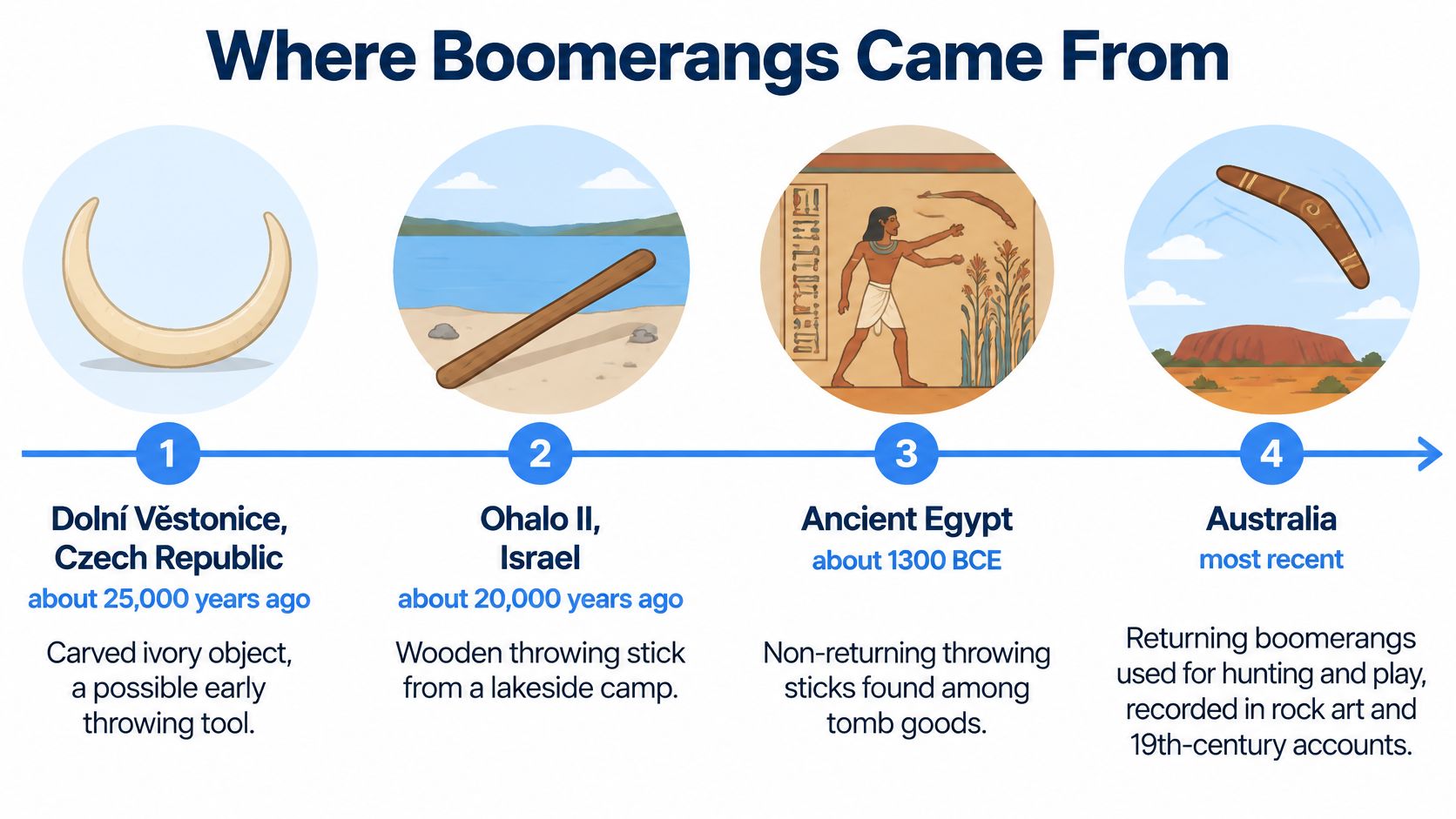
Start with the earliest find. Archaeologists recovered a mammoth-tusk boomerang from Obłazowa Cave in southern Poland, and radiocarbon analysis of the human and animal remains found with it places the object tens of thousands of years old, far earlier than any Australian example yet known. The Australian Museum describes the artifact as about 72 centimeters long and shaped to fly when thrown, though its design would not have produced a return flight. Built to fly and strike, not to loop back.
Australia then has its own engineering line, and it runs deep. The oldest Australian boomerangs, and rock-art depictions of their use, are many thousands of years old. Ethnographic work summarised by EXARC puts returning boomerangs in Australia at least 10,000 years ago, and the word itself derives from Dharug-language terms.
Read the timeline as a whole and it proves a class, not a novelty. "Boomerang" names ancient aerodynamic throwing tools rather than a single invention or a modern recreational object. Early sticks were built for range, impact, and hunting. The returning design is the specialised branch of that tradition.
How a Returning Boomerang Stays Aloft
A returning boomerang is a rotating, multi-wing airfoil system. Think of a helicopter rotor, then shrink it to two arms you can throw. Each arm behaves like a rotating wing, and the curve alone doesn't store a return.
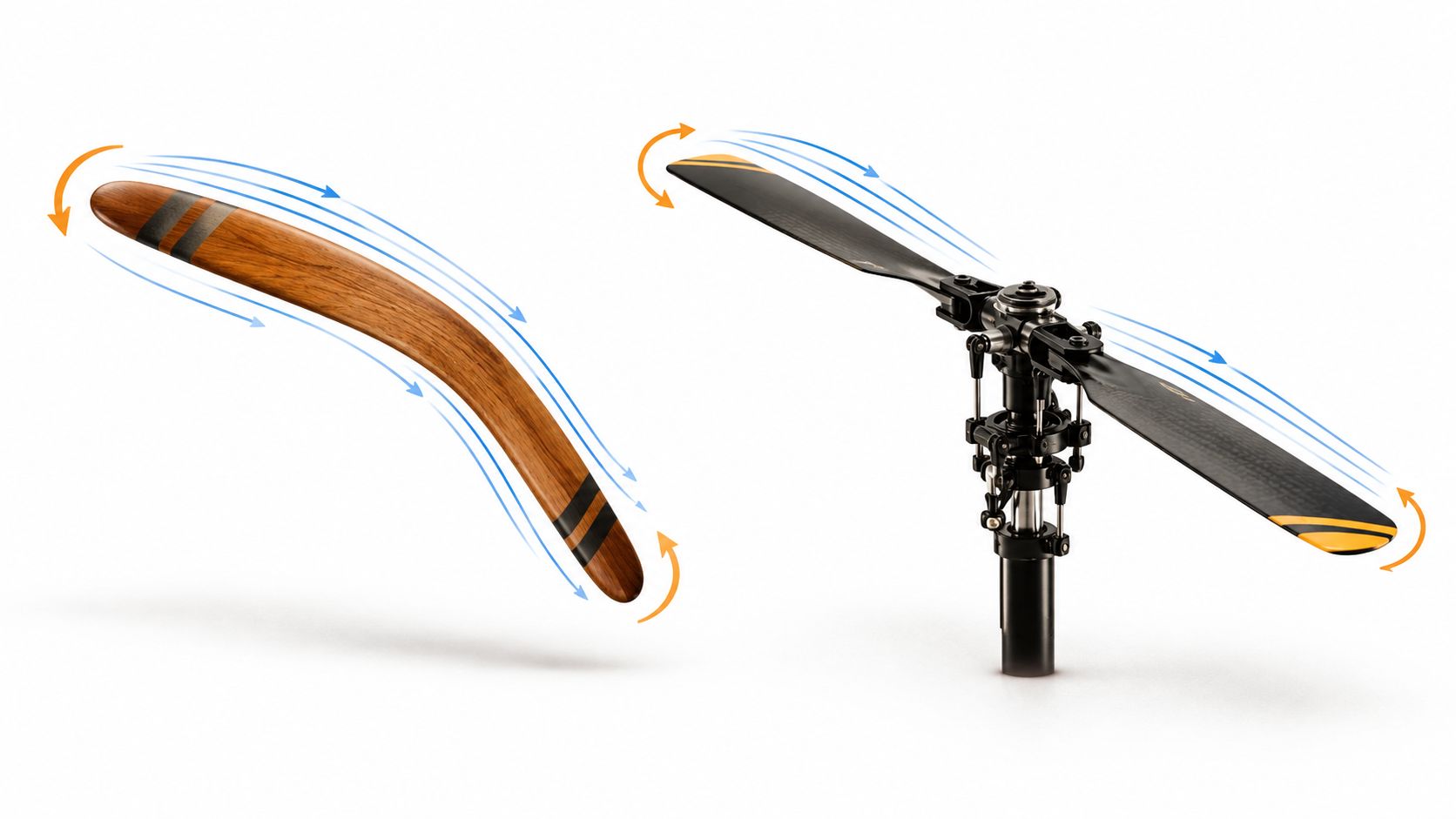
Lift, then unequal lift, then a slow turn
First, lift. Each blade is an airfoil, so moving air pushes on it. Second, asymmetry. The advancing blade moves through the air faster than the retreating blade, so lift isn't equal, and that imbalance creates a rolling moment. Third, gyroscopic precession. The boomerang carries substantial angular momentum, so the rolling moment doesn't flip it the way a loose card would flip. The spin axis turns slowly instead. A flight-dynamics treatment on arXiv frames this as one coupled problem: lift, drag, gravity, asymmetric blade speed, and precession, not a passive "return" built into the curve.
Launch it nearly vertically, with enough forward speed and spin, and the lift first acts mostly sideways. That sideways push bends the path into a loop. As precession changes the attitude, part of the lift points upward and holds the object against the same downward pull described in everyday examples of Earth's gravity. Drag and lost energy then bring it back toward the launch region.
Too little spin weakens gyroscopic stability. Too little forward speed cuts lift, and the boomerang drops early.
"Boomerang" doesn't mean "object that comes back." A failed return is usually a release or technique problem, not a defective object. You control three variables: a release angle near vertical, forward velocity, and spin.
Say you throw a returning model flat, the way you'd throw a frisbee. The airfoils still make lift, but that lift isn't aimed to hold the object up, so it falls instead of laying down a loop. Fix the attitude before you blame the wood.
How Shape Controls Range and Return
A boomerang's outline works like a budget. Everything the shape does is paid for out of the energy you supply at release, and the spending shows up as lift, drag, or both. More lift can keep the object airborne longer. Extra blade area, or a blade set at an unfavourable angle, adds drag that drains spin and forward speed faster.
Four levers do most of the work. Open, elongated wings generally trace a longer flight path. A sharper angle between the arms lowers effective tip speed, which makes the catch easier on the hands. Three- and four-wing layouts can raise lift and shorten the return path. Camber and blade thickness decide how repeatable that behaviour is, which is what sport throwers are really buying. Teacher notes from the Institution of Engineering and Technology put these same choices inside a fixed classroom build limit, which is a useful way to see the trade-off in action.
| Design choice | Effect on flight | Best fit |
|---|---|---|
| Open, elongated wings | Longer flight path | Distance throws |
| Sharper arm angle | Lower effective tip speed and easier catch | Beginners learning to catch |
| Three or four wings | More lift and a shorter return path | Tighter returns near the thrower |
| Airfoil camber and thickness | Repeatable lift and stability | Sport performance |
One sheet, one goal
Say a student may use a sheet no larger than standard US letter paper, about 21.6 cm by 27.9 cm, and must account for lift, drag, blade thickness, and camber. The first decision is the goal, not the shape. Distance points to a large, open two-wing form. A tight return points to a sharper-angled three-wing form.
Then the discipline matters: change one design variable at a time, and test every version with the same throwing routine. Change two things at once and you can no longer tell which one moved the flight. Identical releases are what let the shape, not a sloppy throw, explain the result.
How to Throw a Beginner Boomerang Safely
A beginner boomerang is light enough that a bad throw costs you a short walk, not a broken window, and the routine below is built around that margin. Each step has a reason, and each has a common slip worth knowing before you make it.
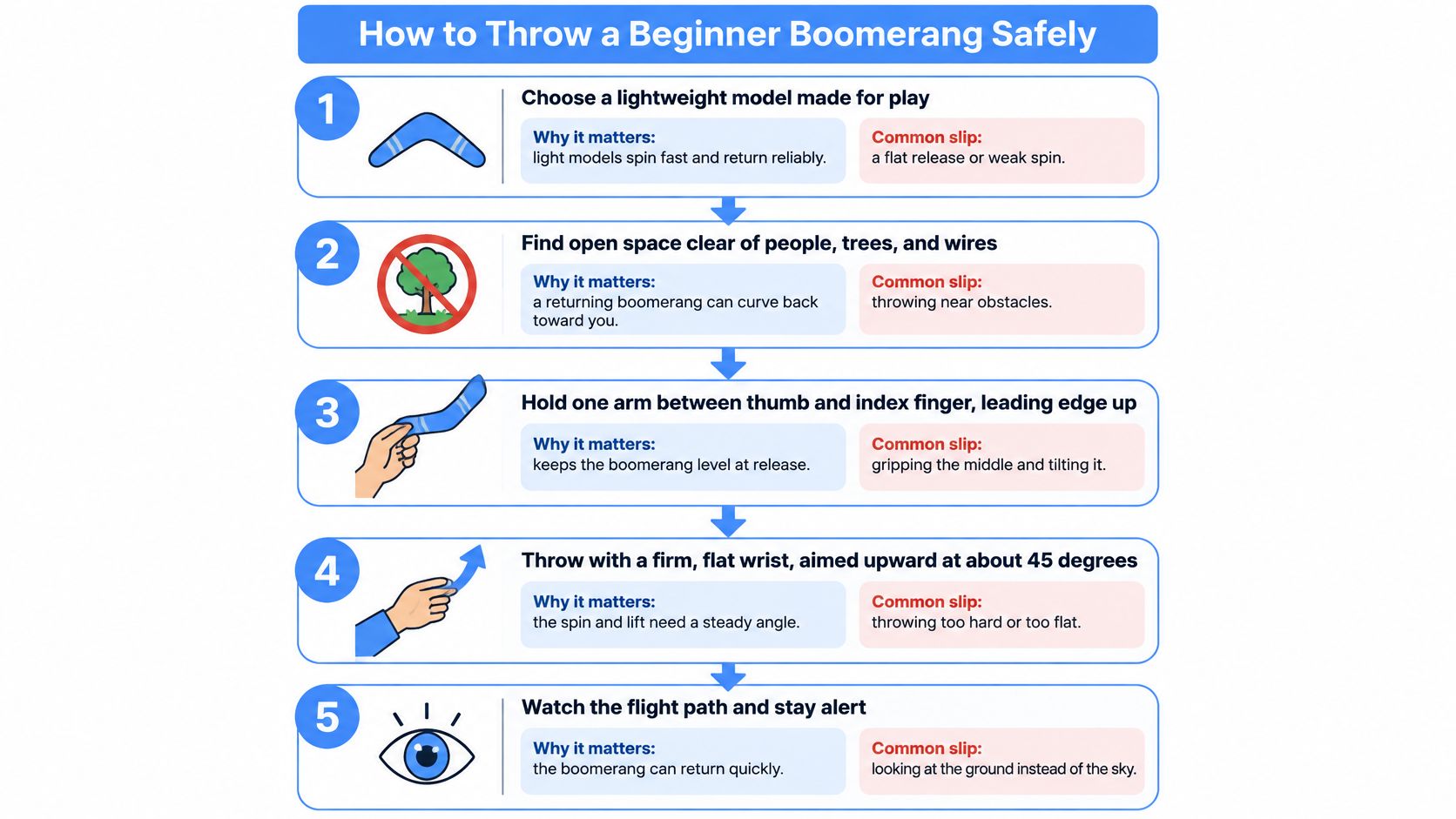
- Choose a lightweight model made for play. A heavy non-returning stick keeps going when the release is wrong, and a flat release or weak spin is harder to diagnose on a heavy object. The Australian Museum records that children throughout Australia made toy boomerangs from lightweight, easily carved woods, and beginner models follow the same principle: less mass means a gentler consequence when technique slips.
- Pick an open area and check the wind. Nobody, no animal, no road, and no building should sit inside the reach of a bad throw, and that reach is wider than a first-time thrower expects. Wind changes the loop, so don't start until you know which way it's pushing.
- Set a visible landing marker a short distance away. You're scoring proximity, not a heroic distance. A marker gives every throw the same target, so your results stay comparable from one attempt to the next.
- Hold the boomerang nearly vertical. Keep a relaxed arm, with the leading edge facing the direction you intend. A flat, frisbee-style hold points the lift the wrong way and sends the boomerang climbing into a stall rather than around its loop.
- Release with forward speed and a firm spin. Follow through toward the marker. Speed feeds lift, and spin feeds the stability that lets the path curve instead of tumbling. Spin comes from the wrist, so a weak snap shows up as a wobble in the air.
- Judge the landing against the marker. Closer is the success, even if the path looked modest. Chasing distance alone hides whether the return is working.
That proximity score is the better beginner scorecard. A throw that lands near the marker shows the boomerang curved back and that you aimed it; a throw that flies far and wide shows neither.
If it fails to return, change only one variable per throw, such as release angle, speed, or spin, and note the result.
The Boomerang Member Share Program Explained
Boomerang Member Share is a different object entirely. The wooden wing returns because of physics; this boomerang returns value to a household through referrals. It is the referral program inside Approved Traveler, the annual travel membership from Approved Experiences, priced at $899 per year for the Traveler tier. The primary member earns Reward Credits on hotel and car bookings made by shared family and friends.
Household scale is part of the mechanic. An account can include up to 10 members, with full benefit parity and no per-person fees, so a large household pays nothing extra as its roster grows. Reward Credits never expire, and they redeem toward future bookings, maintenance fees, resort usage fees, annual renewal, and eGift cards in the US, Mexico, Canada, Costa Rica, Australia, and the UK. The program assigns no fixed dollar value to a credit because redemption rates vary, so treat credits as flexible spending rather than as cash. Readers comparing how referrals work across clubs can study travel referral programs and then check this program's narrower rule: only hotel and car bookings made by shared family and friends qualify.
| Program element | How Boomerang Member Share works |
|---|---|
| Membership | Approved Traveler, $899 per year |
| Who earns Reward Credits | The primary member |
| Qualifying bookings | Hotel and car bookings made by shared family and friends |
| Household size | Up to 10 members per account |
| Benefit parity | Full benefit parity for all members |
| Per-person fees | None |
| Credit expiry | Reward Credits never expire |
| Redemption options | Future bookings, maintenance fees, resort usage fees, annual renewal and eGift cards (US, Mexico, Canada, Costa Rica, Australia, UK) |
A reunion that shows the boundary
Eight relatives share a reunion across three rooms. One sibling books the hotel rooms. Another books the rental car. Both are qualifying bookings made by shared family members, so the primary member earns Reward Credits on each. A tour package or an activity booking falls outside the named qualifying categories, even if the same relatives pay for it. The name earns its meaning here: the spending travels outward to family and friends, and the credits curve back to the primary member.
Choose the Boomerang or Membership That Fits Your Goal
Match the word to the job, then take one first step.
- Throwing: Buy or borrow a lightweight returning model and run the beginner routine in an open space with a visible marker. When it doesn't come back, change one variable on the next throw and write down what changed.
- Designing: Start from the outcome you want, a long path or a tight return, and stay inside the classroom sheet limit if that challenge applies. Then pick arm angle and wing count from the design table so the shape matches the goal.
- Travel membership: Confirm the household stays within the account's member limit, and list which planned bookings are hotel or car bookings made by shared family and friends. Confirm the current credit accrual rate with Approved Experiences before you enroll, and compare options such as vacation club memberships without mixing them up with a wooden wing.
When you search or buy, keep the throwing object, Boomerang Member Share, and the employment meaning in separate piles.
Approved Experiences Traveler is annual travel infrastructure for a household that needs wholesale access to hotels, flights, cruises, cars, vacation homes, tours, and activities in one place, and Boomerang Member Share is the part that credits the primary member when shared family and friends book hotels and cars. If you're lining up a multi-room reunion or a long stay, separate that membership from the curved throwing tool before you compare options. Visit Approved Experiences Traveler and check household size, qualifying bookings, and the current Reward Credit accrual rate before you enroll.
Want the wider view?
Ten categories. One report. Every quarter. The Approved List tracks what's rising and what's fading: data-backed signals, not opinions.
Free to join · Delivered by email