←All Articles
The Journal
What Is Expense Tracking and Why It Matters
October 8, 202611 min readwhat is expense trackingbudgeting basics
Learn what is expense tracking, how it works, and why it saves hours each week. A clear, practical guide for professionals and growing households.

Expense tracking is the systematic process of recording, categorizing, and reviewing every amount of money spent so you can decide what to do next. Its value comes from the review step, not the logging step.
It's Sunday night. Your laptop is open, receipts are spread across the desk, three bank apps are waiting for attention, and a subscription charge has appeared on a card nobody checks regularly. You suspect a reimbursement is missing, but you're not sure which transaction it was. Expense tracking turns that scattered evidence into a usable control system, then gives you a basis for deciding what to keep, cancel, reimburse, renegotiate, or question.
The Real Meaning Behind Expense Tracking
A useful definition of expense tracking has three parts: record the payment, classify its purpose, and review the record while there's still time to act. Each transaction typically needs at least three core data points, the amount, spending category, and date. Those fields turn receipts, bills, card charges, transfers, and cash withdrawals into an organized record.
Suppose you see a restaurant charge on your business card. Logging it as “restaurant” preserves the amount and date, but it doesn't explain whether it was a client meal, personal dining, or a team expense. Adding the purpose changes the record from a historical list into something you can use. You might submit it for reimbursement, attach the receipt, question it, or adjust a future spending decision.
That distinction separates expense tracking from bookkeeping theater. A ledger that nobody reviews may satisfy a later administrative requirement, but it won't help you notice an unwanted renewal, recover money someone owes you, or identify a cost that deserves renegotiation.
Recording is only the first move
The broader accounting function tracks both income and expenses. Its roots reach back more than 5,000 years, to clay tablets from ancient Mesopotamia that documented trade, taxes, and agricultural output, as described in this history of accounting overview. The original purpose was operational control, measuring resources, obligations, and transactions.
The same logic applies to a modern professional. You're not merely asking, “How much did I spend?” You're asking:
- What is recurring? Identify subscriptions, retainers, and other ongoing commitments.
- What is discretionary? Separate optional purchases from unavoidable operating costs.
- What needs follow-up? Flag reimbursements, disputed charges, and missing evidence.
- What decision is available? Cancel, reallocate, renegotiate, forecast, or escalate.
For readers building a broader money routine, Toya AI's budget planning tips can help connect expense records to planning. Keep the sequence clear, though. First create a reliable record, then use it to make a decision.
The Core Mechanics of a Working System
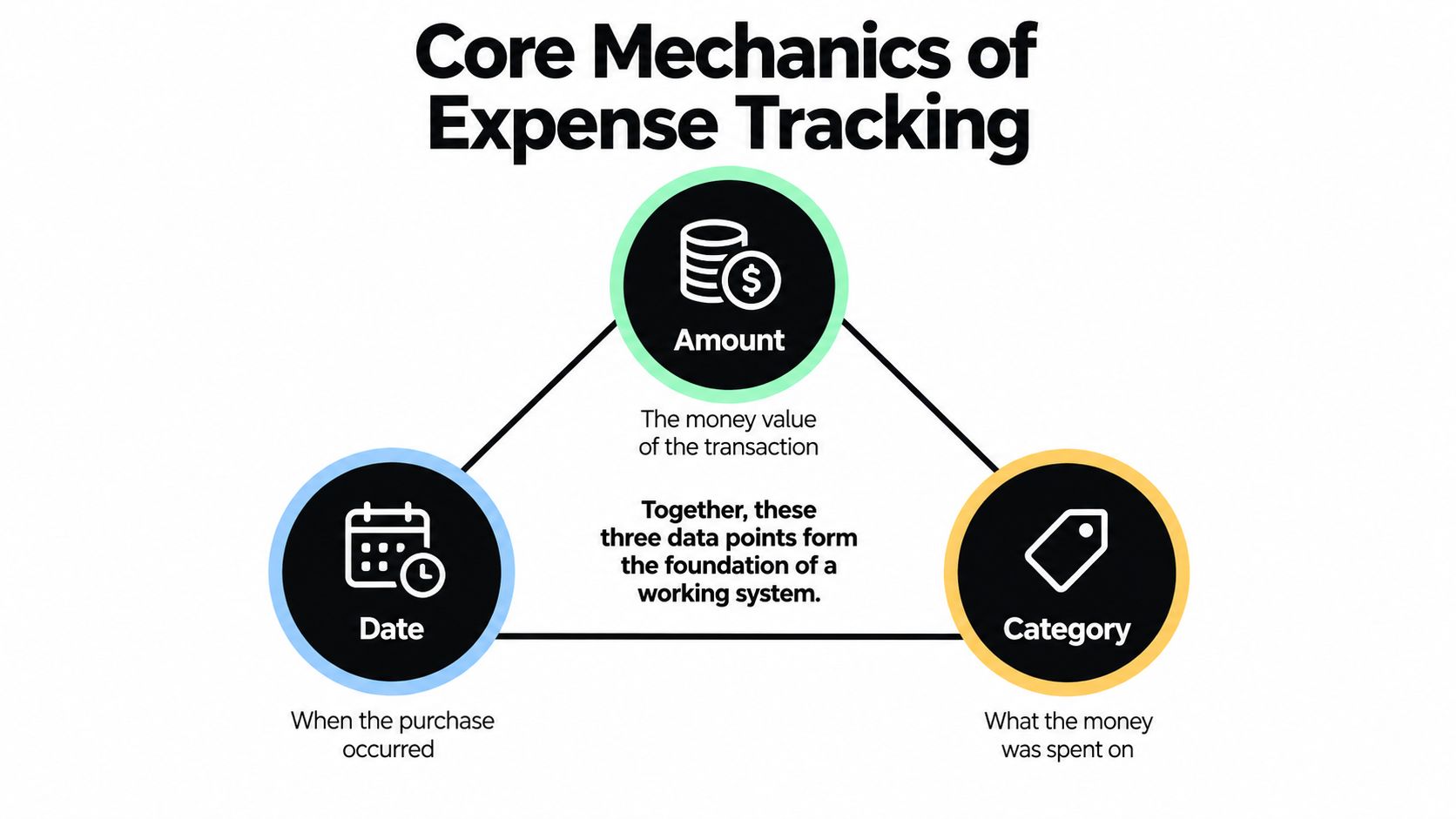
A working tracker starts with three fields for every transaction:
- Amount: How much money left the account.
- Date: When the transaction occurred.
- Category: What the money was spent on.
These fields are the minimum structure. Without the amount, you can't total or reconcile the charge. Without the date, you can't place it in the right reporting period. Without the category, you can't compare spending or decide what action belongs next.
Work one transaction from capture to decision
Take a $180 client lunch. The amount and date stay the same, but the category and supporting note change the meaning:
- Meals: The charge enters a meals total and may require business-purpose documentation.
- Client development: The charge connects to a relationship or commercial activity.
- Personal dining: The charge shouldn't remain in a business expense record.
Add the payee, payment method, receipt or PDF, and a concise business-purpose note. For a private household ledger, you may not need every supporting field. For reimbursement, reconciliation, or professional accounting review, those details create an evidence trail that another person can understand without guessing.
The IRS recordkeeping guidance identifies invoices, receipts, paid bills, credit-card statements, canceled checks, and electronic-payment records as supporting documentation. A practical workflow is to capture the source document, extract the transaction fields, check for duplicates or missing entries, apply a consistent category, and route ambiguous items for human review. A focused track business expenses guide can provide additional process ideas, while this receipt organization workflow addresses the evidence layer.
The structure has a long accounting lineage. Benedetto Cotrugli described double-entry bookkeeping in 1458, and Luca Pacioli published the first widely recognized printed explanation in 1494 in Summa de Arithmetica, Geometria, Proportioni et Proportionalità, according to the Journal of Accountancy's history of accounting article. Double-entry records connect transactions across accounts, which explains why a cost affects more than a shopping list. Your personal tracker may not require debit and credit columns, but it should still connect each purchase to a meaningful financial purpose.
The Five Expense Types Every Tracker Needs
“Needs versus wants” is too blunt for operational control. A useful tracker separates expenses according to the action they require. A recurring subscription needs a different review than a reimbursable client meal, even if both appear as card transactions.
| Expense Type | Examples | Review Cadence | Typical Action |
|---|---|---|---|
| Fixed | Rent, software subscriptions, retainers | Annual or at renewal | Renegotiate, cancel, or confirm |
| Variable | Utilities, groceries, supplies | Monthly variance check | Adjust usage or allocation |
| Discretionary | Optional dining, entertainment, upgrades | Weekly visibility loop | Keep, reduce, or remove |
| Reimbursable | Client travel, employer purchases, business meals | Before the cutoff | Submit, document, and follow up |
| Irregular | Annual renewals, quarterly obligations, repairs | Forward-looking review | Reserve, forecast, or schedule |
Match each type to a question
Fixed costs are predictable but easy to ignore. A household may pay for several digital services without checking whether anyone still uses them. A small business may carry a professional subscription that made sense at launch but no longer supports current work. The review question is, “Does this commitment still earn its place?”
Variable costs move with activity. Grocery spending can rise with household needs, while utilities or supplies can shift with usage. Compare the current category with prior periods and investigate the reason for movement, rather than treating every change as a failure.
Discretionary spending is optional by definition. That doesn't make every discretionary purchase wasteful. It means the category gives you a visible place to decide what matters enough to keep.
Reimbursable expenses carry deadline risk. A consultant who pays for client travel personally should record the transaction, preserve the receipt, note the business purpose, and submit it before the agreed cutoff. A charge that stays uncategorized can become a missed recovery.
Irregular expenses are infrequent, not necessarily surprising. Annual renewals and repairs become easier to handle when the tracker records the obligation and its expected timing. The action is to prepare before the money leaves, not react afterward.
For business travel, keep these distinctions visible in a dedicated category rather than burying every charge under “miscellaneous.” A practical business travel expense resource can help organize travel-related records and follow-up rules.
Building a Weekly Review Habit That Actually Sticks
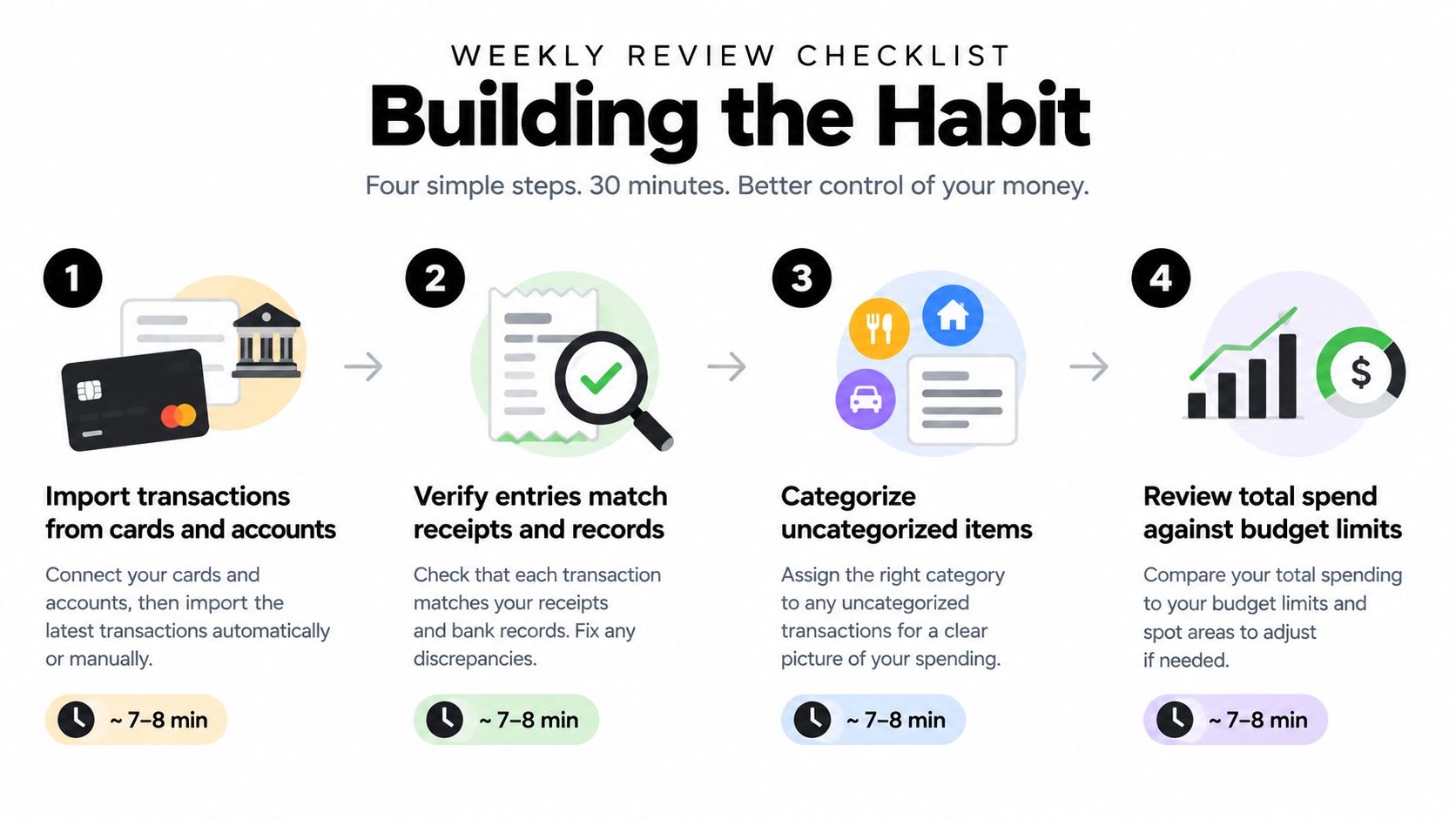
A weekly review keeps the record close to the transaction. You don't need a complicated finance meeting. Reserve one 30-minute session and complete five straightforward passes.
A repeatable review
- Import transactions, about 5 minutes. Pull in card and bank activity, or collect the week's receipts if you use a manual ledger.
- Check for duplicates, about 5 minutes. Compare imported entries with receipts and look for repeated merchant, date, and amount combinations.
- Classify unclear charges, about 10 minutes. Decide whether an item is household, business, personal, reimbursable, or another defined category.
- Flag exceptions, about 5 minutes. Route missing receipts, unusual category changes, disputed charges, and transactions that exceed your internal approval threshold.
- Look ahead, about 5 minutes. Write one sentence about expected variable spending, such as groceries, supplies, travel, or repairs.
Practical rule: Booking an expense recognizes that money was spent. Posting it assigns that expense to the correct category. Your tracker needs both.
The distinction matters because a transaction can be present in your bank feed and still be operationally incomplete. If a charge is booked but not posted, you know money left, but you don't know which budget or responsibility should absorb it.
Research published in the Journal of Consumer Research found that budgeters reduced spending more than comparable non-budgeters across multiple categories, and app users were still reducing spending six months after setting a budget, according to the consumer budgeting study. The practical lesson isn't to demand perfect compliance. A short weekly pass is more useful than a heroic month-end recovery session, even when some entries remain imperfect.
Why Logging Alone Rarely Changes Outcomes
Automation solves collection, not judgment. A card feed can import every transaction, but it can't reliably know whether a restaurant charge was personal dining, a client meeting, or a household meal unless someone supplies the purpose.
A 2025 study found that digital-wallet technology was viewed as helpful but not game-changing. Its expense-management dimensions clustered in a merely "high" range rather than a "very high" range, as reported in the Frontiers in Education expense-management research. The finding supports a useful operating model: automate the repetitive capture, then preserve a human review for classification and action.
Use a hybrid workflow
Let bank and card transactions flow into your tracker automatically. During the weekly review, manually confirm the purpose, assign the category, attach evidence, and flag anything unusual. This approach keeps convenience without removing the attention that makes spending visible.
Research on tracking behavior also distinguishes automated collection from active tracking. Automated tools are more convenient, while manual entry requires more engagement and was associated with greater financial self-awareness in the Consumer Interests Association research.
The operational test isn't “Did every transaction get logged?” It's “Did tracking surface a decision, prevent a missed reimbursement, or eliminate a recurring obligation?”
That test changes how you measure value. Look for fewer follow-ups, cleaner reimbursement packets, faster reconciliation, earlier cancellation decisions, and less mental load. A longer transaction history isn't the outcome. Better decisions are.
Shared Households and Mixed-Purpose Spending
Expense tracking becomes a coordination problem when several people use the same money. One household may combine personal purchases, family spending, travel, side-project costs, and reimbursable work on overlapping cards. A category list alone won't decide who reviews the charge or what evidence belongs with it.
Consider a grocery receipt containing household food, supplies for a side project, and a client-related item. The correct process is to preserve the receipt, split the lines according to an agreed rule, and record the business or project portion with a clear note. If the split is ambiguous, one named person should decide or escalate it, rather than allowing the charge to sit in an indefinite “miscellaneous” category.
Establish ownership before the next cycle
Agree on three points:
- Duplicate review: Name the person responsible for checking repeated charges across cards and accounts.
- Ambiguous charges: Decide who resolves a disputed item and what happens when the answer remains uncertain.
- Recurring renewals: Set a process for reviewing subscriptions that appear on an unmonitored card.
Add practical boundaries around receipt retention, reimbursement cutoffs, and access. Not every household member needs the same financial visibility, and not every Assistant or administrator should have unrestricted access to every account. Store only the evidence needed for the task and route regulated accounting, tax, or legal judgments to a qualified professional.
Financial literacy is associated with budgeting and expense-tracking practices, while income and education can influence financial literacy, according to the household financial-management research. That makes plain-language rules important. A shared system should make responsibilities obvious without assuming everyone already understands accounting terminology.
Tools can support the record, but they can't replace governance. A practical overview of free shared expense trackers from Divvy may help with tool selection. The more important decision is who owns each exception and when that person must act.
When an Assistant Team Makes Tracking Operational
Expense tracking is well suited to delegation because much of the work is repeatable. An Assistant team can collect receipts, extract transaction details, maintain categories, follow up on missing evidence, identify duplicate-looking entries, and prepare an exception list for review.
The member or authorized finance professional should retain responsibility for accounting, tax, and legal judgments. The Assistant team handles the administrative layer, then surfaces decisions rather than making regulated decisions on the member's behalf.
Measure the handoff by outcomes
A useful delegation brief defines success in operational terms:
- Hours reclaimed per week: Time no longer spent searching statements, renaming files, or chasing receipts.
- Missed reimbursements prevented: Charges identified and submitted before the relevant deadline.
- Recurring obligations changed: Subscriptions, services, or vendor costs canceled or renegotiated after review.
This is different from outsourcing a spreadsheet without context. A team with shared context can learn which transactions require escalation, which receipts are routinely missing, and which recurring obligations deserve attention. A structured virtual assistant for bookkeeping workflow can clarify where administrative support ends and professional accounting begins.

The best handoff reduces operational noise. You still approve the judgment calls, but you don't have to reconstruct the evidence trail after a long workday.
Putting It All Together
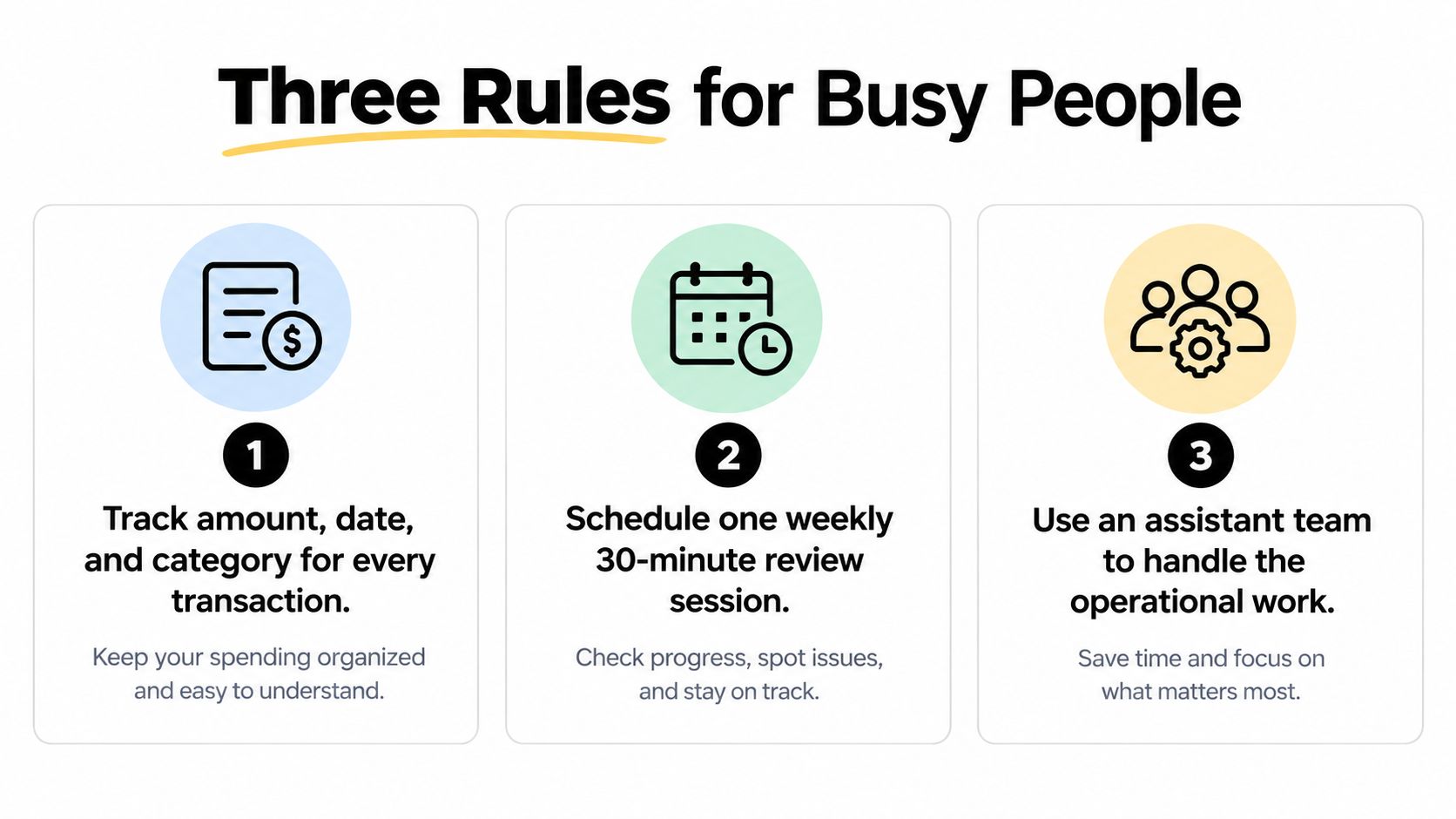
Three rules make expense tracking workable for a busy professional.
Rule one is the definition rule
Track the amount, date, and category for every transaction. Those fields create the minimum record needed to total spending, place it in the right period, and compare like with like. Start today by creating those three columns and adding the next transaction before it disappears into a statement.
Rule two is the cadence rule
Review weekly, not monthly. A 30-minute Sunday review gives you a chance to resolve ambiguity, catch duplicates, protect reimbursements, and adjust upcoming spending while the details remain available. Put the session on your calendar, then follow the same five-pass workflow each week.
Rule three is the delegation rule
Hand collection, classification, and follow-up to an Assistant team when administrative work is blocking higher-value responsibilities. Keep approval and professional financial judgment with the appropriate decision-maker, but remove the repetitive searching and chasing from your own workload.
Expense tracking works because it creates a reliable record of where money goes, then turns that record into deliberate action. The objective hasn't changed since early accounting records: manage resources based on evidence instead of reacting to scattered information.
Approved Lux Personal Assistant provides a US-based human Assistant team for expense tracking and other professional support, with 24/7 availability through call, SMS text, or email. If you want receipts collected, transactions organized, and follow-ups surfaced without adding another administrative block to your week, visit Approved Lux Personal Assistant and choose the support model that fits your workflow.
Want the wider view?
Ten categories. One report. Every quarter. The Approved List tracks what's rising and what's fading: data-backed signals, not opinions.
Free to join · Delivered by email