
All Articles
The Journal
What Is a Virtual Assistant? what is virtual assistant and how it works
January 31, 202617 min read
Learn what is virtual assistant and how they can reclaim your time. Explore types, tasks, and benefits for busy professionals.
So, what exactly is a virtual assistant?
At its core, a virtual assistant (VA) is a professional who handles administrative, creative, or technical tasks for you remotely. But that definition feels a bit sterile, doesn't it? It's better to think of them as a strategic partner—someone who runs the behind-the-scenes logistics of your life or business so you can focus on what you do best.
What a Virtual Assistant Really Does

Think of your life as an airport. You've got flights coming in and going out constantly—meetings, family schedules, home repairs, vacation plans, and a hundred other things all demanding a spot on the runway. A virtual assistant is your air traffic controller, expertly managing all that inbound and outbound chaos so you don't have to.
They are the operational layer that stands between you and the daily grind. This isn't just about handing off a to-do list. It's about delegating the entire process of getting something done.
For example, you don't just ask them to book a flight. You tell them you need to be in San Francisco for a conference next month, and they handle everything: the flights, the hotel, the rental car, dinner reservations, and even a shareable itinerary for your family.
More Than Just an Assistant
The role has evolved far beyond a remote secretary. A modern VA is a flexible operations partner, giving you a powerful way to reclaim your most valuable resources: time and focus. To see just how broad the support can be, it's worth exploring the offerings from a good virtual assistant agency.
This support system lets you offload the mental clutter that comes from juggling endless details. A great VA learns to anticipate your needs, solve problems before you even know they exist, and keeps the engine of your life running smoothly in the background.
For a quick overview, here's a look at what a virtual assistant brings to the table.
Virtual Assistant at a Glance
| Key Function | What It Means for You |
|---|---|
| Logistics & Scheduling | Your calendar is managed, appointments are set, and travel is booked without you lifting a finger. |
| Task Management | Complex projects and daily to-dos are organized and executed, freeing up your mental bandwidth. |
| Research & Vetting | Need a plumber or the best restaurant for a client dinner? They find and vet the top options for you. |
| Communication Hub | They can act as a gatekeeper for your email and calls, ensuring only the important stuff gets through. |
This table just scratches the surface, but it highlights the core idea: a VA handles the "how" so you can focus on the "what" and "why."
A virtual assistant isn't a luxury; it's a strategic investment in personal productivity. By offloading logistical tasks, you buy back hours of focused time for high-value work and personal well-being.
Ultimately, a VA helps you switch from constantly reacting to being proactive. They manage the details that drain your energy, giving you the clarity to concentrate on what truly matters—whether that's scaling a business, launching a new project, or just being more present with your family.
The Journey from Chatbots to Human-Powered AI
The concept of a virtual assistant feels modern, but its story actually begins way back in the 1960s with early AI experiments like ELIZA, a program that could simulate a conversation. For a long time, these "assistants" were more science fiction than reality—simple, rule-based chatbots that could only follow very specific commands.
Everything shifted in 2011 when Apple put Siri in millions of pockets. Suddenly, a voice-activated assistant wasn't a lab experiment anymore; it was a mainstream tool. That moment kickstarted a massive industry.
The global virtual assistant market, which was valued at $4,624.26 million in 2025, is now expected to climb to an incredible $18,317.53 million by 2032. This explosion in growth isn't just about more chatbots; it's about the shift from basic tools to assistants that can genuinely solve problems. You can explore a detailed breakdown of these market trends for virtual assistants in the US on Statista.com.
From Simple Commands to Complex Understanding
Those early chatbots were pretty rigid. They worked on a simple "if-then" logic. Ask, "What is the weather?" and it would pull up a report. But they couldn't handle any ambiguity or follow-up questions, which made them useless for real-world logistical planning.
The real game-changer was the advancement in Natural Language Processing (NLP) and machine learning. This is what gave modern virtual assistants the ability to understand our intent, learn our preferences, and manage complicated tasks that require some level of reasoning. They finally moved beyond just answering questions to actually doing things.
This evolution is fascinating to watch, especially when you see how a sophisticated AI chatbot for small business can now manage everything from customer support queries to internal company workflows.
The Rise of the Hybrid Model
Even with all these incredible leaps forward, purely AI-driven assistants still have their limits. They can get tripped up by nuance, sudden changes, or any task that needs subjective judgment. Think about a last-minute flight cancellation or a complex itinerary change—these situations often require a level of creative problem-solving and negotiation that algorithms just can't handle.
This gap between AI's raw efficiency and the messy reality of life is precisely what led to a better solution: the hybrid model. It’s an approach that pairs the speed of artificial intelligence with the critical thinking and resourcefulness of a human expert.
This blend is really the peak of what a virtual assistant can be today. The AI takes care of the routine work—processing data, scheduling, and sending reminders—while a human expert steps in to navigate the tricky parts, verify crucial details, and make sure everything goes off without a hitch. It’s this combination that turns a simple digital tool into a truly reliable personal operations platform, making it an essential part of a high-efficiency lifestyle.
The 3 Types of Virtual Assistants You Need to Know
When you hear "virtual assistant," what comes to mind? For some, it’s a dedicated person handling their calendar from halfway across the world. For others, it’s the AI voice on their phone. Both are correct, but the reality is much more nuanced.
To find the right kind of support, you first need to understand the three main models: the classic human VA, the AI-powered tool, and the modern hybrid platform that brings them together.
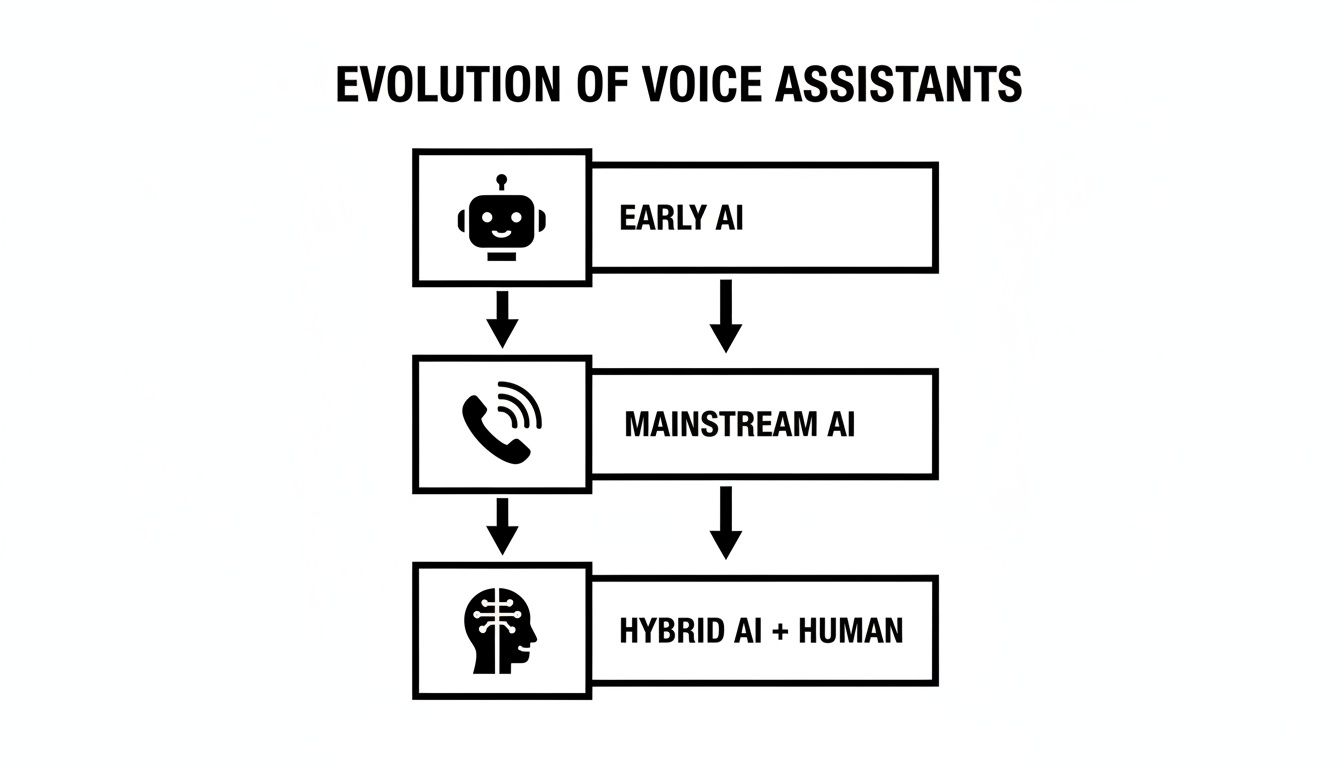
As you can see, the journey has moved from simple automation to sophisticated systems that integrate human intelligence, offering a much more powerful kind of support.
The Human Virtual Assistant
This is the original model: a real person, working remotely as a freelancer or through an agency, who you hire to take things off your plate. Think of them as your remote right-hand person.
Human VAs are fantastic for tasks that require a personal touch, emotional intelligence, or creative problem-solving. Need someone to draft a thoughtful, personalized follow-up email to a key client? Or maybe handle a delicate negotiation with a vendor? That’s where a human shines.
The real advantage is their ability to think on their feet and adapt. The trade-off, however, is that they have set working hours, and the process of finding, hiring, and training the right person can be a job in itself.
The AI-Powered Virtual Assistant
At the other end of the spectrum, you have assistants like Siri, Alexa, and Google Assistant. These AI tools are built for one thing: speed. They can process huge amounts of data and execute simple, structured commands in an instant.
Ask one to set a reminder, play a specific song, or give you a weather forecast, and it gets the job done perfectly. But their limits become clear as soon as a task requires context or common sense. An AI can book a standard flight, but it can’t reason with an airline representative to find a creative solution when your flight gets canceled.
The core challenge with pure AI is its lack of nuance. It can execute a command perfectly but struggles to solve a problem creatively, especially when things don't go according to plan.
The Hybrid Platform Model
This is where things get really interesting. The hybrid model blends the efficiency of technology with the intelligence of real people, giving you the best of both worlds. It’s not just a person or just an app—it’s an integrated system.
Here’s how it typically works: Technology acts as the front door, handling your request, organizing the details, and managing the workflow. This makes the service feel seamless and instantly available, 24/7.
Behind the scenes, a dedicated team of human experts is ready to step in. They handle the complex parts, make judgment calls, and ensure every detail is just right. They provide the critical thinking that AI simply can’t.
This integrated approach strikes the perfect balance:
- Speed & Efficiency: AI manages the intake and tracks progress, so you get an immediate response.
- Expertise & Nuance: Human experts take over for complex problem-solving and quality control.
- Scalability: You get access to a full team's capabilities without the headache of hiring or managing anyone directly.
Imagine you need to plan a last-minute anniversary dinner. An AI might pull a list of restaurants with reservations. But a hybrid platform's human expert will vet those options, find the one with the best ambiance, speak to the maitre d' to secure a quiet corner table, and even arrange for flowers to be there when you arrive. That’s the difference.
To help you decide which model might be right for you, let's break down the key differences side-by-side.
Comparing Virtual Assistant Models
This table offers a quick comparison of what you can expect from each type of virtual assistant, helping you match your needs to the right solution.
| Feature | Human VA | AI VA | Hybrid Platform |
|---|---|---|---|
| Availability | Typically standard business hours | 24/7, instant | 24/7 intake, human expertise during business hours |
| Best For | Creative, high-touch, subjective tasks | Simple, repetitive, data-driven commands | Complex, multi-step tasks requiring real-world action |
| Judgment | High (human intuition and experience) | None (follows programmed rules) | High (AI for data, humans for final decisions) |
| Management | High (hiring, training, managing) | None (it's a tool) | Low (platform handles all coordination) |
| Cost Structure | Hourly or retainer | Free or subscription | Subscription or pay-per-task |
| Example Task | "Draft a marketing email for our new launch." | "Set a timer for 15 minutes." | "Plan a 3-day trip to Napa, including flights, a rental car, and two winery tours." |
Ultimately, the choice comes down to what you're trying to accomplish. If you need simple commands executed quickly, an AI is fine. If you need a deep, long-term partner for your business, a dedicated human VA might be the answer. But for busy individuals and families looking for reliable, comprehensive support without the management overhead, the hybrid model often provides the most effective and flexible solution.
What Can You Outsource to a Virtual Assistant?
Knowing the difference between an AI and a human assistant is a good start, but the real "aha!" moment comes when you see exactly what you can hand off. A virtual assistant’s value isn't just an abstract idea; it becomes tangible when you start clearing your plate of the specific, time-sucking tasks that bog down your day.
Instead of thinking about a simple to-do list, imagine delegating entire categories of your life to a capable professional. For busy executives and their families, the support they need almost always falls into three main buckets.
Professional Support and Business Logistics
This is the traditional sweet spot for an assistant—keeping your professional life running like a well-oiled machine. Rather than losing hours to coordinating schedules or booking travel, you can have a virtual assistant manage the behind-the-scenes operations. That frees you up to concentrate on the work that actually matters.
Common tasks include:
- Complex Calendar Management: This is more than just adding appointments. A great VA juggles multiple time zones, confirms every attendee, and anticipates and solves scheduling conflicts before you even know they exist.
- Travel Planning and Coordination: From booking flights and hotels to arranging ground transportation, they handle it all. They'll also build detailed, day-by-day itineraries for those multi-city business trips. For more on this, check out our expert tips on how to improve your travel experience.
- Meeting and Event Preparation: They'll organize the agenda, pull together background research on attendees, and manage the logistics for any meeting, whether it's virtual or in person.
Personal Logistics and Household Management
Here’s where a virtual assistant truly becomes an operations manager for your personal life. They take on the never-ending coordination that keeps a modern household afloat, saving you from the constant back-and-forth and mental load of follow-ups.
For example, a VA can:
- Coordinate Home Services: Need a plumber, an electrician, or a reliable housekeeper? They can find, vet, and schedule the right person for the job.
- Manage Family Appointments: They’ll take care of booking and confirming doctor’s visits, parent-teacher conferences, and all the kids' extracurriculars.
- Handle Important Errands: This could be anything from arranging prescription refills and coordinating package deliveries to researching the best local summer camps.
The goal is to remove the friction from your daily life. A VA handles the tedious "life admin," allowing you to be more present and less stressed, both at work and at home.
Lifestyle and Social Planning
Beyond the day-to-day necessities, a virtual assistant can also handle the details that make life more enjoyable. This kind of support means you never miss out on an opportunity just because you were too busy to plan it. Whether it's scoring a reservation at that new restaurant or getting tickets for a sold-out show, they make it happen.
The demand for this kind of high-touch support is growing fast. The virtual assistant market is expected to hit a staggering USD 178.80 billion by 2034. It’s a field where technology and human expertise are merging; chatbots are now handling routine inquiries 40% faster, which in turn frees up human assistants to focus on more complex, personalized planning. You can see more data on the intelligent virtual assistant market on PrecedenceResearch.com.
The Real ROI of a Personal Virtual Assistant
Sure, getting time back is the most obvious perk of having a virtual assistant, but the real return on your investment goes way beyond just a few extra hours. For busy founders and professionals, the true value is in getting your mental energy back and being able to laser-focus on the things that actually move the needle.
Think of it less as outsourcing tasks and more as insourcing clarity.
Every little decision you make throughout the day—what to grab for lunch, which plumber has the best reviews, how to reschedule that dentist appointment—chips away at your cognitive resources. When you hand off these logistical puzzles to a virtual assistant, you dramatically cut down on that decision fatigue. It means you show up to your most important work with a full tank, ready to think creatively and solve the big problems.
Investing in Focus and Balance
The effect of this newfound focus is something you can actually feel. Instead of spending your morning juggling calendars, you can use that time to prep for a make-or-break negotiation. Instead of getting lost in a rabbit hole of flight comparisons, you can mentor a promising team member. It’s about shifting your peak energy to the work that truly scales your business or advances your career.
The ultimate goal isn't just to do less; it's to achieve more of what matters. A virtual assistant service is a strategic investment in your personal productivity and overall well-being.
This kind of strategic delegation is becoming a non-negotiable for modern leaders. With hybrid work now the norm, the global demand for remote talent has shot up by 29% year-over-year. For executives, offloading personal logistics to a VA offers a powerful way to get more done without the financial commitment of a full-time hire. You can learn more about how remote talent is reshaping productivity and see the data for yourself.
In the end, the ROI is measured in real-life results. It's being fully present at the dinner table with your family because your mind isn't cluttered with household to-do lists. It’s having the headspace to finally map out that new business idea. Understanding what a virtual assistant really gives you means seeing it not as a luxury, but as a core part of building a successful and balanced life.
How to Choose the Right Virtual Assistant
Picking the right virtual assistant isn't just about hiring a person—it's about finding the right system for your life. With so many options out there, the best choice really boils down to a few key things: how reliable they are, what they can actually do for you, what it costs, and how much of a pain it is to get started.
Let's use a car analogy. You could hire a personal assistant directly, which is like owning a classic car. It’s fantastic, but it requires a lot of your personal time for maintenance and management. On the other end, you have AI assistants, which are like a ride-sharing app—perfect for simple, one-off tasks but not much else. A hybrid platform, however, is more like a luxury car subscription. You get all the performance and reliability without any of the headaches.
First, Figure Out What You Actually Need
Before you even start looking, take a moment to get brutally honest about what you need help with. Are we talking about straightforward administrative tasks like managing your calendar and inbox? Or are your problems more complex and rooted in the real world, like coordinating a kitchen remodel or planning a detailed family trip across three cities?
Make a quick list of all the things that consistently drain your time and energy. Think of this as your personal blueprint. It will immediately show you whether a purely human, AI, or hybrid model has the right toolkit for your life.
The right virtual assistant solution should feel like an extension of your own mind—proactively handling things and getting tasks done with almost no friction. It’s supposed to reduce your mental load, not add to it with a bunch of extra management.
Key Factors to Consider
Once you have your list, use these four points to weigh your options:
- Reliability: Can you truly count on them to get the job done right, every single time? This is huge. Look for services with built-in quality control and human oversight, because this is exactly where purely AI tools tend to stumble.
- Scope of Services: Does the assistant handle the full spectrum of your life, from professional to personal? A service that only focuses on business support is useless when you're trying to get your household logistics under control.
- Pricing Model: Is the cost predictable and straightforward? Subscription models are often easier to manage because you pay a flat fee for a defined scope of work. This beats the unpredictable hourly rates of a freelancer or the significant overhead that comes with a full-time employee. To see a modern take on this, you can learn more about the Approved Lux personal assistant service and how it's structured.
- Onboarding Process: How fast can you actually start handing things off? A good platform should have a dead-simple, intuitive process that lets you delegate tasks from day one, skipping the long hiring and training sagas.
At the end of the day, you're looking for a solution that gives you the dedicated, personal touch of an executive assistant blended with the wide-ranging capabilities of a five-star concierge, all wrapped up in a modern, flexible package.
A Few Common Questions About Virtual Assistants
As you start picturing how a virtual assistant could slot into your life, you're bound to have some practical questions. Getting these answered is the final step before you can really see the value and feel confident about moving forward.
Let's tackle a few of the most common things people ask before they dive in.
How Much Do Virtual Assistant Services Cost?
This is a big one, and the answer really depends on the type of assistant you're looking at. The landscape is pretty varied.
A freelance human VA, for instance, usually charges by the hour. Rates can be anywhere from $20 to $75+, depending entirely on their level of experience and the specific skills you need. On the other end of the spectrum, most pure-AI assistants are either free or just part of a device you already own.
Hybrid platforms like ours typically go with a subscription model. You pay a flat monthly fee for a certain number of tasks or hours, which keeps your costs predictable. It’s a great way to get consistent support without the overhead and hassle that comes with hiring a full-time employee.
Is My Personal Information Secure?
Absolutely. Security is, without a doubt, a top priority for any serious virtual assistant service. Professional platforms lean heavily on encrypted communication, secure data storage, and operate under iron-clad confidentiality agreements.
One of the biggest upsides of using an established platform instead of hiring a random freelancer is that all the security measures and vetting are already handled for you. It's a built-in layer of trust that ensures your personal and professional information is kept safe.
What's the Difference Between a VA and a Concierge?
It's easy to see why people mix these two up, but their roles are fundamentally different. A traditional concierge is usually your go-to for luxury lifestyle requests—think scoring tickets to a sold-out show or getting a last-minute table at an exclusive restaurant.
A modern virtual assistant, however, is much more integrated into the day-to-day operations of your life. They handle a far broader scope of practical logistics. We’re talking about coordinating home repairs, managing your entire family’s calendar of appointments, or planning a multi-leg business trip. These are the kinds of complex, real-life tasks that are way beyond what a typical concierge does.
If you'd like to see more examples of what a VA can take off your plate, you can explore our other articles on the Approved Experiences blog.
Ready to reclaim your time and offload the mental clutter? Approved Lux provides a seamless, reliable personal assistant service designed to manage the logistics of your busy life. Discover how our platform can become your personal operations layer.
Want the wider view?
Ten categories. One report. Every quarter. The Approved List tracks what's rising and what's fading: data-backed signals, not opinions.
Free to join · Delivered by email