
←All Articles
The Journal
Cabin with Jacuzzi: The Operational Booking Guide
September 28, 202614 min readhot tub cabingroup travel planning
Plan the perfect cabin with jacuzzi stay. Learn how to evaluate layouts, verify maintenance, and leverage wholesale travel access for multi-room group trips.

The most popular advice about a cabin with jacuzzi is also the least useful: choose the property with the best deck photos. That approach works for a short couples' escape, but it breaks down when you're coordinating parents, children, snowbirds, remote workers, or a reunion spread across several rooms.
A hot tub is travel infrastructure. It needs reliable access, safe water, sufficient power, practical placement, and rules that fit the group's schedule. A beautiful cabin with an unavailable jacuzzi can create more friction than a simpler property with a well-maintained, private spa that operates throughout the stay.
The Operational Reality of Booking a Cabin With Jacuzzi
A jacuzzi changes how guests use a cabin, but it also changes what the organizer must verify. The amenity affects arrival timing, cleaning schedules, electrical demand, quiet hours, weather access, and the property's suitability for a longer stay. Treating it as decoration encourages planners to overlook the details that determine whether the feature works after the first evening.
The economics explain why hosts promote these properties so heavily. Across seven mountain markets, hot tub-equipped cabins measured 8% to 27% higher annual revenue than comparable cabins without one, according to AirROI's mountain-market cabin analysis. The largest increase appeared in Big Bear Lake, California, at +$9,715 per year, or +27.2%, while Blue Ridge, Georgia, recorded the smallest increase, +$3,816 per year, or +8%. The same analysis found that hot tubs can support a 20% to 25% higher average daily rate, with the revenue premium reaching 34% on RevPAR in mountain markets.
Those figures describe host economics, not a promise to guests. They tell you that the jacuzzi may be central to the property's pricing strategy, which makes a direct verification call worthwhile. If you're paying for a premium amenity, confirm that it's open, private, heated, and maintained during your dates.
Treat year-round access as a booking requirement
Listings often answer whether a jacuzzi exists but avoid the questions that matter operationally:
- Is it indoor or outdoor?
- Is it open during winter?
- Does the host preheat it before arrival?
- Can weather, snow, or freezing conditions restrict access?
- What maximum temperature is permitted?
- Is the tub private to the rental or shared with a resort community?
- Are there quiet-hour restrictions?
For a multi-night stay, those answers matter more than whether the deck overlooks a valley. Families may use the tub in shifts. Retirees may want predictable morning access. Remote workers may depend on a quiet, private space after meetings. A property that shuts down the jacuzzi overnight or during cold weather may not suit the itinerary, even if the listing photographs are excellent.
Practical rule: Ask the property manager to confirm jacuzzi availability and operating restrictions in writing before you pay.
The wider accommodation market is moving toward wellness-focused and technology-enabled stays, including smart controls and automated filtration, as described in this hospitality guide to wellness-led cabin inventory. That doesn't remove the need for verification. Smart controls are useful only if the host monitors them, and automated filtration doesn't tell you whether the water was serviced before your arrival.
A functioning jacuzzi should support the way your group travels. If the property has a full kitchen, usable workspaces, private bedrooms, and reliable access to the tub, it can serve as a shared retreat rather than a romantic prop. If it has a striking deck but unclear maintenance, limited occupancy, or seasonal restrictions, the amenity is a liability in the booking decision.
Evaluating Layouts and Accessibility for Group Travel
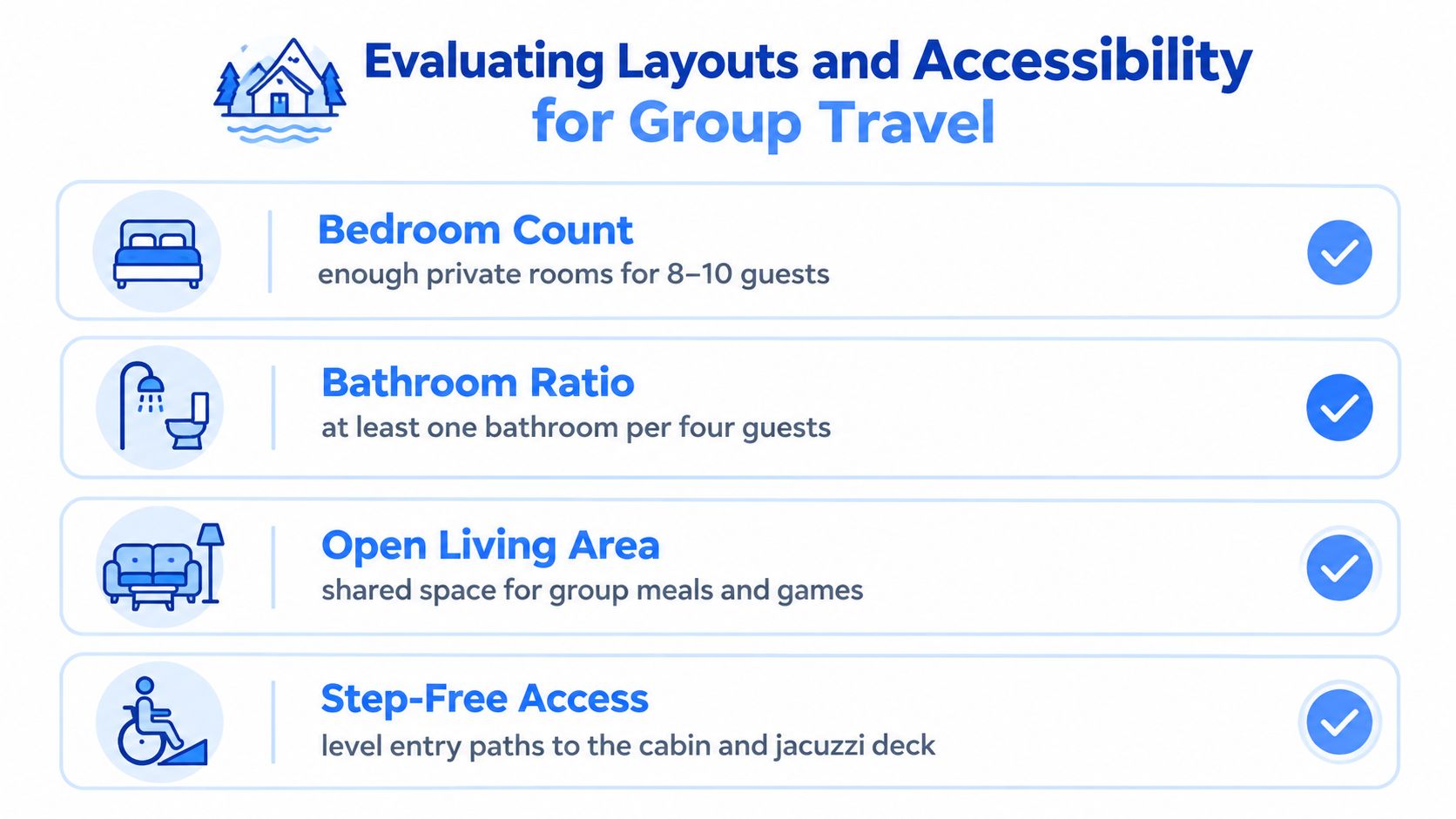
The floor plan determines whether a cabin works for a group. For 8 to 10 guests, count bedrooms, bathrooms, entrances, parking spaces, and the distance between the living area and the jacuzzi. A property can technically sleep a large party while forcing older relatives to climb stairs, leaving children without a safe route to the deck, or making every meal a scheduling exercise.
Private access beats shared convenience
A private jacuzzi gives the organizer control over cleanliness, timing, privacy, and supervision. A shared community tub introduces variables outside the rental agreement. It may be crowded, closed for servicing, subject to separate rules, or located far enough away that older guests and young children won't use it comfortably.
Attached outdoor tubs are usually easier to manage than facilities across a resort. Check whether guests must cross snow, gravel, or wet decking to reach the water. Look for a level route, handrails, nonslip surfaces, lighting, and a place to leave robes or towels. If an older relative has balance or mobility concerns, ask for current photographs of the path rather than relying on a general accessibility label.
The base itself also matters. A poorly prepared pad can create settling, drainage, or access problems. For a technical reference on preparing a stable foundation, the code ready hot tub pad guidance from Firm Foundations is more useful than a listing description that says “deck-mounted.”
Check the legal capacity, not just the sleeping capacity
Local rules can invalidate an otherwise suitable reunion booking. South Lake Tahoe, for example, limits vacation rental occupancy by bedroom count and paved parking spaces, permits up to five children aged 13 and under to be excluded from occupancy limits in homes with one or more bedrooms, and prohibits hot tub use between 10:00 p.m. and 8:00 a.m., according to the city's vacation home rental rules.
That example changes the booking conversation. A cabin might advertise enough beds for your party but lack the permitted parking or impose quiet-hour rules that conflict with your group's habits. Ask the manager to confirm the legal occupancy, parking allowance, and jacuzzi schedule for the exact property, not merely the destination.
For smaller groups, compare the cabin's private-room arrangement with the total shared space. The guide to two-bedroom cabin layouts can help you assess whether a compact property offers genuine separation or places multiple sleeping surfaces around one common room.
Use this short inspection before confirming:
- Bedrooms: Verify real bedrooms, not only loft beds or sofa beds.
- Bathrooms: Check morning capacity and whether any bathroom requires stairs.
- Parking: Confirm paved spaces, winter access, and vehicle limits.
- Jacuzzi route: Inspect steps, lighting, drainage, rails, and door clearance.
- Common space: Make sure the kitchen and dining area can handle the group without blocking circulation.
The right cabin layout reduces coordination. Guests can reach the jacuzzi safely, use the kitchen without queues, and retreat to private rooms when the group needs quiet.
Verifying Safety, Maintenance, and Energy Loads
A hot tub's quality depends on its maintenance record, not its jets. Before booking, ask who services the water, when the last check occurs before arrival, whether the host records readings, and what happens if the heater or pump fails. A professional manager should answer directly and explain the remedy, rather than treating maintenance as an invisible back-office task.
Confirm the water and temperature controls
For private and vacation homes, public-health guidance sets routine targets of free chlorine 3 to 10 ppm, bromine 4 to 8 ppm, and pH 7.2 to 7.8, with water kept at or below 104°F, or 40°C. These targets come from North Carolina public-health guidance for hot tubs. The CDC-based vacation-rental safety guidance also recommends water temperatures between 100°F and 104°F, free chlorine at 3 to 10 ppm, and pH at 7.2 to 7.8.
Use the following as a booking conversation, not as a substitute for the host's maintenance process:
| Metric | Target Range | Operational Impact |
|---|---|---|
| Free chlorine | 3 to 10 ppm | Supports disinfection when maintained and tested routinely |
| Bromine | 4 to 8 ppm | Provides an alternative sanitizer target for spa water |
| pH | 7.2 to 7.8 | Helps sanitizer work effectively and limits irritation or corrosion |
| Water temperature | 100°F to 104°F | Supports normal use while limiting heat-stress and burn risk |
Ask for a maintenance log, a recent test reading, or a smart-control display. Cloudy water, strong chemical odor, damaged covers, or vague answers should trigger a pause. Don't enter water that appears poorly maintained, and don't assume a host's claim of “freshly cleaned” means the chemistry has been checked.
Understand the electrical burden
A typical electric hot tub heater draws about 1,500 watts on a 120V system or 6,000 watts on a 240V system, while a large user dataset averages about 6 kWh per day across seasons, as explained by Direct Energy's hot tub electricity guide. The exact load depends on weather, insulation, cover use, water temperature, and how often guests open the lid.
For guests, the practical questions are simple. Does the property manager report recurring breaker trips? Is the tub on a dedicated circuit? Is the cover intact and used between sessions? A poorly insulated tub or a damaged cover can increase heat loss, and an older cabin's electrical system may not handle the demand reliably.
Hosts should also verify installation requirements before listing. Depending on the jurisdiction, a hardwired 220V installation may require an electrical permit, structural changes may need a building permit, and local rules may impose setbacks from property lines or septic systems. Fencing or barriers can also apply, as outlined in this short-term rental hot tub compliance guide.
For broader property planning, compare the jacuzzi with other infrastructure such as heating, hot water, and backup systems. A resource explaining when to replace your water heater in San Antonio illustrates why dependable mechanical systems deserve the same attention as visible amenities. Your cabin doesn't need luxury-grade equipment everywhere, but it does need systems that support the number of guests and the length of the stay. The vacation rental amenities checklist is useful for checking the jacuzzi alongside kitchens, laundry, workspace, heating, and connectivity.
Top Destinations and Extended-Stay Considerations
Mountain, rural, and winter destinations tend to support stronger jacuzzi demand, but the right market depends on your itinerary. A ski-area cabin may offer reliable winter infrastructure yet face snow access and local quiet-hour rules. A rural retreat may provide privacy and space but require longer drives for groceries, medical care, or repair support. A warm-weather cabin can be comfortable for snowbirds, but the property still needs dependable servicing for stays that last weeks.
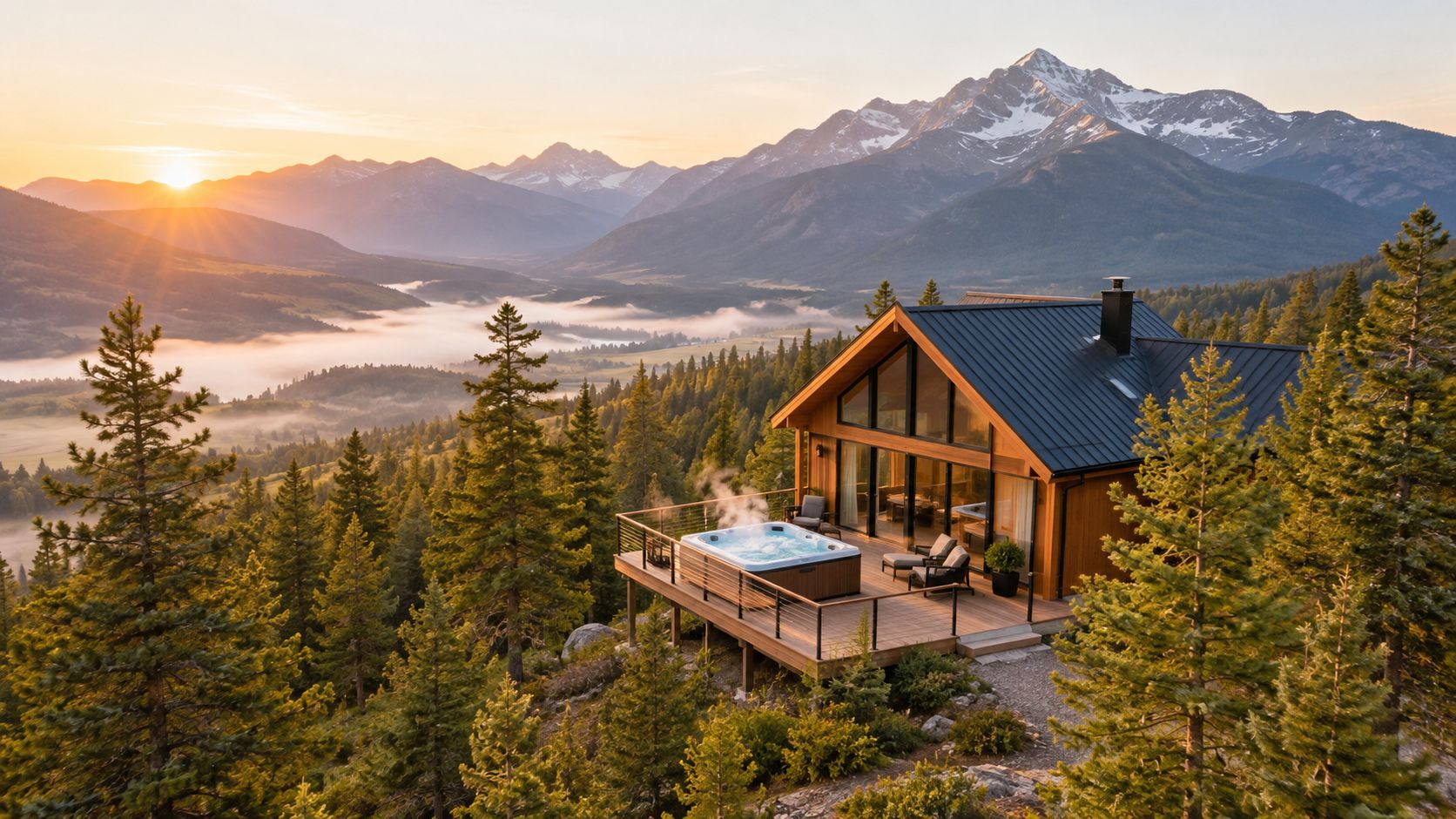
The revenue premium attached to the amenity shapes inventory quality and pricing. One industry market report valued the global hot tubs market at $5.8 billion in 2025, while short-term rental analytics cited by industry publications found hot tub listings can outperform comparable properties by 15% to 40% in nightly rate and 15% to 25% in occupancy, depending on market and season, as summarized in this hot tub selection guide for Airbnb properties. Those ranges aren't a booking guarantee. They explain why hosts in competitive leisure markets may invest more heavily in the amenity, while also passing operating and maintenance costs into the nightly rate.
Compare destinations by operating conditions
Mountain markets usually suit groups seeking snow, views, and concentrated cabin inventory. Confirm road access, snow removal, winter opening status, and whether the deck remains usable after storms. Big Bear Lake and Blue Ridge illustrate how materially the economics can differ between mountain markets, so don't assume one destination's pricing or availability pattern applies to another.
Rural lake and forest areas can work better for extended family stays because they often provide larger kitchens, parking, outdoor space, and quieter surroundings. The trade-off is distance from services. Ask how quickly a technician can respond to a failed heater or pump, and identify the nearest grocery, pharmacy, and urgent-care option before arrival.
Winter destinations require a more detailed arrival plan. Confirm that the host heats the cabin before check-in, keeps the jacuzzi open during freezing conditions, and provides a safe route from the building to the tub. A property that technically operates year-round may still restrict access during severe weather.
Before selecting a destination, evaluate:
- Seasonal reliability: Confirm operating months, weather restrictions, and preheating procedures.
- Stay length: Check laundry, kitchen storage, workspace, internet, and local supply access.
- Group logistics: Match bedrooms, parking, and legal capacity to the actual party.
- Regulatory friction: Review permits, quiet hours, occupancy rules, and jacuzzi restrictions.
- Service coverage: Ask who handles urgent repairs outside business hours.
A long stay exposes weak infrastructure quickly. The first evening may reward scenery, but the second week depends on laundry, groceries, stable internet, comfortable beds, and a jacuzzi that remains clean and available.
For planners comparing the feel of a destination before committing, this cabin-focused visual offers a useful reminder that the deck is only one part of the operating environment.
Leveraging Approved Traveler for Multi-Room Bookings
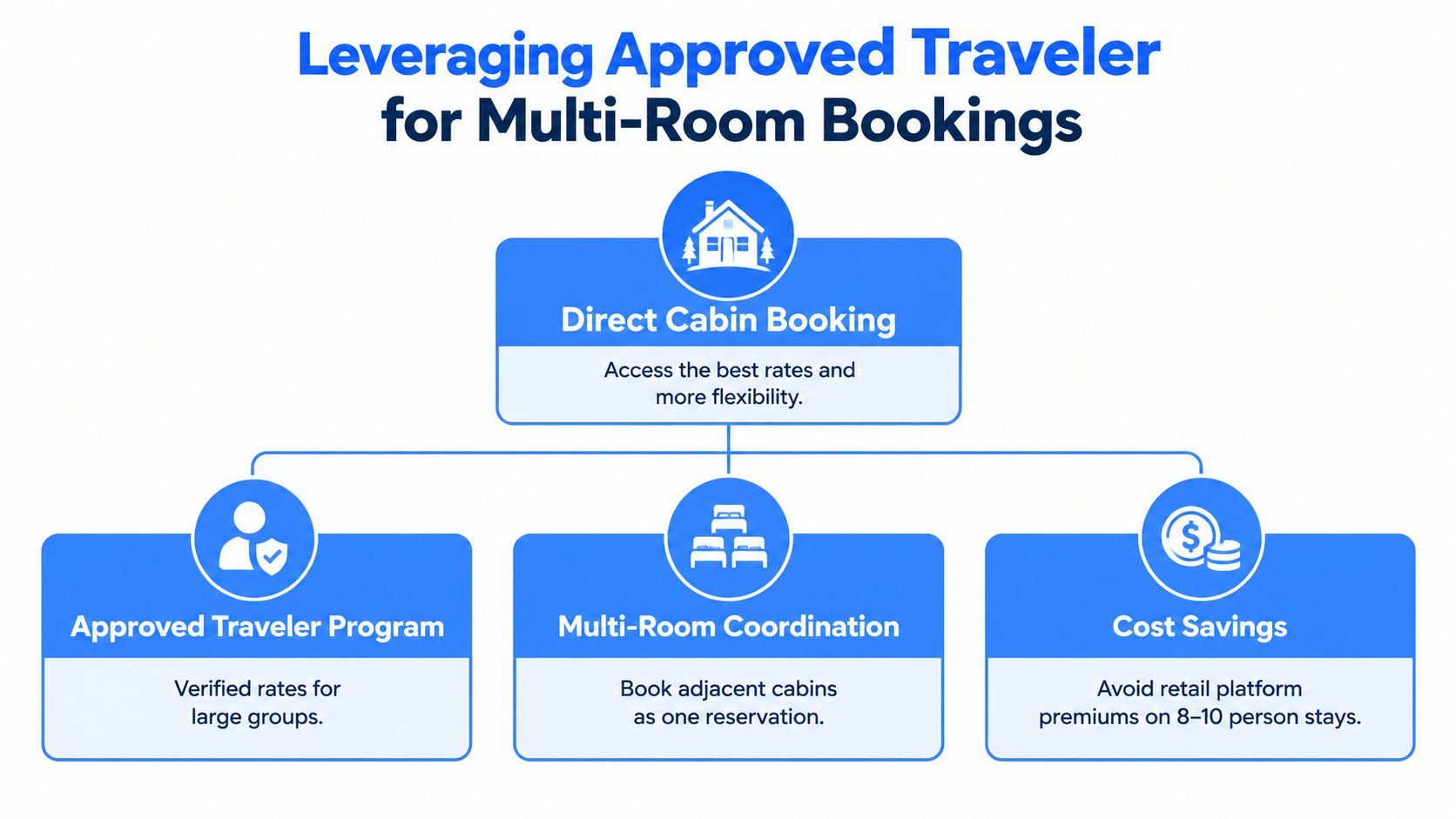
Large-group cabin planning becomes difficult when inventory is fragmented across retail booking sites, exchange networks, and separate property managers. The organizer may need one large home, adjacent cabins, or several properties in the same area, then coordinate dates, payment, cancellation terms, amenities, and arrival instructions across each reservation.
Approved Traveler treats that problem as an access and consolidation issue. Its marketplace includes access to 500,000+ vacation homes, alongside hotels, airlines, cruises, car rentals, tours, and activities, so the organizer can search broader travel inventory from one membership structure rather than assembling every trip through unrelated channels.
Build the booking around the household
A family organizer should start with the travel pattern, not the property photograph. Establish whether the group needs one large cabin or multiple nearby units, which guests require ground-floor bedrooms, whether remote workers need separate work areas, and whether every property must include a private jacuzzi.
The membership model supports up to 10 household members with benefit parity and no per-person fees. That matters when parents, adult children, and siblings participate in recurring trips. The Boomerang Member Share program also allows the primary member to earn Reward Credits on eligible hotel and car bookings made by shared family and friends, helping keep trip activity connected to the household organizer.
Use Approved Traveler as one inventory source in the comparison process. Check the property's actual cancellation terms, occupancy, jacuzzi status, parking, and accessibility directly, because platform access doesn't replace property due diligence.
Measure leverage beyond the nightly rate
The 110% Best Value Guarantee provides a defined comparison mechanism if a member finds a lower publicly available price. If the conditions apply, the refund equals 110% of the difference. Keep the public comparison, dates, room type, occupancy, and terms documented, especially for a multi-room booking where small mismatches can invalidate a price claim.
Reward Credits add another layer of household planning. Members earn them on bookings, and they don't expire. They can be redeemed toward future bookings, maintenance fees, resort usage fees, annual renewal, and eligible eGift cards, but redemption values vary, so don't assign them a fixed cash value when building the trip budget.
For a high-net-worth household with complex scheduling, Lux Traveler includes the Approved Lux 24/7 Personal Assistant and covers up to 10 household members. That support can be relevant when the cabin is only one part of the itinerary and the organizer is also coordinating flights, transfers, childcare, medical appointments, or several arrival windows.
Timeshare owners have a separate liquidity question. V.O.I.C.E. allows owners to deposit up to 5 weeks per year for credits, exchange weeks at no fee, or list weeks in a peer-to-peer rental marketplace with no listing fee. That can help an owner redirect unused inventory toward a cabin stay, though the exchange must still be evaluated for dates, location, occupancy, and jacuzzi access.
The useful insight is operational: consolidate search and household participation where it reduces coordination, then verify each property as if you were managing it yourself.
Finalizing Your Cabin With Jacuzzi Itinerary
A confirmed reservation isn't the same as a ready arrival. The last 48 hours should focus on eliminating uncertainty, especially for a group that will reach the property at different times or rely on the jacuzzi as part of the first evening.
Complete the organizer's final check
Send one concise message to the property manager. Confirm the exact address, entry method, parking arrangement, jacuzzi availability, preheating procedure, water-testing process, quiet hours, and the emergency contact. Ask whether the tub will be ready at the stated check-in time and whether weather could change access.
Then distribute the information to the group:
- Arrival details: Give each driver the address, gate instructions, parking limits, and winter-road notes.
- Room assignments: Allocate bedrooms before departure, including ground-floor options for guests who need them.
- Jacuzzi rules: Share temperature limits, shower expectations, quiet hours, maximum use guidance, and the location of towels.
- Food plan: Confirm kitchen equipment, grocery delivery access, refrigerator space, and the first meal.
- Work requirements: Test the planned internet-dependent schedule against the manager's connectivity information.
Pack the items that rentals frequently omit. Bring water-testing strips, nonslip water shoes, extra towels if the group is large, waterproof storage for phones, and a robe or cover-up for the walk between the cabin and deck. In severe cold, ask the manager whether an insulated replacement cover is already provided rather than improvising with an unsafe substitute.
Protect the first night
Don't ask the host to heat the jacuzzi far beyond the permitted range. Request normal pre-arrival heating within the property's stated safety limits, and plan a short inspection when you arrive. Check the cover, water clarity, surrounding surface, lighting, and path before anyone enters.
Children and older adults need a clear supervision plan. Assign one adult to monitor entry and exit, keep drinks and glass away from the tub, and enforce the property's quiet hours. South Lake Tahoe's prohibition on hot tub use between 10:00 p.m. and 8:00 a.m. demonstrates why local rules belong in the group message, not buried in the listing.
If the jacuzzi is cloudy, too cold, overheating, leaking, or inaccessible, photograph the condition and contact the manager before using it. Don't attempt chemical adjustments unless the manager specifically directs you. A documented report gives the host a chance to resolve the problem and protects the organizer from being blamed for a pre-existing issue.
The best arrival is uneventful. Everyone knows where to park, older relatives can reach the cabin safely, the kitchen supports the first meal, and the jacuzzi is available without a late-night argument about rules. That's the standard to use when evaluating every cabin with jacuzzi, regardless of how compelling the listing images look.
Approved Experiences Traveler provides consolidated access to vacation-home inventory, including properties that can be evaluated for jacuzzi access, group capacity, and extended-stay needs. Review the available infrastructure for your next family retreat through Approved Experiences Traveler, then verify the property's operating details before you reserve.
Want the wider view?
Ten categories. One report. Every quarter. The Approved List tracks what's rising and what's fading: data-backed signals, not opinions.
Free to join · Delivered by email