All Articles
The Journal
Cathay Pacific Economy vs Premium Economy: Is It Worth the Upgrade?
January 12, 202614 min readcathay pacific reviewpremium economy
Is the upgrade worth it? Our detailed Cathay Pacific Economy vs Premium Economy comparison covers seats, service, and real-world value for long-haul flights.

When you're staring down a 12-hour flight on the booking screen, the real question isn't just about price. It's about what that extra money buys you in comfort. Is Cathay Pacific's Premium Economy really worth the upgrade from a standard Economy seat? For anyone flying long-haul, my answer is almost always a hard yes.
This isn't just about a slightly better seat. It’s about choosing a fundamentally different travel experience—one designed to help you arrive feeling rested and ready to go, not cramped and exhausted.
Cathay Pacific Economy vs Premium Economy At a Glance
For those who need a quick answer, this table cuts straight to the chase, highlighting the most significant differences between the two cabins.
| Feature | Economy Class | Premium Economy |
|---|---|---|
| Legroom (Pitch) | 32 inches | 38 inches |
| Seat Width | 17.2 inches | 18.5 - 19.5 inches |
| Recline | 6 inches | 9 inches |
| Checked Baggage | 1 x 23kg bag | 2 x 23kg bags |
| Boarding | Standard | Priority Boarding |
| Screen Size | 11.6 inches | 12.1 inches |
While the numbers give you a good idea, the feel of that extra space is what truly matters on a long flight from New York to Hong Kong.
Evaluating the Upgrade Value
Think about it: an extra six inches of legroom doesn't sound like much on paper, but when you're trying to sleep, it’s the difference between knocking your knees and stretching out.
Cathay Pacific specifically engineered its Premium Economy cabin, launched back in March 2012, to hit that sweet spot for long-haul comfort. The seats offer a generous 38-inch pitch—that's half a foot more than you get in Economy. Combine that with a seat width of up to 19.5 inches, and you have a personal space that actually feels, well, personal. You can find more details on their cabin philosophy over at AeroTime.
Here's a visual breakdown of just how much more room you're getting across the different cabins.
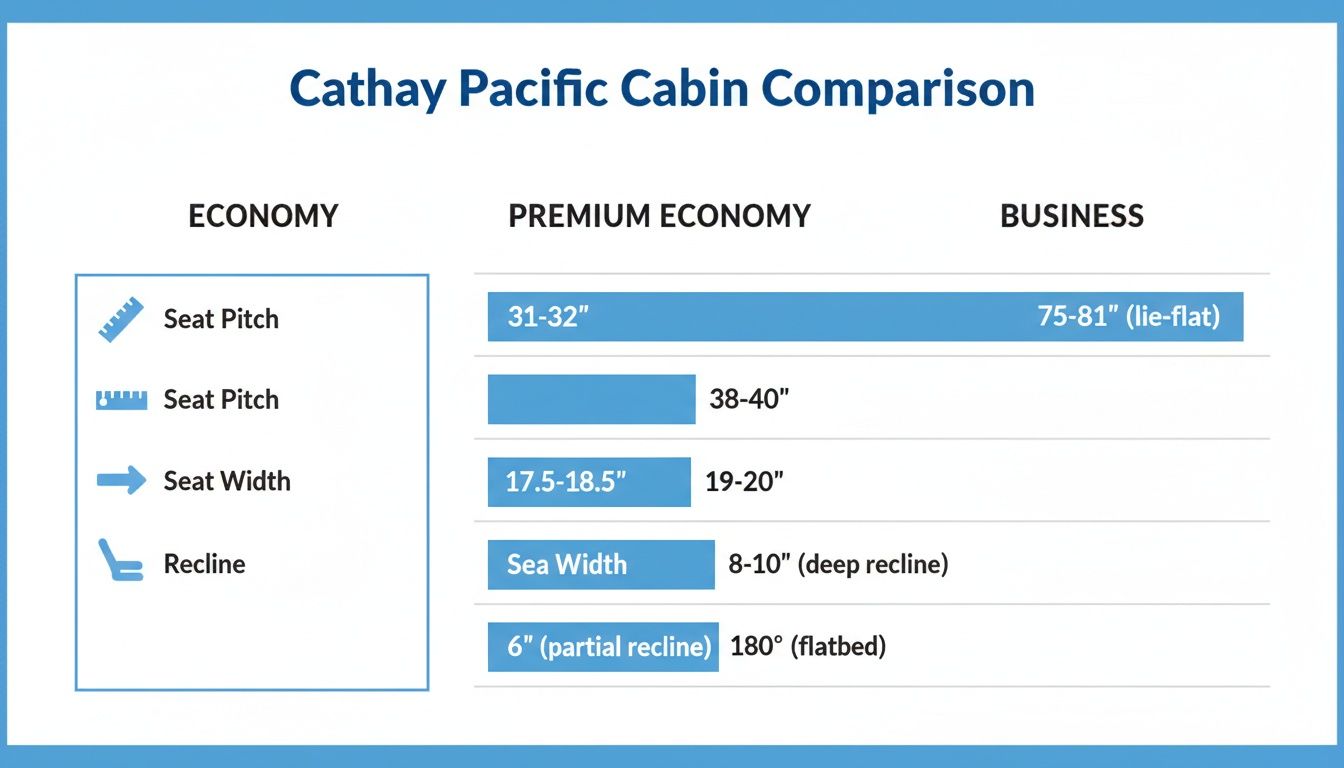
As you can see, the upgrade is more than just a marketing gimmick. It's a tangible, measurable increase in personal space—more legroom, a wider seat, and a deeper recline—that makes all the difference when you’re in the air for half a day.
The In-Seat Experience: A Tale of Two Cabins
When you’re staring down a 15-hour flight from New York to Hong Kong, the real value of an upgrade isn't in the marketing brochure—it's in how your body feels when you land. Both cabins will get you there, sure. But the difference in the in-seat experience is where your money truly goes to work.
This is where the abstract numbers on a booking screen become your physical reality.
The single biggest leap is in personal space. Premium Economy gives you a seat pitch of 38 inches, a full six inches more than the 32 inches you get in Economy. That might not sound like much on paper, but over the course of half a day in the air, it’s the difference between endurance and comfort.
From Cramped Quarters to Personal Space
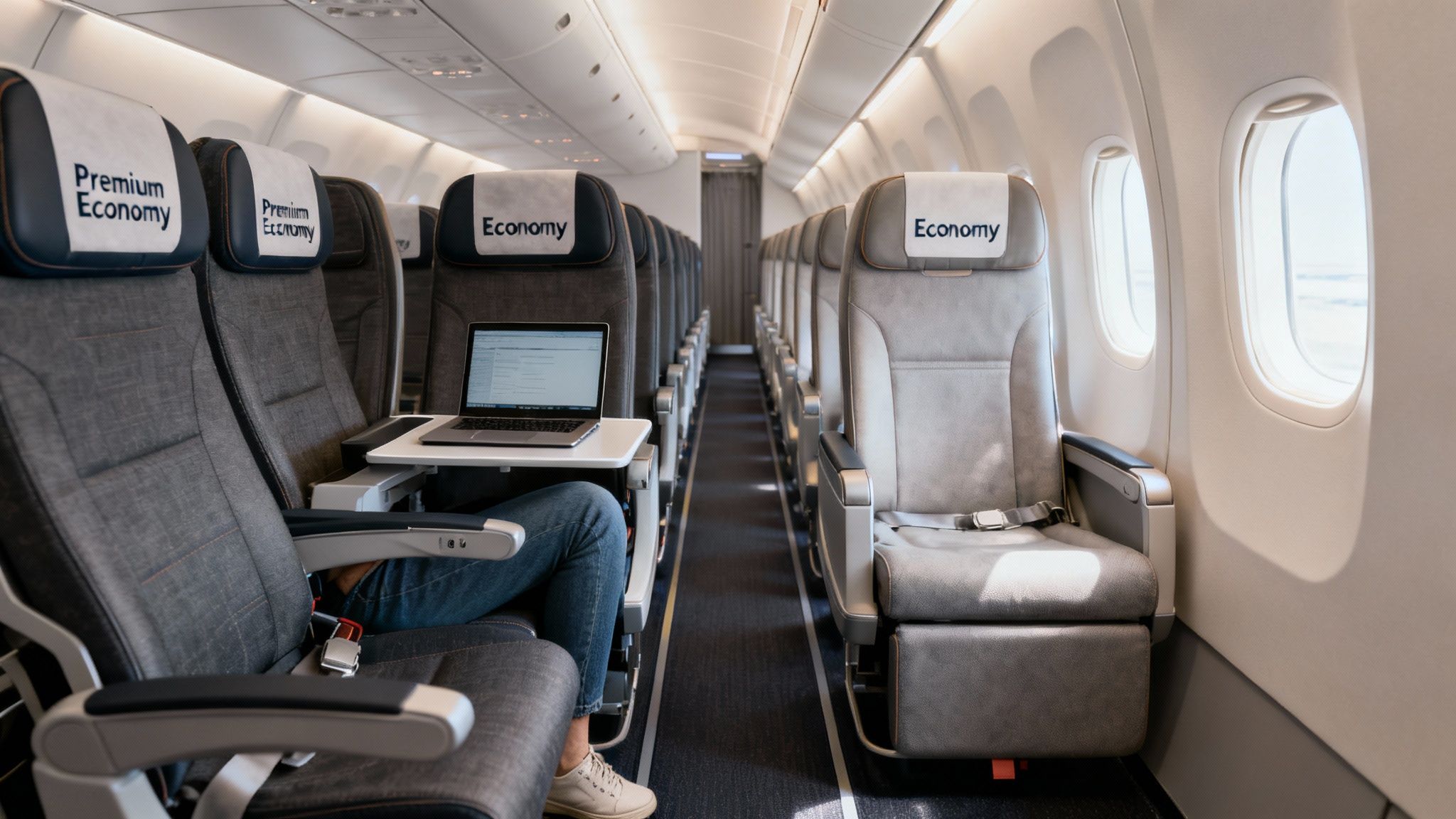
Let's get practical. In Economy, if the person in front of you reclines their seat, your laptop screen is suddenly angled at 45 degrees, making it impossible to type. You’re performing a constant balancing act with your drink, your meal tray, and your screen.
Now, picture the Premium Economy scenario. With that extra half-foot of space, you can have your laptop open and a drink on your tray table simultaneously, even when the seat in front is fully reclined. You can cross your legs without bumping the seatback. For anyone over 5'10", this isn't a luxury; it's a necessity for surviving a long-haul flight.
Actionable Insight: If you need to work or just want to watch a movie without feeling trapped, that extra six inches means you control your own space. You're no longer at the mercy of the person in front of you.
Beyond Legroom: The Nuances of Comfort
While legroom grabs the headlines, it’s the other small, thoughtful details in Premium Economy that truly fight off travel fatigue. The seat itself is wider—up to 19.5 inches compared to a snug 17.2 inches in Economy. That extra couple of inches means your shoulders aren't constantly brushing up against your neighbor.
But it doesn't stop there. The Premium Economy seat comes loaded with features designed for rest:
- A Padded Leg Rest: This is a game-changer. It supports your lower legs, boosts circulation, and takes a ton of pressure off your lower back. Practical tip: Use it during "night" hours on the flight to significantly reduce leg swelling.
- A Deeper Recline: You get 9 inches of recline versus just 6 inches in Economy. This allows you to find a far more natural sleeping angle, preventing the dreaded "head-bob" nap.
- An Adjustable Headrest: Proper neck support is everything. The multi-way adjustable headrest lets you create a cradle for your head, so you don't wake up with a stiff neck.
Put it all together, and you have a sleep setup that’s simply impossible to replicate in a standard Economy seat. Instead of stuffing your jacket behind your back for lumbar support, you can recline properly, lift your legs, and get several hours of genuine rest.
This is the heart of the Cathay Pacific Economy vs Premium Economy debate. One cabin is designed for transit. The other is designed for arriving like a functional human being.
Dining and Onboard Service: The Little Touches That Matter
The real difference between flying Economy and Premium Economy on Cathay Pacific isn't just the seat—it's the service. And it starts with a small gesture that completely changes the tone of your flight before you even leave the ground.
In Premium Economy, the crew greets you with a welcome drink—sparkling wine, juice, or water—as you get settled. It’s a simple touch, but it’s powerful. It shifts the experience from the typical herd-like boarding process to something far more relaxed and personal.
How the Meal Service Stacks Up
Once you’re in the air, the gap widens. The dining experience in Premium Economy is thoughtfully designed to feel less like an assembly line and more like a proper meal service.
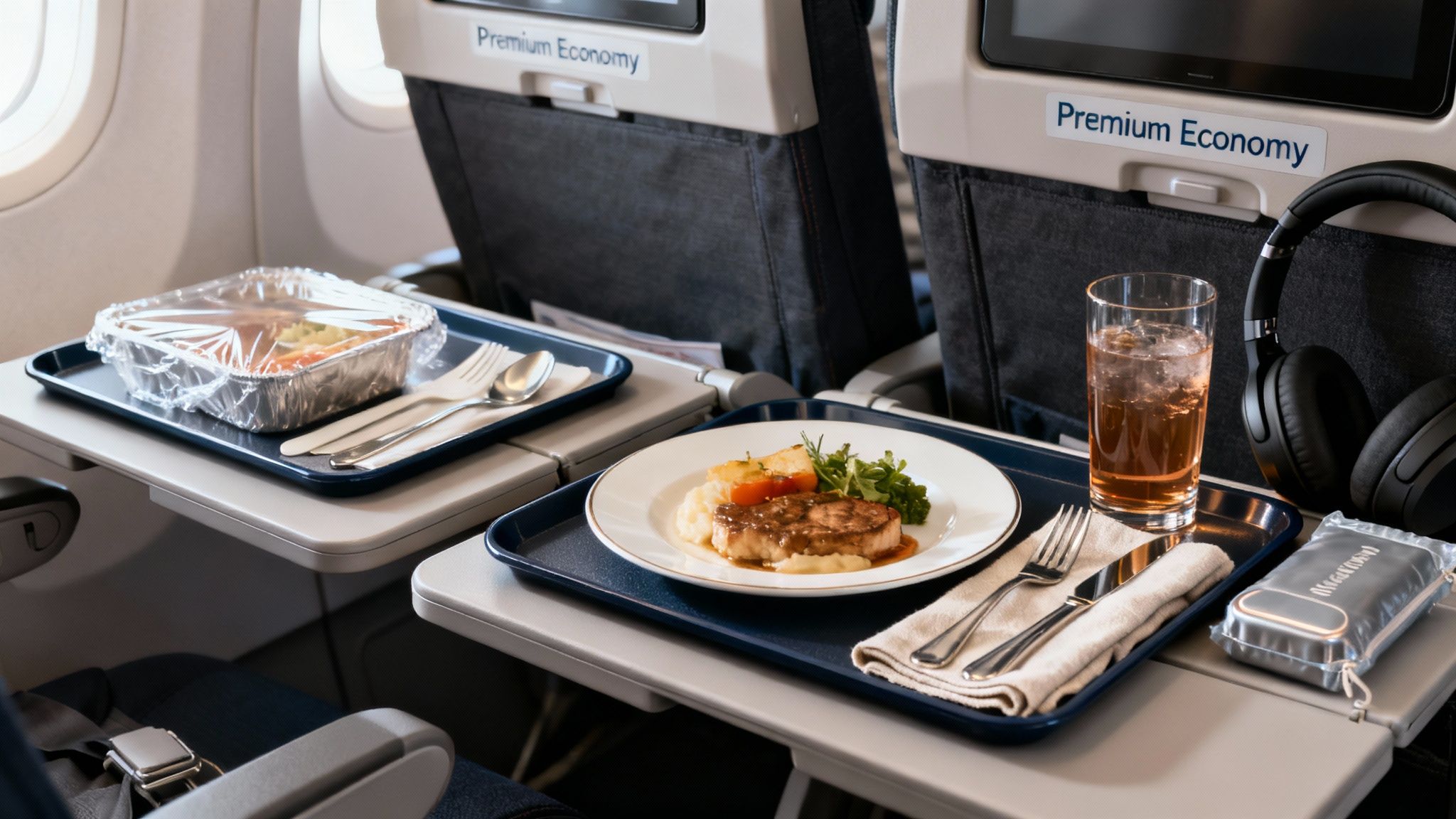
While the food in Economy is perfectly fine, it’s served on a standard, functional tray. In Premium, everything is elevated—literally. The whole process is calmer and more civilized, which makes a huge difference on a long flight.
Let's break down exactly what that looks like:
| Feature | Economy Class | Premium Economy |
|---|---|---|
| Main Courses | 2-3 standard choices | Upgraded, larger meals, often from restaurant partnerships |
| Cutlery | Plastic or basic metal | Full-size metal cutlery |
| Tableware | Standard plastic tray | Larger tray with a tablecloth and real glassware |
| Beverages | Standard soft drinks, juice, beer, wine | Expanded selection, including sparkling wine and signature drinks |
What does this all mean in practice? It means that when you cut into your chicken, your plastic fork won't bend. Your wine is served in a proper glass, not a plastic cup. These details transform the meal from a necessity into a pleasant ritual that helps break up the monotony of the flight.
Actionable Insight: The meal in Premium Economy isn't just about better food; it’s about creating a better dining environment. The improved presentation and beverage selection help break up the flight and make the whole experience feel more premium.
Beyond the Meal: Amenities That Actually Help You Rest
The enhanced service doesn't stop with food. Premium Economy passengers get a better amenity kit with higher-quality essentials, but the real game-changer is something else entirely.
Headphones.
In Economy, you get the standard flimsy earbuds. But in Premium Economy, you're handed a pair of proper noise-canceling headphones, the same kind you’d find up in Business Class. On a long-haul flight, this is an incredible perk.
These headphones do a far better job of blocking out the constant drone of the engines, letting you actually hear your movie or just get some peace and quiet. Practical example: You can watch a dialogue-heavy film without cranking the volume to max, which reduces ear fatigue and helps you relax more deeply.
Ground Experience and Pre-Flight Perks
When you're weighing Cathay Pacific Economy vs Premium Economy, the difference in experience kicks in long before you even see the plane. The real value of the upgrade starts to show its face at the airport, letting you sidestep some of the most frustrating parts of modern air travel.
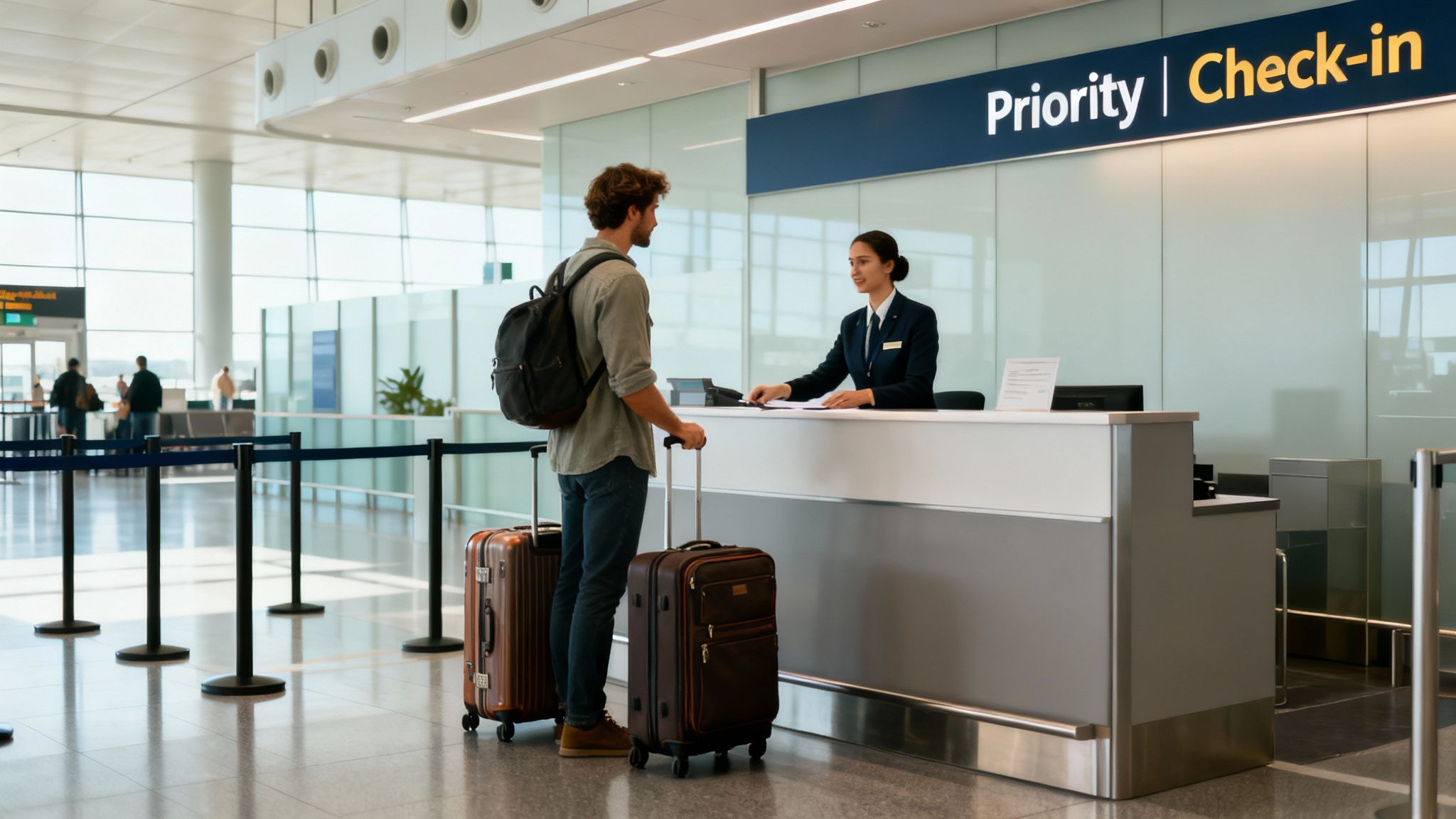
It begins right at check-in. Instead of getting stuck in the snaking Economy queue, Premium Economy passengers get their own dedicated check-in counters. At a chaotic hub like Hong Kong (HKG) or during peak season, this simple perk can easily save you 30 to 60 minutes. That’s time you can spend having a relaxed coffee instead of stressing in a line.
And that seamless feeling continues all the way to the gate.
Boarding and Baggage: The Real-World Advantages
Priority boarding isn't just about feeling important—it's about getting rid of the overhead bin anxiety. As a Premium Economy passenger, you're invited to board before the main rush, which means you can find your seat, stow your carry-on right above you, and settle in without the usual chaos. No stress, no last-minute gate checks.
But the biggest game-changer on the ground is the baggage allowance. For anyone on a long-haul flight, this is huge.
- Economy Class: You get one checked bag up to 23kg (50lbs). Standard stuff.
- Premium Economy: This is where it gets good. You get two checked bags, each up to 23kg (50lbs).
Practical example: A family of three flying Premium Economy can check six bags in total, versus only three in Economy. For a two-week trip, this means you can pack ski gear, souvenirs, or extra outfits without paying a single dollar in overweight fees, which can often exceed $100 per bag.
By doubling your checked luggage allowance, Premium Economy effectively removes one of the biggest constraints of long-haul travel, allowing for greater packing flexibility and significant cost savings.
Of course, even with a bigger allowance, you still want to be smart about what you bring on board. After choosing the perfect carry-on luggage, you can make that smooth airport experience even better.
Ultimately, these ground perks are all about one thing: reducing friction. They're designed to save you time and stress, ensuring your journey is smooth from the moment you walk into the terminal.
Finding the Real Value in the Upgrade
The sticker shock for a Premium Economy ticket can make the upgrade seem like a pure luxury. But just looking at the total fare difference is the wrong way to think about it. The smart traveler breaks it down into a metric that actually matters: what you're paying for each hour of a better experience.
I call it the "cost per hour of comfort." It’s a simple calculation that completely reframes the decision, taking it from a vague splurge to a concrete investment in your own well-being.
Do the "Cost Per Hour" Math
Let's run the numbers on a real-world route. A flight from San Francisco (SFO) to Hong Kong (HKG) is a long haul—roughly 15 hours in the air. Let's say the price difference between an Economy and Premium Economy seat is $600.
- Fare Difference: $600
- Flight Time: 15 hours
- Cost Per Hour of Comfort: $600 ÷ 15 hours = $40 per hour
Suddenly, the question isn’t, "Is the upgrade worth $600?" It's, "Am I willing to pay $40 an hour to have more space, recline further, and actually get some sleep?" On a grueling overnight flight where arriving rested is paramount, that often becomes a very easy "yes."
Actionable Insight: This cost-per-hour framework is the single most important tool for this decision. It shifts your thinking from a luxury purchase to a calculated investment in how you'll feel and function on the first day of your trip.
How to Score an Upgrade Without Paying Full Price
Paying the full cash difference isn't the only path to a better seat. If you're strategic, you can often land in Premium Economy for a fraction of the sticker price, especially since these cabins are more popular than ever.
Airlines are actively managing this demand. In fact, Cathay Pacific's recent traffic figures show its passenger load factor hit a strong 84.7% in May, with premium cabins being a major driver of that success. You can see the full trend in their official May 2025 traffic report. This high demand actually creates opportunities.
Here are the proven ways to get it done:
- Use Your Asia Miles: This is often the best value. Actionable Tip: Look for flights with more award availability (typically mid-week) and book a higher Economy fare class (like Y, B, or H) which requires fewer miles to upgrade.
- Bid on an Upgrade: After booking, log in to Cathay's "Manage Booking" section to see if you're eligible to bid. Check sites like ExpertFlyer to see how many Premium Economy seats are left. If the cabin is wide open, a lower bid might just win.
- Watch for Airline Sales: This sounds obvious, but be specific. Set up a fare alert on Google Flights or Kayak for your exact route in Premium Economy. Airlines often run flash sales to fill these seats, and the price can sometimes dip to just 20-30% more than a standard Economy ticket.
Ultimately, getting the best value in the Cathay Pacific Economy vs Premium Economy debate comes down to smart math combined with even smarter booking tactics.
Making the Right Choice for Your Trip
Deciding between Cathay Pacific’s Economy and Premium Economy isn't really about which one is “better”—it’s about which one is right for your specific trip. The answer almost always comes down to your flight time, your budget, and what you need to accomplish when you land.
Think of the upgrade not as just another expense, but as an investment in how you'll feel and function on arrival. Once you frame it that way, the choice becomes much clearer.
Matching the Cabin to Your Travel Style
Let's break it down by who you are and what your trip looks like.
Stick with Economy if you are a:
- Budget-conscious traveler: Practical example: If the $500 upgrade cost is the difference between taking the trip or not, Economy is the clear winner. Use that saved money for a great hotel or unique experiences at your destination.
- Resilient sleeper: Some people can just knock out anywhere. If a good neck pillow and noise-canceling earbuds are all you need, save your money.
- Short-haul flyer: On flights under five hours, like Hong Kong to Bangkok, you simply won't have enough time in the air to feel the full benefit of the Premium Economy seat.
Spring for Premium Economy if you are a:
- Business traveler: Practical example: If you're landing in London at 6 AM and have a 10 AM client meeting, the ability to sleep properly on the flight isn't a luxury—it's essential for your job performance.
- Family with young children: That little bit of extra room for kids to squirm, plus the priority services, can be the difference between a smooth trip and a stressful ordeal.
- Couple on a special trip: A honeymoon, an anniversary—start the vacation the right way. The enhanced comfort sets the perfect tone from the moment you board.
- Long-haul traveler on an overnight flight: This is the big one. For any flight over eight hours, especially a red-eye, the ability to properly recline and get a few solid hours of sleep is an absolute game-changer.
The decision boils down to this: Economy is a transaction to get you from A to B. Premium Economy is an investment in how you feel and function when you arrive at B.
And it's clear travelers are making that investment. Cathay Pacific has seen passenger numbers jump by 27.6% year-to-date, with load factors hitting an incredible 93.4% on a single day. This surge, especially on long-haul routes to the UK and the Americas, shows just how much business and student travelers value that extra comfort. You can see the full numbers in Cathay Pacific's recent traffic performance report.
A Few Lingering Questions
Even after a side-by-side look, you probably have a couple of specific questions floating around. Let's tackle the most common ones to help you lock in your decision.
Does Premium Economy Get Me Into the Lounge?
I get this one a lot, and the short answer is no—a standard Premium Economy ticket won't get you past the velvet rope. Lounge access is one of those perks Cathay reserves for its Business and First Class passengers, along with high-tier Cathay and Oneworld alliance elites.
Actionable Insight: Don't let this stop you. Use an app like LoungeBuddy to purchase one-time access, or check your credit card benefits. Cards like the American Express Platinum or Chase Sapphire Reserve often include Priority Pass membership, giving you access to lounges worldwide regardless of your ticket class.
What’s the Real Story on Baggage Allowance?
Here’s where Premium Economy delivers a huge practical win. Passengers get a much healthier baggage allowance. On most long-haul flights, you can check two bags of up to 23kg (50lbs) each.
That's literally double the single bag you get in standard Economy. If you're a family packing for two weeks or someone who never comes home empty-handed, that extra bag can save you well over $100 in excess fees right off the bat.
The Bottom Line: That doubled baggage allowance isn't just a small perk; it's a real financial benefit that can easily offset a good chunk of the upgrade cost, especially if you know you're a heavy packer.
Can I Upgrade After I've Already Booked an Economy Ticket?
Yes, you absolutely can, though it all comes down to timing and availability. Cathay Pacific gives you a few ways to play this.
The most common route is their online bidding system. As your flight gets closer, keep an eye out for an email inviting you to place a cash bid for a seat in the next cabin up. The other popular strategy is to use your Asia Miles—Cathay’s loyalty points—to request an upgrade. Success here often depends on your original ticket's fare class and your frequent flyer status, but it's always worth a shot.
Ready to turn your travel dreams into reality with unmatched savings? As a member of Approved Experiences Traveler, you can unlock wholesale pricing on flights, hotels, and more, making that Premium Economy upgrade more affordable than ever. Discover how thousands are saving on luxury travel at https://www.approvedexperiences.com.
Want the wider view?
Ten categories. One report. Every quarter. The Approved List tracks what's rising and what's fading: data-backed signals, not opinions.
Free to join · Delivered by email