
All Articles
The Journal
Cruise Planning Checklist: 10 Steps for 2026
October 1, 202621 min readcruise planningfamily cruise
Use this cruise planning checklist to compare itineraries, book travel, prepare documents, coordinate families, manage costs, and follow up after sailing.

A family cruise rarely fails because someone forgot sunglasses. It fails when a grandparent's cabin is far from the elevators, one passport expires too soon, a flight arrives after embarkation, or twelve people make onboard purchases without a shared budget. The fare is only one part of the operation. You're coordinating inventory, cabins, flights, hotels, transfers, documents, dining, excursions, accessibility, spending, and the records you'll need after disembarkation.
This cruise planning checklist follows the trip by decision timing. You'll compare 44+ cruise lines and 30,000+ itineraries, secure cabins and transport, verify documentation, reserve activities, control onboard spending, and reconcile the trip afterward. It works for an individual traveler, a couple, or a multi-generational household using Approved Traveler to consolidate cruise, airline, hotel, car, and activity inventory in one travel infrastructure.
Demand makes timing more important. CLIA reported 31.7 million global cruise passengers in 2023, up from 29.7 million in 2022, with 2023 volume reaching 107% of 2019 levels. CLIA later reported 34.6 million passengers in 2024, showing continued expansion after the pandemic-era reset. CLIA's 2024 State of the Cruise Industry Report supports a practical conclusion: don't treat cruise planning as a single booking event. Build the plan before you board, then assign someone to maintain it.
1. Verify Cruise Line Inventory Across 44+ Carriers and Compare Itineraries
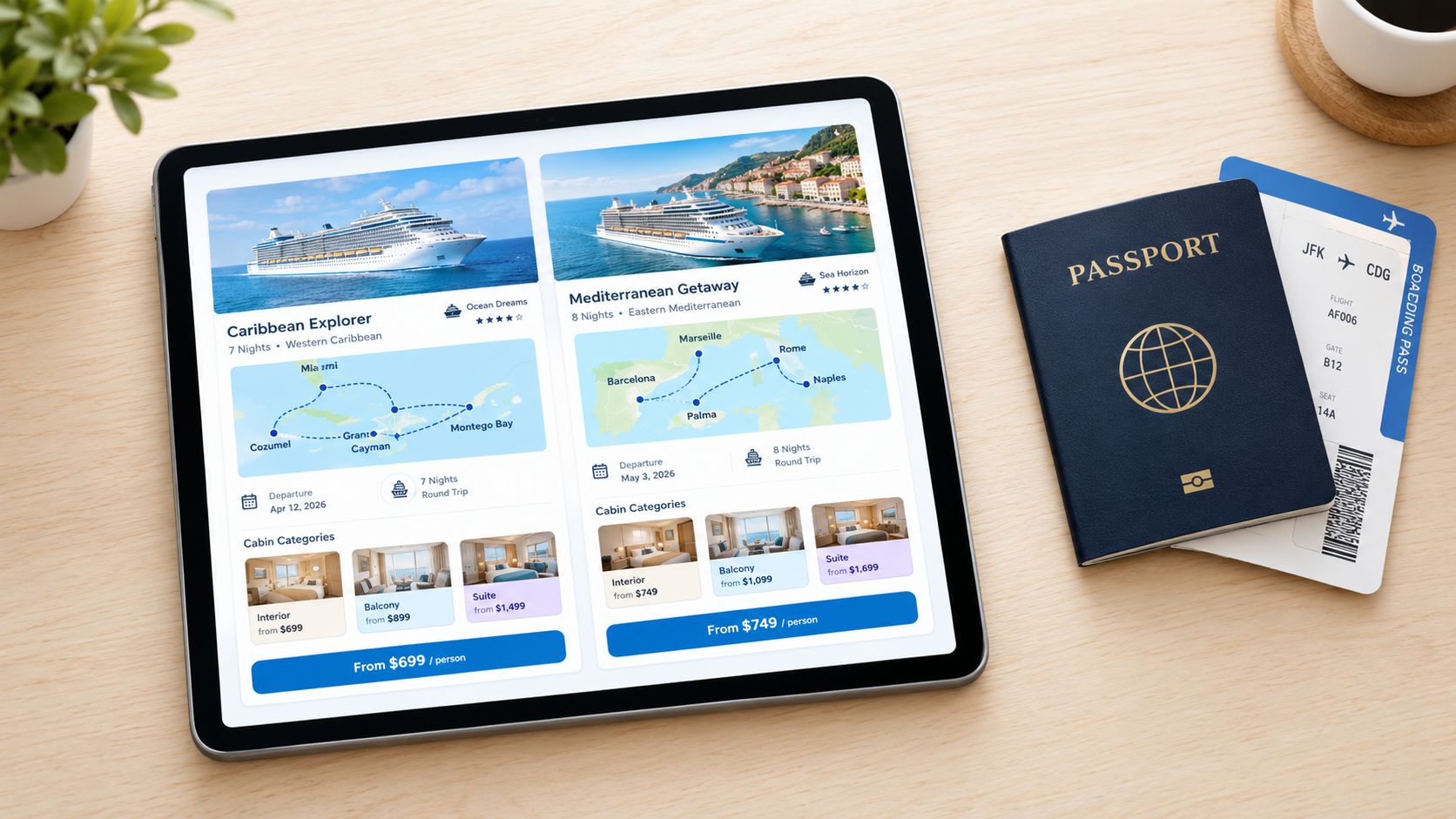
At 120 days, establish the inventory baseline before a cabin, flight, or hotel narrows the decision. Approved Traveler provides access to 44+ cruise lines and 30,000+ itineraries in one interface, allowing comparisons of departure ports, cabin categories, amenities, sailing dates, and per-person pricing across Royal Caribbean, Carnival, Norwegian, Viking, Disney Cruise Line, and other carriers.
Compare sailings against the same household requirements. For an Eastern Caribbean trip, review itinerary length, embarkation port, sea days, cabin position, dining structure, children's programming, and transfer needs before judging the fare. A Galveston sailing may appear attractive until flights, a hotel, and ground transport are added. A Miami departure may carry a higher cruise fare while reducing travel complexity for the group.
Search by constraints first
Set the filters in this order:
- Cabin requirement: Identify whether an inside, ocean-view, balcony, suite, or accessible stateroom fits the travelers before comparing totals.
- Port access: Add flights, pre-cruise accommodation, parking, and transfers to the port decision.
- Household fit: Check kids' clubs, adult-only spaces, dining flexibility, medical access, and mobility requirements.
- Itinerary quality: Review port duration, tender ports, sea days, and whether available excursions match the group's pace.
At 90 days, save the strongest options and record why each one qualifies. At 60 days, recheck pricing, cabin availability, and transport costs. For repeat cruisers, compare loyalty benefits with the wider inventory. Onboard credit or an upgrade may matter, but neither should outweigh a better sailing, cabin location, or departure port without a clear value difference.
Use alerts and revisit the same itinerary instead of restarting the search under pressure. For selection context, read this guide to the best cruise booking sites. If the trip includes a separate land stay, browse curated safari tours as another itinerary reference.
Practical rule: At 30 days, approve the option whose total cost and operational burden fit the household, not merely the lowest cruise fare.
2. Lock in Cabin Selection and Pre-Assign Staterooms for Multi-Cabin Bookings
Cabin assignments can determine whether a family trip feels coordinated or fragmented. Before paying, match each traveler to a specific stateroom and record the cabin number, deck, bed configuration, accessibility requirements, and preferred distance from the rest of the group. Adjacent rooms may support supervision, while cabins on the same deck can simplify meetups without forcing every traveler into one area.
A twelve-person group might choose four ocean-view staterooms together, while grandparents may need a quieter cabin near elevators and dining venues. Families with young children often benefit from nearby rooms, but a cabin beneath a nightclub, pool deck, theater, or service area can create noise problems. Check the deck plan above and below each room. Labels such as “lower deck” or “near the center” do not show the full operational picture.
Build the rooming plan around people
Assign rooms by need, then verify the arrangement against the ship's layout:
- Mobility: Record accessible-stateroom requirements, equipment clearance, bathroom access, and elevator proximity in the booking notes.
- Sleep: Check nearby venues, crew-service areas, theaters, and mechanical spaces before accepting a location.
- Supervision: Place children near supervising adults. Independent adults can stay farther from the family hub.
- Household records: Keep cabin numbers, emergency contacts, dining assignments, and account permissions in one shared document.
For larger households, Approved Traveler can consolidate multi-cabin bookings so one coordinator can manage assignments instead of relying on separate reservations. Use the same booking view to compare two-bedroom cabin options when privacy and shared space matter more than placing every traveler in adjacent rooms.
At the 60-day checkpoint, confirm that requested cabins remain assigned and that bed configurations match each traveler. At 30 days, review the final cabin map with the group. If the cruise line changed an assignment, contact the booking team before departure, while alternatives may still be available. Resolving an accessibility, noise, or supervision issue ashore is easier than addressing it after boarding.
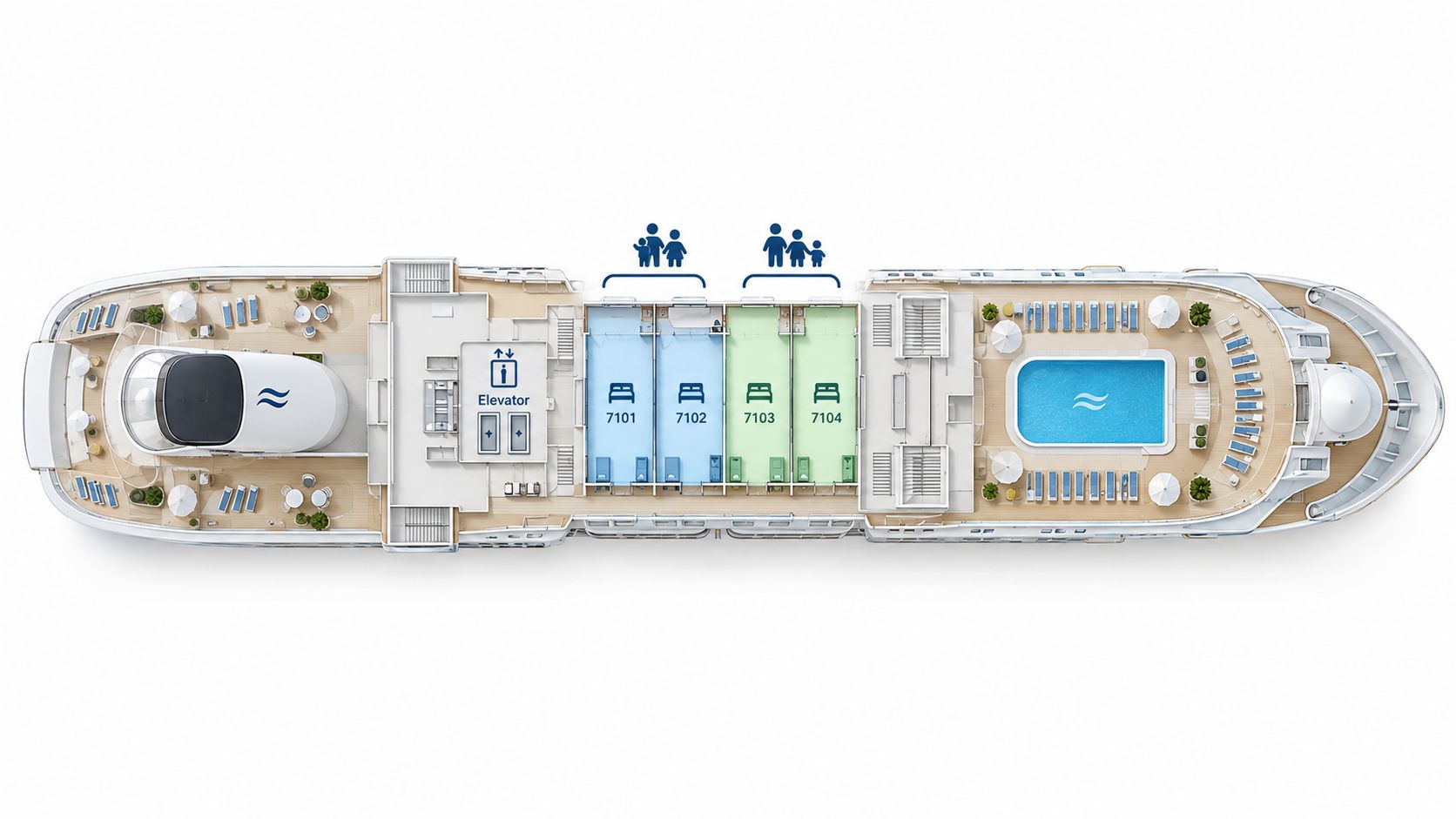
Use the deck plan during a family call. Mark each room, trace the main circulation paths, and choose a meeting point that does not depend on everyone finding the same elevator.
3. Coordinate Travel, Pre-Cruise Hotel, and Port Transfers for All Household Members
A cruise departure can fail before anyone reaches the ship. A delayed flight, missing car seat, or transfer too small for the luggage can disrupt the entire household. Build the land portion around the embarkation time, with enough margin for weather, baggage delays, and different mobility needs.
At 120 days, identify arrival windows for every traveler and decide whether the group needs a shared hotel night. Separate flights may offer better schedules or lower fares, but they also create different arrival times and more transfer coordination. For multi-generational households, an overnight near the port often provides better protection than a same-day connection.
Use Approved Traveler as the central booking record for flight confirmations, hotel details, transfer reservations, mobility notes, and emergency contacts. Its access to 700+ airlines and 1M+ hotels allows the coordinator to compare related bookings in one place. A group travel planning platform guide can help establish responsibilities when several households are traveling together.
Set checkpoints for the ground plan
At 90 days, confirm the pre-cruise hotel, room requirements, and the preferred transfer method. Check vehicle capacity for luggage, wheelchairs, walkers, car seats, and every passenger. A rental vehicle can suit a large group staying before the cruise, while separate rides may work better for travelers arriving at different times.
At 60 days, record driver instructions, pickup locations, flight numbers, and backup contacts. For Lux Traveler members, the Approved Lux 24/7 Personal Assistant can handle preferred airlines, hotel requirements, flight monitoring, and port transfers. Provide names, arrival windows, mobility needs, and the person authorized to approve changes.
At 30 days, compare the plan against actual arrival times. Reconfirm the port departure time and allow for hotel checkout, luggage loading, traffic, and the group's slowest traveler. Keep a backup option if a flight arrives late.
At 0 days, carry a printed transfer plan. Include addresses, confirmation numbers, driver details, and emergency contacts. A paper copy prevents a tired family at a busy port from searching several apps for instructions. Complete health preparation before travel by reviewing where to find affordable travel vaccines.
4. Secure Necessary Documentation and Verify Passport and Visa Requirements by Destination
A missing passport or visa can hold up an entire household at check-in. Review documents by traveler, citizenship, and port of call. A closed-loop cruise from a U.S. port may let a U.S. citizen use government-issued photo identification and proof of citizenship, while other itineraries and nationalities may require passports and visas. American Express Travel explains that some U.S. and Canadian citizens on closed-loop cruises can use photo identification plus proof of citizenship, while other non-U.S. and non-Canadian travelers generally need passports and necessary visas. Its cruise documentation guidance also reinforces reviewing every destination and carrying printed records.
At 120 days before sailing, create a private household document register. Record each traveler's citizenship, passport number, expiration date, visa requirement, birth certificate status, and emergency contact. Add fields for copies received and the date each item was verified. This separates a family-wide paperwork problem from one traveler's unresolved requirement.
Use the itinerary as the control document:
- Passport validity: Check the cruise line's rules and each destination's requirements, not only the embarkation country.
- Visa requirements: Verify transit and port-entry rules for every nationality in the group.
- Closed-loop eligibility: Confirm whether photo identification and citizenship evidence are accepted for that itinerary.
- Minor documentation: Order certified birth certificates and confirm parental consent requirements where relevant.
- Printed records: Prepare boarding documents, hotel confirmations, excursion details, transportation records, and copies of originals.
By 90 days, resolve applications, renewals, and missing certificates. At 60 days, compare the register with the cruise line's online check-in requirements. A cruise planning packet may require each participant to submit paperwork one month before sailing, while other cruise operations require a pre-cruise questionnaire before a meeting. These deadlines place document control inside the cruise workflow rather than at packing time.
At 30 days, verify that every approved document matches the booking name. At 0 days, keep originals in a secure carry-on and copies separately. Store encrypted digital copies where the designated coordinator can access them, but retain paper records for a dead phone battery or unavailable port connection.
5. Review Cruise Contract Terms, Cancellation Policy, and Travel Insurance Options
Review the cruise contract as soon as the booking is held. It sets payment deadlines, occupancy rules, dining arrangements, cancellation penalties, liability limits, medical procedures, and the line's response to weather or port changes. Keep the contract with the booking confirmation, since the confirmation alone may not show the full terms.
At 90 days before sailing, identify the cancellation deadline, remaining balance date, refund method, and documentation required for a claim. Examine the penalty schedule closely. A common structure increases cancellation penalties at 90, 60, and 30 days before departure, with the most restrictive terms nearest sailing. Check each cabin separately when one household booking contains different fares or passengers.
Compare coverage by risk
Match insurance to the entire trip, not only the cruise fare. A multi-cabin itinerary may include flights, hotels, transfers, excursions, and medical expenses. Check whether the policy covers:
- Trip cancellation and interruption: Covered reasons, proof requirements, and exclusions.
- Medical treatment: Limits, deductibles, overseas care, and pre-existing-condition wording.
- Evacuation: Medical necessity, transport type, and destination restrictions.
- Baggage: Reimbursement limits, delayed-bag rules, and receipts.
- Cruise disruption: Missed connections, quarantine, and itinerary changes.
A traveler with a chronic condition should disclose it accurately and confirm when the policy must be purchased for a pre-existing-condition waiver. Record medications and medical history securely for onboard treatment and claims.
At 60 days, verify that policy limits cover the largest unrecoverable costs. At 30 days, save the policy, cancellation schedule, receipts, and contact numbers with the booking records. The right choice is the policy whose exclusions you understand and whose limits fit the itinerary's main financial and medical risks.
6. Book Activities, Dining Reservations, and Excursions 60+ Days Pre-Departure
A popular excursion may fill before the ship sails, while a flexible activity can wait. At 60 days, review the remaining inventory and reserve anything with limited capacity, fixed timing, or accessibility requirements. This checkpoint protects the schedule without locking every hour of the trip.
Reserve the activity with the tightest return window first, then fit meals around it. A shore tour that ends late may rule out an early specialty dinner. Families with young children may prefer an early shared meal, while a mixed-age household can combine one group reservation with separate activities.
Use this order when building the calendar:
- High-demand excursions: Check duration, walking distance, tender requirements, meeting points, cancellation terms, and the buffer before all-aboard time.
- Dining: Confirm table size, seating time, dietary needs, and whether cabins can be grouped under one reservation.
- Children's programming: Review age bands, registration rules, supervision, and required forms before promising the activity to a child.
- Mobility and recovery time: Leave practical space between long walks, meals, excursions, and transfers across the ship.
- Independent tours: Compare customization and price with the responsibility for transport, timing, and return to the vessel.
A cruise-line excursion may cost more, but its port timing is usually easier to coordinate when a call is short. An independent operator can provide a better fit for the household, provided someone verifies vehicle access, meeting points, cancellation rules, and a conservative return buffer.
For a specialized day ashore, consider a private cruise with Northern Spain Travel when it fits the broader itinerary.
Store confirmations, payment records, meeting instructions, and accessibility notes in the shared calendar. At the 30-day review, check for schedule changes and waitlists. At 0 days, keep offline copies on the phones of the travelers responsible for each booking. A reservation that only one person can retrieve creates avoidable risk for a multi-cabin household.
7. Establish Onboard Budget and Allocate Dining, Beverage, and Activity Spending
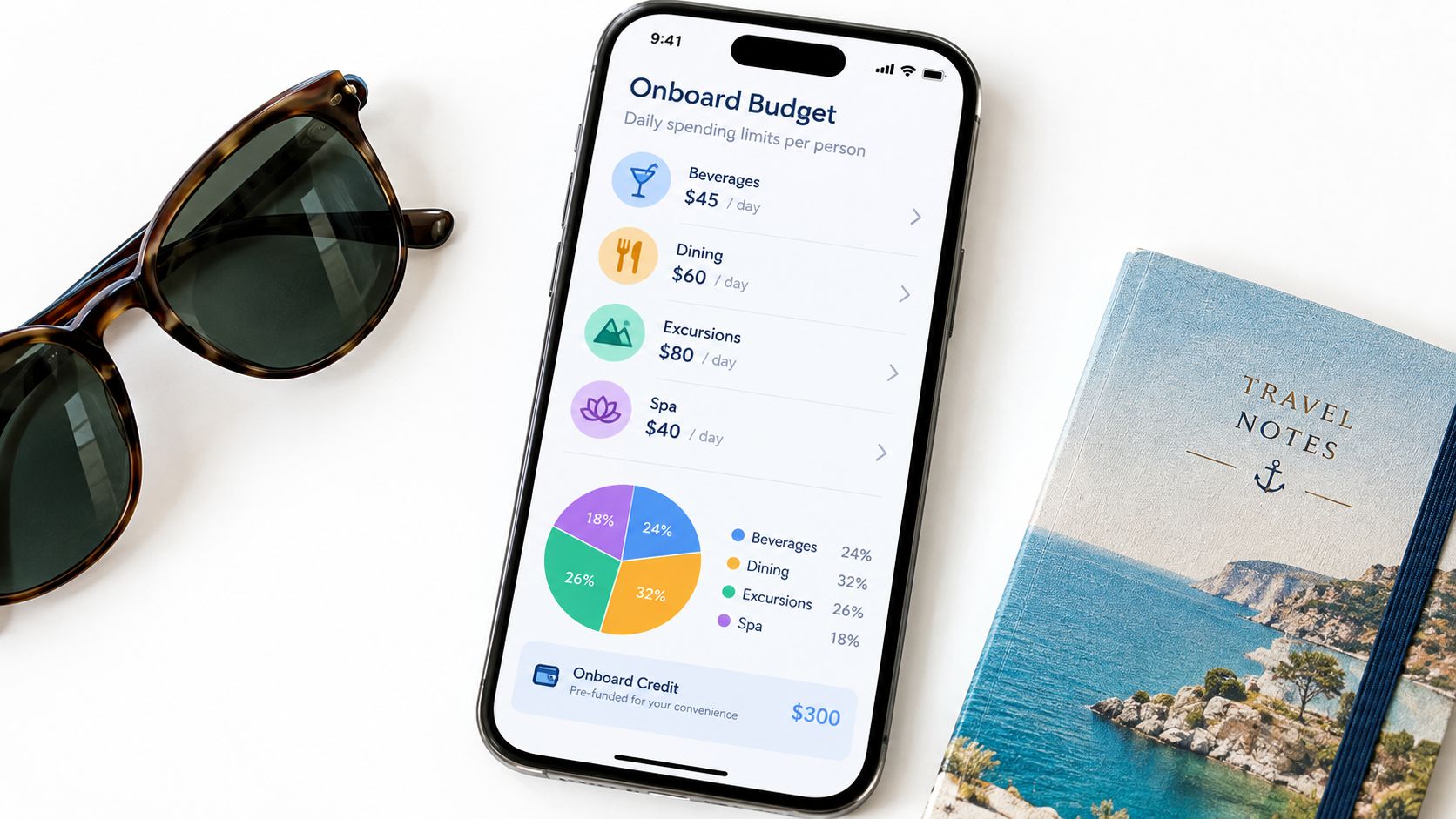
Set the onboard budget before departure, then separate committed costs from choices made at sea. Start with the cruise fare, taxes, required fees, flights, hotel nights, transfers, and gratuities. Add specialty dining, beverage purchases, spa services, casino spending, premium activities, excursions, and internet access. Automatic daily gratuities can range from about $10 to $15 per passenger per day or about $14 to $23 per person per day, depending on the guide and cruise line. On a seven-night sailing, that may add roughly $98 to $161 per guest before extras. This gratuity comparison shows why gratuities belong in the initial estimate.
Use a simple allocation for each traveler or cabin:
| Cost category | Include |
|---|---|
| Base cost | Fare, taxes, required fees, flights, hotel, and transfers |
| Prepaid cost | Excursions, dining, beverage packages, internet, and insurance |
| Daily discretionary cost | Drinks, shopping, casino, spa, and premium activities |
| Contingency | Medical needs, transport changes, or missed connections |
Separate shared and personal allowances. The household might fund one shared excursion while each adult chooses a spa treatment or specialty meal. Mark those decisions before boarding so a teenager's purchase, one couple's premium dining, or a last-minute tour is not charged to the group by assumption.
Check beverage packages against actual habits and included categories. Frequent purchases may justify a package, while à la carte pricing can suit a traveler who drinks little. Buying a package for every household member without comparing expected use can waste money.
Keep service charges visible as their own line. According to Frommer's cruise gratuity guidance, many lines add automatic gratuities of about 15% to 20% to some specialty dining, spa, and beverage purchases. Review the fare, prepaid items, daily allowance, and contingency at the 30-day checkpoint, then reconcile actual charges at 0 days after disembarkation.
8. Establish Household Rules, Budget Controls, and Communication Protocol for Onboard Spending
A teenager buys an activity, one adult orders a premium meal, and the charge reaches the shared cruise account. Without agreed rules, the household may argue about approval instead of enjoying the trip. Set spending boundaries before boarding and assign one financial coordinator to review account activity.
Write the rules where every adult can access them. Identify shared purchases, personal allowances, child authorization, and whether unused funds remain available. Parents might permit teenagers to charge approved activities while requiring approval for casino spending, premium dining, or expensive merchandise. Keep private adult spending separate from group totals.
Use a short daily check rather than waiting for the final statement:
- Review charges: Match onboard purchases with receipts and investigate unfamiliar items promptly.
- Confirm approvals: Check that restricted purchases received the required authorization.
- Report the balance: Post a concise household summary in the family group chat.
- Resolve disputes: Address errors before checkout and the final statement.
- Protect privacy: Share rules and shared totals without exposing another adult's personal spending.
Financial controls work better when paired with a communication plan. Set meeting points after breakfast, before dinner, and after port days. Keep changes in one designated message thread, with a backup contact for older travelers who may need help. This reduces repeated calls to the coordinator and makes schedule changes visible to the household.
Reward Credits may cover eligible travel expenses, subject to the applicable redemption rate. Confirm that rate before assigning credits to the plan, and record which expense they will fund. Treat them as a planned funding source, not as approval to increase the household budget.
At the 30-day checkpoint, confirm the rules, allowances, communication thread, and payment permissions. At 0 days, compare the final statement with receipts and settle shared balances before everyone leaves the port.
9. Membership Tiers, Services, and Fees
Treat membership as an operating-cost decision, not a cruise upgrade. Before enrolling, map the next 12 months of flights, hotels, cruises, car rentals, vacation homes, tours, and activities. Count the separate searches, reservations, payment records, and follow-ups your household would otherwise manage. A consolidated platform is more useful when that workload is recurring and involves several travelers.
Approved Traveler provides access to inventory across 1M+ hotels, 700+ airlines, 44+ cruise lines, 30,000+ itineraries, 30,000+ car rental locations, 500,000+ vacation homes, 5,500+ tour packages, and 150,000+ activities. Use that breadth to compare actual bookings on your calendar, rather than assuming access alone creates savings or convenience.
The Traveler tier is listed at $899 per year and provides marketplace access. Lux Traveler is listed at $1,799 per year and includes the Approved Lux 24/7 Personal Assistant, with coverage for up to 10 household members. The higher fee has a clearer rationale when one person coordinates delays, multi-city arrivals, transfers, medical needs, or childcare across multiple bookings. If your plans usually involve one straightforward sailing, that service may add little practical value.
Before choosing, document:
- Expected use: List the bookings you would place through the platform during the year.
- Household coordination: Confirm who can make reservations, change plans, and manage shared travel details.
- Fee recovery: Compare the annual fee with expected booking value, time saved, and any applicable 110% Best Value Guarantee, subject to its terms.
- Exit test: Ask whether you would renew if the next cruise were your only major booking.
Review Reward Credits separately from the membership decision. Confirm how they accrue and where they may be redeemed before including them in the travel budget. The right tier is the one supported by repeated use, clear account responsibility, and a travel calendar complex enough to justify consolidated management.
10. Reward Credits, Boomerang Member Share, and Redemption Strategies
Reward Credits should have an assigned job before the cruise is booked. Eligible bookings can generate credits, while household sharing may consolidate accrual when several travelers use the same account structure. Boomerang Member Share also allows a primary member to earn Reward Credits from eligible hotel and car bookings made by shared family and friends, subject to program terms.
Create a simple decision record at booking time:
- Source: Identify the household reservation producing the credits.
- Status: Track accrued, pending, redeemed, and remaining balances.
- Purpose: Assign credits to onboard spending, a pre-cruise hotel, an activity, or a future booking.
- Approval: Name the person authorized to approve a shared redemption.
- Timing: Confirm when credits become available and whether cancellations change the balance.
Check the redemption terms for the specific expense. A credit's value or eligibility may differ by use, so build the household budget around confirmed redemption rules rather than an assumed rate. This checkpoint matters most when several cabins, travelers, or final onboard charges are being coordinated.
After disembarkation, reconcile the account once final charges and cancellations have settled. Record what was redeemed, what remains, and who controls the next decision.
Longer-term planning requires the same discipline. Review permitted uses for future bookings and renewal-related redemptions, and treat credits as program benefits rather than cash. Households with unused timeshare weeks may also review V.O.I.C.E. options. Subject to program terms, members can deposit up to 5 weeks per year for credits, exchange weeks at no fee, or list weeks through its peer-to-peer rental marketplace.
10-Point Cruise Planning Checklist Comparison
| Item | Implementation Complexity 🔄 | Resource Requirements ⚡ | Expected Outcomes ⭐ | Ideal Use Cases 📊 | Key Advantages 💡 |
|---|---|---|---|---|---|
| Verify Cruise Line Inventory Across 44+ Carriers and Compare Itineraries | Medium, account setup and platform learning | Membership fee (e.g., $899/yr), internet, search time | High ⭐⭐⭐, fast cross-carrier price & itinerary discovery | Price-shopping across carriers; itinerary optimization | Consolidated 30k+ itineraries, cabin-level comparisons, wholesale rates |
| Lock in Cabin Selection and Pre-Assign Staterooms for Multi-Cabin Bookings | Medium, coordinate deck plans and multi-cabin requests | Time to review deck maps, possible pre-assignment fees, booking coordination | High ⭐⭐, greater chance of adjacent/accessible cabins (not guaranteed) | Family reunions, group cruises needing adjacent cabins | Ensures proximity/accessibility, reduces on-ship cabin change requests |
| Coordinate Travel, Pre-Cruise Hotel, and Port Transfers for All Household Members | High, multi-party scheduling and contingency planning | Flights/hotels/transfers booking, possible assistant (Lux), buffer nights cost | High ⭐⭐⭐, lowers risk of missed embarkation | Long-distance/international ports; large households | Consolidates logistics, 24/7 assistant option, reduces travel disruption risk |
| Secure Necessary Documentation and Verify Passport/Visa Requirements by Destination | Medium, timeline-driven paperwork and checks | Passport/visa fees, appointments, lead time (90–120 days) | High ⭐⭐⭐, prevents denied boarding and visa problems | International itineraries; mixed-documentation families | Centralized checklist, expedited options, legal compliance guidance |
| Review Cruise Contract Terms, Cancellation Policy, and Travel Insurance Options | Medium, policy comparison and legal review | Insurance premiums ($200–$650+), time to compare coverage | High ⭐⭐⭐, protects financial & medical risk of cancellations | Large multi-cabin bookings; travelers with health risks | Trip cancellation/medical coverage, pre-existing condition waivers |
| Book Activities, Dining Reservations, and Excursions 60+ Days Pre-Departure | Low–Medium, time-sensitive reservations | Early booking windows, activity fees/supplements | High ⭐⭐⭐, secures high-demand dining and excursions | Families with kids; travelers wanting specialty experiences | Guarantees spots, coordinates family schedules, avoids sell-outs |
| Establish Onboard Budget and Allocate Dining, Beverage, and Activity Spending | Low, budgeting and allocation work | Time to calculate budgets; cost of packages/excursions | Medium–High ⭐⭐, reduces surprise final bill | Budget-conscious families; households with teens | Prevents checkout shocks, enables package/value comparisons, uses Reward Credits |
| Establish Household Rules, Budget Controls, and Communication Protocol for Onboard Spending | Low, agree rules and designate coordinator | Family agreement time, communication tools (group chat) | Medium ⭐⭐, lowers disputes and uncontrolled spending | Multi-generational cruises; groups with teens | Clear authority, daily tracking, pre-set spending limits |
| Membership Tiers, Services, and Fees | Low–Medium, select appropriate tier and enroll | Annual fees (e.g., Traveler $899), evaluate travel volume | Medium–High ⭐⭐, access to inventory and concierge benefits | Frequent cruisers, group coordinators, those needing support | Wholesale access, household sharing, Lux 24/7 assistant for complex needs |
| Reward Credits, Boomerang Member Share, and Redemption Strategies | Low, earn/tracking and pre-allocation work | Booking volume to accrue credits, admin to manage redemptions | Medium ⭐⭐, offsets onboard/pre-cruise costs (value varies) | Households pooling bookings; repeat members | Pre-fund onboard accounts, centralize credit earning, reduce out-of-pocket spend |
Close the Loop After Disembarkation
Disembarkation isn't the end of the planning cycle. It's the point at which you can see whether the original assumptions were accurate. Download the final onboard statement as soon as it becomes available, then compare each charge with the household budget, prepaid reservations, receipts, and approved exceptions.
Start with disputed items. A beverage purchase, excursion adjustment, gratuity, or retail charge is easier to investigate while the booking system still has the transaction context. Keep the final statement with insurance records, medical receipts, transportation invoices, hotel folios, and any documentation required for a claim.
Reconcile the actual trip
Use a post-trip review that covers:
- Final spending: Separate fare, travel logistics, prepaid activities, onboard purchases, gratuities, and personal charges.
- Insurance records: Save policy details, claim forms, medical notes, receipts, and correspondence.
- Reward Credits: Confirm what was earned, what was redeemed, and what remains pending.
- Cabin performance: Record whether the location worked for noise, elevators, dining access, children, and mobility.
- Itinerary fit: Note which ports, sea days, excursions, and dining times suited each age group.
- Booking workflow: Identify which coordination tasks should move earlier next time.
For multi-cabin households, document the rooming plan while it's fresh. Maybe the grandparents needed a cabin closer to dining, the children's rooms were too far from the family meeting point, or two households preferred separate dining times. Those observations are more valuable than generic reviews because they describe your group's actual operating needs.
The same applies to transport. Record whether the pre-cruise hotel reduced stress, whether the airport transfer could handle luggage, and whether the return schedule left enough time after disembarkation. If a flight delay forced a change, note who made the decision and whether the backup plan worked. The next trip should inherit those decisions instead of recreating them from memory.
Approved Traveler members should confirm eligible Reward Credits and consolidate follow-up bookings while receipts and confirmations are still organized. If you used Boomerang Member Share, check that shared reservations were attributed correctly. If a Lux Traveler household relied on the Approved Lux 24/7 Personal Assistant, write down which tasks should be delegated earlier, such as passport monitoring, hotel coordination, family arrival tracking, or port transfers.
A strong cruise planning checklist also captures what didn't happen. If the family skipped a specialty restaurant, an excursion felt too strenuous, or a beverage package went unused, remove that assumption from the next budget. If a shared calendar prevented confusion, keep it. Operational planning improves when each trip produces a cleaner template.
The wider cruise market supports this disciplined approach. CLIA's research reported that ocean cruisers' satisfaction was 9.29 out of 10 when travel agents always planned the travel, compared with 8.85 out of 10 when travelers never used professional assistance. The same research reported that 85% to 87% of cruisers were very likely to book a cruise for their next vacation and that 9 out of 10 probably or definitely would cruise again. CLIA and J.D. Power consumer research provides a useful operational lesson: planning support matters most when it consolidates decisions rather than adding another disconnected booking channel.
The best workflow is not the one with the most reservations. It's the one where the right traveler has the right document, the right cabin, the right transfer, and the right spending authority at the right time. A cruise is a connected travel system, not just a ship reservation. Build the system before departure, maintain it during the sailing, and reconcile it afterward.
Approved Experiences Traveler gives you consolidated access to cruise, airline, hotel, car, and activity inventory, with household coordination and Reward Credits built into the travel workflow. Visit Approved Experiences Traveler to compare how it can support your next cruise planning checklist.
Want the wider view?
Ten categories. One report. Every quarter. The Approved List tracks what's rising and what's fading: data-backed signals, not opinions.
Free to join · Delivered by email