All Articles
The Journal
Family Friendly Cruises: How to Plan a Multi-Gen Voyage
September 24, 202615 min readmulti-gen cruisescruise planning
Plan family friendly cruises with confidence. Compare ship types, cabins, dining, and itineraries, and learn how to coordinate multi-generational groups
On a Tuesday morning, one daughter-in-law sits at the kitchen table with four tabs open: stateroom layouts, the grandparents' mobility notes, a toddler's nap window, and a teenager's excursion wish list. Her partner's phone lights up with another pricing question from his sister. Nobody is asking whether the ship has a kids' club. They're asking whether eight people with different bodies, schedules, budgets, and patience levels can function as one traveling group.
That's why family friendly cruises need more than a list of waterslides and children's activities. A multigenerational sailing is an operations problem disguised as a vacation choice. Embarkation, muster, dining, shore days, and disembarkation either run with enough structure to protect everyone's energy, or the group starts negotiating every decision by the second sea day.
The useful approach is practical. Treat ship selection, cabin geometry, dining systems, and itinerary length as adjustable levers, each driven by the actual age mix and mobility profile. A broader look at the benefits of group travel helps explain the appeal of shared trips, but a successful cruise requires more than shared enthusiasm.
Why Family Cruises Need a Different Plan
A family sailing can look organized on paper and still break down before lunch. One cabin becomes crowded, the grandparents face a long route to meals, the toddler misses a nap, and teenagers need an adult escort for every activity. A “family-friendly” label does not solve those conflicts.
Cruising has become a common choice for extended families. One industry summary reports that nearly 28% of cruise passengers sail with three or more generations on the same voyage, while another says one-third of families cruise with at least two generations and 28% of cruise travelers include three to five generations of relatives and friends (Mums Do Travel). The planning problem is specific: people in the same group may need different cabins, walking distances, budgets, meal times, and levels of independence.
A family-friendly trip and a multigenerational trip are different assignments. A family with young children may prioritize childcare hours, nap-friendly cabin locations, and flexible meals. A group that includes grandparents needs accessible routes, suitable cabin geometry, and an itinerary that does not turn every port into a race. With four to ten travelers, those details determine whether the ship reduces friction or creates it.
The vacation has a logistics layer
For four travelers, a poor cabin choice is inconvenient. For ten, it can produce a bathroom queue, missing shoes, and a late breakfast every morning. Separate dining assignments force households to coordinate nightly. A shore excursion that looks manageable online may fail once a tender boat, steep gangway, or long walk enters the plan.
Family travel also represents a substantial part of cruising. Historical research noted that more than 2 million children under 18 went on cruises in 2015, and intergenerational groups represented up to one-fifth of Norwegian Cruise Line passengers at that time (Edith Cowan University research). A later industry summary reported that families with children represented 38% of cruise passengers in 2023, while passengers under 12 represented 9% and teenagers aged 13 to 19 another 6%. The figures support a practical conclusion: ship design and onboard systems matter as much as children's programming.
Planning rule: Choose the ship for the least flexible person in the group, then build the fun around everyone else.
Use that rule to select the cruise format, cabin arrangement, dining system, shore plan, and voyage length. A useful overview of the benefits of group travel explains why shared trips appeal to families, but shared enthusiasm does not replace workable logistics.
What Family Friendly Actually Means On Board
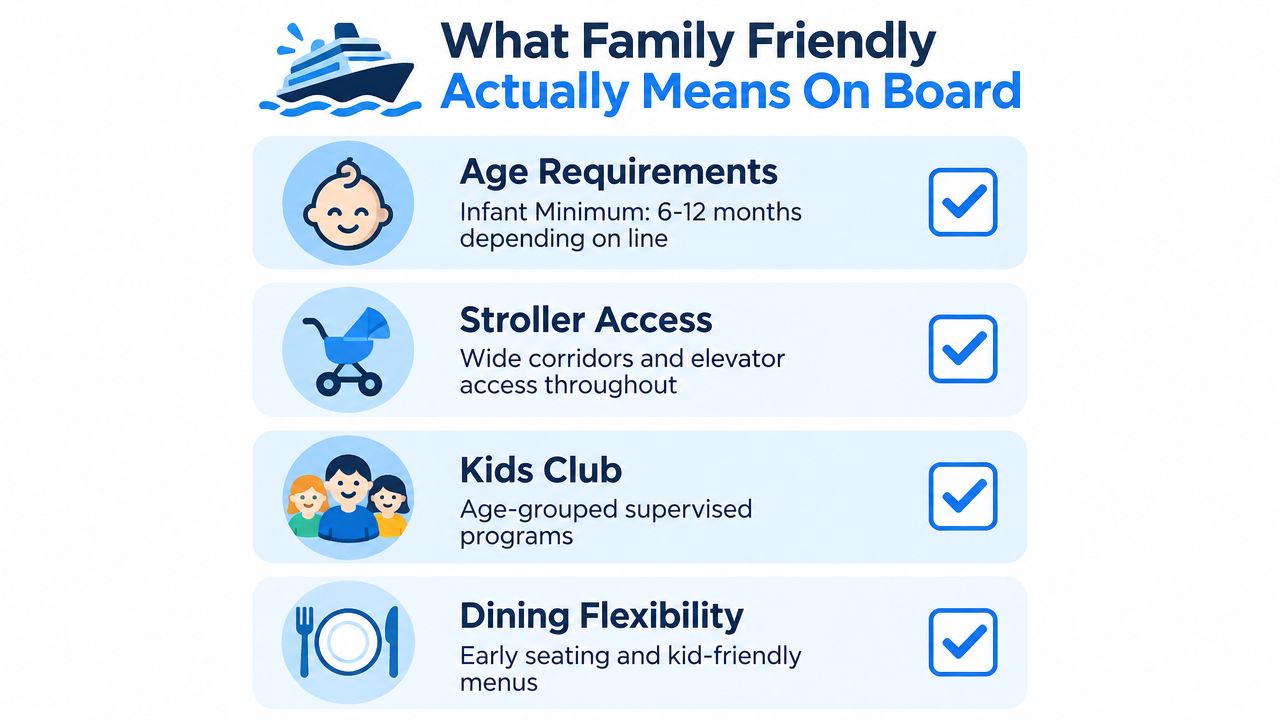
Before comparing Royal Caribbean, Carnival, Norwegian, Disney Cruise Line, or MSC, screen the sailing against four practical requirements. A family-friendly ship isn't defined by branding. It earns that label by making care, movement, sleeping arrangements, and meals workable for the group.
Start with age rules
Infant eligibility is a booking constraint, not a footnote. Many standard sailings require infants to be at least 6 months old, while longer or transoceanic itineraries often require infants to be 12 months old (Cruise Critic). Check the specific sailing policy before paying a deposit, especially if a baby will be close to the threshold at embarkation.
Then inspect the children's programming by age band. Stronger programs separate younger children, school-age groups, tweens, and teens, rather than placing every child under a broad “kids” label. Ask whether staff change diapers, whether parents must remain nearby, how late the program runs, and how the ship contacts parents.
Audit the cabin plan
Standard cruise cabins generally hold two to four guests, while family configurations use pull-out sofas, upper bunks, and adjoining rooms to reach five to ten or more. Some MSC Family Cabins combine two or more connecting cabins, each with its own bathroom, with space for up to 10 people (Cruise Critic).
That geometry matters. A room that technically sleeps four may not comfortably hold a cot, luggage, a stroller, and four people getting dressed at the same time. Verify connecting doors, bathroom count, bunk placement, stroller routes, and balcony access on the deck plan.
Confirm medical and movement support
Ask about the ship's infirmary hours, pediatric capabilities, medication storage, elevator access, and the process for medical clearance. A cruise line may offer excellent children's entertainment while providing limited support for a grandparent whose mobility changes during the voyage.
For destination planning, pair the ship's schedule with an independent resource such as best sunset spots in Key West if the family wants a low-effort evening activity. The point is to identify options that don't require every generation to follow the same demanding shore program.
Matching Cruise Formats to Mixed Age Groups
Three cruise formats consistently solve different versions of the multigenerational problem. The mistake is choosing by reputation alone. Choose by who needs the most structure, who needs the most space, and how much crowding the adults will tolerate.
Mainstream mega-ships
Royal Caribbean, Carnival, and Norwegian are the practical choice for groups that include young children, teens, and adults who want different activities at the same time. Their large ships typically provide broad children's programming, water attractions, sports, entertainment, and flexible dining. That variety lets an eight-person group split without creating a new itinerary for every person.
The tradeoff is scale. Sea-day venues can become crowded, elevators can slow movement, and popular activities may require advance reservations or timed access. Port days create another bottleneck when thousands of guests move toward the same gangways and excursion meeting points.
Premium family-focused lines
Disney Cruise Line and MSC are stronger when the family values tighter age-band programming, immersive experiences, or more deliberate cabin engineering. Disney can work especially well for families with younger children who care about themed entertainment and character dining. MSC deserves attention for its year-round policy allowing children under 18 to sail free in the same cabin as their parents, although taxes and port fees still apply and older children may have separate discounted pricing depending on the itinerary (Cruise Critic).
These lines may trade some mega-ship breadth for a more focused experience. The premium positioning can also increase the total fare, so the family should value the programming and cabin layout rather than assuming the brand name solves coordination.
Small and expedition ships
Small and expedition ships suit grandparents who prioritize calm days, destination depth, and fewer onboard diversions. They usually work poorly for families with young children because supervised programming is thinner and some itineraries rarely accept children under eight.
| Cruise Format | Kids' Programming | Family Cabins | Dining Flexibility | Crowd Level | Best Fit |
|---|---|---|---|---|---|
| Mainstream mega-ship | Broadest range, including children and teen spaces | Many configurations, but deck-plan review is essential | Usually the most adaptable | High during peak periods | Families with toddlers, school-age children, and teens |
| Premium family-focused line | More focused age programming and themed experiences | Strong options on selected ships | Structured or flexible, depending on line | Moderate to high | Younger children and families prioritizing immersion |
| Small or expedition ship | Limited and sometimes age-restricted | Fewer family configurations | Often calmer, but less casual variety | Lower | Mobile adults and older children who value destinations |
For a group planning meals ashore, tips for intergenerational food adventures can help shape a plan that gives adventurous adults room to explore without forcing younger travelers into an unsuitable schedule. The self-selection rule is direct: choose the mega-ship for simultaneous activity, the premium family line for concentrated family service, and the smaller ship only when calm and destination access matter more than children's infrastructure.
Cabins, Dining, and Daily Flow for Groups of Four to Ten
Cabin selection is where many family cruise plans fail. A standard room may list four berths, but occupancy is not the same as usable living space. Adding a fourth guest can compress storage, bathroom access, stroller placement, and movement around beds.
Build the cabin arrangement around movement
For four people, a quad stateroom can work when the children are old enough to use upper bunks or a sofa bed without assistance. For five, two adjacent cabins are usually more functional than forcing everyone into one room. For eight or ten, prioritize connecting cabins, a shared interior door, and enough bathrooms before considering the view.
Request adjacency at the time of booking, not as a casual request to a call-center agent after the inventory has tightened. Confirm the exact cabin numbers, door locations, bed configuration, and whether the interior connecting door is available on the selected category.
A balcony can improve toddler logistics because one adult can sit outside while the child naps inside, but only if the balcony door, shade, and cabin layout support that routine. Don't book a balcony as a substitute for space. It adds an outdoor area, not another bathroom or storage wall.
Make dinner protect bedtime
Early fixed seating, often around 5:30 to 6:00, is the cleanest option for toddlers and grandparents who prefer a predictable rhythm. Flexible dining works better when teenagers, shore excursions, and nap schedules vary, but the group should confirm whether the line can seat the full party together rather than splitting the reservation.
For a group of eight, ask whether a seven-top or larger table assignment is possible and how the line handles odd-numbered seating. For ten, consider whether two adjacent tables are more realistic than one oversized table. A children's menu helps, but shared plates and a fast first course can matter more when the group has multiple food preferences.
Register for supervised programs early
Many lines open kids' club registration online 30 to 45 days before sailing, and places can fill quickly. Prepare the children's names, birth dates, emergency contacts, medical information, and authorized pickup details before the window opens. Verify the program's age rules and operating hours instead of assuming every child can attend whenever the adults want time ashore.
Shore days require the same discipline. Tender ports may exclude walkers, dock ports may have steep gangways, and some islands require a ship-organized tour to guarantee timely reboarding. Ask the shore planner to identify the walking distance, vehicle steps, bathroom access, and return buffer for each generation.
| Group Size | Cabin Strategy | Dining Slot | Shore Approach |
|---|---|---|---|
| Four | Quad room if the children can use the sleeping arrangement safely | Early fixed seating for young children | Short independent outings with a clear return plan |
| Eight | Two adjacent or connecting cabins, with at least two bathrooms | Flexible dining or a confirmed large-table assignment | Split into mobility-compatible subgroups |
| Ten | Multiple connecting cabins or a family suite with verified capacity | Two nearby tables may work better than one oversized table | Pre-book transport, accessible routes, and staggered activities |
Families planning for six can use this cruise planning guide for a family of six as a practical reference point, but the same rule applies to larger groups: solve the cabin and meal system before discussing excursions.
Itinerary Choices for Multi-Gen Families and Long-Stay Travelers
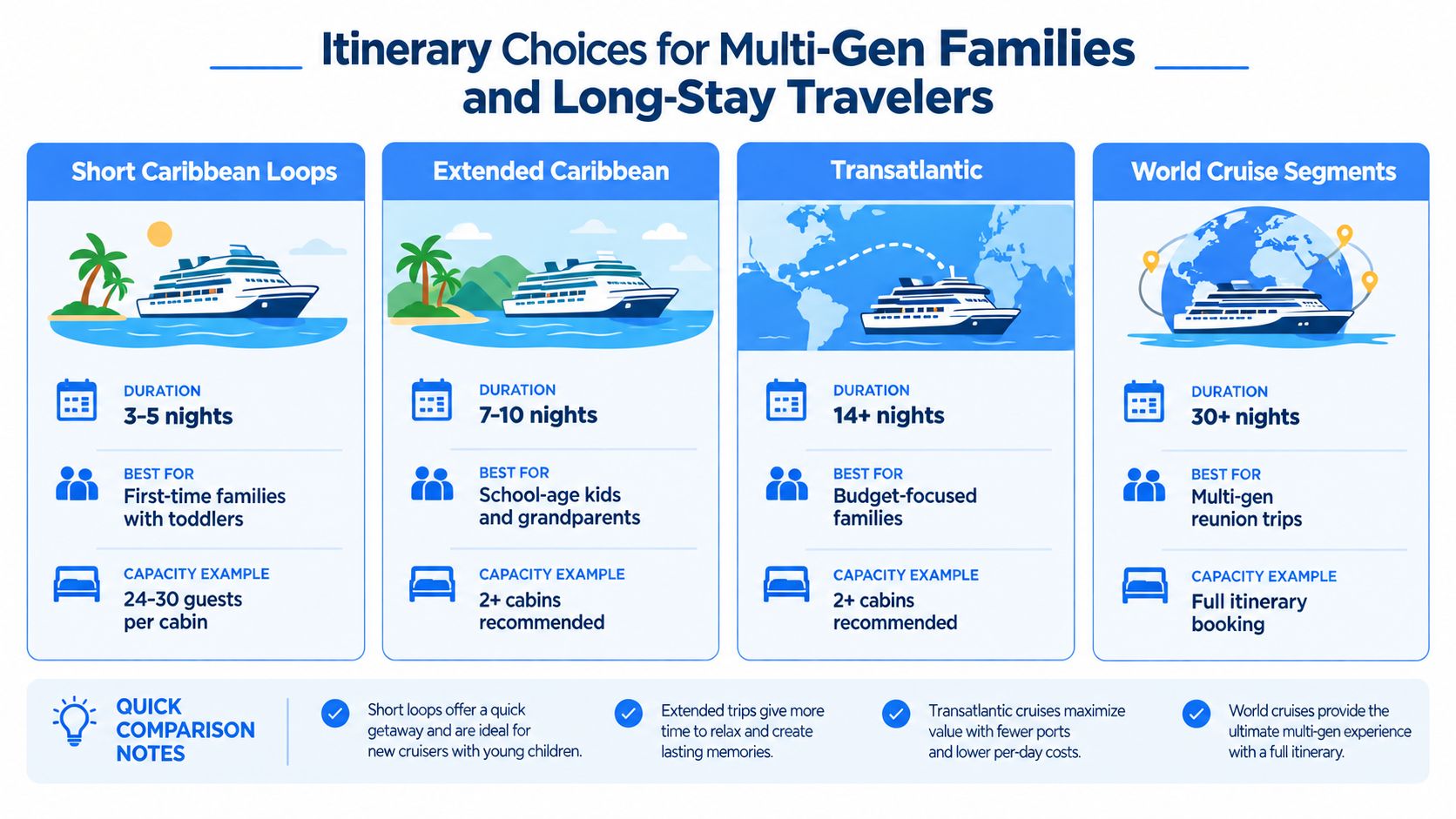
The right itinerary is the one that minimizes friction for the least adaptable traveler. Shorter voyages protect families who don't yet know how toddlers handle sea days. Longer itineraries reward groups that can manage more complex routines without turning every port into a compulsory event.
Four itinerary patterns
A 3 to 5-night Caribbean loop is the strongest test run for a first-time family with a toddler. A Houston-based family of four with a 3-year-old might choose a 4-night Bahamas loop because the shorter commitment limits the consequences of a poor nap pattern, seasickness, or a child who refuses the kids' club.
An Alaska 7-night itinerary gives grandparents glacier viewing and cooler-weather scenery, but families should plan for gear, longer indoor stretches, and sea days that can challenge children under seven. It's a good fit when older adults value scenery more than pool time and the children can handle slower days.
A 7 to 12-night Mediterranean voyage suits school-age children and mobile grandparents who want cultural stops. Walking-heavy ports can exclude wheelchair users, tire teens, and expose a group to heat, stairs, and uneven streets. A Chicago family of eight with one wheelchair user should compare Barcelona round-trip with Reykjavik embarkation based on airport transfers, port access, and the exact excursions, not just the destination list. Use this guide to the best cruise destinations for families as a starting point, then audit every port for mobility.
Repositioning voyages and world cruise segments lasting 14 to 60 nights are a different product. They suit retirees and snowbirds who want extended time away and can accept fewer convenient port options. A retired couple selling a house might find a 21-night Panama Canal segment operationally sensible, while a school-age child or a family with a limited vacation allowance would face a poor fit.
Itinerary test: If the shortest attention span or slowest walking pace can't tolerate the schedule, the itinerary is wrong regardless of how attractive the ports look.
Cruise activities also need age-aware planning. A snorkeling day may delight teenagers and active grandparents, but a stroller, wheelchair, or toddler changes the transport and safety requirements. Families comparing water activities can review Kona Honu Divers' snorkeling guidance before choosing an excursion that depends on transfers, boat ladders, or extended time in the water.
Building a Realistic Family Cruise Budget
A family cruise budget should start with the cabin and end with the return transfer, not with the headline fare. Published prices are often based on double occupancy, while the third and fourth guest may be priced differently. Kids-sail-free promotions can waive a child's cruise fare under defined conditions, but they don't necessarily remove taxes and port fees.
Royal Caribbean's Kids Sail Free promotion applies to children 12 and under in triple, quad, or family-occupancy staterooms booked with at least two paying guests. It applies only to selected sailings and excludes peak periods including spring break, Thanksgiving, Christmas, and New Year's week (Royal Caribbean). Treat it as an eligibility rule, not as a default family price.
The supplied planning assumptions below are useful for constructing a worksheet, but they aren't verified facts from the approved data. Confirm every amount in the booking quote before relying on it. Port fees, onboard packages, flights, insurance, and excursions can materially change the total.
| Cost Category | Low Estimate | High Estimate | Notes |
|---|---|---|---|
| Base cruise fare | Quote required | Quote required | Usually displayed per person based on double occupancy |
| Third and fourth guests | Quote required | Quote required | Pricing varies by sailing and promotion |
| Port fees and taxes | Quote required | Quote required | Verify whether they're included in the displayed fare |
| Drinks, Wi-Fi, and specialty dining | Quote required | Quote required | Add only services the family will actually use |
| Kids' programming | Quote required | Quote required | Confirm whether supervision is included or separately charged |
| Flights and transfers | Quote required | Quote required | Price the full party, luggage, and accessible transport |
| Travel insurance | Quote required | Quote required | Check medical, cancellation, and interruption limits |
| Shore excursions | Quote required | Quote required | Compare ship-organized, private, and self-guided options |
For a family of four, create separate totals for the cabin, transportation, onboard purchases, insurance, and shore days. For eight or ten travelers, assign one person to collect all quotes and record cancellation rules, because small differences in cabin categories and transfer requirements can create a substantial final gap.
How Approved Traveler Simplifies Multi-Gen Cruise Booking
Large family sailings become easier when one operational layer manages the moving parts. Approved Traveler provides access across 44+ cruise lines and 30,000+ itineraries, alongside broader travel inventory, so the coordinator can compare cruise options without maintaining separate systems for every booking category.
For an eight- to ten-person group, the useful function is consolidation. Wholesale inventory can bring cabin holds, dining assignments, and shore options into one group manifest. That allows the coordinator to track grandparents in cabin 8204 and a family of five in connecting cabin 8212 as one sailing plan, subject to actual availability and confirmation.
Use the membership features deliberately
Family-scale membership covers up to 10 household members with benefit parity and no per-person fees. Members earn Reward Credits on bookings, and the Boomerang Member Share can route unused credit opportunities through shared family and friends' hotel and car bookings back to the primary member.
The 110% Best Value Guarantee applies when a member finds a lower publicly available comparable price, with the refund equal to 110% of the difference under the program's comparison conditions. It's a verification mechanism, not a reason to skip cabin, dining, or cancellation-rule analysis.
Lux Traveler adds the Approved Lux 24/7 Personal Assistant. That service can handle reissues, medical fit-to-cruise documentation, and emergency rebooking when a child becomes sick before or during the voyage. For a family coordinator already managing multiple households, removing those message chains can be more valuable than adding another onboard activity.
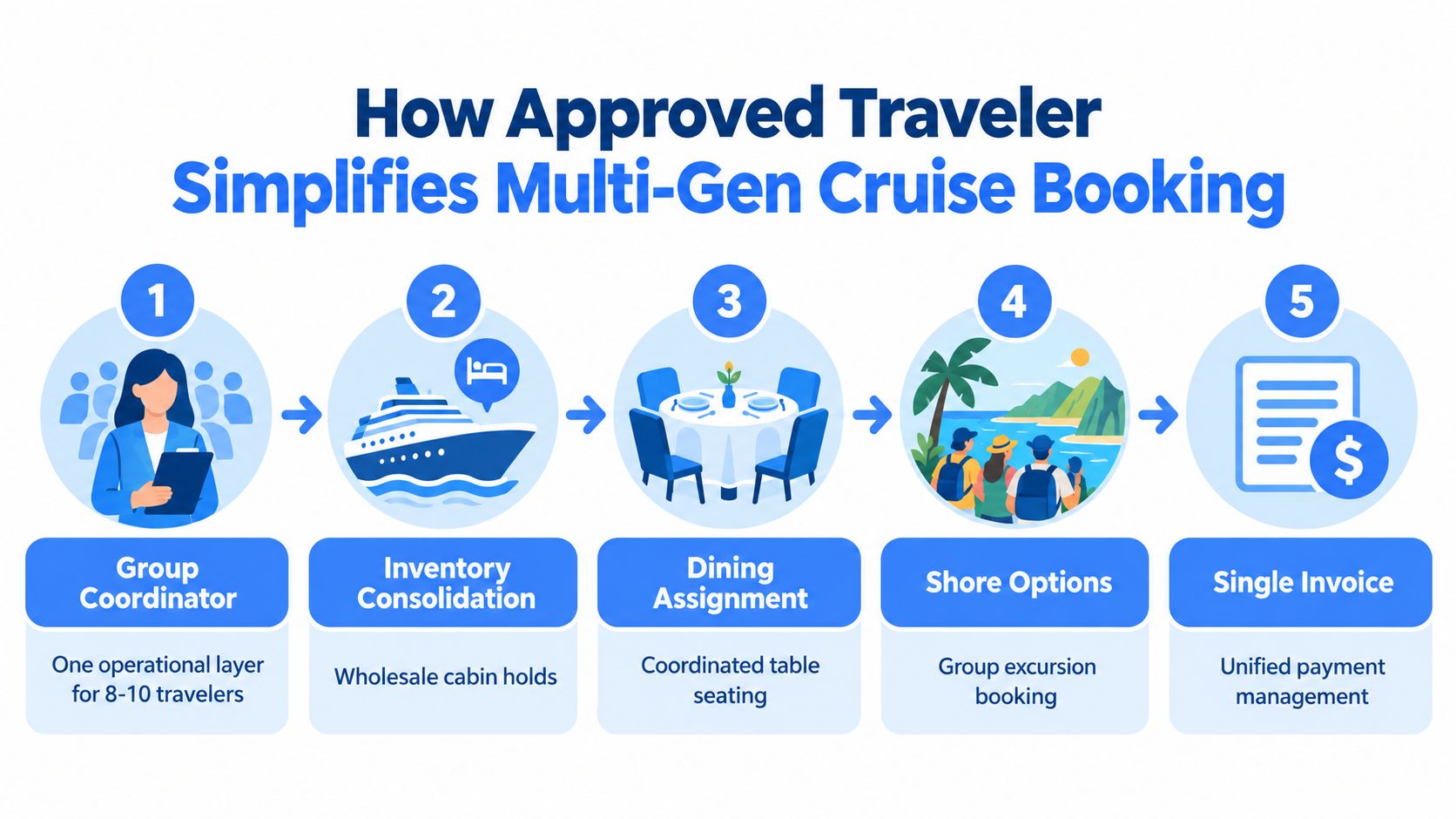
Set up the group in this order: create the traveler list, identify cabin relationships, hold compatible inventory, assign dining preferences, then attach shore and transfer requirements. The system should support the operational plan, not replace the family's decision about whether a mega-ship, premium line, or smaller vessel fits.
Your Decision Checklist for the Right Family Cruise
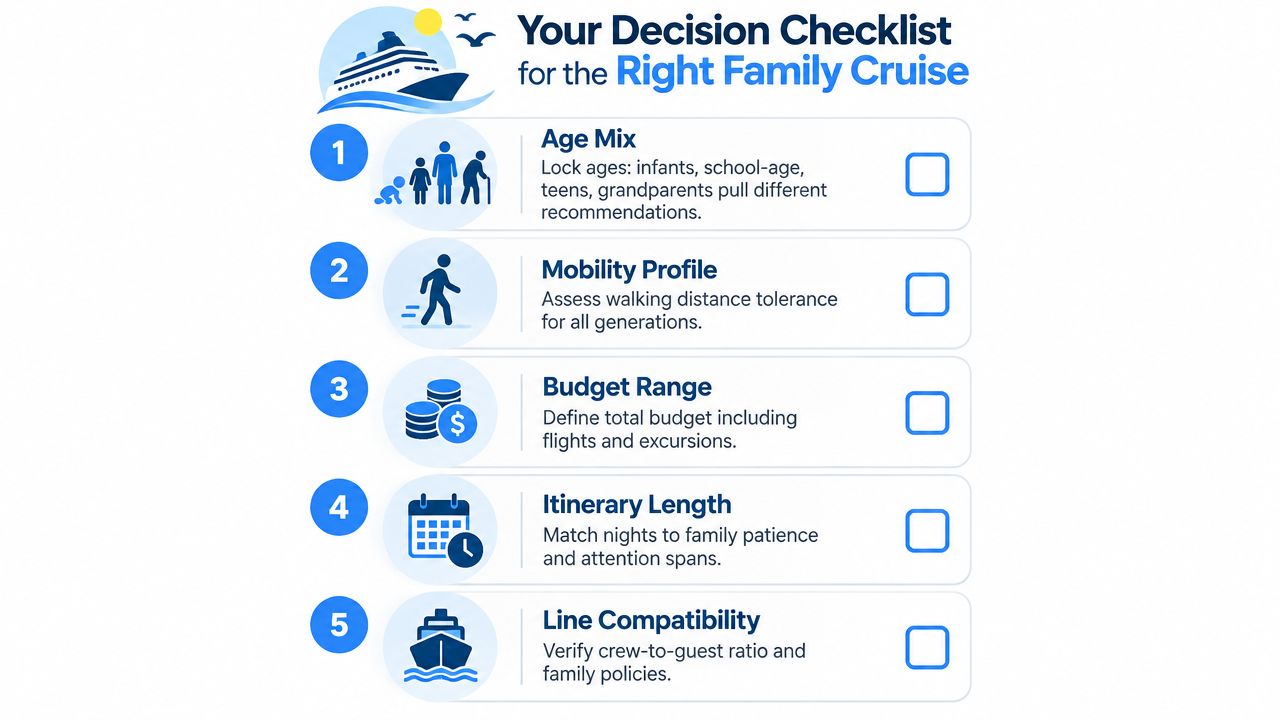
Run these five questions before paying a deposit:
- Age mix: How old are the infants, school-age children, and teens, and what do the grandparents need?
- Mobility profile: Can every traveler manage the cabin-to-elevator route, gangways, port walks, and tender procedures?
- Budget range: Have you included fares, taxes, transport, insurance, onboard packages, and excursions?
- Itinerary length: Does the voyage match the group's shortest attention span and the adults' tolerance for sea days?
- Line compatibility: Does the ship provide the required cabin layout, dining system, supervised programming, and age policy?
If the answers point in different directions, reopen the format decision. A ship with excellent children's programming may still be wrong for a wheelchair user. A calm expedition vessel may delight retirees while failing a teenager's need for activity. A short Caribbean loop may protect a toddler's routine, while a longer Mediterranean sailing may reward mobile school-age children and adults who want cultural depth.
The best family friendly cruises aren't the ones with the longest amenity list. They're the sailings where cabin geometry, dining, mobility, supervision, and itinerary length agree with the people in your group.
Approved Experiences Traveler offers consolidated access to cruise inventory and related travel bookings for families coordinating multiple cabins, dining plans, and shore logistics. Visit Approved Experiences Traveler to evaluate whether its household coverage and booking infrastructure fit your next multigenerational sailing.
Want the wider view?
Ten categories. One report. Every quarter. The Approved List tracks what's rising and what's fading: data-backed signals, not opinions.
Free to join · Delivered by email