
←All Articles
The Journal
How to Decentralize Decision Making Without Losing Control
September 18, 202613 min readdecision rights frameworkdelegation playbook
Learn how to decentralize decision making across teams and households with a practical playbook that reclaims time, sharpens focus, and scales judgment.

At 6:42 a.m., the founder is already behind. A school carpool dispute, a vendor invoice, and a hiring question are all waiting in the same inbox, beside a coffee that's going cold. Nothing is strategically difficult, but every item still demands the same scarce resource, the founder's attention.
That pattern appears in households too. One parent decides which pediatrician to call, which contractor to approve, and whether a schedule change works. The problem isn't a lack of capable people. It's that authority hasn't moved to the person closest to the information.
Decentralize decision making without removing control by separating judgment from involvement. Give routine, local, reversible decisions to trusted operators, then keep standards, exceptions, and consequential choices visible at the center. The result isn't fewer decisions. It's fewer decisions that only one person is allowed to make.
What Decentralized Decision Making Feels Like
Three months later, the same Tuesday runs differently. A partner handles the invoice within a defined spending limit. An Assistant triages the carpools email and books the swap. A hiring lead owns the offer-letter scope. Over breakfast, the founder reviews a one-page exception report instead of opening every thread.
The relief is physical. Fewer interruptions arrive carrying the implied question, “What do you want me to do?” People act within known boundaries, while the principal sees choices that require judgment. The leader remains accountable without serving as the operating system for every small action.
The practical aim: authority without constant involvement, with confidence that ordinary calls are being made correctly.
The same operating system works across work and home:
- Project pricing: A delivery lead can approve a standard quote when the scope, margin rules, and client profile fit the template. An unusual risk or nonstandard promise goes upward.
- Contractor selection: A household manager can choose from an approved vendor list and authorize routine work. A structural issue or ambiguous warranty requires review.
- Medical scheduling: A family member can find appointment options and coordinate transport. A clinical decision remains with the appropriate professional and the person responsible for it.
- Staffing adjustments: A frontline manager can address coverage gaps when the change fits documented rules, rather than waiting for executive approval for every swap.
Decentralization moves decision authority to lower organizational levels. Research on employee autonomy describes the mechanism clearly: supervisors grant authority so people can use information from the work itself instead of waiting for upper-management approval. In practice, a manager lets a frontline team handle pricing exceptions or staffing adjustments within defined boundaries. Research on authority, autonomy, and responsibility supports that operating principle.
The cost of coordination still needs a place in the design. Distributed authority creates value when standards, ownership, and exception paths prevent every local choice from becoming a new discussion. A MIT CISR survey of 342 organizations gives the argument financial weight. Organizations classified as decentralized, meaning operational decision rights existed in at least 50% of teams, needed about 244 days on average to sense and seize opportunities, compared with 566 days for centralized organizations. The decentralized group also outperformed centralized peers by 6.2 percentage points in average net profit margin and 9.8 percentage points in revenue growth, while revenue from products and services launched in the prior three years reached 28.8 percent, or 1.5 times as high.
The result is distributed responsibility with visible standards. You decide what matters, who owns the outcome, and where exceptions land. Approved Lux can absorb the follow-through that otherwise pulls decisions back to the center. Proximity to the org chart does not create better information. Clear rights let the person closest to the work act on it.
Readiness Signals and the Hidden Costs of Letting Go
Delegation fails when leaders confuse permission with preparedness. A team, household, or founder-led company is ready to decentralize when five conditions are present.
Five signals that authority can move
- Documented standards: People can see what “good” looks like without extracting it from the leader's head.
- Stable context: The recurring work has enough consistency for a boundary to mean something.
- Trusted proxies: Someone has the judgment, access, and reliability to act on the principal's behalf.
- Low-defect delegation history: Prior handoffs have closed cleanly, with problems surfaced rather than hidden.
- Portable values: The leader's priorities travel through written principles, examples, and trade-offs.
The fifth signal matters most. A proxy shouldn't need to imitate the leader's personality. They need to understand the choices the leader will protect, reject, or revisit.
The first myth is that more autonomy always creates more speed. It doesn't. Local decisions can move quickly while creating extra coordination work across teams, regions, channels, and functions. Recent work on the algorithmic workplace warns that decentralized decisions can shift managers toward coordination while increasing coordination overhead unless organizations add new mechanisms for shared boundaries and role clarity. The discussion of coordination in algorithmic workplaces is useful precisely because it rejects the simplistic productivity story.
The second myth is uniform decision-making authority. A junior hire shouldn't automatically receive the same authority as a tenured operator. Match rights to decision quality, context, and demonstrated reliability. Give a new operator pre-approved choices with tight boundaries, while a proven operator owns a wider range of reversible calls.
The third myth is that delegation eliminates context-switching. Poorly designed delegation can multiply it. If five people ask the leader for separate clarifications, the leader still carries the cognitive load, only now with more threads and less visibility.
For people working through staffing, performance, and operating friction, 9 common HR challenges offers useful adjacent context. Decision rights won't repair unclear roles, weak communication, or inconsistent expectations by themselves.
Start with reversibility. Ask: What decisions, if made wrong tomorrow, can I reverse within 48 hours? Those decisions are the on-ramp. They let people practise authority while keeping the cost of learning contained.
Designing Decision Rights That Hold Up Under Pressure
A decision-rights matrix should answer three questions before a stressful moment arrives:
- How reversible is the choice?
- How quickly must someone act?
- How good is the local information available to the person doing the work?
Score each axis from one to five. High reversibility, urgent timing, and strong local information point toward decentralization. Low reversibility, broad impact, or weak context point toward escalation or reservation.
Four tiers of authority
Autonomous decisions are owned by the named operator. They act, record the decision, and remain accountable for the result.
Pre-approved decisions have a defined boundary, such as a budget, vendor list, service standard, or response template. The operator acts without fresh permission when the conditions fit.
Escalated decisions require a handoff because a trigger has been met. The original operator supplies the facts, options, and recommendation. Escalation shouldn't mean surrendering thought.
Reserved decisions stay with the founder, executive, parent, or designated principal because the consequences are strategic, irreversible, legally sensitive, or intensely personal.
| Decision Tier | Reversibility | Speed Required | Local Info Quality | Example | Owner |
|---|---|---|---|---|---|
| Autonomous | High | High | High | Marketing manager adjusts a live campaign within approved creative and channel rules | Marketing manager |
| Pre-approved | High to moderate | Moderate | High | Household manager books travel under a stated budget and preferred itinerary rules | Household manager |
| Escalated | Unclear | High | Mixed | Vendor dispute where contract terms or service obligations are ambiguous | Operating manager, then contract owner |
| Reserved | Low | Variable | Distributed | Strategic acquisition or a major family commitment | Founder or principal |
RACI logic keeps the matrix from becoming a permission chart with blurred accountability. Assign one Responsible operator who does the work, one Accountable owner who carries the outcome, the people Consulted before a consequential decision, and the people Informed afterward. Never use “the team” as a substitute for a named accountable person.
Teams handling distributed launches may also benefit from practical guidance on product marketing for distributed teams, especially where local execution must remain consistent with a shared market position.
Print the matrix. Argue over it. Revise it after real decisions. The friction of building it together is valuable because people remember boundaries they helped define. A useful companion for making ownership explicit is this team accountability framework.
Try the exercise today. Pick three decisions currently sitting on your desk, score reversibility, urgency, and local information from one to five, then place each into a tier. If you can't explain the owner and escalation trigger in one sentence, the matrix isn't ready.
Guardrails, Escalations, and the Human Execution Layer
A matrix becomes operational when busy people can apply it without asking for permission each time. Write the rules in plain language, then test them against real requests and time pressure.
Convert authority into guardrails
Set spend thresholds for routine purchases. Define response-time SLAs for urgent items. Maintain vendor exclusions for providers that create unacceptable risk or inconsistency. Establish brand-voice limits for external communication, covering claims, discounts, tone, and approval requirements.
Create a one-page escalation map with four fields:
- Trigger: What condition exceeds the operator's authority?
- Routing path: Where does the issue go first?
- After-hours owner: Who can decide when the normal owner is unavailable?
- Reset rule: What happens after the exception is resolved?
A strong escalation request states the decision needed, relevant context, options considered, and recommendation. “What should we do?” creates more work. “The vendor changed the renewal terms, option A preserves continuity, option B reduces exposure, I recommend B because the contract allows it” gives the next owner something usable.
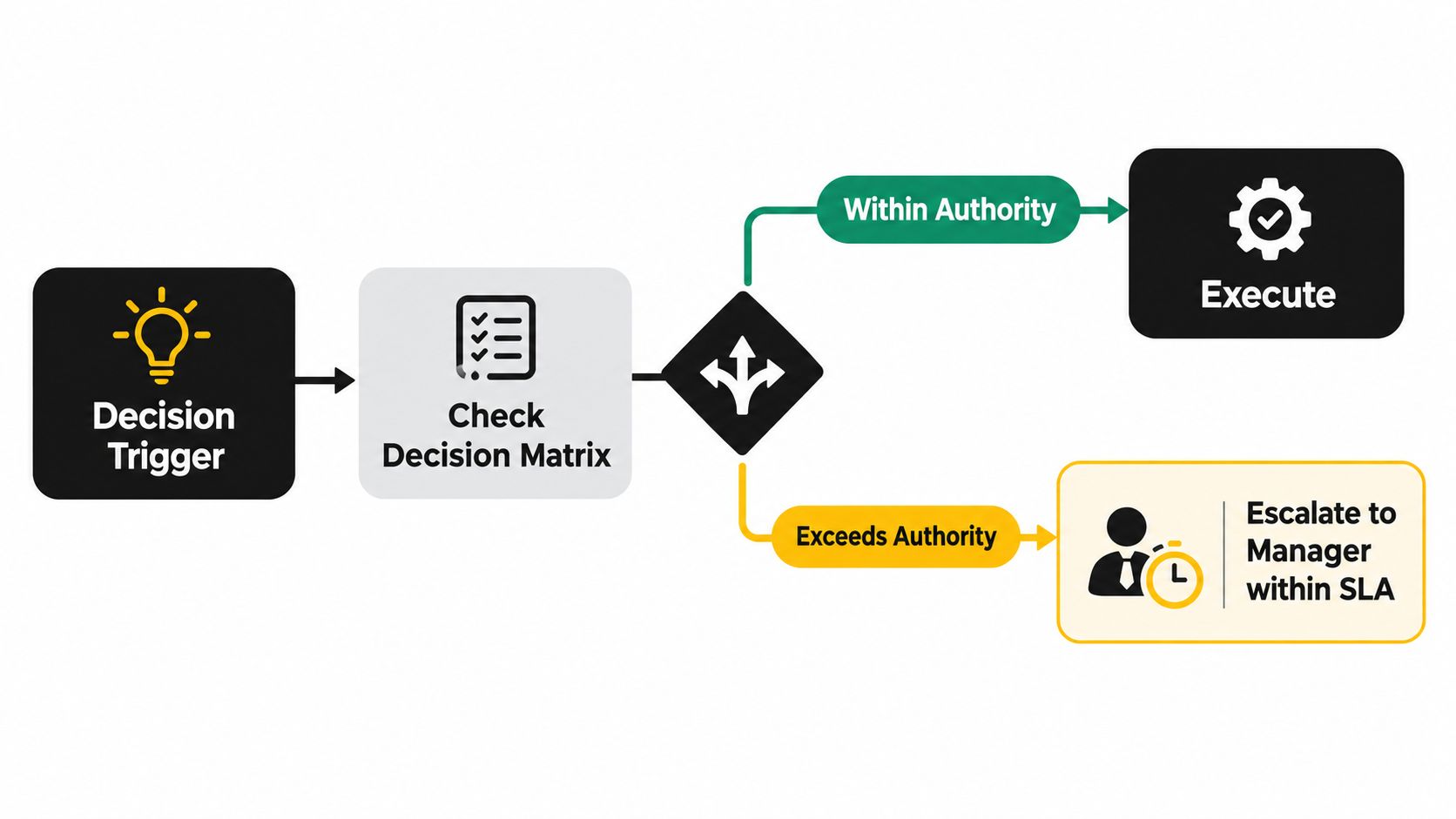
Follow-through is the operating test. A delegated decision sitting in an inbox leaves the obligation unresolved and sends work back to the principal.
A human layer can close that gap. Approved Lux operates as a US-based Assistant team reachable by phone, SMS, email, and chat, handling execution that written guardrails authorize. Its Proactive Preference Learning helps the team anticipate recurring choices, while the commitment remains the completed outcome, not merely a created ticket. For a broader explanation, see this operating systems perspective.
Consider a busy afternoon. A vendor renewal fits the approved spend and service rules, so the Assistant team confirms the terms and records it. A school pickup changes, so the team checks the family schedule, confirms the replacement, and updates the relevant people. A client escalation exceeds the response boundary, so it routes to the designated manager with the facts and recommendation. The principal is not interrupted, and each item closes with a visible trail.
Control comes from boundaries, records, and exception handling rather than forcing every decision through one person. Set those controls before delegation, then review the exceptions that expose weak rules.
A 30-60-90 Rollout That Builds Trust Fast
Don't launch decentralization as a cultural slogan. Launch it as a contained operating experiment with a short feedback loop.
Days 1 to 30, audit and select
Start by reviewing current decision volume. Look for repeated approvals, stalled threads, routine questions, and tasks that return to the same principal after partial execution. Select three high-frequency domains where the information is local and mistakes are recoverable.
Draft the rights matrix for those domains. Include the owner, the boundary, the escalation trigger, and the record required after execution. Brief the team with examples, not abstract language. “You can approve standard vendor work within the stated limit” is clearer than “You have more autonomy.”
Train three habits:
- Reverse cheaply: Know how to undo or correct a decision before acting.
- Write context briefly: Summarize the situation in two sentences.
- Ask a useful escalation question: State what decision is needed and why it exceeds the boundary.
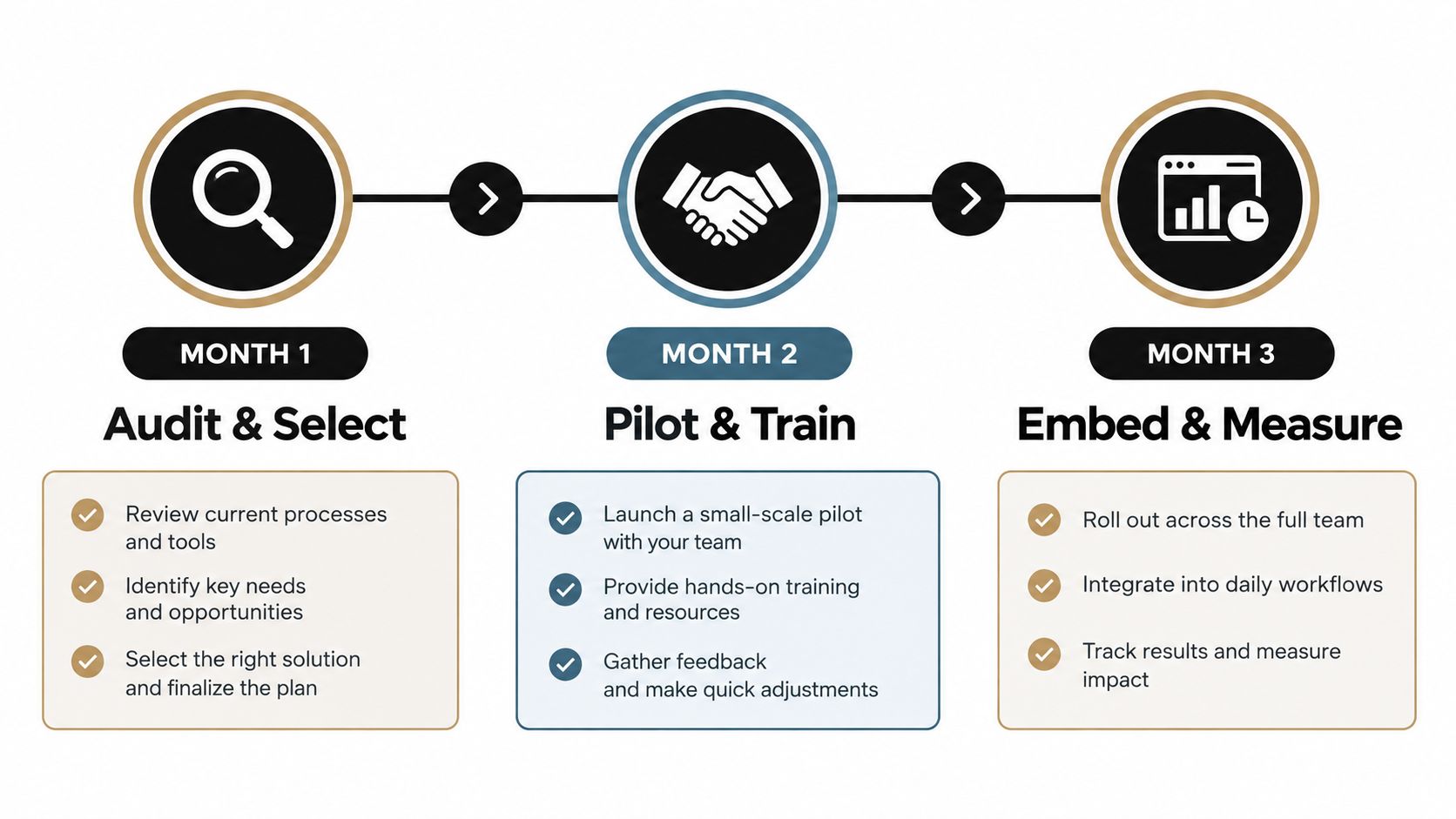
Days 31 to 60, shadow and instrument
Run shadow rounds. Delegates make the decision, then the principal reviews afterward rather than pre-approving it. Record every escalation, including why it happened and whether the matrix was unclear, the operator lacked context, or the decision was misclassified.
Onboard execution support in the domains with the most follow-through drag. A shared workflow tool can help, and these practical monday.com use cases provide relevant examples for organizing ownership, status, and handoffs. Pair the rollout with sound onboarding best practices, especially around access standards and escalation expectations.
Days 61 to 90, expand and embed
Expand rights where the log shows sound judgment and clean closure. Retire any category that repeatedly produces unforced escalations until its boundary or training improves. Codify the playbook in the place people already work.
Hold a 15-minute Friday review. Discuss what was decided, what escalated, and what surprised the team. Rollout speed matters more than rollout size. A small system that people trust will outperform a broad program that nobody understands.
Measuring the Hours and Mental Bandwidth You Get Back
Decentralization is an investment. It needs an operating scorecard, not applause.
Track four leading indicators every week:
- Principal time reclaimed: Hours the central decision-maker no longer spends approving or chasing routine items.
- Delegation share: The proportion of eligible decisions handled by assigned owners rather than personally handled.
- Delegated resolution time: The average time from assignment to completed outcome.
- Escalation-to-decision ratio: How often delegated items require escalation before closure.
Add one lagging indicator, repeat incidents. If the same category escalates twice, the system is telling you something. The guardrail may be under-trained, the decision may be misclassified, or the named owner may lack access or context.
| Metric | What It Measures | Target Band |
|---|---|---|
| Principal time reclaimed | Capacity returned to judgment, strategy, or family presence | A sustained upward trend without repeat incidents |
| Delegation share | Whether authority is actually moving to the edges | A rising band among eligible decisions |
| Delegated resolution time | Whether delegated work closes rather than waits | A stable band that meets the agreed SLA |
| Escalation-to-decision ratio | Whether boundaries are appropriately designed | A declining band after training and matrix revisions |
| Repeat incidents | Whether the same failure keeps returning | Zero repeated category failures after correction |
Use a simple weekly sheet with the decision, owner, tier, outcome, time to close, escalation reason, and correction. For a business, translate reclaimed hours into the value of the principal's time or the revenue-producing work those hours enable. For a household, measure hours returned to rest, childcare, relationships, or personal priorities.
Watch for decentralization theatre. Everything may be “delegated,” yet nothing closes because the principal still has to approve, chase, clarify, and repair every handoff. The system is working only when responsibility moves and completion follows.
If an Assistant team supports the model, review delegated task volume, channel mix, and preference-learning accuracy alongside the decision scorecard. That shows whether the layer is absorbing operational noise or merely adding another place to check.
Use a target band, not a vanity number. The right range is the one that improves speed and recovered attention without increasing repeat incidents or damaging decision quality.
The Decentralization Checklist You Can Run This Week
Decentralization is multiplied capacity, not abdication. Keep judgment that requires broad context at the center. Move decisions based on immediate information and timely action to the people closest to the work.
Run this checklist before the week ends:
- Choose three reversible decisions: Select recurring calls that can be corrected quickly, such as routine scheduling, standard vendor coordination, or ordinary project adjustments.
- Write one-line rights: For each team member or family participant, state what they own, the boundary they must respect, and the result they must record.
- Define two escalation triggers: Make each trigger observable. Examples include an ambiguous contract term, a decision outside the spending limit, or a risk affecting multiple teams.
- Install one shared log: Record the decision, owner, outcome, and escalation reason in one visible place.
- Name the follow-through owner: Assign a person or Assistant team to confirm that approved actions finish.
- Review on Friday: Spend 15 minutes identifying what moved cleanly, what escalated, and what the matrix needs to clarify.
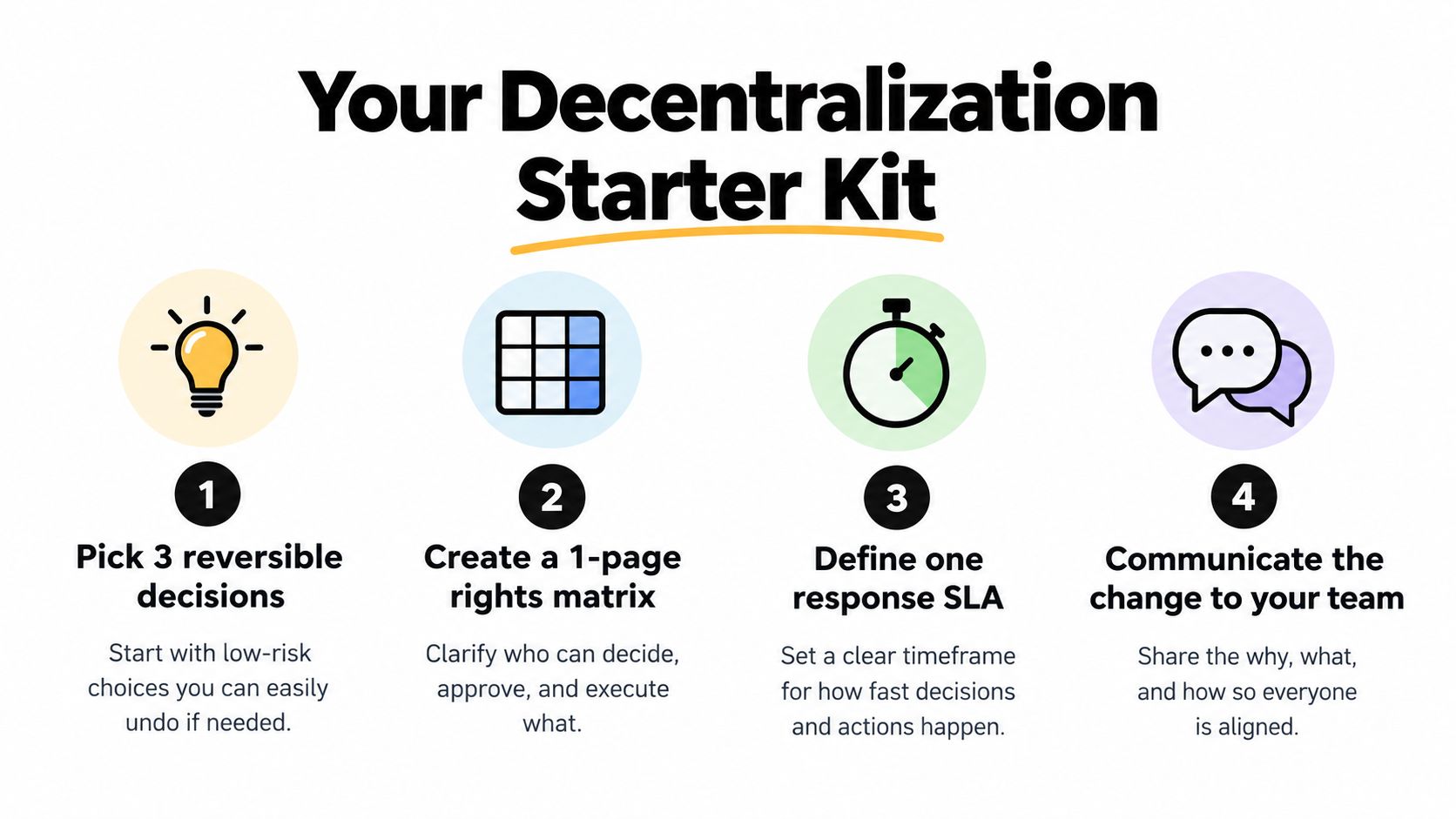
The best first decision is the one that happens often, depends on local information, and creates little damage if corrected. Give it a named owner, a clear boundary, and a reliable closing mechanism.
Widen the system only when the evidence supports it. The center becomes more valuable when its attention stays reserved for choices nobody else can responsibly make. Approved Lux can absorb the follow-through that otherwise turns delegated authority into more chasing. For execution support, visit Approved Lux Personal Assistant.
Want the wider view?
Ten categories. One report. Every quarter. The Approved List tracks what's rising and what's fading: data-backed signals, not opinions.
Free to join · Delivered by email