
←All Articles
The Journal
Delegate Leadership Style: The Practical Guide
September 17, 202614 min readlaissez-faire managementdelegation framework
Master the delegate leadership style with frameworks, real examples, and accountability tactics that turn autonomy into measurable team output.
Most delegative leaders don't fail because they give away too much authority. They fail because they give away authority without building the controls that make ownership safe. That distinction matters because delegation has been linked with stronger affective commitment, task performance, behavior, and job satisfaction in empirical leadership research, including a 2007 study of 171 subordinate-supervisor dyads in China published by the Academy of Management.
The practical opportunity is larger than better team morale. A well-designed delegate leadership style can reclaim hours from a principal's calendar, move decisions closer to the information, and absorb execution noise before it reaches the founder, executive, practitioner, or parent. Delegation isn't a personality test. It's an operating system.
Why Delegative Leadership Is a System, Not a Personality
Delegative leadership fails when a leader hands over work without handing over the conditions for sound decisions. “Hire capable people, trust them, and stay out of the way” leaves unanswered questions about priorities, authority, resources, standards, and escalation. Autonomy requires design.
Build the operating system around four controls:
- Clarity: The owner knows the outcome, boundaries, timing, and definition of done.
- Access: The owner can reach the information, tools, people, and budget required to act.
- Cadence: The leader and operator agree when progress will be reviewed.
- Consequence: Someone owns the result, and deviations trigger a defined response.
The leader designs these conditions and remains accountable for them. The operator owns execution within them. Delegation therefore changes the location of control without eliminating control. It replaces constant approval with explicit interfaces, review points, and escalation rules.
The leader's job changes
A principal using this model should stop serving as the default approval desk. Their work becomes context protection, blocker removal, exception handling, and outcome review. Routine decisions stay with the person closest to the work. Decisions carrying unusual risk, strategic consequences, or unclear ownership return through a low-friction escalation path.
The same design applies in companies and households. Adults spend substantial time on work and personal-life administration, as Brightpearl reported in its survey of 2,000 adults reported in its 2021 release. The constraint is not effort alone. Too many coordination decisions remain attached to the principal, consuming attention that should go to higher-value work.
Operating rule: Delegate the decision, not merely the task. If every meaningful choice returns to the leader, the handoff is cosmetic.
Research supports treating delegation as a system rather than a personal preference. One analysis found that delegative leadership and the non-physical work environment together explained 28.5% of employee performance variance. The same analysis reported a 5.1% direct effect and 15.9% total effect on job satisfaction in the cited leadership analysis. These findings do not make delegation automatic. They show that authority can influence measurable outcomes when the surrounding work environment supports it.
Set the outcome, grant the authority, provide the resources, schedule the review, and specify the response when performance or risk leaves the agreed range. The offload math is simple: every decision that stays with the operator is a unit of principal time reclaimed. That is how autonomy becomes reliable instead of theatrical.
Defining the Delegate Leadership Style
The delegate leadership style, sometimes called laissez-faire leadership, pushes decision-making authority down to the operator closest to the work. The principal defines the result, provides context and resources, removes blockers, and audits outcomes without prescribing every step.
That definition separates delegation from abandonment. A delegated owner isn't merely completing an assignment. They're making the decisions required to produce the result. The leader doesn't hover over the process, but they also don't surrender responsibility for the operating environment.
Three styles, three use cases
Autocratic leadership concentrates decisions with the leader. Commands flow downward, and accountability remains visibly centralized. That model fits a crisis, a safety event, or compliance-heavy work where consistency and speed matter more than broad participation.
Democratic leadership brings people into the decision process before action begins. It works well for creative ideation, culture-building, and problems where diverse perspectives improve the answer. Its weakness is delay when the group keeps debating after the decision has become clear.
Delegative leadership assigns authority to a capable operator and reserves the leader's attention for alignment, exceptions, and review. It fits execution-heavy environments where the principal's attention is the binding constraint and the operator has enough competence to act without constant instruction.
| Dimension | Autocratic | Democratic | Delegative |
|---|---|---|---|
| Decision location | Leader | Group | Operator closest to the work |
| Primary strength | Crisis control and consistency | Shared insight and buy-in | Execution speed and ownership |
| Typical failure | Bottlenecking and dependency | Slow decisions and debate | Drift, ambiguity, or uneven standards |
| Leader's focus | Directing action | Facilitating agreement | Setting context and auditing outcomes |
| Best fit | High-risk or regulated work | Ideation and culture-heavy work | Expert teams and repeatable execution |
A useful resource for leaders building this structure is Cyndra's guide to departments for executive leaders, especially when responsibilities need to be separated across executive functions rather than left in one principal's head.
Preconditions before you delegate
Start with competence. A new hire learning a process usually needs direction or coaching before they receive full decision rights. A proven operator with sound judgment can take ownership sooner.
Then assess the work itself. Delegation is a poor fit when the task involves confidential personnel decisions, non-transferable legal accountability, or a situation where the cost of an unreviewed mistake is unacceptable. In those cases, preserve tighter control while delegating supporting work around the decision.
Finally, document the interface. The owner needs to know what they can decide, what they must report, what resources are available, and when the principal will re-enter. Without those boundaries, “autonomy” becomes a polite word for guessing.
Core Mechanics That Make Delegation Actually Work
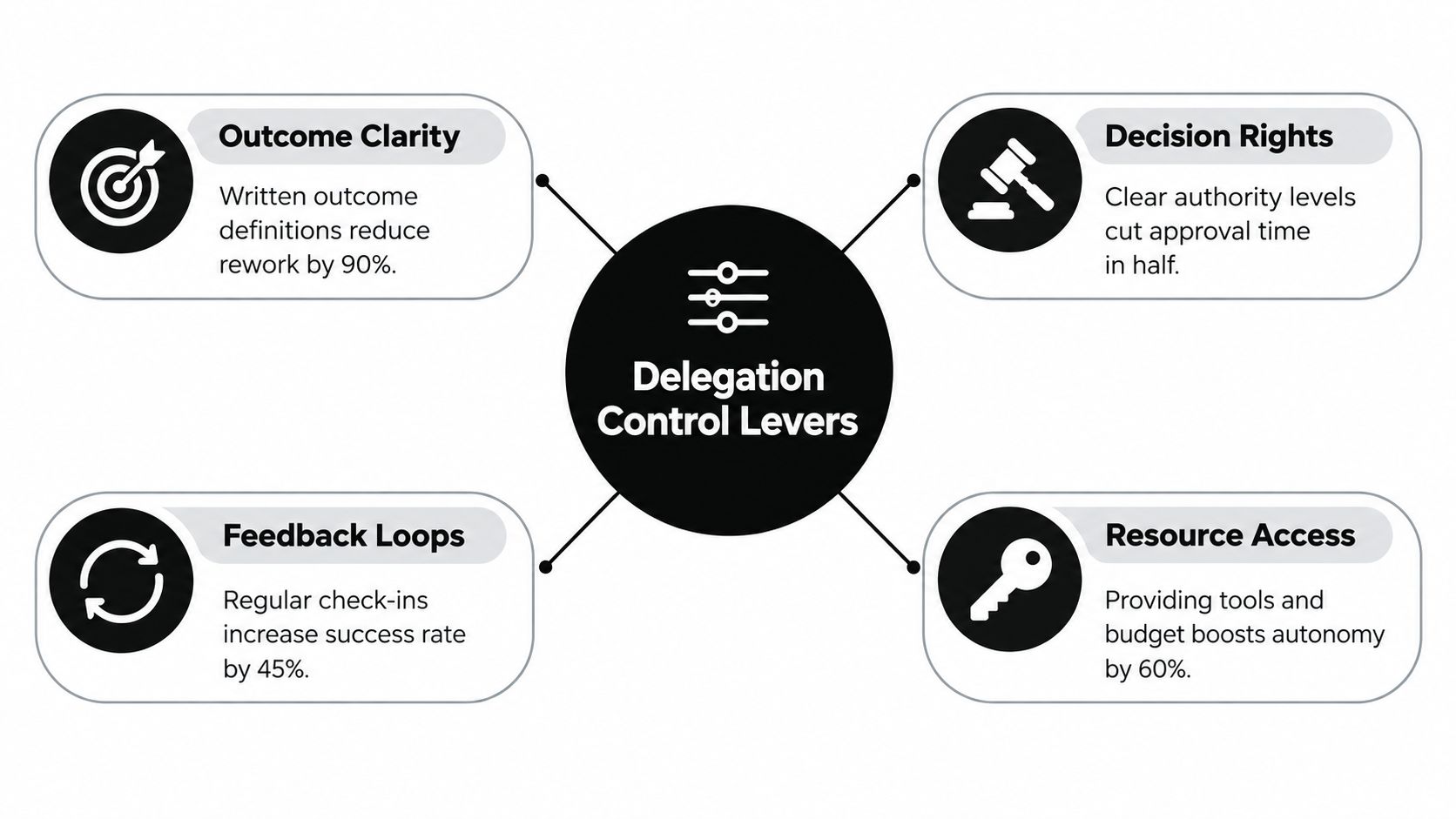
Delegation becomes operational when four control levers work together: outcome clarity, decision rights, feedback loops, and resource access. Remove any one of them and the leader usually gets pulled back into the work.
Outcome clarity
Write the result in observable terms. “Improve the client onboarding process” invites interpretation. “Create a documented onboarding flow that gives the client a confirmed next step after every interaction” gives the owner something to build and the leader something to inspect.
A strong brief names the objective, deadline, constraints, and definition of done. It also states what the owner doesn't need to optimize. That last point prevents a delegated operator from spending time improving adjacent systems that weren't part of the assignment.
Decision rights come next. State which decisions the owner can make independently, which require notification, and which require approval. The hand-off approach for operational work is useful here because the handoff should transfer context and authority together, not send a task over the wall with an implied request for permission.
Feedback loops
A checkpoint isn't a surveillance mechanism. It's a control loop that catches ambiguity while correction is still inexpensive. Use a short early rhythm for unfamiliar work, then reduce the frequency as the owner demonstrates sound judgment.
The review should focus on outcomes, risks, and decisions needed, not a replay of every activity. Ask what changed, what is blocked, what moved outside the agreed range, and what decision the owner recommends.
Resource access
Delegation fails when the operator owns a result but lacks the account access, budget, documentation, vendor relationship, or authority to act. Give access before the work starts. Record the relevant walkthroughs, name the escalation path, and identify the person who can resolve a blocked dependency.
Consequence and measurement
Accountability requires a visible owner and a response to variance. Choose a metric that matches the work, such as turnaround time, defect rate, rework hours, satisfaction, or completion against deadline. Don't create a dashboard full of numbers nobody uses. One meaningful measure with a clear escalation rule beats a dozen decorative indicators.
The evidence is strongest when autonomy is paired with trust. In a matched-sample study of 451 pairs of academic scientific employees, job autonomy had a positive relationship with work outcomes, with stronger effects when employees trusted the supervisor granting that autonomy as described in the cited study. The control system should therefore protect both performance and the relationship that makes independent action possible.
Pros, Cons, and Where the Style Fits
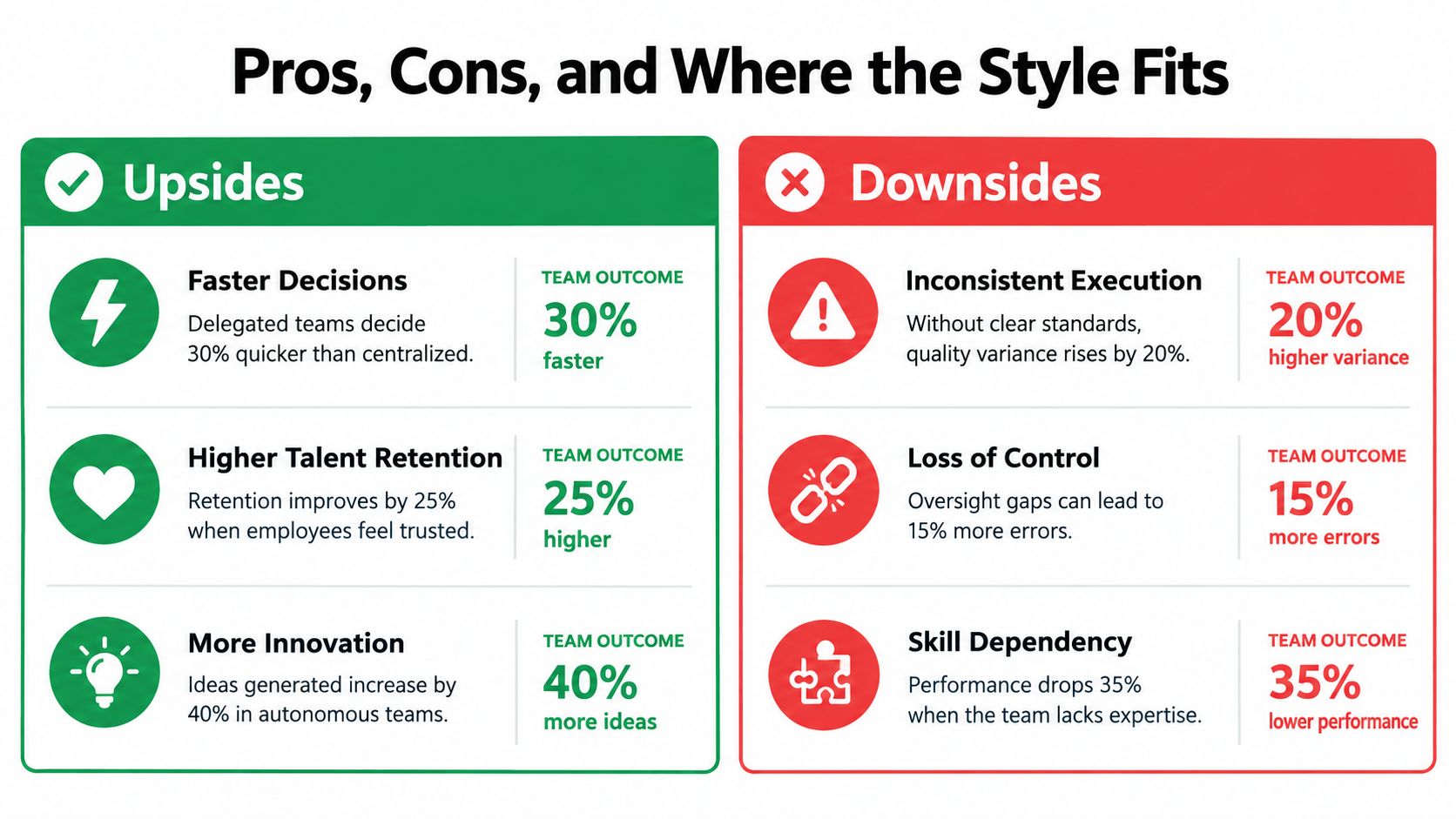
Delegative leadership can increase speed and ownership, but it also exposes weak operating standards quickly. Treat each benefit and risk as a measurable operating question rather than a belief about management.
The upside
Decision-making improves when the person with the most relevant information can act without climbing an approval ladder. A Harvard Business School working paper on span of control explains that broader spans are traditionally associated with greater delegation and less direct managerial involvement, while related research connects wider spans with better timeliness when managers can adjust their pace to the situation in the cited working paper. Track this through decision latency, not the number of management layers.
Autonomy can also improve retention and initiative because capable people gain meaningful ownership. Monitor eNPS, regretted attrition, internal mobility, and the number of improvements shipped. If employees have authority but no access to information or recognition, the expected benefit won't appear.
The downside
The first risk is misalignment. Two capable operators can make locally rational decisions that conflict with the broader objective. Track rework hours, cross-functional defects, and missed dependencies. If those rise, the problem may be the operating brief rather than the people.
The second risk is accountability fog. Leaders sometimes grant responsibility without naming who owns the metric. When results deteriorate, everyone can explain their activity and nobody can explain the outcome. Assign one accountable owner, even when several people contribute.
The third risk is skill dependency. A team that relies on one expert may look autonomous until that person is unavailable. Build backup coverage, documented procedures, and deliberate skill transfer. Delegation should increase organizational capacity, not create a new single point of failure.
A team accountability framework can help leaders connect ownership to visible outcomes rather than vague expectations.
Where it fits
Use the style with high-trust expert teams, late-stage scaling operations, and creative or research units where judgment improves the work. Use more direction with new hires in their first 90 days, in regulated operations requiring tight audit trails, and in teams with weak written norms.
The right question is not, “Am I a delegative leader?” Ask, “Does this person have the competence, context, authority, and support required for this decision?” If the answer is no, tighten the controls temporarily. If the answer is yes, don't keep the approval bottleneck out of habit.
Real-World Examples Across Three Operating Contexts
A founder, a practice owner, and a dual-career parent can all use the same operating logic, even though their work looks unrelated. Each must transfer authority, preserve visibility, and prevent routine coordination from consuming the principal's attention.
The Series B founder
A Series B founder hands product roadmap ownership to the head of product. The boundary is explicit: the head of product owns prioritization, sequencing, and communication with engineering and design, while the founder retains responsibility for company strategy, major customer commitments, and decisions that materially change the business direction.
The team ships weekly. The founder reviews outcomes quarterly, with an exception path for a major customer risk, a strategic conflict, or a material change in assumptions. The failure mode avoided is founder re-entry, where product managers technically own the roadmap but still wait for approval on every meaningful tradeoff.
The control isn't “trust the head of product.” The control is a written decision boundary, a predictable review, and a defined reason to escalate.
The dental practice owner
A dental practice owner assigns insurance verification, recall follow-ups, and inventory cycles to trained leads. The owner doesn't approve every verification or personally chase every overdue recall. Instead, each lead owns a workflow, a service standard, and an escalation rule for exceptions.
The owner reviews the relevant operating measures at a fixed cadence and uses the recovered clinical time for patient care and practice decisions. The failure mode avoided is administrative work displacing clinical capacity, followed by the owner taking the tasks back because the first handoff was unclear.
Training matters here. A regulated or patient-facing environment requires stronger documentation and review than a low-risk internal task. Delegation can still work, but the audit trail must remain intact.
The dual-career parent
A dual-career parent delegates school logistics, meal planning, bill workflows, and household scheduling to a partner Assistant service. The handoff includes household preferences, approval limits, calendar access standards, and a rule for what requires direct confirmation.
The parent receives a concise review of open decisions rather than a stream of fragmented questions. The failure mode avoided is the invisible second shift, where one partner remains the household's routing layer after paid work ends.
Research on dual-earner couples describes scaling back and restructuring family roles as common responses to overload, while also linking the balance of paid and unpaid work with stress and mental well-being in the cited family research. A household handoff works when it moves coordination ownership, not just individual errands.
Across all three settings, the pattern is identical: define the boundary, grant usable authority, schedule review, and keep exceptions visible.
A Practical Framework for Effective Delegation
Run the first handoff this week. Pick one recurring workflow that consumes attention but doesn't require the principal's personal judgment at every step.
Write the one-page brief
Use five fields: outcome, owner, deadline, constraints, and definition of done. Add the decision rights separately. The owner should know what they can approve, what they should communicate, and what must return to the leader.
| Field | What to Write |
|---|---|
| Outcome | The result that must exist when the work is complete |
| Owner | One person accountable for the result |
| Deadline | The date or recurring service window |
| Constraints | Budget, policy, quality, privacy, or scope limits |
| Definition of done | The observable evidence that closes the work |
| Decision rights | Decisions the owner can make without approval |
| Escalation | The condition that brings the leader back in |
Transfer context once, then stop repeating yourself
Hold a focused context-transfer meeting. Walk through the current process, relevant history, stakeholders, known risks, and examples of acceptable work. Record the walkthrough and send a written recap so the owner can revisit context without reopening the leader's calendar.
During the first week, use short asynchronous check-ins. Ask for status, blockers, next decision, and confidence level. Don't ask for a transcript of activity. The purpose is to catch missing context while the handoff is still easy to correct.
For the following month, use a weekly outcome review. After the workflow stabilizes, shift to monthly checkpoints tied to the selected KPI. The cadence should shrink as judgment improves, not remain permanently intrusive.
Match the KPI to the work
Operational work should usually be measured through turnaround time, backlog age, or rework. Client-facing work can use NPS or CSAT. Revenue work can use conversion rate, qualified pipeline movement, or another measure that reflects the actual commercial objective.
Create a simple accountability register:
- Metric owner: Who is accountable for movement?
- Review point: When will the metric be checked?
- Escalation trigger: What variance, risk, or blocker requires intervention?
- Leader's stop list: Which approvals, follow-ups, and routine checks end now?
For more practical handoff guidance, use this resource on how to delegate tasks effectively. The leader's most important act is the final one: stop doing the delegated work. If you keep rescuing the workflow, the operator never receives the clean feedback required to build judgment.
Reclaiming Hours With Force-Multiplied Delegation
Delegation creates capacity only when the handoff produces measurable hours. Start with recurring work that interrupts judgment: inbox triage, scheduling, vendor follow-ups, travel logistics, research, appointment coordination, and household administration. Record the current time cost, required inputs, expected output, and review cadence for each category.
Use illustrative numbers first, then replace them with a week of actual logs. The table below shows how a delegate model can convert routine work into a specific weekly budget.
| Task Category | Hours/Week In-House | Hours/Week Delegated | Est. Annual Savings vs. W-2 Hire |
|---|---|---|---|
| Inbox and scheduling | 4.5 hrs, example | 0.5 hrs, example | Compare against loaded hiring cost |
| Travel and logistics | 3.5 hrs, example | 0.5 hrs, example | Compare against loaded hiring cost |
| Vendor and household follow-up | 4 hrs, example | 1 hr, example | Compare against loaded hiring cost |
| Research and recommendations | 5 hrs, example | 1.5 hrs, example | Compare against loaded hiring cost |
| Professional administration | 5 hrs, example | 1 hr, example | Compare against loaded hiring cost |
| Total | 22 hrs, example | 4.5 hrs, example | 17.5 hrs reclaimed per week |
The calculation is straightforward: 22 in-house hours minus 4.5 hours of oversight leaves 17.5 hours for strategy, hiring, or customer work. Replace the examples with logged figures before approving the handoff. If delegation still requires nearly as much supervision as execution, the workflow lacks a clear brief, access rule, or escalation boundary.
A subscription Assistant team applies this control system without requiring a full-time W-2 hire. Salary is only one part of the comparison. A 2025 salary survey reports a U.S. executive assistant median of $70,310 and a mean of $73,680, while a separate 2026 source reports an average of $88,739 and notes healthcare, 401(k), disability coverage, and time off in the cited compensation overview. Payroll, benefits, recruiting, management, and coverage gaps also shape the operating cost.
Healthcare leaders can compare specialized options through this guide to best medical virtual assistant companies. Set the workflow, access standards, escalation boundaries, and outcome metric before transferring responsibility.
A founder can test the model by logging 18 recurring tasks and calculating recovered capacity from the actual week. Approved Lux Personal Assistant provides 24/7 access to a US-based human Assistant team through Triple-channel access, call, SMS text, or email, with Lux Solo at $99.99 per month and Lux Circle at $299.00 per month for up to four people through its service page. Use it for scheduling, research, logistics, errands, and professional administration. Keep judgment-heavy decisions with the principal.
Approved Lux offers a factual way to apply delegative leadership to personal and professional coordination, with a US-based Assistant team, Triple-channel access, and Proactive Preference Learning. Review the last week, identify recurring work that does not require direct judgment, and visit Approved Lux Personal Assistant to choose the first handoff.
Want the wider view?
Ten categories. One report. Every quarter. The Approved List tracks what's rising and what's fading: data-backed signals, not opinions.
Free to join · Delivered by email