←All Articles
The Journal
Family Reunion Cruise Packages How to Plan for 10
September 22, 202613 min readgroup cruise planningmulti-generational cruise
Plan family reunion cruise packages for 8-10 people with timelines, cabin strategy, budgets and how to consolidate bookings with Approved Traveler.
You've got the family chat open, eight to ten relatives interested, three generations with different budgets, and no agreement on whether everyone should stay together, eat together, or even do the same activities. That's where family reunion cruise packages become useful. A cruise can turn a scattered travel project into one shared itinerary, but only if you treat the booking as an operational system rather than a collection of separate cabins.
The decisions that matter most happen before anyone boards. You need a cabin map that protects grandparents' rest and children's nap schedules, a dining plan that doesn't force every relative into every meal, and a budget that includes more than the advertised fare. You also need one person to own the decisions, because group consensus without a decision process usually creates delays and fragmented inventory.
Why Family Reunion Cruises Work for Multi-Generational Groups
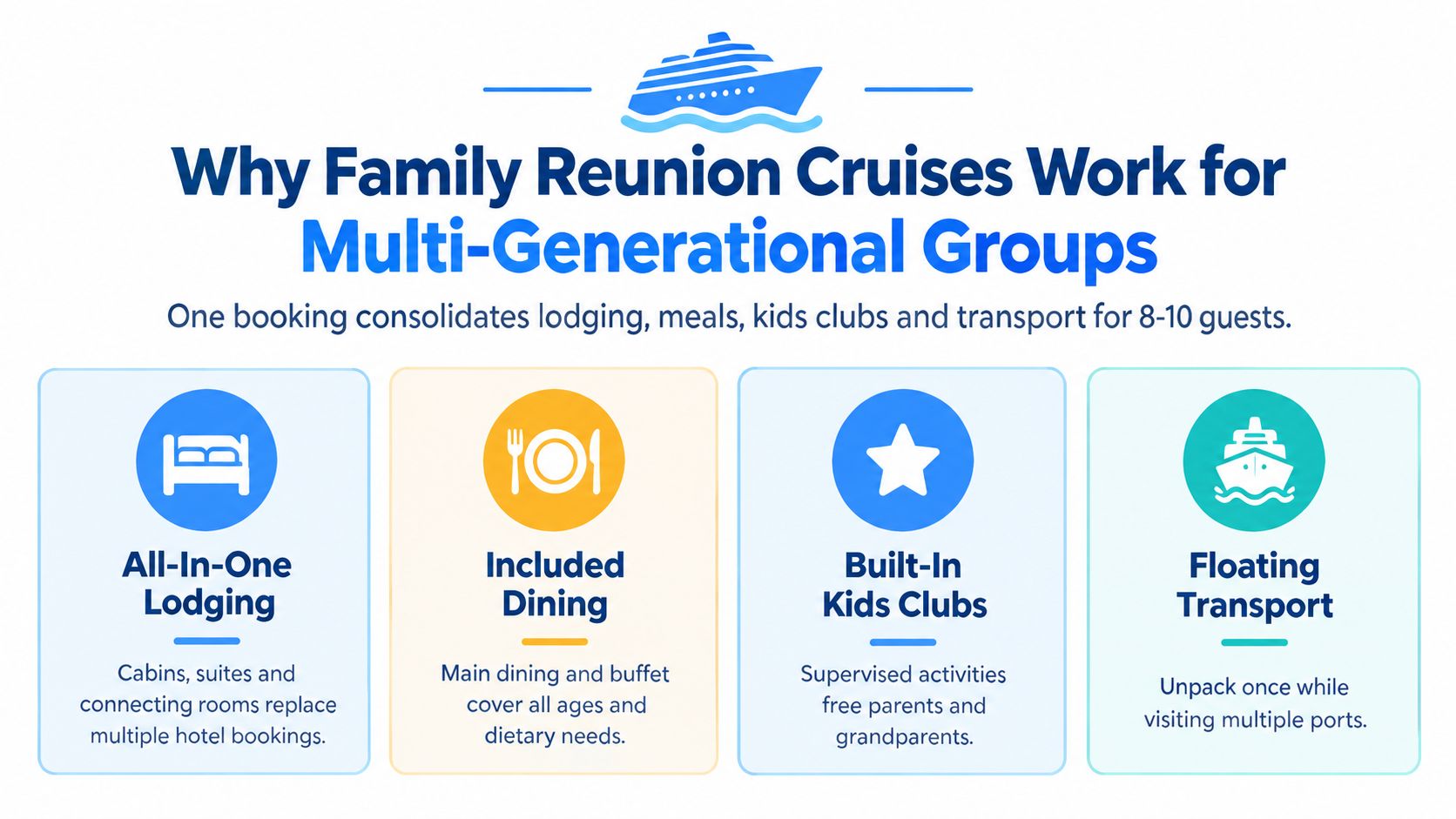
A reunion with grandparents, parents, teenagers, and young children creates different needs from the same travel party. Grandparents may want quiet mornings, parents may be coordinating meals and bedtime, teenagers may want independence, and children may need supervised activities. A cruise lets everyone unpack once, stay within the same ship, and choose different parts of the day without turning the reunion into separate vacations.
That convenience depends on the booking setup. Place grandparents and young children in nearby cabins, confirm which rooms connect or sit across the corridor, and avoid assuming that a ship's shared public areas will solve every mobility or supervision issue. The group can then divide naturally, with one household resting while another uses the kids' club, joins an excursion, or meets elsewhere onboard.
Cruises combine lodging, meals, entertainment, kids' clubs, and transport between destinations in one trip. For 8 to 10 relatives, that shared structure can reduce coordination work while preserving individual schedules. The trade-off is less control than a private house or land-based itinerary, particularly around meal times, cabin layout, and time ashore.
The group-booking structure matters
Family reunion cruise packages generally work better as a formal cruise group than as separate household reservations. Group-cruise rules commonly begin at 8 or more staterooms traveling on the same ship and sailing date, according to industry guidance on group cruise planning. That structure gives one coordinator a way to manage cabin inventory, dining requests, and shared arrangements while the cruise line still has relevant cabins available.
For a reunion organizer, the practical value is inventory control. Consolidating 8 to 10 bookings into one wholesale group workflow makes it easier to request adjacent cabins, compare room categories, track deposits, and identify cost by household. It also reduces the risk that one family books a preferred location before the rest of the group has decided.
Early planning matters when adjoining rooms, family suites, or preferred dining times are priorities. Group inventory may be allocated well before departure and can close months before sailing, so a smaller reunion should still make cabin and dining requests before availability narrows.
Practical rule: The person who starts the family chat should not automatically become the booking manager. Appoint one decision owner, then set deadlines for cabin preferences, traveler details, and payments.
A cruise does not suit every reunion. Families seeking a private house, flexible meal times, or extensive time ashore may prefer a vacation rental. This guide to family adventure holidays in Europe can help compare a cruise with a land-based itinerary based on mobility, activity, and privacy needs. Choose the cruise when shared infrastructure and varied onboard schedules matter more than complete control over the destination.
How to Choose the Right Cruise Line and Itinerary for Your Family
Start with the people, not the ship. A cruise line's reputation means little if the itinerary requires difficult transfers, the ship lacks suitable accessibility features, or the children's programming doesn't match the ages in your group.
Send one short poll before anyone compares sailings. Ask each household to identify its preferred departure region, maximum travel time to port, cabin priorities, mobility considerations, excursion interest, and activities that are essential. Don't ask everyone to rank dozens of ships. The purpose is to identify constraints that eliminate unsuitable options.

Filter the itinerary before comparing fares
Use four filters in order:
-
Departure-port friction: Choose the port that minimizes flights, overnight stays, long transfers, and complicated arrival times. A theoretically attractive sailing can become impractical when grandparents and young children face a difficult pre-cruise journey.
-
Age and activity fit: Toddlers need age-appropriate care and predictable routines. Teens usually need independent spaces and activities. Older relatives may value shows, quiet lounges, accessible routes, and comfortable dining more than high-intensity attractions.
-
Mobility and cabin access: Review elevator proximity, walking distances, tender-port requirements, and excursion demands. A cabin near an elevator can be useful for mobility, but a high-traffic location may not suit a light sleeper. Ask the cruise line or planner specific questions instead of relying on deck photos.
-
Dining flexibility: Confirm whether the line can link reservations, accommodate dietary needs, and offer alternative dining times. A shared dinner can anchor the reunion, but the group shouldn't design the entire day around one table.
Caribbean itineraries often work well for first-time reunion groups that want warm weather, varied onboard programming, and accessible port options. Alaska may suit families drawn to scenery and educational excursions, but cooler conditions and more demanding shore activities can affect grandparents and young children. Mediterranean sailings offer cultural variety, yet longer port days and extensive walking can create a sharper mobility divide.
Narrow the decision to a manageable shortlist
The decision owner should present two or three viable options, not an open-ended catalog. For each option, show the departure port, sailing date, cabin availability, dining setup, likely excursion intensity, and the main trade-off. One family might prefer a balcony cabin, while another needs a lower-cost interior room near the parents. Your shortlist should make those differences visible.
Use the ship's official accessibility information, children's programming details, dining policies, and group-booking terms to verify assumptions. A group can compromise on ship décor or entertainment. It shouldn't compromise on a mobility requirement or a cabin arrangement that affects sleep and supervision.
This video can help families visualize the broader group-cruise planning process before they make a final shortlist:
Once the group selects the itinerary, stop reopening the destination debate. Shift the conversation to cabin placement, payments, dining, and documents. That's where execution determines whether the reunion feels coordinated or improvised.
Cabin Strategy and Pricing for Groups of 8 to 10
Cabin selection is where many family reunion cruise packages either become comfortable or become stressful. The cheapest rooms aren't automatically the best allocation, especially when grandparents, parents, teens, and young children need different levels of proximity and privacy.
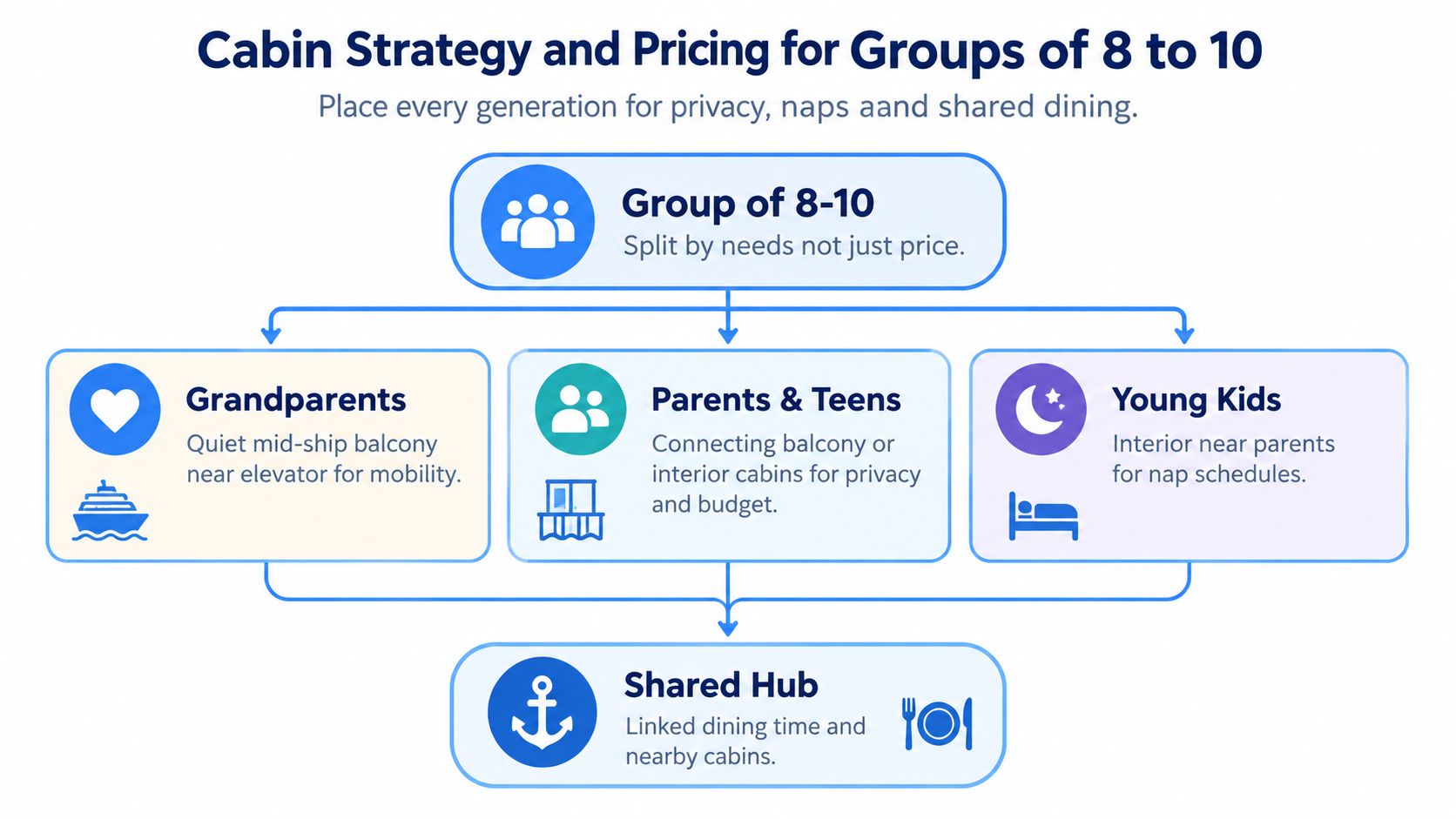
Begin with a generation-based cabin map. Put grandparents close enough to the shared dining and elevator routes to reduce walking, but not directly beside a noisy entertainment venue. Place parents and teens in connecting or nearby rooms when supervision and privacy both matter. Keep young children close to their parents, with the cabin configuration supporting naps and early bedtimes.
Build the map around needs, not equal treatment
An effective map might look like this:
-
Grandparents: A quiet mid-ship balcony near an elevator, subject to availability, can balance mobility and rest. Avoid assuming that the largest suite is the right answer if the layout creates unnecessary walking.
-
Parents and teens: Connecting balcony or interior cabins can preserve privacy while keeping the group financially flexible. Teens may appreciate a nearby interior room, while parents may prioritize a balcony for quiet time.
-
Young children: A room near the parents generally works better than a room selected solely for a lower fare. Nap schedules and nighttime supervision are operational concerns, not minor preferences.
-
Shared hub: Link the cabin map to one dining time, a meeting point, and a shared communication channel. The group needs an easy place to reconnect, not a requirement to remain together all day.
A connecting door is not the same as adjacent rooms, and adjacent rooms are not always on the same side of the ship. Confirm the precise layout, bed configuration, accessibility features, and occupancy rules before asking relatives to pay. If the group is considering larger connected accommodation, review practical two-bedroom cabin considerations before treating a suite as a universal solution.
Use the group block as an inventory tool
Many cruise-line group programs define a group at approximately 8 cabins minimum, and the group structure can help keep the party on one sailing while inventory is still coordinated. Virgin Voyages states that groups start at 8 cabins and can include up to 75 cabins, with a benefit of one complimentary cabin for every 16 booked, subject to its terms and availability, as explained in its group cruise program.
That kind of rule can affect how the group evaluates cabin categories. Don't promise that a complimentary cabin will cover a particular household. Treat it as a group-level planning benefit, then agree in writing whether it offsets shared expenses, supports the decision owner, or is allocated another way.
Pricing should be assigned by household, not divided equally without context. Let each household choose from a defined cabin category range, then show how proximity, balcony access, occupancy, and suite space change the total. The objective is to keep everyone on the same sailing while making the trade-offs transparent.
Booking Timeline and Coordination Checklist That Prevents Chaos
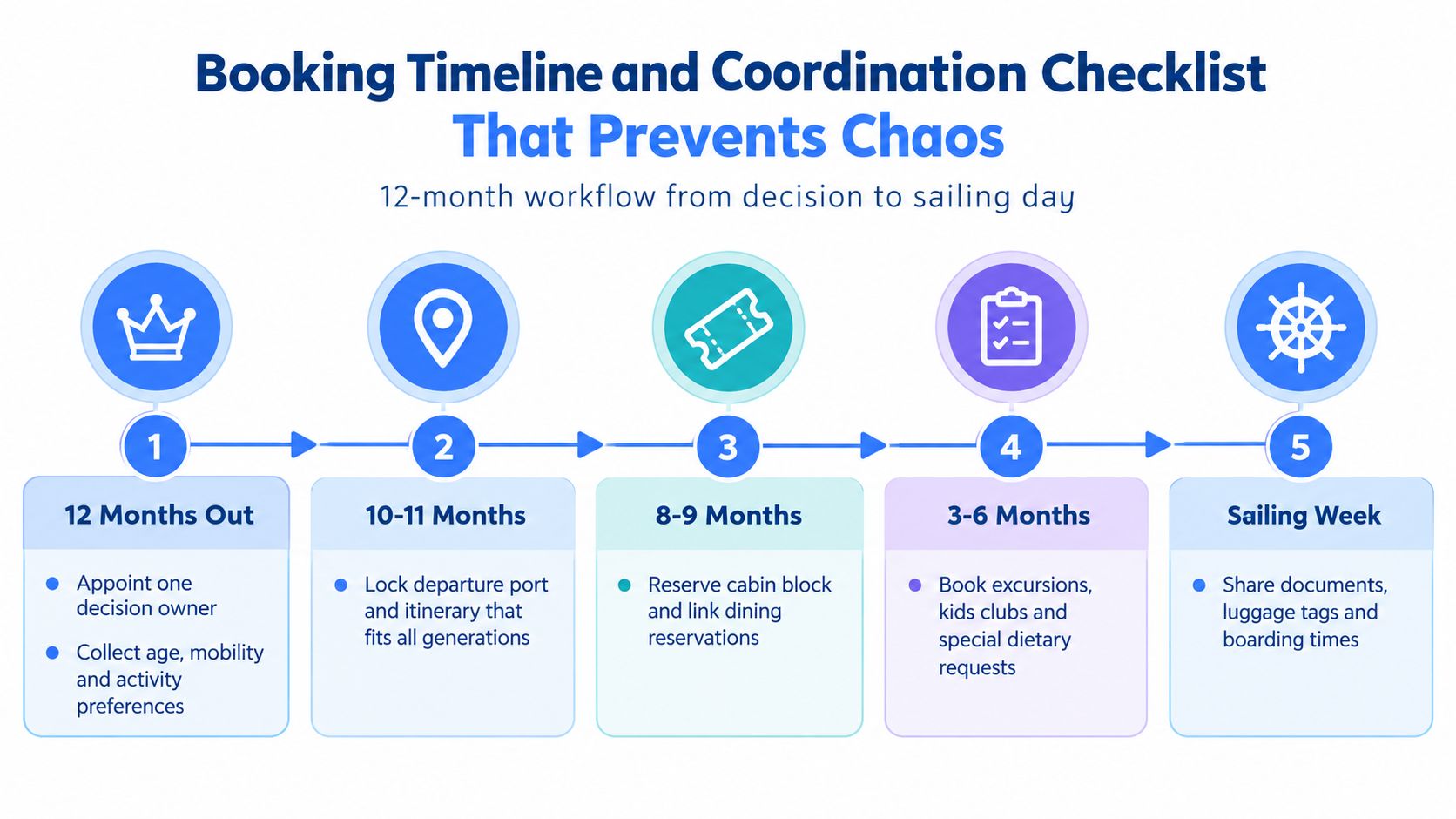
A reunion booking needs an owner-led workflow. Without one, relatives make reasonable individual decisions that produce an unreasonable group result, such as cabins spread across the ship, dining reservations at incompatible times, or unpaid deposits that release the block.
Start planning at least 12 months ahead when adjacency, cabin mix, and coordinated dining matter. Group-planning guidance recommends appointing one decision owner, collecting preferences, choosing a practical departure port, reserving staterooms early, and distributing a shared itinerary and cabin map for multi-generational groups, as outlined in this group cruise planning methodology.
Use a single source of truth
The decision owner should maintain one shared file containing:
- Household details: Names as they appear on travel documents, ages, mobility needs, dietary requirements, and emergency contacts.
- Cabin assignments: Room number, category, occupancy, connecting status, and the household responsible for payment.
- Financial deadlines: Deposit amount, payment dates, cancellation terms, and any shared-cost commitments.
- Dining and activity plans: Linked reservations, preferred meal periods, childcare expectations, excursions, and free-time rules.
- Travel documents: Passports or other required identification, flights, transfers, luggage tags, boarding windows, and insurance details.
A family travel planner template can provide a useful structure for organizing these fields, but the file only works if one person controls updates and communicates changes.
Understand deposits before the block is released
Cruise-line terms can differ sharply by group size. Norwegian Cruise Line states that groups of 8 to 16 cabins have no initial deposit, while groups of 17 to 99 cabins have an initial deposit due 60 days after booking and a second deposit due no later than 120 days before sailing, according to its published group terms. These terms are line-specific, so confirm the rules for the selected sailing rather than applying one operator's schedule across the market.
Late booking is a common source of failure. Family travel research identifies affordability as the top obstacle for 73% of parents, while 35% book only 2 to 3 months before departure and 31% book 4 to 6 months out, according to the Family Travel Association survey report. That timing may work for an individual cabin, but it can be too late for adjoining rooms, family suites, and coordinated dining.
Set childcare, elder-care, privacy, alcohol, excursion, and extra-cost rules before deposits are due. Write down whether children can move between cabins, whether grandparents are expected to supervise, and which activities are optional. Families don't need identical schedules. They do need shared expectations.
Budget Modeling Beyond the Base Fare and How to Split Costs
A cruise fare is only the starting point. Family reunion cruise packages can appear simple because lodging and core dining are bundled, but groups may still pay for taxes, gratuities, drinks, Wi-Fi, specialty dining, excursions, transfers, and pre-cruise lodging.
For orientation, neutral planning guidance places a 7-night Caribbean cruise at about $5,400 to $8,500 for a family of four once taxes, gratuities, drinks, Wi-Fi, and excursions are included. The same family cruise cost guide estimates $1,000 to $1,500 in extras alone for a family of four on top of the fare. Treat those figures as a planning reference, not a quote for your sailing, because cabin category, traveler age, itinerary, and spending choices change the result.
Build the budget in two layers
The first layer contains expenses the group must reserve or estimate for everyone. The second contains personal choices that shouldn't be imposed on relatives who don't want them.
| Cost Component | What It Covers | Budget Tip |
|---|---|---|
| Base fare | Cabin, core onboard access, and the selected sailing | Quote each household's cabin category separately |
| Taxes and gratuities | Mandatory or customary charges tied to the booking | Put these in the baseline, not the optional column |
| Drinks | Beverage packages and individual purchases | Let households choose unless the package is required |
| Wi-Fi | Internet access for personal or work use | Assign by user rather than splitting across the whole family |
| Specialty dining | Restaurants or upgraded meal experiences | Make the reunion meal shared, then leave other reservations private |
| Excursions | Port activities and transportation | Group by mobility and interest, not by family rank |
| Transfers and pre-cruise stay | Airport, hotel, and port logistics | Allocate to the households using each service |
| Contingency | Unplanned meals, transport, medical needs, or changes | Keep it visible as a planning category rather than hiding it |
Use a household worksheet that shows fare, mandatory charges, shared expenses, optional purchases, and payment deadlines in separate columns. A budget spreadsheet for any income can help structure the household side of that process, provided you adapt it to cruise-specific categories.
Decide what “together” means financially
A shared dinner doesn't require shared Wi-Fi. A group excursion doesn't mean every traveler pays the same amount when some relatives stay onboard. Decide whether the following are communal or private:
- Communal: A single reunion meal, shared transportation, group photos, or a private event.
- Household-based: Cabin fare, gratuities, Wi-Fi, drinks, and childcare-related purchases.
- Individual: Spa services, specialty dining beyond the shared meal, casino spending, and optional excursions.
Don't collect vague contributions into one family fund. That approach creates disputes when one household uses more services or another opts out. Publish a per-household total, identify what can change, and set a payment deadline for every shared commitment.
Leveraging Approved Traveler to Consolidate Bookings and Capture Value
The operational advantage of a consolidated travel platform is not a coupon. It's inventory control. A reunion organizer who searches one cabin on one site, another cabin through a cruise line, and excursions through separate providers may create a patchwork of confirmations, payment dates, and cancellation rules.
Approved Experiences Traveler provides wholesale-rate marketplace access across 44+ cruise lines and 30,000+ itineraries, alongside hotels, airlines, car rentals, vacation homes, tours, and activities. For an organizer coordinating 8 to 10 travelers, the relevant question is whether the platform can help keep the search, booking records, and household participation aligned. Its membership supports up to 10 household members, which fits the scale of many reunion-planning households and can reduce the need to manage separate travel access for each participant.
The platform also includes Reward Credits on every booking, with credits that never expire and can be applied toward future bookings, maintenance fees, resort usage fees, annual renewal, and eligible eGift cards. The 110% Best Value Guarantee provides a defined process if a member finds a lower publicly available price, with the refund equal to 110% of the difference. Those mechanisms matter most when the family travels repeatedly, because the organizer can treat bookings as part of an ongoing travel system rather than a one-off transaction.
Keep the membership aligned with the workload
Traveler provides marketplace access. Lux Traveler adds the Approved Lux 24/7 Personal Assistant for travel logistics, family scheduling, childcare, medical appointments, and household management, with coverage for up to 10 household members. That expanded assistance may be relevant when the reunion includes complex schedules, older relatives, or multiple households that need coordination beyond cabin selection.
Use a platform only after you've defined the itinerary, cabin map, and cost rules. A membership won't replace the decision owner or solve unclear family expectations. It can, however, consolidate the booking workflow and give the organizer a consistent place to manage future trips. For a broader look at the operating model, review this group travel planning platform guide.
Approved Experiences Traveler gives reunion organizers access to cruise inventory across 44+ cruise lines and 30,000+ itineraries, with one membership supporting up to 10 household members and Reward Credits that never expire. Review Approved Experiences Traveler to consolidate your next family reunion cruise booking and build a repeatable travel workflow.
Want the wider view?
Ten categories. One report. Every quarter. The Approved List tracks what's rising and what's fading: data-backed signals, not opinions.
Free to join · Delivered by email