All Articles
The Journal
How to Plan a Family Cruise That Works for Everyone
September 15, 202613 min readmulti-generational cruisefamily cruise tips
Learn how to plan a family cruise that fits multiple generations, from cabins and flights to excursions and payments, with practical tips
Your family group chat has probably reached the familiar stage where everyone wants the cruise, but nobody agrees on the rooms, dates, flights, dining, or who's paying for what. Grandparents want manageable walking distances, parents want reliable childcare and predictable costs, teenagers want independence, and younger children need sleep schedules that don't collapse on the first sea day.
How to plan a family cruise that works for 8 to 10 travelers is less about choosing the most exciting ship and more about building a working household system. Assign ownership, document every decision, match the cabin layout to supervision rules, and budget the operational costs before anyone pays a deposit. The cruise should feel effortless onboard because the complicated work happened beforehand.
Treating the Family Cruise as a Household Project
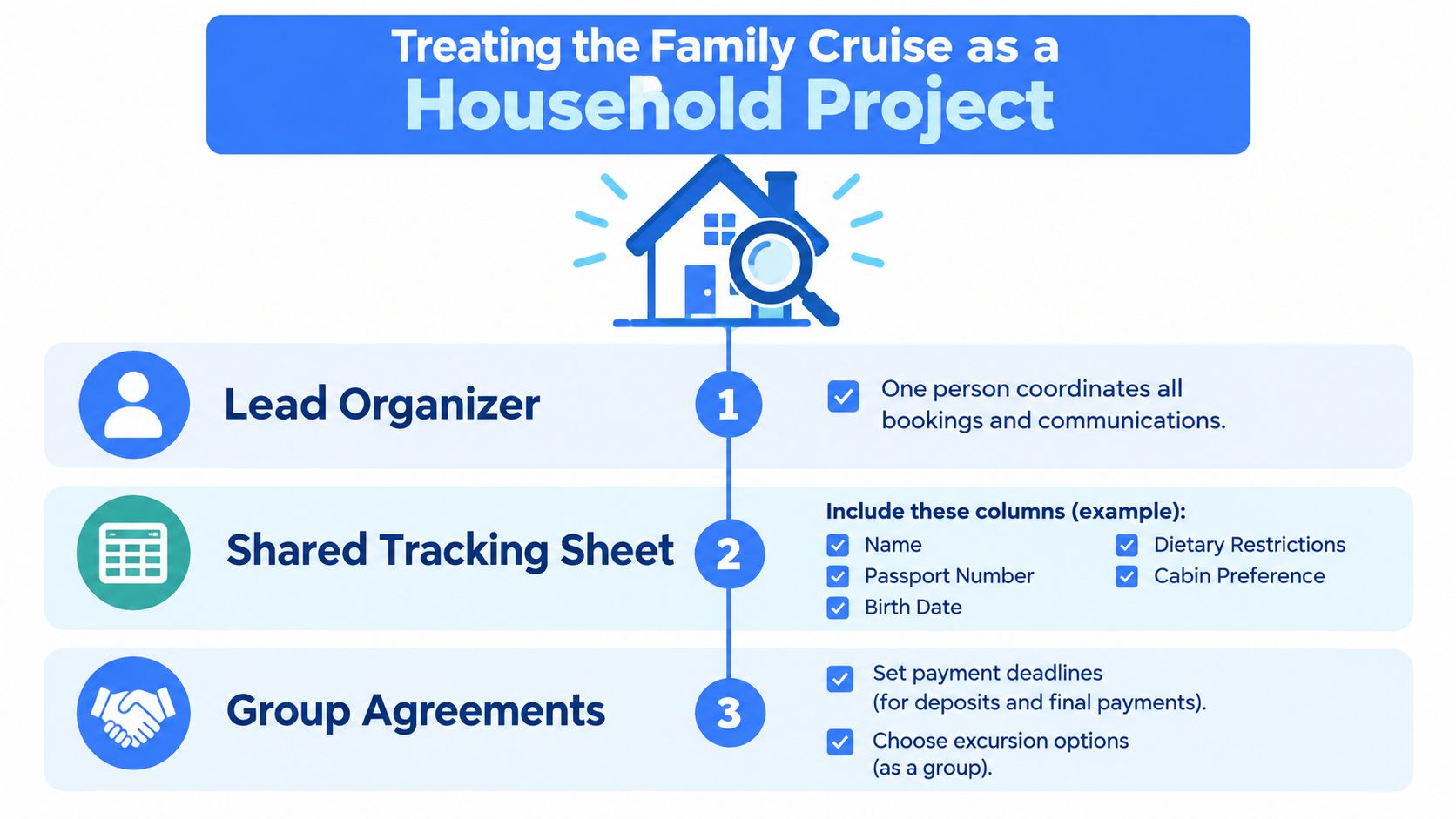
Start by naming one lead organizer. This person doesn't have to pay for everyone or make every decision, but they must own the master booking record, deadlines, communications, and final confirmation check. Without one coordinator, relatives will book different cabins, answer the same question several times, and assume someone else handled passports or transfers.
Create a shared tracking sheet before you compare ships. Use one row per traveler and include:
- Identity details: Full legal name, birth date, passport number, passport expiration date, and citizenship.
- Health and food information: Dietary restrictions, allergies, mobility needs, medication notes, and emergency contacts.
- Room preferences: Balcony or interior, preferred deck, connecting-room requirement, bed arrangement, and who needs to sleep near whom.
- Payment ownership: Household payer, deposit status, final-balance responsibility, onboard-account preference, and receipts.
- Decision status: Approved, pending, or declined for cabins, dining, transfers, and excursions.
That spreadsheet becomes the operating record. Don't rely on scattered messages, especially when relatives live in different households and one person is coordinating 8 to 10 travelers.
Freeze the first decisions quickly
Cruise travelers often book well ahead. Twenty-seven percent book one year or more before sailing, according to the Cruise Lines International Association's 2025 State of the Cruise Industry Report. That long planning window matters most when your group needs multiple cabins, connected rooms, specific dining times, and coordinated flights.
Set a decision deadline and communicate it once. For example, each household can submit its cabin and itinerary preferences by a fixed date, after which the lead organizer selects from the viable options. Endless group-chat voting is not collaboration. It's a scheduling failure.
Choose a booking model early. One travel advisor can manage the entire reservation, each household can work with the same advisor while paying its own cabin, or the lead organizer can handle a direct multi-room booking. For a reusable planning framework, keep a copy of this family travel planner template alongside the cruise record.
Practical rule: The person who controls the master confirmation should also control the deadline calendar.
The first 72 hours after the family agrees to travel should produce a short list of acceptable sailing dates, a cabin strategy, a payment model, and a named decision-maker. Those choices determine almost everything that follows.
Matching the Ship and Itinerary to Your Group
Don't choose a ship by reputation alone. Choose it by throughput, stamina, and age mix. Large and mega-ships appeal to families because they offer broader amenities and denser activity schedules, but a ship with abundant options can also create more coordination work. A mid-size vessel may suit a group that values shorter walking routes and simpler meeting points.
Cruise history helps explain why ships now operate as large, structured vacation environments. The purpose-built leisure ship Prinzessin Victoria Luise launched in 1900, a shift that helped establish cruising as a vacation experience rather than transport, as described in this cruise industry history. Royal Caribbean's Sovereign of the Seas later launched in 1988 as the first so-called megaship, carrying 2,850 guests, according to this timeline of cruise industry development. Today's operational scale is useful when your family needs several room categories and activity choices, but it doesn't eliminate the need for a plan.
Match the trip to energy levels
A 7-night sailing is often the cleanest default for a mixed-age group because it creates room for sea days, port days, rest, and a disrupted sleep schedule without turning the trip into a long endurance test. A shorter sailing can work when school calendars or work obligations dominate. A longer itinerary deserves scrutiny if grandparents, toddlers, or first-time cruisers are joining.
Sea days are not empty days. They give grandparents a chance to join breakfast, allow teens to split off without missing the whole group, and create a dependable occasion for a shared lunch or show. Put one group event on the calendar, then leave the rest flexible.
| Group Profile | Recommended Ship Size | Suggested Length | Best Sailing Window |
|---|---|---|---|
| Toddlers with grandparents | Large, but easy to navigate | Shorter itinerary | School-compatible shoulder season |
| School-age children and teens | Large or mega-ship | 7-night sailing | School break or a carefully chosen shoulder period |
| Active adults with older children | Mega-ship with varied activities | 7-night or longer | Window that supports direct flights |
| Mobility-sensitive multi-generational group | Mid-size or well-zoned large ship | Moderate itinerary | Season with comfortable port conditions |
| Several households with different interests | Large ship with flexible dining and activity inventory | 7-night sailing | Date accepted by every household |
School calendars should come before destination enthusiasm. Compare embarkation ports against direct-flight availability from each household's home city, then account for weather patterns that can disrupt air travel, transfers, or port calls. The different cruise lines comparison can help organize that shortlist, but the final decision should reflect your actual travelers, not a generic ranking.
Planning Cabins That Work Across Generations
Cabin planning is where family cruises become operationally different from ordinary vacations. You aren't buying beds. You're assigning supervision, sleep zones, privacy, mobility access, and nighttime movement across several rooms.
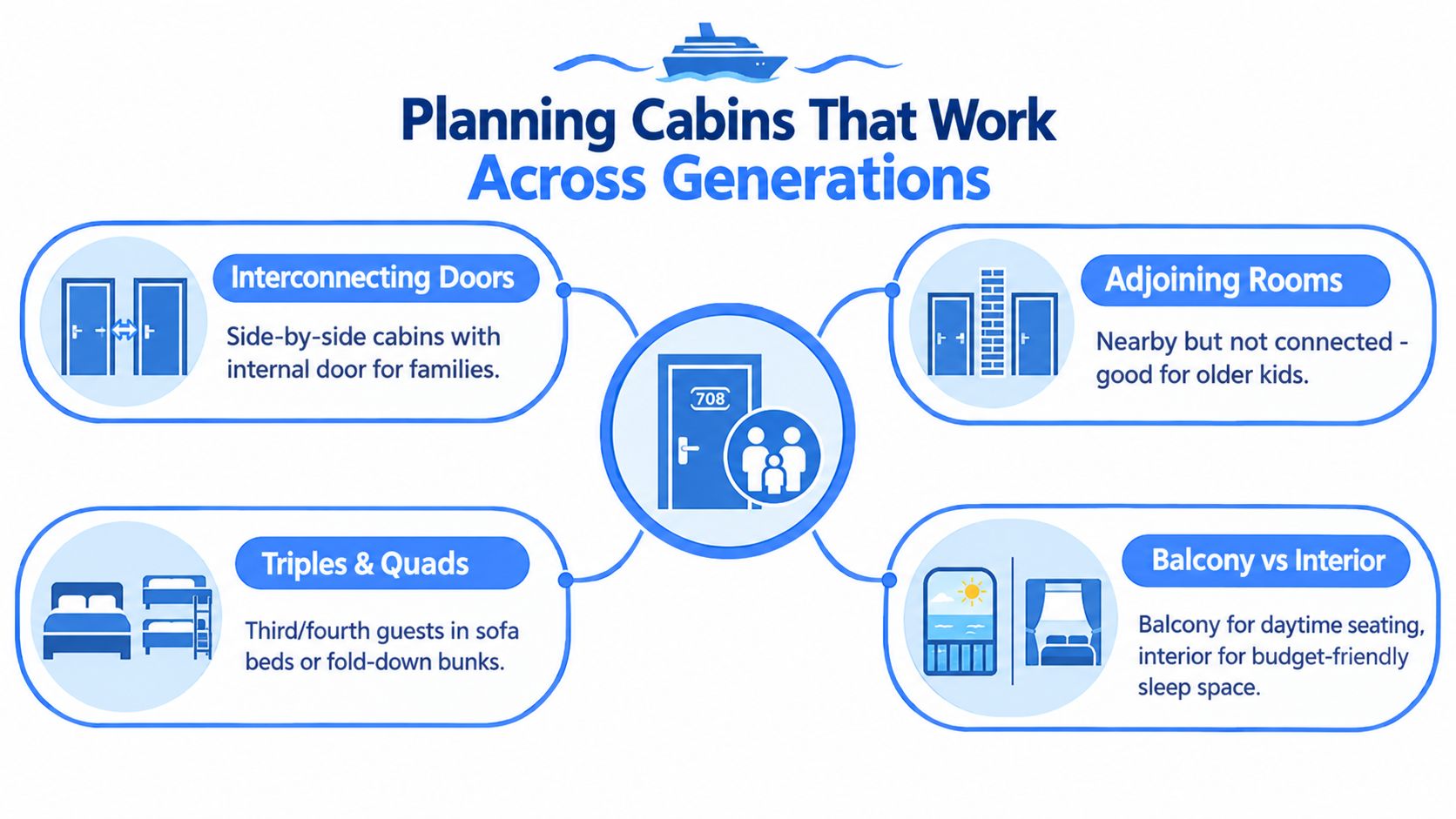
Start with the cruise line's minor-occupancy rules before looking at deck plans. MSC requires a parent or legal guardian and minors to stay in connecting staterooms, and the minor cabin's balcony must remain locked. MSC defines connecting staterooms as cabins joined by an internal door, according to its children and teens policy. Carnival's rules also affect placement. Passengers aged 14 and under must stay in the same cabin or a connecting room with a relative or guardian aged at least 25, while teens aged 15 to 17 can be booked no more than three staterooms away from those adults, as reported by USA Today.
Build the room map before booking
Draw the cabin arrangement as a supervision map. Put the adult guardian room in the center, place younger children in a connecting cabin where required, and assign older teens to nearby adjoining rooms only when the cruise line permits it. Mark grandparents who need quiet, travelers who wake early, and anyone who needs a shorter route to elevators or dining.
Triples and quads can lower the number of reservations, but they can also make sleep arrangements uncomfortable. Confirm whether the third and fourth beds are sofa beds, Pullman berths, or another configuration, and ask who can use them safely. A balcony can provide useful daytime seating and a quiet place for an adult, while an interior cabin may suit a child who sleeps better in darkness. Don't assume a larger cabin automatically solves privacy problems.
Position matters. Motion-sensitive travelers generally benefit from a stable-feeling location, while families with strollers may prefer a route that avoids long corridors and repeated deck changes. Keep the group close enough for meetings, but don't put a light sleeper beside a noisy activity area.
Room-planning rule: Book the configuration that satisfies supervision first, then optimize view, deck, and price.
For groups of three or more rooms, connected cabins and desirable clusters can disappear before ordinary room inventory does. If a cabin must be rebooked later, verify the new room's occupancy rules, deposit terms, connecting status, and proximity to the rest of the family before changing anything.
Coordinating Flights, Transfers, and Excursions
Air travel should be coordinated as a group system, not handled as eight separate itineraries. Aim for arrivals on the same morning into the embarkation port only when the schedule leaves a substantial buffer before the ship's departure. A pre-arranged private transfer gives you more control than a shared shuttle, especially when households arrive with strollers, mobility devices, or bulky luggage.
Connect each movement on one page
Record each household's flight number, arrival time, terminal, luggage count, transfer contact, and mobile number. Confirm the exact port address, because large embarkation cities can have several terminals and rideshare pickup areas.
A private van is usually the cleaner option for a large family because the driver can wait for the final household and load luggage in one place. A ship transfer may be simpler when everyone uses the cruise line's air program or when the terminal is difficult to manage independently. For return flights, calculate the full path from ship arrival to disembarkation, luggage collection, ground transfer, airport security, and the departure gate. A flight that looks reasonable on paper can be unusable if the group has to move slowly.
Shore excursions need the same ownership model. Assign one household lead per port, then present one or two options rather than asking everyone to research everything. Catamaran sails, beach breaks, scenic tours, and accessible city visits can work across generations when the pace, shade, walking distance, restroom access, and return timing are clear.
Leave some ports open. Teens may want independent time, grandparents may prefer a slower morning, and parents may need a day without a scheduled activity. Any split group must return with enough margin before the ship's all-aboard time.
Operational safeguard: Keep flights, hotels, transfers, excursions, insurance details, and emergency contacts in one shared document. The lead organizer should be able to solve a disruption without calling every traveler.
Building the Real Trip Budget Beyond the Fare
The headline fare is only the starting point. Build the budget per traveler, per cabin, and per booking, because different charges follow different allocation rules. A household may pay for its cabin directly, while shared transfers, a group excursion, or a booking service needs a separate split.
Daily gratuities deserve an early line item. Major cruise lines commonly charge about $16 to $20 per guest per day, and some charge children the same rate as adults, according to this cruise gratuities guide. A 7-night sailing therefore creates a per-person service-fee obligation that should be discussed before the deposit, not discovered onboard.
Use a working cost sheet
| Budget Category | Per Person | Per Cabin | Per Booking | Typical Range (USD) |
|---|---|---|---|---|
| Cruise fare | Yes | Sometimes bundled | No | Varies by sailing |
| Daily gratuities | Yes | Sometimes posted together | No | About $16 to $20 per guest per day |
| Beverage package | Often | May require cabin-wide purchase | No | Varies by line and plan |
| Wi-Fi | Often | Sometimes shared by plan | No | Varies by device and package |
| Specialty dining | Sometimes | No | Often reservation-based | Varies by venue |
| Shore excursions | Yes | No | Sometimes group-priced | Varies by activity |
| Travel insurance | Yes | No | No | Varies by traveler and coverage |
| Transfers | No | Sometimes | Often | Varies by vehicle and route |
| Pre-cruise hotel | No | Yes | Sometimes | Varies by room and city |
| Onboard spending | Yes | No | No | Set a household limit |
Don't put a made-up range beside every category. Cruise lines, ships, itinerary lengths, and promotions change the actual price. Instead, enter the live quote for each traveler and label the charge by ownership. Beverage packages should be compared with actual consumption, Wi-Fi should reflect who needs connectivity, and specialty dining should be treated as an experience choice rather than an automatic requirement.
Parents in a recent family-travel survey reported practical cost controls, including booking lodging with a kitchen, capping paid attractions, and avoiding providers with extra fees. Those preferences support a cruise budget that protects convenience while identifying every optional purchase before departure, as shown in the 2025 family travel survey.
For broader trip planning outside the cruise invoice, use this guide to estimate trip costs in Canada. Keep a contingency line for impulse purchases, photos, spa appointments, and forgotten transfers, but don't present that reserve as a guaranteed percentage. The correct amount depends on your family's habits.
Splitting Payments and Using Reward Credits
The cleanest payment structure assigns one payer to each cabin. Each household sees its own cabin balance, insurance decision, and onboard-account responsibility, while the lead organizer maintains a master ledger for shared costs. Don't collect random partial payments into one personal account unless everyone has agreed on the reconciliation process.
Cruise deposits, final-payment dates, and cancellation schedules vary by line and sailing. Lock the payment calendar into the shared sheet as soon as the reservation is created. Carnival's policy states that multi-occupancy cabins, including three-, four-, or five-person staterooms, can be subject to cancellation charges for the entire cabin reservation, even when every traveler name wasn't supplied at booking, as described in this discussion of connecting rooms and cancellation rules. That makes cabin-level payment and cancellation ownership essential.
Apply credits transparently
Reward Credits should be treated as a booking adjustment, not as invisible savings that one household absorbs. Approved Experiences describes Reward Credits as applying to future bookings and other eligible uses, while redemption value depends on the applicable program terms. Keep the host's name on the lead booking when that preserves access to the credits and related member benefits.
For a simple illustration, suppose the host applies 500 dollars in Reward Credits to a four-cabin sailing. If the family agrees to divide the benefit equally, the ledger records a 125-dollar reduction against each cabin's balance. The actual accounting should follow the booking's eligible redemption rules and the family's written agreement.
Boomerang Member Share can route returned booking value from shared hotel or car reservations back toward the primary member's account or a future family booking, subject to program terms. It shouldn't be mixed casually with cruise deposits. Record the original payer, the credit source, the applied amount, and the remaining balance.
Use a separate card or payment method for each household when possible. Save confirmation numbers and receipt dates, then reconcile shared transfers, excursions, and common activities after the cruise. The best reward programs comparison can help you evaluate how credits fit into the broader travel-payment system.
Final Checklist and Common Questions
Reverse planning from embarkation day prevents the familiar last-week scramble. Work backward through the deadlines, then assign each task to a named person rather than leaving it as a family responsibility.
The reverse timeline
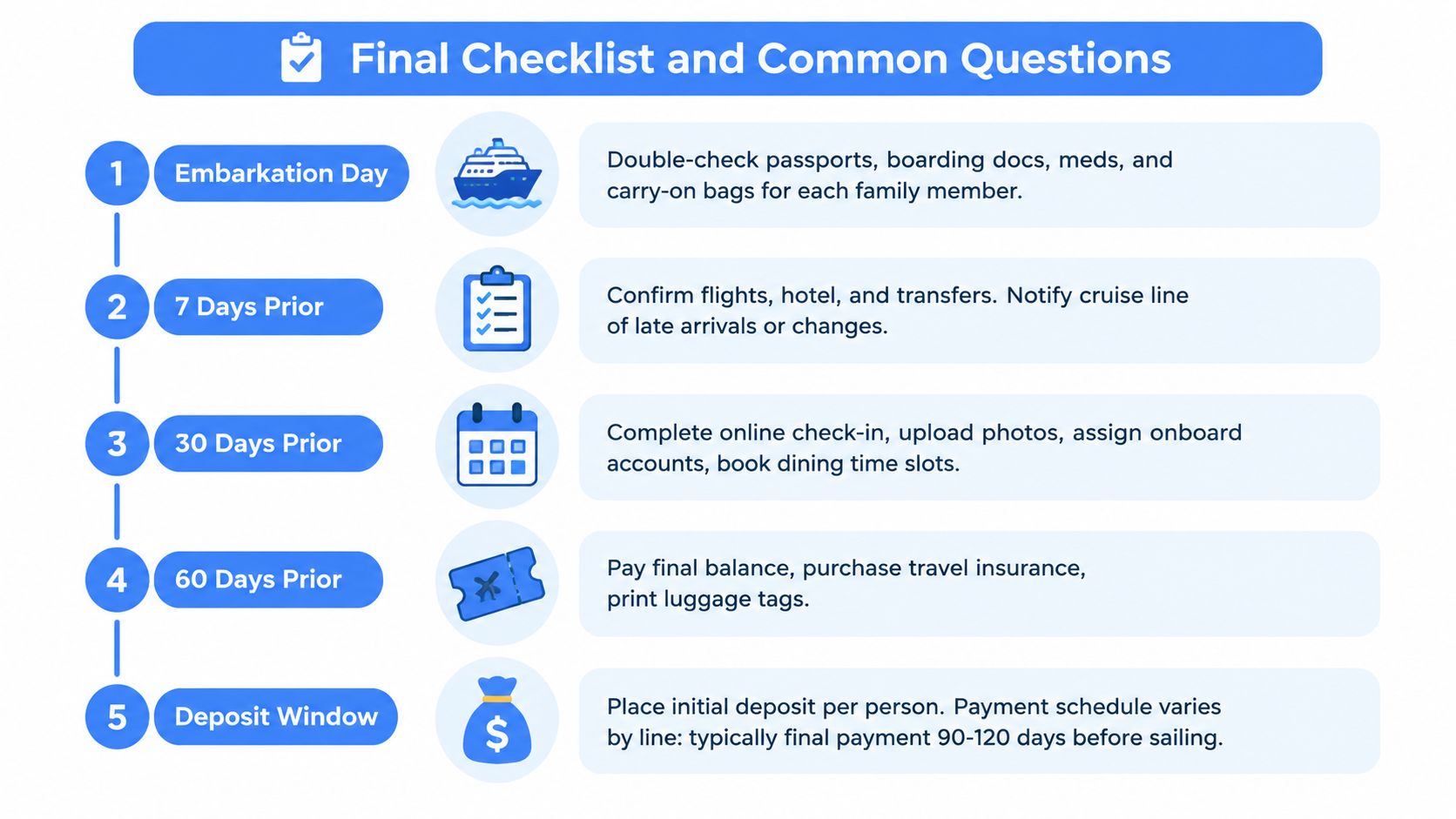
- Embarkation day: Each traveler carries passports, boarding documents, medication, required medical supplies, and essential items in a carry-on. Confirm the terminal meeting point before anyone leaves the hotel or airport.
- One week before: Reconfirm flights, pre-cruise hotel, transfers, and excursion return times. Check every household's luggage tags and notify the cruise line about any late arrival or itinerary change.
- Four weeks before: Confirm cabin assignments, dining times, dietary notes, excursion inventory, onboard accounts, and the final decision on prepaid gratuities. Approved Traveler inventory can be checked if your booking workflow uses that marketplace.
- Eight weeks before: Review the final payment status, travel insurance, passport validity, luggage plan, and transfer details. Give grandparents and teens a simple contact sheet with meeting points.
- Twelve weeks before and the deposit window: Freeze the cabin map, verify every legal name, assign payment responsibility, and document deposit and final-balance deadlines. Cruise Lines International Association research places the median planning time for the last cruise at about four months, with the average sailing lasting 7.5 days, so waiting until the final weeks creates avoidable availability pressure, as reported in this CLIA planning research.
Common questions
What if a guest joins mid-itinerary? Confirm whether the cruise line permits that port embarkation, then verify documentation, fare treatment, transfers, and muster requirements before changing the reservation.
What if a cabin needs to be rebooked? Check minor-occupancy rules, connecting status, cancellation exposure, insurance effects, and the location relative to the rest of the family. Never move only the cabin without reviewing the supervision map.
Can Reward Credits offset onboard charges? Only when the applicable program terms allow that redemption. Confirm eligibility before promising that credits will pay for gratuities, Wi-Fi, drinks, or excursions.
How does Boomerang Member Share interact with an insurance claim? Keep booking value, credit activity, and insurance documentation separate. Ask the program administrator and insurer how a cancellation or claim affects each balance before filing.
When should you contact the Approved Lux 24/7 Personal Assistant for a missed connection? Contact the Approved Lux 24/7 Personal Assistant as soon as the missed connection threatens the embarkation plan, so the travel logistics can be coordinated while the lead organizer keeps the family together.
The operational scaffolding is what makes the vacation feel easy. Once cabins, payments, documents, transfers, and shared activities have clear owners, relatives can choose their own pace onboard without turning every decision into a group emergency.
Approved Experiences Traveler gives families consolidated access to cruise inventory across multiple lines and itineraries, while Lux Traveler adds the Approved Lux 24/7 Personal Assistant for travel coordination and household logistics. Visit Approved Experiences Traveler to review whether that infrastructure fits your next multi-household cruise plan.
Want the wider view?
Ten categories. One report. Every quarter. The Approved List tracks what's rising and what's fading: data-backed signals, not opinions.
Free to join · Delivered by email