
All Articles
The Journal
Family Vacation Package Buying Guide for Large Groups
October 15, 202614 min readmultigenerational travelvacation home booking
Compare family vacation package options for multigenerational trips. Learn how to evaluate cost, lodging, and access across hotels, homes, and cruises.

Your sister wants connecting rooms, your parents need a quieter space and an accessible bathroom, the teenagers want activities, and someone still has to coordinate flights, transfers, meals, and payment splits. For an 8 to 10 person family reunion, the hard part isn't finding a hotel rate. It's building one workable operating plan from inventory that was designed to be booked separately.
A family vacation package should therefore be judged by coordination load, usable capacity, change flexibility, and total itinerary cost. The right structure might be a whole vacation home, several hotel rooms, a packaged tour, or a cruise. The correct choice depends on how your households move, sleep, pay, and make decisions.
| Structure | Best for Group Size | Cost Driver | Coordination Cost | Flexibility |
|---|---|---|---|---|
| Vacation home | 8 to 10 travelers sharing space | Property total, cleaning, utilities, transport, meals | Low inside the property, higher for transport and activities | Strong for longer stays, subject to rental rules |
| Multi-room hotel | Separate households needing service and privacy | Room count, nightly rates, resort fees, meals, transfers | Moderate, especially across rooms and arrival times | Moderate, governed by room and rate rules |
| Packaged tour | Families wanting guided logistics | Per-person itinerary price and included services | Low for planned components, limited customization | Lower, because the itinerary is structured |
| Cruise | Families who value onboard amenities and one itinerary | Fare, occupancy, add-ons, flights, hotels, excursions | Low onboard, higher for cabin allocation and pre-cruise logistics | Limited once sailing and cabin choices are fixed |
What This Guide Solves for Multi-Room Family Organizations
The core work is coordinating people, inventory, and responsibility. Booking one room for yourself is a purchase. Booking for grandparents, parents, children, siblings, and in-laws is procurement. You need a reservation structure that supports sleeping capacity, mobility needs, different activity levels, arrival timing, cancellation terms, and separate payment obligations.
That distinction matters because family travel combines several categories that are often sold through disconnected systems. A single plan may include a vacation home or multiple hotel rooms, flights, car rentals, transfers, cruises, tours, meals, and activities. If every category lives in a different account, the primary organizer becomes the manual integration layer.
Family travel is also a repeatable, substantial expenditure category. The 2025 Family Travel Association survey reported that the average American family spent approximately $8,052 on travel during 2024, about 20% more than in 2023. The same survey found that 8% of families spent more than $20,000, while 39% of parents expected to spend more on domestic travel over the following year and 33% planned to increase international travel spending. That spending pattern justifies treating the booking process as infrastructure, not a one-off search.
Start with the household, not the destination
Before comparing properties, record:
- Households: Identify each family branch and who approves its spending.
- Capacity: Count adults, children, grandparents, solo travelers, and required beds.
- Access needs: Note mobility, bathroom, kitchen, medication, dietary, and quiet-space requirements.
- Decision rights: Assign one person to approve lodging, transportation, activities, and changes.
- Timing: Capture school breaks, work commitments, flight windows, and acceptable arrival differences.
Practical rule: Don't ask, “Which package is cheapest?” Ask, “Which inventory structure lets this group function without constant manual intervention?”
The framework below is designed for several distinct profiles. Multigenerational reunion organizers need coordinated capacity. Snowbirds need long-stay lodging. Timeshare owners may need liquidity. Remote workers require kitchens and workspaces. Frequent leisure travelers benefit from a reusable booking ledger, while Lux Traveler households usually need delegated logistics more than lower rates.
What a Family Vacation Package Actually Is in 2026
The traditional package began with a simple promise: combine transportation, lodging, and meals into one purchase. In nineteenth-century Britain, Thomas Cook arranged a rail excursion from Leicester to Loughborough on 5 July 1841, when approximately 485 people paid one shilling each for the journey. In 1845, his commercial excursion from Leicester to Liverpool carried about 1,200 passengers and included rail transportation, meals, and a handbook. By 1855, Cook's continental tours included transportation, accommodation, and food. These historical milestones are documented in the history of Thomas Cook's organized excursions.
The underlying function hasn't changed. A package consolidates fragmented travel components into a standardized purchasing framework. What has changed is the number of components and the flexibility families expect.
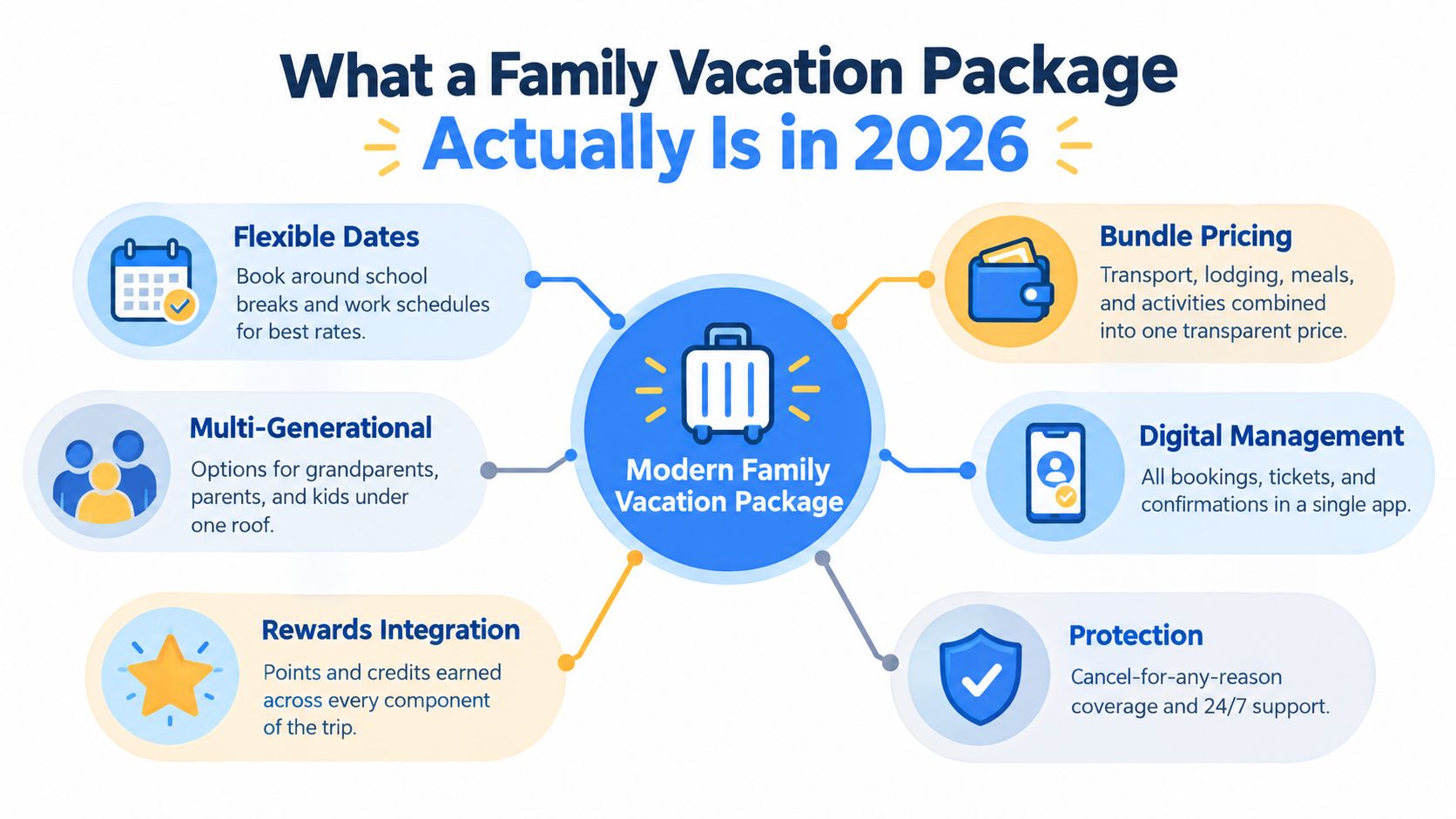
The modern model is consolidated access
A contemporary family vacation package doesn't have to be a pre-set resort itinerary. It can be a coordinated reservation structure in which the organizer selects suitable components from a shared inventory pool:
- Lodging: Hotels, connecting rooms, suites, vacation homes, and condos.
- Transportation: Airlines, rental cars, transfers, and cruise departures.
- Experiences: Tours, activities, family attractions, and downtime options.
- Household management: Shared confirmations, occupancy assignments, payment responsibility, and change tracking.
- Financial infrastructure: Reward accumulation, public-price validation, and future booking continuity.
For large households, access breadth matters because the best lodging format may differ from the best transportation format. A whole home might solve sleeping arrangements, while separate airline bookings suit different departure cities. A cruise might consolidate meals and entertainment, but require careful cabin allocation and pre-embarkation lodging.
Approved Traveler provides access to more than 500,000 vacation homes, 1,000,000+ hotels, 700+ airlines, 44+ cruise lines, 30,000+ car-rental locations, 5,500+ tour packages, and 150,000+ activities, according to the available membership information. That breadth supports a consolidated-access approach, where the organizer compares a complete operating plan instead of treating one hotel or airline as the entire solution.
Comparing Vacation Homes, Multi-Room Hotels, Packaged Tours, and Cruises
A vacation home is usually the strongest choice when the family spends meaningful time together at the property. Shared kitchens, living areas, laundry, and outdoor space reduce the friction of feeding children, accommodating grandparents, and holding informal family time. For longer stays, weekly or monthly pricing can make more sense than multiplying a short-stay nightly rate.
The tradeoff is that the organizer must verify the details that hotels often standardize. Check bedroom separation, bathroom count, stairs, accessibility, parking, cleaning charges, local transport, cancellation terms, and the distance to activities. For a practical guide focused specifically on this lodging format, review vacation rentals for large groups.
Multi-room hotels fit families that want predictable service, housekeeping, on-site dining, reception support, and separate private spaces. They work particularly well when grandparents want independence, parents need proximity to children, and different branches may arrive or leave on different schedules. Hotels also simplify maintenance and can support brand-based recognition programs.
The weakness is coordination across rooms. A headline room price doesn't show the total cost of multiple rooms, taxes, resort charges, meals, parking, transfers, and activities. Confirm connecting-room availability in writing, because “nearby” isn't the same as connected.
Packaged tours are appropriate when the family values turnkey logistics over customization. Transportation, guides, accommodation, and planned activities can reduce the organizer's workload, especially for a destination with complicated transfers. They are a poor fit when one household needs slower days, another wants intensive sightseeing, and a third wants to change the itinerary.
Cruises work best for families who value one moving resort, onboard dining, entertainment, pools, and visits to multiple ports. Consumer Reports reported that the typical price paid for a seven- to 10-day cruise was about $2,750 per adult, with flights, pre- or post-cruise hotels, and travel insurance generally extra. Wi-Fi, drinks, specialty dining, excursions, spa treatments, photos, and tips can add more than $1,000 per person, as detailed in Consumer Reports' cruise booking guidance.
For ideas on reducing transport complexity for larger parties, larger group travel made easy is a useful resource. The central decision remains operational: choose the structure that removes the most work for your specific family.
The Consolidated-Access Procurement Workflow
Start with a trip specification, not a search box. A family organizer who searches before defining requirements will compare attractive but unusable inventory.
Establish the operating parameters
Write down the following before anyone pays:
- Headcount and households: Include every traveler, age category, and family branch.
- Sleeping requirements: Specify beds, bedrooms, bathrooms, cribs, quiet rooms, and shared-space tolerance.
- Mobility and dietary needs: Record elevators, accessible showers, kitchens, allergies, and medication storage.
- Budget responsibility: Decide whether the organizer pays centrally or each branch funds its own share.
- Arrival logic: Note airports, arrival windows, transfer requirements, and who can travel independently.
- Change boundaries: Set the latest acceptable date change and cancellation conditions for each branch.
The why is simple. A property that sleeps ten isn't automatically suitable for ten people. A cruise cabin priced for double occupancy may create a different cost structure when room assignments include solo travelers. Consumer Reports notes that solo cruise travelers can pay an additional 10% to 100% of the fare, depending on the cruise and cabin arrangement, which is why cabin allocation must happen early. See the cruise line comparison guidance for the relevant pricing mechanics.
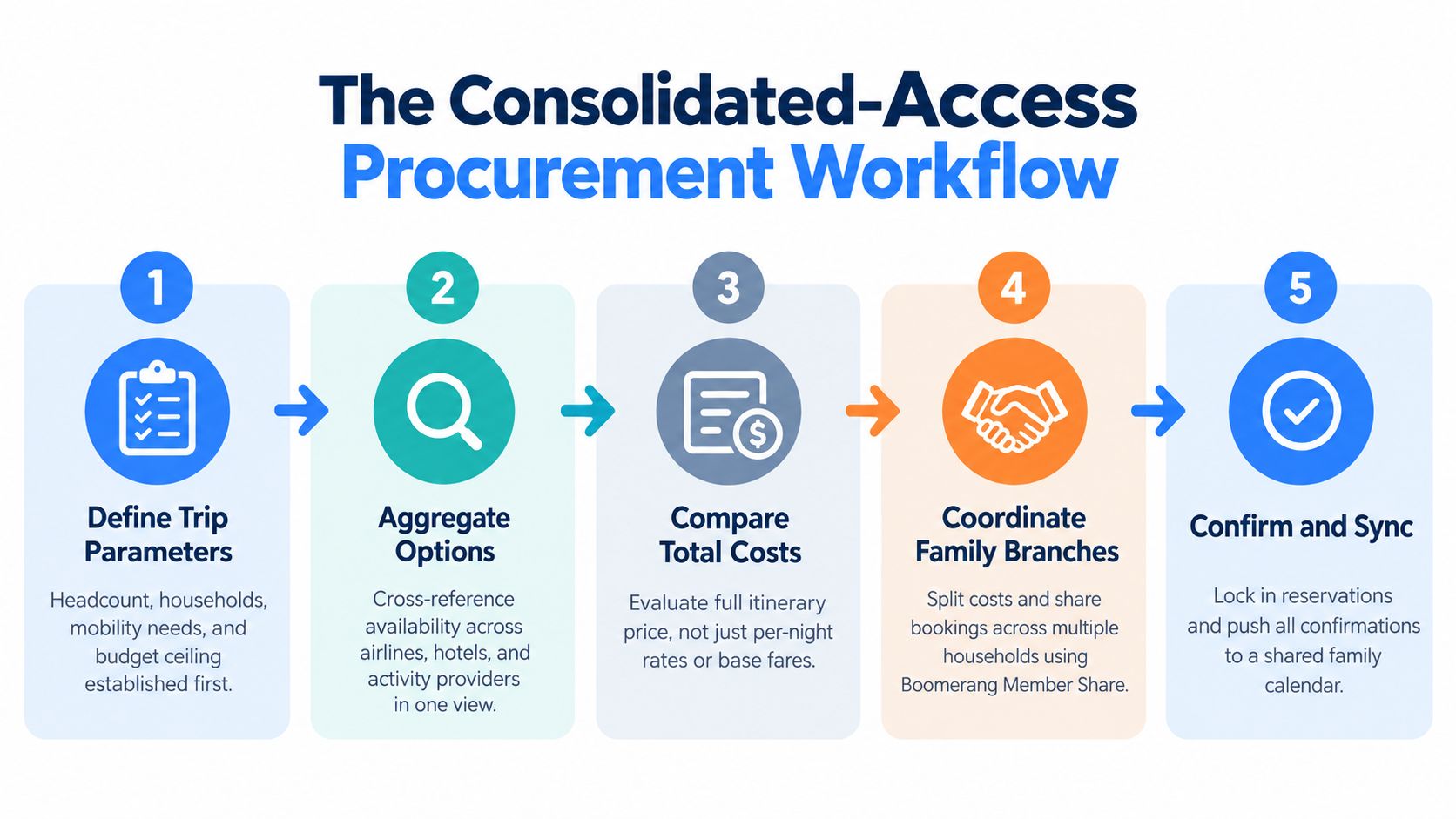
Source components as one operating plan
Compare lodging, transportation, and activities together. Consolidated access to 1,000,000+ hotels, 500,000+ vacation homes, 30,000+ car-rental locations, 5,500+ tour packages, 30,000+ cruise itineraries, and 150,000+ activities lets the organizer test different structures without opening a separate procurement process for every category.
Approved Traveler's membership model also supports up to 10 household members with benefit parity and no per-person fees. That matters when a family reunion includes multiple branches. The account should become the booking ledger, while a separate family document records occupancy, payment responsibility, arrival timing, and approved changes.
Before confirming, lock these items:
- Cancellation terms: Record the deadline, penalty, and whether each component follows a different rule.
- Occupancy rules: Confirm guests, beds, bathrooms, child policies, and cabin or room allocation.
- Payment responsibility: Assign each charge to a household branch before the booking is finalized.
- Arrival synchronization: Decide who needs a shared transfer and who can arrive independently.
- Confirmation control: Store every reservation number in one shared document and calendar.
Cost Analysis and How Reward Credits Compound
A nightly room rate is a poor benchmark for a ten-person household. The correct measure is total cost per traveler-night after mandatory fees, while also checking whether the space and schedule work.
For a representative week, build one worksheet with separate lines for lodging, airfare, ground transport, meals, activities, gratuities, cleaning charges, resort fees, taxes, and pre- or post-trip hotel nights. Then compare the full itinerary against alternatives. A vacation home may have a higher property total but lower meal and room costs. A cruise may include meals and entertainment while adding airfare, port charges, internet, excursions, gratuities, and hotel nights.
The available source data supports this all-in approach. Airbnb reported that nearly 20% of U.S. family Thanksgiving bookings included 10 or more guests, while more than two-thirds of hosts offered weekly or monthly-stay pricing. That makes capacity and duration part of the cost calculation, not secondary details. See Airbnb's family Thanksgiving travel data.
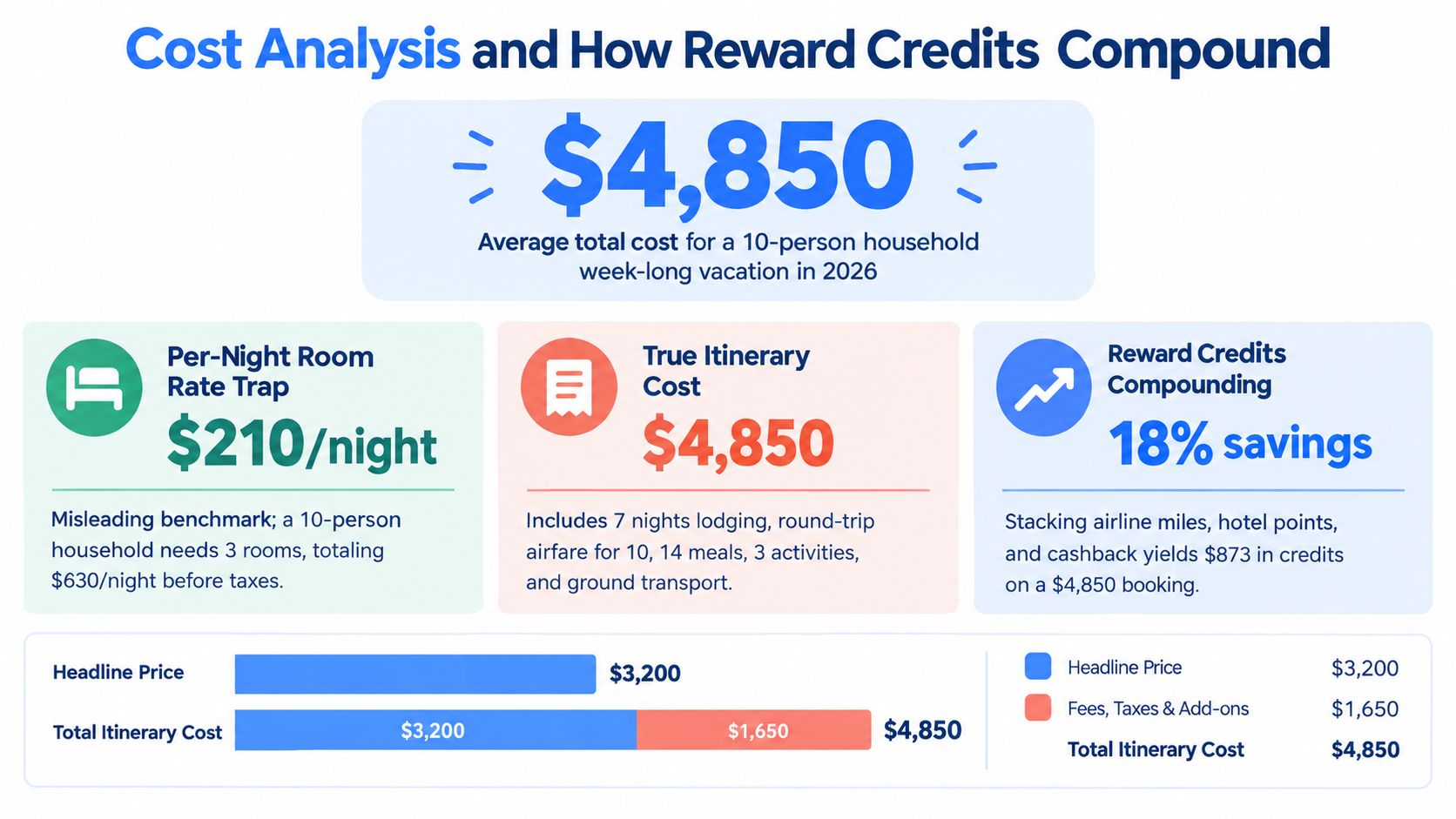
Use the booking ledger beyond one trip
Reward Credits change the analysis for families that book repeatedly. Approved Traveler states that Reward Credits accrue on every booking and do not expire. Don't assign them a fixed dollar value in your comparison, because redemption depends on the applicable booking and use.
Instead, track credits as reusable booking infrastructure across beach trips, ski trips, holiday reunions, cruises, and activities. The value is operational continuity. The same family account can accumulate credits across different inventory categories rather than keeping benefits locked inside one hotel chain or airline program.
Validate each package against public pricing before finalizing. The 110% Best Value Guarantee applies when a lower publicly available price is found under the program's applicable terms, with a refund equal to 110% of the difference. Save the comparable price, travel dates, inclusions, cancellation rules, and taxes so the comparison is auditable.
For a clear framework for comparing a package with separate bookings, use vacation packages versus booking separately. The point isn't to force every component into one fare. It's to determine whether consolidated access lowers coordination work while preserving acceptable flexibility.
Which Structure Fits Which Family Profile
The best structure depends on the household's recurring pattern, not a universal ranking.
Multigenerational reunion organizers
Choose a vacation home when grandparents, parents, and children need shared space, a kitchen, and a common gathering area. Approximately 46% of U.S. family travel involves multiple generations, and about 14% of family trips use short-term rentals, according to the family travel discussion reported by Skift. Select a multi-room hotel instead when privacy, housekeeping, accessibility, or independent schedules matter more than shared living space.
Snowbirds and long-stay retirees
Choose condo-style or vacation-home inventory for one- to three-month stays. Compare kitchens, workspace, elevators, utilities, cleaning, cancellation terms, and total occupancy cost. A market analysis reported that bookings of 30 or more days represented 31% of transactions in 2026 and generated approximately 42% of annual vacation-rental revenue, with an 11.2% compound annual growth rate for the segment. Review the long-stay vacation-rental analysis before treating a nightly hotel rate as a useful benchmark.
Timeshare owners seeking liquidity
Use V.O.I.C.E. when an owned week no longer fits the household's calendar. The program allows owners to deposit up to 5 weeks per year, exchange weeks at no fee, or list weeks on a peer-to-peer rental marketplace with no listing fee. This profile needs an inventory exit or exchange path, not another fixed vacation commitment.
Remote workers and digital nomads
Choose a monthly vacation home or condo with a reliable workspace, kitchen, separate sleeping areas, and a practical cancellation policy. Mid-term contracts lasting 8 to 30 nights were identified as a faster-growing vacation-rental segment with a projected 7.42% compound annual growth rate in the vacation-rental market analysis. Don't trade a functional work setup for a superficially lower room rate.
Frequent leisure travelers
Choose a consolidated membership ledger when the household books three or more trips across hotels, flights, activities, and cruises. Reward Credits accrue across eligible bookings and don't expire, so the benefit is cumulative rather than tied to one brand ecosystem.
Cruise enthusiasts
Compare Royal Caribbean, Carnival, Norwegian, and Viking by all-in itinerary cost, cabin allocation, included services, excursions, internet, and pre-cruise lodging. A cruise is the right fit when the family wants one controlled route and onboard programming. It isn't the right fit for relatives who need independent dates or extensive destination flexibility.
Lux Traveler households
Choose Lux Traveler when time scarcity is the binding constraint. The Approved Lux 24/7 Personal Assistant covers up to 10 household members and can manage travel logistics, family scheduling, childcare, medical appointments, and household management. This is a delegation decision, not a room-rate decision.
Operational Tactics for Synchronizing Family Itineraries
A large family trip succeeds when the organizer separates shared decisions from individual preferences. Everyone doesn't need the same room, flight, activity pace, or payment method. They do need one source of truth.
Use Boomerang Member Share to extend booking participation to shared family and friends. Eligible hotel and car bookings made by those participants can earn the primary member Reward Credits, while the organizer maintains the central ledger. Set a rule that each household confirms its own dates and payment responsibility before the primary member approves the booking.
Grandparents might want a quiet hotel wing while teenagers prefer the activity zone. Keep those preferences separate in the inventory plan, then synchronize only the elements that need coordination, such as airport transfers, dinner reservations, reunion activities, and departure timing.
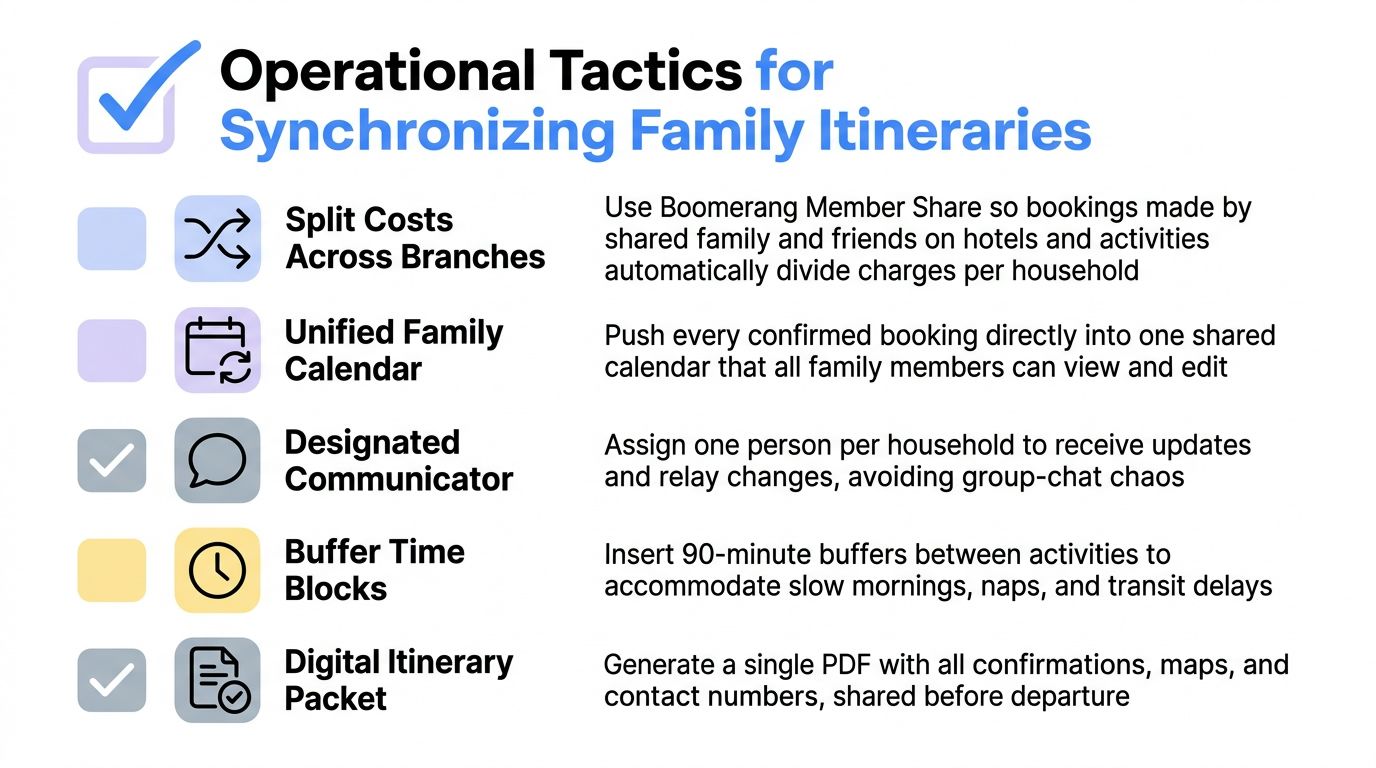
Protect the group from one person's change
Give every traveler a change protocol:
- Date changes: The traveler contacts the organizer before changing any shared component.
- Separate reservations: Keep one person's flexible flight or hotel reservation separate when possible.
- Shared transport: Recalculate transfers if the changed traveler no longer matches the group arrival.
- Activity capacity: Remove or add the individual without canceling the full family booking.
- Payment records: Document refunds, credits, and replacement costs by household branch.
For hotel-specific room allocation and group booking mechanics, see large-group hotel booking.
Run the departure checklist
During departure week, verify identity documents, confirmations, transfer contacts, medication, dietary notes, accessibility arrangements, room assignments, and the shared calendar. Give each household a digital itinerary packet with its own reservations plus the group schedule.
Timeshare owners should also check whether any V.O.I.C.E. deposit, exchange, or peer-to-peer listing affects the current trip. The operational objective is simple: no traveler should need to search through a different family's email account to find a confirmation.
The Core Decision Rule for Choosing Your Family Vacation Package
Choose the inventory structure that matches your coordination load, not the headline nightly rate. Vacation homes suit shared living and longer stays. Multi-room hotels suit privacy and consistent service. Packaged tours suit families that want guided logistics. Cruises suit groups willing to follow one itinerary in exchange for consolidated onboard amenities.
The strongest operating model combines five pillars: aggregated wholesale access, Reward Credits that don't expire, household coverage for up to 10 members, the 110% Best Value Guarantee, and V.O.I.C.E. for timeshare owners. None of those replaces a full cost review or a written change plan. They make the procurement system more reusable.
This week, create one trip specification with headcount, households, sleeping requirements, mobility needs, payment responsibility, arrival windows, and cancellation limits. Then compare one vacation home, one multi-room hotel plan, one packaged tour, and one cruise using the same total-itinerary worksheet.
Approved Experiences Traveler provides consolidated access to hotels, vacation homes, airlines, cruises, car rentals, tours, and activities, with a membership structure that supports up to 10 household members. Visit Approved Experiences Traveler to evaluate whether its inventory access, Reward Credits, Boomerang Member Share, and family-oriented booking infrastructure fit your next group trip.
Want the wider view?
Ten categories. One report. Every quarter. The Approved List tracks what's rising and what's fading: data-backed signals, not opinions.
Free to join · Delivered by email