
All Articles
The Journal
Florida Vacation Packages for Families: 2026 Guide
October 14, 202614 min readmultigenerational travelvacation rentals
Compare Florida vacation packages for families with top resorts, theme parks, and beaches. Get expert tips to plan a stress-free, budget-friendly trip in 2026.
Florida recorded 142.9 million person-trips in 2024, proving that its travel infrastructure is built to handle enormous multigenerational demand. For families, the strongest Florida vacation packages combine lodging, flights, cars, activities, and supervision planning in one workable itinerary instead of scattering ten travelers across disconnected reservations.
The familiar version of this trip starts with one person opening too many tabs. One tab holds a hotel, another has flights, a third has rental cars, and someone else is comparing cruises or theme-park tickets. By the time the family agrees on dates, room arrangements, and who pays for what, the organizer is managing a small operations desk rather than planning a holiday.
That problem matters because Florida serves domestic households, international visitors, school-holiday travelers, snowbirds, grandparents, and families traveling with young children at the same time. The destination has plenty of inventory. The hard part is making that inventory function as one trip.
The Operational Reality of Large Family Trips
A family organizer booking for ten people rarely has one simple requirement. One grandparent may need step-free access, teenagers may want later evenings, younger children may need quiet time, and adults may split the budget differently. Add dietary restrictions, different arrival times, medication schedules, and the question of whether everyone should sleep under one roof, and a standard hotel search becomes inadequate.
The operational burden grows when reservations sit on unrelated platforms. A hotel may permit one cancellation policy, an airline may use another, and a cruise booking may require a separate payment schedule. If one traveler changes plans, the organizer has to check every connected reservation manually.
A practical starting point is to create a group matrix before searching:
- Sleeping capacity: Record adults, older children, infants, accessibility needs, and preferred room arrangements.
- Movement: Identify who needs a rental car, airport transfer, stroller space, or minimal walking.
- Daily rhythm: Separate early risers, late sleepers, nap schedules, and adults who want independent time.
- Shared commitments: Mark the activities where everyone must arrive together, such as a cruise departure or reserved tour.
- Financial responsibility: Decide which costs are shared and which belong to individual households.
Practical rule: Design the trip around the least flexible traveler first, then add optional activities for everyone else.
A vacation home can solve the common-space problem, but it introduces capacity, location, cleaning, and transport questions. A hotel can simplify services and daily housekeeping, but multiple rooms may separate grandparents from children and make meal coordination harder. Guidance on selecting a vacation rental for large groups is useful when the group needs kitchens, shared living areas, or several sleeping zones.
Florida's visitor volume confirms that this isn't a niche planning problem. The state's 2024 visitation included 130.7 million domestic visitors, 8.9 million overseas visitors, and 3.3 million Canadian visitors, according to Florida's 2024 visitor estimates. The issue isn't finding something to book. It's coordinating the right combination without turning the organizer into a full-time transaction processor.
Understanding Florida Travel Infrastructure Scale
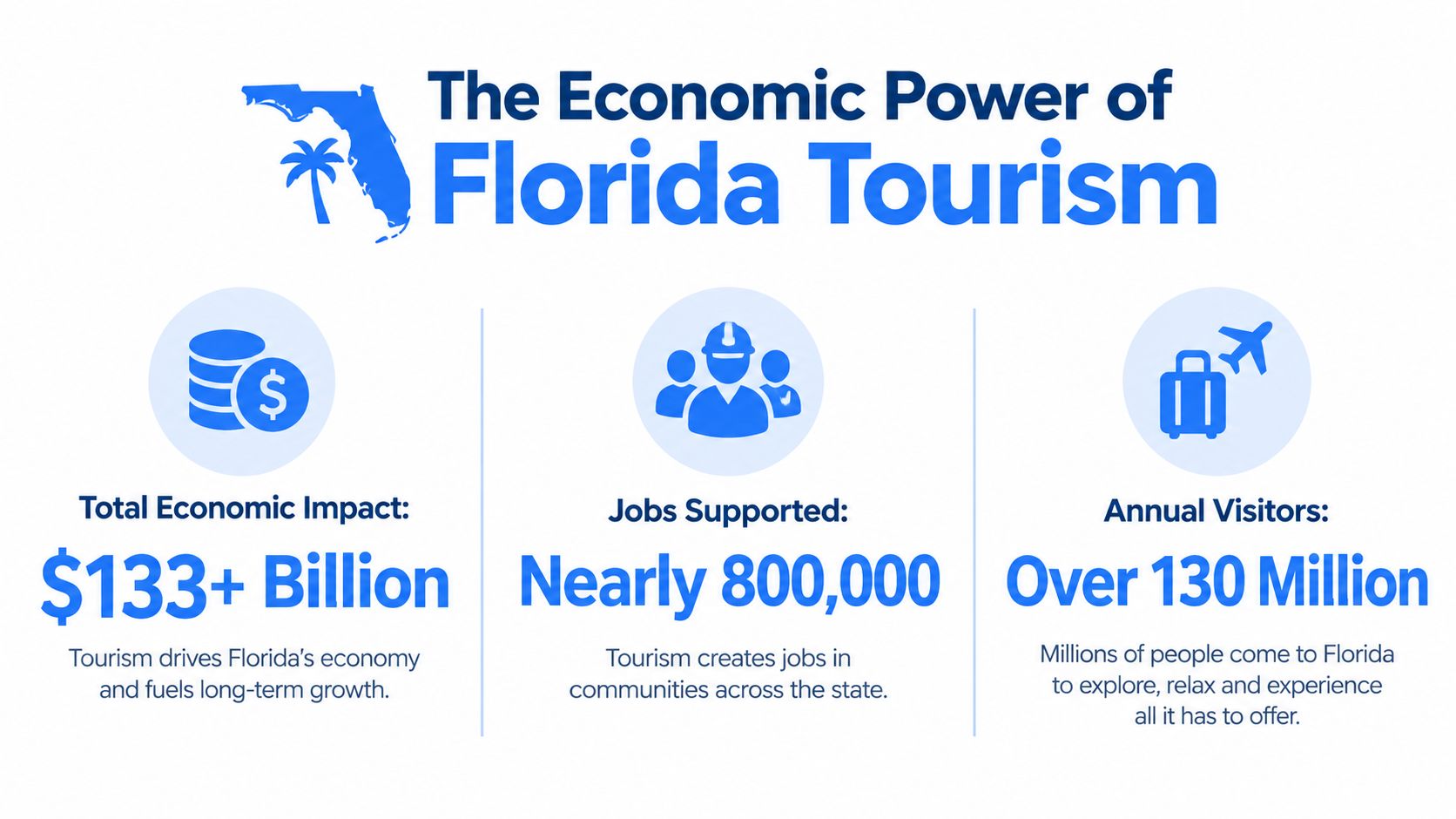
Florida's travel economy is large enough to support a dense supplier network across lodging, transportation, recreation, dining, cruises, vacation homes, and guided activities. State-reported 2024 figures put tourism's economic impact at $133.6 billion, equal to 7.8% of Florida's nominal gross state product, while tourism-supported employment reached 1.8 million jobs. The same state report records $134.9 billion in out-of-state visitor spending, including $120.1 billion from domestic travelers and $14.8 billion from international visitors. These figures are detailed in the Florida tourism economic impact report.
Those numbers explain why fragmentation is so common. Florida doesn't operate from one supplier or one travel corridor. A family may need an airport hotel, a vacation home, theme-park admission, a rental car, a beach activity, and a cruise departure, each supplied by a different operator with separate rules.
Why fragmented booking creates avoidable work
The usual process is familiar:
- Search for lodging on one marketplace.
- Compare flights elsewhere.
- Reserve cars through a separate channel.
- Add activities after the main bookings are complete.
- Reconcile names, dates, deposits, cancellation windows, and transport times in a spreadsheet.
That approach can work for a couple with a flexible itinerary. It becomes fragile when one booking changes the rest. A late flight can affect car pickup, hotel check-in, a prepaid activity, and the number of nights needed before a cruise.
The state's tourism footprint also means that household organizers should expect multiple viable configurations, not one obvious package. A family could use a hotel near attractions, a whole-home rental with a kitchen, or a split stay that places some relatives near a resort while others use a larger property. Understanding this broader tourism infrastructure makes consolidation a planning requirement rather than a cosmetic convenience.
For arrival or departure properties, operational details matter too. Families staying in vacation homes may need turnover support between guests, and a resource covering house cleaning across Central Florida can help organizers assess local service availability before committing to a property.
The useful question is not whether Florida has enough inventory. It does. The question is whether the organizer can view and coordinate that inventory through one workflow.
Calculating Lodging Capacity for Multigenerational Groups
A nightly room rate masks the true lodging calculation. A group of ten might see an attractive hotel price, then discover that it needs five standard rooms, multiple deposits, separate accessibility checks, and a daily plan for keeping children close to adults. The advertised rate is only the first input.
Start with the legal overnight capacity, not the number of beds shown in a listing. In Miami-Dade County, the general formula is two people per bedroom plus two additional people per property, with an overall maximum of 12 people. Children under age three are excluded from that calculation under the county's stated rule, as explained by Miami-Dade vacation-rental occupancy guidance.
A capacity check for a family of ten
A four-bedroom property generally reaches ten occupants under the formula, eight based on bedrooms plus two additional occupants. A five-bedroom property reaches the countywide cap at twelve rather than automatically allowing every possible bedroom occupant plus two.
Use this sequence before paying a deposit:
- Count overnight occupants: Separate adults, older children, and children under age three.
- Check the permitted limit: Don't rely only on beds, sofas, or marketing language.
- Confirm the room layout: Verify whether grandparents need a ground-floor room and whether children can sleep near supervising adults.
- Model shared space: A kitchen and living room may reduce meal and supervision friction.
- Price the complete stay: Include transport between the property and activities, not just rent.
A condo or vacation home often works when the family values shared meals, common space, and flexible downtime. A hotel or resort is usually better when daily housekeeping, children's programming, on-site dining, and separate schedules matter more than one shared address. Broader context on multigenerational households can also help families think through why space and privacy affect the success of a shared trip.
The right package may combine both formats. For example, grandparents and parents might use adjacent hotel rooms for a dense theme-park itinerary, while another branch of the family stays in a nearby condo with a kitchen. That arrangement only works if the organizer maps driving times, check-in windows, and daily meeting points before booking.
The following video can provide additional context while you compare condo-style lodging and hotel arrangements.
For Orlando planning, a condo near Disney World may be worth comparing with several standard rooms, but the comparison must include parking, transport, meal costs, and the time required to regroup after each park day.
Consolidating Multi-Room and Multi-Property Bookings
A family can arrive on different flights, sleep in several properties, and still operate from one itinerary. The organizer needs a single view of arrival times, room assignments, overlapping dates, transportation, and activities that depend on the whole group.
Separate booking sites produce separate confirmations. One account may hold hotel details, another flights, and a third activities. The operational burden remains with the family organizer, who must reconcile check-in windows, cancellation terms, guest names, and payment responsibilities.
Approved Traveler membership offers access to over 1,000,000 hotels, 700+ airlines, 44+ cruise lines, 500,000+ vacation homes, and 150,000+ activities through one platform. That range allows the organizer to compare lodging, air travel, cruises, homes, and activities as connected parts of one itinerary.
Two ways to structure the same trip
| Fragmented booking | Consolidated workflow |
|---|---|
| Hotel, flight, car, and activity reservations sit in different accounts. | Inventory can be reviewed through one membership access layer. |
| Each household may receive separate confirmation emails. | The organizer can build a shared itinerary structure. |
| Cancellation terms must be reconciled manually. | Booking conditions can be reviewed before committing to the complete plan. |
| Cost splitting happens after reservations are made. | Household roles and shared responsibilities can be assigned during planning. |
Start with a master itinerary containing the arrival airport, lodging locations, activity dates, car requirements, and cruise timing. Label every reservation fixed, flexible, or optional. A cruise departure is fixed. A beach day is flexible. A restaurant reservation may be optional.
Record the person responsible for each booking, the payment deadline, the cancellation window, and the travelers attached to it. This small administrative layer prevents a common failure: one household assumes another has confirmed transportation or added the correct guest names.
Mixed lodging can work when the schedule is designed around the split. Relatives who want resort services may stay separately from relatives who prefer a vacation home. Keep shared meeting points, transport capacity, and departure times visible so different addresses do not create missed activities.
If one branch owns or manages coastal inventory, treat buying a Destin vacation home as a fixed lodging node in the master itinerary. Plan transport, sleeping capacity, maintenance access, and arrival timing around that address, while keeping ownership and rental decisions separate from the immediate trip.
The organizer's job is to design dependencies before making reservations, not to collect confirmation numbers afterward.
A consolidated view still leaves airlines, hotels, cruises, and activities with their own rules. It reduces disconnected searches and makes the trade-offs visible before the family commits.
Leveraging Membership Perks for Family Logistics
Membership benefits earn their place in a family itinerary only when they reduce administrative work. Evaluate who can book, who receives each benefit, how cancellations are handled, and whether unused value stays with the organizing household. A lower room rate matters less if the account structure leaves one person responsible for every change.
Approved Traveler's stated 110% Best Value Guarantee addresses price protection when a member finds a lower publicly available price. The refund equals 110% of the difference, subject to the program's terms. Use the guarantee as a verification step, then compare dates, room types, taxes, cancellation rules, and ticket conditions before confirming a booking.
Match the membership structure to the household
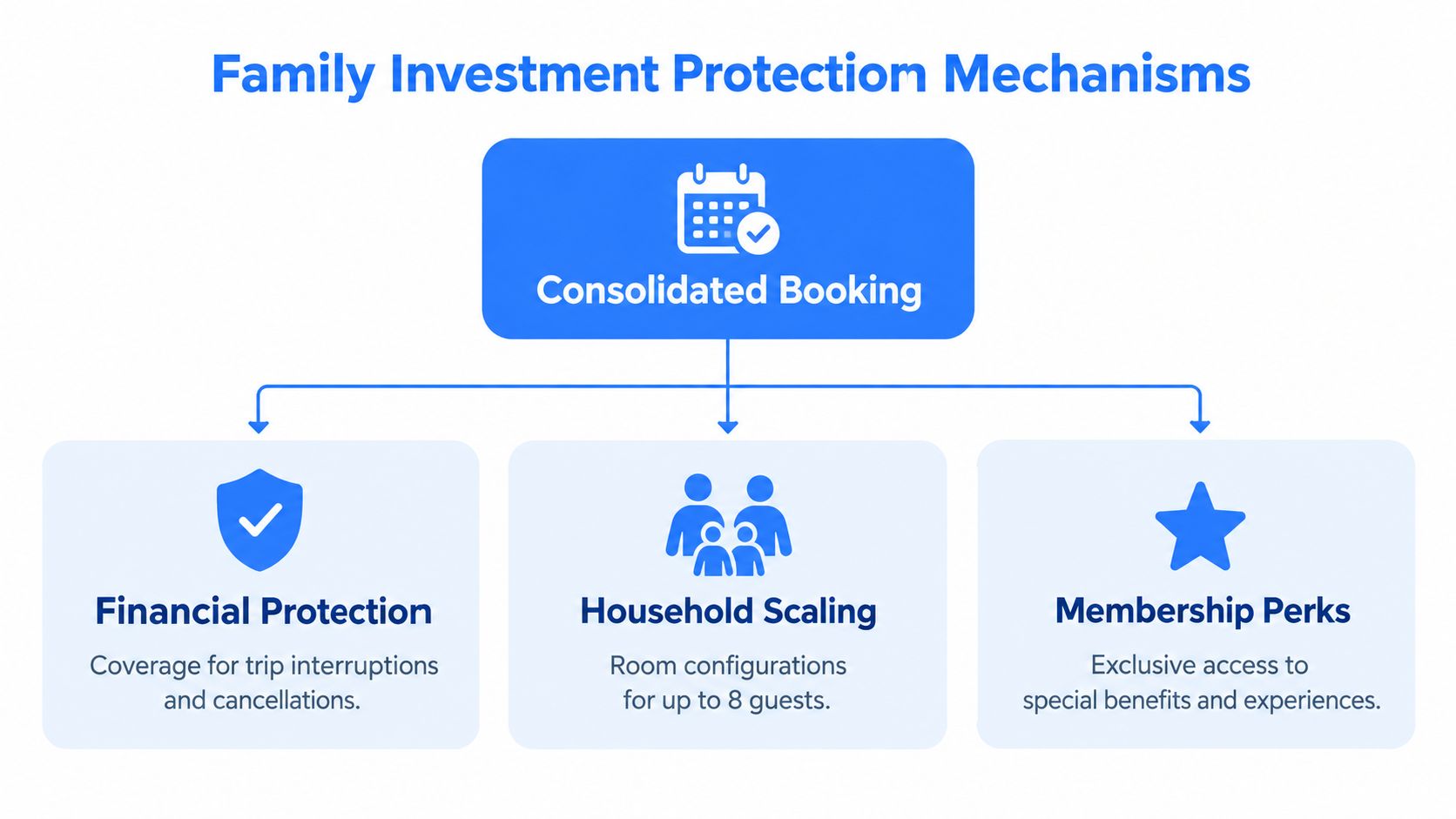
A household can include up to 10 members with full benefit parity and no per-person fees, according to the membership information. That arrangement suits trips where parents, children, and grandparents need access through one account, while booking responsibilities remain distributed.
The higher tier, Lux Traveler, includes an Approved Lux 24/7 Personal Assistant for complex travel and household logistics. Route time-sensitive requests, such as schedule conflicts, childcare arrangements, or medical appointments during the trip, to the assistant and log the confirmation in the master itinerary. Keep a named human owner for every request, because a service response does not replace a decision about transport, supervision, or timing.
The Boomerang Member Share program lets the primary member earn Reward Credits on eligible hotel and car bookings made by extended family and friends. Apply those credits to future travel only after checking the redemption terms. Do not assign them a fixed cash value in the initial budget.
Assign booking authority deliberately
The primary organizer should control the master itinerary without becoming the only person who can act. Assign clear owners:
- Primary account holder: Maintains the master itinerary and confirms final dates.
- Adult household members: Check traveler names, passport information where relevant, and room preferences.
- Transportation lead: Reviews flights, rental cars, airport transfers, and pickup timing.
- Activity lead: Manages park admission, tours, cruises, and accessibility questions.
- Each household: Confirms its payment responsibility and cancellation exposure.
Florida State Parks shows why this division needs a written record. Each reservation carries a nonrefundable $6.70 reservation fee, while a standard cancellation generally incurs a $17.75 cancellation fee. The reservation office can waive both fees when a booking is canceled within 24 hours of booking and the visitor requests the waiver, according to Florida State Parks reservation information. Treat two cabins as separate reservations, because the fees apply per reservation.
Use the first day after booking to verify school calendars, flights, and sleeping arrangements before standard cancellation charges apply. Record the confirmation, deadline, responsible person, and affected household in one itinerary.
Navigating Theme Park Packages and Group Rules
Booking directly with a theme park can be sensible, but it isn't automatically the simplest option for a multigenerational group. Direct packages may combine hotel and admission efficiently, yet the organizer still has to interpret ticket validity, date-specific pricing, supervision rules, and weather policies.
Universal Orlando's published package structure demonstrates the issue. A five-or-more-night stay can qualify for savings of up to 30%, and a 3-Day Park-to-Park Ticket can include two additional days under the stated offer conditions. Universal also notes that ticket prices and availability vary by day, and the example savings are based on a seven-night stay, as shown on Universal Orlando's official site.
The correct comparison is not “package versus no package.” Compare:
- Stay length: Does the family need the required number of nights?
- Park days: Will everyone use the included admission?
- Ticket type: Park-to-Park access differs from single-park admission.
- Date selection: Are the selected days priced and available as expected?
- Room configuration: Does the hotel layout work for grandparents, children, and bedtime routines?
Supervision changes the evening plan
Universal states that guests younger than eighteen without park admission or qualifying alternative arrangements must leave by 8 p.m. unless accompanied by a parent or guardian aged 21 or older. One parent or guardian may accompany no more than five guests under eighteen, and the adult may need government-issued photo identification showing date of birth.
For a group with eight minors, one adult cannot cover everyone under that rule. Assign at least two qualifying adults, or confirm that each minor has an allowed admission or reservation arrangement before planning an evening away from the parks.
Weather flexibility also needs verification. For qualifying bookings made directly with Universal, a hurricane or tropical-storm policy may allow rescheduling or cancellation without imposed change or cancellation fees when the National Hurricane Center issues a warning or a state of emergency is declared for the Orlando area or the traveler's place of residence within seven days of arrival. Families should confirm eligibility and retain reservation contact details.
The practical lesson is simple. Evaluate the operational rules alongside the headline package terms. A package that looks efficient on paper may create supervision or cancellation problems unless the organizer maps the details first.
Building Your Family Travel Strategy
Reliable Florida vacation packages for families start with itinerary infrastructure, not attraction lists. The organizer sets the group's capacity, movement, supervision, and cancellation requirements before comparing hotels, vacation homes, theme parks, cruises, and activities. That order reduces expensive changes after deposits are paid.
Florida offers a large range of lodging to compare. VISIT FLORIDA reports 507,282 hotel and motel rooms across 4,738 properties as of December 2025, with a 2025 average daily room rate of $193.69 and average occupancy of 68.1%, according to its research FAQ. These statewide figures do not predict the rate or availability of a particular property. They do show why families should calculate the total room requirement instead of judging an arrangement by one advertised nightly price.
Use a pre-booking decision sheet
Before anyone pays a deposit, record the decisions that must be verified:
- Room configuration: Assign bedrooms or rooms around mobility, supervision, privacy, and sleep schedules. Check the legal capacity separately, using the group matrix established earlier.
- Transport dependency: Map airports, car pickup, lodging, attractions, cruises, and return times.
- Activity flexibility: Mark each reservation as fixed, changeable, or optional.
- Weather exposure: Review cancellation and rescheduling rules for parks, outdoor activities, and state facilities.
- Future value: Record Reward Credits as a future-use benefit without assigning them a fixed cash amount.
- Booking ownership: Identify the platform or contact responsible for each reservation and the person who will make changes.
- Change deadlines: Record deposit dates, final-payment dates, cancellation windows, and the documents needed to request a change.
This list keeps the check focused on facts to verify before money is committed. Capacity, transport responsibility, and payment coordination still belong in the group matrix, so the organizer can check them without rebuilding the entire plan.
Multigenerational groups also need deliberate separation. A theme park morning can be followed by a quiet afternoon for older adults, while teenagers continue with a later activity under the correct supervision arrangement. Giving each age group a workable option often prevents one reservation from controlling the whole day.
Treat the itinerary as a system
Use one source of truth for dates, traveler names, addresses, deposits, cancellation deadlines, and emergency contacts. Add a fallback for every high-risk dependency. If a flight arrives late, decide whether the car pickup, hotel check-in, and first activity can move. If a rental home fails the occupancy check, prepare a hotel configuration before the deposit deadline.
Separate booking platforms may suit a couple willing to reconcile details themselves. A family coordinating eight to ten travelers, several rooms, and different activity preferences may benefit from one infrastructure layer that brings hotels, airlines, cruises, vacation homes, and activities into one view. The benefit is operational: fewer disconnected searches when a traveler changes a requirement.
The organizer still compares room types, dates, rules, and total trip costs. Consolidated access gives those decisions a cleaner record and clearer ownership.
The successful trip isn't the one with the most reservations. It's the one where every reservation supports the people, timing, and capacity of the group.
Start with every traveler and fixed commitment. Test lodging capacity, the transport sequence, cancellation windows, and supervision arrangements before selecting the final package. That process turns Florida travel from rate shopping into deliberate itinerary design.
Approved Experiences Traveler provides consolidated access to hotels, airlines, cruise lines, vacation homes, and activities for families coordinating complex Florida trips. Families can use that infrastructure to organize a package around their group's capacity, schedules, and responsibilities.
Want the wider view?
Ten categories. One report. Every quarter. The Approved List tracks what's rising and what's fading: data-backed signals, not opinions.
Free to join · Delivered by email