
←All Articles
The Journal
Florida Weekly Vacation Rentals: A Complete Guide
September 29, 202612 min readflorida vacation homesweekly rental guide
Find and book Florida weekly vacation rentals with confidence. Learn pricing trends, neighborhood recommendations, legal rules, and how

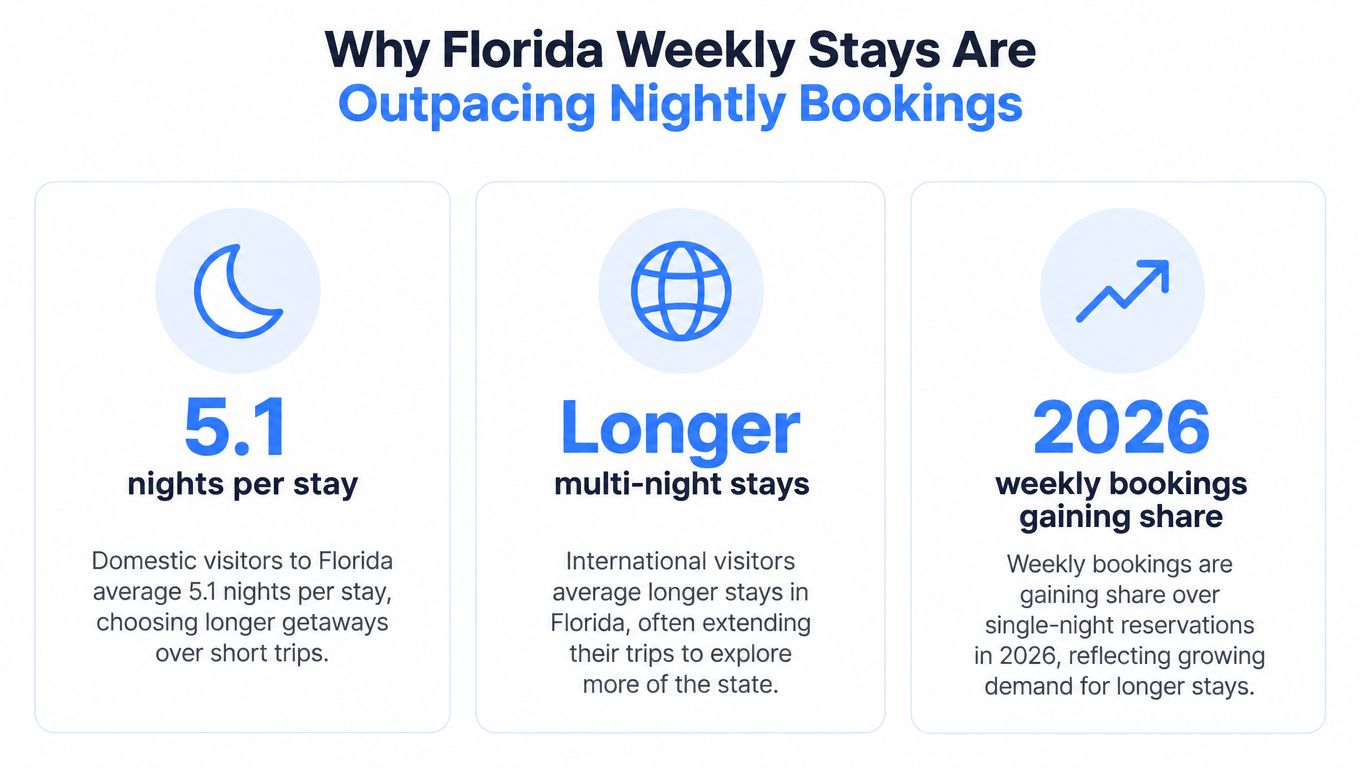
Domestic visitors to Florida average 5.1 nights per stay in 2026, while international visitors average 8.3 nights. With the statewide average now around 5.8 nights, Florida's travel pattern aligns directly with weekly booking behavior, especially for Saturday-to-Saturday stays.
That matters because a weekly rental isn't just a nightly booking multiplied by seven. It involves a different operating model, with minimum-stay rules, local licensing, occupancy limits, tax treatment, cleaning schedules, and inventory access all affecting whether a property works for your group. Families, snowbirds, remote workers, and timeshare owners need to evaluate the entire stay rather than focus only on the advertised nightly rate.
Why Florida Weekly Stays Are Outpacing Nightly Bookings
A seven-night reservation fits Florida travel patterns better than a one-night booking for many groups. Domestic visitors average 5.1 nights, international visitors average 8.3 nights, and the statewide average is about 5.8 nights, according to Florida rental demand and tourism trend data. These averages support weekly planning, particularly when travelers need a kitchen, laundry, several bedrooms, and outdoor space.
A family traveling from Ohio for a beach reunion may need a home from Saturday through the following Saturday. An international traveler may also prefer one base because flights, transfers, and extended time in one destination make frequent moves inconvenient. The operational question is whether the property, dates, rules, and access method support the entire stay.
Why the inventory mix is changing
Vacation rentals accounted for about 18% of accommodation spending in 2019 and roughly 26% in 2025, with a projected 28% to 30% in 2026, according to the same Florida rental demand and tourism trend data. Homes and condos therefore serve more than large families seeking extra space. They are becoming a significant lodging option, which gives weekly travelers more reason to compare consolidated inventory across traditional platforms, OTAs, and timeshare exchanges instead of checking each channel separately.
Average daily rates also rose from roughly $215 in 2022 to $247 in 2024, with a projected $257 to $263 in 2026 according to that source. A higher rate does not automatically make a weekly stay poor value. One properly configured home may work better than several hotel rooms when the group needs shared cooking, living, laundry, and parking facilities.
Practical rule: Choose weekly inventory for how your group will live in the property, not only for how many beds it advertises.
Family reunions, snowbird stays, and remote work generally favor multi-night occupancy. Look for a property that supports ordinary routines, including breakfast preparation, quiet work, luggage storage, and shared downtime. Saturday-to-Saturday dates can simplify planning, but local rules, flight schedules, and work obligations may justify a different arrival day. Confirm those constraints before comparing rates or committing to a booking channel.
Understanding Weekly Pricing and Seasonal Demand Patterns
KAYAK users typically book Florida vacation rentals for 8 days, with an average weekly price of $1,929 based on searches from the previous two weeks. Vrbo lists 210,349 vacation rentals in Florida and notes that weekly and monthly discounts are common across the state. These figures provide market context, not a guaranteed rate for a specific beach, building, or travel date. Review Vrbo's Florida vacation rental inventory alongside the current quote and its full fee schedule.
A weekly rate may reduce the effective nightly cost, but the reservation can impose practical trade-offs. Arrival dates may be less flexible, cancellation terms may be stricter, and cleaning or resort charges can raise the final total. Compare the complete reservation amount, including taxes and mandatory fees, rather than treating the advertised discount as the full saving.
Location changes the calculation
Property type and geography often affect the total more than the word “weekly.” A modest two-bedroom Gulf-front condo in Siesta Key or Sanibel may run $400 to $800 per night, while a similar inland property may run $250 to $400 per night. Luxury oceanfront homes in Miami Beach, Key West, and Naples can reach $1,000 to $5,000 per night during peak season. Treat these ranges as planning inputs, then verify the exact property, dates, and inclusions before comparing channels.
| Property choice | What usually drives the price |
|---|---|
| Gulf-front condo | Direct beach access, views, building amenities, and seasonal demand |
| Inland condo or home | More space for the rate, but added driving time to the coast |
| Luxury oceanfront home | Size, privacy, location, premium finishes, and peak-season demand |
Christmas and Spring Break often bring one-week minimum stays. A seven-night booking may therefore be the standard operating pattern for those periods, not a special exception. Check whether each quote includes a weekly adjustment or adds seven independent nightly rates. Also confirm arrival-day restrictions, since a lower price is less useful if it conflicts with flights, work schedules, or local booking rules.
For a closer comparison of extended-stay structures, consult this guide to long-stay rentals. The distinction matters when consolidating inventory across OTAs, timeshare exchanges, and traditional rental platforms. A true long-stay arrangement may price and manage occupancy differently from a listing that merely accepts consecutive nights.
Choosing the Right Florida Neighborhood by Traveler Profile
The right Florida neighborhood depends on what the group needs to do inside and outside the property. A popular beach name won't compensate for an inadequate kitchen, unreliable internet, long drives to activities, or an occupancy rule that excludes part of the group.
Match the destination to the group
Multi-generational families should start with layout rather than scenery. Look for multiple bedrooms, accessible bathrooms, a usable kitchen, indoor gathering space, and outdoor areas where children and adults can separate comfortably. Calm beach communities may be a better operational choice than nightlife-centered districts, particularly when grandparents, young children, or different sleep schedules are involved.
Snowbirds and long-stay retirees often benefit from condo-style inventory with elevators, kitchens, laundry, parking, pools, and nearby grocery access. A property farther inland may provide more usable living space, while a coastal condo may justify its premium through walkability and easier daily routines. Confirm the weekly minimum and building rules before paying, because an attractive monthly-style listing may not accept the exact arrival pattern you need.
Remote workers need a dedicated surface, a quiet room, dependable internet, and a backup plan for interruptions. A property with a beautiful view but an open-plan sleeping arrangement may work for a short holiday and fail during a working week. Ask whether the workspace is shown in the listing, not merely mentioned in the description.
Frequent leisure travelers may prioritize access to beaches, restaurants, attractions, airports, or cruise ports. A central location can reduce transport coordination, but it may also bring noise, parking restrictions, or tighter occupancy controls.
| Traveler profile | Prioritize | Watch for |
|---|---|---|
| Family organizer | Bedrooms, kitchen, bathrooms, calm surroundings | Occupancy caps and HOA rules |
| Snowbird | Condo services, groceries, laundry, flexible dates | Minimum-stay restrictions |
| Remote worker | Quiet workspace and reliable internet | Shared rooms and weak connectivity |
| Leisure traveler | Activities, dining, ports, transport access | Noise and location premiums |
Use the Florida Keys vacation rentals guide when comparing island-based inventory, but apply the same decision rules. The destination should serve the group's daily routine, not just the promotional photograph.
Navigating Florida Rental Regulations and Local Rules
A weekly rental is a compliance question before it's a pricing question. Florida classifies a vacation rental as a transient public lodging unit in a condominium, cooperative, or individually or collectively owned single-family to four-family dwelling that isn't a timeshare project. The state framework applies when a unit is rented more than three times in a calendar year for periods under 30 days, or when it's advertised as regularly rented to guests, as described in Florida Statute 509.242.
That threshold matters because repeatable weekly inventory needs formal onboarding. A property owner or platform may need licensing, tax registration, and local-rule screening. A guest shouldn't assume that a listing visible online is automatically legal for the dates, group size, or rental pattern being considered.
Screen the property in this order
-
Confirm the state classification and license path. Ask for the applicable vacation-rental or public-lodging license information where required. If the host avoids the question, treat that as an operational risk.
-
Check the city or county ordinance. Miami-Dade defines a short-term vacation rental as less than 30 days or one calendar month. Its occupancy rule allows 2 persons per bedroom plus 2 additional persons per property, up to 12 total, excluding children under 3, according to Miami-Dade's residential short-term rental guidance.
-
Review local exceptions and legacy permissions. Naples can limit sub-30-day rentals after three uses per year, and Key West requires a scarce transient rental license. Fort Myers Beach preserves weekly rentals in specified zones and legacy properties, while some condominiums may allow shorter stays if association rules and historic permissions apply. These distinctions are summarized in this Florida short-term rental regulation guide.
-
Read the declaration and house rules. A city may permit a stay that the condominium association prohibits. Confirm guest registration, parking, pet rules, quiet hours, and the maximum number of occupants in writing.
Tax treatment also belongs in the screening process. Florida treats rentals of living or sleeping accommodations for periods of six months or less as transient accommodations and applies a 6% state sales tax to the rental charge, plus any applicable discretionary sales surtax, according to the Florida Department of Revenue transient accommodation guidance. Counties may impose local option transient rental taxes in a range of 3% to 6%, and Lee County's tourist development tax is 5% of the gross rental amount, as explained by the Department of Revenue local tax guidance.
Booking Logistics and Total Cost Breakdown for Weekly Stays
Availability isn't static. Nearly 31% of reservations are booked within five days of check-in, according to the 2025 Florida vacation rental report. That creates two opposing realities. Early planning is important for large families and peak dates, but last-minute inventory can appear when owners need to fill an open week.
Don't compare listings from the headline rate alone. Build a complete total for the same dates, guest count, and cancellation terms.
Use a repeatable booking check
- Compare weekly against nightly pricing: Multiply the nightly rate by the number of nights, then compare that figure with the quoted weekly total.
- Separate mandatory charges: Record cleaning fees, service charges, resort fees, taxes, parking, and extra-person charges.
- Confirm what the tax line includes: A listing may show taxes separately, include some charges in the headline, or add them only at checkout.
- Review the stay rules: Check minimum nights, check-in days, cancellation windows, deposits, and household member limits.
- Ask about practical access: Confirm parking, elevator access, luggage handling, Wi-Fi, workspace, kitchen equipment, and the check-in process.
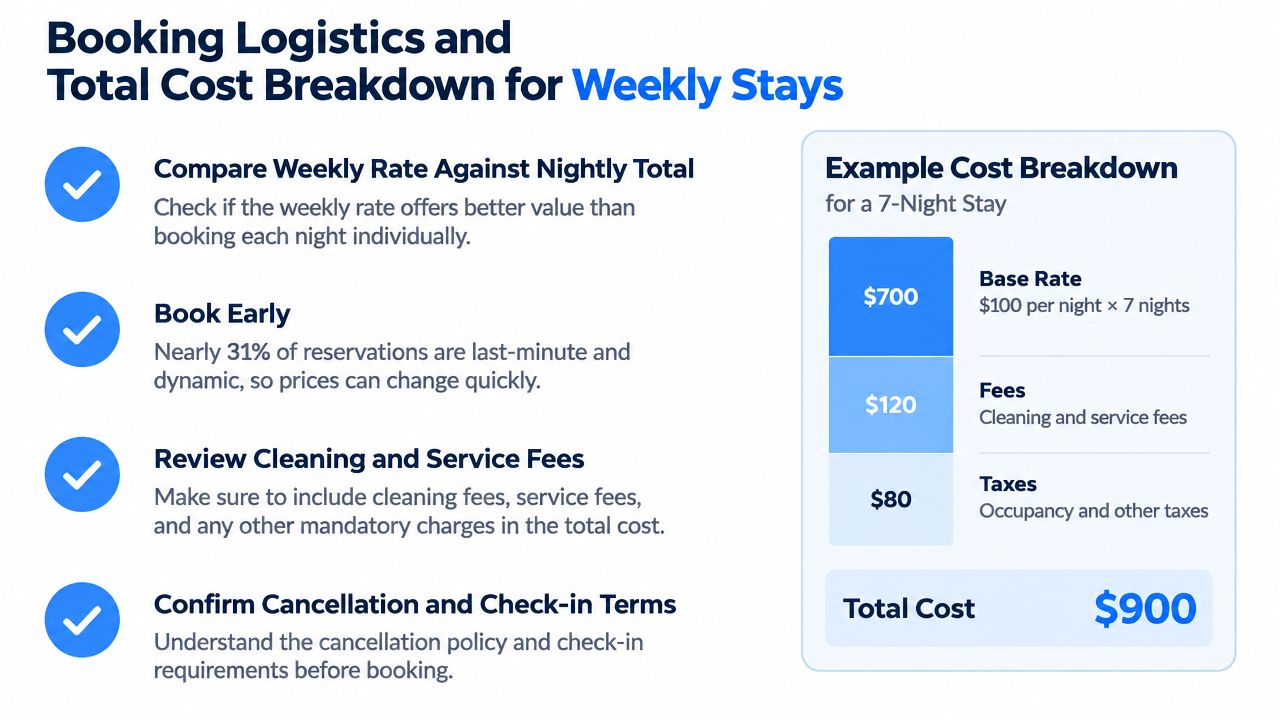
A seven-night comparison should place the base rental, fees, and taxes into one worksheet. For example, if one listing has a lower base rate but substantially higher cleaning and resort fees, it may be the more expensive choice for the actual week. The same worksheet should record the cancellation deadline and the financial consequence of changing dates.
Property presentation also affects screening. A detailed visual walkthrough can reveal room layouts, workspace limitations, stairs, and maintenance concerns that staged photographs hide. For owners and managers, guidance on how to boost bookings with 360° tours can improve the information available before a guest commits.
Using Approved Traveler Access for Florida Weekly Rentals
Weekly rental planning becomes difficult when inventory is fragmented across OTAs, timeshare exchanges, traditional platforms, hotel systems, and separate activity providers. Approved Traveler treats that problem as infrastructure management. Its marketplace consolidates access to 500,000+ vacation homes, more than 1,000,000 hotels, 700+ airlines, and multiple cruise lines, so a family organizer can work from one travel access layer rather than coordinate every category separately.
Turn repeated bookings into usable infrastructure
A weekly stay often sits inside a larger trip. One household may need flights, a condo, rental cars, activities, and a cruise segment for another journey. Consolidating those categories can reduce duplicate searching and make it easier to compare the same travel dates across different inventory types.
Members earn Reward Credits on every booking. Those credits don't expire and can be redeemed toward future bookings, maintenance fees, resort usage fees, annual renewal, and eligible eGift cards. The Boomerang Member Share program can also earn the primary member Reward Credits on qualifying hotel and car bookings made by shared family and friends.
Timeshare owners have a different operational need. Through V.O.I.C.E., owners can deposit up to 5 weeks per year for exchange credits or peer-to-peer rental listing, or exchange weeks at no fee. That creates an alternative to leaving an unused week idle, although owners should still review their timeshare agreement and all applicable local requirements.
Operational perspective: The value of consolidated access isn't just the reservation screen. It's the ability to manage recurring travel inventory, household participation, and unused ownership capacity through one structure.
Membership tiers support family-scale planning with up to 10 household members. The 110% Best Value Guarantee provides a defined price-validation mechanism. If a lower publicly available price is found, the refund equals 110% of the difference, subject to the program's terms.
Review the Approved Traveler membership details before deciding whether this infrastructure fits your booking pattern. For any arrival inspection, especially in a private home, a practical bed bug evidence spotting guide can help guests know what to check without turning routine preparation into an assumption about the property.
Next Steps for Booking and Managing Florida Weekly Rentals
The right next move depends on who owns the planning problem.
Family organizers should begin with the legal occupancy limit, then filter for bedrooms, bathrooms, kitchen capacity, parking, and common space. Get the full weekly total in writing before asking relatives to commit. A consolidated inventory source can reduce coordination across separate platforms, but it doesn't replace checking the property's local rules and building restrictions.
Snowbirds should compare the seasonal cycle rather than assume that every weekly rate behaves like a short holiday booking. Ask whether the owner accepts consecutive weekly stays, whether the building has arrival-day restrictions, and how utilities, cleaning, parking, and taxes are handled for longer occupancy.
Timeshare owners should review unused weeks early and determine whether V.O.I.C.E. fits their exchange or peer-to-peer rental goals. Deposit timing, ownership terms, and destination demand still matter, so the program should be evaluated as an inventory-management option rather than a guaranteed cash outcome.
Remote workers need a documented workspace, reliable internet, a quiet sleeping arrangement, and clear tax inclusion. Ask for specific answers about the desk, chair, Wi-Fi, backup access, and noise exposure. If an owner or manager handles several units, outside support such as Airbnb co-host bookkeeping help may help keep reservation records and operating costs organized.
Before finalizing, compare the public price, total charges, cancellation terms, occupancy rules, and booking dates. Members can use the 110% Best Value Guarantee to validate a lower publicly available price, while Reward Credits can support future bookings, maintenance fees, resort usage fees, or annual renewals. That process is more reliable than choosing a listing from the nightly headline alone.
Approved Experiences Traveler gives members consolidated access to Florida weekly vacation rentals alongside hotels, flights, cruises, and other travel inventory, with Reward Credits earned on bookings and household access for up to 10 members. Visit Approved Experiences Traveler to evaluate whether one travel infrastructure can simplify your next weekly stay.
Want the wider view?
Ten categories. One report. Every quarter. The Approved List tracks what's rising and what's fading: data-backed signals, not opinions.
Free to join · Delivered by email