All Articles
The Journal
The Four Pillars of Trust in Delegated Services
October 14, 20269 min readdelegation strategiesmental load
Discover the four pillars of trust that make delegation work. Learn how to reduce mental load and reclaim time with reliable, accountable support.

Most advice about trust gets the order wrong. It starts with tone, empathy, or polish, then assumes trust will follow. In delegated work, trust is earned much earlier, at the point where a request stops living in your head and starts moving through a system that won't drop it, distort it, or hand it back to you half-finished.
That's why the four pillars of trust matter most when the work is messy, urgent, or private. If a support team can't absorb the cognitive burden of noticing, prioritizing, monitoring, and closing the loop, the delegation hasn't really happened. It just created another item to track.
Why Trust is an Operational Metric
Trust shows up in operations long before it shows up in sentiment. If a delegation workflow still forces you to chase status, restate preferences, or make the same decision twice, the service may be polite, but it is not yet dependable.
The OECD's trust framework makes that gap visible. In its survey, 49% of respondents on average considered their national government reliable, while only 34% were confident it upheld public integrity, and 53% were confident institutions could make decisions based on evidence and sound judgment (OECD survey on drivers of trust). Those qualities are related, but they are not the same. A system can respond quickly and still be inconsistent. It can look competent and still handle sensitive work poorly.
What good delegation removes
The test is simpler. Does the support team remove the task, or does it only remove the execution?
Good delegation absorbs the work behind the work, the noticing, prioritizing, checking back, and mental replay. That is why what operational efficiency looks like in practice is not just about throughput. It is about cutting the invisible loops that keep a request alive in your head.
Practical rule: if a request still needs your repeated attention, the delegation is incomplete.
You can see the difference in travel, household coordination, and professional admin. A badly rebooked flight creates more work than if no one had touched it. A school form handled without the right context turns into three more messages and a second review. The task did not disappear. It moved back onto your desk.
That is why trust is measurable. Fewer follow-ups. Fewer repeated explanations. Fewer missed deadlines. More decisions handled once, correctly, and without reopening the thread.
Defining the Four Pillars of Trust
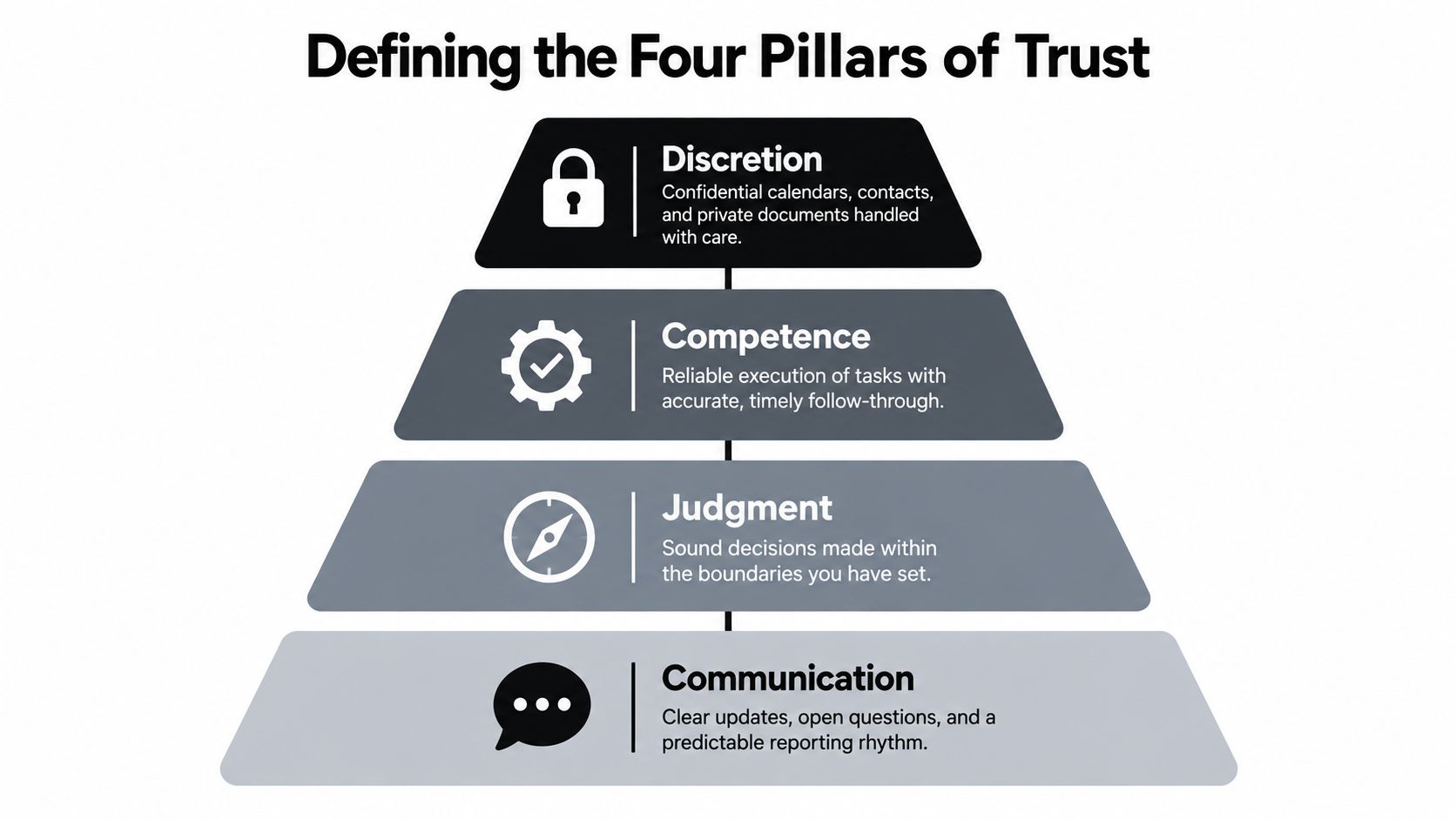
Trust in delegated work is operational. For Approved Lux, the four pillars are competence, integrity, dependability, and transparency. Those are the traits that decide whether an Assistant team can carry a request all the way through without adding hidden risk or extra mental load.
Competence and integrity
Competence is simple to spot in practice. A team handles a multi-leg itinerary with a tight connection correctly the first time, keeps appointments aligned, and clears scheduling conflicts without turning the issue into a cleanup thread. It shows up when the work closes cleanly, with no follow-up round to fix what should have been caught on the first pass.
Integrity is different. It is the honest handling of sensitive information, commitments, and limits. It means saying what can be done, what cannot, and where approval is required. A team that overpromises or blurs boundaries may sound helpful, but it is not reliable support.
Dependability and transparency
Dependability is consistency across channels, coverage windows, and handoffs. In delegated work, that keeps a request from breaking when the first person who saw it is not the person who finishes it.
Transparency means no guessing about status, ownership, constraints, or next steps. You should not have to ask twice to understand where a request stands.
A useful comparison comes from modern sales operations thinking, where execution only works when process, ownership, and reporting stay visible across the workflow. The same logic appears in Yalc on modern GTM execution, where clear handoffs matter more than good intentions alone. Delegated support works the same way.
Trust gets stronger when human judgment is visible, bounded, and correctable.
That is why observable controls matter. Structured onboarding captures preferences. Documented handoffs preserve context. Clear escalation rules keep requests inside agreed authorization boundaries. Transparency then becomes part of the workflow, not a reassurance statement.
Designing Workflows for Closed-Loop Delegation
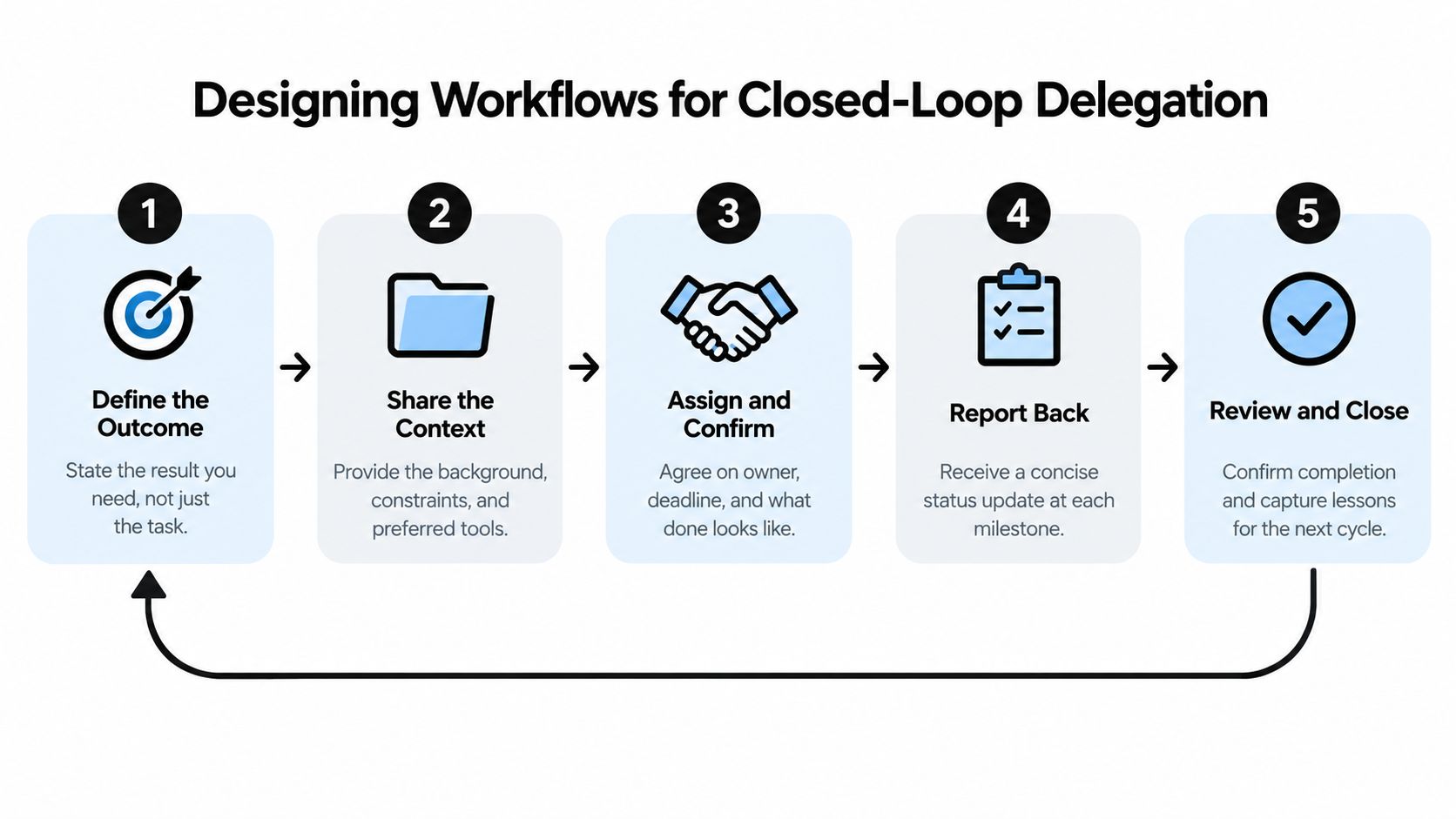
Closed-loop delegation starts before anyone takes action. If you only hand off an isolated errand, you keep ownership of the rest of the workflow in your head. If you hand off the workflow, the support team can absorb the sequence, the exceptions, and the follow-through.
Start with the outcome, not the task
“Find a plumber” is a task. “Resolve the leak by Friday, keep the budget reasonable, and use a provider who can enter through the side gate” is a workflow. The second version gives the Assistant team a decision frame, which is what lets them act without forcing you to revisit every step.
That matters because household and professional coordination are rarely one-step jobs. A school registration, travel change, or home repair request includes research, scheduling, document checks, and last-mile confirmation. The more of that chain you define up front, the less of it comes back to you later.
For a good model of workflow ownership across coordination-heavy work, the guide Tribulys pour les proches aidants is a useful reference point for how structured support prevents confusion from spreading across a care process.
Build the loop so exceptions come back, not the whole job
The rule is simple. Routine decisions stay inside the boundary, exceptions come back for approval. That keeps the service moving while protecting your final say on anything sensitive, unusual, or high-stakes.
Use a short workflow brief with five parts:
- Outcome: what done looks like.
- Context: why the request matters, plus any constraints.
- Boundary: what the team can decide without asking.
- Escalation: what requires your approval.
- Closeout: how you want the result reported.
That is where workflow orchestration principles become practical instead of technical. The point isn't automation for its own sake. It's keeping the workflow intact until it reaches a clean ending.
The result is fewer open loops. You don't need to keep checking whether someone remembered the follow-up, because the follow-up is part of the design. That's the difference between task completion and closed-loop delegation.
Evaluating the Economics of Delegated Capacity
Delegated capacity starts to make sense when you look past salary alone. Direct hiring brings employer-paid compensation, benefits, payroll overhead, equipment, and management time into the picture before a single task is handed off. A private-industry compensation benchmark reports total employer compensation of $46.89 per hour, including $14.07 per hour in benefits, which is roughly 30% on top of wages (executive assistant salary benchmark).
The loaded-cost problem
That same benchmark puts a $76,590 executive-assistant salary at about $99,567 once benefits are added, before recruiting, paid leave, coverage gaps, or the time spent managing the role (executive assistant salary benchmark). Those costs are easy to miss when the comparison stops at a monthly fee versus a salary line.
A subscription-based Assistant team changes the calculation because it behaves like capacity, not headcount. The better question is how many delegated hours you reclaim, and what it costs to keep those hours off your calendar.
Compare the value of time reclaimed, not the price tag alone.
Where ROI shows up fastest
The fastest payback usually comes from work that repeats and interrupts. Travel changes, inbox triage, meeting prep, and follow-ups break attention into fragments, so they are easy to underestimate. A founder or operator can track those tasks for two weeks, estimate the hours they consume, and compare that capacity against the fully loaded cost of a hire.
The link between cost and capacity is what makes a subscription model attractive as a first hire without overhead. For a broader look at how that model is framed, see the subscription model advantages discussion.
The financial case is also about speed and flexibility. Work can begin as soon as the need appears, without the recruiting cycle, onboarding burden, or idle capacity that can come with a full-time role when workload shifts. That flexibility matters when the goal is operational efficiency rather than org chart expansion.
Trust in Action Across High-Stakes Scenarios
The test of any delegated service is what happens when the day breaks pattern. That's when users stop caring about claims and start caring about whether the team can absorb pressure without losing context.
Travel disruption without the 9-to-5 bottleneck
A frequent traveler doesn't need a cheerful status note at midnight. They need someone who can take the cancellation, understand the constraints, and push the next move across phone, text, or email without forcing them into a ticket queue. Triple-channel access matters here because the member doesn't have to adapt to the service's preferred channel.
US-based accountability also matters in these moments, because the person handling the request is expected to own the judgment, not just route it onward. If a hotel change affects ground transport, the team has to preserve the thread of the decision, not just the booking reference. That's where transparency and dependability stop being abstract terms.
Household coordination under mental load
Dual-career households hit the same trust problem in a different form. The request isn't just “schedule the appointment.” It's “notice the appointment, compare the options, check the school calendar, avoid the conflict, and only come back to me when a real decision is needed.”
A useful research lens here is the mental load itself. The British Psychological Society summary notes that mothers report handling 71% of household tasks requiring mental effort, compared with 45% for fathers (BPS research digest). That gap explains why closed-loop delegation matters so much in family logistics.
The issue isn't task volume alone. It's the constant need to remember, prioritize, and monitor. When a support team absorbs the routine decisions, the household gets back the attention cost, not just the calendar slot.
For families and founders alike, that's the trust test. Not whether the service sounds helpful. Whether it reliably keeps the second shift from creeping back in.
Transitioning from DIY Management to Trusted Support
The move from self-management to trusted delegation works best when it's staged. People usually try to hand off everything at once, then blame the service when the handoff is too vague to succeed. The better approach is to start with recurring workflows, define the boundaries, and let the team earn more scope through consistency.
A practical onboarding checklist
The first handoff should be narrow enough to measure. Capture recurring tasks, access standards, preferred communication modes, and escalation triggers in one place. Then review whether the team closes loops cleanly before expanding scope.
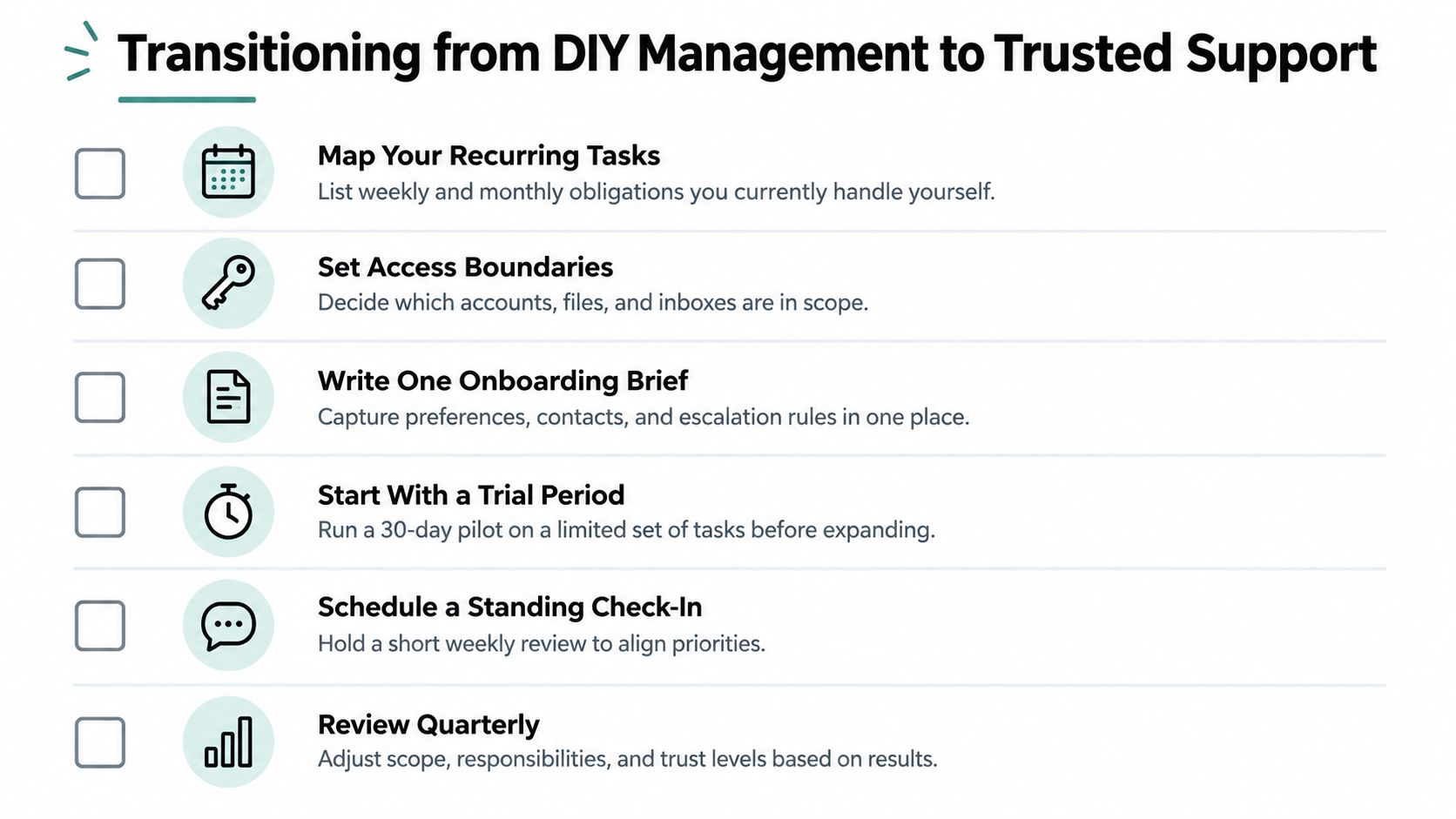
A strong setup usually includes:
- Map recurring tasks: list the weekly and monthly work that keeps landing back on your desk.
- Set access boundaries: decide which accounts, files, and inboxes are in scope.
- Write one onboarding brief: keep preferences, contacts, and escalation rules in one place.
- Start with a trial period: limit the first cycle to a few workflows you can inspect closely.
- Schedule a standing check-in: use a short review to resolve exceptions and tighten decisions.
- Review quarterly: adjust scope as the team learns your routines.
What to measure after the handoff
The right success metrics are behavioral. Look for fewer reminders, fewer duplicate instructions, fewer unresolved follow-ups, and faster handling of exceptions. If you're still re-explaining the same preferences, the workflow is leaking.
This is also where Ever Outbound white label program is a useful reference for how service delivery can be structured around repeatable, accountable operations rather than loose promises. The principle carries over cleanly. Good systems make performance easier to see and easier to improve.
Proactive Preference Learning compounds only when the changes are visible and correctable. A team that captures a new travel preference, a new scheduling rule, or a new approval threshold should make that shift obvious in the next workflow, not bury it in memory. That's what turns support into lasting advantage.
Approved Lux Personal Assistant is built for exactly this kind of delegation, where trust has to show up as fewer follow-ups, cleaner handoffs, and real time reclaimed. If you want a US-based Assistant team that works across call, text, and email while helping reduce operational noise, visit Approved Lux Personal Assistant and see how the model fits your workflows.
Want the wider view?
Ten categories. One report. Every quarter. The Approved List tracks what's rising and what's fading: data-backed signals, not opinions.
Free to join · Delivered by email