All Articles
The Journal
Fractional Executive Assistant: The Force Multiplier Guide
October 11, 202613 min readexecutive assistantvirtual assistant
Discover how a fractional executive assistant delivers the leverage of a first hire without overhead. Compare ROI, hours reclaimed, and costs vs full-time.

You're halfway through a strategic discussion when your phone vibrates. A flight has been canceled, a child's school form is due, a vendor needs an answer, and three emails are waiting for a reply only you can apparently write. None of these tasks is difficult alone. Together, they fracture the attention you needed for the work that moves your business or family forward.
A fractional executive assistant gives that operational noise a defined place to go. The value isn't just having someone complete errands. It's protecting context, reducing follow-up, and moving coordination out of the executive's head before small tasks become expensive interruptions.
The Hidden Cost of Operational Overload
A founder can lose an afternoon without spending it on one obvious problem. The time disappears in short transitions: checking a calendar, answering a travel question, rescheduling a meeting, confirming a delivery, then trying to remember where the strategic analysis stopped. A working parent experiences the same pattern across different systems, moving from a client deadline to a pediatrician appointment, then to a home repair and a school message.
The visible task may take five minutes. The mental reset can take much longer. Workplace observation research found that knowledge workers switch between activities roughly every three minutes and between broader work spheres about every 10 to 11 minutes. One diary study found that 40% of interrupted tasks weren't resumed immediately, and returned-to tasks consumed approximately 4.5 hours of a 40-hour workweek, or 11.25% of weekly capacity (workplace interruption research).

Why the small tasks become strategic problems
Operational overload doesn't require a packed inbox. It requires too many open loops. A delayed follow-up can stall a deal. An unresolved travel change can consume an evening. A household appointment can force one parent to maintain the full chain of research, scheduling, reminders, forms, and transportation.
The American Time Use Survey reported that people spent an average of 1.99 hours per day on household activities and 1.36 hours per day caring for or helping household children and parents in 2025 (U.S. Bureau of Labor Statistics). Household activities include paperwork, balancing accounts, planning events, errands, and managing the home. The first figure alone equals roughly 726 hours across a year, before care activities are counted separately.
That workload matters because coordination is often invisible until it fails. If family responsibilities include elder-care logistics, a practical starting point is this complete guide to family care planning, which can help organize appointments, responsibilities, and handoffs before the burden concentrates on one person.
Practical rule: Delegate the workflow, not just the final click. “Book the appointment” includes finding options, checking conflicts, preparing information, confirming the booking, and tracking what happens next.
A fractional executive assistant is a structural response to this problem. Instead of asking the executive to maintain a longer personal task list, the model creates an operating layer for scheduling, research, logistics, communication, and follow-up. The result you're looking for isn't busyness. It's fewer executive-originated switches, fewer reopened threads, and more uninterrupted blocks for strategic or revenue-generating work.
Defining the Fractional Executive Assistant
A fractional executive assistant provides experienced administrative and operational support through flexible capacity rather than a conventional full-time employment arrangement. The client obtains access to executive-support capability when the workload requires it, without automatically committing to a full-time role, benefits package, paid leave, equipment, recruiting, and ongoing supervision.
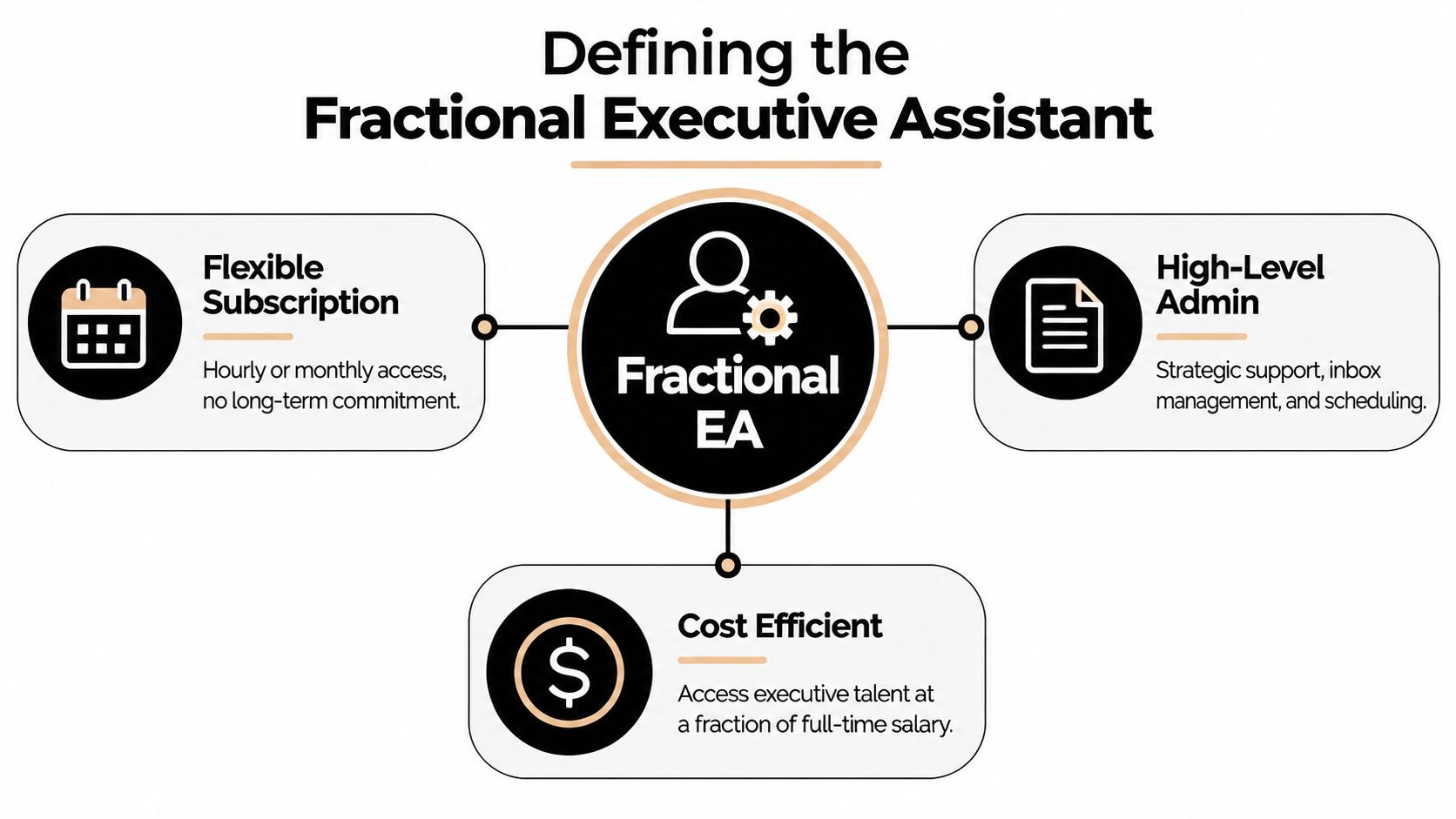
The role sits within an established labor market. The U.S. Bureau of Labor Statistics reported approximately 3.5 million secretary and administrative-assistant jobs in 2025, including about 489,300 executive secretaries and executive administrative assistants. The executive segment represented roughly 14% of the broader occupation group, while median annual wages were $76,590 for executive secretaries and executive administrative assistants compared with $48,310 for the occupation group overall** (BLS occupation data).
What the role handles
The best use of fractional capacity combines high volume, meaningful friction, and limited need for the executive's personal judgment. Typical work can include:
- Calendar control: Resolve conflicts, protect focus blocks, coordinate participants, and prepare the executive for important meetings.
- Travel logistics: Build itineraries, monitor changes, coordinate hotels and ground transport, and manage authorized rebooking when plans fail.
- Communication support: Triage an inbox, draft routine replies, identify decisions, and keep follow-ups visible.
- Research and coordination: Compare vendors, synthesize reviews, gather options, and move a decision toward completion.
- Personal operations: Arrange appointments, household services, gifts, events, and family logistics without treating personal work as separate from professional capacity.
This isn't a luxury concierge function. It is closer to an operational infrastructure layer. The assistant reduces the number of decisions and reminders the executive must personally hold, while preserving the executive's authority over sensitive or high-judgment matters.
The distinction between a general virtual assistant and an executive-support team is context and ownership. A task executor may book a meeting. A fractional executive assistant should understand the scheduling constraints, recognize the priority, protect the right preparation time, and report what remains unresolved. A useful reference for comparing service models is this guide to virtual executive assistant services.
The Economics of Hiring a Full-Time Assistant
A salary comparison understates the decision. A full-time employee brings capacity, but the employer also funds payroll taxes, benefits, paid leave, recruiting, equipment, software, supervision, and capacity that may go unused during quieter periods.
Available compensation estimates place the national median executive-assistant salary around $65,500 for 2026. One cost breakdown estimates total annual employer expense at approximately $90,481 to $97,081, after including employer FICA, health-insurance contributions, paid time off, retirement matching, recruiting and onboarding, equipment, and software (executive assistant compensation analysis). The figures vary by market, seniority, benefits, and employment arrangement, so they aren't a universal hiring quote. They do show why the salary line isn't the full cost.
A practical comparison looks like this:
| Expense Category | Full-Time Hire | Fractional Subscription |
|---|---|---|
| Compensation | Fixed salary, paid regardless of weekly demand | Purchased support capacity aligned with the service model |
| Employer costs | Payroll taxes, benefits, paid leave, and retirement contributions | Generally avoids direct W-2 benefits and payroll administration |
| Recruiting | Sourcing, interviews, references, onboarding, and replacement risk | Provider handles matching or team coverage, depending on the arrangement |
| Equipment and software | Employer-funded tools and setup | Often included in the service structure or managed by the provider |
| Availability | Broad availability during the employee's working schedule | Defined by the subscription and operating model |
| Context | Can become deeply embedded with one executive | Shared context can provide continuity, though not always one-person exclusivity |
| Capacity risk | You pay for unused hours | You may have less capacity during sudden spikes or need to manage scope carefully |
The trade-off most buyers miss
Fractional support isn't automatically cheaper in practice. Poorly written requests, fragmented channels, and repeated context-setting can create coordination overhead. A shared model works when the provider maintains strong documentation, clear permissions, consistent standards, and continuity across the team.
The opposite assumption also fails. A full-time assistant isn't automatically efficient if the executive has only intermittent, bounded work. The relevant question is whether the assistant can own enough valuable coordination to justify the fixed capacity and loaded employment cost.
A useful hiring framework should therefore examine the work itself. Track administrative hours, interruptions, delayed follow-ups, and tasks that remain open because nobody owns the next step. Guidance on hiring an executive assistant becomes more useful when paired with that workload evidence rather than a salary comparison alone.
Measuring ROI Through Reclaimed Hours
A founder blocks ninety minutes for strategy, then spends the first forty-five chasing a rescheduled meeting, answering a vendor email, and fixing a travel detail that should have been off their plate. The visible loss is time. The bigger loss is cognitive residue. Each interruption leaves a thread open, and getting back to high-value work takes more than reopening the document.
That is why ROI starts with reclaimed attention. Completed errands matter, but the genuine gain shows up when recurring coordination leaves the executive's head, stops bouncing back for clarification, and no longer breaks the day into fragments.
Start with a two-week baseline. Record where time goes, but also where focus breaks. A fractional executive assistant is working when ownership moves with the task, not when the executive stays in the loop on every small decision.
A simple measurement model
Track five indicators:
- Administrative hours: Time spent personally scheduling, researching, coordinating, and following up.
- Executive-originated switches: How often strategic or client work is interrupted by logistics.
- Response latency: How long important requests wait before someone acts.
- Reopened threads: Tasks that return because the first handoff did not include the full workflow.
- Protected work blocks: Calendar periods preserved for client delivery, business development, or family priorities.
These measures work together. Lower administrative time without fewer interruptions may mean the assistant is completing tasks but still pulling the executive back into the process. More protected blocks without faster follow-up can mean the calendar looks better while important work still stalls.
For a solo practitioner billing $300 to $800 per hour, even a modest reduction in administrative work carries meaningful opportunity cost, as the law firm marketing ROI guide explains. That is not a promise that every recovered hour becomes revenue. It is a practical question. What should this person be doing instead: client work, business development, case preparation, rest, or household coordination that prevents tomorrow's disruption?
As the household figures noted earlier show, care and home administration compete directly with working time. That matters because many executives are not losing hours to one big task. They are losing them to a constant stream of small obligations that interrupt concentration and force repeated resets.
The best ROI question is not “How many tasks did the assistant complete?” It is “How many decisions, interruptions, and follow-ups no longer required my involvement?”
Why a team can outperform a single part-time person
A team-based model can reduce waiting and context bottlenecks when the handoff system is tight. One assistant can handle a travel issue while another continues scheduling or vendor coordination, as long as preferences, permissions, and prior decisions are documented clearly.
There is a trade-off. Shared support only works when the executive defines rules up front: what can be booked, what needs approval, which vendors are preferred, and how urgent matters get escalated. A realistic time value calculation includes the time spent managing the relationship, because poor delegation can create as much switching cost as it removes.
Review results after the first month using the same baseline. If the executive still answers every clarification, checks every draft, and remembers every deadline, the model is underbuilt. If follow-ups move without prompting and focus blocks stay intact, the assistant is functioning as operational infrastructure.
How Approved Lux Operates as a Force Multiplier
Approved Lux is a subscription model built around a US-based human Assistant team, available 24/7/365 through Triple-channel access. Members can use a phone call, SMS text, or email, with each channel monitored at equal priority. That matters when the request arrives in the middle of a meeting, during travel, or while the executive is handling a family issue and can't open another application.

The service uses shared context rather than promising the same Assistant every time. That distinction is important. Shared context supports continuity across travel, scheduling, research, personal errands, inbox triage, document formatting, expense tracking, and meeting preparation, while a team structure reduces dependence on one person's availability.
Build the first week around friction
Don't begin by sending every task you can imagine. Start with work that has clear inputs, repeatable steps, and a visible completion point.
- Day one, calendar audit: Identify recurring conflicts, protect focus periods, and collect rules for accepting, declining, or moving meetings.
- Day two, travel brief: Record preferred airlines, seating, hotel standards, ground-transport preferences, and approval limits.
- Day three, open-loop review: Hand over delayed follow-ups, vendor questions, and messages that need a response or a decision.
- Day four, household workflow: Assign one complete process, such as scheduling a service appointment, comparing options, confirming the time, and adding reminders.
- Day five, preference capture: Review what required clarification and turn those decisions into durable operating preferences.
Proactive Preference Learning allows service quality to compound as the Assistant team adapts to routines and standards. The objective isn't to make the member repeat a long profile for every request. It's to turn prior decisions into usable context while preserving approval boundaries.
When a disruption occurs, send the sequence rather than a vague request. For a canceled flight, specify the meeting deadline, acceptable arrival window, change authority, hotel needs, and people who must be notified. The Assistant team can then research alternatives, coordinate authorized changes, update ground transport, and send a concise status summary.
The model is most useful when the client defines escalation rules. Assistants can coordinate appointments, compare vendors, draft communications, and manage logistics, but they shouldn't provide legal, medical, financial, or tax advice. Sensitive matters need the appropriate professional, with the Assistant handling scheduling, documentation, reminders, and communication support around that advice.
Practical Examples of High-Impact Delegation
The strongest first handoffs are rarely the most glamorous. They are the tasks that interrupt often, require several steps, and don't require the executive to exercise specialized judgment.
Consider business travel. A 2025 survey reported that 56% of business travelers experienced a delay of more than one hour, 36% experienced a cancellation, and 26% missed a connection during the prior 12 months (business travel disruption survey). When a midnight cancellation threatens a morning client meeting, the valuable delegation isn't just “find another flight.” It is a coordinated sequence covering replacement options, arrival times, authorized costs, hotel and ground transport changes, meeting notifications, and a revised itinerary.
Household coordination presents the same pattern. USC researchers surveying 322 mothers of young children found that mothers carried approximately 73% of cognitive household labor, compared with 27% for partners, while mothers performed about 64% of physical housework, compared with 36% for partners (USC research on cognitive household labor). The planning imbalance included appointments, household maintenance, and family logistics.
Delegate complete operating loops
A strong brief might read:
- Pediatrician appointment: Find suitable availability, check both calendars, prepare required information, book after approval, add reminders, and communicate the appointment.
- Summer camp registration: Compare options against location and schedule preferences, identify deadlines, gather forms, submit authorized information, and track confirmation.
- Home service: Vet vendors, compare availability and reviews, schedule the visit, record the window, and follow up if the provider doesn't confirm.
- Inbox triage: Separate decisions, drafts, reference material, and urgent matters, then identify the next action for each active thread.
Skeptics often worry that shared support means lower quality. The test is continuity of context, not whether one person touches every request. A team with documented preferences and clear ownership can outperform a nominally dedicated assistant who still requires the executive to restate priorities and chase updates.
The model breaks when the client sends fragmented instructions across disconnected channels or delegates only the visible final action. Give the Assistant the outcome, constraints, authority, and deadline. Then measure how many follow-ups return to the executive.
Why Flexible Capacity Beats Traditional Hiring
The need for support changes. Travel disruption, a product launch, family care, a board cycle, or a busy client period can create a sharp increase in coordination, while quieter weeks may not justify permanent capacity.
A fractional executive assistant lets a founder, solo professional, or dual-career household buy operational support around actual demand. The trade-off is narrower capacity and the need for clear scope. A full-time hire remains more appropriate when work is continuous, closely embedded, highly confidential, or requires constant in-person availability.
For everyone else, the strategic comparison is broader than subscription price versus salary. It includes payroll overhead, unused capacity, interruption cost, context recovery, delayed follow-ups, and the value of returning to high-judgment work with a clear mind. Approved Lux Personal Assistant applies that model through a US-based Assistant team, Triple-channel access, shared context, and Proactive Preference Learning, giving professionals a flexible operational layer without making a W-2 hire.
Approved Lux Personal Assistant provides 24/7/365 access to a US-based human Assistant team for travel, scheduling, research, household coordination, inbox support, and follow-up through phone, SMS text, or email. If you want to measure how much operational noise you can remove before committing to a traditional hire, visit Approved Lux Personal Assistant and choose the support model that fits your workload.
Want the wider view?
Ten categories. One report. Every quarter. The Approved List tracks what's rising and what's fading: data-backed signals, not opinions.
Free to join · Delivered by email