
All Articles
The Journal
Group Travel Planning Template That Actually Works
September 25, 202613 min readfamily reunion planninggroup trip checklist
Use this group travel planning template to coordinate rooming, costs, and activities for multi-generational trips. Includes a downloadable checklist and booking

You're six weeks from a family trip, and the WhatsApp thread has become the trip. One relative wants a resort, another wants a vacation home, someone's added a partner without updating the room list, and nobody agrees on what “around the same budget” means. Meanwhile, your mother's mobility needs still aren't recorded anywhere official.
A reliable group travel planning template isn't an itinerary with extra columns. It's a governance system for decisions, money, traveler information, and booking handoffs. That distinction matters because family reunions often involve long lead times, multiple households, and mixed ages. One reunion survey found that 55% of travelers begin planning six months to one year in advance, while 68% start one year or longer ahead, including 21% who begin two years ahead. The average reunion trip lasts five days and includes eight adults and four children, according to reunion planning research.
I've organized enough trips for eight to twelve people to know the itinerary rarely causes the first serious problem. Unassigned decision rights and unclear payment expectations do. Build the template around those pressure points first, then add rooms, transport, activities, and confirmations.
Why Most Group Trips Fall Apart Before the Flight
The trip usually starts well. Ten relatives agree that they should travel together, someone creates a WhatsApp group, and a confident organizer posts three destinations. Then the thread fills with reactions, side conversations, screenshots, and unanswered questions.
Six weeks before departure, the group has a problem that looks personal but is structural. Nobody knows who can make the final call. The quiet dissenters haven't said they dislike the destination. The quoted room rate doesn't include every shared cost. A cousin adds a partner, the roster changes, and a mobility requirement appears after the resort has already been selected.
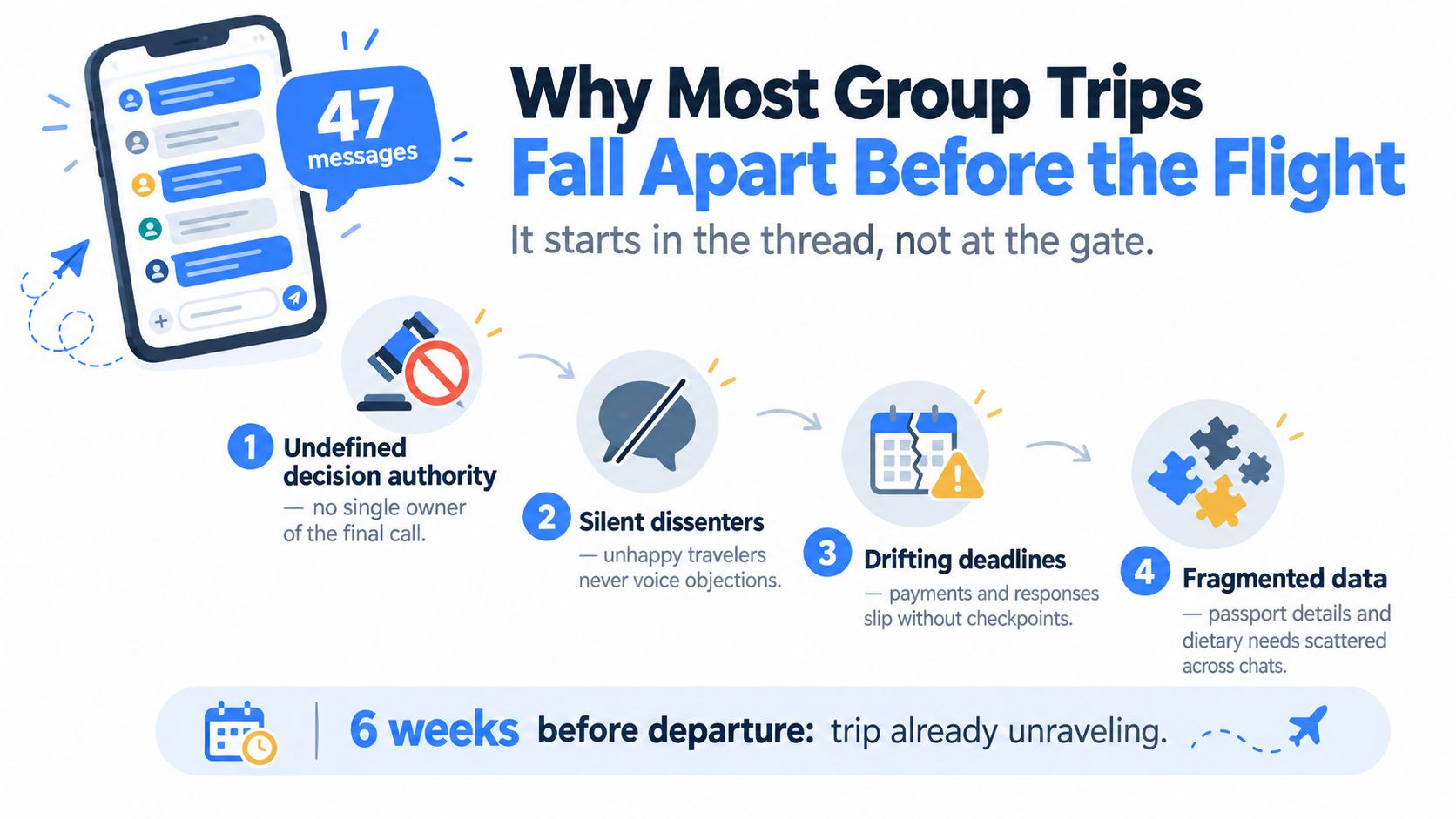
The hidden chain of failure
A ten-person family trip often fragments in the same sequence:
- One person defaults to leader: They research options, but nobody formally gives them authority to close a decision.
- Everyone assumes consensus: A thumbs-up gets treated as approval, even though several people haven't checked the details.
- Prices arrive without context: Travelers compare a room-only figure with a package that includes transport, fees, or activities.
- The roster keeps moving: Partners, children, and room preferences enter through private messages instead of a controlled record.
- Needs surface too late: Mobility, dietary, medication, or quiet-room requirements appear after inventory is committed.
Research on travel planners reinforces the operational burden. The median group travel organizer plans 10 group trips each year, and those tours average 30 passengers. A separate survey found that planning can require 83 messages and nearly 19 hours over 11 days, which is exactly why scattered chat threads fail as a working system. Those figures appear in research on the modern travel planner.
Practical rule: Treat the template as the official record. The chat is for alerts and discussion, not for storing the final decision.
The fix is not to demand better behavior from every relative. Give the group a single source of truth with a named trip lead, deputy, treasurer, response deadlines, signed commitments, and a visible decision log. The group travel planning guide can help you frame the trip around shared information instead of an endless message stream.
A good governance document answers four questions before anyone pays: Who decides? What exactly are we approving? Who owes what? By when must each person respond? Once those answers sit in one accessible template, disagreements become visible while there's still time to solve them.
Inside the Group Travel Planning Template
Start with a blank workbook or shared planning platform and build the modules in the order decisions occur. Don't begin with daily activities. Begin with the people, authority, constraints, and money that determine whether activities are bookable.
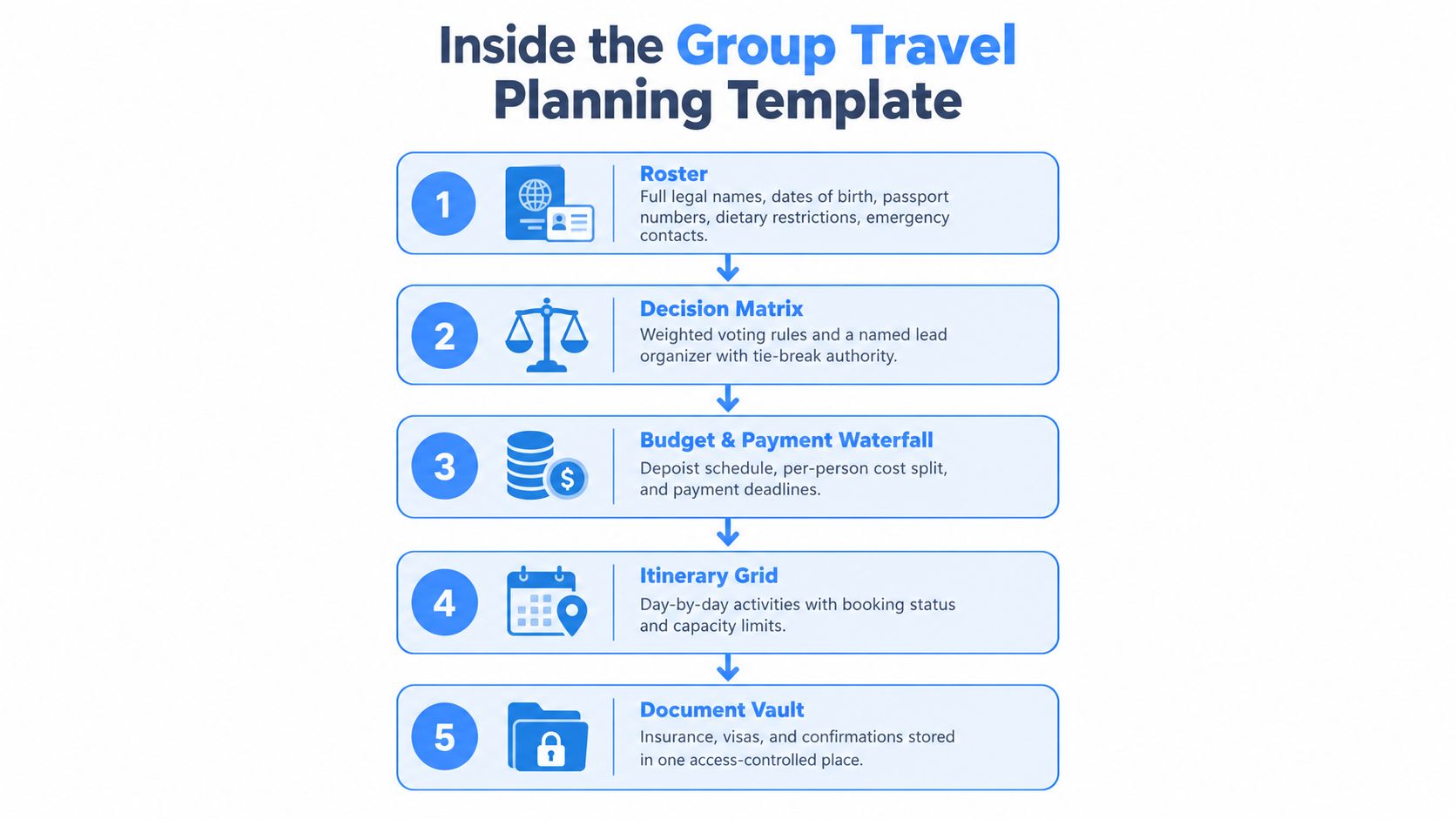
Module 1, roster and requirements
Capture each traveler's full legal name, date of birth, passport number, dietary restrictions, mobility needs, and emergency contact. Add household, preferred room type, arrival details, and whether the person can share a room. These fields exist because a blank booking record creates a last-minute chase, and a nickname or incomplete identity field can delay a reservation.
Limit access to sensitive information. The organizer needs a reliable record, but the entire group doesn't need unrestricted access to passport data.
Module 2, decision governance
Name a trip lead, deputy, and treasurer. Then create a decision log with the proposal, options considered, decision date, outcome, voters or approvers, and the person responsible for the next action.
Use weighted scoring for destination choices rather than asking, “Where does everyone want to go?” Score budget fit, flight access, accessibility, weather preferences, and activities for different age bands. For example, a destination can score well for children but poorly for grandparents if every shared activity requires long walks.
Module 3, destination shortlist
Keep the shortlist narrow enough to compare properly. Record the total expected cost structure, lodging type, transfer needs, flight practicality, cancellation terms, and activities that work for different energy levels.
The template should also surface firm constraints early. Collaborative travel planning research found that 77.4% of tasks contained at least one within-group preference conflict, with a mean of 7.52 conflicts per task, while even strong agents produced plan validity below 12% in benchmark work on multi-user travel planning. The findings are detailed in research on collaborative leisure travel planning.
Module 4, itinerary skeleton
Add arrival, departure, anchor activities, transport windows, and at least one unscheduled half-day for each generation. A skeleton keeps the group connected without forcing every traveler into the same pace.
Mark activities as shared, optional, or independent. A shared dinner may require a confirmed headcount, while a beach afternoon can remain open for naps, errands, or a smaller subgroup.
Module 5, rooming plan
Build rooms from family units first, then adjust by request. Record occupancy, bed requirements, accessibility, quiet-room preferences, children, and any pairing that must be avoided. Don't let room assignments remain buried in private messages, because the rooming plan affects inventory, cost allocation, and arrival logistics.
Module 6, activity coordination
Use tiered sign-up sheets with capacity caps. Separate “must attend,” “interested,” and “not joining” rather than forcing a yes-or-no response to every activity. Add an opt-out path that doesn't require an explanation.
Module 7, communication cadence
Choose one official channel and one weekly check-in day. Each update should include decisions made, open questions, deadlines, and the next owner. A short decision log beats a long thread because people can audit what changed and why.
This group travel planning video is useful as a visual complement to the written workflow.
The template works when every field has a job. If a column doesn't change a decision, payment, booking, or traveler experience, remove it.
Cost-Splitting and Payment Workflow That Stops the Drama
Money needs its own operating system. Don't use a Venmo thread as the ledger, and don't wait until everyone gets home to discover that one household paid for deposits while another paid for extras.
A 2025 Experian survey found that over half of Gen Z and millennial travelers who travel with friends reported a money-related disagreement, 1 in 5 said they had ended a friendship over a money issue, and unexpected costs plus fair cost-splitting were the two biggest stress points. The same survey found that many respondents spent more than planned, with Gen Z and millennials most likely to go 50% or more over budget. Those findings are reported in Experian's survey on the financial stress of traveling with friends.
Separate shared, individual, and optional spending
Create a Cost Categories sheet before anyone makes a reservation.
| Cost Category | Examples | Payment Owner | Split Method |
|---|---|---|---|
| Shared | Lodging, group transport, group dinners | Trip treasurer | Equal household or per-person split |
| Individual | Airfare, personal excursions, child add-ons | Individual traveler | Paid by the traveler |
| Optional | Spa appointments, premium tours, upgrades | Participating traveler | Split only among participants |
Then publish a target per-person range and the assumptions behind it. If lodging is split by room while transport is split by traveler, state that clearly. People don't object to every unequal split. They object to discovering it after the commitment.
Use a payment waterfall
Move shared expenses through one treasurer using a dedicated account or a single designated card. Publish the sequence:
- Reservation deposit: Identify the payer and the date funds must arrive.
- Second installment: Reconcile any roster or room changes before this checkpoint.
- Final balance: Confirm every traveler has cleared their obligation before the booking becomes non-refundable.
- Optional spending: Collect separate funds rather than mixing elective purchases into shared cash.
Prepaid deposits beat reimbursements because the group confirms commitment before inventory is released. They also give the treasurer a clean record of who has funded the trip and who hasn't.
Record every transaction
The Itemized Settlement Sheet should list the transaction, date, category, amount, person who fronted the money, participating travelers, and balance owed. Export a PDF after each major checkpoint so the group can refer to a fixed version rather than argue over a changing spreadsheet.
If a member's booking generates Reward Credits, record the credits as a shared-savings input only when the redemption terms are clear. Boomerang Member Share can also let an adult child credit a parent's share with accrued credits. Don't reduce the headline cost until the credit is applied and the beneficiary is named.
For a broader framework, use this travel budget planning resource to structure categories, deadlines, and settlement rules before booking.
Plugging the Template Into a Wholesale Booking Workflow
A spreadsheet becomes valuable when it transfers cleanly into booking operations. Approved Traveler is one option for consolidating wholesale lodging, flights, cruises, car rentals, vacation homes, tours, and activities under household-level access. The important question isn't whether a platform has many categories. It's whether your roster, payment waterfall, and activity decisions remain coherent when reservations are made.
Step 1, enroll the household
Set up the family household under one organizer account and include the 10 travelers in the profile. Keep the legal names and dates of birth identical to the roster. Store rooming units as household blocks, such as “Garcia household” or “parents' room,” while preserving each traveler's individual record.
This prevents the common mistake of creating separate reservations before the group has agreed on occupancy. It also gives the organizer one place to track confirmations and traveler assignments.
Step 2, sync the rooming roster
Transfer names, room preferences, occupancy, accessibility notes, and arrival information into the booking workflow. Fields such as passport details, dietary restrictions, and medication notes may need manual reconciliation depending on the supplier, so mark them as transferred, verified, or pending rather than assuming a completed booking carries every requirement.
Wholesale inventory can aggregate supplier rates that aren't presented through ordinary consumer OTAs. Compare the total booking terms, not just the nightly display price, and retain the public comparison in the decision log.
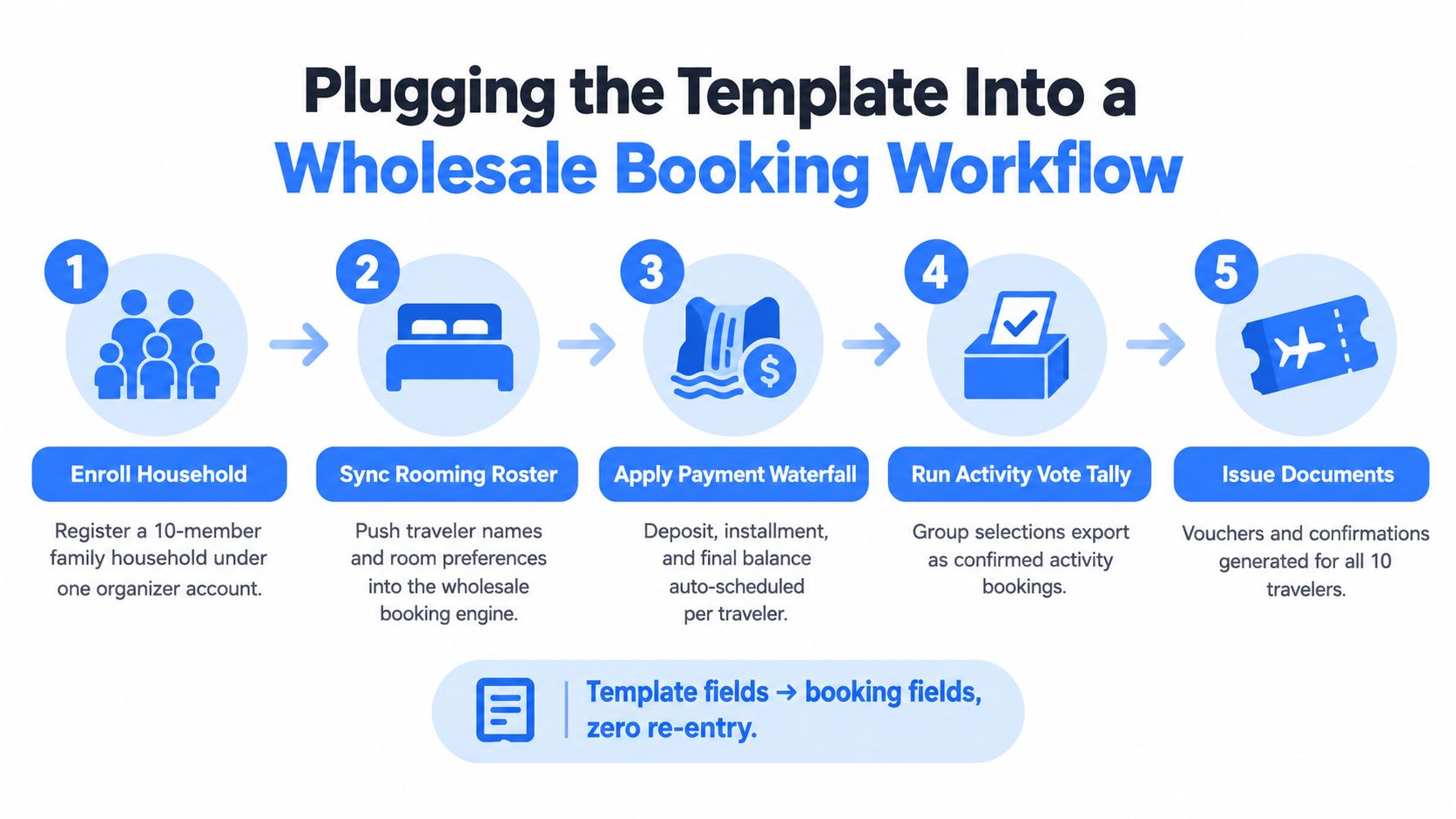
Step 3, apply the payment waterfall
Map each traveler or household to a deposit deadline, installment checkpoint, and final balance. The treasurer's sheet should show the booking reference, amount due, payer, and status. If a person misses a deadline, the decision log should show the action taken, such as changing room type or releasing an optional activity.
Approved Traveler members earn Reward Credits on bookings, and those credits can contribute to future travel-related redemptions. Boomerang Member Share lets shared family and friends' eligible hotel and car bookings generate Reward Credits for the primary member, which makes household attribution worth recording from the start.
Step 4, tally activities
Use the activity vote tally to identify confirmed shared activities, optional tracks, and capacity limits. Export the final selection into the itinerary and attach the booking confirmation to the activity row. For group transport, airport transfers, and other specialist logistics, reviewing BusAustin service offerings can help you compare an arranged transport option with self-managed transfers.
Step 5, issue and audit documents
Store vouchers, confirmations, cancellation terms, room assignments, emergency contacts, and transport details in a document vault. Approved Traveler's 110% Best Value Guarantee provides a price-match safety net when a member finds a lower publicly available price, subject to the program's terms. Record the comparison and outcome in the template instead of leaving it in a private message.
For air inventory, the airline ticket wholesale guide offers useful context for separating airline fields from lodging and activity fields. The final check is simple: every confirmed booking must have a traveler, payer, deadline, cancellation rule, and document location.
Adapting the Template for Different Group Types
The core template stays stable, but the priority fields change with the group. A family reunion needs a different operating rhythm from a remote-worker cohort, even when both involve shared lodging and transport.
| Template Field | Multi-Generational | Snowbird Couples | Remote Workers | Cruise Group |
|---|---|---|---|---|
| Rooming | Mobility access, medication notes, quiet rooms | Pair-based occupancy and longer-stay units | Workspaces, privacy, reliable connectivity | Cabin category, bed configuration |
| Schedule | Rest blocks and mixed-energy tracks | Flexible departure and return windows | Meeting windows and time-zone coverage | Port-day preferences and ship activities |
| Budget | Per-person and household splits | Installment cadence for extended stays | Lodging, workspace, and connectivity costs | Fare, gratuities, excursions, and transfers |
| Activities | Opt-out rules and accessibility checks | Weather and climate triggers | Sightseeing around work obligations | Pre-booked excursions and dining seating |
| Constant fields | Lead, treasurer, emergency contact | Lead, treasurer, emergency contact | Lead, treasurer, emergency contact | Lead, treasurer, emergency contact |
Multi-generational trips
Add a mobility-access column, medication notes, quiet-hour blocks, and a clear opt-out path. Grandparents and toddlers rarely share the same energy curve, so build an anchor activity for everyone and separate active and slower tracks around it.
Snowbird couples and extended stays
Collapse rooming into pairs, expand the stay-duration field, and record a climate-trigger departure date. The budget module should show recurring accommodation payments, utility or cleaning charges where applicable, and a fallback property if dates move. For teams or households comparing longer-stay accommodation with work-ready lodging, an aparthotel for business travelers Norwich illustrates why accommodation type belongs in the intake, not as an afterthought.
KAYAK reports that in a 2026 projection, 35% of Gen Z and 31% of Millennials say credit or installment plans will determine how many trips they can take, while 41% rank awe-inspiring experiences as a top priority and 63% say natural wonders guide their plans. These projections appear in the KAYAK WTF Report 2026. For extended stays, payment timing and alternative lodging structures deserve as much attention as the destination.
Remote workers and cruise groups
For remote workers, prioritize Wi-Fi reliability, desk setup, coworking proximity, and meeting windows above sightseeing. For cruise groups, replace hotel-night rows with cabin categories, port-day preferences, dining assignments, excursion capacity, and embarkation logistics.
Jotform's group trip intake approach includes dates, accommodation type, transportation, estimated budget, dietary restrictions, and special needs. That breadth is appropriate. The mistake is treating every field as equally important for every group. Keep the lead, deposit deadline, emergency contact, and decision log constant. Expand or remove the rest according to the travelers in front of you.
Launch Checklist and Final Takeaways
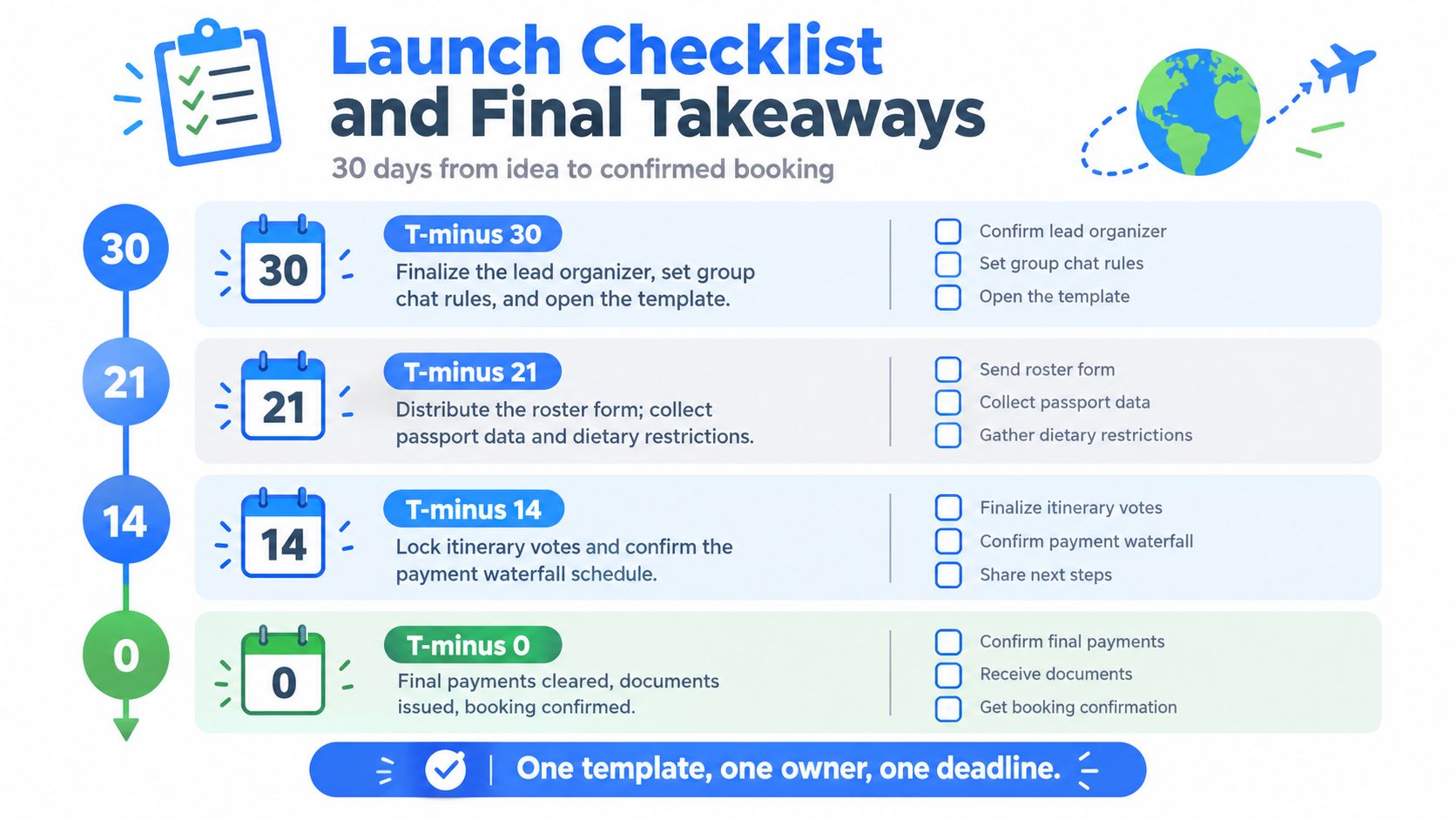
A 30-day launch checklist keeps the template active instead of turning it into a document everyone reads once and ignores.
- T-minus 30: Name the lead organizer, deputy, and treasurer. Set the single-channel rule, open the roster, and publish the first decision deadline.
- T-minus 21: Distribute the rooming and budget modules. Collect legal traveler details, requirements, and deposits. Mark incomplete fields visibly.
- T-minus 14: Lock the destination shortlist, run the activity vote, and request Approved Traveler quotes. Compare public rates under the 110% Best Value Guarantee, recording the terms rather than relying on screenshots.
- T-minus 7: Confirm rooming assignments, finalize the payment waterfall, and apply Reward Credits or Boomerang Member Share where eligible. Issue a decision log update.
- T-minus 3: Send the day-of itinerary, emergency contacts, ground transport details, booking references, and opt-out instructions. Confirm that every traveler can access the document vault.
The rule that survives every group type is simple: decide who decides before you decide what. A template can't repair unclear authority after the first argument, and it can't make a vague payment promise fair after deposits are due. Assign decision rights in the first module, expose financial commitments early, and keep every booking tied to a named traveler and deadline.
Approved Experiences Traveler provides centralized access to wholesale travel inventory, including lodging, flights, cruises, car rentals, vacation homes, tours, and activities, with household coordination for up to 10 members. Visit Approved Experiences Traveler to evaluate whether its booking infrastructure, Reward Credits, Boomerang Member Share, and 110% Best Value Guarantee fit the group travel planning template you're building.
Want the wider view?
Ten categories. One report. Every quarter. The Approved List tracks what's rising and what's fading: data-backed signals, not opinions.
Free to join · Delivered by email