
All Articles
The Journal
Is a Vacation Home Worth It? a 2026 Cost Guide
October 23, 202614 min readsecond home costsvacation rental income
Is a vacation home worth it in 2026? Compare total ownership costs, rental income, tax rules, and flexible alternatives before you buy.

A vacation home is worth it only when your household uses it often enough to justify paying year round carrying costs, and traditionally owned vacation homes are typically used just 4 to 6 weeks per year while owners pay taxes, insurance, maintenance, and financing for all 52. That gap is where most purchases fail. Buyers start with appreciation, add optimistic rental income, then treat personal use as a bonus. Reverse the order. If the nights you will actually sleep there don't carry the cost, appreciation has to rescue a weak deal, and that isn't underwriting. It's hope with a mortgage attached.
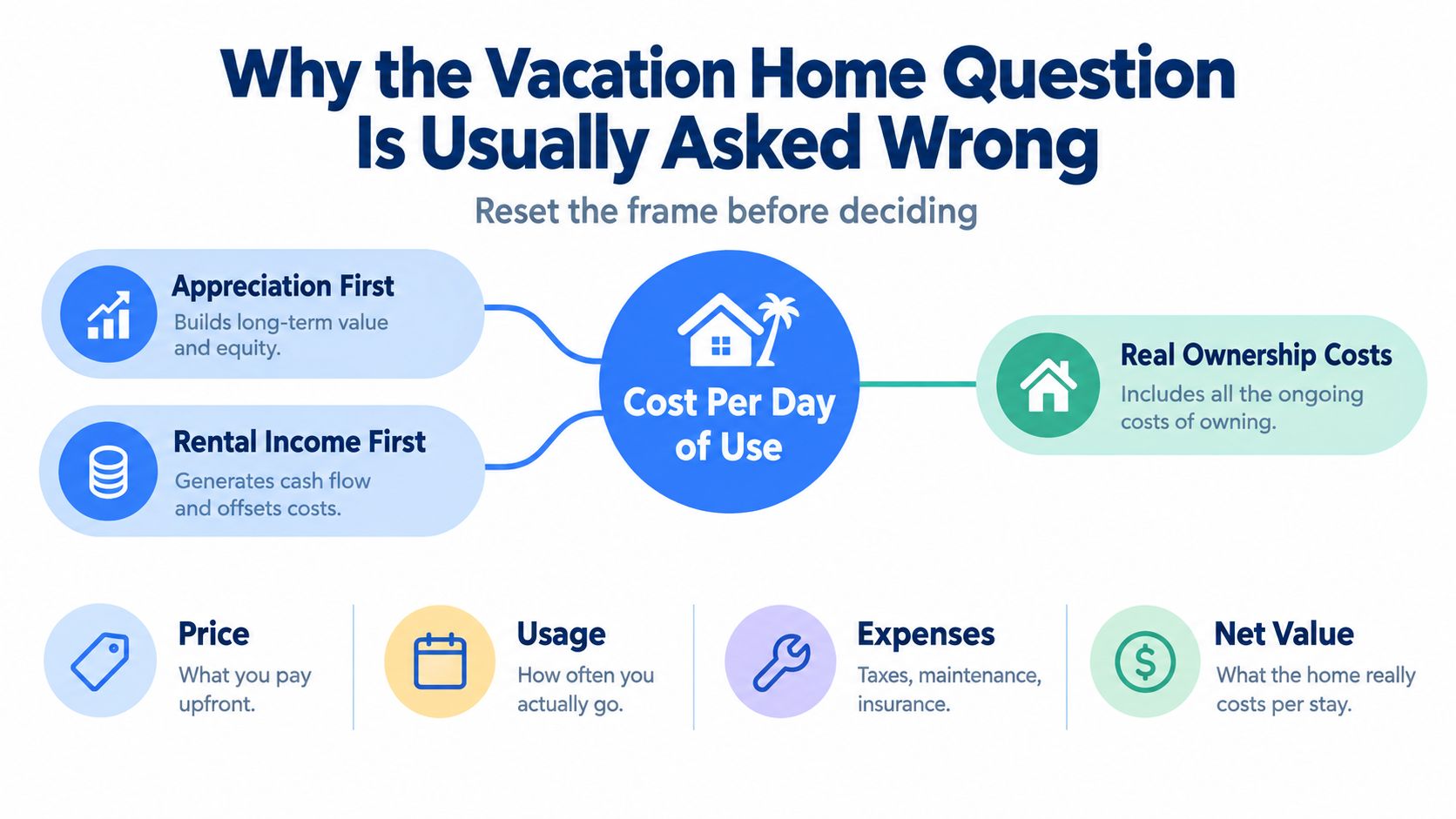
Why the Vacation Home Question Is Usually Asked Wrong
The popular question, is a vacation home worth it, usually gets asked as a prediction about prices. Buyers look at recent appreciation, scan nightly rates nearby, and work backward to a yes. That sequence hides the only variable you control after closing, how many nights your household uses the property.
Start With Cost Per Personally Used Night
Add every annual cost, subtract realistic net rental income, then divide the remainder by your realistic personal nights. That result is your cost per personally used night. Compare it with what you'd pay for comparable lodging only when you need it, with a kitchen, enough bedrooms, and shared space for your group.
If your cost per night is higher, ownership needs another justification. Control, storage, familiarity, and the ability to arrive without booking may have value, but price them realistically. Don't let a lifestyle preference masquerade as an investment return.
Ownership has always been a minority strategy, not a default step for households that travel. A historical industry account of vacation home ownership in 1990 reported 5.5 million U.S. families owning vacation homes or timeshares, approximately one in 13 households, with detached houses and cabins at 51%, condominiums and townhouses at 19.6%, and timeshare weeks at 15.6%. That mix matters because different property types carry different fixed costs, association rules, and exit problems.
Separate the Two Returns
Most buyers blend two different calculations into one optimistic number. Keep them apart.
- Owner use value: The comparable lodging cost you avoid on nights you personally occupy the home.
- Rental return: Net income after vacancy, cleaning, repairs, management, taxes, insurance, furnishing, and financing.
- Residual cost: Annual carrying cost left after rental income, which your personal nights must justify.
A home can appreciate and still lose for you. It can rent occasionally and still lose for you. If you reserve the best weeks, travel less than planned, or underestimate repairs, the personal nights become extremely expensive even while the property looks successful from the outside.
Underwriting rule: Never approve a purchase until you've written down the number of personal nights required to beat flexible access, then checked that number against your real calendar.
Ask one question before touring properties. How many nights will this household use, in this destination, for several years running, given school schedules, work, health, and changing tastes? If you can't defend that number, you don't have a buy case yet.
The Full Cost Stack of Owning a Vacation Home
A mortgage payment is not the annual cost. It's one line in a stack that continues whether the house is full, rented, or empty. Deals die when buyers annualize the payment and treat everything else as incidental.
Fixed Costs Don't Take Vacations
Property taxes, insurance, mortgage interest, basic utilities, association dues, security, and routine maintenance apply during vacancy. Roofs age when nobody's there. Pipes leak when nobody's there. Landscaping, pest control, pool service, and wear from weather continue on schedule.
Variable costs rise with occupancy, including cleaning, consumables, higher utilities, laundry, and guest related repairs. Management sits between the two categories, since you may pay a base arrangement plus activity tied to bookings and visits. Furnishing is also easy to understate, because a home used by family and guests needs durable furniture, linens, kitchen equipment, and periodic replacement.
| Cost Component | Scales With Occupancy | Applies During Vacancy |
|---|---|---|
| Mortgage interest | No | Yes |
| Property taxes and insurance | No | Yes |
| Utilities | Partly | Yes, at a base level |
| Repairs and maintenance | Partly | Yes |
| Cleaning and laundry | Yes | No, except periodic checks |
| Management | Partly | Often yes |
| Furnishing replacement | Yes, over time | No |
| Vacancy loss | Yes, inverse to bookings | Yes, as lost offset |
Build the stack before applying any rental offset. If the property sits unused for long stretches, you still carry the fixed portion and lose the chance to spread it across personal nights or paid stays. That's the arithmetic that turns a pleasant idea into a permanent second household budget.
Recent demand reflects how demanding that stack has become. Redfin data on second home mortgages in 2024 reported 86,604 second home mortgages, down 5% from 2023 and the lowest level in records beginning in 2018, with second homes at 2.6% of mortgages versus a 5% peak in 2020, while separate housing data put vacation homes at 4.74 million in 2024, down from 5.47 million in 2018, and their share fell from approximately 4.0% to 3.3%. Those figures don't prove every purchase fails. They signal that higher prices, financing, insurance, taxes, maintenance, and local restrictions have raised the hurdle.
Capital Has a Cost Too
Your down payment and reserves aren't free because they're already in your account. Capital tied up in one property can't be used elsewhere, and it concentrates your travel budget in one destination. If family interests shift, a local market weakens, or rental rules tighten, you can't rebalance a house the way you can change next year's bookings.
Run a practical example with your own figures. List twelve months of fixed costs, add a conservative annual repair and furnishing reserve, then divide by your defensible personal nights before counting rent. If that preliminary number already shocks you, rental income has a large hole to fill.
Rental Income Scenarios and What They Really Net
Gross nightly rate is the most abused number in second home analysis. Multiply it by an assumed number of booked nights and almost anything looks workable. Net income is lower, later, and less predictable.
Convert Gross Revenue Into Cash You Keep
Start with booked nights you can support from comparable properties, not the best listing in the market. Then subtract vacancy between stays, platform and payment costs where they apply, cleaning that isn't fully recovered, repairs, management, supplies, utilities, insurance appropriate to rental use, taxes, and financing. Include the cost of your own time if you'll handle pricing, guests, vendors, and emergencies.
Seasonality does most of the damage. In many leisure markets, demand clusters into school breaks, holidays, and prime weather. Those are often the same weeks your family wants. Every peak week you keep removes some of the easiest revenue and leaves lower demand periods to carry the annual result.
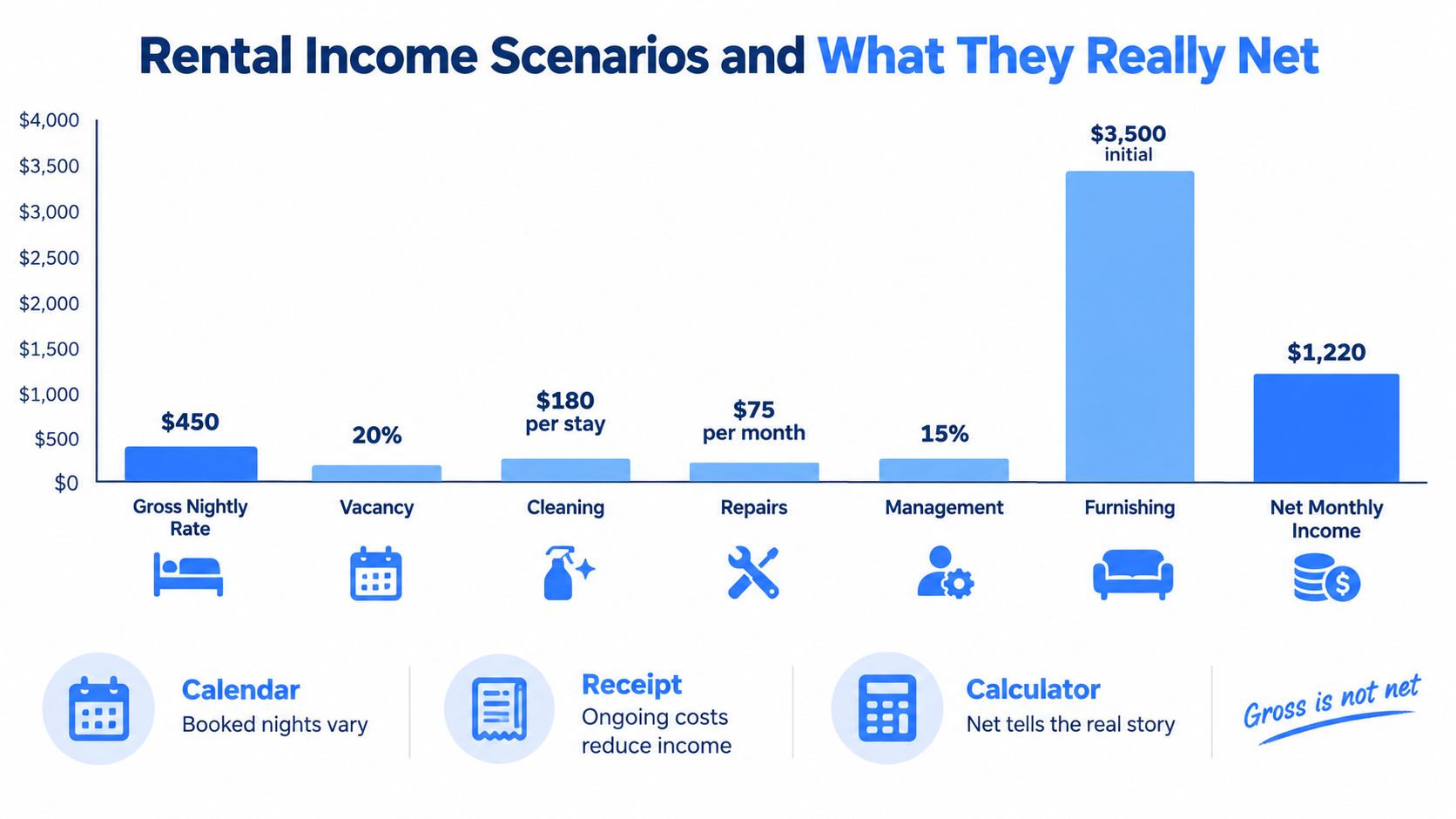
Model three cases in plain language. A low case assumes fewer booked nights, more discounting, and a repair you didn't plan. A base case uses comparable occupancy and full operating costs. A high case assumes strong peak bookings, but only after your personal calendar is fixed.
- Low case test: Can you carry the property without stress if rent covers only part of operating costs?
- Base case test: Does net rent materially reduce your cost per personal night, or merely soften it?
- High case test: Are you relying on peak weeks your family also wants to use?
If the deal only works in the high case, it doesn't work. You're buying a hospitality operation and hoping your family schedule cooperates with strangers' demand. Professional help can reduce friction, and it's worth reviewing the operating scope in a guide to vacation home rental management responsibilities before assuming management solves weak occupancy.
Utilization is the other side of the same equation. Market research on fractional vacation property use estimates traditionally owned vacation homes are typically used only 4 to 6 weeks per year, while owners remain responsible for taxes, insurance, maintenance, utilities, financing, and management for the full year. At that usage level, rent isn't a side benefit. It has to be substantial, repeatable, and legally available.
A rental projection isn't credible until it survives vacancy, cleaning, repairs, management, and the removal of your favorite weeks.
Finish with the break even question. After realistic net rent, how many personal nights must you use for the remaining cost to match booking comparable homes only when needed? Put that required number beside last year's actual travel. The gap, if there is one, is your answer.
Tax Rules That Change the Buy Decision
Tax treatment can change the ranking of two otherwise similar properties. It should be modeled before you offer, not discovered when you file. The key issue is how personal use and rental use interact.
Personal Use Changes the Category
Under IRS guidance for residential rental property and personal use, expenses must be allocated between rental and personal use when you do both, and only the rental use portion is generally deductible on Schedule E. The property is treated as a personal residence when personal use exceeds the greater of 14 days or 10% of days rented to others at fair market rent.
That threshold creates a direct trade off. More family days can improve lifestyle value while reducing rental inventory and changing how mortgage interest, taxes, insurance, maintenance, utilities, and depreciation can offset rental income. Fewer family days may support a rental profile, but then why own this specific home instead of a cleaner investment asset?
Use a simple example before you buy. If projected rentals rise, the personal use threshold tied to rented days can rise too. Schedule the calendar and the tax model together, with dates, expected rent, and who occupies the home. A spreadsheet that treats family weeks as free is wrong twice, once on revenue and once on taxes.
Debt Limits Apply Across Both Homes
Mortgage interest on a personally used second residence can qualify under the same general requirements as a primary home, but the combined limit matters. IRS guidance on mortgage interest and real estate taxes states the federal home acquisition debt limit is $750,000, or $375,000 for married taxpayers filing separately, for homes acquired after December 15, 2017, applied to combined qualifying debt on the primary and second homes.
That means existing primary residence debt reduces room for deductible interest on the second home. Don't copy a generic tax benefit into your model. Compare the proposed loan with your current qualifying debt and confirm treatment with a tax professional, especially if rentals are planned.
Keep records from day one.
- Calendar: Personal, rented, vacant, and maintenance days.
- Agreements: Rental terms and amounts received.
- Expenses: Invoices separated where possible between rental and personal purposes.
- Loan records: Balances and interest for combined debt analysis.
Tax planning also belongs in the exit conversation, not just the purchase conversation. Reviewing exit strategies for second-home buyers helps you think through how classification and holding intent affect your options later. A property that's awkward to use, rent, and sell has three problems, not one.
Comparing Ownership With Flexible Access Options
Ownership wins on control. Flexible access wins on matching cost to actual travel. The right choice depends on which of those your household will use more.
Longer stays make home style lodging more valuable, but they don't automatically make owning one home logical. U.S. vacation rental market analysis on stay length reports average stays rose from 4.0 nights to 4.42 nights in 2025, 14 to 30 night stays are forecast to grow at a 9.3% compound annual rate through 2031, and bookings of 28 days or more increased 25% year over year. Treat the growth figures as market projections and reported change, not a promise for one property.
Compare Models on the Criteria That Differ
Ownership requires upfront capital and fixed annual cost, gives you storage and customization, and is hardest to exit. Weekly rentals preserve destination choice and avoid maintenance, but availability and price vary. Monthly rentals suit longer work or seasonal stays without a purchase. Timeshares and exchanges can provide recurring access with scheduling constraints. A long term lease in one area gives stability for a defined period without tying capital to a sale later.
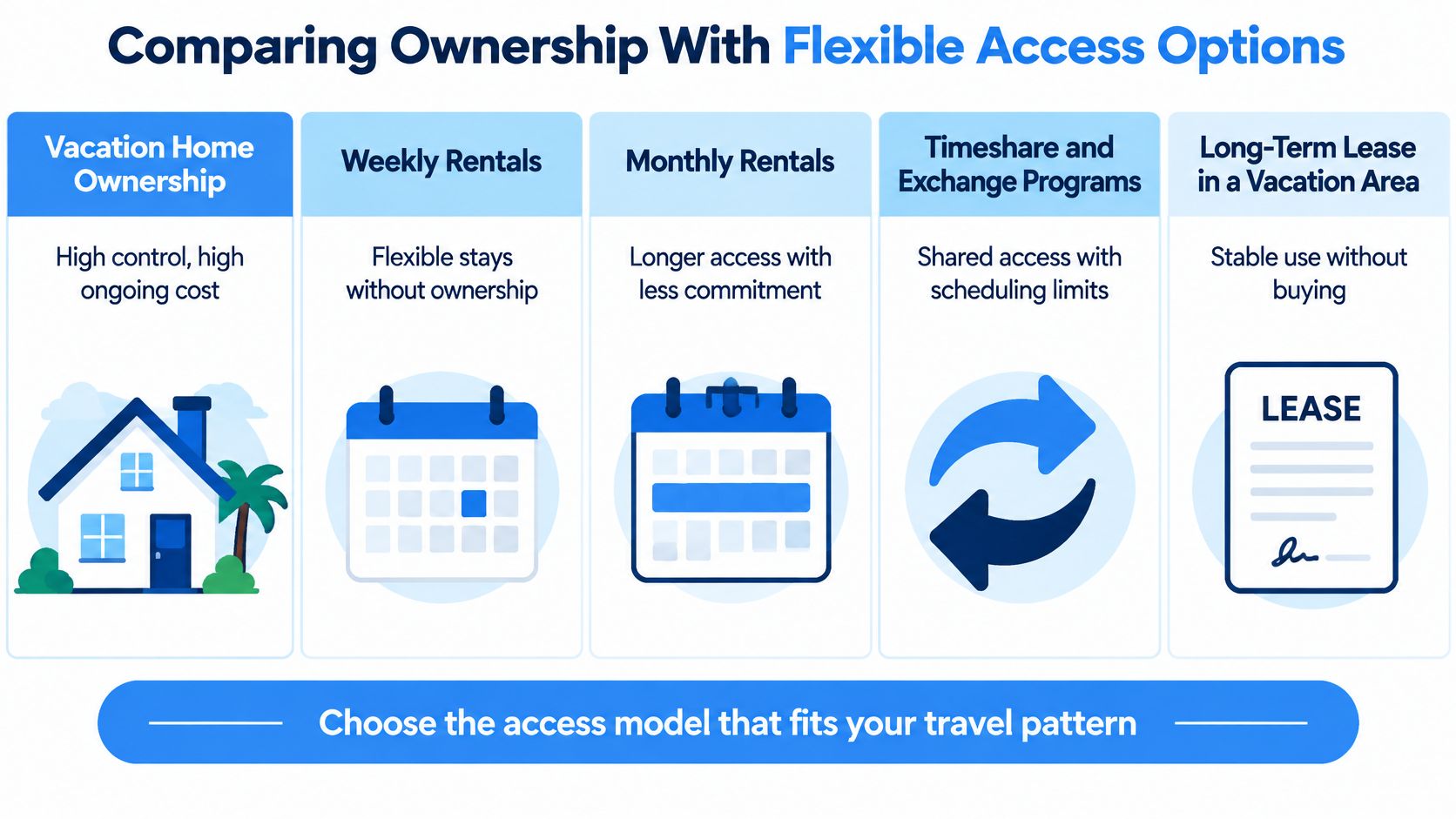
The practical comparison is your annual travel calendar, not a brochure for one destination. Mark trips you'd take to the owned home, trips you'd still take elsewhere, and trips that need more bedrooms than you'd buy. If several important trips fall outside the property, ownership covers only part of your travel while consuming the full fixed budget. A side by side review of hotel versus vacation rental trade offs can help separate when you need a whole home from when a hotel is operationally simpler.
One consolidated access option is Approved Traveler, an annual membership providing wholesale rate access to more than 500,000 vacation homes, 1,000,000 hotels, and 700+ airlines, with Reward Credits that never expire and a 110% Best Value Guarantee. For existing timeshare owners, V.O.I.C.E. allows depositing up to 5 weeks per year for credits, exchanging weeks at no fee, or listing weeks on a peer to peer rental marketplace with no listing fee. Evaluate that structure like infrastructure: does one access layer replace fragmented booking across homes, hotels, flights, and cars for your actual volume?
There's also the stay-home alternative buyers rarely price. If part of the urge is for a better setting to rest, ideas to create a vacation feel at home may satisfy some weekends without adding a second property. That doesn't replace travel, but it can reduce the number of nights you were counting on a purchased home to justify.
Matching the Decision to Your Travel Profile
Generic advice fails because households don't travel alike. Match the model to your calendar, group size, and tolerance for operations. The same property can be rational for one family and wasteful for its neighbor.
For a quick visual sense of the planning tension between buying one place and planning trips across places, use the image below as a prompt to map your next two years realistically.

Multi generational organizers coordinating 8 to 10 people need bedrooms, bathrooms, common space, and dates that work across households. Ownership helps only if the same large group returns to the same place often. If reunions rotate or group size changes, access to varied large homes is more useful than owning one fixed floor plan.
Snowbirds staying one to three months may get enough personal nights to make ownership math less brutal, especially in a place they'll revisit for years. The test is the empty remainder of the year. If you won't rent it, price those vacant months directly into your winter nights.
Work, Frequency, and Existing Inventory
Remote workers taking four to eight week trips need reliable workspace, a kitchen, and neighborhood fit. They often benefit from trying different bases before committing, because a great vacation street can be a poor work base. Frequent leisure travelers taking three or more trips a year spread demand across seasons and destinations, which weakens single property utilization but strengthens the case for consolidated access and accumulating Reward Credits across bookings.
The video below is useful as a planning check before you assign your household to a profile. Compare the travel pattern described with your booked history, not the pattern you intend to start after buying.
High net worth households may rationally pay for control and time savings even when cost per night is high. Call that a consumption decision and budget it as one. Existing timeshare owners face a different problem, unused weeks and exchange friction, so reviewing vacation home exchange programs and alternatives is more relevant than adding another fixed obligation.
Family scale changes the access calculation. A consolidated membership structure with up to 10 members per account at full benefit parity and no per person fees spreads fixed membership cost across more travelers, while Boomerang Member Share earns Reward Credits on hotel and car bookings made by shared family and friends. Ownership spreads cost only when those same people travel to the same house. That's a narrower condition than most buyers admit.
Running Your Own Numbers Before You Commit
Run the checks in order, and stop when one fails. Don't compensate for a failed legal or utilization test with a more optimistic price forecast.
First, verify rental rules with the city, county, state, and any association. A Congressional Research Service summary of short term rental regulation identifies New York City as banning entire home short term rentals of fewer than 30 days, notes Santa Monica and Irvine use restrictions including occupancy requirements that can prevent whole home short term rentals, and states nearly every locality imposes some tax on short term stays. Confirm licensing, minimum stay rules, occupancy limits, and lodging taxes before counting income.
Next, build a two year travel calendar and mark personal nights you'd truly use the target property. Then calculate the full annual cost stack, subtract only conservative net rent, and divide by those nights. Use a lender quote or a tool to calculate monthly mortgage costs, then add taxes, insurance, utilities, maintenance, management, furnishing reserves, and vacancy so the mortgage doesn't stand in for ownership.
Finally, price the flexible alternative for the same calendar. Compare weekly or monthly homes, hotels where they fit, and a consolidated annual membership against your actual trips, group sizes, and destinations. Confirm tax treatment with a professional, and keep calendars, agreements, and expense records if you proceed. If ownership doesn't beat access on your own calendar, don't buy the calendar you wish you had.
If your numbers point toward access instead of another fixed property, Approved Experiences Traveler consolidates wholesale access to vacation homes, hotels, flights, cars, cruises, and activities in one annual membership, with Reward Credits that never expire and a 110% Best Value Guarantee. Compare the Traveler and Lux Traveler tiers against your household travel volume, then choose the infrastructure that matches the trips you'll really take.
Want the wider view?
Ten categories. One report. Every quarter. The Approved List tracks what's rising and what's fading: data-backed signals, not opinions.
Free to join · Delivered by email