
←All Articles
The Journal
Vacation Home Rental Management: A Practical Guide
September 20, 202618 min readshort-term rental operationsrental pricing strategy
A practical guide to vacation home rental management covering pricing, guest ops, compliance, and how to leverage consolidated travel infrastructure for scale.
More than 140,500 companies now manage vacation rentals worldwide, each overseeing an average of 79 properties, and the U.S. alone has about 1,985,280 professionally managed vacation rental properties. If you're still running one or two homes like a side project, you're operating in a market that has already professionalized around software, compliance, and channel control.
You're probably juggling one or two properties while costs, rules, and guest expectations keep rising. One guest wants an early check-in, another can't find the lockbox, your cleaner is running late, and a permit renewal is suddenly due.
That's why vacation home rental management in 2026 isn't really a listing-and-cleaning job anymore. It's an operating discipline. The owners who keep margin don't just write better listing copy. They build repeatable systems for pricing, messaging, reporting, access, and inventory control.
What Vacation Home Rental Management Actually Covers
Friday at 5:40 p.m., a guest cannot get through the gate, the cleaner found damage from the last stay, Airbnb and Vrbo are showing different availability, and your city wants quarterly occupancy data by Monday. That is vacation home rental management. It is a compliance-and-operations job tied to a real estate asset, not a listing task with a cleaning checklist attached.
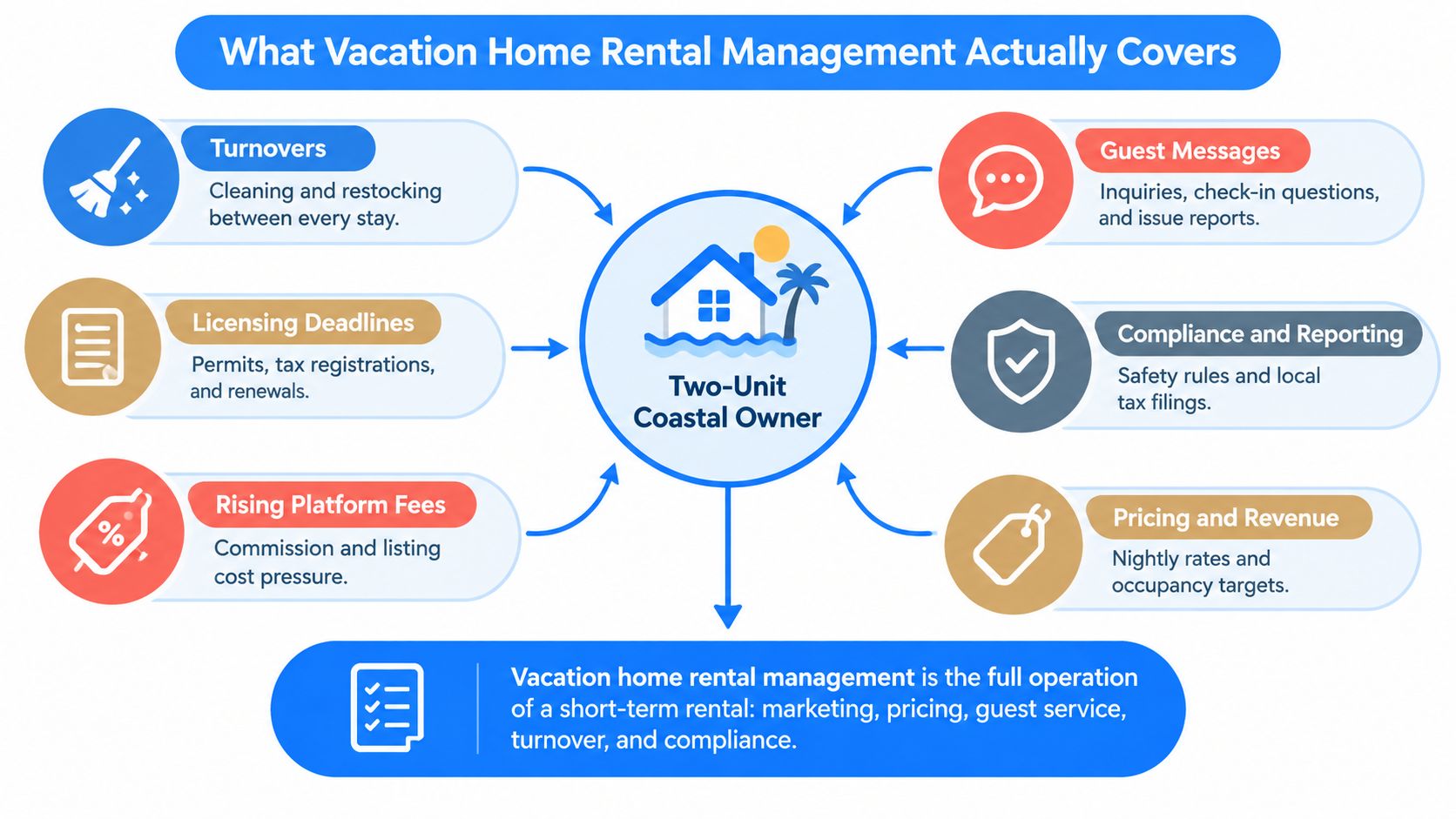
The five domains that matter
Guest operations. Every booking moves through inquiry, screening, pre-arrival messaging, access, in-stay support, checkout, review collection, and issue resolution. Casual texting does not scale. Use response rules, message templates, escalation paths, and documented service standards.
Revenue controls. Nightly rate is only one lever. Minimum stays, orphan-night rules, discounts, cancellation terms, check-in patterns, and owner blocks shape yield just as much. Operators who treat pricing as "set the weekend rate and hope" leave money behind.
Channel and inventory control. Distribution is an operating system decision. Your calendars, rates, fees, restrictions, and content need one source of truth across every booking channel. If they live in separate dashboards, you are inviting double bookings, stale pricing, and reporting errors.
Compliance and tax handling. Permits, local registration, occupancy tax setup, guest record retention, safety requirements, and filing deadlines belong in the core workflow. Skip this and the penalties erase months of margin fast.
Asset protection. Turnovers, preventive maintenance, damage claims, supply controls, inspections, and access logs protect both reviews and resale value. If your home sits in a controlled-access property, guest entry needs system design, not improvisation. Owners in managed communities should evaluate tools like gated community access control before volume increases.
One rule matters more than the rest. If a task repeats every booking, document it, assign it, and measure it.
Why short-stay management is a different operating model
A long-term rental has fewer handoffs and fewer failure points. A vacation home resets every stay. New guests arrive, cleaners turn the unit, supplies get consumed, locks need to update, messages need to send, and support issues can hit outside business hours.
That cadence changes the job. You are running a small hospitality operation with compliance exposure, not collecting rent on a static lease.
What the operating stack looks like now
The market already rewards operators who standardize. Analysts at StayFi noted the global vacation rental management field includes more than 140,500 companies, with an average of 79 properties per company in one recent industry summary (industry summary on vacation rental scale). The takeaway is straightforward. Fragmented homes are being pulled into professional systems.
That is the scope of vacation home rental management. You are coordinating distribution, access, vendor work, guest communication, reporting, and compliance inside one operating layer. The owners who win treat each property as part of a portfolio, then use wholesale travel infrastructure to consolidate fragmented inventory into a single system they can control.
Self-Management vs Professional Management
Self-management can work. It just stops working earlier than most owners think.
The break point usually isn't emotional burnout. It's when owner time, slower response, and inconsistent turnover start leaking margin faster than a manager's fee would. If you live near the property, have flexible time, and like operations, stay involved. If you're remote, juggling multiple units, or can't tolerate guest-service misses, hire help sooner.
The fee isn't the decision
The common mistake is comparing management models by fee alone. That's lazy math. You compare them by net income, control, and how much operational risk stays on your plate.
Full-service vacation rental operators commonly charge 20% to 40% of gross revenue (management fee data). That sounds expensive until you compare it with what self-management really costs when you're answering late messages, replacing vendors, coordinating maintenance, and fixing calendar errors yourself.
| Self-Management vs Professional Management: Cost and Workload Trade-Offs | |||
|---|---|---|---|
| Dimension | Self-Management | Professional Management | Hybrid (Co-Hosting) |
| Cost structure | No formal management fee, but you absorb software, vendor coordination, and your own time | Usually 20% to 40% of gross revenue for full-service | Lower-fee structure than full-service, with owner retaining some operating tasks |
| Included services | Only what you personally build and manage | Guest communication, pricing, turnovers, maintenance coordination, compliance support, channel execution | Usually a split, such as owner-led pricing with outsourced guest support or local ops |
| Owner time | Highest | Lowest | Moderate |
| Control over pricing and brand | Highest | Lower unless contract gives owner approval rights | Shared control |
| Best fit | One nearby property, strong availability, hands-on owner | Remote owner, multiple properties, low tolerance for service lapses | Owner wants control of strategy but not daily execution |
Where self-management starts to break
Three situations push owners toward professional help fast:
- Remote ownership: If you can't inspect the home, solve access issues, or verify cleanings quickly, small misses become review problems.
- More than one unit: Two units don't just double work. They create scheduling conflicts, message overlap, and more chances for a compliance miss.
- Low availability tolerance: If you can't respond quickly because of your day job or travel, you'll feel it in conversion and guest sentiment.
For owners comparing local operators, market-specific roundups like this overview of Florida vacation property management can help you see how service models differ by region.
My advice on hybrid setups
Hybrid management is underrated. Keep pricing, stay controls, and owner calendar strategy if you're good at them. Outsource turnovers, after-hours guest messaging, and local maintenance coordination if those are your weak points.
Owners should stay hands-on until operations crowd out acquisition, family time, or decision quality.
That's the line I use. If the property is running you instead of the other way around, you've waited too long.
Channel and Inventory Strategy
A calendar can look full and still be poorly managed. I see this all the time. Owners spread listings across every channel they can find, accept whatever booking mix shows up, and miss the job: controlling inventory, margin, and compliance risk across the whole portfolio.
Channel strategy is an operating discipline, not a marketing exercise. Each booking source should earn its place by producing clean demand at an acceptable net return, with rules you can enforce. If a channel brings high cancellation rates, weak guest fit, chargeback headaches, or calendar fragmentation, it is not helping the business.
Audit channels by operational value
Review the last 12 months of bookings by source and judge each channel on four things:
- Net revenue after all channel costs: Commissions, payment fees, promotions, and support time count.
- Booking behavior: Look at lead time, cancellation rate, modification rate, and length-of-stay pattern.
- Rule compatibility: Some channels fight your minimum stays, occupancy caps, fee structure, or damage policies.
- Operational drag: Track guest messaging volume, issue rate, review volatility, and claims.
A source that fills peak dates at low margin is often worse than a source that fills shoulder gaps cleanly and leaves weekends open for higher-value bookings.
One property can survive sloppy distribution. A portfolio cannot.
Stop treating OTAs and direct as a branding debate
OTAs are demand pipes. Use them for reach, especially in markets where discovery matters and repeat intent starts low. Direct booking works best after the first stay, when the guest already knows the product and trusts the operation.
The mistake is ideological channel management. Some owners chase direct bookings too early and starve occupancy. Others stay dependent on major platforms and accept rising fees, policy changes, and ranking volatility as if they have no choice. Both approaches leave money on the table.
A better approach is simple. Use OTAs to acquire the first booking. Use your own systems to keep the guest relationship, collect consented contact data where allowed, and drive the second booking into a lower-cost path. That is how mature operators improve margin without sacrificing demand.
Inventory control is the real scaling constraint
Manual calendar updates are not a small-process problem. They are a control failure. Once you run multiple channels or multiple homes, inventory has to sit inside one operating layer with rules, reporting, and synchronization built in.
Use a centralized system to push availability, rate plans, minimum stays, blackout dates, and booking restrictions across every channel. If you want a practical view of how that operating layer works, read this guide to a travel inventory management system.
That shift matters because vacation home rental management stops being a listing business as soon as you have real volume. It becomes portfolio operations. You are allocating nights across channels, protecting date value, enforcing stay controls, and reducing failure points across distributed inventory.
Consolidation beats channel sprawl
The operators who scale cleanly do not win by adding more listings to more sites. They win by consolidating fragmented inventory into one controllable system, then using wholesale travel infrastructure to distribute that inventory where it performs best.
That model does three things well. It reduces duplicate work. It gives you one source of truth for availability and restrictions. It makes reporting usable enough to spot where margin is leaking.
Skip vanity distribution. Build a channel mix you can control, measure, and enforce. That is what raises net revenue across a vacation rental portfolio.
Revenue Management and Pricing Discipline
Revenue management is where owners either act like investors or hobbyists.
A booked calendar can still be an underperforming calendar. The fix starts with better metrics. Track net ADR, RevPAR, repeat-guest rate, acquisition cost, and channel contribution, then compare them against a real comp set instead of your own old numbers. That's the framework behind PriceLabs' guidance on net performance metrics, referenced earlier.
Track the metrics that survive fee leakage
Gross ADR flatters bad decisions. Net ADR tells the truth. If two bookings have the same top-line rate but one came through a higher-cost source, they're not equally valuable.
Use this table as your weekly scorecard:
| Revenue Management Metric Targets | ||
|---|---|---|
| Metric | Target Range | Why It Matters |
| Net ADR | Strong enough to hold close to your listed rate after channel costs | Shows whether distribution costs are quietly eroding yield |
| RevPAR | Trend upward versus your comp set and seasonality pattern | Tells you whether pricing and occupancy are working together |
| Length-of-stay mix | Balanced by season, market, and cleaning burden | Prevents long bookings from blocking higher-value short windows |
| Repeat-guest rate | Rising over time | Lowers acquisition dependence and improves margin |
| Channel contribution | Diversified, with weak channels corrected or reduced | Protects you from concentration risk and fee creep |
Price the rules, not just the nights
Most owners obsess over nightly price and ignore the settings that shape profitability.
Use these levers aggressively:
- Minimum stays: Stretch weekends and holidays when demand supports it.
- Gap-night management: Fill awkward one- and two-night holes instead of letting them rot on the calendar.
- Last-minute adjustments: If a date isn't booking, solve the problem before arrival week.
- Long-stay logic: Extended stays can reduce turnover cost, but they can also block stronger segmented demand.
A useful market signal sits in stay-length trends. U.S. vacation rental operators saw average length of stay increase from 4.0 nights in 2024 to 4.42 nights in 2025, while average occupancy slipped from 53% to 51% (U.S. stay-length and occupancy update). Longer stays didn't automatically fix performance. Owners still had to manage supply pressure.
If your pricing tool sets rates and you never override it for local demand spikes, you're outsourcing judgment, not using software well.
Fee decisions belong inside pricing strategy
Don't separate fee structure from pricing. Cleaning strategy, channel cost, and stay-length rules all affect what you keep. Owners who anchor on gross revenue usually feel busy and underpaid. Owners who anchor on net performance usually make cleaner decisions faster.
Guest Operations as a Measurable System
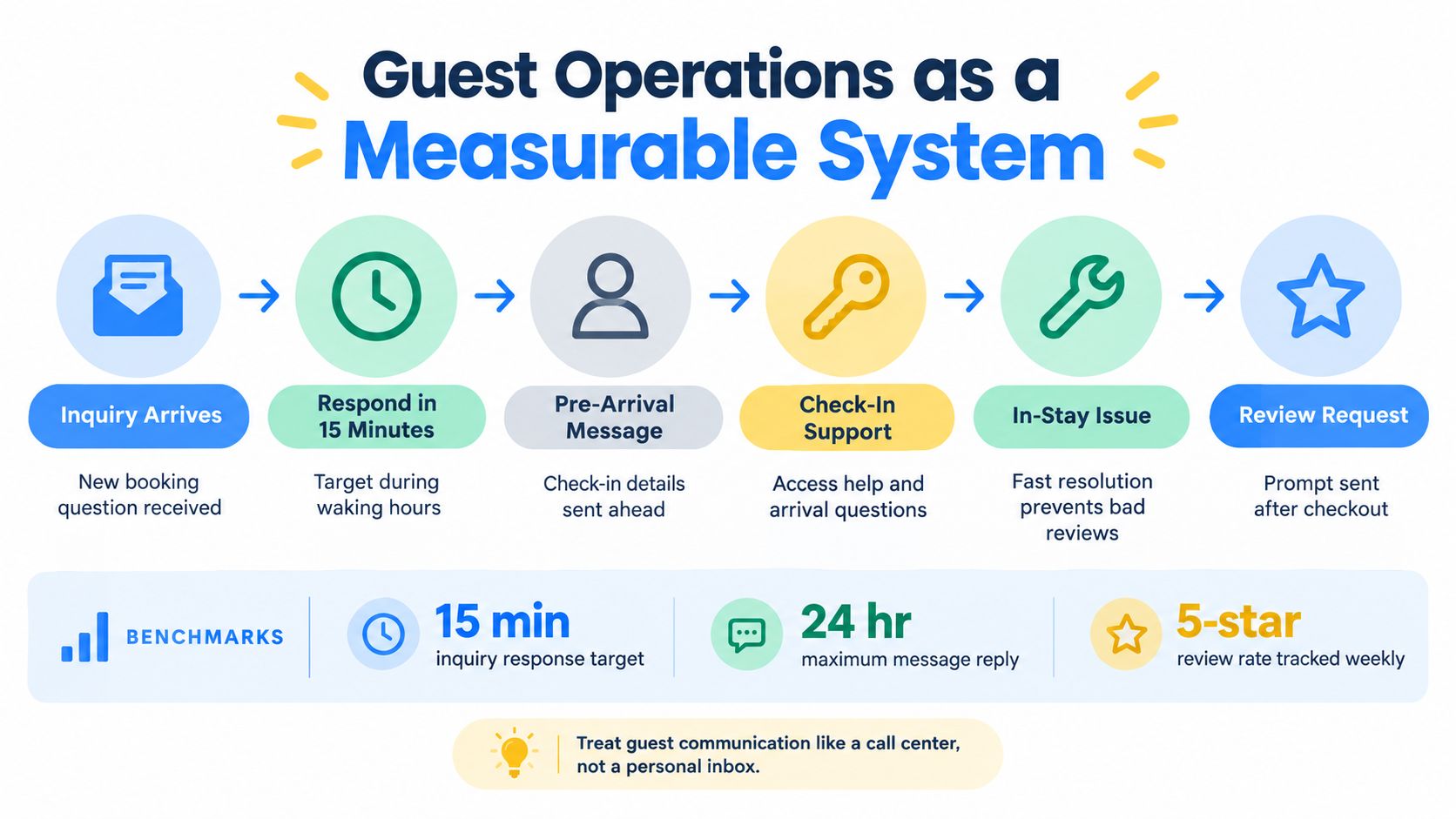
Guest communication shouldn't live in your personal inbox. Run it like a service desk.
Published benchmarks show average response times as low as 8 minutes for high-performing operators, versus 17 minutes and even 193 minutes in weaker cohorts. That gap affects inquiry conversion, response-rate metrics, and booking-platform ranking behavior. Operators increasingly target sub-30-minute inquiry handling and sub-10-minute acknowledgement for in-stay issues (Guesty response-time benchmarks).
Build the message flow before you need it
If you're typing the same answer over and over, your system is broken. Set up templates for:
- Inquiry replies: Fast answers on dates, parking, pets, and sleeping setup
- Pre-arrival instructions: Access codes, arrival timing, Wi-Fi, and rules
- In-stay troubleshooting: Noise, HVAC, appliance, or access problems
- Post-stay follow-up: Review request and repeat-booking invitation
This is also where your local service standards show up. A polished turnover is part of guest operations, not just housekeeping. Owners looking to formalize that side of the stack can study how teams structure professional turnover cleaning by Clean Space SA for handoff consistency.
Put automation on routine work
Tools like Guesty, Hospitable, and OwnerRez are useful because they remove lag from repetitive communication. The goal isn't to automate hospitality. It's to automate the predictable parts so humans can handle the exceptions well.
For amenity planning, guest expectations, and what cuts support messages, this guide to vacation rental amenities is a good operational complement.
A short walkthrough helps if you're redesigning guest messaging and support workflows:
Use service levels you can actually manage
I like simple internal targets:
| Service Moment | Operating Target | Why It Matters |
|---|---|---|
| Inquiry response | Within minutes, not hours | Protects conversion while the guest is still shopping |
| Pre-arrival instructions | Sent early enough to reduce panic messages | Cuts avoidable support load |
| In-stay issue acknowledgement | Immediate confirmation, then action path | Keeps a small problem from becoming a public review |
| Post-stay follow-up | Prompt and consistent | Increases review capture and repeat intent |
Fast guest communication isn't a hospitality flourish. It's a revenue control system.
Compliance, Licensing, and Data Reporting
Most owners still underestimate compliance because they remember when short-term rental rules were loose and mostly local. That era is gone.
Vacation home rental management is now a compliance-and-data-operations problem. Recent rules in the EU, effective May 2026, require platforms to transmit monthly activity data per listing. Major U.S. markets such as California and South Lake Tahoe require detailed registration, address disclosure, annual permits, local managers, and in-person or virtual check-ins. Some cities also cap permits and require 24/7 response capability (short-term rental regulations overview).
The risky assumption owners still make
Owners think compliance is something they can "sort out later" once bookings start coming in. That's backward. If your permit status, tax setup, local contact rules, or reporting obligations are wrong, every booking after that compounds the problem.
This is especially painful for multi-unit operators. Once you manage homes across city or state lines, the rules diverge fast.
What your operating file should contain
You need a live compliance register for every unit. At minimum, keep these fields current:
- Permit status: Application date, approval date, renewal deadline, display requirements
- Tax setup: Which taxes are collected by the platform, which remain your responsibility
- Local response requirement: Whether a local manager or contact must be available
- Guest reporting rules: What data must be transmitted, stored, or produced on demand
- Building and zoning restrictions: HOA, condo board, neighborhood, or municipal limitations
| Compliance and Licensing by Jurisdiction | ||
|---|---|---|
| Jurisdiction | Permit/License Requirement | Data Reporting Obligation |
| EU markets under the 2026 rule set | Operators and platforms may face registration and listing-linked compliance requirements | Monthly activity data per listing must be transmitted by platforms |
| California markets | Registration is required in many markets before listing, with local rule variations | Operators may need to maintain detailed records tied to local enforcement |
| South Lake Tahoe | Detailed permit and local manager requirements apply | Reporting and operational-response requirements are more explicit than many owners expect |
| Dubai | A licensed Holiday Home Operator is required if managing on behalf of others or owning more than eight units (fee and regulation summary) | Reporting obligations follow local operator licensing frameworks |
Skip none of this
A permit register, tax workflow, and audit trail for guest-data handling aren't "nice to have." They're the operating spine.
Owners who ignore compliance don't stay independent for long. They either get forced out, forced into a manager, or forced into cleanup work that costs more than doing it right the first time.
Timeshare Liquidity and the V.O.I.C.E. Alternative
Traditional timeshare exchange systems are expensive partly because they charge in layers. Owners don't just pay one access cost. They pay membership, then exchange fees, then guest certificate fees, and often other trip-specific charges around the swap.
One 2026 pricing breakdown listed RCI Weeks membership at $109 for 1 year, $199 for 2 years, $279 for 3 years, $439 for 5 years, and $768 for 10 years, with a week-long reservation exchange fee of $299 and exchange-plus tiers ranging from $399 to $1,599 depending on level (RCI fee schedule breakdown). A separate 2026 breakdown cited annual RCI membership at $99-$149, exchange fees of $199-$299, and guest certificate fees of $59-$99, putting a single exchange at roughly $400-$900+ before travel expenses (timeshare exchange cost stack).
Why the old exchange model frustrates owners
The issue isn't only cost. It's fragmentation. Every transaction can create another fee event, another constraint, or another usage rule. That makes week-by-week planning clumsy for owners who need flexibility.
| Timeshare Exchange Costs vs. V.O.I.C.E. Deposit Economics | ||
|---|---|---|
| Cost / Outcome | RCI / Interval International (Typical Swap) | V.O.I.C.E. Consolidated Deposit |
| Access structure | Membership plus transaction-based exchange mechanics | Single deposit framework for eligible weeks |
| Fee experience | Stacked charges such as membership, exchange, and guest certificate costs | Owners avoid the same per-transaction exchange friction inside the deposit model |
| Liquidity | Value is tied to exchange availability and fee tolerance | Deposited value becomes more flexible operational inventory |
| Use case | Traditional week swap | Deposit, exchange at no fee, or list through the peer-to-peer marketplace |
If you're weighing broader exit or flexibility paths, this review of timeshare alternatives is a useful place to compare structures.
Why V.O.I.C.E. matters operationally
V.O.I.C.E. changes the shape of the problem. Instead of treating an unused week as a trapped obligation, it treats it like inventory that can be deposited and re-used inside a more flexible system. Owners can deposit up to 5 weeks per year. That matters if you're trying to smooth family travel planning, unused ownership, or seasonal mismatch without constantly triggering another fee event.
For anyone managing travel assets, that's the key distinction. Cleaner liquidity beats stacked exchange friction.
Scaling Through Consolidated Travel Infrastructure
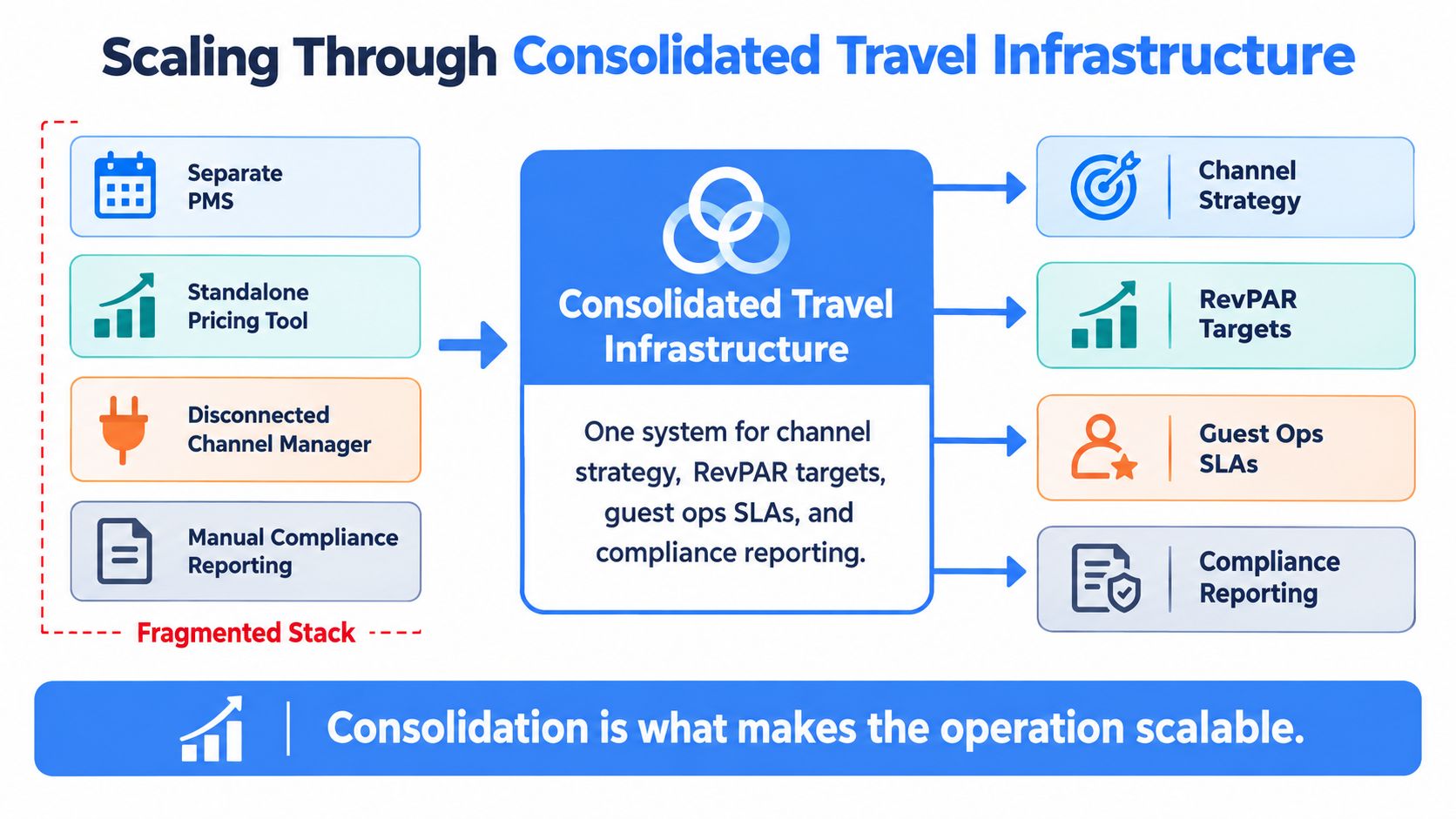
It usually breaks the same way. A property manager adds units faster than the operating stack matures, then ends up running reservations in one system, guest messaging in another, owner reporting in spreadsheets, and compliance records wherever they fit. Revenue leaks long before occupancy drops.
Scaling vacation home rental management is an operations problem first. If your inventory, rules, reporting, and traveler access sit in separate tools, you are not building a portfolio. You are stitching together manual work.
What consolidation fixes
A consolidated travel layer solves four scale problems.
- Inventory stops behaving like isolated supply: Homes, hotel stays, cruises, flights, cars, and alternative travel products can sit inside one operating environment instead of separate booking silos.
- Rules become portable: Rate logic, stay controls, traveler policies, and owner use standards are easier to apply consistently when teams are not re-entering decisions across disconnected systems.
- Portfolio reporting gets sharper: You can track which units, traveler segments, and booking paths produce margin, and which ones create service load without enough return.
- Unused value becomes operational inventory: Travel credits, ownership deposits, and mixed-use demand are easier to manage when they live inside one bookable system.
That shift matters because vacation home rental management is not just listing distribution and turnovers. It is licensing, tax handling, audit trails, reservation controls, traveler servicing, and capital allocation across a portfolio. Consolidation supports all of it.
Approved Traveler is one example of that broader infrastructure model. It combines access to hotels, airlines, cruises, car rentals, vacation homes, tour packages, and activities in one platform, with Reward Credits attached to bookings and a 110% Best Value Guarantee. For owners and family travel coordinators handling mixed trip types, that setup is more useful than juggling separate memberships, exchange accounts, and one-off booking logins.
The wholesale layer is the scale layer
Wholesale infrastructure is what lets fragmented travel inventory function like one system. That is the part many operators miss.
Once inventory is aggregated at the infrastructure level, the management task changes. You stop treating every reservation source, ownership type, and travel category as a separate workflow. You can standardize controls, centralize reporting, and make cleaner decisions about margin, owner value, and guest use across the full book of business.
That matters if your portfolio serves different demand patterns across the year. A family may need a large vacation home in summer, a shorter hotel stay in fall, and a way to repurpose unused timeshare value later. Separate booking paths make that messy. Consolidated infrastructure makes it manageable.
Consolidation turns fragmented travel products into an operating system.
The operators who scale well are not the ones with the most apps or the most channel logins. They are the ones who control inventory through one scalable layer, tie compliance and reporting to that layer, and measure every decision against net revenue.
If you're trying to simplify how you source and manage vacation-home stays across a portfolio or a family travel calendar, Approved Experiences Traveler is built as travel infrastructure, not a patchwork of separate memberships. It gives you consolidated access to vacation homes, hotels, cruises, flights, cars, and activities in one system, plus Reward Credits and V.O.I.C.E. for timeshare flexibility, which fits exactly where modern vacation home rental management is heading.
Want the wider view?
Ten categories. One report. Every quarter. The Approved List tracks what's rising and what's fading: data-backed signals, not opinions.
Free to join · Delivered by email