All Articles
The Journal
No Long Term Contracts: Reclaiming Time and ROI
September 29, 202612 min readflexible subscriptionstime management
Discover how no long term contracts save time and money. Learn to evaluate flexible services and see how Approved Lux reclaims hours for busy professionals.

An independent survey found that adults spend 21 hours and 36 minutes each week on job-related administration, plus 8 hours and 48 minutes on personal administration. That's more than a full working week consumed by coordination, follow-ups, scheduling, and paperwork, before the work that creates revenue or family time begins. The survey data makes the operational case for flexible support far more clearly than any promise about convenience.
“No long term contracts” shouldn't be treated as a cancellation-rights slogan. It's a procurement decision. For a founder, executive, independent professional, or dual-career parent, the key question is whether a service can remove recurring administrative work quickly enough to justify its cost, without trapping the buyer when priorities change.
Understanding the Shift Away from Long-Term Lock-Ins
Contract activity is already routine. A 2025 Adobe survey found that 73% of U.S. consumers, 68% of knowledge workers, and 91% of SMB owners work with contracts at least monthly. Adobe's contract survey shows that agreements are part of ordinary operating life, not an occasional legal event.
That frequency changes what buyers expect. People are used to starting, reviewing, renewing, and ending recurring services in shorter cycles. They want the ability to test operational fit, adjust capacity, and leave when the service stops earning its place in the budget. A multi-year commitment may still make sense for infrastructure that requires major installation or financing, but it's a poor default for services whose value should be demonstrated through ongoing responsiveness.
This is why flexible monthly agreements have moved from a niche positioning tactic to a mainstream commercial advantage. A service provider that needs a long lock-in to retain customers is asking the buyer to finance uncertainty. A provider that competes on performance has to keep earning renewal through useful work, fast response, and clear accountability.
Practical rule: Treat contract length as a risk variable, not a discount.
The broader policy direction reinforces this commercial shift. The federal Negative Option Rule dates to 1973, and later U.S. measures, including ROSCA in 2009 and California's automatic renewal law in 2010, pushed providers toward clearer disclosure, explicit consent, and easier cancellation. California later added reminder requirements for subscriptions with a term of one year or more, or free trials longer than 31 days, making longer commitments a more sensitive category for providers.
The operational implication is straightforward. Buyers increasingly expect monthly relationships and rapid opt-out options, especially when purchasing administrative support. If the value is ongoing coordination, not ownership of a physical asset, flexibility should be part of the service design.
For a deeper look at recurring-service economics, see this analysis of subscription model advantages. The useful distinction is between a subscription that creates continuing value and one that merely spreads a purchase over monthly payments.
Calculating the Hidden Costs of Contractual Inertia
The lower monthly price on a long-term plan can be real and still be misleading. The relevant figure is the effective cost after exit risk, not the advertised rate on the first page.
New America's U.S. broadband analysis found a median contract length of 12 months and an average early-termination fee of $162.76. Plans with long-term contracts carried a higher average termination fee of $195.84. The underlying wireless and broadband analysis demonstrates how providers use exit penalties to suppress switching.
That mechanism matters outside telecommunications. A vendor can offer a lower headline price because the contract reduces the chance that an unhappy customer will leave. The buyer then carries the cost of a poor fit, delayed replacement, internal retraining, and the mental burden of repeatedly defending a service that no longer works.
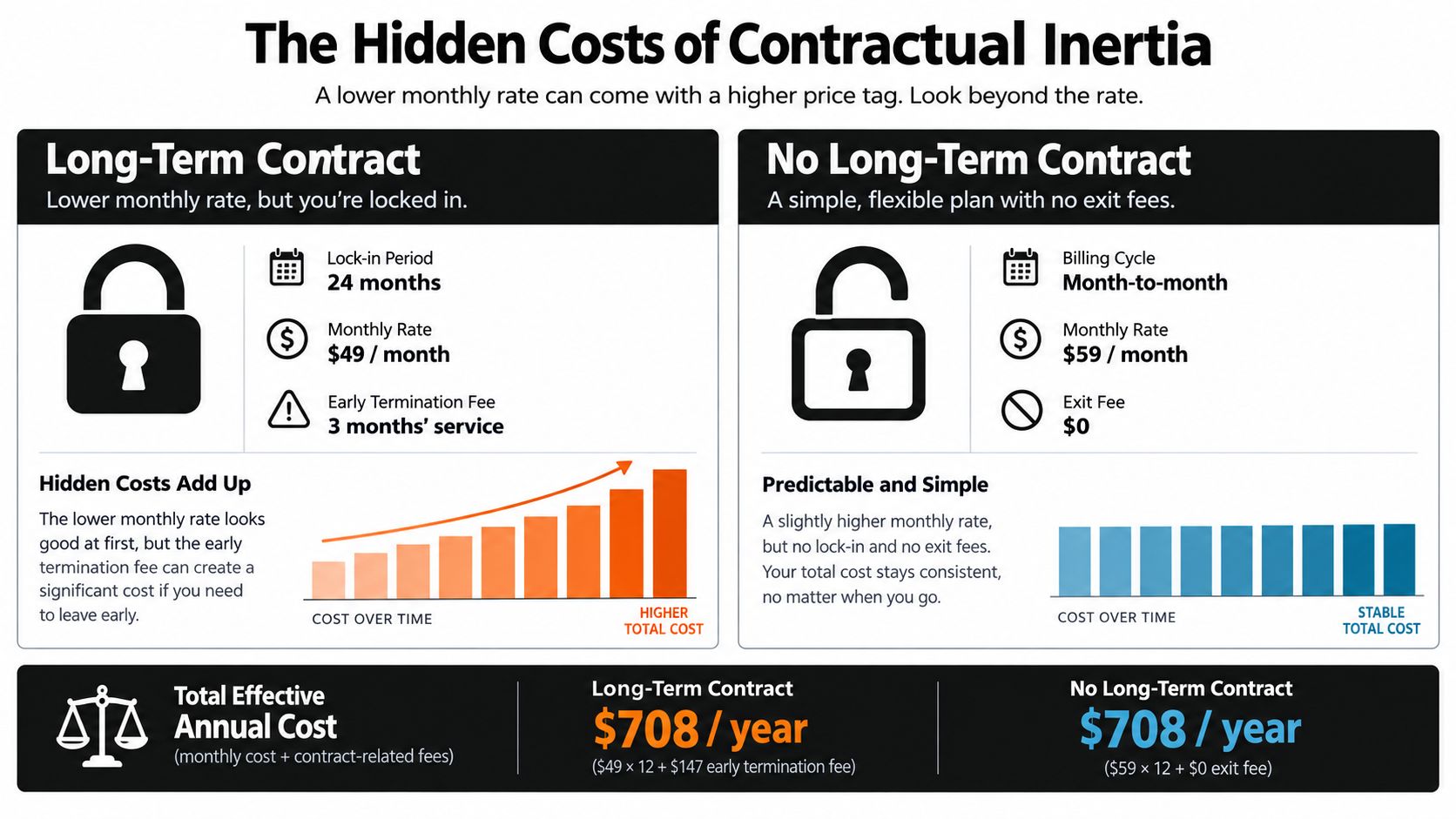
Use this calculation before accepting a commitment:
- Add the exit cost. Include early-termination fees, prepaid amounts, hardware obligations, and any notice-period charges.
- Estimate switching labor. Count the hours required to migrate data, retrain users, explain preferences, and rebuild workflows.
- Price the delay. Ask what happens if the service underperforms for several billing cycles while you wait for an exit window.
- Compare flexibility-adjusted cost. A slightly higher monthly price may be cheaper if it lets you reallocate spend immediately.
A useful comparison is the server scheduler cloud cost guide, because total cost analysis should include more than the visible monthly line item. The same discipline applies to personal and executive support. A low rate that forces you to absorb coordination failures isn't low cost.
The strongest argument for monthly terms is that flexibility preserves judgment. You can keep a service because it works, not because leaving is expensive. That distinction protects cash flow when hiring plans, family schedules, travel demands, or workload volumes change.
Evaluating Flexible Services Beyond the Hype
A monthly billing cycle doesn't automatically mean a flexible service. Some providers remove the annual contract but keep friction elsewhere through vague scopes, difficult cancellation procedures, setup charges, or slow response times. Evaluate the operating model, not just the billing interval.
Recent retention data points to the actual failure modes. An analysis of nearly three million cancellation sessions in 2025 found that budget limitations were cited 33% of the time, while infrequent usage was cited 31% of the time. The State of Retention 2025 report makes the buying test clear. A service must become useful enough, quickly enough, that the customer sees it as operating infrastructure rather than optional spend.
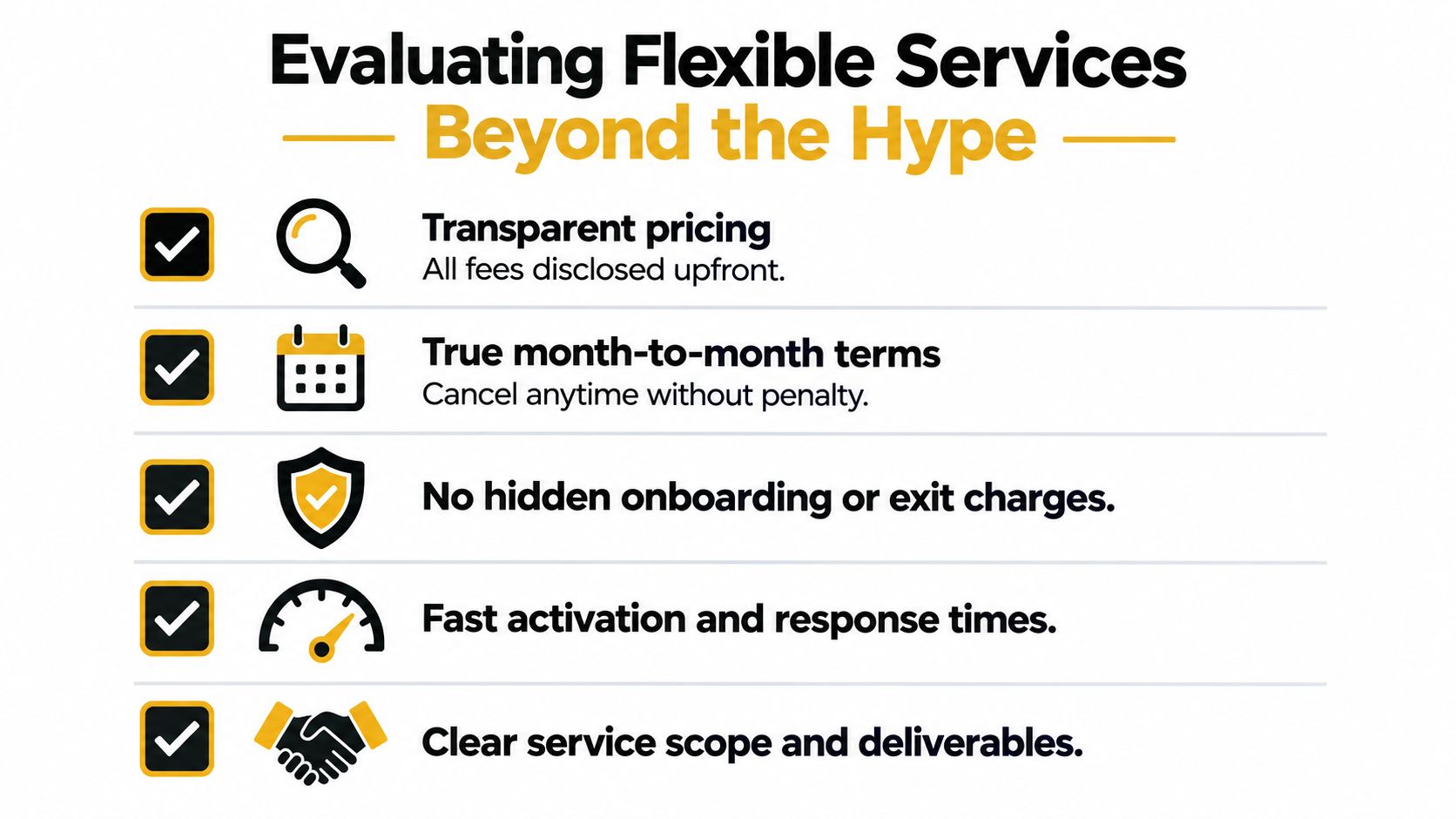
Ask providers five questions before subscribing:
- What happens during onboarding? A serious service should capture preferences, access standards, recurring obligations, and communication rules early. If the provider expects you to repeat the same context every time, the monthly fee buys activity, not efficiency.
- How does cancellation work? Confirm the notice requirement, final billing date, unused service treatment, and any exit charges in writing. “Cancel anytime” is incomplete unless the mechanics are simple.
- How fast does value appear? Identify the first tasks that can be delegated immediately. Inbox triage, appointment scheduling, travel changes, vendor research, and follow-ups are useful starting points because their completion is visible.
- Does service quality compound? The team should learn how you make decisions, which vendors you trust, and what requires approval. That accumulated context reduces future explanation.
- What does the service handle? Demand a clear scope. Vague promises create mismatched expectations and make low usage inevitable.
For practical questions to raise with any recurring household provider, these Dublin cleaning contract tips offer a useful reminder to inspect scope, cancellation language, and additional charges before signing.
Pricing also needs to be judged against the work being removed. A virtual assistant pricing guide can help frame the comparison, but don't stop at an hourly equivalent. Human judgment, response availability, retained preferences, and the number of decisions removed from your queue all affect operational value.
The correct test is not, “Can I cancel?” It's, “What recurring burden disappears before the next renewal?” If the answer is unclear, the subscription is probably discretionary.
Calculating the ROI of Delegated Administration
Administrative work creates two costs. The first is the time required to complete each task. The second is the interruption cost when a task breaks concentration, delays a decision, or leaves an unresolved obligation competing for attention.
The survey cited in the introduction recorded 21 hours and 36 minutes of job-related administration and 8 hours and 48 minutes of personal administration each week. Those figures are large enough to justify measurement, not vague complaints. Start by separating the time spent doing the work from the capacity lost when it interrupts higher-value responsibilities.
| Admin Category | Average Weekly Hours | Annualized Time Lost | Delegation Impact |
|---|---|---|---|
| Job-related administration | 21 hours 36 minutes | More than 1,100 hours | Recovers focus for revenue, leadership, and client work |
| Personal administration | 8 hours 48 minutes | More than 450 hours | Reduces household coordination and decision fatigue |
| Combined administration | 30 hours 24 minutes | More than 1,500 hours | Creates a measurable pool of work for delegation |
The annualized figures use the survey's weekly times. They do not imply that every task should be handed off. They show the size of the pool, so you can identify recurring work that consumes attention without requiring your personal judgment.
Measure reclaimed capacity, not activity
Set a baseline for one working week. Record scheduling, email sorting, appointment research, travel changes, vendor calls, household follow-ups, and document preparation. Track both completion time and the number of interruptions, reminders, or decisions each task creates.
Then place the work into three groups:
- Delegate immediately: Tasks with a clear outcome, such as arranging a meeting or comparing service providers.
- Delegate with approval: Tasks that require your preference, spending limit, or final confirmation.
- Keep personally: Decisions that depend on leadership authority, sensitive judgment, or professional responsibility.
The ROI calculation is direct: hours reclaimed multiplied by the value of those hours, minus the subscription cost. Value may come from billable capacity, avoided overtime, protected executive focus, or time returned to family. A defensible baseline is more useful than a perfect financial model that takes weeks to build. These ROI calculation methods can help structure the calculation.
For a founder, the return may come from preserving an uninterrupted morning for product or sales work instead of resolving travel, calendar, and vendor issues. For a dual-career household, the return may come from removing the repeated mental scan of school forms, pediatric appointments, home repairs, and family deadlines.
Administrative delegation must account for coordination and mental labor, not only visible task completion. A 2023 systematic literature review found substantial invisible planning work among dual-earner parents. Some studies reported wives and husbands each spending roughly two to three hours per week on mental labor, while other research found mothers devoted about one-fourth of their time to it compared with one-fifth for fathers. The review also discussed a gender gap of about 10 hours per week in parental multitasking. The review and its discussion of executive support reinforces the operational point: delegation should remove coordination from your queue, not merely transfer individual errands.
Run a short operating test. Compare hours reclaimed, follow-ups eliminated, interruptions reduced, and decisions no longer occupying your working memory. If the subscription does not improve those measures, change the scope or stop using it.
How Approved Lux Delivers Flexible Operational Capacity
Approved Lux applies the no long term contracts model to administrative capacity. It provides a monthly subscription with 24/7/365 access to a U.S.-based Assistant team, reachable by phone call, SMS text, or email. Each channel has equal priority, so users can choose the fastest way to handle the request instead of waiting in a ticket queue.
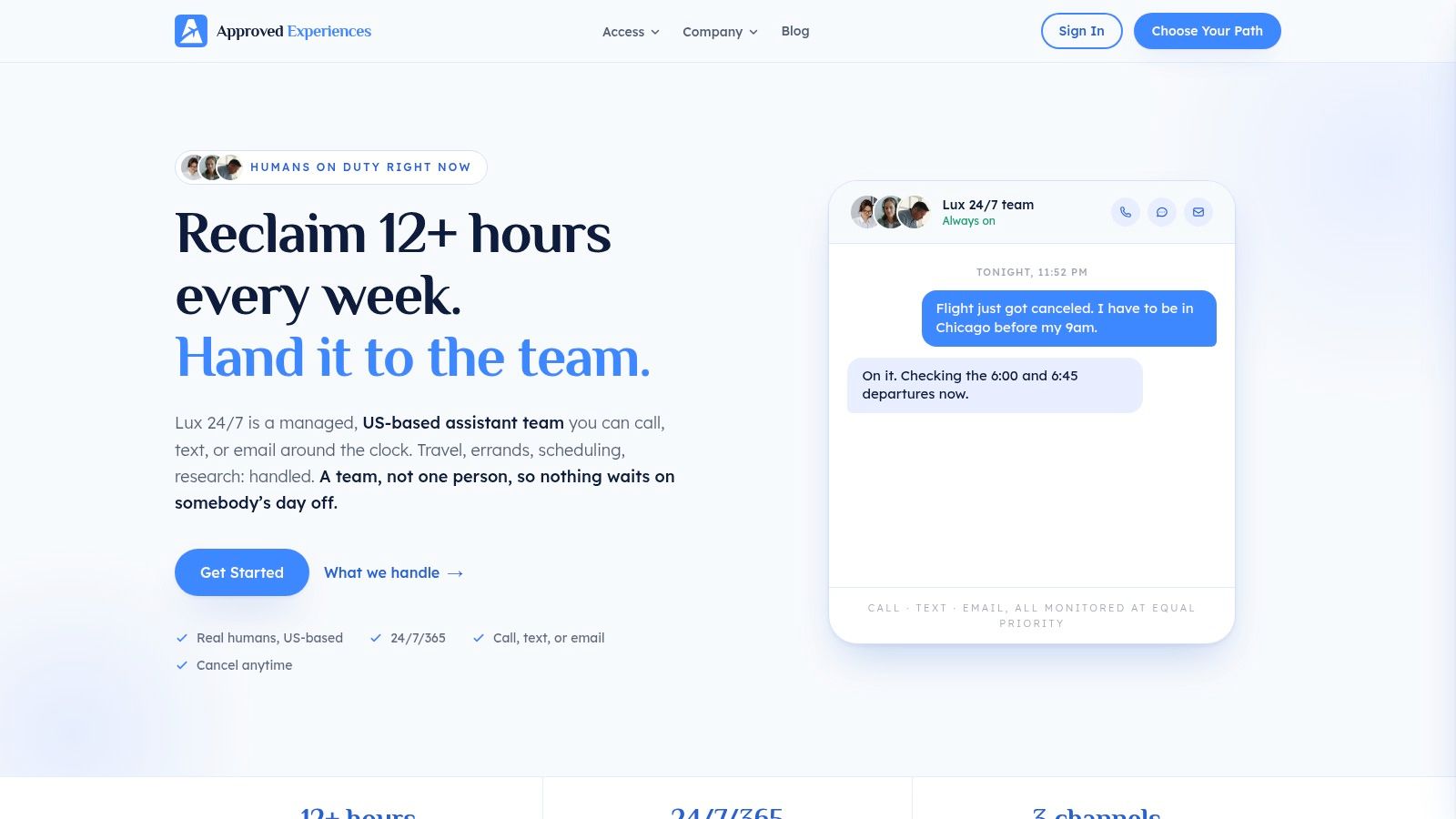
The model is built for interruptions. A flight problem may require a call, while a scheduling change may be faster by text. Documents and itineraries can stay in email. Triple-channel access matches the support method to the work, reducing delays when priorities change.
Approved Lux handles travel and logistics, scheduling, personal errands, research and recommendations, and professional support. Typical requests include building an itinerary, resolving calendar conflicts, sourcing a gift, arranging home services, drafting an email, preparing meeting materials, tracking expenses, and vetting vendors.
The first hire without overhead
A direct hire creates a management obligation beyond salary. U.S. Bureau of Labor Statistics-based salary data places executive assistant compensation at about $76,590 in median annual wages, while employer-paid benefits add about 29.4% to total compensation in private industry. The compensation analysis illustrates why payroll, benefits, equipment, and management time can make internal hiring a substantial operating commitment.
Approved Lux does not replace every executive assistant role. It adds recurring administrative capacity before a full internal hire makes sense. The practical position is first hire without overhead, with a clear focus on work that would otherwise consume the principal's time.
Human judgment remains part of the service. The Assistant team can interpret requests, compare options, follow constraints, and escalate decisions that require approval. U.S.-based accountability helps when a task depends on context, discretion, or a rapidly changing situation. Delegation decisions differ by function. A company comparing distributed technical staffing, such as hiring developers from Brazil, can apply the same flexibility-first test, while administrative support addresses coordination and execution work.
The service also uses Proactive Preference Learning. Onboarding captures preferences and access standards, then the Assistant team adapts to established routines. The no-contract structure limits commitment risk, while retained context makes repeated requests more efficient instead of restarting from zero.
Review the operating model before judging the service by its subscription label.
Matching the Right Plan to Your Operational Bottlenecks
Choose the plan according to who carries the coordination burden and how often that work interrupts higher-value responsibilities. Lux Solo supports one person's operating capacity. Lux Circle covers up to four people on one account, making it the practical choice when household or family logistics create the bottleneck.
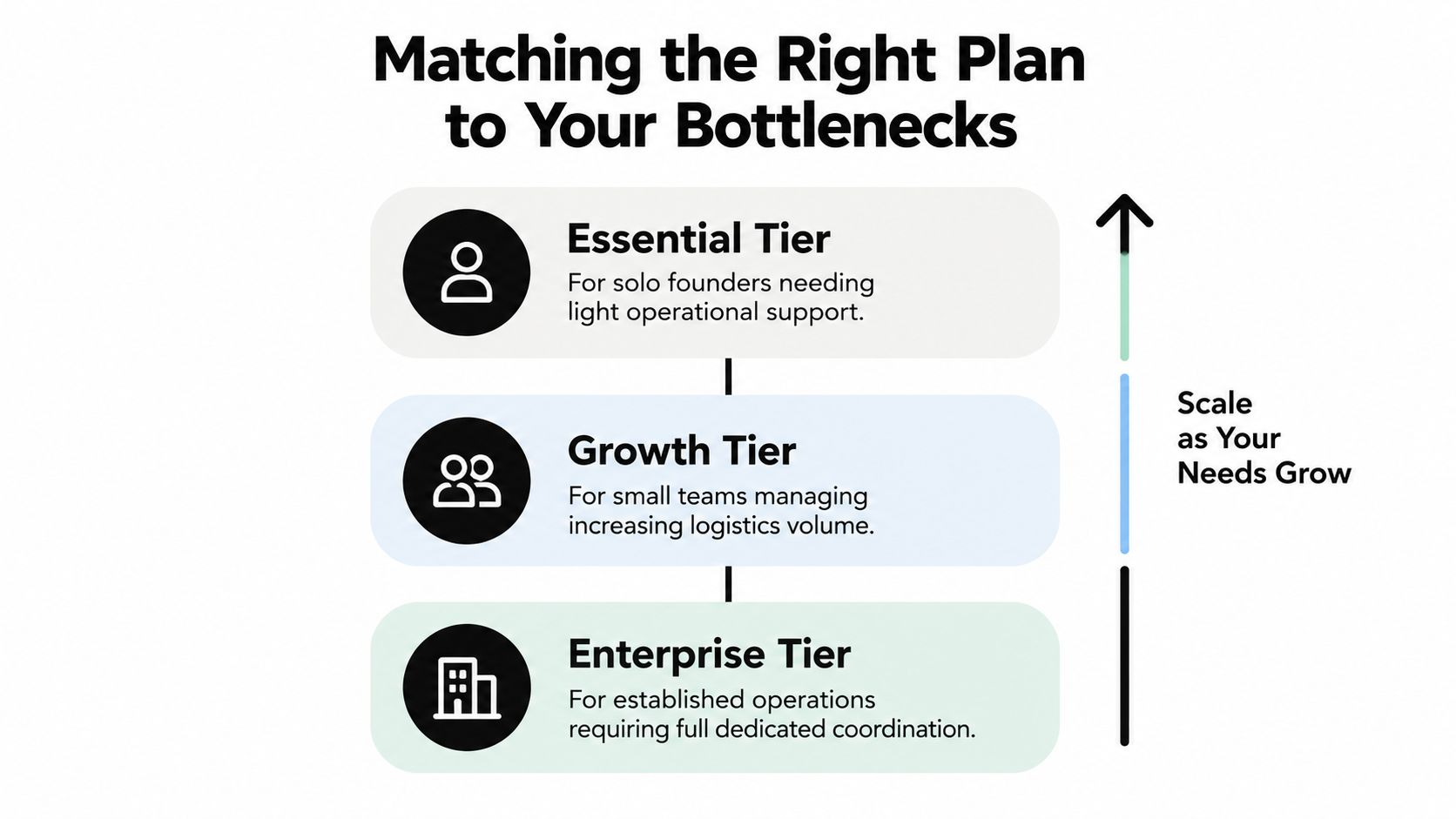
Lux Solo for individual capacity
Lux Solo fits a founder who loses working time to inbox triage, scheduling, travel changes, meeting preparation, and vendor follow-ups. It also suits independent professionals whose client-facing hours are repeatedly interrupted by routine administration.
A frequent business traveler can delegate flight disruptions, hotel changes, ground transportation, restaurant research, and itinerary adjustments outside normal office hours. A creator can transfer sponsor coordination, appearance travel, and business logistics out of the creative workflow. The operating rule is simple: assign recurring work with a defined outcome when the principal's personal execution adds no value.
Lux Circle for the second shift
Lux Circle fits dual-career parents, sandwich-generation caregivers, and households managing several schedules. With coverage for up to four people, it places coordination with the Assistant team instead of leaving one family member to maintain every deadline and follow-up.
Typical handoffs include school enrollment, pediatric scheduling, camp registration, household maintenance, elder-care appointments, vendor follow-ups, and family travel. Sensitive decisions remain with the household. The service removes the repeated searching, scheduling, reminding, and chasing that turns family administration into a second shift.
For households, the mental-labor research covered earlier translates into a workload-allocation decision: move coordination to a shared operational layer instead of allowing one parent to absorb it invisibly. The plan earns its place when it reduces recurring cognitive load and keeps responsibilities visible across the household.
When travel changes the buying decision
If travel support is the primary need, compare a standalone plan with the bundled Lux Traveler option. Approved Lux is bundled into Lux Traveler at $1,799 per year, while separate purchase of Lux Circle and Traveler totals $4,487 per year, based on the stated plan prices. Someone who needs both administrative support and travel benefits should compare those structures directly.
Do not choose a higher tier because its feature list sounds complete. Choose the structure that matches the number of people involved, the frequency of coordination, and the cost of keeping the work in your own queue.
Making the Transition to Month-to-Month Infrastructure
Start with the work already causing friction. A founder can hand off the next week of calendar conflicts, travel planning, inbox triage, and vendor research. A family can begin with school deadlines, pediatric scheduling, home-service follow-ups, and the appointments currently sitting in one parent's memory.
During onboarding, document decision boundaries. State preferred vendors, budget limits, communication preferences, approval requirements, travel habits, and the situations that require an immediate call. Clear inputs reduce back-and-forth and accelerate time to value.
Then measure the handoff. Track the tasks completed, hours reclaimed, follow-ups removed, and interruptions avoided. If the first wave of work produces no visible reduction in administrative noise, change the task mix or reassess the provider. A flexible subscription earns its place through observed operating improvement.
The strongest transition isn't a dramatic lifestyle overhaul. It's a controlled transfer of repetitive coordination. Within the first operating cycle, the user should know which work can leave their queue permanently, which decisions still require personal involvement, and whether the service is compounding in usefulness through Proactive Preference Learning.
That's the standard for no long term contracts. Flexibility lowers the cost of testing, but fast operational value is what earns retention.
Approved Lux Personal Assistant provides monthly access to a U.S.-based Assistant team for travel, scheduling, household logistics, research, and professional support through Triple-channel access. If you want to test whether delegated coordination can reclaim focus without a long commitment, visit Approved Lux Personal Assistant and start with the administrative work currently consuming your next working block.
Want the wider view?
Ten categories. One report. Every quarter. The Approved List tracks what's rising and what's fading: data-backed signals, not opinions.
Free to join · Delivered by email