All Articles
The Journal
Setting the Bar High Without Burning Out
September 27, 202613 min readhigh standardsdelegate admin
Learn what setting the bar high actually requires — from defining clear standards to delegating the admin load that keeps high performers stuck.

The popular advice about setting the bar high is incomplete. High standards don't require you to answer every email, arrange every meeting, book every flight, and remember every household deadline personally. They require a system that protects important work from low-value coordination.
That distinction matters because overloaded professionals rarely fail from a lack of ambition. They stall because excellence gets buried under operational noise. The answer isn't more willpower or longer days. It's to define the standard clearly, move repeatable execution into reliable workflows, and keep personal judgment focused where it creates the most value.
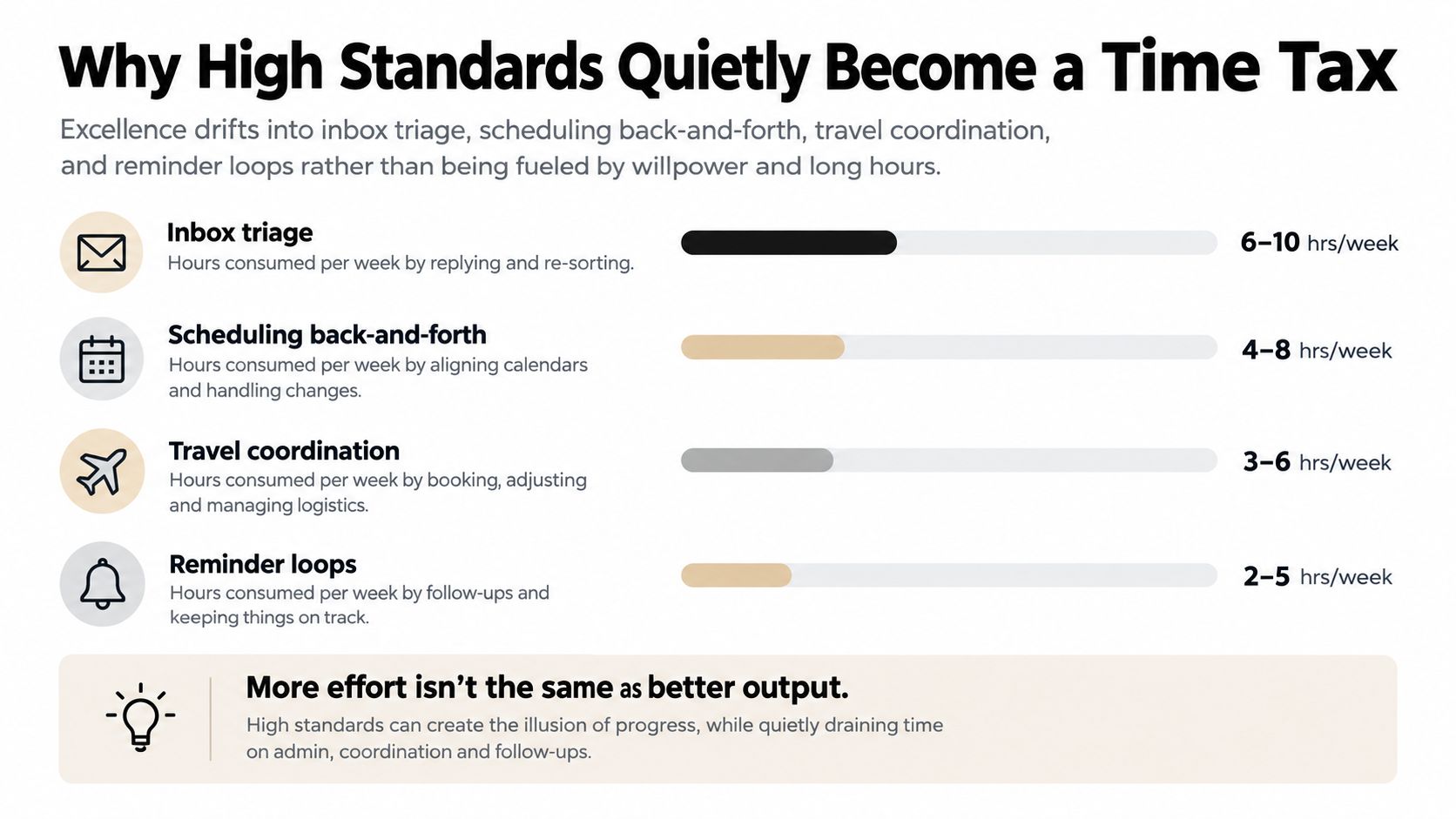
Why High Standards Quietly Become a Time Tax
High standards become expensive when the person who cares most about the outcome also owns every step beneath it. A founder may insist on polished client communication, disciplined travel, and a well-run calendar, then spend the week in inbox triage, scheduling back-and-forth, travel coordination, and reminder loops. The quality expectation hasn't changed. The operating system has failed to carry it.
American time-use data shows that people spend about 2 hours per day on household activities on an average day, with 81% engaging in tasks such as cooking, housework, lawn care, or household management (Bureau of Labor Statistics time-use data). Among adults living with children under 18, adults who weren't employed spent 3.1 hours per day on household activities, compared with 1.7 hours for employed adults. Women were also more likely than men to perform household work, 87% versus 75%, and spent more time on it when they did, 2.8 hours versus 2.1 hours (Bureau of Labor Statistics time-use data).
The hidden second shift
A working parent may lose several hours to recurring coordination without labeling it work. School messages, appointments, forms, household vendors, and calendar conflicts rarely arrive as one large project. They arrive as interruptions, and interruptions stretch the day.
A 2026 working-parent survey found that 70% of working parents perform parenting-related tasks while working, 59% perform work-related tasks while with their children, and 54% say balancing work and family responsibilities is difficult (Pew Research Center). The problem isn't merely the number of tasks. It's the repeated switching between roles.
Operational rule: If a task can be described as “remember, coordinate, confirm, and follow up,” it probably shouldn't depend on the highest-value person's memory.
Administrative work creates the same drag at work. A neutral academic study found that adults spend about 1 hour per day on administrative tasks on average, with totals ranging from 0.5 to 1.5 hours per day depending on the sample and recall method (academic study of everyday administrative burdens). Bills, goods and services, and savings were among the most time-intensive domains, each taking roughly 9 to 16 minutes per day.
The bar didn't slip. The system did. Setting the bar high sustainably means removing the routine work that surrounds the standard, then reserving personal effort for judgment, relationships, and decisions that genuinely require you.
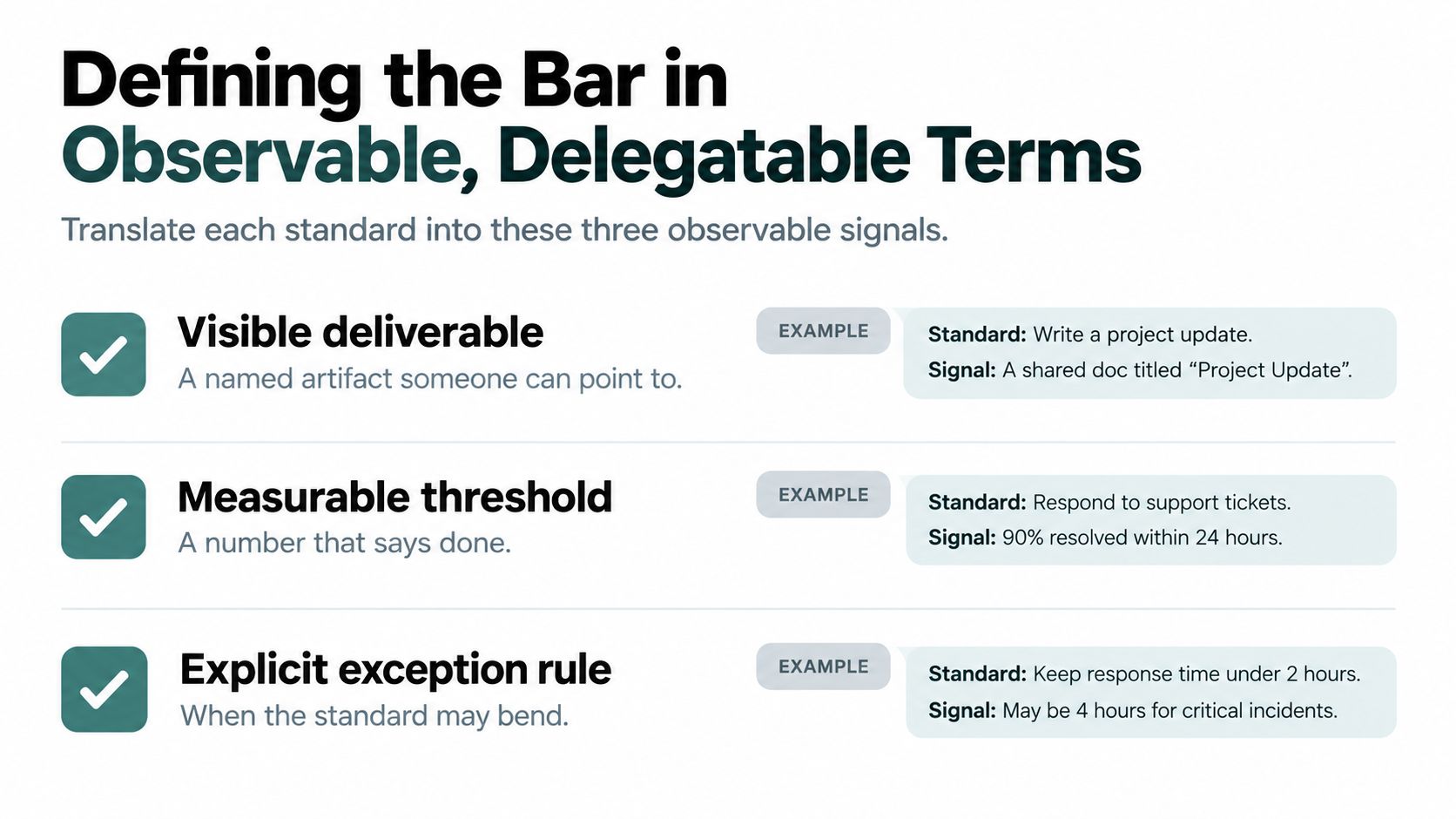
Defining the Bar in Observable, Delegatable Terms
A standard that lives only in your head can't be delegated. “Make it excellent” tells another person almost nothing. A useful standard has three parts: a visible deliverable, a measurable threshold, and an explicit exception rule.
Start with the artifact
Name what “done” produces. A clean kitchen is an observable result, but so is a sales call followed by a clear next-step email. A child's packed backpack and a client onboarding packet use the same logic. Each should exist in a recognizable state before the work is considered complete.
Then define the threshold. “The kitchen is ready for morning” might mean counters cleared, dishes loaded, and lunch supplies placed in the refrigerator. “The sales follow-up is complete” might mean the email states the agreed action, owner, and deadline.
Finally, define when the rule bends. A sick child, a changed client deadline, or a canceled flight may justify an exception. Without an exception rule, assistants either interrupt you constantly or make inconsistent judgment calls.
Use this checklist to test each standard:
- Visible deliverable: What named artifact or finished condition can someone point to?
- Measurable threshold: What tells the executor that the work is complete?
- Exception rule: Which situations allow the normal standard to change?
- Single-sentence test: Can the person executing the task explain the rule in one sentence?
- Handoff test: Could someone follow it without asking what you meant by “good”?
If the answer to the single-sentence test is no, the standard isn't defined yet. For service businesses, the same principle applies when documenting client-facing work. A resource on writing a cleaning service proposal is useful because a proposal becomes easier to delegate when its required sections, quality checks, and approval conditions are explicit.
A high standard becomes scalable when another person can recognize completion without borrowing your intuition.
Apply this approach to your top recurring tasks with effective task delegation. Don't document everything at once. Choose the work that repeatedly interrupts your highest-value responsibilities.
Translating Standards into Repeatable Workflows
High standards become expensive when they depend on your constant attention. Travel coordination exposes the problem quickly: scheduling, inbox triage, and vendor follow-up consume the hours your standards were meant to protect. Build the workflow so a capable person or system handles routine movement while you keep judgment for exceptions.
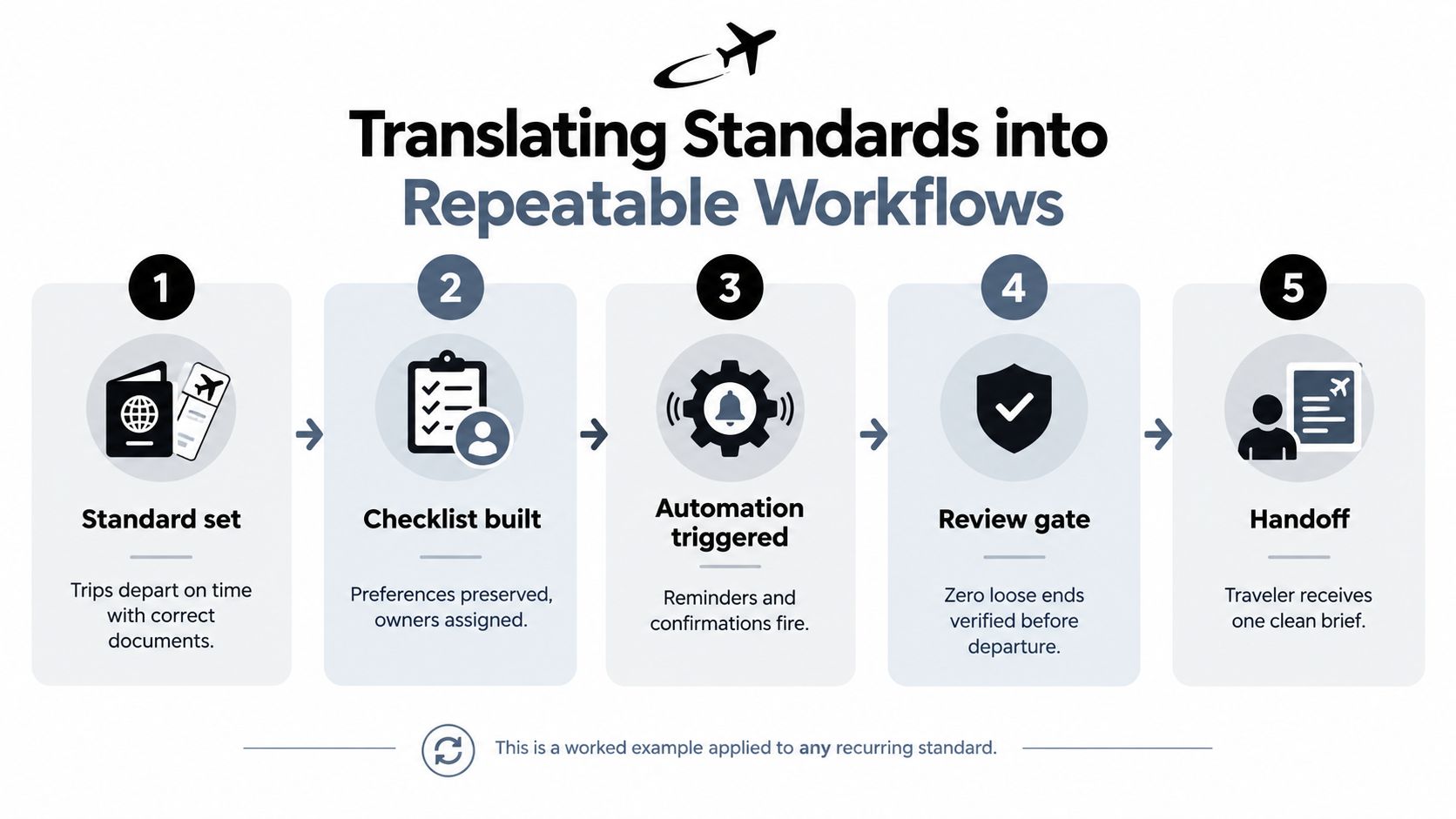
Use travel planning as a working model:
- Thirty days out, check documents. Confirm passport validity, entry documents, and traveler details. Record the result in the trip file and escalate uncertainty immediately.
- Fourteen days out, lock the itinerary. Confirm flights, hotels, ground transport, meeting locations, and preferences. Every segment needs a confirmation and a named owner.
- Seventy-two hours out, make confirmation calls. Verify changes with vendors and record the outcome. Unconfirmed items enter an exception queue instead of disappearing into email.
- Forty-eight hours out, trigger the packing list. Base it on destination, weather, meeting requirements, and preferences. Send one consolidated list.
- On departure day, assign one accountable owner. That person monitors timing, transport, and last-minute changes. The traveler receives a concise brief and one contact point.
The sequence protects quality by removing repeated personal checks. Automation can send reminders and route information. A capable owner still interprets exceptions and makes the call when the normal path no longer fits. For a practical explanation, see how workflow automation works.
Apply the same operating logic to a vendor renewal. Sixty days before a contract ends, the owner retrieves the agreement and records renewal terms. Forty-five days out, the finance lead checks spend and payment history. Thirty days out, the service owner reviews performance against agreed deliverables and records any unresolved issues. Twenty-one days out, the owner requests revised pricing and scope. Ten days out, the approver accepts the renewal, rejects it, or assigns a replacement search. The final review occurs five business days before expiry, leaving time to negotiate or transition.
For more reusable patterns, see this guide on workflow streamlining. Store the workflow in one accessible location and revise it after each exception. A checklist earns its place only when another person can run it and produce the expected result.
A Real Scenario Before and After the System
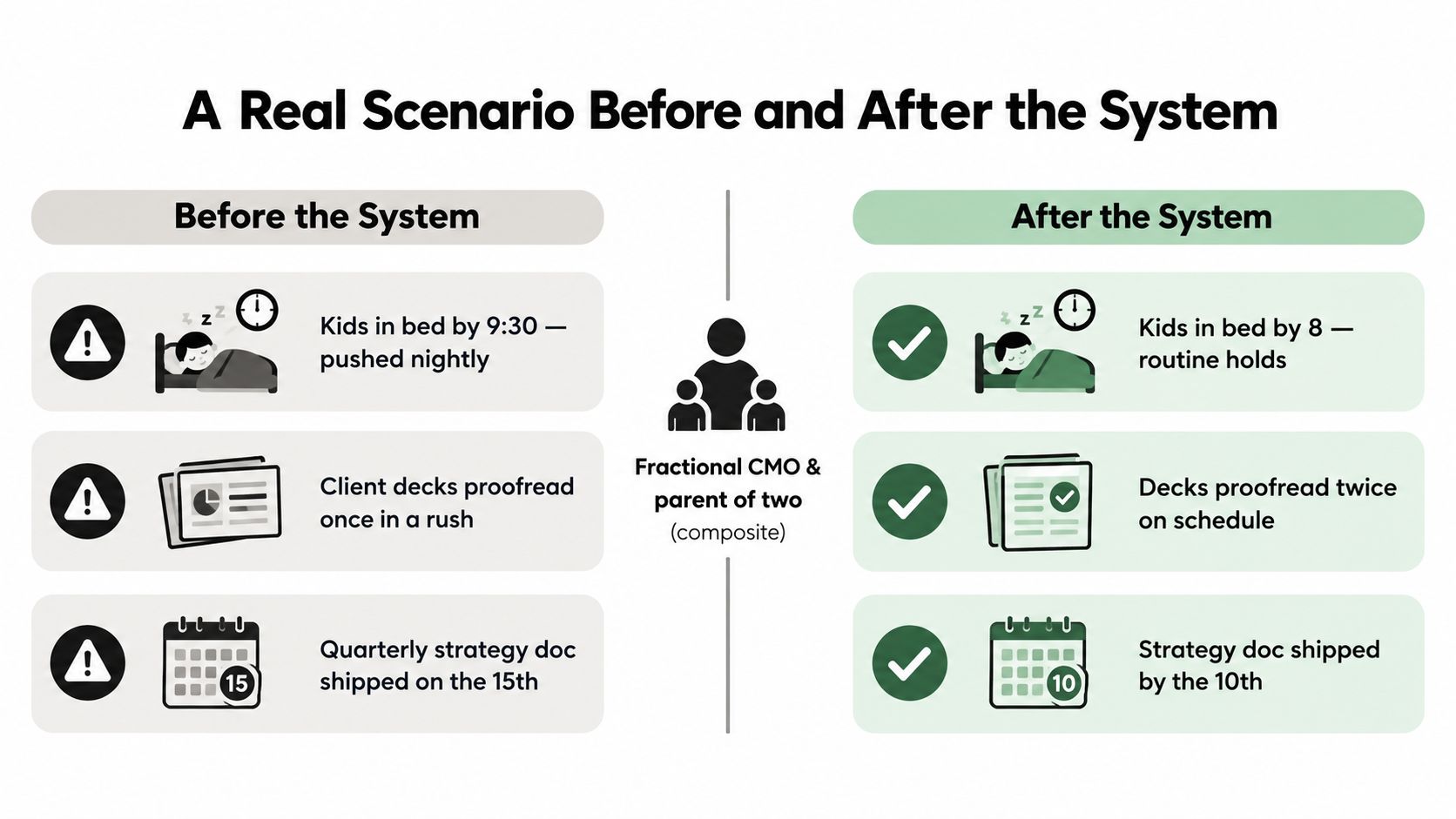
Consider a composite scenario involving a fractional CMO and parent of two. Her standards are clear: children in bed by 8, every client deck proofread twice, and the quarterly strategy document shipped by the 10th.
One Tuesday, the system collapses. School pickup conflicts with a board deck due Thursday. Two client emails are marked urgent, and a Friday flight still needs booking. She keeps every decision in her own head, so the day fills with 14 context switches, three reschedules, one missed school event, and a deck section with a typo the client catches.
The personal-effort version
She starts the morning by answering urgent messages, pauses for school logistics, returns to the deck, and then reopens the calendar after a pickup change. A flight search interrupts proofreading. Another reschedule pushes the strategy document into the evening.
The problem isn't poor discipline. She is performing work that needs ownership, but not necessarily her personal involvement. Her standards have become promises she must repeatedly rescue.
The operating-system version
The same Tuesday looks different after the standards become workflows:
- Client decks: A designated owner works from the approved template and completes the second proofread before delivery.
- School logistics: Shared calendar entries include default coverage rules, so a conflict routes to the next available option instead of starting a fresh negotiation.
- Travel: A one-page standard operating procedure covers preferences, documents, confirmations, and final briefing.
- Inbox: Triage runs in a 30-minute batch, with urgent items escalated against defined criteria.
- Strategy work: The CMO keeps the judgment-heavy work, including the quarterly argument, priorities, and decisions.
The result is the same bar held with roughly nine hours reclaimed, zero reschedules, and only one late evening devoted to the strategy document she actually wanted to write. Those scenario figures describe the composite example, not a measured external case study.
The question isn't whether you care enough to maintain the standard. It's whether the workflow makes your care necessary at every step.
The distinction is visible in the deliverables. The children follow the routine, the decks receive both reviews, and the strategy document ships on time. Personal involvement moves upstream, where it protects quality, rather than downstream, where it repairs preventable errors.
Measuring What Changed Each Week
High standards become an operating system when you measure the friction they remove each Friday. For the first 30 days, log four indicators immediately, using same-day notes instead of memory.
Hours reclaimed from administration measure the payoff. Record before-and-after estimates for scheduling, inbox work, travel, errands, and household coordination. An academic study places average administrative work at about 1 hour per day, while another survey of 2,000 adults reported 21 hours and 36 minutes per week on work administration and 8 hours and 48 minutes on personal administration (academic study of everyday administrative burdens; survey of adult administrative time). Your log shows which tasks are consuming capacity and which should leave your desk.
Follow-ups dropped measure delegation quality. Count each repeated request for the same item. A high count points to missing context, unclear ownership, or no defined completion condition.
Context switches dropped measure cognitive cost. Add a tally whenever you move between unrelated work, such as a client deliverable, a school message, and a travel booking. A lower tally shows that the operating layer is absorbing interruptions instead of passing them back to you.
Standard violations prevented show whether the bar held without personal rescue work. Log each case where the workflow caught an error before it reached a client, child, vendor, or stakeholder.
Weekly high-standards scorecard
| Metric | What to Log | Why It Matters |
|---|---|---|
| Hours reclaimed | Estimated time before and after delegation | Measures reclaimed capacity |
| Follow-ups dropped | Repeated requests for the same item | Measures delegation quality |
| Context switches dropped | Tally of shifts between unrelated tasks | Measures cognitive cost |
| Standard violations prevented | Errors caught before delivery or impact | Shows the bar held without rescue work |
For more guidance on selecting useful measures, review these work performance dashboard tips. Keep the scorecard small enough to maintain every week.
Use the final column to record what changed upstream. You may have clarified a threshold, assigned one owner, removed an unnecessary approval, or added an escalation rule. A metric counts only when you record it on the day it occurs. If a number improves but the cause remains unclear, the system is not ready to trust. Find the workflow change that produced the result and document it.
Where an Assistant Team Fits as a Force Multiplier
An Assistant team is the missing layer between a demanding standard and consistent execution. It isn't a perk. It's an operating resource that handles the coordination required to keep important work moving.
For a solo practitioner, the calculation starts with billable capacity. Every hour spent booking travel, reconciling a calendar, or triaging an inbox is an hour not spent serving a client at the professional's standard rate. The work may be necessary, but it doesn't require the same expertise as the service being sold.
For caregivers and dual-career professionals, the cost appears in a second shift. Administrative work that interrupts the day often returns at night as lost sleep, reduced patience, and less family presence. A reliable Assistant team moves that coordination away from the hours the household can't extend.
What the team should own
The Assistant team should execute the workflows already defined:
- Travel and logistics: flights, hotels, ground transport, restaurant reservations, and itinerary building.
- Scheduling: appointments, deadlines, and conflict resolution.
- Personal coordination: gifts, home services, events, dry cleaning, and shopping.
- Professional support: inbox triage, email drafting, document formatting, expense tracking, and meeting preparation.
- Research and follow-up: vendor vetting, price negotiation, review synthesis, and status checks.
The owner remains accountable for the standard. The team remains accountable for throughput, follow-up, and clean handoffs. That division prevents a common failure mode, where delegation technically occurs but the executive still monitors every minor action.
Approved Lux Personal Assistant provides a 24/7 US-based human Assistant team through Triple-channel access, phone call, SMS text, or email. Its onboarding captures preferences and access standards, while Proactive Preference Learning lets the team adapt to established routines over time. The service offers Lux Solo at $99.99 per month for individual access and Lux Circle at $299.00 per month for up to four people on one account (Approved Lux Personal Assistant).
The subscription model also avoids the payroll, benefits, and management overhead of hiring directly. Salary.com reported an average Executive Assistant I salary of $62,557 per year, or about $30 per hour, as of September 1, 2026 (Salary.com Executive Assistant I salary data). Compare that employment cost with the cost of one missed client call, one unproofed deck, or one forgotten school form.
The right question isn't whether support feels convenient. It's whether the recovered capacity is worth more than the subscription.
For guidance on choosing the right support model, use this practical resource on how to hire a personal assistant.
Your First 30 Days Setting the Bar the Right Way
Start on Monday with observation, not a motivational pledge. A four-week rollout will expose where your standards are being protected by personal effort instead of dependable execution.
Week 1
Log every recurring task for seven days. Separate tasks that directly express the bar, such as client deliverables, household routines, and child logistics, from tasks that merely protect it, such as scheduling, inbox triage, receipts, travel, and vendor follow-up.
Don't rely on memory. Record the task, the interruption it created, its owner, and what would have happened if you hadn't handled it. The pattern will show you which work is routine, frequent, and expensive to keep.
Week 2
Choose the top five bar-protecting tasks. Rewrite each as an observable outcome with a threshold and exception rule, then pair it with a one-page checklist.
For example, replace “keep travel organized” with “the traveler receives one confirmed itinerary, document status, transport plan, and final brief before departure.” Replace “stay on top of school logistics” with a shared calendar entry, a named owner, a deadline, and a defined escalation path.
Week 3
Hand the checklists to an Assistant team and provide a short Loom walkthrough. Set a daily 15-minute review window, but stop handling routine exceptions personally. If every question returns to you, improve the rule instead of taking the task back.
Many high performers sabotage delegation in this situation. They expect a new operator to infer preferences that were never documented. Write the missing rule, then let the system run.
Week 4
Run the weekly scorecard. Compare reclaimed hours, repeated follow-ups, context switches, and prevented violations against the first week's log. Keep the workflow if it reduces noise. Rewrite it if it creates new noise.
A 2025 executive productivity report found that more than 50% of executives spend 30% or more of their day on busywork, while executives with assistant support reported roughly 12.4 hours reclaimed per week, rising to 15.7 hours after more than 12 months with the same support relationship (Prialto Executive Productivity Report 2025). The practical lesson isn't that every person will achieve the same result. It's that delegation quality improves when context accumulates and ownership becomes precise.
High standards hold when the operating system carries routine work. Your first Monday move is simple: start logging, identify the work that protects the bar, and stop treating personal rescue as proof of excellence.
Approved Lux Personal Assistant provides a US-based Assistant team for travel, scheduling, inbox support, household logistics, research, and follow-up through Triple-channel access. Visit Approved Lux Personal Assistant to choose Lux Solo or Lux Circle and move the routine work beneath your standards into a managed operating system.
Want the wider view?
Ten categories. One report. Every quarter. The Approved List tracks what's rising and what's fading: data-backed signals, not opinions.
Free to join · Delivered by email