
←All Articles
The Journal
Tour Package Booking: An Operational Guide
October 6, 202614 min readgroup travel logisticswholesale travel inventory
Master tour package booking with this operational guide. Learn to coordinate group logistics, audit flexibility, and leverage wholesale travel inventory.

In 2022, almost 63 million package trips were organized in the European Union, after the market had climbed from approximately 29 million in 2020 and 36 million in 2021. The recovery shows that package travel isn't a minor convenience purchase. It is a durable way to coordinate transport, accommodation, and related services at meaningful scale, as documented in the European Parliament assessment of package travel.
That scale changes how a group should approach tour package booking. A package isn't just a hotel and flight displayed on one checkout page. For a multigenerational family, it becomes shared travel infrastructure, with room allocation, transfer timing, payment responsibility, activity capacity, cancellation exposure, and supplier rules all connected. The booking succeeds when those dependencies are visible and controlled before anyone pays.
The Operational Reality of Tour Package Booking
Package travel already carries substantial economic weight. In 2017, package trips represented approximately 9% of all tourism trips taken by EU residents, while package travel accounted for about 21% of their total tourism expenditure, according to the European Parliament's package-travel briefing. The same assessment estimates EU-27 package-travel revenue at €96.4 billion in 2023, with projected revenue of €100.4 billion by 2027 and approximately 94.6 million package-holiday travelers in 2027.
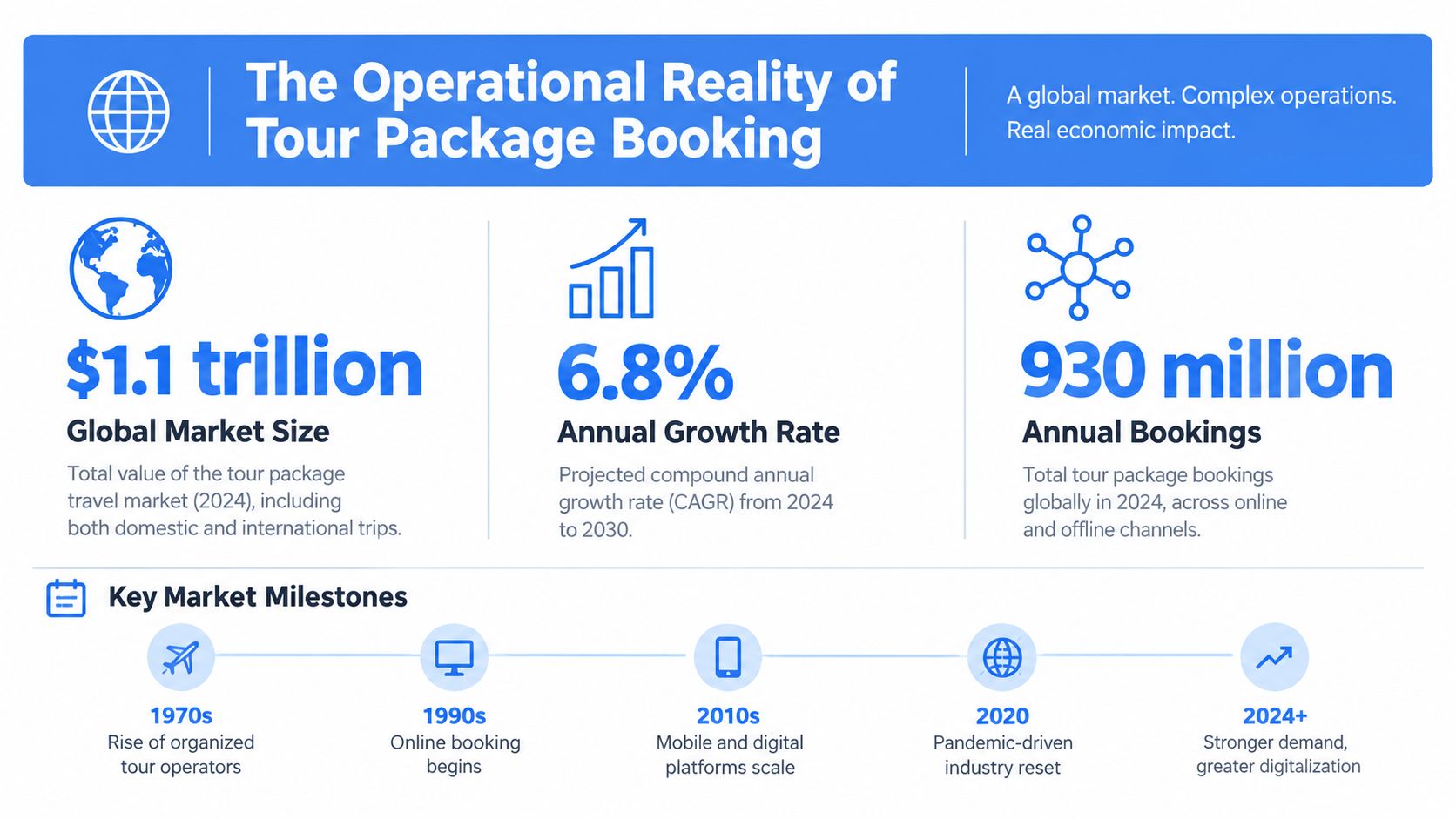
The practical point isn't the headline revenue. It's the operating model behind it. A package consolidates fragmented inventory into a structured itinerary. A family might otherwise buy flights from one retailer, rooms from another, airport transfers separately, and activities directly from local suppliers. Each additional booking introduces another confirmation, payment rule, amendment process, and failure point.
The rebound after the pandemic reinforces the need for dependable infrastructure. EU package-trip volume more than doubled between 2020 and 2022, rising from approximately 29 million to almost 63 million trips, according to the same package-travel market analysis. An organizer who plans only around destination appeal can miss the harder question: can the platform keep the entire group's inventory aligned when availability changes?
What consolidation should accomplish
A useful booking platform should let the organizer see the relationship between components, rather than merely place them beside one another. Look for:
- Connected inventory: Flights, lodging, transfers, cruises, tours, and activities should be evaluated as parts of one itinerary.
- Visible rules: Each component should show its deposit, amendment, cancellation, and passenger-name conditions before payment.
- Group control: The organizer should be able to identify travelers, rooms, arrivals, dietary needs, and activity selections without maintaining disconnected spreadsheets.
- Operational records: Confirmations should identify the suppliers, payment recipient, itinerary, and applicable protections.
A trip-property data resource such as this trip property API reference can also help technical teams understand how travel-related property information may be structured for more consistent itinerary workflows. That matters when an operator needs to compare accommodation attributes across hotels, vacation homes, and other lodging types instead of treating every listing as an isolated retail page.
The strongest test is simple: remove the marketing language and ask whether the package reduces the number of decisions the trip coordinator must reconcile. If it doesn't, the bundle may be cosmetic. A consolidated itinerary should reduce administrative friction while making operational dependencies easier to inspect. The travel booking platform guide offers useful context for evaluating that broader platform model.
Selecting Itineraries and Consolidating Inventory
Destination appeal gets people interested. Inventory structure determines whether the trip works. Start by listing every service the group needs, then classify each as essential, optional, or independently arranged. Transport to the destination and suitable lodging are usually essential. A private excursion, spa appointment, or second city stay may be optional. This distinction prevents an attractive itinerary from forcing every traveler into the same pace.
Organized travel has always depended on this kind of coordination. Thomas Cook's first organized leisure journey, in 1841, was a one-day rail excursion from Leicester to Loughborough priced at one shilling per passenger, according to the history of Thomas Cook's organized travel model. Four years later, Cook organized an international trip from Leicester to Calais. A later Liverpool tour attracted 1,200 customers, and a second departure was arranged for another 800 customers when demand exceeded capacity.
The enduring lesson is operational rather than nostalgic. Pre-arranged transportation, standardized itineraries, group participation, and centralized administration made fragmented travel easier to scale. Modern tour package booking should be judged by the same principle.
A practical selection sequence
First, map the route. Check whether the itinerary avoids unnecessary backtracking and whether arrival times leave enough margin for transfers, check-in, and rest. A package that saves one booking step but creates a difficult connection isn't efficient.
Next, separate shared and personal components. Shared airport transfers and group excursions can improve coordination, but independent meals, free afternoons, and optional activities may protect the trip from becoming exhausting. For a mixed-age group, compulsory activities should be limited to what most travelers can reasonably complete.
Then, inspect inventory depth. Ask whether the provider is drawing from a broad supply network or displaying a narrow set of retail options. Inventory breadth matters when one traveler needs a larger room, another needs step-free access, or the group needs different departure times.
Finally, test substitution. Before paying, ask what happens if the chosen hotel, flight, cabin, or activity becomes unavailable. A solid package process should explain whether the organizer proposes a comparable alternative, reprices the booking, or requires the group to accept a material change.
Practical rule: A package earns its place when it consolidates decisions without hiding the dependencies between them.
Duration deserves the same scrutiny. A shorter itinerary isn't automatically easier, and a longer one isn't automatically better. The right length allows arrival recovery, realistic transfer windows, and enough unscheduled time for travelers who don't share the same energy or interests.
Inventory management is also a technical discipline. Teams building or operating a booking workflow can use this travel inventory management system guide to think through availability, attributes, allocation, and supplier synchronization. The objective isn't to display the largest possible catalog. It's to expose inventory that can be combined accurately and serviced after purchase.
Coordinating Multi-Room and Group Logistics
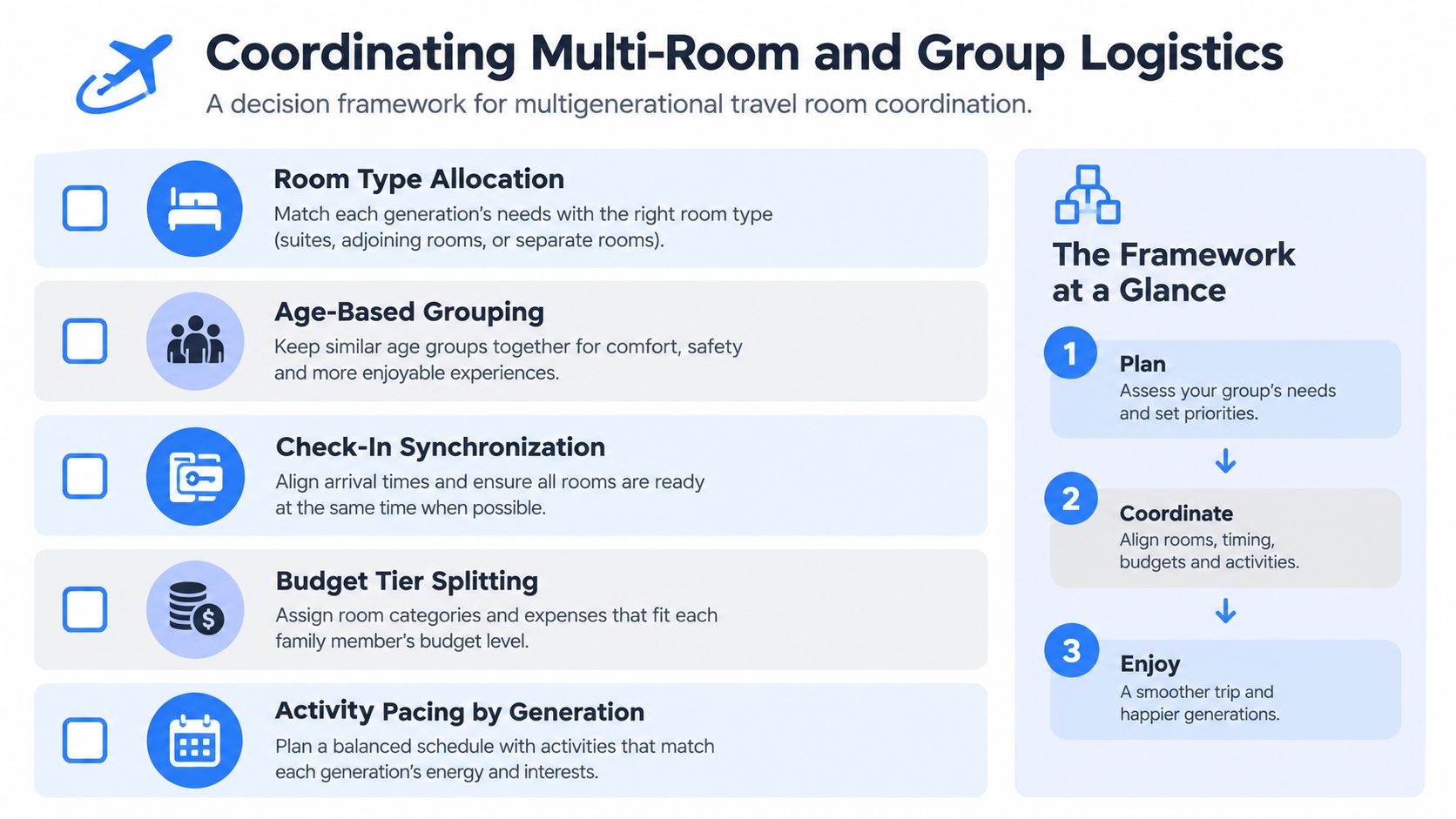
A property can be family-friendly and still be unsuitable for a large family. A children's club doesn't solve a long walk from the accessible room to the restaurant. A spacious suite doesn't help if grandparents need separate sleeping arrangements, teenagers need privacy, and one household arrives hours after the others.
The organizer should treat each household as a logistics unit, then connect those units into a shared plan. Record room type, bed configuration, mobility requirements, child ages, dietary needs, flight details, and payment responsibility before selecting the final property.
Build the room plan before the itinerary
Start with access and adjacency, not aesthetics. Ask the accommodation provider to confirm whether rooms are adjoining, nearby, on the same floor, or merely in the same property. Treat “subject to availability” as an unresolved risk, not as confirmation.
A useful room allocation record includes:
- Household identity: Who shares a room or unit, and who needs independent space?
- Sleeping configuration: Beds, sofa beds, cots, and any restrictions on occupancy.
- Mobility information: Walking distance, elevator access, bathroom configuration, and transfer assistance.
- Arrival sequence: Which travelers arrive first, who holds keys, and whether late arrivals need separate check-in instructions.
- Cost ownership: Which household pays for lodging, transfers, meals, and optional activities?
The payment plan should be written in plain language. One person may pay the shared transfer, while each household covers its own room and discretionary excursions. Don't rely on a group chat to preserve that agreement. Put the allocation in the booking record and circulate the version everyone is expected to follow.
For larger properties, a resource such as this bunk room guide for rental owners can help organizers and accommodation operators think more carefully about sleeping layouts, stair access, and practical room design. The same principle applies to hotels and vacation homes: capacity on paper isn't the same as comfort or suitability in use.
Assign one coordinator
One person should own the master itinerary, but that doesn't mean one person should pay for everything. The coordinator tracks confirmations, amendments, deadlines, and supplier contacts. Each household representative confirms its own traveler details and reports changes through one channel.
Use a simple status system:
- Confirmed: The room, transfer, and activity are booked and documented.
- Requested: The supplier has received the request, but availability isn't final.
- Conditional: The component is held under a deadline or depends on another booking.
- Independent: The traveler arranged it separately and accepts the coordination risk.
Household-scale membership features can support this structure. The Boomerang Member Share program allows a primary member to consolidate booking activity from shared family and friends, while the account can cover up to 10 household members without per-person fees. That can simplify the administration of a reunion, but it doesn't replace the room and payment matrix. Rewards or account benefits shouldn't be mistaken for confirmation that the group will be adjacent or transferred together.
The large-group hotel booking guide provides a useful reference for the property-side questions that need to be resolved before a group commits.
Auditing Flexibility and Total Cost Mechanics
Bundling can simplify procurement, but it can also conceal rigidity. A single displayed total may combine a refundable hotel, a restricted airfare, a non-refundable activity, and a transfer with its own amendment deadline. The package is only as flexible as its least flexible component.
Survey evidence reflects this concern. 49% of travelers prefer somewhat flexible bookings, 43.8% prioritize very flexible options, and 72% consider generous cancellation policies critical to reducing booking uncertainty, according to the TravelBoom leisure travel study. Those preferences don't make every flexible option financially sensible, but they do justify a detailed audit before payment.
Pre-Payment Flexibility Audit
| Audit Category | Operational Checkpoint | Risk if Ignored |
|---|---|---|
| Deposit and final payment | Record the deposit deadline and the date when the remaining balance becomes due. | The group can lose funds or default without realizing the deadline has passed. |
| Cancellation | Identify the rule for every component, not only the package headline. | A supposedly flexible booking may contain a non-refundable service. |
| Traveler changes | Confirm name-correction rules, passenger substitutions, and the effect of removing one person. | One traveler's change may reprice or disrupt the entire reservation. |
| Inclusions | Check baggage, resort charges, transfers, meals, taxes, and activity fees. | The displayed total may not represent the group's actual trip cost. |
| Disruption | Read force-majeure, supplier-failure, credit, and future-use provisions. | The group may receive a credit when it expected cash, or face unclear rebooking duties. |
| Public comparison | Compare identical dates, occupancy, cancellation terms, inclusions, and taxes. | A lower public price may not be comparable under the guarantee's conditions. |
Under the EU Package Travel Directive, a booking generally becomes a regulated package when it combines at least two different travel services for the same trip, such as transport, accommodation, car rental, or a guided tour. The rule can apply to online, in-person, or telephone bookings, including self-customized combinations selected through one point of sale.
That structure creates meaningful protections. Organizers must provide package information, including itinerary characteristics, total price, and additional charges, and they must arrange insolvency protection for refunds and, where necessary, repatriation.
If an organizer cancels an EU-covered package, the traveler is generally entitled to a full refund. The European Consumer Centres Network explains that a refund should be issued within 14 days after the traveler contacts the operator and requests it. Travelers may also cancel without a termination fee when unavoidable and extraordinary circumstances significantly affect the destination or journey, or when the package price rises by more than 8% of the total trip price. On a €4,000 package, that threshold is above €320.
Before payment: Save the original confirmation, identify the legal organizer, and request important changes or refund demands in writing.
For event organizers and hospitality operators, a resource such as this banquet margin improvement guide can also sharpen thinking about total-cost control. The principle transfers directly to travel: margin and value depend on the full operating cost, not the first price visible on the screen.
The 110% Best Value Guarantee should be used only after an exact public comparison meets its conditions. Persistent Reward Credits can contribute to total economic value, but don't assign them a fixed cash value unless the applicable redemption terms support that calculation.
Leveraging Membership Infrastructure and Assets
A travel membership becomes operationally useful when it consolidates access that would otherwise sit across separate systems. The relevant question isn't whether a platform has a long catalog. It's whether the organizer can source lodging, air, cruises, tours, activities, and vacation homes through one controlled workflow while preserving the records needed for a complex group.
Start with the inventory requirement, not the membership feature. Define the destination, dates, room layout, transport needs, activity intensity, and flexibility threshold. Then use the available inventory to test alternatives. A broad supply base is valuable when the first property can't support adjacency, when a flight schedule creates an unacceptable arrival gap, or when a group needs both hotel rooms and a vacation home.
Convert unused ownership into usable access
Timeshare owners face a different problem from ordinary package buyers. They may have an unused week that represents locked travel equity but doesn't fit the current year's schedule. V.O.I.C.E. allows eligible owners to deposit unused weeks for credits, exchange weeks without an exchange fee, or list weeks through a peer-to-peer rental marketplace without a listing fee.
That workflow needs the same discipline as any other inventory decision. Confirm the week's destination, season, occupancy, reservation restrictions, transfer requirements, and deadline before treating it as available for a family itinerary. A deposited week can expand options, but it may not solve a need for flexible dates or a particular room configuration.
Reward Credits earned through bookings can be applied toward future bookings and other permitted uses, including maintenance fees, resort usage fees, annual renewal, and selected eGift cards. They never expire under the stated membership structure. Keep the credit balance separate from the trip budget, because its practical value depends on eligible redemption and the booking selected later.
Delegate coordination when time is the scarce resource
A high-complexity household may need more than inventory access. The Approved Lux 24/7 Personal Assistant can support travel logistics, family scheduling, childcare arrangements, medical appointments, and household management for Lux Traveler members. That service is most useful when the household has multiple calendars and decision-makers, not when the only task is booking a single hotel.
Give the assistant a defined operating brief:
- Decision rights: What may be researched, held, or changed without additional approval?
- Household preferences: Room layouts, transfer tolerance, dietary requirements, and accessibility needs.
- Escalation rules: Which changes require the primary member's confirmation?
- Documentation standard: Where confirmations, receipts, and supplier correspondence are stored.
The assistant shouldn't be asked to make an ambiguous itinerary coherent after payment. Use it early, while the group can still compare room layouts, flight timing, and cancellation exposure. That is where administrative effort has the greatest effect.
A consolidated platform also supports a cleaner audit trail. Keep the original itinerary, component terms, payment receipts, traveler list, and change history together. Whether the organizer uses wholesale infrastructure, direct suppliers, or a combination, the record is what makes a complex trip manageable when plans change.
Execution Checklists for Distinct Traveler Profiles
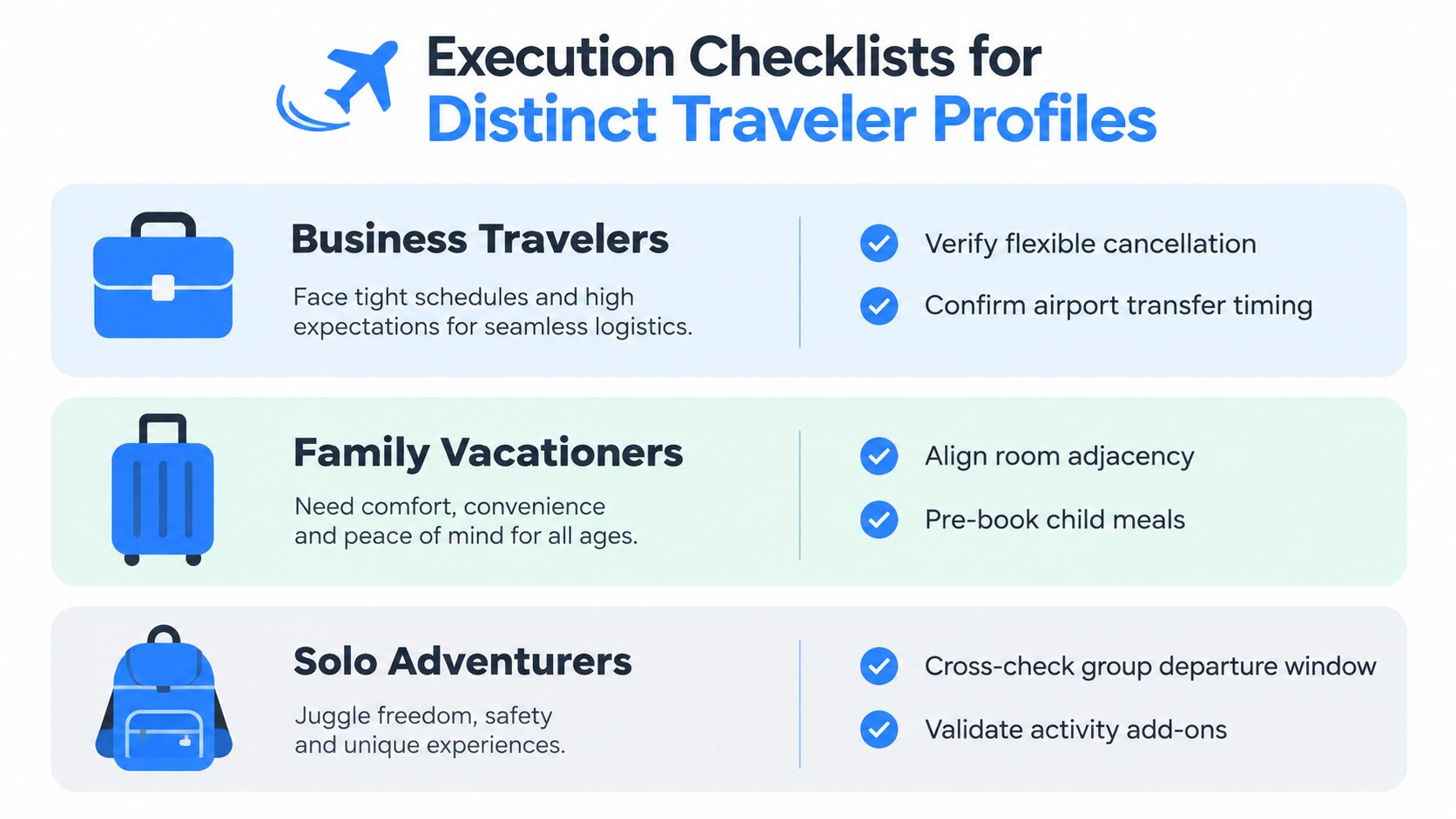
The right workflow depends on who is traveling and what failure would cost them. A multigenerational organizer is protecting group adjacency and shared timing. A snowbird is protecting the suitability of a long stay. A remote worker is protecting daily functionality. A cruise traveler is protecting the connection between a sailing and the land arrangements around it.
Multigenerational family organizers
- Map the households: Record room type, sleeping arrangements, accessibility needs, child ages, dietary requirements, and payment ownership.
- Protect adjacency: Obtain written confirmation of adjoining or nearby rooms. Don't treat a shared property as a shared location.
- Pace the itinerary: Mark activities as compulsory or optional, then provide independent time for travelers with different energy levels.
- Control changes: Require every household to report amendments to one coordinator before changing flights, rooms, or transfers.
The demand for extended-family travel makes this workflow increasingly relevant. 58% of surveyed Millennial and Gen Z parents planned to bring extended family on vacation in 2025, compared with 31% of Gen X and Baby Boomer parents, while 81% of global respondents preferred destinations with activities for all ages, according to the American Express Global Travel Trends report. Activities for all ages are useful only when the itinerary also handles mobility, room placement, and arrival differences.
Snowbirds and long-stay retirees
- Choose the right housing type: Confirm that the package provides a condo-style or vacation-home layout if a kitchen, laundry, or separate living space is essential.
- Check the full stay cost: Review cleaning charges, utilities, resort usage fees, deposits, and the cancellation terms for an extended reservation.
- Verify access: Ask about elevators, parking, medical proximity, walking distances, and transfer arrangements before accepting the property.
- Avoid false flexibility: A long stay can be harder to amend than a short hotel booking, so document every deadline.
Remote workers and digital nomads
- Verify the workspace: Confirm desk suitability, lighting, internet details, noise conditions, and whether the workspace is separate from the sleeping area.
- Confirm kitchen function: Check whether the listing has the appliances, cookware, refrigeration, and dining space needed for the planned stay.
- Test arrival reliability: Align check-in access with the arrival flight and identify a contact for late or delayed arrivals.
- Separate work from activity planning: Keep essential workdays free from compulsory excursions and long transfers.
Cruise enthusiasts
- Compare across lines: Review cabin category, embarkation timing, transfers, onboard inclusions, and cancellation terms rather than relying on the headline cruise fare.
- Add connection margin: Consider pre- or post-cruise lodging when a same-day flight creates unnecessary risk. The cruise and stay planning guidance explains how hotel stays and coordinated transfers can reduce pressure around embarkation.
- Check the port sequence: Confirm whether a land package, transfer, or independent hotel creates a new responsibility outside the cruise operator's package.
- Keep supplier identities clear: Know which entity handles the cruise, hotel, transfer, and any refund request.
A solo traveler or business traveler still benefits from the same discipline. Verify cancellation, airport transfer timing, departure windows, activity add-ons, and the consequence of changing one component. The group may be smaller, but the operational dependencies remain.
Approved Experiences Traveler offers consolidated access to hotels, airlines, cruises, vacation homes, tour packages, and activities, with Reward Credits earned on bookings and household coordination through its membership structure. If you're planning a complex family itinerary or want one platform for comparing connected travel inventory, visit Approved Experiences Traveler and evaluate the available infrastructure against your flexibility, room, and payment requirements.
Want the wider view?
Ten categories. One report. Every quarter. The Approved List tracks what's rising and what's fading: data-backed signals, not opinions.
Free to join · Delivered by email