
←All Articles
The Journal
Wailea Maui Vacation Rental Guide
October 7, 202614 min readmaui condo rentalslarge group hawaii travel
Plan your Wailea Maui vacation rental with this operational guide. Evaluate large-group condos, taxes, and wholesale inventory access for family trips.
Your family has agreed on Wailea, but the booking page has created more questions than answers. The villa appears to sleep everyone, the photos show a resort-style pool, and the nightly rate looks manageable until cleaning, taxes, parking, resort access, and minimum-stay rules enter the calculation.
A Wailea Maui vacation rental shouldn't be treated as a larger hotel room. It's a piece of regulated, capacity-limited inventory inside a master-planned resort district. Before you compare views or bedroom counts, verify that the exact unit can legally host your group, fits your dates, and works operationally for grandparents, children, and whoever is responsible for solving problems on arrival.
The Reality of the Wailea Rental Market
Coordinating a multigenerational trip requires a different standard of research than booking a room for two. One bedroom may suit grandparents, another may work for parents and children, and a shared kitchen may reduce daily friction. But those advantages matter only if the property is permitted for your dates and the total cost remains sensible after occupancy, taxes, and operating charges.
Maui County is Hawaiʻi's largest vacation-rental market by reported monthly supply. In January 2025, it recorded 224,100 available vacation-rental unit nights, up 7.3% year over year and 6.0% above January 2019. Demand reached 134,900 unit nights, up 4.5% year over year but still 24.3% below January 2019, producing 60.2% occupancy. The county's January 2025 vacation-rental performance report records those figures.
The price signal is just as important. Vacation-rental ADR was $474, up 11.2% year over year and 66.0% above 2019, while Maui County hotels reported a $592 ADR and 62.1% occupancy in the same month. That gap doesn't prove a rental is a better or worse choice. It proves that a rental and a hotel are different lodging categories, with different utilization patterns and different cost structures.
Wailea is a resort district, not a loose collection of homes
Wailea's accommodation base grew through a major late-20th-century development cycle. Maui County's official development-history report identifies Wailea as a resort destination area that expanded during the island's construction surge, adding roughly 2,700 hotel visitor units through projects including the Aston Wailea Resort, Grand Wailea Resort, and Kea Lani Hotel.
The first Wailea hotels opened in 1976, followed by the Four Seasons in 1990, and both Grand Wailea and Fairmont Kea Lani in 1991. That history explains why today's rental inventory often appears as condominiums, villas, and resort residences connected to established beaches, golf, retail, and visitor services. You're evaluating a mature resort infrastructure, not an isolated coastal house.
Practical rule: Treat every listing as a specific operating unit inside a larger system. The resort name establishes context, but it doesn't prove that the advertised unit is available, permitted, or suitable for your itinerary.
For organizers managing property details, guest communications, and availability across multiple units, it can help to explore real estate CRM features before building a comparison process. The right system won't replace legal verification, but it can keep owner contacts, documents, dates, and follow-up tasks from disappearing into email.
Navigating Legal and Tax Constraints
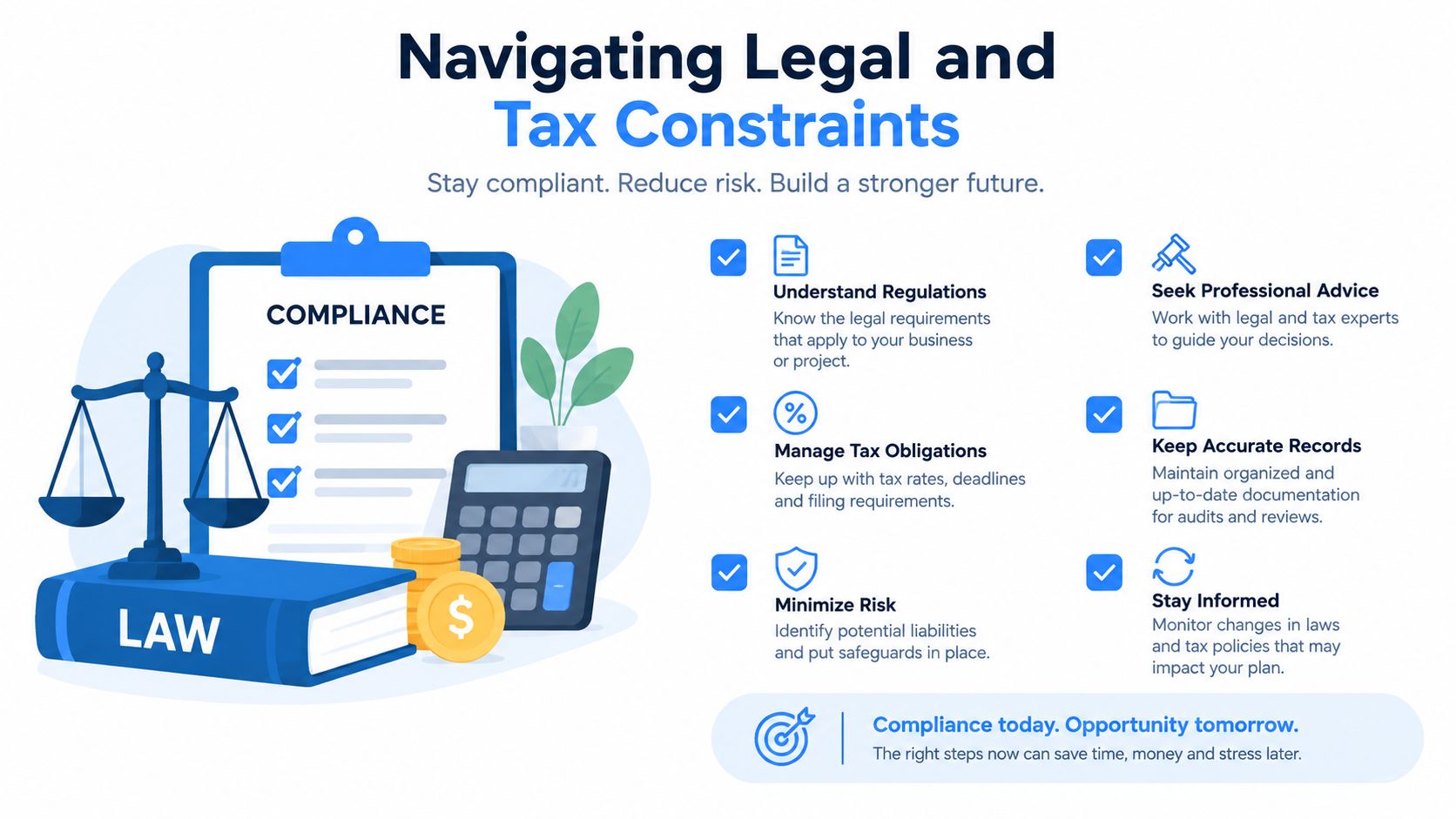
The first question isn't “Does this condo look comfortable?” It's “Can this exact unit legally be rented for the dates we need?” Hawaii defines a transient accommodation broadly as a house, condominium, apartment, beach house, or similar lodging rented for fewer than 180 consecutive days. That definition covers vacation homes and resort condos, not only hotels.
Use a property-level verification process
Start by requesting documentation for the unit, not just the complex. A building may have visitor accommodation inventory while a particular residence has different bylaws, a longer minimum stay, or no authorization for the use shown in an advertisement.
-
Confirm the permitted rental period. Ask whether the unit accepts nightly, weekly, or 30-day stays. Don't infer permission from a calendar that allows you to submit an inquiry.
-
Request registration and permit details. The applicable state and county tax registrations, permits, or other authorization should identify the advertised unit or the legally relevant operating arrangement.
-
Read the condominium rules. Check minimum stays, occupancy limits, parking, pets, quiet hours, guest registration, and whether the association requires advance rental information.
-
Verify the manager. Get the name and local contact method for the person who handles lockouts, plumbing issues, access problems, and urgent maintenance on Maui.
-
Reconcile the dates. A unit may be legal for transient use but unavailable for your precise arrival and departure pattern. Ask the manager to confirm the intended stay in writing.
Wailea Point materials, for example, state that off-island owners must designate a Maui-based agent and submit rental information before occupancy. Reporting on Wailea Point also describes restoration of a 30-day minimum rental rule, while clarifying that the ruling doesn't authorize nightly or weekly rentals. The operational lesson is simple: a famous address doesn't answer the stay-length question.
Calculate the tax-inclusive price
Hawaii's state TAT is 10.25% of gross rental proceeds, calculated before operating costs. Operators must also account for the 4% GET plus any applicable county surcharge, according to the Hawaii Department of Taxation guidance on transient accommodations. Maui County imposes an additional 3% Transient Accommodations Tax on gross rental proceeds and fair-market rental value for taxable short-term accommodations, as set out in the Maui County ordinance.
Ask for a written breakdown showing base rent, cleaning, taxes, parking, resort charges, deposits, and cancellation terms. If the manager can't explain which taxes the platform collects and which obligations remain with the operator, pause the booking. For ownership, compliance, or disputed-use questions, it may be sensible to hire a Maui real estate attorney rather than rely on a listing description.
Evaluating True Value for Large Groups
A large villa doesn't automatically create value. It can reduce room fragmentation and give a family one kitchen, but it can also leave you paying for bedrooms that grandparents won't use, carrying a larger cleaning charge, and managing a property with fewer services than a hotel.
Official data makes the comparison less intuitive. In October 2025, Maui County vacation rentals averaged $505 per night with 42.4% occupancy, while Maui hotels averaged $434 and 65.6% occupancy. In November 2025, vacation-rental ADR was $537, occupancy was 46.4%, and demand fell 4.2% year over year while supply rose 10.2%. These figures are from the official October 2025 vacation-rental performance report.
Those figures don't settle your decision. A rental can still win when the group uses the kitchen, laundry, living area, and bedrooms efficiently. A hotel block can win when you value daily service, predictable check-in, resort infrastructure, flexible room allocation, and the ability to place relatives in nearby rooms rather than one shared home.
Build the comparison around the whole stay
Use the table below as a decision screen, not as a substitute for a quote. Put the actual booking amounts into each row before you compare options.
| Cost Factor | Vacation Rental Impact | Hotel Block Impact |
|---|---|---|
| Base accommodation | One large property may consolidate the group, but unused bedrooms reduce value. | Multiple rooms let you pay for the sleeping capacity you actually need, though shared living space is limited. |
| Cleaning and turnover | Cleaning fees can be substantial, especially for a larger home or villa. | Housekeeping may be included, separately charged, or governed by the hotel's service schedule. |
| Taxes | State and county taxes apply to taxable short-term accommodation and can change the all-in total. | Hotel pricing also requires tax review, but the property normally presents charges through a standardized folio. |
| Resort and parking charges | Confirm whether the rental includes access rights, parking, and any building or resort fees. | Ask whether each room carries separate resort or parking charges. |
| Food and laundry | A kitchen, refrigerator, and laundry can reduce restaurant and packing friction. | Dining and laundry are more centralized, but the group may purchase more meals away from the property. |
| Capacity risk | One failed bedroom, sofa bed, bathroom, or parking allocation affects the whole group. | A problem in one room may be isolated, and the hotel may be able to reassign inventory. |
| Management effort | The organizer handles more coordination, including arrival instructions, supplies, and maintenance escalation. | Front-desk infrastructure absorbs many routine issues. |
| Cancellation terms | Policies can vary by owner, manager, and booking channel. | Policies may be more standardized, but the block still needs a careful review. |
Choose the format that matches the family
For a group with young children and a shared daily schedule, one properly permitted villa may be operationally efficient. For a family with different sleep patterns, mobility needs, or privacy expectations, adjacent hotel rooms or separate condominium units may work better. Splitting into two nearby rentals can also reduce the risk that one unit's access or maintenance problem disrupts everyone.
Ask three questions before choosing:
- Will we use the shared space? If most meals happen out and relatives spend the day separately, the villa's common areas may not justify its premium.
- Who will manage the property? If the answer is “the booking platform,” you don't yet have an operating plan.
- What happens when someone cancels? A large home may be difficult to resize, while hotel inventory can sometimes be adjusted room by room.
Leveraging Wholesale Inventory and Timeshare Assets
Retail browsing gives you a list of properties. It doesn't necessarily give you a coordinated lodging strategy. A family organizer may need a villa for one household, a condo for grandparents, adjacent rooms for another branch of the family, and activities that fit the same dates. Consolidated inventory makes that planning problem easier to manage because the organizer can compare lodging, transportation, and activities within one workflow.
Approved Traveler is one such infrastructure option, with access to a consolidated marketplace that includes vacation-home inventory. Its relevance here isn't a promise that every Wailea unit will be available. The practical value is the ability to submit a defined requirement, compare suitable inventory, and keep the search connected to the rest of the trip instead of opening unrelated retail tabs.
Turn unused ownership into usable travel capacity
Timeshare owners should evaluate unused weeks as an asset with options, not as an unavoidable annual obligation. V.O.I.C.E. allows eligible owners to deposit up to 5 weeks per year for credits, exchange weeks at no fee, or list weeks on a peer-to-peer rental marketplace with no listing fee. The owner still needs to confirm the program's terms, the week's rights, and the destination availability before treating it as a Wailea solution.
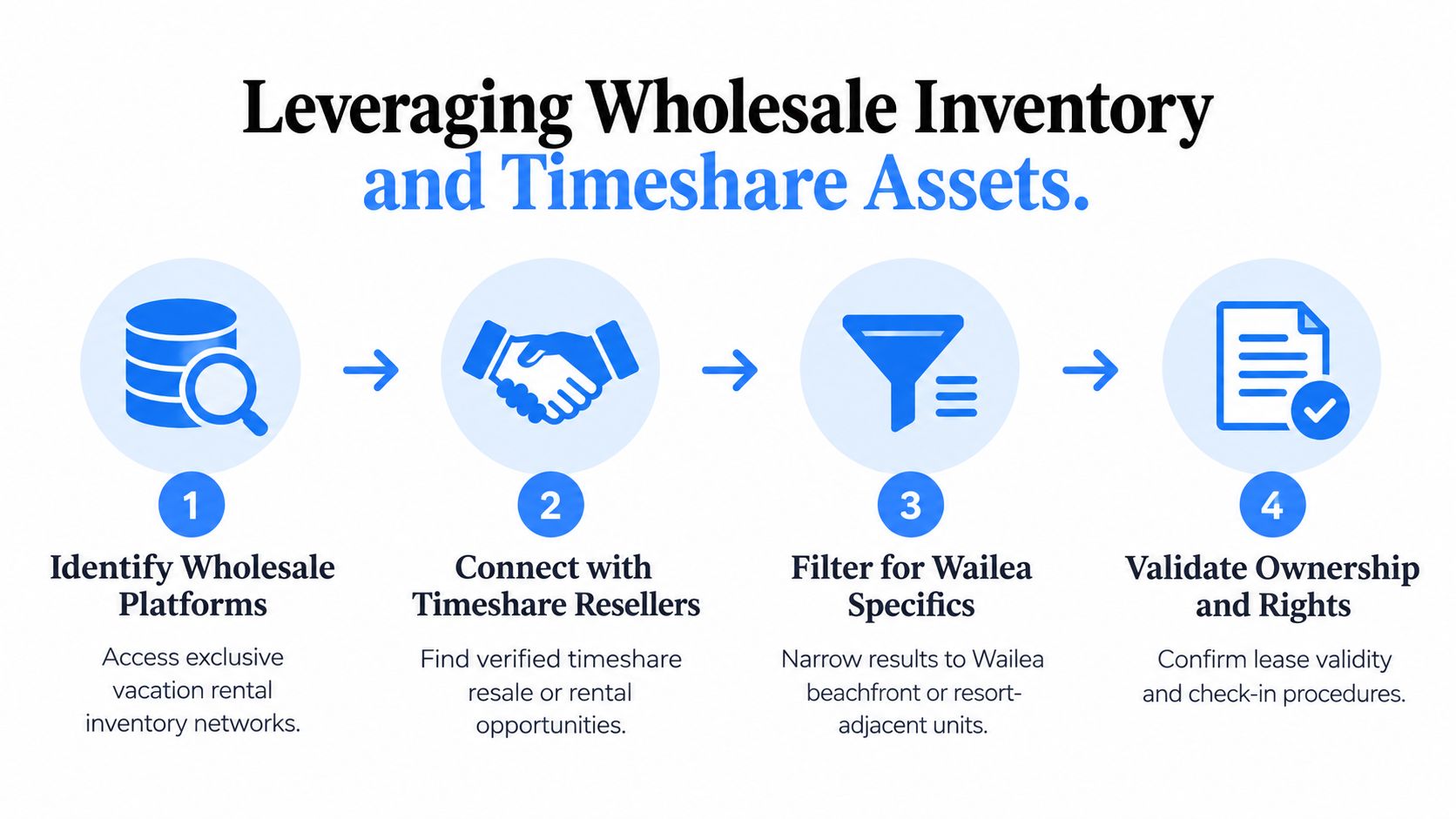
The operational sequence is straightforward:
- Identify the requirement: Define dates, bedrooms, accessibility needs, parking, cooking facilities, and the maximum acceptable transfer or check-in complexity.
- Search consolidated inventory: Compare a whole-home stay, resort residence, hotel block, and split-unit plan instead of assuming the first large villa is the answer.
- Review the ownership route: If you hold an unused timeshare week, determine whether depositing or exchanging it supports the trip without creating a new mismatch in dates or capacity.
- Validate rights: Confirm the unit, guest names, booking authority, cancellation rules, and check-in process before any transfer.
Reward Credits add another layer to the planning model. Members can earn them on eligible travel bookings and apply them toward future bookings, maintenance fees, resort usage fees, annual renewal, and eligible eGift cards. Don't assign a cash value until you understand the redemption terms for the specific transaction.
The right question isn't whether wholesale infrastructure always produces the lowest visible rate. Use the 110% Best Value Guarantee as a verification step where it applies, then compare the full itinerary, legal status, service level, and booking conditions. A lower base price is irrelevant if the property can't host the group or creates an avoidable arrival problem.
Operational Screening Checklist for Family Organizers
A listing can be attractive and still fail your trip. Before you pay, create a property file containing the listing, the exact unit identifier, the manager's contact details, the rules, the price breakdown, and written answers to every unresolved question.
Maui County reported 21,911 visitor-accommodation units in 2025, with vacation rentals representing 33.3% of inventory, while statewide vacation-rental supply increased 3.9% year over year, according to the 2025 Visitor Plant Inventory. A large inventory doesn't remove the need to verify individual units. It makes disciplined filtering more important.
Run the unit through five screens
Capacity: Count beds, not marketing language. Ask how many adults each bedroom accommodates, whether sofa beds are involved, how many bathrooms are usable by the whole group, and whether the stated occupancy matches the permitted occupancy.
Rules: Obtain the minimum stay, guest-registration procedure, quiet hours, pet policy, smoking policy, parking allocation, and rules for visitors who aren't listed on the reservation. Ask whether the condominium board can change the rule between booking and arrival.
Authorization: Request the unit's applicable transient-use permit, registration, or other proof of authorization. Maui County rules preserve limits on certain existing transient vacation rentals, so authorization for the building or resort doesn't independently establish authorization for the specific advertised unit.
Arrival: Confirm key exchange, parking access, elevator or gate procedures, after-hours support, and what happens if a flight delay pushes arrival beyond the stated check-in window. A local contact should be able to respond on Maui, not only through a distant messaging queue.
Cost: Reconcile the quote against the contract. Include taxes, cleaning, deposits, resort access, parking, delivery fees, cancellation terms, and charges for additional guests. Don't approve a family budget from the nightly rate alone.
The property file should answer one question without interpretation: can this exact unit host these exact people for these exact dates?
Technology details belong in the same operational review. Confirm the internet service, device limits, workspace suitability, and whether the host can explain the passwordless guest WiFi cost if the property uses a managed access system. For a broader amenities review, compare the practical features in this vacation-rental amenities guide, then separate practical infrastructure from decorative listing language.
For a multigenerational group, add a family-specific pass. Can a grandparent reach the bedroom without stairs? Is there a shaded place to sit? Can children sleep while adults use the living room? Is the refrigerator large enough for medication, formula, or groceries? These questions are more valuable than another round of pool photographs.
Strategic Planning for Long-Stay and Snowbird Visits
A month in Wailea is a temporary relocation, not a long weekend. Snowbirds, retirees, and remote workers need a reliable living system with groceries, transportation, laundry, internet, workspace, medical access, and a clear local contact. The rental must function after the novelty of the first few days wears off.
The first decision is the legal stay structure. Hawaii treats accommodations rented for fewer than 180 consecutive days as transient accommodations, while individual Wailea communities may impose a 30-day minimum or another rental-period rule. Don't assume that a longer reservation automatically removes taxes, licensing duties, or building restrictions. Have the manager confirm the treatment for your exact dates and contract.
Make the unit support ordinary life
For an extended stay, rank these features ahead of a dramatic view:
- A real kitchen with usable storage and reliable appliances.
- A washer and dryer inside the unit or in a clearly accessible location.
- A desk or table that supports work, paperwork, and video calls.
- Stable internet with a defined support process.
- Parking that accommodates the actual vehicle, including accessibility needs.
- A responsive Maui-based manager.
- A cancellation and extension policy that doesn't force a premature commitment.
Long-stay guests should also price the operating layer. Vehicle rental, grocery delivery, prescription coordination, cleaning, activities, and occasional hotel nights for visiting relatives can affect the budget more than a small change in the advertised rental rate. A centralized support service can reduce the organizer's workload, but it shouldn't replace verification of the property's local procedures.
Use this long-stay rentals resource to build a requirements list before requesting inventory. Then ask for a written monthly proposal that separates rent, taxes, cleaning, deposits, utilities, parking, and extension terms.
For timeshare owners, V.O.I.C.E. may provide another route to extended-stay access through eligible deposited weeks or exchanges. The important question is whether the available rights match the required dates and length. A flexible-looking asset is useful only when its booking rules align with the relocation plan.
Executing the Final Booking Workflow
Consider a family organizer with grandparents arriving separately, parents traveling with children, and one relative who may stay longer. The passive approach is to select a villa, send the listing to the family, and hope the details work out. The operational approach creates a decision record before payment.
First, define the inventory requirement. Record the dates, sleeping arrangements, accessibility needs, parking, workspace, kitchen requirements, acceptable minimum stay, and whether the group needs one property or adjacent units. Then compare the rental against a hotel block and a split-stay plan using the full cost, not the headline rate.
Second, verify legality and management. Obtain the unit-level authorization details, written minimum-stay rule, condominium restrictions, tax breakdown, cancellation terms, and local emergency contact. If any answer is verbal, ask for it in writing before the payment deadline.
Make the final decision auditable
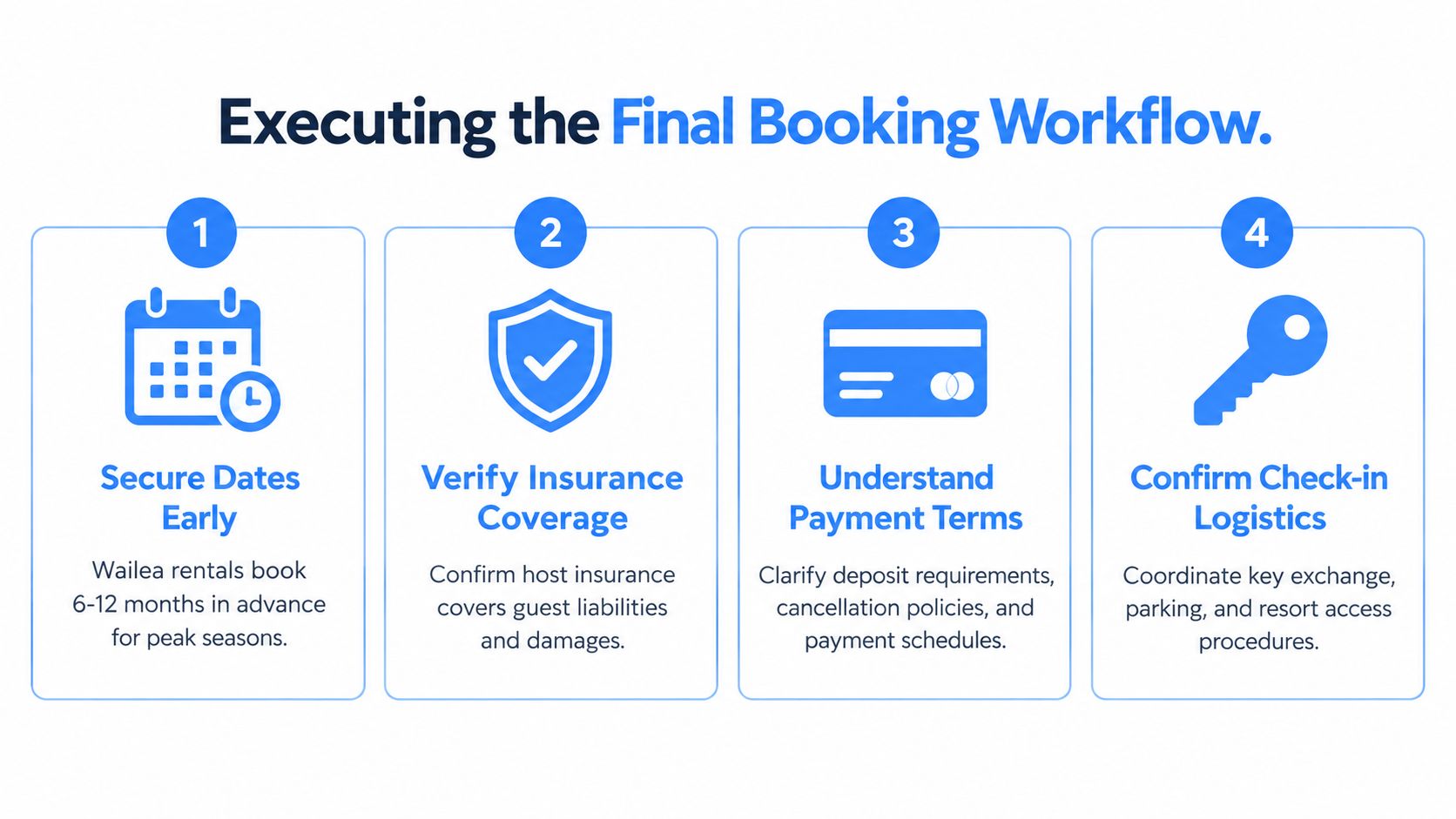
A strong booking file includes the signed agreement, the final tax-inclusive total, the names of all occupants, parking instructions, check-in procedures, manager contacts, and screenshots or PDFs of the approved unit details. Put one person in charge of changes, but give every adult traveler the information needed to arrive independently.
If you're consolidating air and accommodation, include the plane-ride planning guide for Hawaii in the family schedule, then work backward from arrival to check-in. A late flight, delayed baggage, or separate airport transfer shouldn't leave grandparents waiting outside a locked gate.
Before paying, confirm the applicable 110% Best Value Guarantee for eligible wholesale rates and verify that every household member is properly registered under the travel membership if shared logistics support is part of the plan. That doesn't make a rental compliant. It gives the organizer a cleaner process for comparing inventory, documenting decisions, and coordinating the rest of the trip.
The final approval should require four yes answers:
- Capacity: The unit sleeps the group comfortably under the actual occupancy rules.
- Compliance: The exact unit and rental period are authorized.
- Cost: Taxes, fees, deposits, parking, and unused capacity are included.
- Execution: A named local manager can resolve arrival and in-stay problems.
Approved Experiences Traveler gives family organizers consolidated access to vacation homes and other travel inventory, with Reward Credits and operational tools that can support a complex Wailea itinerary. Visit Approved Experiences Traveler to compare the infrastructure before you commit to a rental that hasn't passed the legal, financial, and family-capacity checks.
Want the wider view?
Ten categories. One report. Every quarter. The Approved List tracks what's rising and what's fading: data-backed signals, not opinions.
Free to join · Delivered by email