All Articles
The Journal
9 Travel Games for Family Trips That Actually Work
October 24, 202615 min readroad trip gamescar games
Explore 9 travel games for family drives, flights and stays with rules, ages, group sizes and no-material play ideas for all ages.
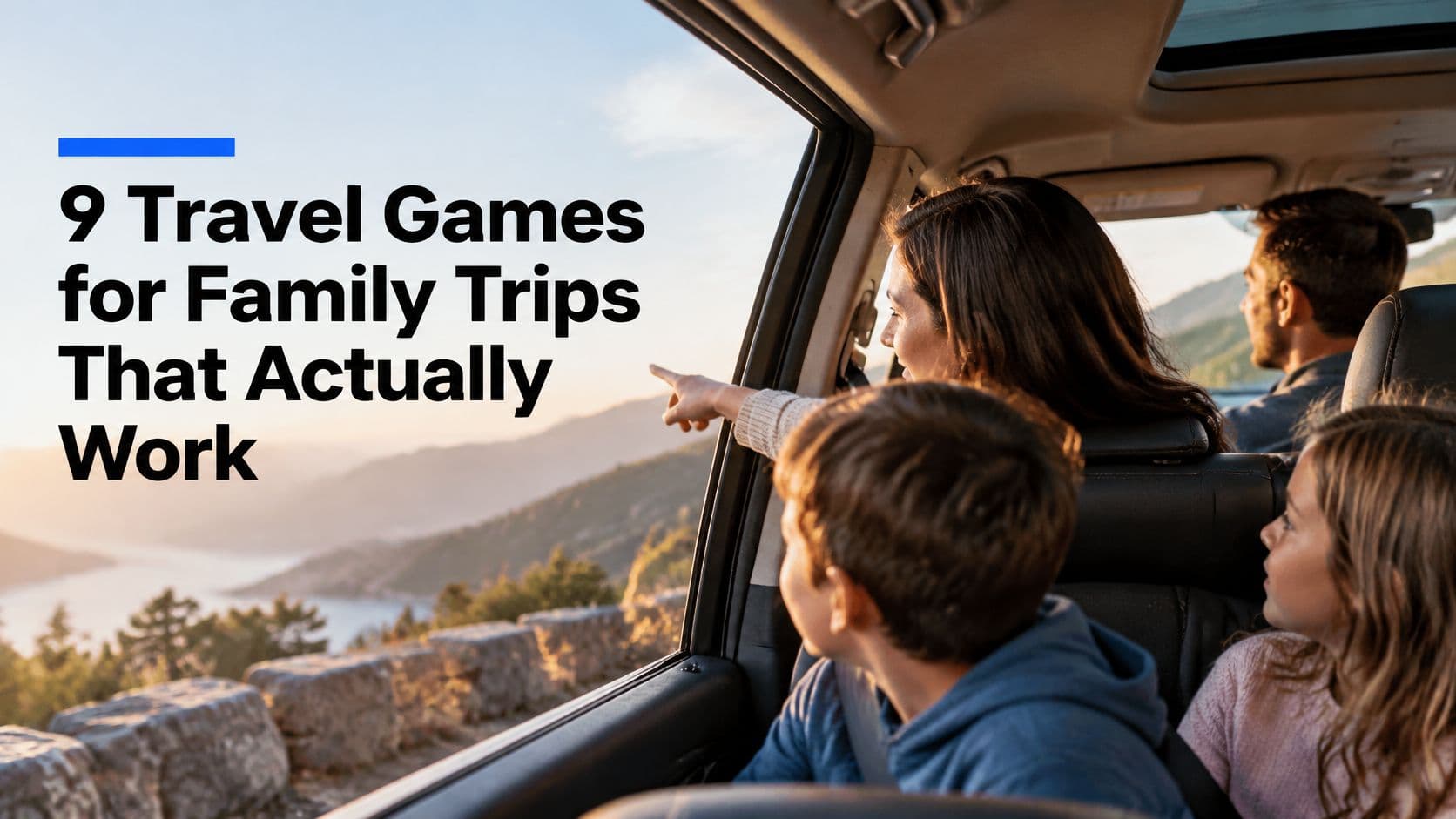
The drive still has hours to go, your flight's delayed, and rain is forecast for the first afternoon at the rental. Someone wants a tablet, someone else wants the charger, and the grandparent in the middle seat can't hear the movie. A small play kit, backed by games that need no equipment, gives everyone another option.
The best travel games for family trips aren't necessarily the most elaborate. They're the ones you can explain without a speech, pause when boarding starts, and adapt when a preschooler wants to join the adults. Keep observation and conversation games available during transit, then save cards and hidden-board games for places where everyone can sit comfortably.
There's a reason to make room for shared play. In a survey of parents and children about vacation experiences, 53% of children named bonding with parents and siblings as a favorite experience, with the same share selecting games.
Pack for comfort as well as entertainment, using a practical guide to arriving refreshed alongside your play kit. The options below include recommended player arrangements, readiness-based ages, clear rules, and no-material alternatives. Treat the age guidance as a starting point, not a reason to exclude someone who wants to participate.
1. Mad Libs
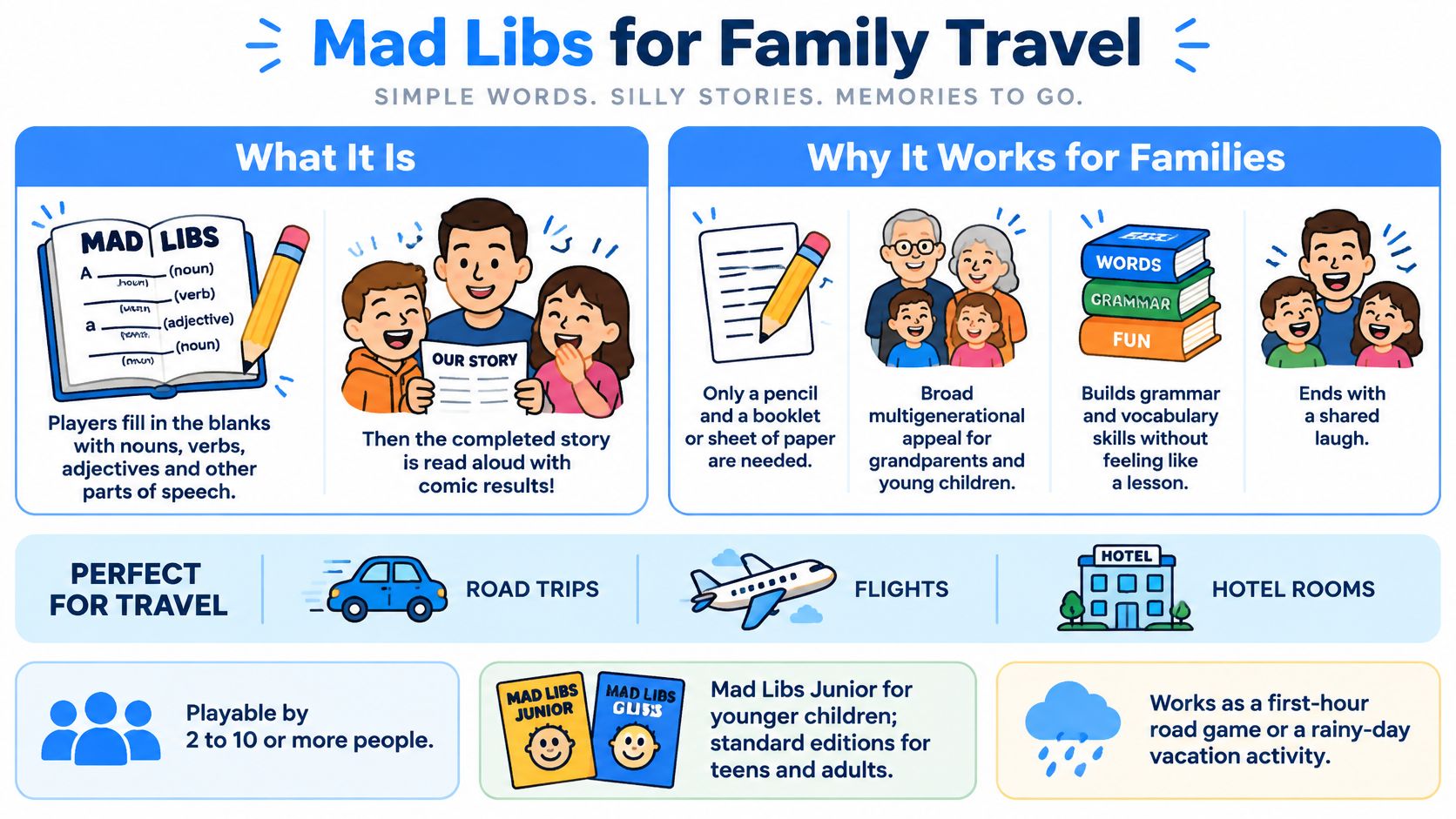
Best during transit or at the rental. Mad Libs suits school-age children who enjoy wordplay, with preschoolers contributing familiar objects and describing words. Use a reader and a small group of contributors, or let the whole household take turns.
The reader keeps the story hidden and asks for the type of word needed in each blank. Everyone supplies answers without hearing the surrounding sentence. Once the blanks are filled, the reader reveals the completed story aloud.
The distinction matters: don't reveal the story before collecting the words. Knowing the context encourages sensible answers, which usually makes the result less entertaining.
Make the grammar optional
During a drive to a lakeside rental, a grandparent can request “something you can hold” rather than “a noun.” An older child can supply action words, while another adult writes. Save the finished story for dinner if the reader would rather not look down while the car's moving.
- Pack lightly: Bring a booklet, pencil, and notepad in the same pouch so the writer isn't searching through luggage.
- Share the spotlight: Request contributions in seating order rather than accepting whichever answer is loudest.
- Use a zero-material swap: Tell an improvised story aloud, pausing for someone to supply an object, action, or description.
The spoken version won't preserve the exact surprise of a hidden written story. It's still useful when the booklet's packed away or a passenger wants to keep their eyes off the page.
2. I Spy
A good I Spy object stays visible long enough for everyone to inspect it. A passing motorcycle doesn't; the airport's blue departure sign does. Choose from the shared view, not whatever happens to be outside the chooser's window.
One player selects an object without saying anything and gives its color or starting letter. The others guess until someone identifies it, then the choosing role passes along. For preschoolers, use colors and shapes; for confident readers, use initial letters or more subtle descriptions.
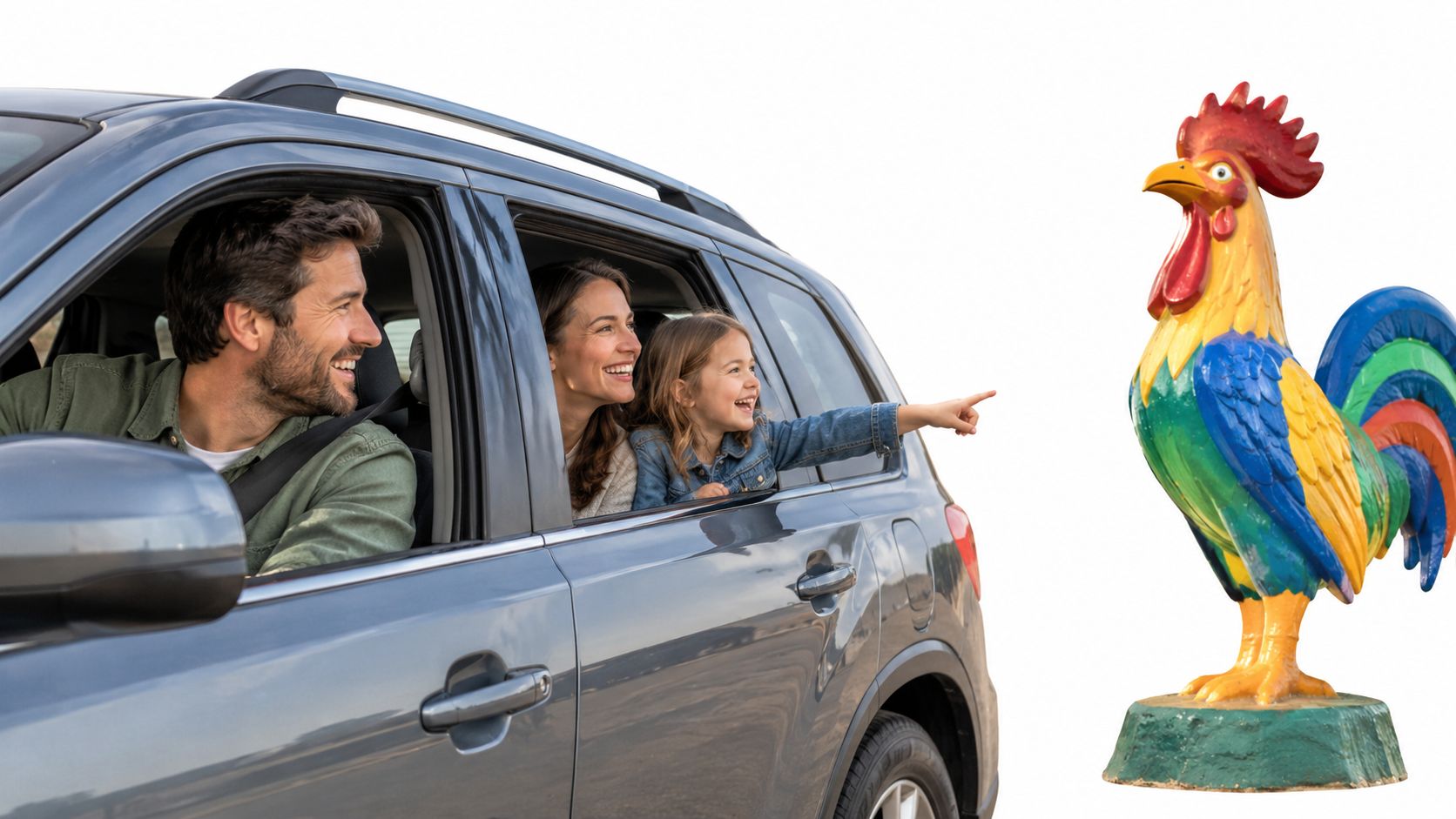
Practical rule: If everyone can't reasonably see the object, it isn't a fair choice.
Recommended group: A pair, a shared seating row, or a small group facing the same space. It's less effective across a crowded shuttle where passengers have different sightlines.
At an airport gate, a child and grandparent might search for something yellow while the other adults organize boarding passes. Give anyone with limited vision permission to request a closer object or a more descriptive clue, without treating that accommodation as a penalty.
No packing or zero-material substitution is necessary. During a nature stop, keep the game observational rather than sending children toward unfamiliar plants or uneven ground; consult Playz tips for safer nature hunts before expanding it into a walking activity.
Keep the driver out of the search. Passengers can play without asking whoever's driving to verify an object.
3. License Plate Game
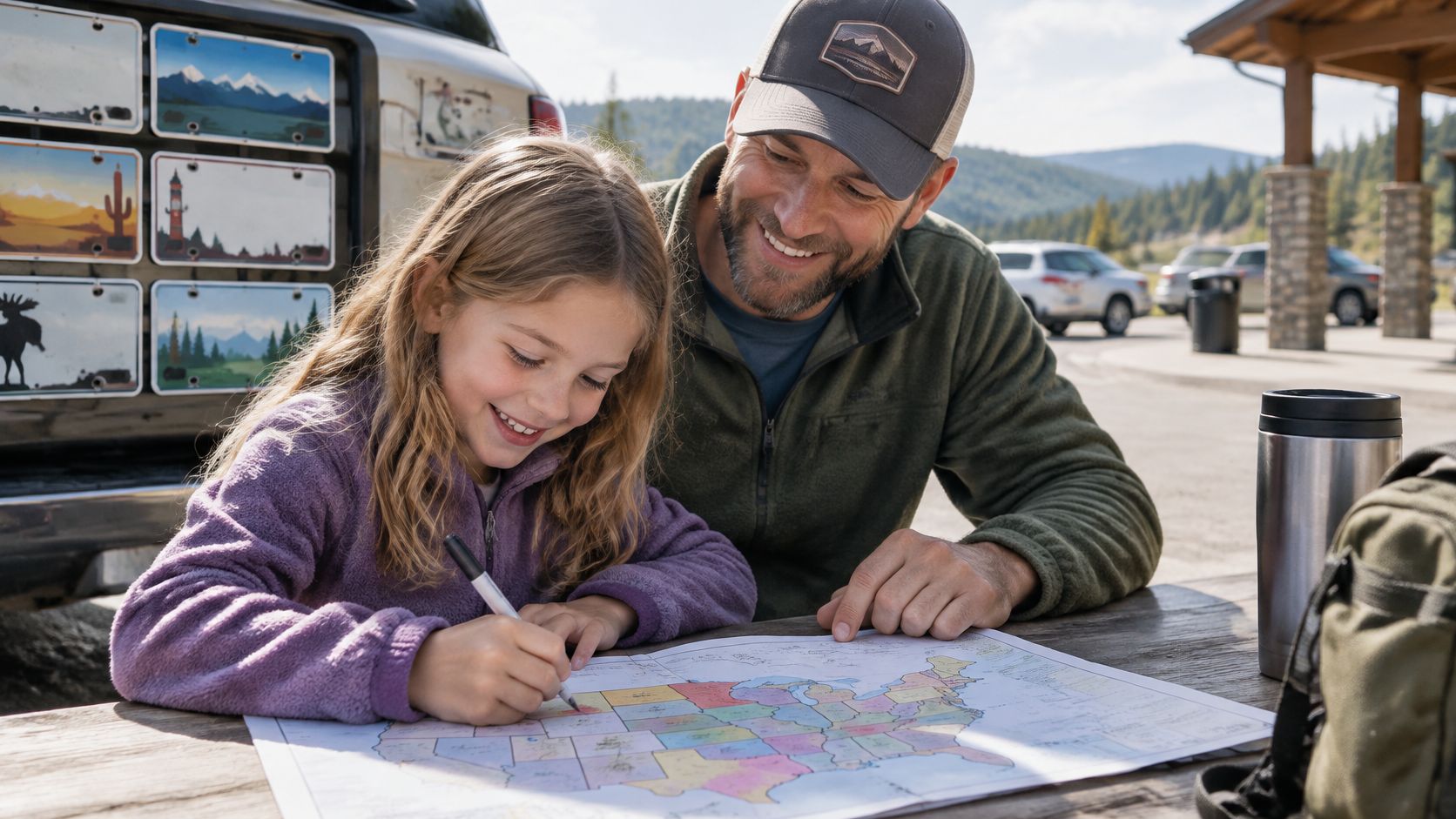
Use this for road transit, not every travel setting. The basic challenge is to spot plates from different states, provinces, or regions and record each new location. School-age readers can identify names, younger children can announce unfamiliar designs, and adults can confirm uncertain sightings.
Keep a shared list rather than competing over who shouted first. Before departure, agree which regions count and whether an unreadable plate needs confirmation before it's recorded. Duplicate locations don't add another entry.
Choose observation or arithmetic
On a hypothetical Chicago-to-Gulf-Coast drive, keep the checklist active across travel days instead of restarting whenever someone falls asleep. Let returning players ask what's new so intermittent participation doesn't mean exclusion.
For children who prefer arithmetic, Komodo Math's license-plate game uses a target of 100: add a plate's digits to a running total and aim to reach the target or get as close as possible. Agree beforehand whether you'll allow scores to pass it.
- Pack: A printed regional checklist and pencil, with an adult passenger responsible for recording.
- Adapt: Let grandparents confirm place names while children scan, or reverse those roles according to comfort.
- Skip materials: Collect unfamiliar region names aloud without maintaining a complete-trip score.
Don't rely on plate spotting to fill every road segment. Sparse traffic and repetitive local plates can make it drag. Handle transport logistics beforehand with this car rental booking guide, then keep the game optional rather than another task on the itinerary.
4. 20 Questions
Best for conversation during transit, restaurant waits, or evenings. Unlike observation games, 20 Questions doesn't depend on daylight, traffic, or a shared window. It's a useful choice when players would rather listen than look down.
A chooser thinks of a person, place, animal, or object. The group asks yes-or-no questions and tries to identify it within the game's 20-question limit, a format included among established car conversation games. Count a direct guess as a question so the ending isn't disputed.
Choose a category before starting. “An animal” gives a young child a workable starting point; “a place we've visited together” gives older relatives something more personal than general trivia.
Ask questions that narrow the field
Recommended players: A pair or a small conversational circle, with preschoolers partnered and school-age children taking independent turns. Larger households should rotate questioners so the fastest adult doesn't conduct the entire investigation.
At a vacation-home dinner, a grandparent might choose an animal seen during the day. Children ask about habitat and size, while adults wait their turn rather than supplying the answer.
A useful question eliminates possibilities. A string of unrelated guesses mostly uses up turns.
Allow “I don't know” when a child chooses something they can't fully describe. Don't turn an uncertain answer into a rules dispute.
There's nothing to pack and no substitute needed. For relatives with hearing difficulties, have the chooser repeat each question before answering, and keep background music low enough for everyone to follow.
5. Travel Bingo
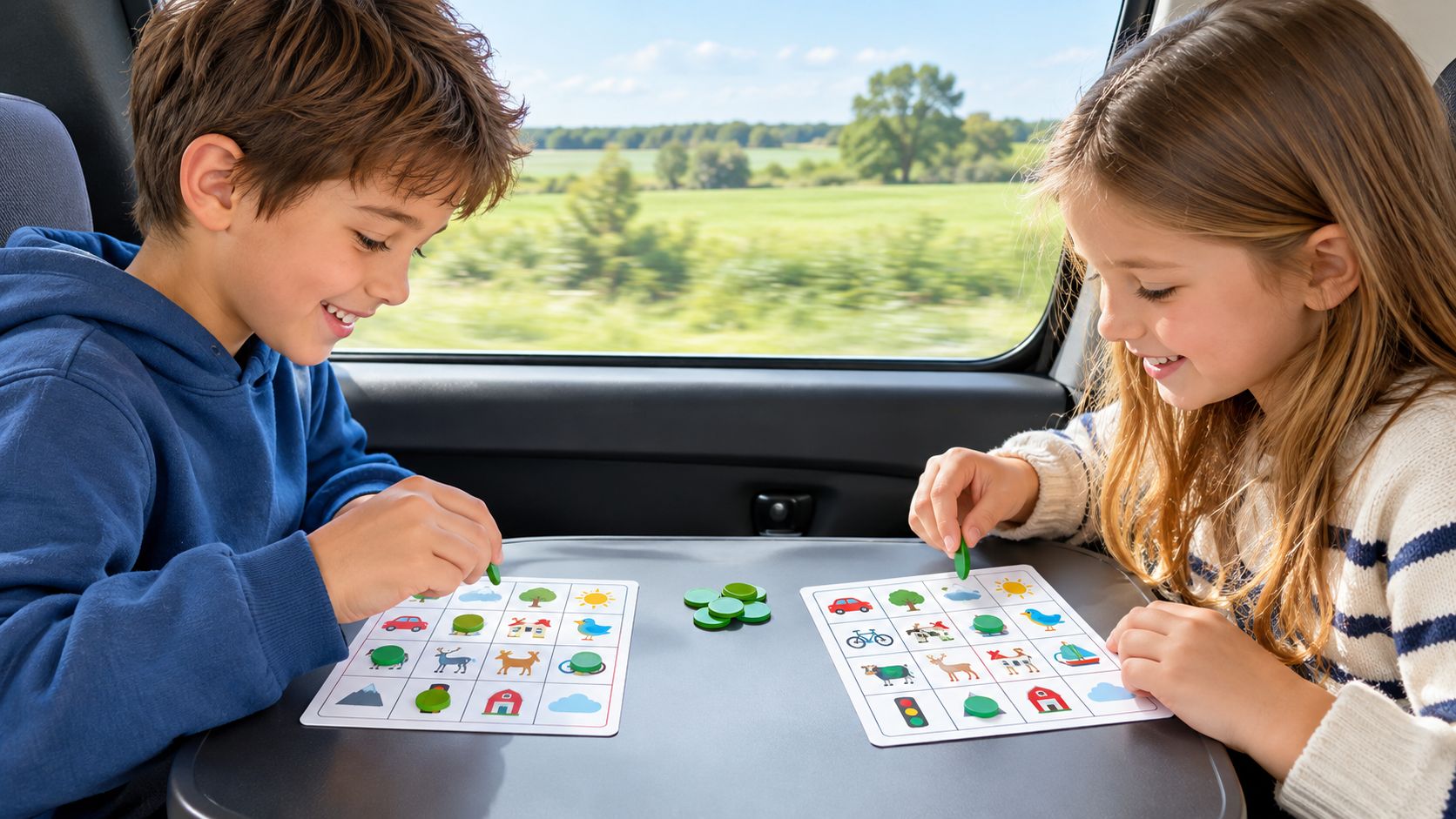
Travel Bingo works when the card reflects the journey you're taking. A rural highway card might include a bridge, livestock, and a water tower. An airport card should use terminal observations rather than objects nobody can see from the gate.
Recommended ages: Preschoolers with picture cards, school-age children with written prompts, and adults as independent players or partners. Give each player or team a card, then mark objects as they're spotted. Agree before starting whether a completed row, column, or diagonal wins.
The Family Travel Association's survey found that 57% of respondents said children older than seven were interested in learning about places they visited. Use that curiosity selectively: a local landmark makes a better prompt than an obscure fact children must research while traveling.
- Match difficulty: Give younger players familiar objects and older players more specific observations, without making either card impossible.
- Pack for reuse: Keep cards in a protective folder and return the pencil to the same pocket after play.
- Make it cooperative: At rest stops, families traveling in separate vehicles can compare discoveries without ranking the children.
For a zero-material swap, name a short collection of things the group must find together. It loses the visual progress of bingo, but keeps the observation challenge.
Use kid-friendly destinations as a planning starting point, then tailor prompts to the route and property rather than promising sightings you can't control.
6. Battleship (Travel Edition)
Save Battleship for seated transit and stays. It needs hidden boards, a stable playing position, and opponents who can hear coordinates clearly. A rental dining table is a better setting than an airport queue that keeps moving.
The travel format suits school-age children who can follow grid references, with an adult partner available for beginners. Play head-to-head, or create opposing teams with a caller and a board manager. Follow the fleet layout and placement rules included with your edition.
Each side secretly places its ships, then takes turns calling a coordinate on the opposing grid. The opponent announces a hit or miss, both sides record the result, and a completed ship is declared sunk. The side that sinks the opposing fleet wins.
Protect the hidden information
A parent and child on a long flight should check that the cases can stand securely without exposing either fleet. If the tray arrangement makes concealment awkward, choose another game rather than balancing boards against drinks.
- Contain components: Keep loose pegs in a resealable bag inside the closed case.
- Confirm each turn: Announce and record the result before the next coordinate is called.
- Balance experience: Let a younger teammate decide the target while an adult handles tracking.
The trade-off is bulk and small pieces. A compact case still takes more luggage space than a card deck.
For a zero-material alternative, switch to a spoken guessing game about an imaginary hidden object. Don't try to maintain a full Battleship grid from memory unless everyone actively wants that extra challenge.
7. UNO (Travel Edition)
UNO earns its place in an evening play kit when you want children and adults around the same table without a long explanation. Use the base rules first. Familiarity can be misleading when relatives arrive with incompatible house rules.
Players match the top discard by color, number, or an applicable symbol, using action and wild cards according to the included rules. Draw when required, announce UNO when appropriate, and aim to empty your hand. Keep the instruction sheet with the deck for disputes about special cards.
Recommended ages: School-age children playing independently, younger children partnered with an adult. For group size, use the player limit printed on your edition rather than assuming every compact or themed deck supports the same arrangement.
Keep the table manageable
During a delayed flight, a family can play around a shared gate-area table, provided everyone can reach the piles without blocking neighboring seats. At a rental, split a crowded group into smaller circles rather than forcing players to reach across dinner plates.
- Protect the deck: Use a sealed pouch or tin and keep drinks away from the draw pile.
- State house rules: Discuss stacking or swapping variants before dealing, not when someone benefits from introducing them.
- Support younger players: Let a partner organize their hand without choosing every move.
A deck belongs with other best travel accessories for long flights, but only bring it out when there's enough surface space.
There isn't a useful equipment-free version of UNO. If the cards are inaccessible, switch to 20 Questions instead of improvising an elaborate memory-based imitation.
8. Exploding Kittens
Choose this for older children, teens, and adults who enjoy tactical surprises. Check your edition's age rating, content, and player capacity before packing it. Don't assume a deck bought for an adults-only weekend is appropriate for every family gathering.
Players use cards to manage risk and avoid drawing an Exploding Kitten. A Defuse card prevents elimination when used according to the rules; without that protection, the affected player leaves the round. Follow the edition's setup carefully, because the mix of cards matters to how the game works.
At a rental after dinner, adult siblings and teenagers can play while younger children choose a separate activity nearby. That's often better than forcing everyone into a game whose humor or elimination mechanic doesn't suit them.
Trade-off to accept: Elimination creates suspense for active players, but it also leaves someone waiting. Keep the next activity available.
Teach the turn before the tactics
Demonstrate a normal turn before explaining every possible combination. Let newcomers read unfamiliar cards openly during a practice round, then start competitive play once everyone understands how a turn ends.
Recommended group: A small circle within the edition's stated capacity. Pair a less confident reader with someone willing to explain cards discreetly, rather than having the whole table comment on their hand.
Keep the deck and rules together in a pouch, and use a stable surface where cards won't slide into seat gaps. There's no faithful zero-material substitute; use a bluffing conversation or deduction game instead when the deck isn't available.
9. Dobble (Spot It!)
Dobble, also sold as Spot It!, is the option to consider when you want a visual game without much reading. Players compare cards, identify the shared symbol, and call it out. The chosen mini-game determines whether they collect cards, discard them, or pass them along.
Recommended ages: Preschoolers who recognize the pictures, school-age children, and adults. Choose a small group for easy viewing, and follow your edition's player guidance. For a mixed-age household, start with a cooperative matching activity before introducing a speed contest.
The matching mechanic is easier to understand when you see cards compared.
Make recognition matter more than speed
During a layover, place the cards on a tray where a child and grandparent can both see them clearly. Agree on acceptable names for unfamiliar symbols before racing, so nobody loses because they called an image something different.
- Remove the rush: Let the current player find the match before anyone else answers.
- Improve access: Bring cards closer to players with limited vision rather than expecting everyone to lean across the group.
- Contain the deck: Use a pouch and a stable tray, especially on moving transport.
The main limitation is visual access. Fast matching isn't automatically inclusive just because it needs no reading.
For a zero-material alternative, ask players to find matching colors or shapes in the room. That preserves the observation element, though it isn't the same game. Stop visual play if someone feels nauseated, develops a headache, or wants a quieter break.
Top 9 Family Travel Games Compared
| Game | 🔄 Complexity & Setup | ⚡ Resources | 📊 Expected Outcome | ⭐ Best Use & Key Advantage |
|---|---|---|---|---|
| Mad Libs | Low; players supply parts of speech, then read the story aloud | Booklet or paper and pencil; 2+ players | Shared laughs; builds vocabulary and grammar awareness | Mixed-age groups; creative, educational play with a humorous finish |
| I Spy | Very low; choose an object and give a color or letter clue | None; flexible group size | Encourages observation; easy to pause and resume | Cars, airports, or other places with visible surroundings; no cost or preparation |
| License Plate Game | Low; spot and track plates against a checklist | Checklist or map and pen | Sustained travel goal; practices geography and regional recognition | Long highway trips; gives players visible progress over time |
| 20 Questions | Low; guess a chosen subject within 20 yes-or-no questions | None; 2–12 players | Practices reasoning and questioning; encourages conversation | Flights, road trips, or downtime; portable, collaborative deduction |
| Travel Bingo | Low to moderate; prepare route-appropriate cards before departure | Printed or handwritten cards; optional markers | Promotes observation and provides a clear goal | Route-specific family travel; easily tailored to ages and interests |
| Battleship (Travel Edition) | Low; learn simple rules, then take turns calling coordinates | Compact game set; 2 players | Short strategic matches; practices coordinate reading | One-on-one play on flights or in hotel rooms; durable, focused gameplay |
| UNO (Travel Edition) | Low; match cards by color or number and use action cards | Compact deck; 2–10 players | Fast, social rounds with outcomes influenced by luck | Layovers and group downtime; easy to learn across generations |
| Exploding Kittens | Low to moderate; draw cards, manage risk, and avoid elimination | Compact deck; best with 3–5 players | Fast, strategic rounds; eliminated players may wait | Small groups of older children, teens, or adults; adds bluffing and risk management |
| Dobble (Spot It!) | Low; race to identify the matching symbol | Compact deck; 2–8 players | Quick rounds that exercise visual recognition | Mixed-age groups and short breaks; no reading required |
Pack Your Play Kit and Go
A transfer runs late, the kids are restless, and the next game needs to work without a table. Pack for the journey you have, not an ideal one: choose two no-material games for transit, then add compact games for evenings or indoor downtime. Mad Libs suits families who enjoy making up stories. Battleship fits a head-to-head match at a table. Leave bulky games behind if your itinerary offers little space or quiet.
Set flexible roles before departure. A preschooler can pick colors, a school-age child can note sightings, and a grandparent can read prompts or keep turns moving. Rotate those jobs so the person who explains the rules does not become the permanent organizer. For a multigenerational group, let younger players answer aloud and give older relatives time to join without rushing.
Match the game to the moment: observation bingo can fill a transfer, a spoken guessing game works while waiting for a meal, and cards suit a rental stay once everyone has settled. Play in pairs or smaller groups when the whole household is not in the mood. Reusing a familiar game with a different partner often takes less effort than teaching another set of rules.
Keep the kit easy to reach
Keep games together with pencils and instructions, and place the pouch in accessible hand luggage rather than beneath suitcases. Store snacks separately. Use travel snack storage and security tips to plan food for the journey without turning the game pouch into a snack bag.
Screen-free play can be one option, not a holiday rule. In a UK family-break survey, 45% of families said technology primarily helped occupy children during travel or waiting. Offer a game when it suits the group, and let passengers have quiet or screen time when they prefer.
For larger households, sort accommodation and transport before departure. Approved Traveler's consolidated inventory offers access to 1M+ hotels and 500,000+ vacation homes for up to 10 members, with Reward Credits and the 110% Best Value Guarantee. That planning supports the stay; a small, reachable play kit covers the gaps between activities.
Before leaving, ask which games your travelers want, explain unfamiliar rules, and put the kit within reach. A ready game can make an unexpected wait easier without scheduling every minute of the trip.
Want the wider view?
Ten categories. One report. Every quarter. The Approved List tracks what's rising and what's fading: data-backed signals, not opinions.
Free to join · Delivered by email