All Articles
The Journal
What Is a Shared Service and How It Works
September 15, 202612 min readoperational efficiencyoutsourcing vs shared services
Discover what is a shared service, how it compares to outsourcing, and how modern subscription models reclaim hours and reduce operational noise.

A shared service consolidates repeatable, high-volume support work into one specialized team, helping eliminate duplication, reduce overhead, and reclaim operational bandwidth. Deloitte's 2021 survey included more than 600 respondents from 500 unique organizations across roughly 45 countries, showing how far this operating model has moved beyond a narrow cost-cutting tactic. Deloitte's shared services survey history traces a model that now supports finance, HR, IT, procurement, and other repeatable enterprise workflows.
You probably feel the problem before you have a name for it. An invoice needs approval, a meeting must move, a supplier needs checking, a flight changes, and an inbox fills while higher-value work waits. In a large company, several departments may solve the same administrative problem independently. In a small team or household, one capable person often becomes the default operations department.
The practical question behind what is a shared service is this: which work should remain close to the person making the decision, and which work should move into a repeatable service layer? That distinction determines whether hiring creates greater efficiency or adds another person to manage.
The Hidden Cost of Duplicated Work
A founder starts Monday by reviewing customer priorities. By midmorning, the plan has been displaced by calendar conflicts, expense receipts, vendor follow-ups, travel changes, and an unanswered message from a contractor. None of those tasks is individually difficult. Together, they consume the attention needed for judgment, selling, hiring, and leadership.
The same pattern appears inside an enterprise. A business unit hires someone to process invoices, another creates its own purchasing workflow, and a third maintains a separate employee-data process. Each team may believe its approach is practical because it serves a local need. The organization then pays for multiple tools, approval paths, training routines, and sources of error.
Practical rule: If several people perform the same administrative sequence, treat the sequence as an operating process before treating it as an individual burden.
Brightpearl reported that surveyed adults spent 21 hours and 36 minutes per week on work administration, alongside 8 hours and 48 minutes on personal administration. Those figures come from Brightpearl's administrative-work survey, and they clarify why administrative overload feels structural rather than occasional. Time disappears through small actions, such as searching for information, checking status, requesting approval, and repeating context.
The operating shift
A shared service changes the question from “Who has time to do this?” to “What service should own this workflow?” That shift matters because personal heroics don't scale. When the same person handles every request, illness, leave, competing priorities, and unclear instructions interrupt delivery.
Centralization doesn't mean every decision belongs in a central office. It means the repeatable portion of work gets a defined owner, process, and measurement system. A finance service can process invoices while business leaders retain budget authority. A personal service team can coordinate travel while the member retains preferences, approvals, and final choices.
The model also applies to individuals. A busy professional can consolidate travel research, appointment scheduling, gift sourcing, and inbox triage into a shared support layer instead of maintaining separate freelancers, apps, and reminders. The result isn't merely fewer tasks on a to-do list. It's fewer context switches and less mental bookkeeping.
The trade-off is real. Centralization can create distance from the person receiving the service, and a poorly designed center can become another queue. The remedy is not to abandon the model. It's to define the work clearly, preserve the decisions that require judgment, and hold the service accountable for outcomes.
Core Mechanics of the Shared Services Model
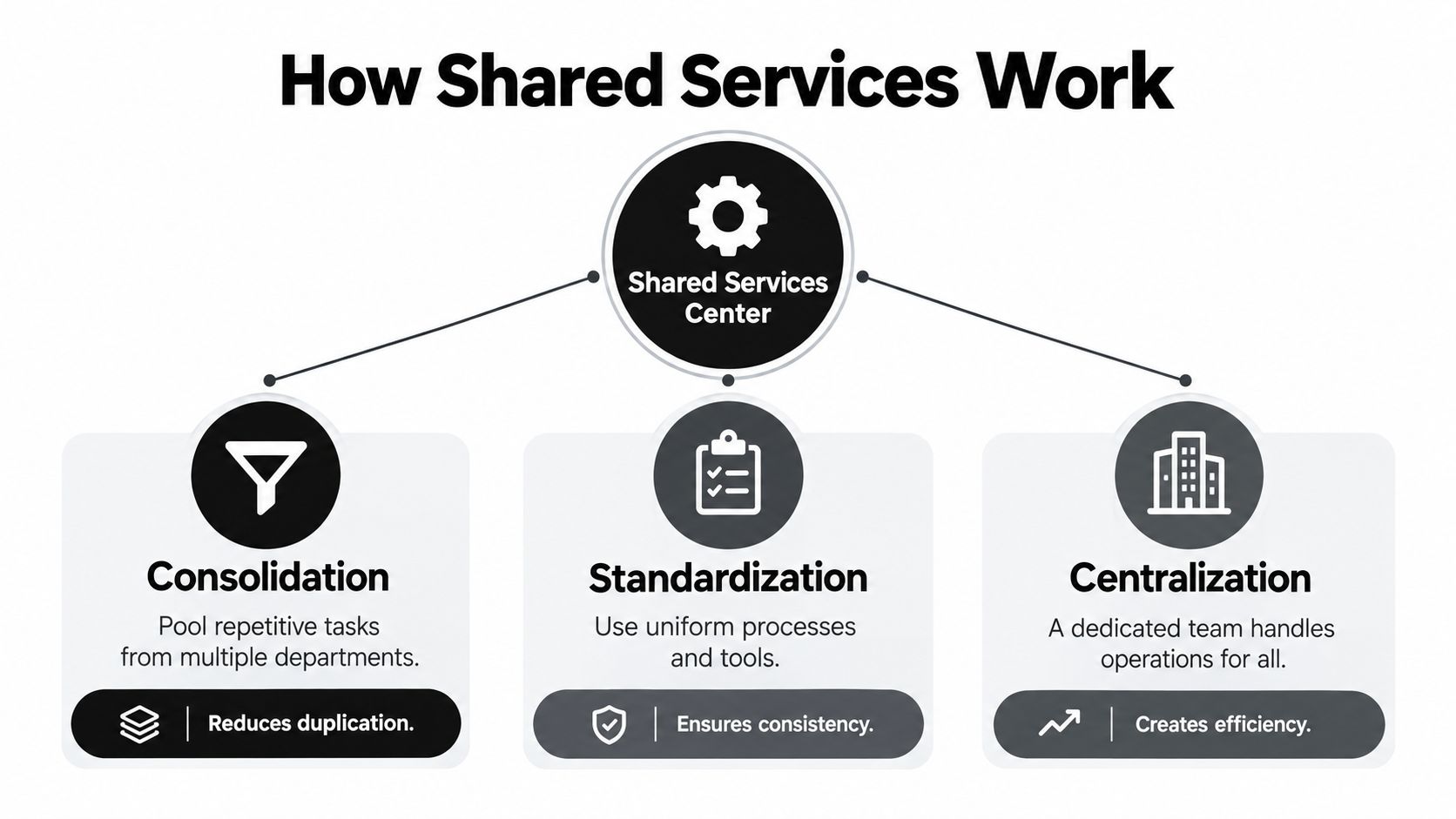
A shared service works through a connected sequence of design choices. The enterprise or team first identifies work that repeats, then creates a common way to perform it, assigns ownership, and measures delivery. Without those steps, centralization merely moves disorder into a new department.
Start with the right work
The strongest candidates are high-volume, transactional, and rules-based. Accounts payable, purchase-order administration, payroll support, employee-data maintenance, IT service requests, scheduling, and travel coordination often fit because the work follows recognizable patterns.
The center then consolidates requests from multiple units into one internal provider. This is the core definition of the model, a shared service takes repeatable support work from multiple units and manages it through KPIs and benchmarking to reduce variation and improve consistency. The shared services overview provides that operating-model foundation.
Standardize before scaling
Consolidation won't fix five different approval rules or inconsistent supplier records. The service team needs a documented process, a clear intake route, decision rights, exception handling, and a shared vocabulary for completion.
Standardization doesn't require treating every request as identical. It creates a default path for ordinary work and a visible escalation path for exceptions. That distinction preserves flexibility without allowing every business unit to redesign the process.
For example, an invoice process might define who validates the supplier, who approves the expense, what information is required, and when an exception returns to the originating team. A personal support service might record preferred airlines, scheduling constraints, household access standards, and communication preferences.
Measure the service, not activity
A center should track measures such as unit cost, cycle time, first-pass accuracy, backlog, rework, and service quality. KPIs turn vague dissatisfaction into a specific operating conversation. Benchmarking then shows whether performance is improving relative to internal history or appropriate peers.
Cost allocation is part of that discipline. If several departments consume a service, leaders need a defensible method for assigning shared costs. A practical guide to understanding cost allocation rules can help teams think through allocation logic, cost pools, and traceability. For a broader view of how operational support can be structured, compare the model with operations support services.
Shared Services vs Outsourcing vs Dedicated Hires
Leaders often compare these options as if they were interchangeable. They aren't. A dedicated hire changes the employment structure. Outsourcing changes the supplier relationship. Shared services changes how repeatable work is organized and governed.
Industry definitions from Deloitte distinguish shared services as an operating model in which processes and accountability remain owned by the enterprise or managed team, while outsourcing is a third-party sourcing choice. A hybrid arrangement can use external providers inside a broader shared-services design, but the governance question still matters.
| Model | Overhead & Cost | Accountability | Scalability | Best Use Case |
|---|---|---|---|---|
| Dedicated Hire | Highest employment and management burden; capacity is concentrated in one person | Direct relationship, but continuity depends heavily on one employee | Limited by one person's time and expertise | Work requiring close collaboration, judgment, and sustained ownership |
| Outsourcing | Vendor fee replaces employment overhead, but scope and change requests must be managed | Contractual accountability, with cultural and communication distance possible | Can expand through the vendor, subject to service design | Specialized work or variable demand that doesn't need internal ownership |
| Shared Services | Costs are pooled across users and supported by common processes | Internal service accountability with defined KPIs and governance | Built to serve multiple units without duplicating the same capability | Repeatable support work with common standards and recurring demand |
What a dedicated hire gets right
A full-time assistant or coordinator can develop deep context and work closely with one principal. That proximity helps when priorities change constantly or when the role includes sensitive judgment. The weakness is concentration risk. One person has finite capacity and may be unavailable, while the employer manages payroll, benefits, onboarding, performance, leave, and workload balancing.
What outsourcing gets right
Outsourcing gives access to external capacity without adding a direct employee. It can work well for a defined process, such as bookkeeping support, document review, or appointment setting. It fails when the buyer hasn't defined the output and instead expects the vendor to discover the operating model through trial and error.
Small teams should also account for management friction. A low hourly rate can lose its advantage if the owner spends substantial time briefing freelancers, checking work, correcting omissions, and coordinating several providers. Guidance on outsourcing to a virtual assistant is useful when evaluating external support, but buyers still need to separate labor cost from supervision cost.
Where shared services fits
Shared services suits work that needs continuity, repeatability, and more capacity than one hire can reliably provide. It can offer specialization and coverage through a team, while preserving an internal service relationship. The price of that flexibility is less one-to-one continuity and a greater need for shared documentation, clear access standards, and consistent communication.
Choose the model based on the work. Keep strategic judgment and relationship ownership close to the leader. Move recurring coordination, administration, and rules-based execution into the layer designed to handle it.
Measuring the ROI of Centralized Operations
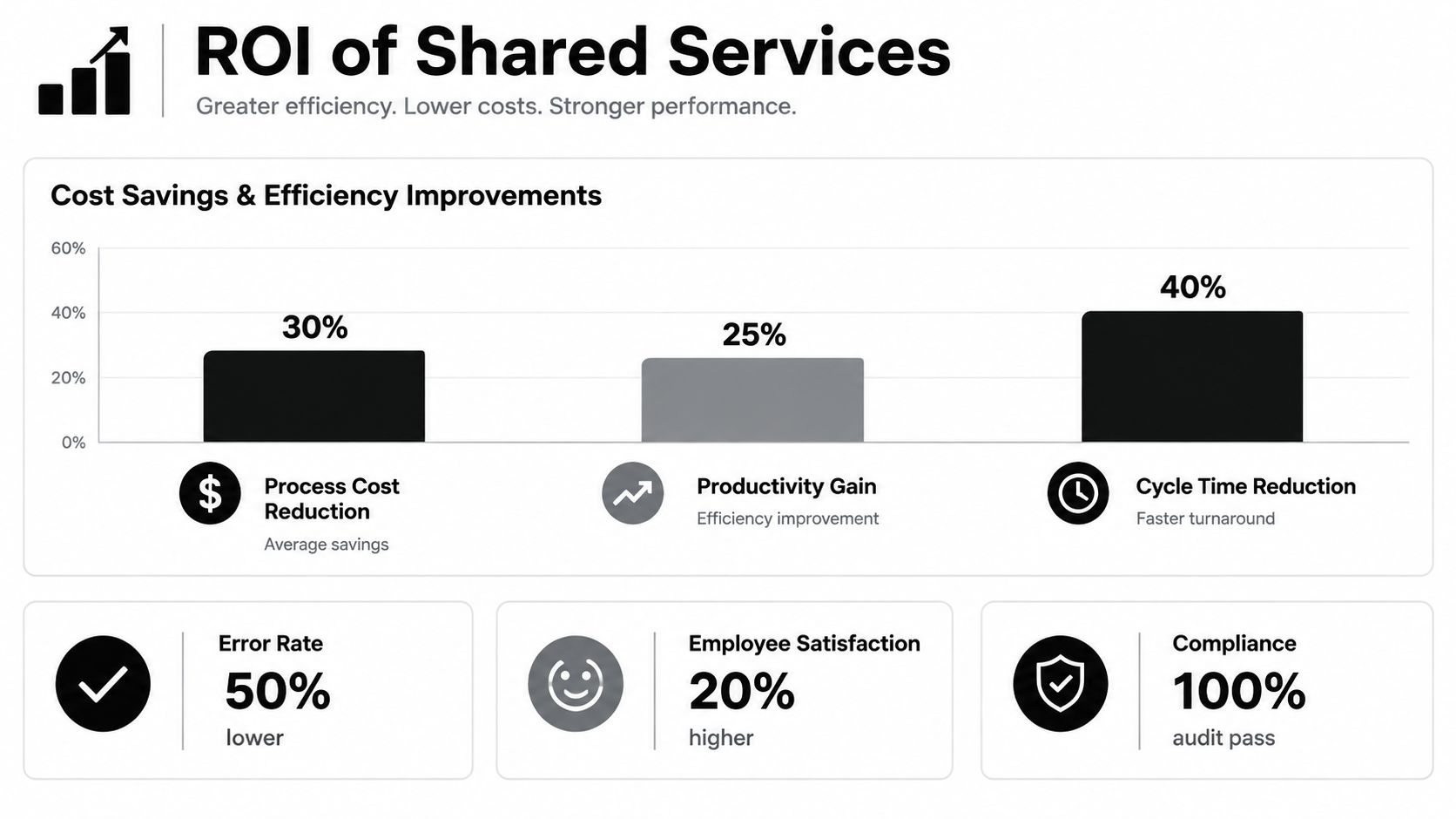
A shared service earns its place through measurable improvement, not the appearance of organization. Before moving work, establish a baseline. Record request volume, completion time for common tasks, rework, errors, and the internal or external resources each process consumes. Without that baseline, a lower invoice can conceal added supervision or slower service.
Deloitte reports that shared-services productivity improves by 8% annually on average, and 73% of respondents reported productivity increases of 5% or higher in its survey panel, as reported in Deloitte's global shared services survey material. The operating lesson is direct: gains come from refining a repeatable service, not relocating employees.
Industry guidance places implementation-related cost savings at 25% to 40% within the first 3 years, while PwC's shared service center guidance cites 25% to 50% cost savings from implementation. These ranges are not promises. They show why leaders should evaluate centralization as both a cost decision and a capacity decision, including the effort required to standardize processes and manage the transition.
Use a practical scorecard
Track measures that cover economics and service reliability:
- Hours reclaimed: Compare time spent by business-unit staff before and after transfer.
- Cost avoided: Include duplicate roles, systems, vendor fees, rework, and supervision.
- Cycle time: Measure elapsed time from request to completion, not only labor minutes.
- Quality: Count errors, returned requests, exceptions, and repeat contacts.
- Capacity released: Identify how recovered time is used, such as selling, serving customers, or making decisions.
A finance benchmark reported by CFO and ScottMadden found best performers spending $1.90 per $1,000 of revenue to run an SSC. The same benchmark reported median non-labor savings of $593,128 per $1 billion of revenue. These measures show that savings can come from overhead, systems, working-capital behavior, and process discipline, not only labor location.
For a small team, the calculation is simpler. If a founder spends a recurring block of time each week on low-value administration, measure that time, assign it a conservative economic value, and compare the result with the service cost. A practical ROI calculation method should include fewer interruptions, faster follow-up, and avoided management effort. In sales organizations, work supporting BDRs can be separated into repeatable administration and higher-value conversation, so leaders measure productive capacity rather than activity alone.
Modern Applications for Professionals and Small Teams
Shared services used to sound like an enterprise decision because large organizations had obvious duplication. Today, the same logic applies to a founder, dual-career household, independent professional, or small leadership team. The common problem is a second shift of coordination that sits outside the person's formal job but still consumes attention.

A subscription-based personal shared service applies enterprise principles at a smaller scale. Instead of hiring one full-time assistant, a member accesses a US-based Assistant team that shares context, distributes work, and handles recurring logistics. The arrangement is not a one-to-one employment relationship, and it shouldn't be evaluated as if it were. Its value comes from flexible capacity, team coverage, and less direct management.
Approved Lux Personal Assistant provides 24/7 access to a US-based human Assistant team through Triple-channel access, phone call, SMS text, or email. The team handles travel logistics, scheduling, personal errands, research and recommendations, inbox triage, email drafting, document formatting, expense tracking, and meeting preparation. Onboarding captures preferences and access standards, while Proactive Preference Learning allows the team to adapt to a member's routines over time.
Replace the second shift with a service layer
A working parent might delegate school scheduling, household maintenance coordination, gift sourcing, and appointment logistics. A founder might move travel changes, inbox triage, vendor research, and meeting preparation out of the workday. A boutique professional might delegate administrative coordination that interrupts client-facing work.
Specialized support can also be appropriate when the workflow has industry-specific requirements. For example, teams evaluating legal virtual assistant staffing should define which administrative tasks are appropriate for support and which decisions must remain with qualified legal professionals.
The trade-off is control versus flexibility. A dedicated employee may offer tighter daily proximity, while a subscription service can reduce the overhead of recruiting, payroll, benefits, leave coverage, and workload management. The service only works when the member provides clear preferences, grants appropriate access, and uses a consistent intake process.
The operating model is visible in how requests move from intake to execution. A team can receive a travel problem by text, handle a scheduling conflict by email, and discuss a time-sensitive issue by phone without forcing the member into a single channel.
This is a personal force multiplier, not a status purchase. The test is whether the service removes operational noise, preserves decision quality, and returns attention to work or family responsibilities that only the member can perform.
Identifying Tasks Ripe for Consolidation
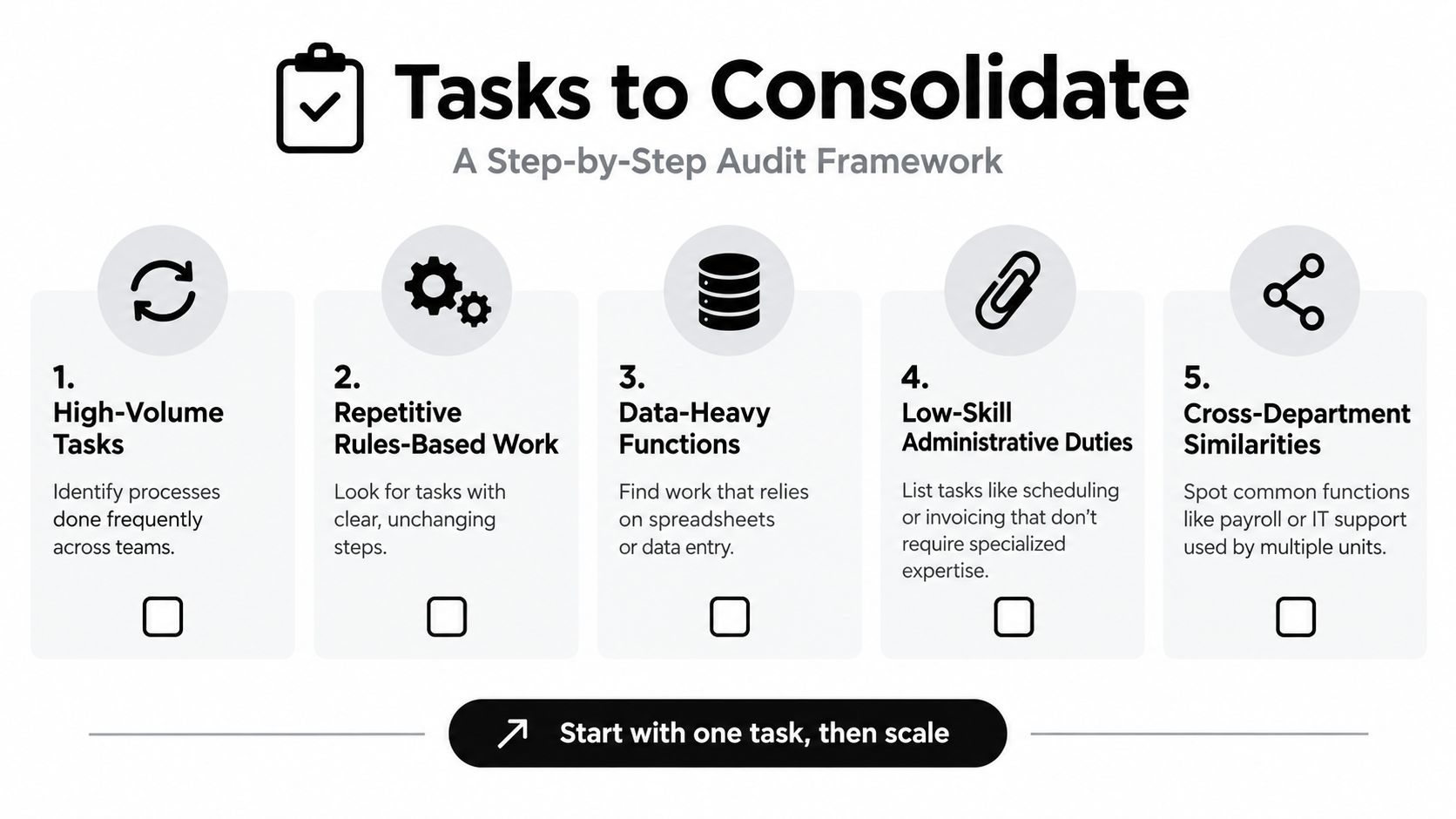
Don't begin by delegating whatever feels annoying today. Begin by auditing the workflow and looking for repeated demand, stable rules, shared inputs, and a clear definition of done.
Run a five-part task audit
-
Find high-volume work. List requests performed frequently across a department, household, or calendar. Invoice entry, appointment coordination, and travel changes are obvious candidates.
-
Separate rules-based tasks. Identify work with stable steps, such as checking required fields, requesting documents, comparing available options, or confirming a deadline.
-
Mark data-heavy activity. Spreadsheets, data entry, contact updates, expense records, and recurring reports often create friction because people repeatedly locate and reformat information.
-
Remove low-skill administration from specialist roles. Scheduling, invoicing follow-up, routine research, and document formatting may be necessary without requiring the professional's specialized judgment.
-
Look for cross-unit similarities. If finance, HR, procurement, or several family members use similar coordination processes, a shared owner may create consistency.
Document preferences before delegation
A service team can't reliably execute invisible standards. Record preferred vendors, approval limits, travel preferences, communication rules, important dates, household contacts, and escalation conditions. Use examples of acceptable and unacceptable outcomes, not just broad instructions.
Start with one workflow. Measure baseline time, transfer it to the service layer, review exceptions, and update the process. The objective isn't to delegate everything at once. It's to establish a repeatable operating pattern and then expand it carefully.
Building Your First Service Layer
Implementation starts with a narrow service catalog. Choose a recurring workflow, define its inputs and completion standard, assign an owner, and select a small set of KPIs. For an enterprise, that may be accounts payable or procurement support. For an individual, it may be travel coordination, scheduling, or inbox triage.
Set communication rules before the first request arrives. Decide which channel handles urgent matters, where approvals are recorded, how exceptions escalate, and how preferences are updated. With a team-based service, shared context matters more than relying on one person's memory.
Review performance against the baseline. Ask whether hours were reclaimed, cycle time improved, rework declined, and the principal spent more time on high-value decisions. If the service creates additional checking work, narrow the scope or repair the process before expanding it.
Administrative overload is not an unavoidable cost of ambition. Treat time and attention as operating assets, then build the service layer that protects them.
Approved Lux offers a monthly subscription with a US-based human Assistant team available 24/7 through Triple-channel access for travel, scheduling, errands, research, and professional administration. Visit Approved Lux Personal Assistant to evaluate whether a shared Assistant layer can remove your recurring operational noise without the overhead of a direct hire.
Want the wider view?
Ten categories. One report. Every quarter. The Approved List tracks what's rising and what's fading: data-backed signals, not opinions.
Free to join · Delivered by email